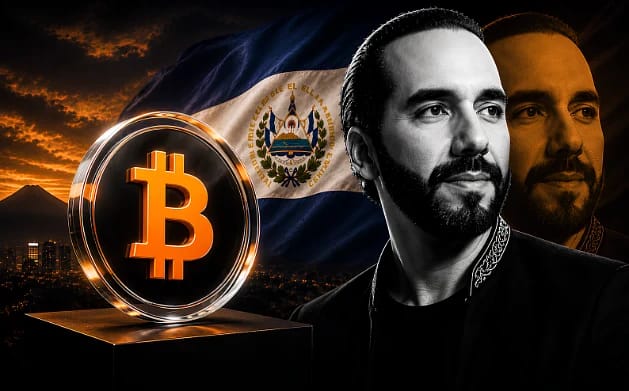



Who is Nayib Bukele?
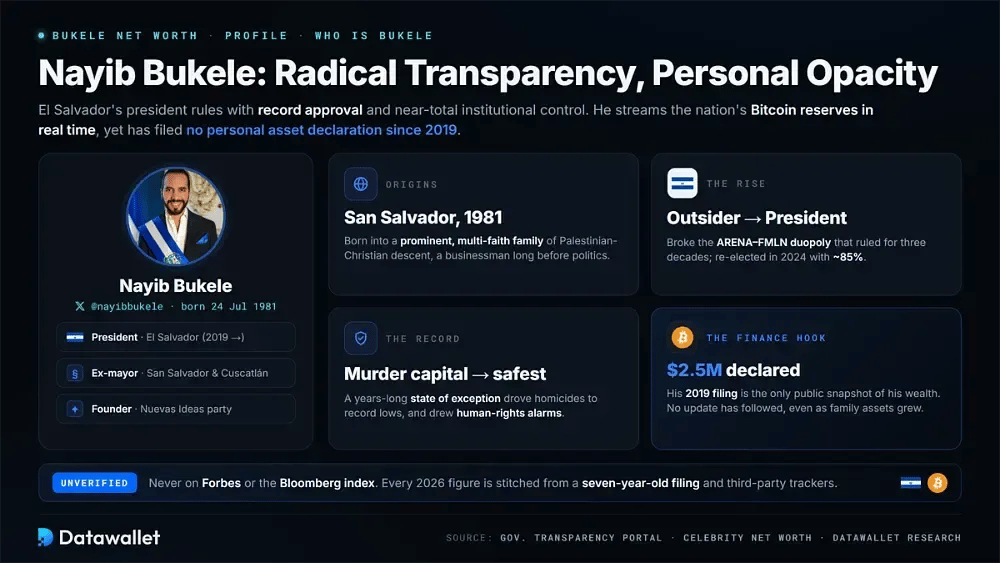
Nayib Armando Bukele Ortez (born 1981) is the president of El Salvador, now in a second consecutive term after first taking office in June 2019. A businessman before politics, he served as mayor of Nuevo Cuscatlán from 2012 and San Salvador from 2015.
Bukele reached the presidency as an outsider, unattached to the right-wing ARENA and left-wing FMLN parties that had traded power for three decades. His social-first communication style, hardline security record, and defiance of institutional guardrails have made him both regionally dominant and internationally divisive.
By 2026 he is arguably Latin America's most closely watched leader. Supporters credit him with turning the hemisphere's murder capital into one of its safest states, while human rights groups and exiled journalists describe a steady dismantling of democratic checks under a years-long state of exception.
What draws the most attention to his finances is the gap between visibility and disclosure. His office publishes real-time Bitcoin reserve data for the whole country, yet Bukele has not released an updated personal asset declaration since the one filed when he entered office.
Nayib Bukele's Background
Bukele's path runs from a privileged, multicultural San Salvador upbringing through a family business empire in advertising and dealerships, into municipal politics, and finally to a presidency that reshaped El Salvador's security, finances, and institutions.
Early Life and Family
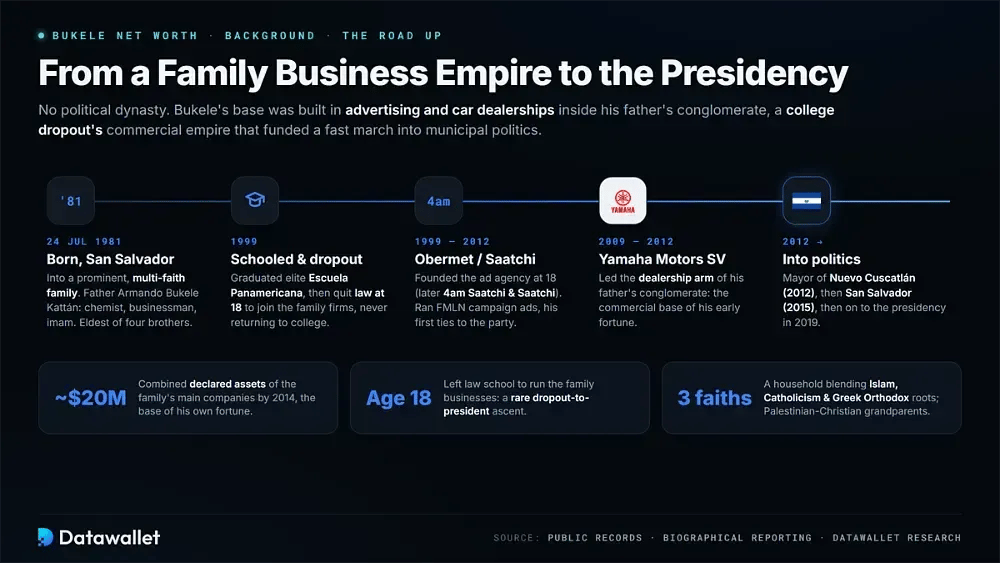
Nayib Bukele was born on 24 July 1981 in San Salvador into a prominent, multi-faith family. His paternal grandparents were Palestinian Christians from Jerusalem and Bethlehem, while his household blended Islam, Catholicism, and Greek Orthodox roots.
His father, Armando Bukele Kattán, was a chemist and businessman who converted to Islam, founded several mosques, and served as an imam. As the eldest of four full brothers, alongside Karim, Yusef, and Ibrajim, Bukele grew up shaped by both entrepreneurship and faith.
Education
Bukele completed his secondary schooling at the elite Escuela Panamericana in San Salvador, a bilingual private school, graduating in 1999. His upbringing was notably comfortable, set apart from the poverty and civil-war violence affecting much of the country.
He then enrolled at Central American University to study law but dropped out in his second year, at age 18, to join the family businesses. He never returned to higher education, making his ascent a rare case of a college dropout reaching a national presidency.
Business Career
At 18, Bukele founded the marketing firm Obermet, later branded 4am Saatchi & Saatchi El Salvador, and ran it across two stints between 1999 and 2012. The agency handled advertising for FMLN presidential campaigns, giving him early ties to the party he would later join.
He also led Yamaha Motors El Salvador, part of his father's conglomerate, from 2009 to 2012. By 2014, the family's main companies reportedly held combined declared assets approaching $20 million, the commercial base from which Bukele's own modest personal fortune later emerged.
Nayib Bukele's Net Worth in 2026
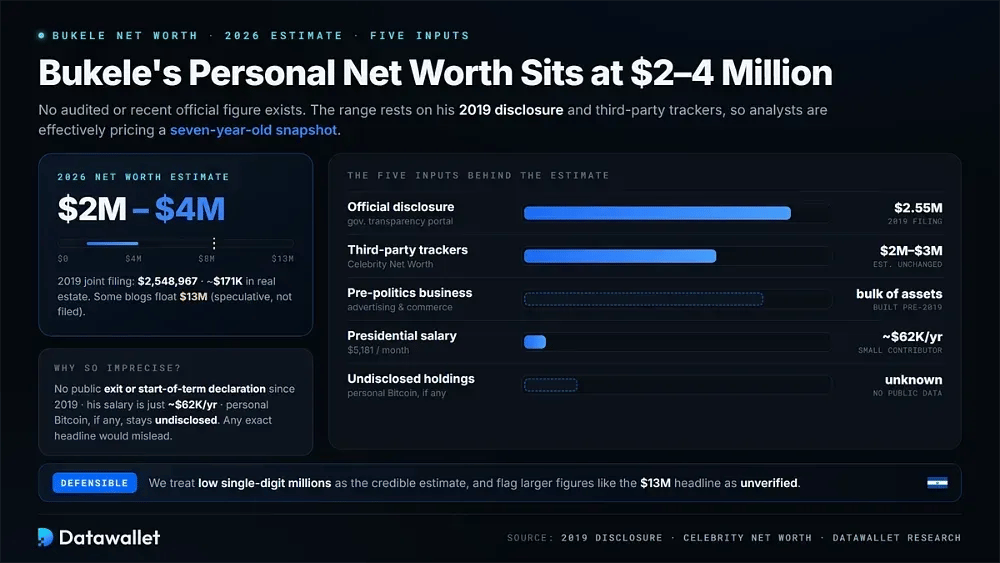
Nayib Bukele's personal net worth in 2026 is estimated between $2 million and $4 million, based on his 2019 disclosure and third-party trackers. No audited or recent official figure exists, so every estimate carries meaningful uncertainty and should be read as an approximation.
The estimate draws on a handful of documented and reported inputs:
- Official disclosure: His 2019 filing on the government transparency portal reported a joint net worth with his wife of $2,548,967, of which roughly $171,000 sat in real estate.
- Third-party trackers: Outlets like Celebrity Net Worth peg his fortune near $2-3 million, treating the 2019 baseline as broadly unchanged in public records.
- Presidential salary: His government pay is roughly $5,181 monthly, about $62,000 a year, modest relative to peers and a small contributor to overall wealth.
- Pre-politics businesses: The bulk of his assets trace to family enterprises in advertising and commerce, built and largely accumulated before he ever ran for office.
- Undisclosed holdings: No public data confirms personal Bitcoin, so his individual crypto position, if any, sits entirely outside verifiable estimates.
The imprecision is the story. Because Bukele has not filed a public exit or start-of-term declaration for his post-2024 mandate, analysts are effectively pricing a seven-year-old snapshot, even as reporting points to substantial new wealth around his household.
External trackers occasionally float higher headline numbers, with some blogs floating figures around $13 million, but these rest on speculative attributions rather than filings. We treat the low-single-digit-millions range as the defensible estimate and flag anything larger as unverified.
Why the Figure Is So Hard to Pin Down
Bukele's wealth resists a clean number because the public record effectively froze in 2019. Salvadoran law requires officials to publish asset declarations, but he has not released a public version for either his contested June 2024 inauguration or the end of his first term.
That opacity matters more given his own rules. In February 2025 his government passed an Anti-Corruption Law requiring officials' declarations to be published within fifteen business days of filing, a standard reporting suggests his own household has not met.
Nayib Bukele's Political Career and Achievements
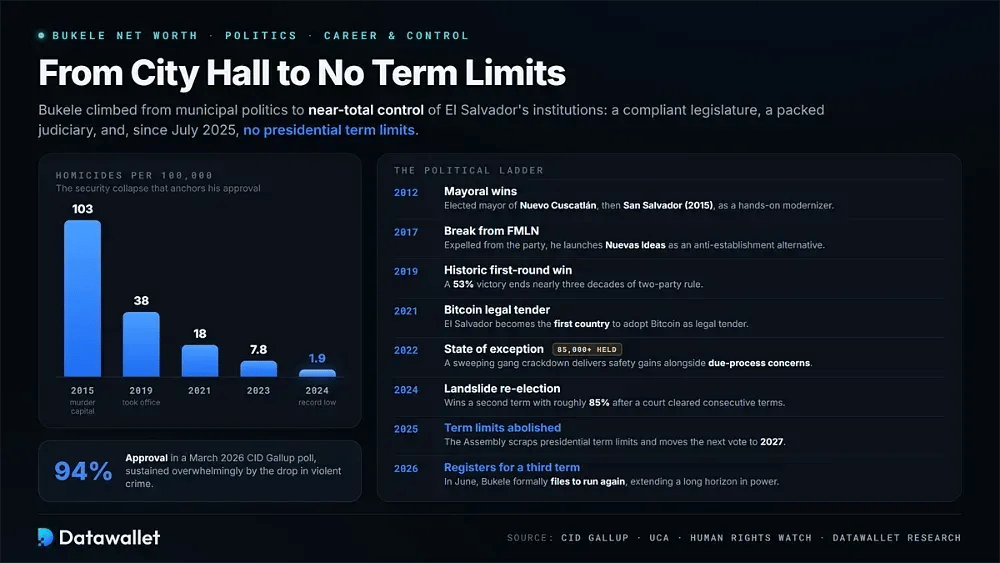
Bukele's rise runs from municipal politics to near-total control of El Salvador's institutions. He entered office through the FMLN, broke away to found Nuevas Ideas, and by 2026 governs with a compliant legislature, a packed judiciary, and no term limit.
Here are the milestones that define his political trajectory:
- Mayoral wins: He was elected mayor of Nuevo Cuscatlán in 2012 and then San Salvador in 2015, building a reputation as a hands-on modernizer.
- Break from FMLN: After his 2017 expulsion, he launched Nuevas Ideas, positioning himself as an anti-establishment alternative to both legacy parties.
- Historic 2019 win: His 53% first-round victory ended nearly three decades of two-party rule and reset the country's political map.
- Security transformation: A sweeping gang crackdown drove the homicide rate down from around 38 per 100,000 in 2019 to historic lows by 2024 and 2025.
- Mass incarceration: More than 85,000 people were detained under an ongoing state of exception, delivering safety gains alongside serious due-process and human rights concerns.
- Bitcoin adoption: El Salvador became the first country to make Bitcoin legal tender in 2021, a status later narrowed under IMF pressure but never fully abandoned in spirit.
- Landslide re-election: In 2024 he secured a second term with roughly 85% of the vote after a court ruling cleared the way for consecutive terms.
- No term limits: In July 2025 the Assembly abolished presidential term limits and moved the next election to 2027, and in June 2026 Bukele registered to seek a third term.
Popularity Versus Democratic Erosion
Few leaders anywhere match Bukele's domestic numbers. A March 2026 CID Gallup poll put his approval at 94%, and University of Central America surveys through mid-2026 kept him near 88%, sustained overwhelmingly by the collapse in violent crime.
That popularity coexists with sharp warnings from watchdogs. Human Rights Watch documents the removal of executive checks, prolonged detentions, and pressure on critics, arguing that high approval reflects genuine security gains rather than healthy institutional guardrails.
How Did Nayib Bukele Build His Wealth?
Nayib Bukele built his wealth mainly through private business before politics, not inheritance-scale fortune or a large public salary. His base came from family-run advertising and commercial ventures, an important distinction given how his household's assets have since grown.
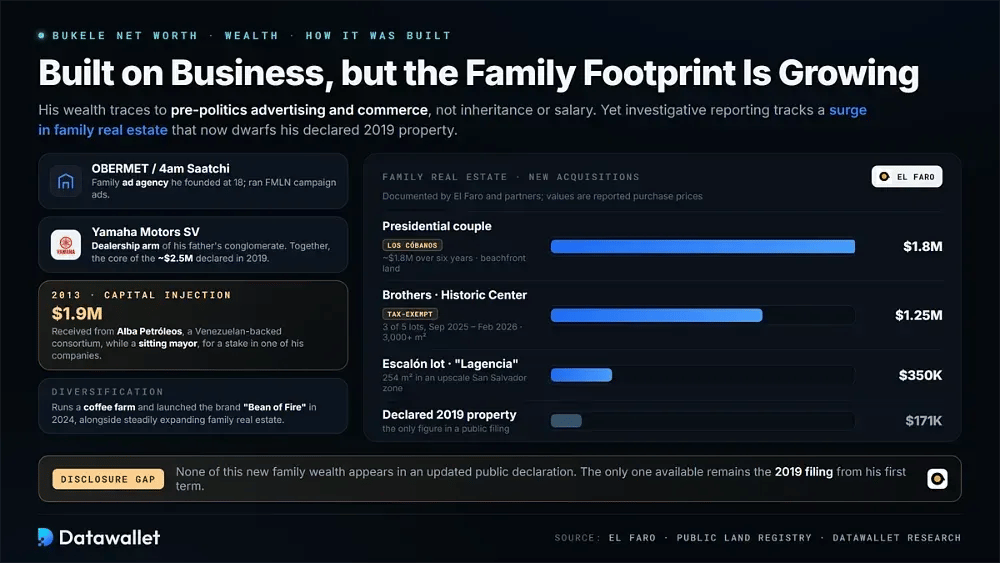
As a young entrepreneur he ran Yamaha Motors El Salvador and later led OBERMET, a family advertising agency whose clients included the FMLN. These enterprises, tied to his father's broader business empire, formed the core of the roughly $2.5 million he declared in 2019.
Beyond operations, he benefited from at least one large capital transaction. In 2013, while a sitting mayor, he received $1.9 million from Alba Petróleos, a Venezuelan-backed consortium, in exchange for a stake and investment in one of his companies.
He has also diversified visibly, running a coffee farm and launching the brand "Bean of Fire" in 2024. Alongside that, investigative outlets have tracked a steady expansion of family real estate that now dwarfs his declared 2019 property.
The Family Real Estate Question
The most significant wealth story of Bukele's presidency may not be his own declaration but his household's property. Reporting by El Faro and partners has traced millions in new acquisitions concentrated in tax-advantaged zones his own policies helped create.
Independent investigations have documented several strands of new wealth:
- Brothers' portfolio: Karim and Yusef Bukele acquired five Historic Center properties totaling over 3,000 square meters in three years, including three bought for $1.25 million between September 2025 and February 2026.
- Presidential couple: Companies run solely by Bukele and his wife purchased roughly $1.8 million in property over six years, including beachfront land near the protected Los Cóbanos area.
- Escalón acquisition: The brothers' firm Lagencia added a 254-square-meter lot in an upscale San Salvador neighborhood for about $350,000, extending the family's footprint beyond the downtown core.
- Tax-exempt overlap: Several parcels sit inside districts benefiting from tourism-related tax breaks championed by the government, raising conflict-of-interest questions the family has not publicly answered.
- Disclosure gap: None of this new wealth appears in an updated public asset declaration, since the only one available remains the 2019 filing from his first term.
- Denied responses: Reporters sought comment from the brothers and government bodies on the purchases and tax status, and at publication received no response, per the outlets involved.
We present this as documented reporting rather than proof of personal enrichment. The family's companies are legally distinct from Bukele's own declaration, but the pattern is central to any honest 2026 read of the wealth around El Salvador's presidency.
How Many Bitcoins Does El Salvador Hold in 2026?
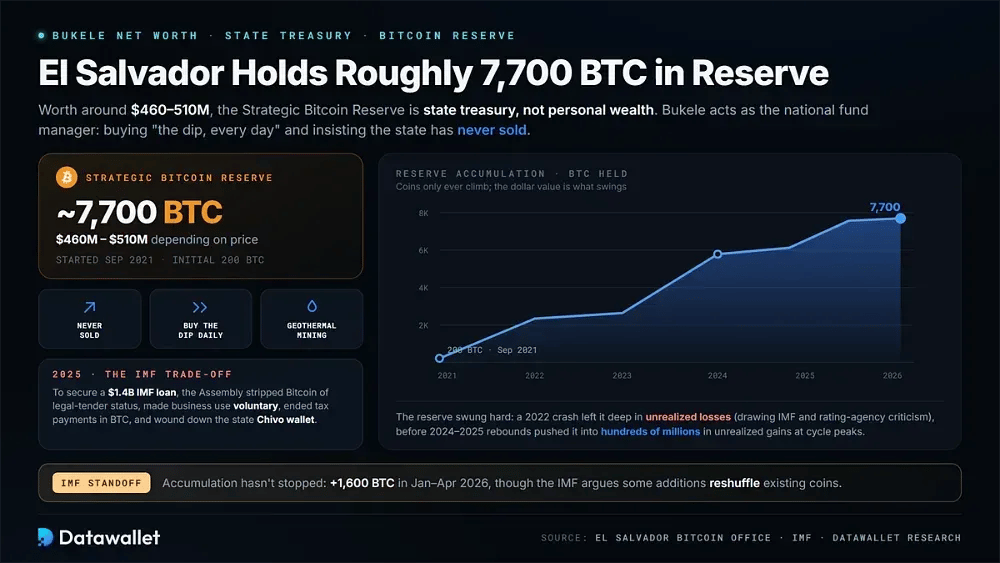
As of mid-2026, El Salvador holds roughly 7,700 BTC in its Strategic Bitcoin Reserve, worth in the region of $460-510 million depending on price. Bukele effectively acts as the national fund manager, though this is state treasury, not personal wealth.
The program began in September 2021 with an initial 200 BTC purchase timed to the legal tender launch. Since then the government has followed a "buy the dip, every day" approach, adding coins through direct purchases, geothermal mining, and conversions, and insisting it has never sold.
The reserve has swung dramatically in value. By mid-2022, a Bitcoin crash left holdings deep in unrealized losses, drawing IMF and rating-agency criticism, before rebounds through 2024 and 2025 pushed the position into hundreds of millions in unrealized gains at cycle peaks.
Crucially, the legal tender status changed in 2025. To secure a $1.4 billion IMF loan, the Assembly stripped Bitcoin of its "currency" and mandatory-acceptance features, made private-sector use voluntary, ended tax payments in BTC, and wound down the state Chivo wallet.
The IMF Standoff Continues
Despite the loan conditions, accumulation has not stopped. Between January and April 2026 the government added over 1,600 coins, pushing the stack past 7,600 BTC, even as the IMF argued some additions merely reshuffle existing coins rather than represent net new buys.
This tension defines the current phase. The reserve now sits alongside traditional reserves in official reporting, and Bukele leans on unrealized gains as a political talking point, while critics question the transparency and independent verifiability of the exact purchase figures.
What Is Shaping Bukele's Financial Narrative in 2026?
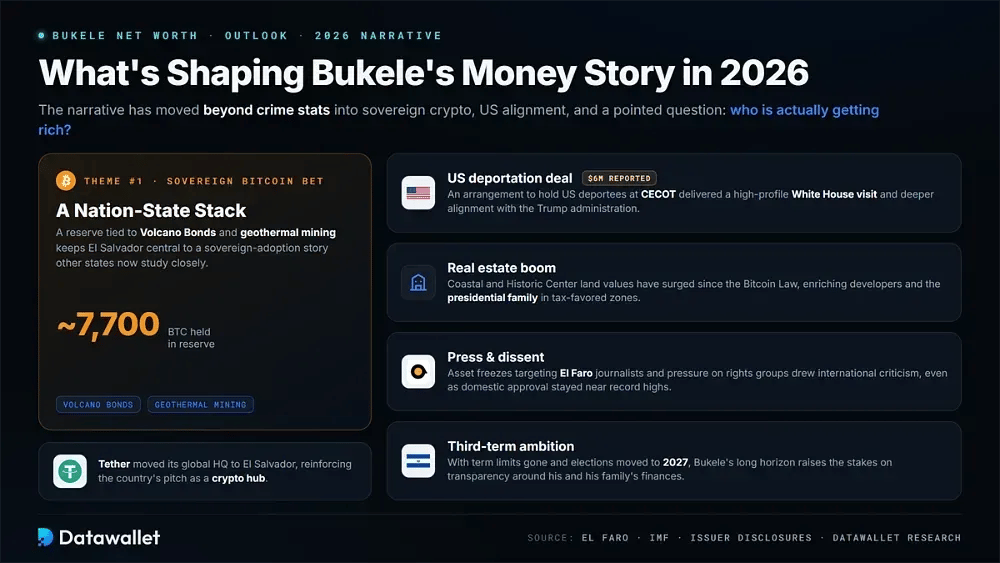
Bukele's economic story has moved beyond crime statistics into a mix of sovereign crypto strategy, US alignment, and questions about who is actually getting rich. These forces shape both his political capital and the wealth debate around his government.
Several themes are driving the 2026 conversation:
- Sovereign Bitcoin bet: A ~7,700 BTC reserve tied to Volcano Bonds and geothermal mining keeps El Salvador central to the sovereign-adoption narrative other states now study closely.
- Tether relocation: Stablecoin giant Tether moved its headquarters to El Salvador, reinforcing the country's pitch as a crypto hub and echoing the broader growth captured in stablecoin data.
- US deportation deal: A reported $6 million arrangement to hold US deportees at CECOT delivered Bukele a high-profile White House visit and deeper alignment with the Trump administration.
- Real estate boom: Coastal and Historic Center land values have surged since the Bitcoin Law, enriching a cluster of developers and the presidential family in tax-favored zones.
- Press and dissent: Asset freezes targeting El Faro journalists and pressure on rights groups have drawn international criticism even as domestic approval stays near record highs.
- Third-term ambition: With term limits gone and elections moved to 2027, Bukele's long horizon raises the stakes on transparency around his and his family's finances.
Bitcoin Reserve as Political Currency
The Bitcoin reserve functions as more than a balance-sheet item; it is a messaging tool. When markets rise, Bukele broadcasts unrealized gains as vindication, framing the sovereign stack as proof that a small nation can lead on financial innovation against IMF skepticism.
That framing carries real risk. A prolonged downturn would compress those paper gains, as investors tracking the Bitcoin treasury sector know well, turning a political asset into a liability and testing the "never sell" commitment the government repeats.
Final Thoughts
Nayib Bukele remains a study in contrast: a president with a relatively modest declared fortune of $2-4 million who wields outsized influence over a nation's finances, security, and increasingly its institutions.
The more revealing 2026 narrative is the widening gap between what is disclosed and what is documented. His personal declaration is frozen in 2019, while investigative reporting tracks millions in fresh property around his household in zones his own policies favor.
For readers, the honest takeaway is that Bukele's individual net worth is small and stable on paper, but the wealth ecosystem surrounding his presidency, from the sovereign Bitcoin reserve to family real estate, is where the consequential money now moves.