
.png)
.png)



What Does the Sui Liquidation Heatmap Show?
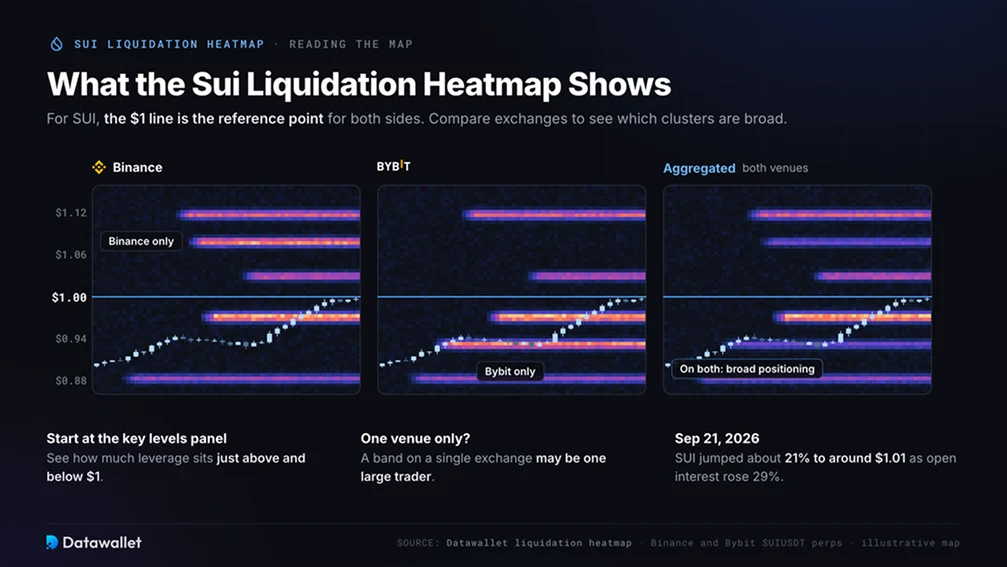
The Sui liquidation heatmap shows the SUI prices at which leveraged perpetual futures traders on Binance and Bybit are most likely to be forced out of their positions. Clusters above the SUI price are mainly shorts at risk of a squeeze. Clusters below are mainly longs at risk of a flush.
For SUI, the $1 line has become the reference point for both sides of the market. Start with the key levels panel to see how much estimated leverage sits just above and just below it. Switch to the single-exchange views to check whether a band is broad or concentrated on one venue. Lean on the shorter windows, because SUI positions turn over quickly on thin order books.
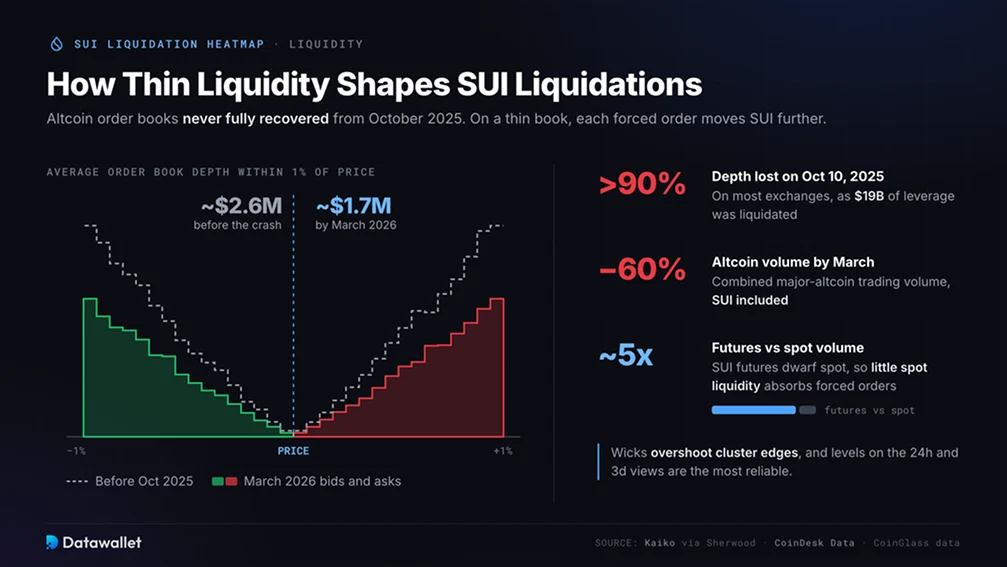
SUI is the native token of Sui, a layer-1 blockchain built by Mysten Labs. Its derivatives market dominates its spot market: in late September 2026, 24-hour SUI futures volume ran about five times spot volume. When forced orders hit SUI perps, there is relatively little spot liquidity to absorb them.
How Does Thin Liquidity Shape SUI Liquidations?
Altcoin order books never fully recovered from the October 10, 2025 crash. On that day, about $19 billion of leveraged positions were liquidated across crypto. Order book depth also fell more than 90% on most exchanges, and SUI printed extreme wicks on several venues.
The effects lasted. By March 2026, Kaiko data showed that combined trading volume for major altcoins, including SUI, had fallen about 60% since the crash. Average depth within 1% of price fell from about $2.6 million to $1.7 million.
Thin books change how SUI clusters behave:
- Forced orders move price further: When a cluster clears, each market order eats through more of the book. That pushes price into the next cluster faster than it would on Bitcoin or Ethereum.
- Wicks overshoot: SUI often trades well past the edge of a cluster before bouncing, because there are no resting orders to stop the move.
- Recent windows matter most: Clusters on the 24h and 3d views are more reliable than older levels, because positions on thin books turn over quickly.
What Happens to SUI Perps When the Sui Network Stops?
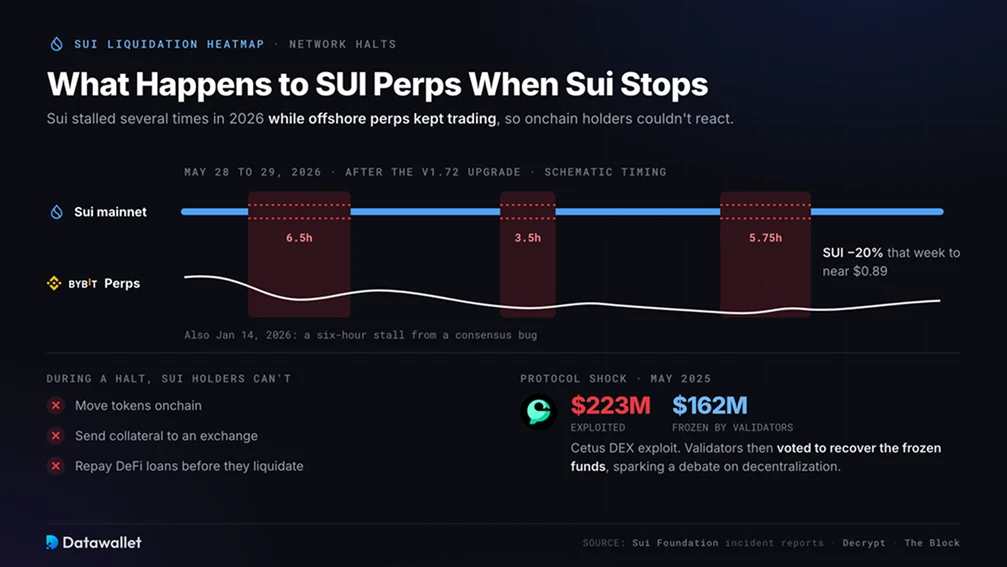
Sui has a risk that most large-cap perpetual markets don't: the underlying blockchain has stopped several times while offshore derivatives kept trading.
- January 14, 2026: The Sui mainnet stalled for about six hours because of a bug in consensus commit logic. There were no forks and no rollbacks.
- May 28–29, 2026: After the v1.72 upgrade, Sui halted three times over two days, for about 6.5, 3.5 and 5.75 hours. SUI fell about 20% that week to near $0.89.
During a halt, SUI holders can't move tokens onchain, send collateral to an exchange or repay DeFi loans. Binance and Bybit perps still trade, so the price can fall while onchain holders can't react. When the chain restarts, delayed onchain liquidations and exchange deposits can all arrive at once.
Protocol events create similar gap risk. In May 2025, the Cetus decentralized exchange lost about $223 million in an exploit. Sui validators froze about $162 million of the stolen funds and later voted to recover them, which set off a debate about how decentralized Sui is. Events like these move SUI leverage in minutes, and no liquidation model can forecast them.
Which Catalysts Are Driving SUI Leverage in 2026?
- Regulated products: 21Shares launched TXXS, a 2x leveraged SUI ETF, in December 2025. Canary SUIS and Grayscale GSUI followed on February 18, 2026 as the first US spot SUI ETFs, both staking their holdings, and 21Shares TSUI launched six days later. CME began trading SUI futures in May 2026.
- Treasury holdings below book value: SUI Group held about 109 million SUI in August 2026 while its stock traded at about 0.72 times the value of its holdings. A discount like that limits how much new SUI such companies can raise money to buy.
- Token unlocks: Only about 41% of SUI's 10 billion token supply was unlocked by September 2026, with vesting running to 2030 and unlocks landing on the 1st of each month. Datawallet's token unlock calendar tracks upcoming SUI releases.
- New products on Sui: The native USDsui stablecoin launched in March 2026, and the Hashi native-Bitcoin collateral system went live on testnet in July 2026. Mysten Labs is due to present a new finance product at Sui Basecamp on October 7–8, 2026.
- The late-September squeeze: On September 21, 2026, SUI jumped about 21% to around $1.01 and open interest rose about 29%. Leverage built faster than price, which leaves fresh clusters on both sides of the $1 line.
How Should You Read SUI Clusters?
- Respect the $1 line: Round numbers attract entries and stops. Clusters just above and below $1 act as the market's main battleground.
- Plan around the 1st: Check the 3d view before each monthly unlock. Leverage often builds before a release and clears once it's absorbed.
- Price in halt risk: Large positions near dense clusters carry extra gap risk, because onchain holders can't respond during a network stall.
- Know what's missing: CME SUI futures, Coinbase's perpetual-style contract, the leveraged ETF, and Sui DeFi venues such as Suilend, NAVI, Scallop and Bluefin aren't in the model.
- Maps, not forecasts: The heatmap shows where forced orders would land. It doesn't show which side breaks first.