
.png)
.png)



What Is the Dogecoin Liquidation Heatmap?
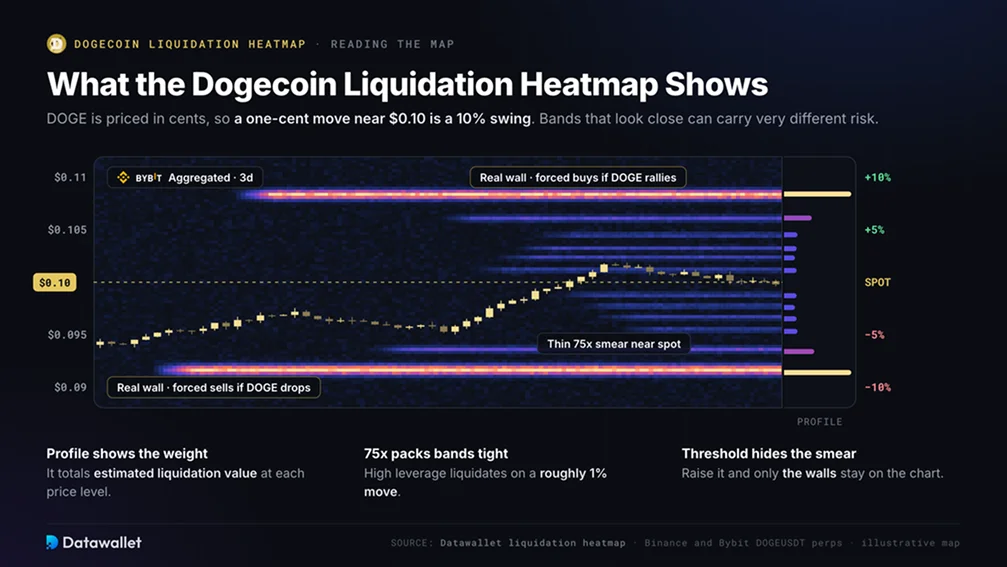
The Dogecoin liquidation heatmap estimates where leveraged DOGE/USDT perpetual futures positions on Binance and Bybit would be force-closed. Short liquidation clusters sit above the DOGE price and would become forced buying if price rose into them. Long liquidation clusters sit below and would become forced selling.
DOGE is priced in cents, so a one-cent move near $0.10 is a 10% swing, and bands that look close together on the chart can represent very different risk. The liquidity profile beside the chart totals estimated liquidation value at each price level. That helps separate a real wall of leverage from a thin smear of high-leverage positions. The threshold slider hides the smallest levels, which matters on a market where 75x positions leave many tiny, tightly packed bands.
Dogecoin is the largest meme coin by market value, and its derivatives market is driven by retail traders. That makes DOGE one of the clearest examples of how leverage, not fundamentals, shapes short-term price.
Why Is DOGE Leverage Rising While Price Falls?
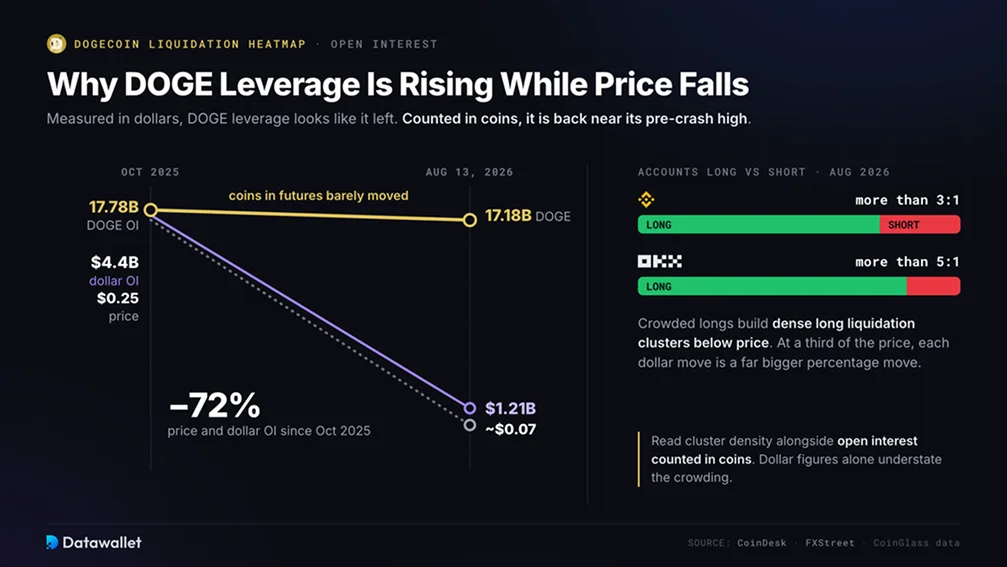
The most useful DOGE metric in 2026 is open interest measured in DOGE, not dollars. Dollar open interest peaked around $5.35 billion in July 2025 and fell toward $1 billion by mid-2026 as the price dropped. That decline looks like leverage leaving the market. The coin count shows the opposite.
- Near-record coin count: On August 13, 2026, DOGE futures open interest reached 17.18 billion DOGE. That was close to the 17.78 billion DOGE held before the October 2025 crash, even though DOGE traded around $0.07 instead of $0.25.
- Lopsided positioning: At the same time, accounts holding longs outnumbered shorts by more than 3 to 1 on Binance and more than 5 to 1 on OKX. Crowded longs create dense long liquidation clusters below price.
- Speculation at a lower base: The same number of coins is committed to leveraged bets at a third of the price. Each dollar move is a far larger percentage move, so liquidation bands sit closer together.
For heatmap readers, the lesson is to read cluster density alongside open interest measured in coins. Dollar figures alone understate how crowded DOGE positioning is.
How Do DOGE Liquidation Cascades Unfold?
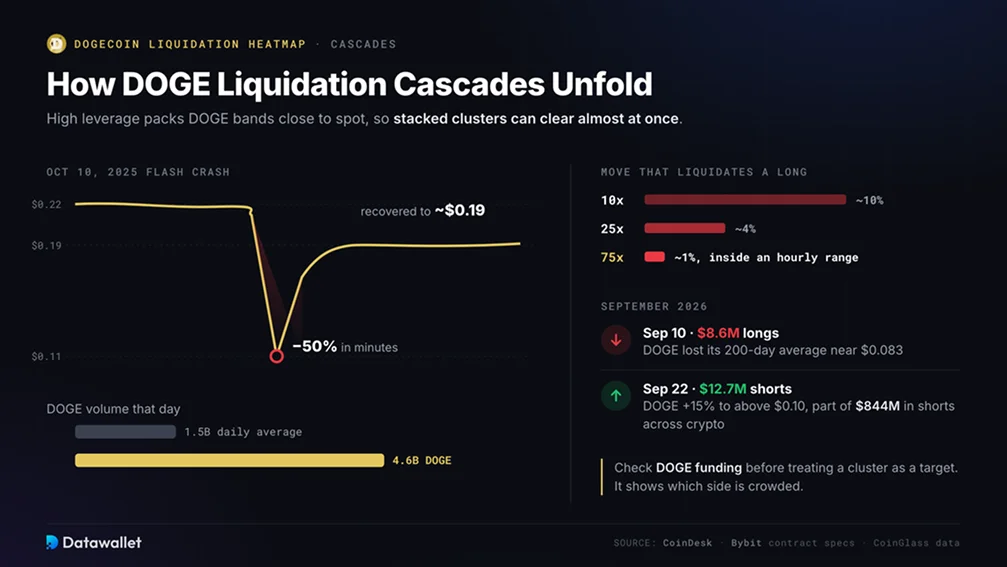
- High leverage, tight bands: Bybit offers up to 75x leverage on DOGEUSDT. At 75x, a position is liquidated after a move of roughly 1% against it, well inside DOGE's normal hourly range. High-leverage clusters therefore sit very close to spot and clear quickly.
- The October 2025 flash crash: On October 10, 2025, DOGE fell 50% from $0.22 to $0.11 within minutes, then recovered to around $0.19. About 4.6 billion DOGE changed hands against a daily average of 1.5 billion. Stacked long clusters cleared almost at once.
- Long flush, September 10, 2026: DOGE lost its 200-day moving average near $0.083, and about $8.6 million of DOGE longs were liquidated.
- Short squeeze, September 22, 2026: DOGE jumped more than 15% to just above $0.10 and led a market-wide rebound. About $12.7 million of DOGE shorts were liquidated, part of $844 million in short liquidations across crypto.
Funding usually tips off which side is exposed. Heavy long clusters with positive funding point to crowded longs. Negative funding with shorts building above price points to squeeze fuel. Compare live DOGE funding rates before reading a cluster as a target.
What Has Changed in Dogecoin's Market Structure?
- Thin ETF demand: US spot DOGE ETFs arrived from September 2025. REX-Osprey DOJE was first, followed by Grayscale GDOG and 21Shares TDOG. Combined net inflows stayed small, around $12 million, and Bitwise announced in September 2026 that it would close its DOGE ETF. Unlike Bitcoin, DOGE has little spot demand to absorb forced selling.
- Treasury companies selling, not buying: CleanCore, the largest DOGE treasury company, held about 463 million DOGE by June 2026 after selling roughly 200 million DOGE. House of Doge began trading on Nasdaq as HODO in July 2026.
- Constant new supply: Dogecoin issues a fixed 5 billion DOGE every year to miners. Miners regularly sell those coins, which adds steady spot supply for price to absorb.
- Regulated futures in the US: Coinbase Derivatives began 24/7 DOGE futures in December 2025. CME doesn't list DOGE futures, so almost all DOGE leverage sits on offshore exchanges.
- Musk headlines matter less: X Money launched as a fiat-only product without DOGE, and the government's Department of Government Efficiency was disbanded in late 2025. Musk-related headlines still cause short spikes, but they rarely hold.
How Should You Trade Around DOGE Clusters?
- Follow Bitcoin first: DOGE cascades usually start with a BTC move. When the Bitcoin liquidation heatmap shows BTC sweeping a major cluster, look at the next dense DOGE band beyond spot.
- Size to volatility: DOGE can move 10% to 15% in a day. Treat clusters inside that range as active targets, and use the 1m or 90d views only for major structural levels.
- Treat headline spikes with care: Social-media-driven rallies often push price into short clusters and then reverse. The void left after the squeeze gives little support on the way back down.
- Remember whale concentration: Wallets holding over 100 million DOGE control more than 100 billion DOGE, although many of those belong to exchanges. Large transfers onto exchanges can come before sharp moves.
- Know what's missing: Coinbase Derivatives, OKX and other venues aren't in the model, even though OKX carries one of the most long-heavy DOGE books. The heatmap shows where forced orders sit, not which way price will go.