




What Are Hypurr NFTs?
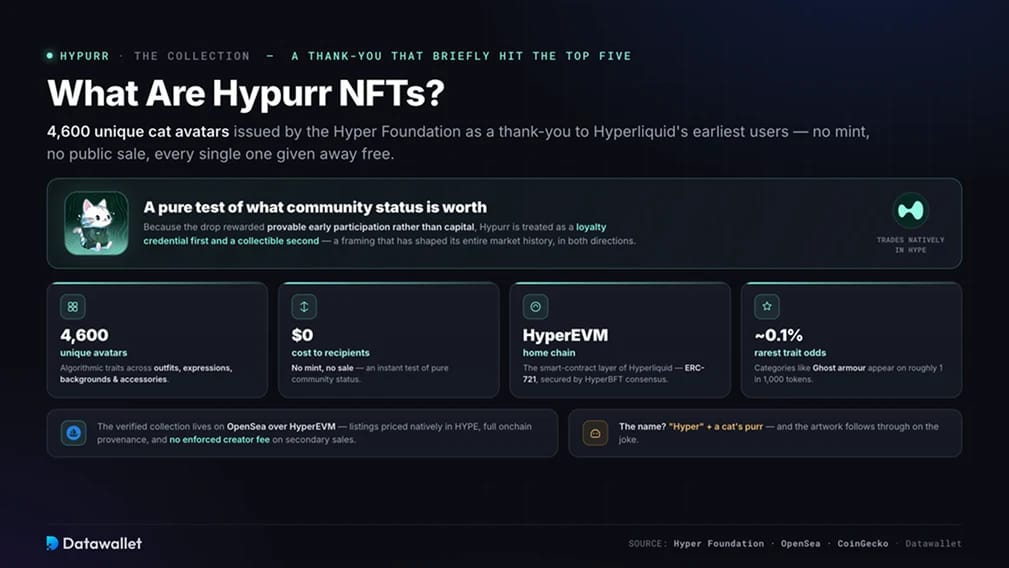
Hypurr NFTs are 4,600 unique cat avatars issued by the Hyper Foundation as a thank-you to the earliest users of Hyperliquid, the layer 1 blockchain best known for its fully onchain perpetuals exchange. There was no mint and no public sale. Every NFT was given away, which made the collection an instant test of what pure community status is worth.
The name blends "Hyper" with a cat's purr, and the artwork follows through on the joke. Each avatar carries algorithmically assigned traits across outfits, expressions, backgrounds, and accessories, with the rarest categories such as Ghost armour appearing on roughly 0.1% of tokens. The collection lives on HyperEVM, the smart contract layer of the Hyperliquid chain, and trades natively in HYPE.
Because the drop rewarded provable early participation rather than capital, many observers treat Hypurr as a loyalty credential first and a collectible second. That framing has shaped its entire market history, in both directions.
How Were Hypurr NFTs Distributed?
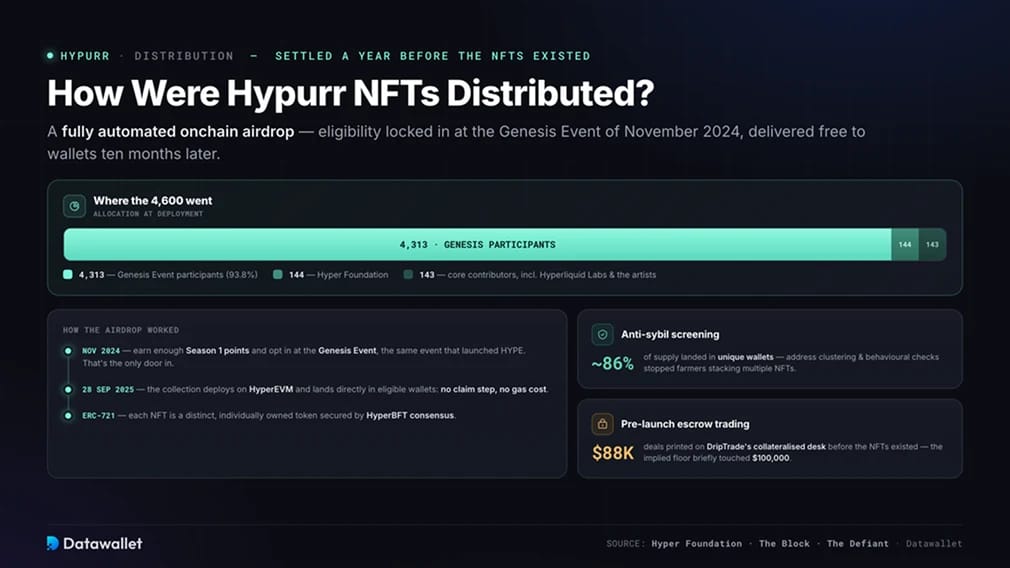
The Hyper Foundation ran the distribution as a fully automated onchain airdrop, with eligibility settled almost a year before the NFTs existed.
- Eligibility: Only users who earned enough points in Hyperliquid's Season 1 campaign and opted in during the Genesis Event of November 2024, the same event that launched the HYPE token, qualified for an NFT.
- Airdrop mechanics: The collection was deployed on HyperEVM on 28 September 2025 and sent directly to eligible wallets, with no claim step and no gas cost for recipients.
- Allocation: 4,313 NFTs went to Genesis participants, 144 to the Hyper Foundation, and 143 to core contributors including Hyperliquid Labs and the collection's artists.
- Anti-sybil screening: Address clustering and behavioural checks stopped single actors from farming multiple NFTs, so around 86% of the supply landed in unique wallets at launch.
- Contract standard: Hypurr uses the ERC-721 token standard, meaning each NFT is a distinct, individually owned token, secured by Hyperliquid's HyperBFT consensus.
- Pre-launch trading: Before the drop, DripTrade's collateralised escrow desk let buyers and sellers agree prices on unissued NFTs, with pre-launch deals reaching $88,000 and the implied floor briefly touching $100,000.
Hypurr Floor Price and Market Performance
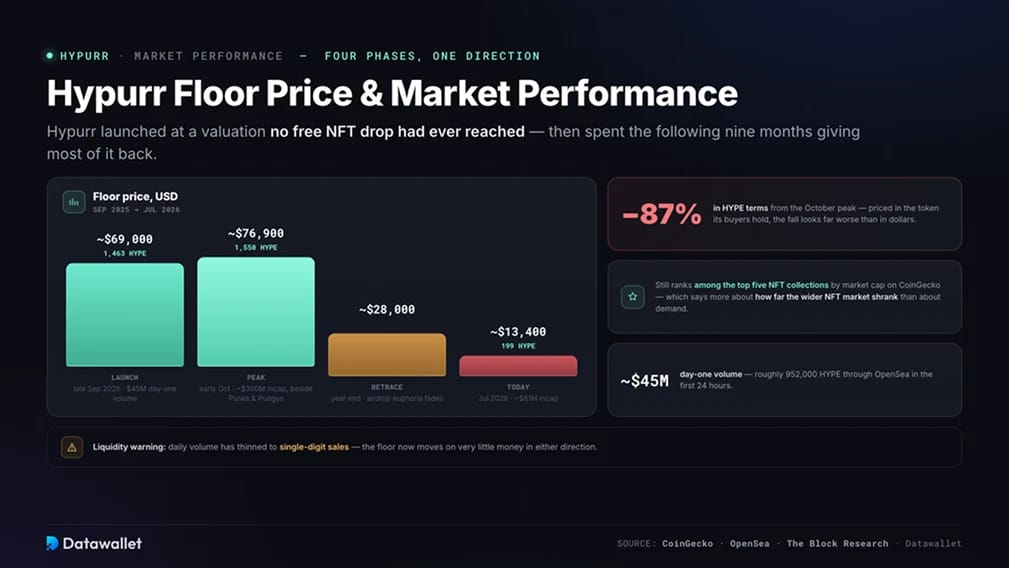
Hypurr launched at a valuation no free NFT drop had ever reached, then spent the following nine months giving most of it back. The timeline splits into four phases.
- Launch (late September 2025): The floor opened around 1,463 HYPE, close to $69,000, and OpenSea processed roughly 952,000 HYPE (about $45 million) of volume in the first 24 hours.
- Peak (early October 2025): The floor topped out near 1,550 HYPE, about $76,900, briefly placing Hypurr's roughly $300 million market capitalisation alongside CryptoPunks and Pudgy Penguins.
- Retrace (late 2025): As airdrop euphoria faded and some recipients cashed out life-changing sums, the floor slid to around $28,000 by year end, according to The Block's research arm.
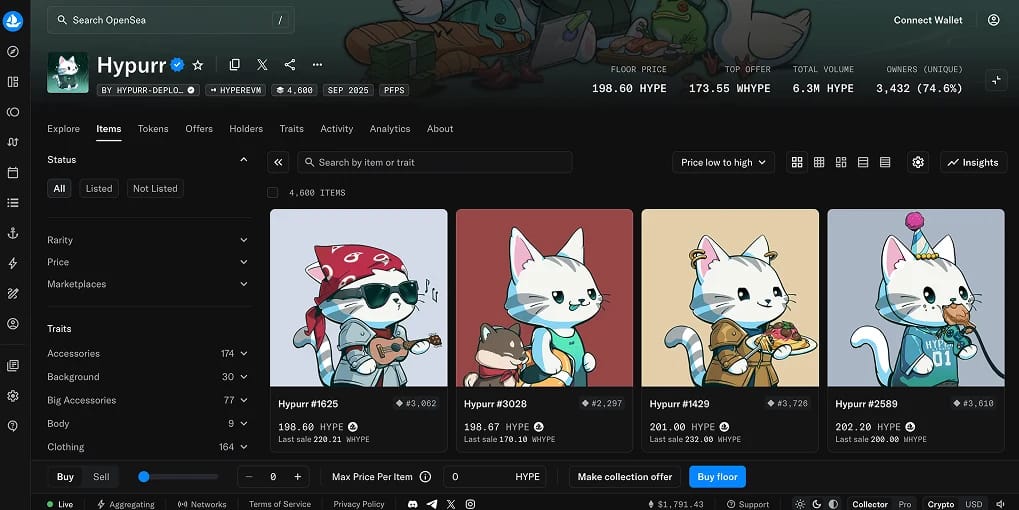
- Current level: As of July 2026, the floor sits near 199 HYPE, roughly $13,400, giving the collection a market capitalisation of about $61 million on a handful of sales per day.
The decline looks worse in HYPE terms than in dollars. Priced in the token its buyers hold, Hypurr has lost about 87% from its peak. Daily volume has thinned to single-digit sales, so the floor moves on very little money, and Hypurr still ranks among the top five NFT collections by market capitalisation on CoinGecko. Both facts say more about how far the wider NFT market has shrunk than about renewed demand.
Why Hypurr Fell While HYPE Rallied
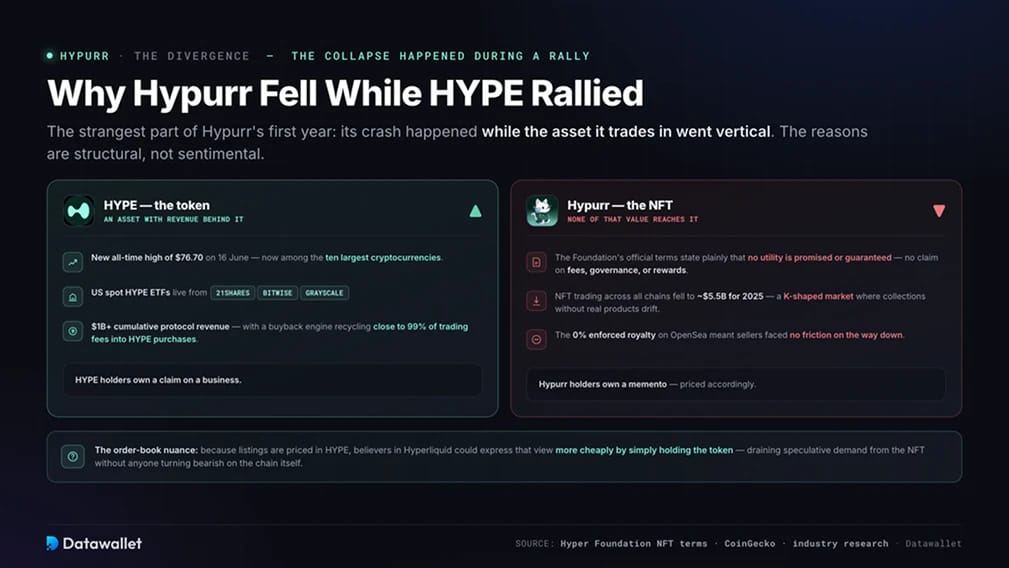
The strangest part of Hypurr's first year is that its collapse happened while the asset it trades in went vertical. HYPE reached a new all-time high of $76.70 on 16 June and now sits among the ten largest cryptocurrencies, supported by US spot HYPE ETFs from 21Shares, Bitwise, and Grayscale, more than $1 billion in cumulative protocol revenue, and a buyback engine that recycles close to 99% of trading fees into HYPE purchases.
None of that value reached the NFTs, and the reasons are structural. The Hyper Foundation's official terms state plainly that no utility is promised or guaranteed, so Hypurr never earned a claim on fees, governance, or rewards. HYPE holders own an asset with real revenue behind it. Hypurr holders own a memento.
The broader market did the rest. NFT trading volume across all chains fell to about $5.5 billion for 2025, and analysts describe a K-shaped market where a few collections with real products retain value while everything else drifts. Without confirmed utility, Hypurr slid from the top branch of that K toward the bottom, and the 0% enforced royalty on OpenSea meant sellers faced no friction on the way down.
We would add one nuance from watching the order book. Because listings are priced in HYPE, holders who believed in Hyperliquid could express that view more cheaply by simply holding the token, which drained speculative demand from the NFT without anyone turning bearish on the chain itself.
Notable Hypurr Sales and Collection Statistics
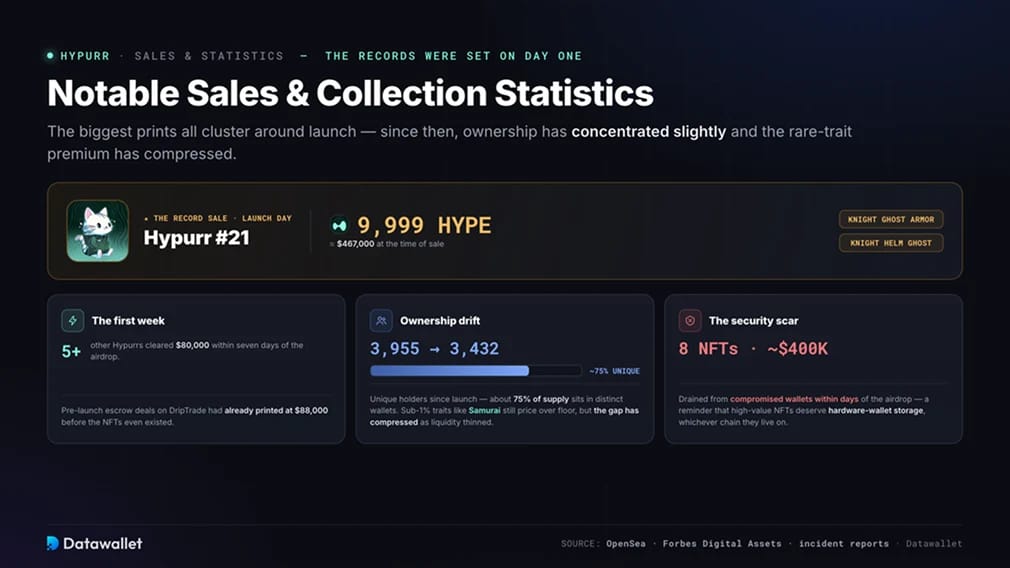
The record sale remains Hypurr #21, which carried the ultra-rare Knight Ghost Armor and Knight Helm Ghost traits and sold for 9,999 HYPE, close to $467,000, on launch day. At least five other Hypurrs cleared $80,000 in the first week, and pre-launch escrow deals had already printed at $88,000.
Ownership has concentrated slightly since then. Unique holders have drifted from roughly 3,955 at launch to 3,432 today, meaning about 75% of the supply sits in distinct wallets. Sub-1% trait categories such as Samurai outfits still command premiums over the floor, though the gap between rare and common pieces has compressed as overall liquidity thinned.
Security remains part of the collection's history. Within days of the airdrop, an attacker drained eight Hypurrs worth around $400,000 from compromised wallets, a reminder that high-value NFTs deserve hardware wallet storage regardless of which chain they live on.
How to Buy Hypurr NFTs
Buying a Hypurr requires HYPE tokens and a wallet connected to HyperEVM. The whole process takes about ten minutes.
- Buy HYPE on an exchange such as Bybit or directly on Hyperliquid's spot market.
- Add the HyperEVM network to MetaMask or another EVM-compatible wallet.
- Withdraw or bridge your HYPE to Hyperliquid, then transfer it from HyperCore to the HyperEVM side if needed.
- Open the Hypurr collection on OpenSea and verify the contract address matches the official collection.
- Buy a listed Hypurr outright or place an offer in HYPE below the floor.
- Approve the transaction in your wallet. Fees on HyperEVM are a fraction of a cent.
- The NFT appears in your wallet immediately, and ownership is verifiable on any HyperEVM explorer.
Hypurr Utility and Ecosystem Integrations
Official utility remains exactly where it was at launch, which is nowhere. The Hyper Foundation's terms allow benefits to be attached later while guaranteeing nothing, and no fee discounts, governance rights, or reward multipliers have been announced by the core team.
Third parties have moved faster. The HyperEVM lending protocol HyperLend offers a points boost to Hypurr holders, several ecosystem projects treat the NFT as a marker of early alignment, and tokenised vaults have appeared that hold Hypurrs and sell fractional exposure to whatever airdrops the collection might attract. That last development cuts both ways, since fractionalisation widens access while confirming that a five-figure entry price shut most buyers out.
The live question is whether Hypurr counts toward future HYPE distributions. Around 38.9% of the total HYPE supply remains reserved for future emissions and community rewards, and holding the collection is widely speculated to factor into Hyperliquid's next airdrop season. Nothing is confirmed, and we would treat any purchase made purely on that thesis as a leveraged bet on an unpublished formula.
Hypurr and the HYPE Token
Every Hypurr trade settles in HYPE, so a holder's dollar exposure has two moving parts, the NFT's price in HYPE and HYPE's price in dollars. Over the past nine months those parts moved in opposite directions, which cushioned the crash for holders who measured their wealth in dollars and magnified it for those who measured in HYPE.
The token's fundamentals have kept strengthening. Hyperliquid processed $492.7 billion in trading volume in the first quarter alone, expanded into permissionless markets through the HIP-4 upgrade, and attracted more than $170 million in combined ETF inflows within weeks of the US listings. You can track the token's live performance on our HYPE price page.
Regulators are paying closer attention as the platform grows. The Monetary Authority of Singapore added Hyperliquid to its Investor Alert List in late June, following an earlier warning from the UK's Financial Conduct Authority, and neither action affects NFT ownership directly, though both feed into the sentiment that prices everything in this ecosystem.
Final Thoughts
Hypurr's first year delivered a rare controlled experiment. Strip away utility, royalties, and roadmap promises, and a free NFT tied to a thriving protocol still found a $300 million valuation, then lost four fifths of it once the loyalty-pass thesis went unrewarded for long enough.
The collection is still historically significant, still the flagship NFT of one of crypto's most successful platforms, and still a candidate for the most expensive NFT collections list if the Hyper Foundation ever attaches real benefits. Until that happens, we view Hypurr as a high-beta claim on Hyperliquid's generosity, priced accordingly at about a fifth of its launch valuation.