


What is Robinhood Chain?
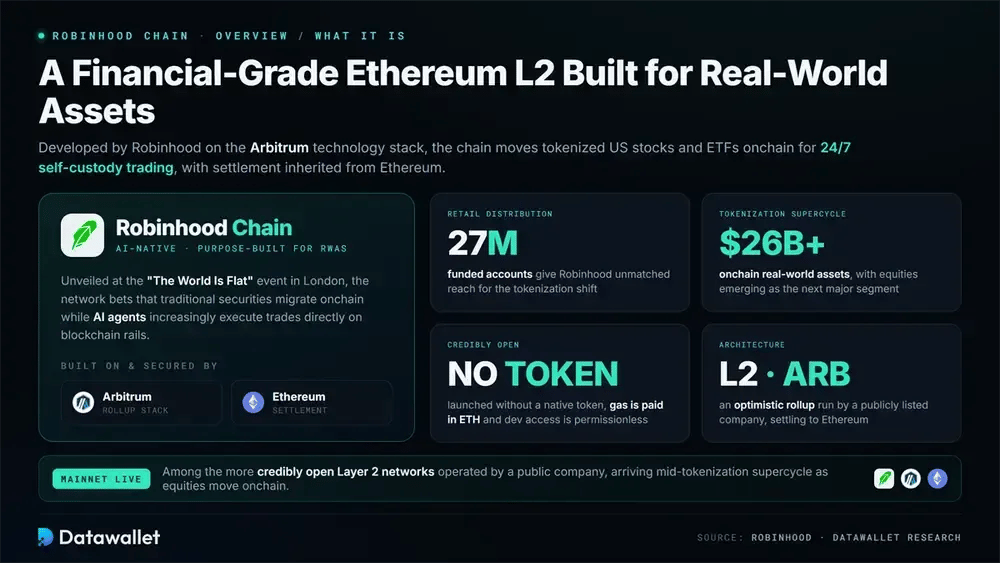
Robinhood Chain is a financial-grade Ethereum Layer 2 blockchain developed by Robinhood, built with the Arbitrum technology stack and optimized for tokenized real-world assets. Users trade tokenized US stocks and ETFs around the clock, hold them in self-custody wallets, and plug them into decentralized finance applications.
The company calls the network "AI-native and purpose-built for real-world assets," a framing unveiled at its "The World Is Flat" event in London. The bet is that traditional securities will migrate onchain while AI agents increasingly execute trades directly on blockchain rails.
Unlike most corporate chains, Robinhood Chain launched without a native token. Gas is paid in ETH, developers can deploy permissionlessly, and settlement inherits Ethereum's security, placing it among the more credibly open Layer 2 networks run by a publicly listed company.
The chain arrives mid-tokenization supercycle, with onchain real-world assets surpassing $26 billion and equities emerging as the next major segment, as covered in our tokenization statistics. Robinhood's 27 million funded accounts give it unmatched retail distribution for that shift.
How Does Robinhood Chain Work?
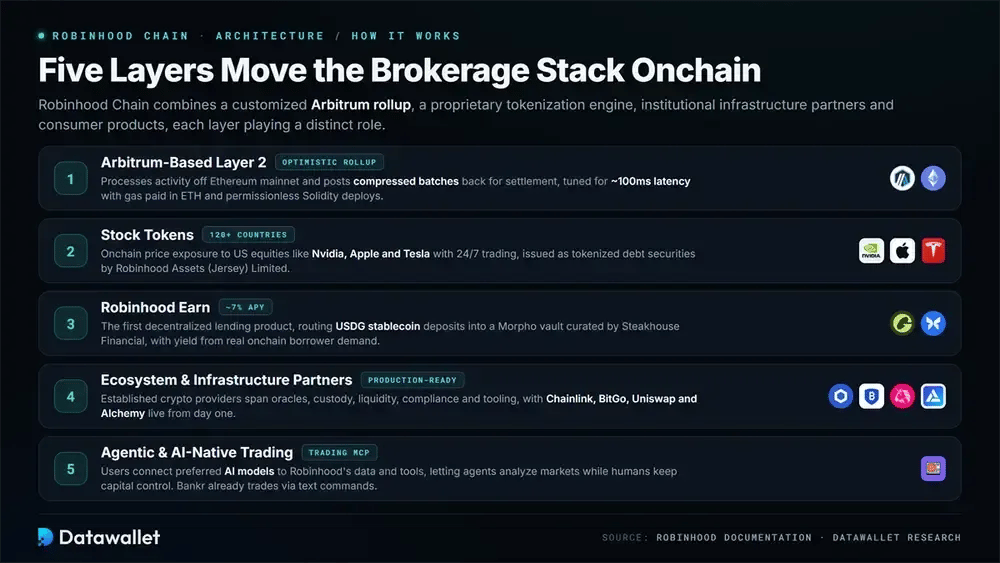
Robinhood Chain combines a customized Arbitrum rollup, a proprietary tokenization engine, institutional infrastructure partners, and consumer products layered on top. Each component below plays a distinct role in moving Robinhood's brokerage stack onchain.
1. Arbitrum-Based Layer 2 Architecture
Robinhood Chain runs on Arbitrum's dedicated chain framework, operating as an optimistic rollup that processes activity off Ethereum mainnet while posting compressed batches back for settlement. The design inherits Ethereum's security guarantees without mainnet gas prices on every trade.
The network is tuned for consumer-grade speed, using configurable block times and preconfirmations to reach roughly 100-millisecond latency. A single Robinhood-operated sequencer orders transactions first-come, first-served, so nobody can jump the queue by paying higher fees, per the official documentation.
Gas is paid in ETH rather than a proprietary token, an unusual choice for a corporate rollup. The chain is also fully permissionless, meaning any developer can deploy Solidity smart contracts with standard EVM tooling like Foundry and Hardhat, no approval from Robinhood required.
2. Stock Tokens
Stock Tokens are the flagship asset class, giving eligible users in over 120 countries onchain price exposure to US equities like Nvidia, Apple, and Tesla with 24/7 trading. Robinhood validated the product on Arbitrum One in 2025 before migrating settlement to its own chain.
Legally, the new Stock Tokens are tokenized debt securities issued by Robinhood Assets (Jersey) Limited, per Robinhood's disclosures. They track the underlying share price but confer no voting rights or legal ownership, a structure still drawing regulatory attention in the US and Europe.
Because the tokens are standard onchain assets, holders can move them to self-custody, supply them to lending pools, or post them as collateral, composability impossible inside a legacy brokerage account. Availability excludes US persons and several jurisdictions including Canada and the UK, as we detail in our guide to tokenized stock trading exchanges.
3. Robinhood Earn
Robinhood Earn is the company's first decentralized lending product, rolling out to eligible US users inside the main app. Customers lend dollar-backed USDG stablecoins from a self-custody wallet at an estimated 7% APY, with yield generated entirely from onchain borrower demand.
Under the hood, deposits flow into a Morpho vault curated by Steakhouse Financial and spread across lending markets where borrowers post collateral from protocols including Ethena, Spark, and Maple. Robinhood procured insurance through Lloyd's of London and RELM to cover eligible losses from cyberattacks or smart contract exploits.
The rate is variable rather than guaranteed, since it reflects real-time borrowing demand across Morpho markets. Robinhood never custodies the funds or private keys. The product wraps DeFi credit infrastructure in a brokerage-grade interface, lowering the technical barrier that historically kept mainstream users out.
4. Ecosystem and Infrastructure Partners
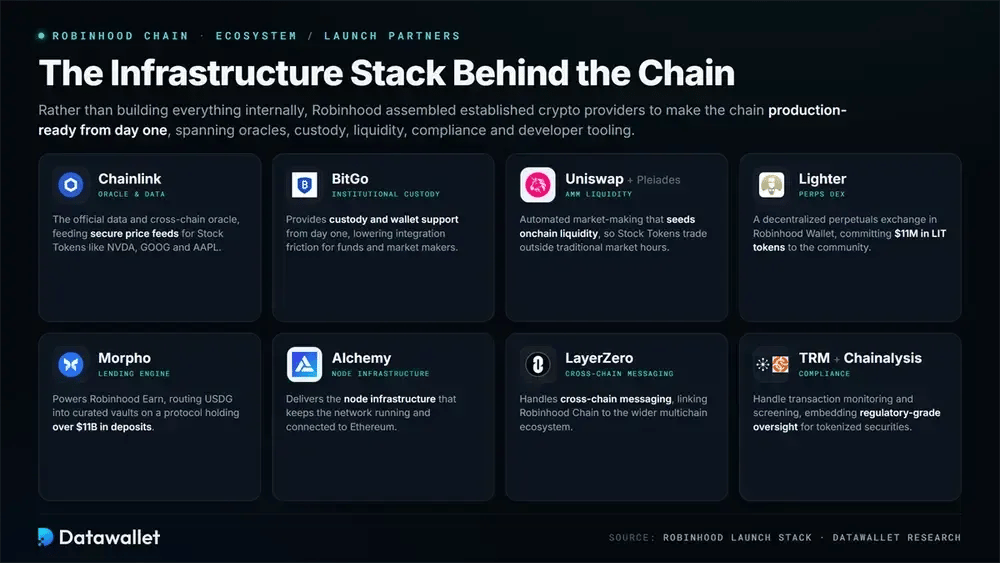
Rather than building everything internally, Robinhood assembled established crypto infrastructure providers to make the chain production-ready from day one. The launch stack spans oracles, custody, liquidity, compliance, and developer tooling.
Key launch partners and their roles include:
- Chainlink: Serves as the official data and cross-chain oracle, feeding secure price data for Stock Tokens like NVDA, GOOG, and AAPL.
- BitGo: Provides institutional custody and wallet support from day one, lowering integration friction for funds and market makers entering the network.
- Uniswap and Pleiades: Supply automated market-making mechanisms that seed onchain liquidity, ensuring Stock Tokens can trade continuously outside traditional market hours.
- Lighter: A decentralized perpetuals exchange integrated into Robinhood Wallet, which committed $11 million in LIT tokens to the Robinhood community.
- Morpho: Powers the lending infrastructure behind Robinhood Earn, routing USDG deposits into curated vaults on a protocol holding over $11 billion in deposits.
- Alchemy and LayerZero: Deliver node infrastructure and cross-chain messaging respectively, keeping the network connected to Ethereum and the wider multichain ecosystem.
- TRM and Chainalysis: Handle transaction monitoring and compliance screening, embedding regulatory-grade oversight into a chain designed to host tokenized securities.
5. Agentic and AI-Native Trading
Robinhood markets the chain as AI-native, and its Agentic Accounts extend that thesis to crypto. Eligible US users will connect preferred AI models to Robinhood's data and tools through its Trading MCP, letting agents analyze markets and build strategies while humans keep capital control.
Third parties are pushing the concept further. Agent platform Bankr integrated Robinhood Chain so users can trade tokenized stocks, ETFs, and memecoins through text commands on X or Telegram. If agent-driven volume scales, the chain could become a primary venue for autonomous onchain trading.
How to Use Robinhood Chain
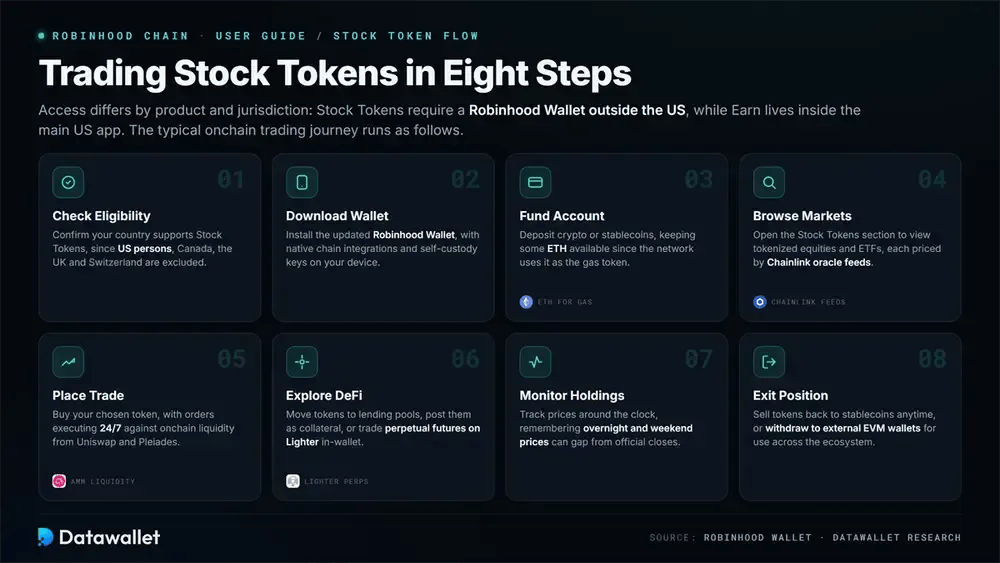
Access differs by product and jurisdiction: Stock Tokens require a Robinhood Wallet outside the US, while Earn lives inside the main US app. The typical Stock Token journey runs as follows.
A standard onchain trading flow follows these steps:
- Check eligibility: Confirm your country supports Stock Tokens, since US persons and several jurisdictions like Canada, the UK, and Switzerland are currently excluded.
- Download wallet: Install the updated Robinhood Wallet app, which ships with native Robinhood Chain integrations and self-custody key management handled on your device.
- Fund account: Deposit crypto or stablecoins into your wallet, keeping some ETH available since the network uses it as the native gas token.
- Browse markets: Open the Stock Tokens section to view available tokenized equities and ETFs, each tracking live prices through Chainlink oracle feeds.
- Place trade: Buy your chosen token, with orders executing 24/7 against onchain liquidity supplied by Uniswap and Pleiades market-making mechanisms.
- Explore DeFi: Move tokens to lending pools, post them as collateral, or trade perpetual futures on Lighter directly inside the wallet interface.
- Monitor holdings: Track token prices around the clock, remembering that overnight and weekend prices can gap significantly from official exchange closes.
- Exit position: Sell tokens back to stablecoins at any time, or withdraw assets to external EVM wallets for use across the wider ecosystem.
Robinhood Chain vs Base
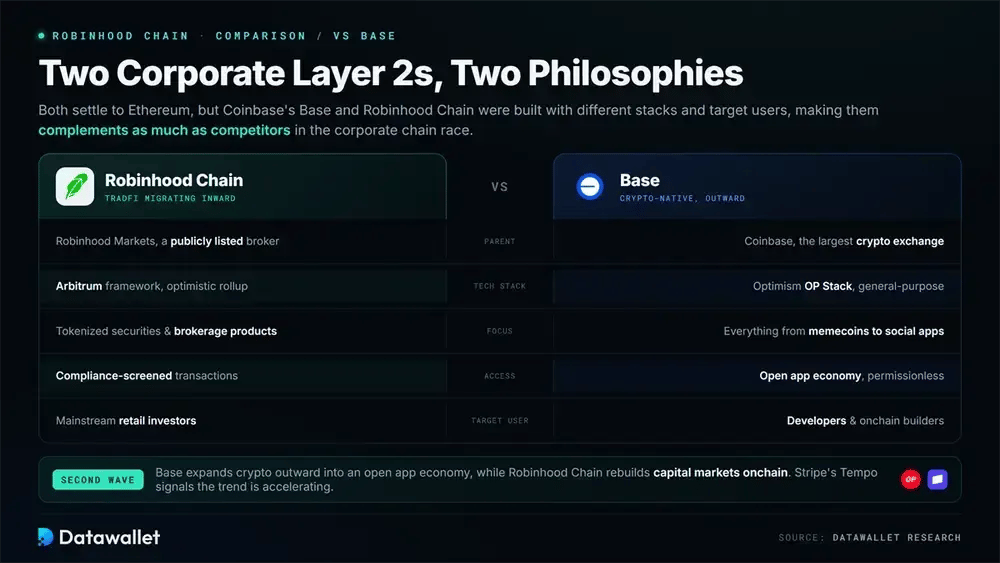
The most natural comparison is Coinbase's Base, the largest corporate-backed Layer 2. Both settle to Ethereum, but they were built with different stacks, philosophies, and target users, making them complements as much as competitors in the corporate chain race.
Base runs on Optimism's OP Stack as a general-purpose developer platform hosting everything from memecoins to social apps. Robinhood Chain uses Arbitrum's framework and focuses narrowly on tokenized securities, compliance-screened transactions, and brokerage-grade financial products aimed at mainstream retail investors.
The strategic contrast matters more than the technical one. Base represents a crypto-native company expanding outward into an open app economy, whereas Robinhood Chain represents traditional finance migrating inward, rebuilding capital markets onchain. Stripe's Tempo and similar corporate chains suggest this second wave is accelerating.
HOOD Stock
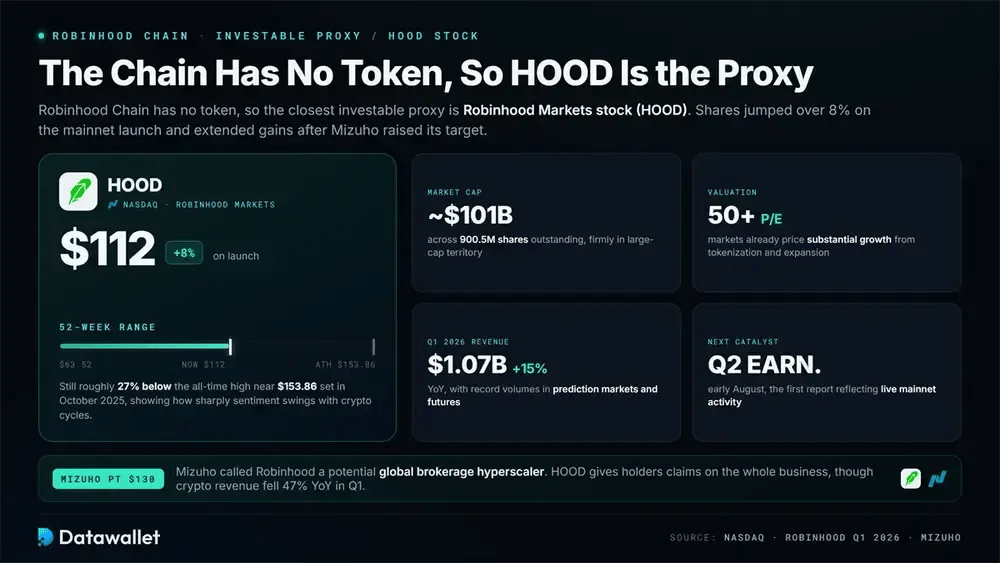
Robinhood Chain has no token, so the closest investable proxy is Robinhood Markets stock (HOOD), listed on the Nasdaq. Shares jumped over 8% on the mainnet launch and extended gains after Mizuho raised its price target to $130, calling Robinhood a potential global brokerage hyperscaler.
Unlike a Layer 2 token, HOOD gives holders claims on the whole business: brokerage, options, prediction markets, crypto, and now onchain infrastructure. That diversification cuts both ways, since crypto transaction revenue fell 47% year over year in Q1 2026 even as total revenue grew.
Key HOOD stock metrics as of early July 2026:
- Share price: Around $112 after the launch rally, still roughly 27% below the all-time high near $153.86 set in October 2025.
- Market cap: Approximately $101 billion across 900.5 million shares outstanding, placing Robinhood firmly in large-cap territory alongside major exchanges.
- Valuation: A trailing P/E above 50, meaning markets already price substantial growth from tokenization, international expansion, and new product lines.
- 52-week range: Between $63.52 and $153.86, showing how sharply sentiment swings with crypto cycles and retail trading activity.
- Q1 2026 revenue: $1.07 billion, up 15% year over year, with record volumes in prediction markets, futures, and index options.
- Next catalyst: Q2 2026 earnings in early August, the first report reflecting live Robinhood Chain activity and mainnet adoption data.
Robinhood Funding
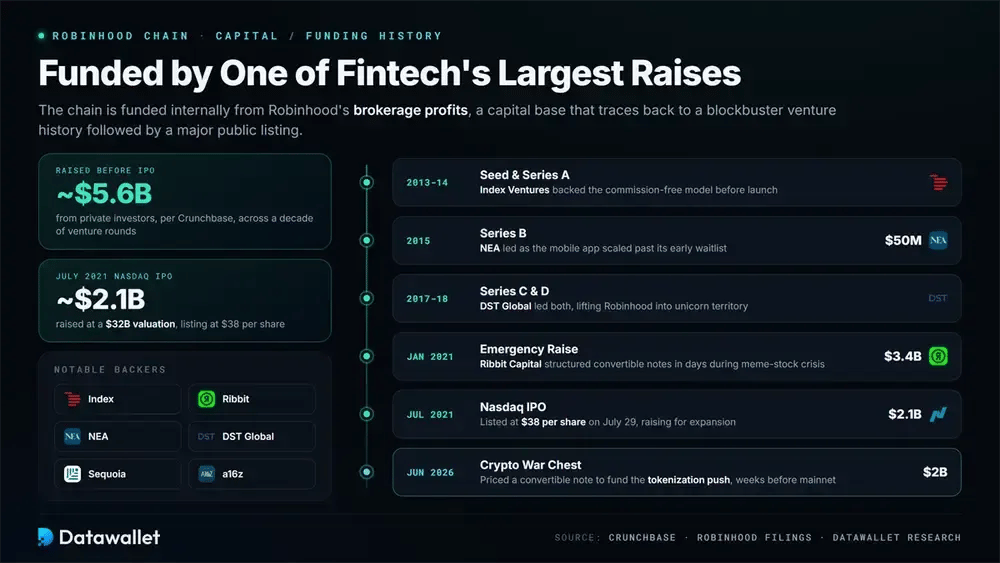
Robinhood Chain is funded internally from Robinhood's brokerage profits rather than through a token sale or ecosystem treasury. That capital base traces back to one of fintech's largest venture funding histories, followed by a blockbuster public listing.
Before going public, Robinhood raised roughly $5.6 billion from private investors, per Crunchbase, including backers like Index Ventures, Ribbit Capital, NEA, DST Global, Sequoia, and Andreessen Horowitz. It then raised about $2.1 billion in its July 2021 Nasdaq IPO at a $32 billion valuation.
Major funding milestones include:
- Seed and Series A: Index Ventures led Robinhood's earliest rounds in 2013 and 2014, backing the commission-free trading model before launch.
- Series B: New Enterprise Associates led a $50 million round in 2015 as the mobile app scaled past its early waitlist.
- Series C and D: DST Global led both 2017 and 2018 rounds, lifting Robinhood into unicorn territory during the retail trading boom.
- Emergency raise: Investors led by Ribbit Capital structured $3.4 billion in convertible notes within days during the January 2021 meme-stock crisis.
- IPO: Robinhood listed on Nasdaq on July 29, 2021 at $38 per share, raising roughly $2.1 billion for expansion.
- Crypto war chest: In June 2026, the company priced a $2 billion convertible note to fund its crypto and tokenization push, weeks before mainnet.
Is Robinhood Chain Safe?
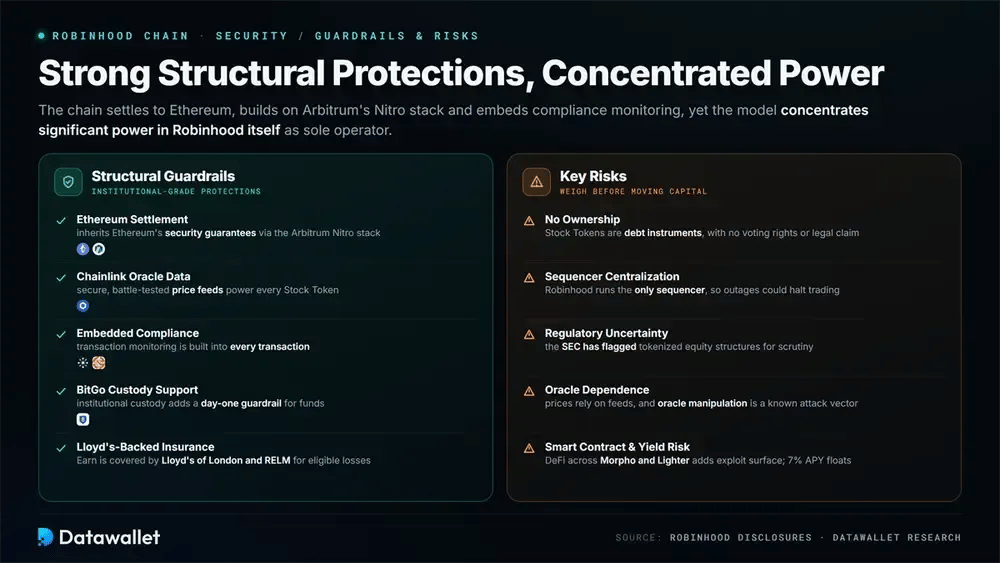
Robinhood Chain benefits from meaningful structural protections. It settles to Ethereum, builds on Arbitrum's battle-tested Nitro stack, uses Chainlink for oracle data, and embeds compliance monitoring into every transaction. BitGo custody support and Lloyd's-backed insurance on Earn add institutional guardrails.
That said, the security model concentrates significant power in Robinhood itself. The company operates the sole sequencer, controls Stock Token issuance through its Jersey entity, and can restrict access by jurisdiction, so users trust Robinhood's operations far more than they would on a decentralized network.
Risks
Like any young network hosting tokenized securities, Robinhood Chain carries risks spanning legal structure, market mechanics, and smart contract exposure. Users should weigh these before moving meaningful capital onchain, especially given how new the mainnet is.
Key risks include:
- No ownership: Stock Tokens are debt instruments tracking prices, so holders receive no voting rights, legal claim, or direct ownership of underlying shares.
- Issuer risk: Token value depends on Robinhood Assets (Jersey) Limited honoring obligations, adding counterparty exposure absent from directly held equities.
- Sequencer centralization: Robinhood runs the only sequencer, meaning outages or censorship decisions could halt trading with no permissionless fallback currently available.
- Regulatory uncertainty: The SEC has flagged tokenized equity structures for scrutiny, and the 2025 OpenAI token dispute shows how fast legal challenges emerge.
- Oracle dependence: Prices rely on Chainlink feeds, and oracle manipulation remains one of DeFi's most damaging historical attack vectors.
- Variable yield: Robinhood Earn's estimated 7% APY floats with borrower demand, and lending pools can suffer losses despite insurance coverage.
- Weekend price gaps: 24/7 tokens can drift from official closes, exposing traders to volatility when underlying stock markets reopen.
- Smart contract bugs: DeFi integrations across Morpho, Lighter, and third-party dApps introduce exploit surfaces beyond Robinhood's direct control.
History and Roadmap
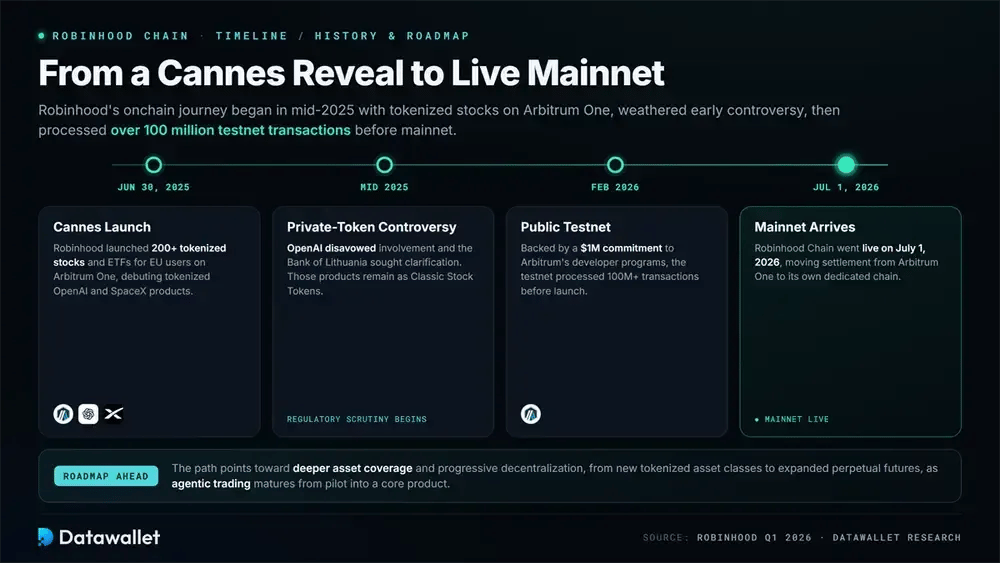
Robinhood's onchain journey began at its Cannes event on June 30, 2025, where it launched over 200 tokenized stocks and ETFs for EU users on Arbitrum One and announced plans for a dedicated chain. Tokenized OpenAI and SpaceX products debuted alongside.
The private-company tokens immediately generated controversy. OpenAI publicly disavowed any involvement, and the Bank of Lithuania, Robinhood's lead EU regulator, sought clarification on the token structure. Those products, now called Classic Stock Tokens, remain available as derivative contracts in the Robinhood Europe app.
A public testnet followed in February 2026, backed by a $1 million commitment to Arbitrum's developer programs, and processed over 100 million transactions before launch, per Robinhood's Q1 2026 results. Mainnet arrived July 1, 2026.
The roadmap points toward deeper asset coverage and progressive decentralization. Robinhood has signaled ambitions to bring its entire ecosystem onchain, from additional tokenized asset classes to expanded perpetual futures access, while agentic trading matures from pilot into a core product.
Robinhood Chain Founders
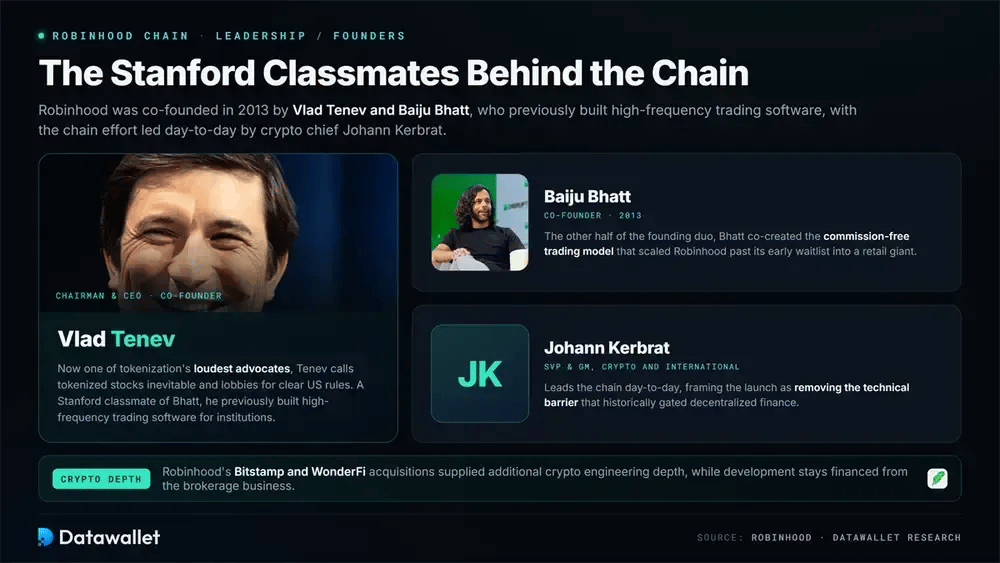
Robinhood was co-founded in 2013 by Vlad Tenev and Baiju Bhatt, Stanford classmates who previously built high-frequency trading software for institutions. Tenev, now chairman and CEO, has become one of tokenization's loudest advocates, calling tokenized stocks inevitable and lobbying for clear US rules.
The chain effort is led day-to-day by Johann Kerbrat, SVP and General Manager of Crypto and International, who framed the launch as removing the technical barrier that historically gated decentralized finance. Robinhood's Bitstamp and WonderFi acquisitions supplied additional crypto engineering depth.
Development is financed from the brokerage business, which posted record engagement in early 2026. That gives the network a well-capitalized parent, though it also ties its priorities directly to shareholder interests rather than a token community.
Final Thoughts
Robinhood Chain is the clearest signal yet that traditional brokerages see public blockchains as core infrastructure rather than a side bet. Pairing 27 million funded accounts with Ethereum settlement, it could onboard more mainstream users to onchain finance than any crypto-native project.
Its early design choices are notably credible: ETH gas, permissionless deployment, established partners like Chainlink and Morpho, and no speculative network token. The open questions are regulatory durability of the Stock Token structure, sequencer centralization, and whether real liquidity follows the marketing.
For traders, the practical takeaway is to understand exactly what a Stock Token legally represents, size DeFi yield positions conservatively, and treat the network as promising but unproven infrastructure. Tokenized equities are clearly here to stay, and Robinhood Chain is now the highest-profile test of how they scale.