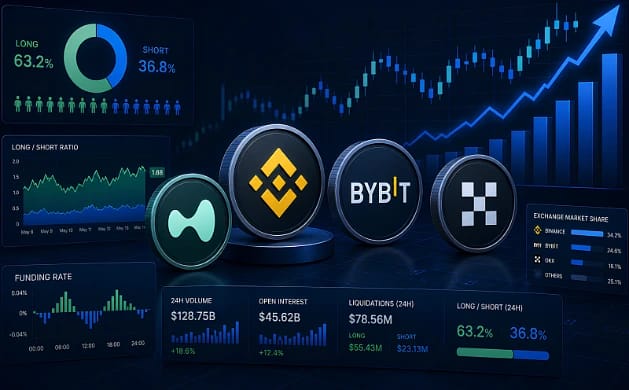



Top 8 Crypto Perpetual Futures Statistics and Trends
The eight statistics below show where perpetual futures volume, open interest, and market share stand today. Figures draw on Coinglass, CoinGecko, DefiLlama, CoinDesk Research, and CFTC filings so readers can verify each number at its source.
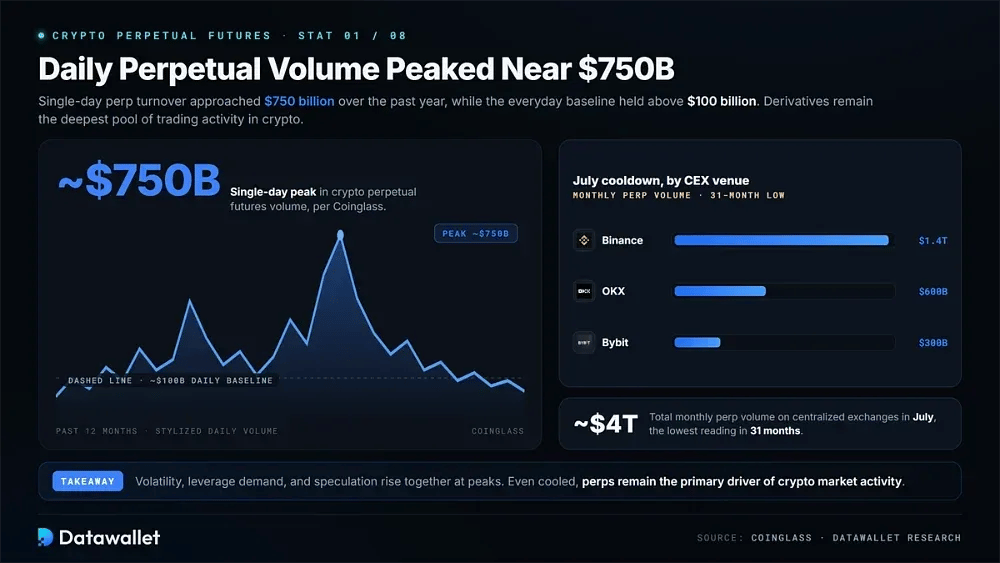
1. Daily Perpetual Volume Peaked Near $750B
Crypto perpetual futures volume hit a single-day peak of nearly $750 billion over the past year, according to Coinglass data. Volatility, leverage demand, and speculative participation tend to rise together during peaks of that size. The result underscores perpetuals' position as the deepest pool of trading activity in digital assets.
The day-to-day baseline is just as significant. Across the one-year view, perpetual volume repeatedly exceeded $100 billion a day and climbed much higher during volatile periods. Derivatives trading therefore remained the primary driver of crypto market activity across centralized and decentralized venues.
Since spring, activity has cooled. Monthly perpetual volume on centralized exchanges fell to roughly $4 trillion in July, the lowest level in 31 months according to reported Coinglass figures. Binance accounted for about $1.4 trillion, while OKX handled around $600 billion and Bybit about $300 billion.
2. Crypto Perps Trade 5x-10x Spot Volume
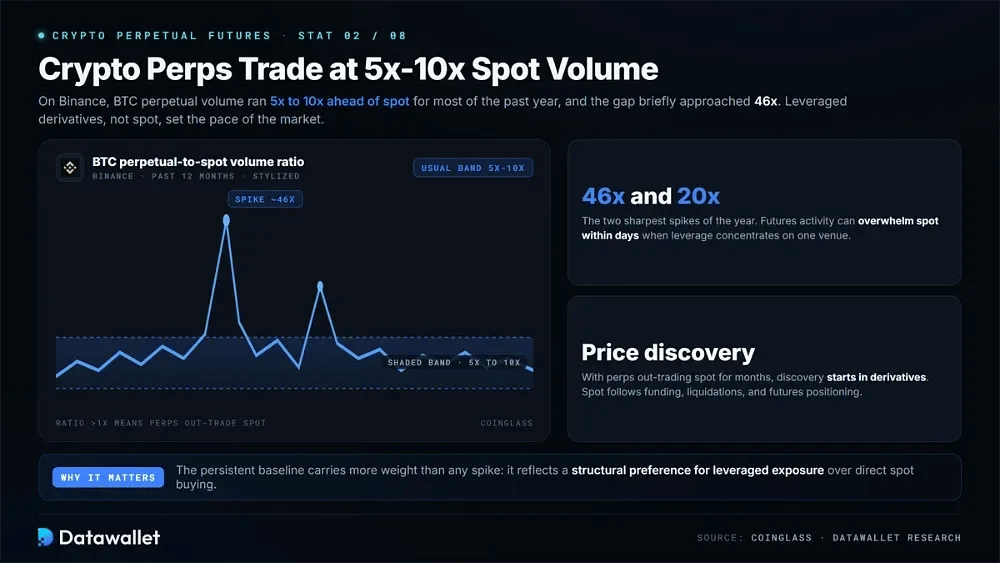
On Binance, BTC perpetual futures maintained a substantial lead over spot volume throughout the past year. Coinglass data shows the perpetual-to-spot ratio usually stayed between roughly 5x and 10x, reflecting traders' strong preference for leveraged derivatives over direct spot exposure.
At the extremes, the gap became much wider. The ratio briefly approached 46x and topped 20x during another sharp spike. Those readings show how quickly futures activity can overwhelm spot trading during short periods of speculation, volatility, or concentrated leveraged positioning on a single venue.
For traders, the persistent baseline carries more weight than an isolated spike. When perpetual volume exceeds spot by such a large margin for months, price discovery increasingly begins in derivatives. Spot markets then often respond to funding, liquidations, and futures positioning instead of leading them.
3. Binance Leads Bitcoin Perps Open Interest
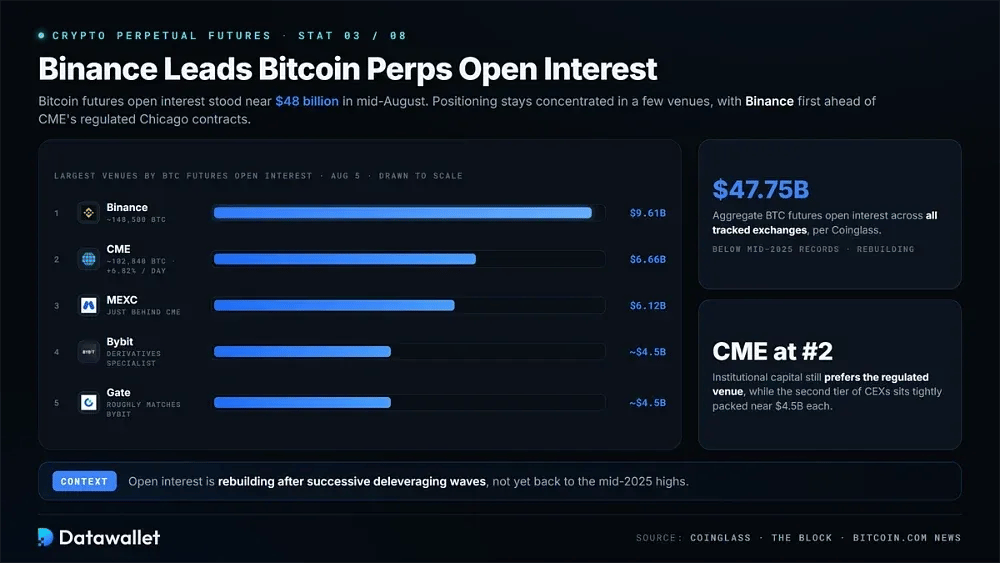
Bitcoin futures open interest stood near $48 billion in mid-August. Most positioning remains concentrated among a small group of venues, with Binance holding the largest individual share ahead of CME's regulated contracts.
Largest venues by Bitcoin futures open interest, per an August 5 Coinglass reading:
- Binance: Roughly 148,500 BTC in open contracts, worth about $9.61 billion. That keeps the exchange in first place for Bitcoin futures risk among all tracked venues.
- CME: About 102,840 BTC, or $6.66 billion, puts CME second after a 6.82% one-day jump and shows that institutional capital still clearly prefers the regulated Chicago venue.
- MEXC: Close to $6.12 billion in Bitcoin futures open interest, placing the exchange just behind CME but well ahead of most retail-focused rivals.
- Bybit: Near $4.5 billion in outstanding Bitcoin contracts. The total keeps the derivatives specialist in the top tier despite losing ground to newer competitors this cycle.
- Gate: Also around $4.5 billion in Bitcoin futures open interest, roughly matching Bybit and showing how tightly packed the second tier of centralized venues remains.
- Market total: Aggregate Bitcoin futures open interest sits near $47.75 billion across all exchanges, per Coinglass. That remains below the mid-2025 records but is rebuilding after successive deleveraging waves.
Data Sources: Coinglass Bitcoin futures data and The Block, Share of Open Interest across Bitcoin Futures.
4. US Regulators Opened the Door to Onshore Perps
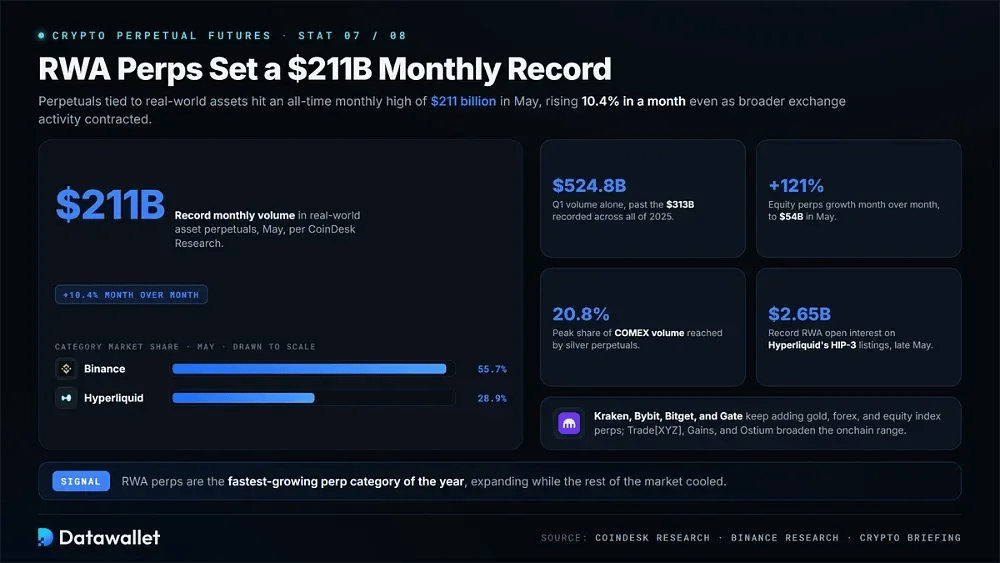
For American traders, perpetual futures were long confined to offshore markets. That changed on May 29, when the CFTC approved the first bitcoin perpetual on a registered US exchange and classified the design as a futures contract.
Key milestones in the US perpetual futures shift so far:
- Kalshi approval: The CFTC issued an Order for Approval allowing KalshiEX to list BTCPERP, a cash-settled contract referencing spot bitcoin and the first true perpetual on a regulated American exchange.
- Coinbase relief: A same-day no-action letter lets Coinbase Financial Markets connect US clients to global perpetuals and options through its Bermuda affiliate, with crypto used as margin collateral.
- Policy statement: The Commission classified perpetual contracts on digital commodities as futures rather than swaps. It also committed to reviewing perpetuals on other asset classes case by case.
- Guardrails: Approved products include leverage limits, volatility controls, and know-your-customer checks. Offshore venues such as Hyperliquid do not impose those restrictions on their permissionless markets.
- CME lawsuit: CME Group sued the CFTC and Chairman Michael Selig in June, arguing that the Kalshi and Coinbase approvals violated the Commodity Exchange Act and harm its franchise.
- New filings: Kalshi filed on August 18 to list perpetuals tracking the MerQube US Large Cap Index and spot copper, extending the product beyond crypto entirely.
- Polymarket plans: Kalshi's prediction-market rival has announced perpetuals referencing stocks such as Nvidia, as well as silver and gold, at 10x leverage. It still awaits its own CFTC approval.
- Hyperliquid pathway: President Trump urged Congress to pass the Clarity Act in August and said regulators are exploring a compliant path for Hyperliquid to serve US traders.
Data Sources: CFTC Order for Approval from May 29, plus The Block and CoinDesk reporting through August 20.
5. DEX Perps Share Reached 10.2% Against CEXs
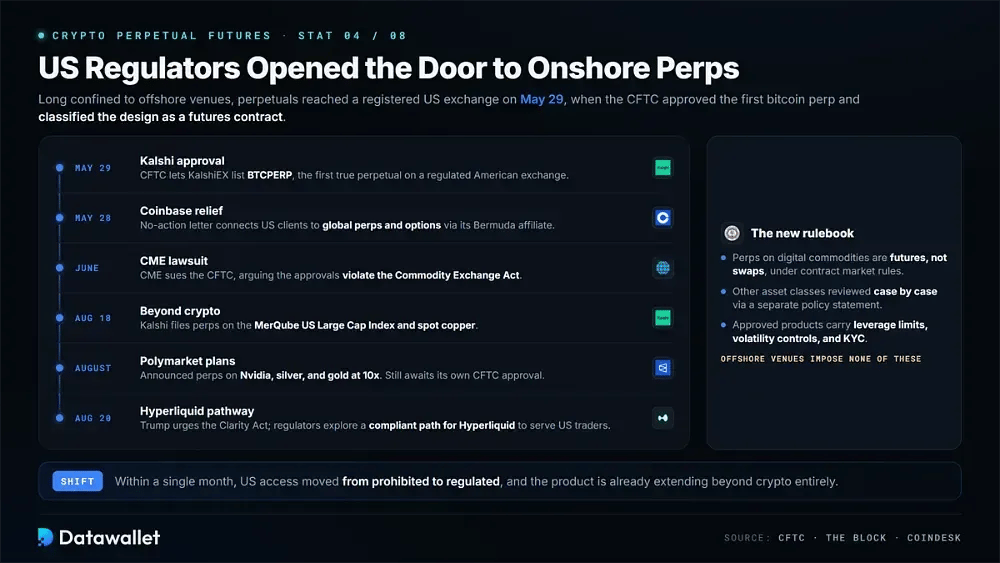
Combined crypto perpetual futures volume rose 75% in two years, from $4.14 trillion in January 2024 to $7.24 trillion in January this year, according to CoinGecko Research. Over that period, perpetuals continued gaining traction as leveraged trading became the market's default instrument for directional exposure.
The fastest growth came from decentralized venues. Monthly perp DEX volume increased from $81.74 billion to $739.48 billion over the same period, an expansion of roughly 8x. That pace far exceeded broader market growth and signaled increasing trader comfort with onchain derivatives platforms and self-custodied collateral.
Market share moved with the volume. DEXs expanded from 2.0% of total perpetuals volume in January 2024 to 10.2% by January this year, a fivefold increase. CoinDesk Research later put DEX futures share at 14.7% in May, after monthly volumes increased 7.64% to $596 billion.
6. Perp DEXs Cleared $2.41T in the First Quarter
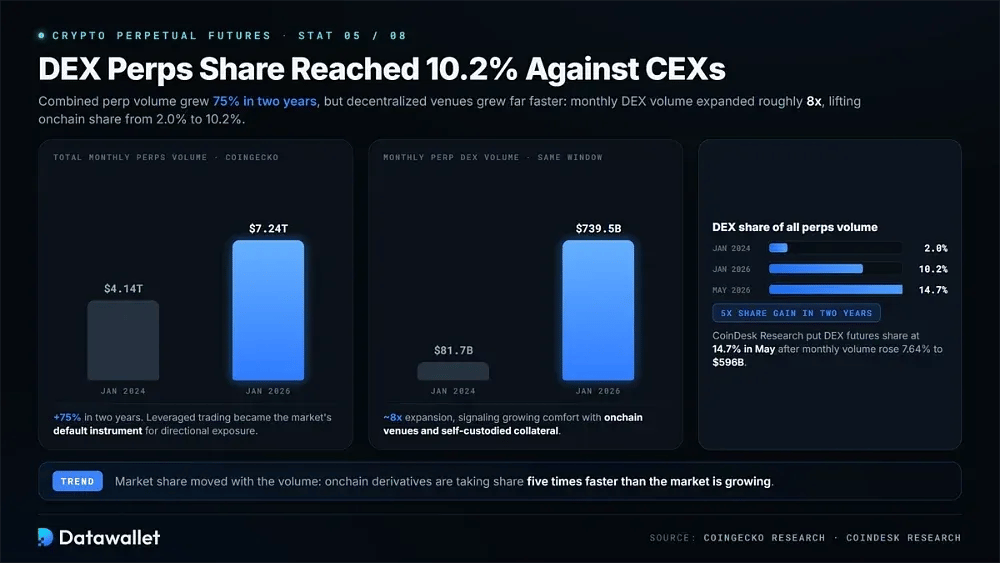
Perpetual DEXs processed about $2.41 trillion from January 1 through March 30. Activity has since cooled alongside the wider market, with DefiLlama's latest 30-day window showing $466.58 billion across all tracked onchain venues.
Top perpetual DEXs by trading volume, 30 days to August 20:
- Hyperliquid: $184.91 billion in 30-day volume and $11.94 billion in open interest. The venue accounts for roughly 39.6% of all onchain perpetuals activity tracked by DefiLlama.
- Aster: $39.49 billion over the trailing month, enough for second place among perp DEXs after the BNB Chain venue cleared $318.70 billion in Q1.
- Lighter: $34.23 billion across its zero-fee zkLighter order book, keeping the zk-rollup exchange near the front of the group it joined during last year's points race.
- ApeX Protocol: $33.58 billion during the past 30 days, a strong result for the omni-chain exchange that ranked sixth overall by volume during the first quarter.
- edgeX: $26.86 billion on its dedicated Layer 1, extending the momentum that took the exchange to $272.28 billion in volume over the first three months.
- Variational: $24.50 billion in the latest window, supported by a $50 million Series A raised in May to expand its commodity and crypto perpetuals coverage.
- Grvt: $19.23 billion for the hybrid exchange. It combines self-custody with a centralized-style matching engine and lists a growing range of stock and commodity pairs.
- GMTrade: $16.84 billion in monthly volume, lifting the newer entrant above several better-known rivals, including dYdX, GMX, and Jupiter, in current DefiLlama rankings.
Data Source: DefiLlama, 30 days to August 20.
7. RWA Perps Set a $211B Monthly Record
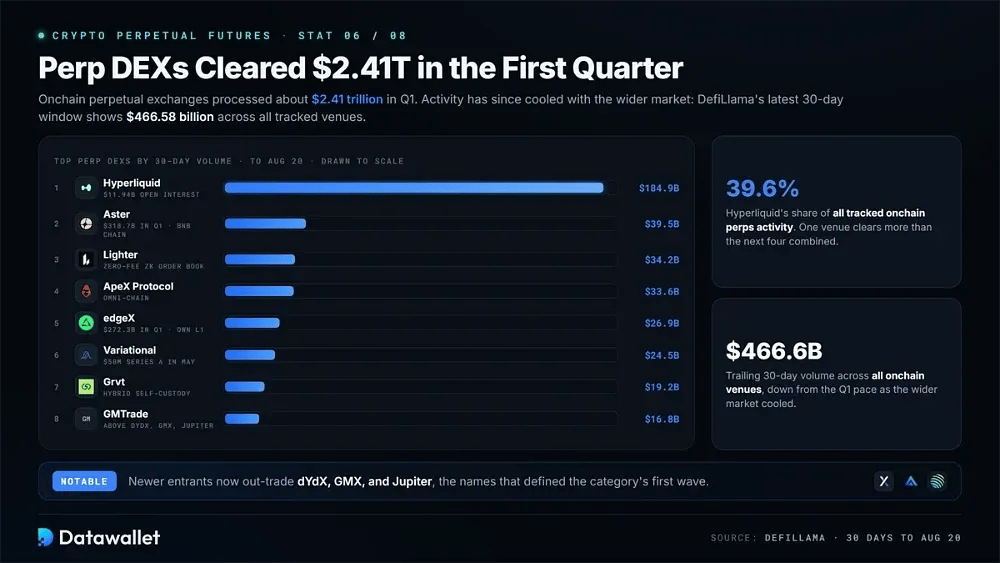
Perpetual futures tied to real-world assets reached an all-time monthly high of $211 billion in May, according to CoinDesk Research. Volume rose 10.4% in a month even as broader exchange activity contracted. Binance led the category with 55.7% market share, followed by Hyperliquid at 28.9%.
Growth this year has been steep. Q1 volume reached roughly $524.8 billion, surpassing the $313 billion recorded across all of 2025. Equity perps climbed 121% month over month to $54 billion in May. Binance Research also reported that silver perpetuals peaked at 20.8% of COMEX volume.
Centralized venues including Kraken, Bybit, Bitget, and Gate continue adding gold, forex, and equity index perps. Onchain, Trade[XYZ], Gains Network, and Ostium are broadening the available product range. Through its permissionless HIP-3 listings, Hyperliquid's real-world asset open interest reached a record $2.65 billion in late May.
8. Hyperliquid L1 Leads Chains in Perps Volume
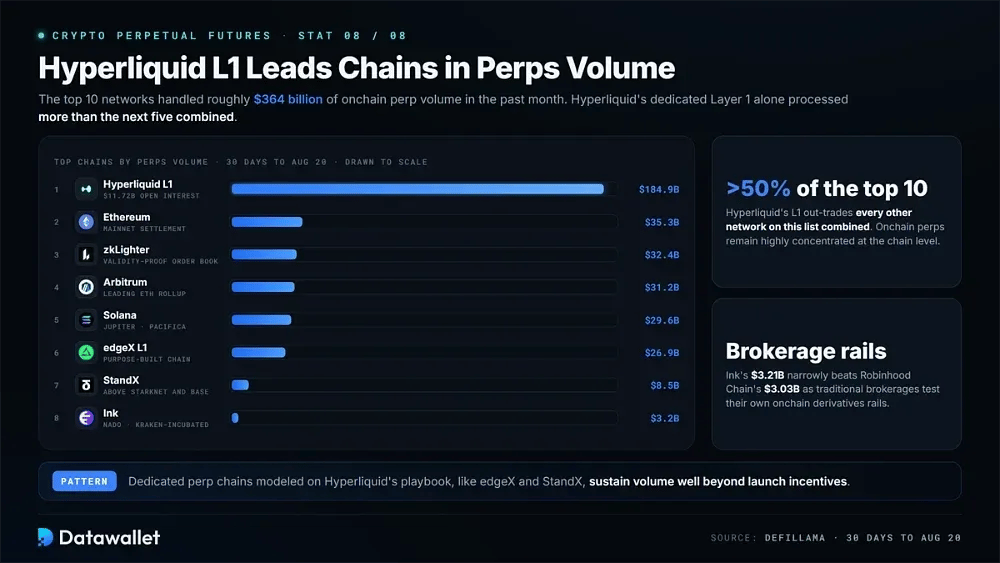
Onchain perpetual trading remains highly concentrated at the chain level. The top 10 networks handled roughly $364 billion in volume over the past month. Hyperliquid's dedicated Layer 1 alone processed more than the next five combined.
Top chains by perpetuals volume, 30 days to August 20:
- Hyperliquid L1: $184.92 billion in monthly perps volume plus $11.72 billion in open interest, giving it a larger onchain footprint than every other network on this list combined.
- Ethereum: $35.34 billion of perpetuals settled on mainnet. The figure shows that the oldest smart contract chain still supports meaningful leveraged trading despite higher costs than newer venues.
- zkLighter: $32.43 billion processed through Lighter's zero-knowledge order book, which settles matches with validity proofs while maintaining execution speeds suitable for demanding professional market makers.
- Arbitrum: $31.18 billion across its resident perp protocols, keeping the leading Ethereum rollup narrowly ahead of Solana for leveraged trading during this monthly window.
- Solana: $29.64 billion from venues such as Jupiter and Pacifica. The high-throughput chain therefore retains an active leveraged trading base beyond its memecoin spot markets.
- edgeX L1: $26.86 billion on the exchange's purpose-built chain, showing that dedicated perp networks modeled on Hyperliquid's playbook can sustain volume well beyond their launch incentives.
- StandX: $8.52 billion for the newer dedicated network, comfortably above Starknet's $6.71 billion and Base's $5.21 billion over the same trailing 30-day comparison window.
- Ink: $3.21 billion via Nado, the Kraken-incubated chain's flagship perp venue. That narrowly exceeded Robinhood Chain's $3.03 billion as traditional brokerages test their own onchain derivatives rails.
Data Source: DefiLlama, 30 days to August 20.
What Are Crypto Perpetual Futures?
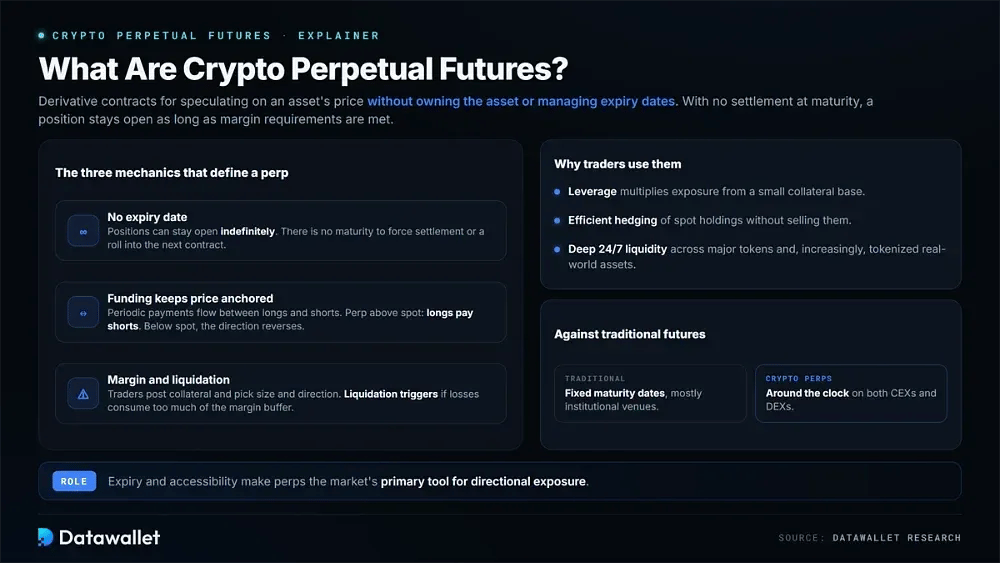
Crypto perpetual futures exchanges offer derivative contracts that allow traders to speculate on an underlying asset's price without owning the asset or managing expiry dates. Because there is no settlement at maturity, a position can remain open indefinitely as long as the trader continues meeting margin requirements.
To keep contracts anchored to spot prices, exchanges use a funding mechanism that periodically transfers payments between longs and shorts. When perpetuals trade above spot, longs generally pay shorts. If they fall below spot, the direction of payment typically reverses until the prices converge again.
Perps are popular for their leverage, efficient hedging, and deep round-the-clock liquidity across major tokens and, increasingly, tokenized real-world assets. Traders post collateral and choose their position size and direction. Liquidation occurs if losses consume too much of the margin buffer supporting the open position.
Expiry and accessibility are the main structural differences from traditional futures. Traditional contracts mature on fixed dates and are used mostly on institutional venues. Crypto perpetuals, by contrast, trade around the clock on centralized and decentralized exchanges, making them the market's primary tool for directional exposure.
How Crypto Perpetual Liquidations Work
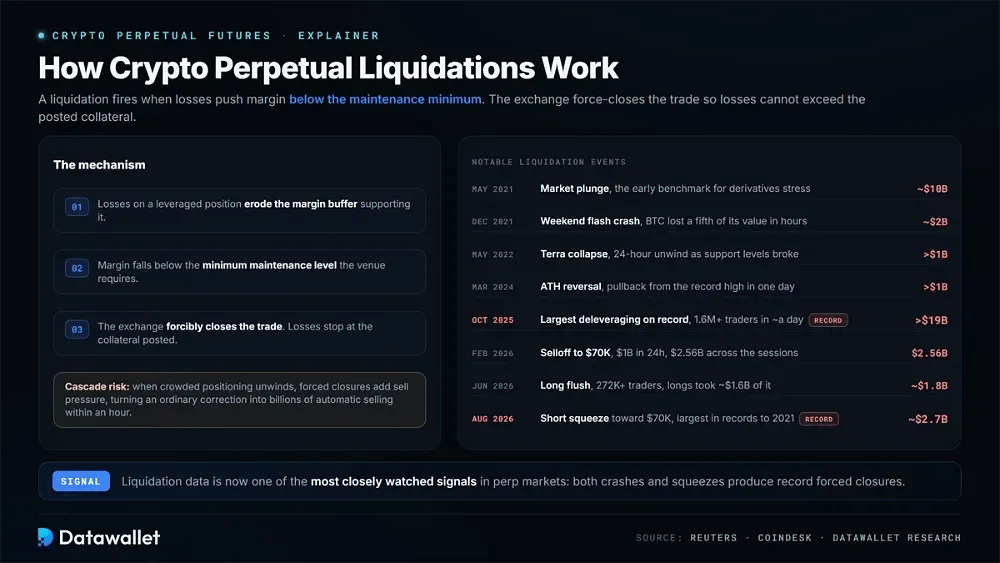
A crypto liquidation occurs when losses push a trader's margin below the minimum maintenance level required to keep a perpetual futures position open. At that point, the exchange forcibly closes the trade so losses cannot exceed the collateral originally posted.
This mechanism protects platforms and counterparties, but it can amplify volatility. If many leveraged traders are positioned in the same direction, forced closures create immediate market pressure. An ordinary correction can then cascade into billions of dollars of automatic selling within a single trading hour.
As a result, liquidation data has become one of the most closely watched signals in perpetual futures markets. It helps explain violent crypto moves during crowded trades, thin weekend liquidity, and broader macro shocks. Both crashes and short squeezes now regularly produce record forced closures.
Notable Crypto Liquidation Events
- May 2021 crash: Roughly $10 billion in leveraged crypto positions were liquidated during the market plunge. The event later became a benchmark for extreme derivatives-driven stress across the still-young perpetuals market.
- December 2021 flash crash: A sharp weekend Bitcoin selloff wiped out about $2 billion in positions as BTC briefly lost around a fifth of its value within a matter of hours.
- May 2022 Terra collapse: More than $1 billion in crypto futures positions were liquidated over 24 hours as the Terra ecosystem unraveled and major assets broke key technical support levels.
- March 2024 record-high reversal: Bitcoin's pullback after reaching a new all-time high triggered more than $1 billion in leveraged liquidations across digital assets in a single day.
- October 2025 liquidation shock: More than $19 billion in leveraged positions were liquidated in roughly a day, affecting over 1.6 million traders in the largest crypto deleveraging event on record.
- February selloff: Reuters reported about $1 billion in Bitcoin liquidations over 24 hours on February 5. Across the surrounding sessions, the total reached $2.56 billion as prices tested $70,000.
- June flush: Around $1.8 billion in leveraged trades were liquidated on June 2, affecting more than 272,000 traders. Long positions accounted for nearly $1.6 billion of the losses.
- August short squeeze: A rally toward $70,000 on August 20 wiped out nearly $2.7 billion in shorts within 24 hours, the largest forced short closure in records dating to 2021.
Crypto Perps Trading Key Terminology
A small set of recurring perp terms makes exchange dashboards easier to interpret and products easier to compare across centralized and decentralized venues. They are also central to managing trading risk.
How Funding Rates Keep Perps Anchored
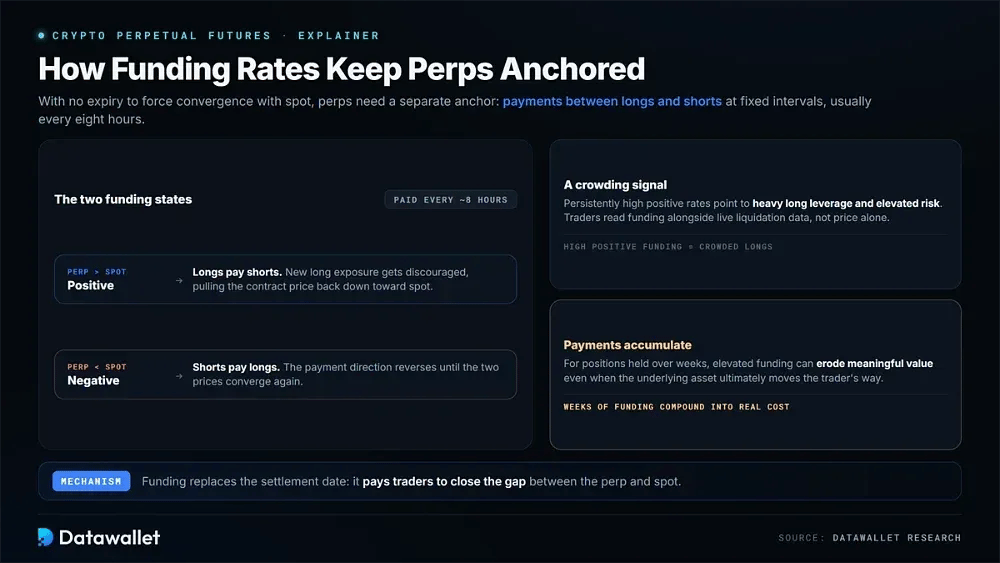
Because perpetual contracts have no expiry date to force convergence with spot, they need a separate price-anchoring mechanism. Funding rates provide it through payments between long and short holders at fixed intervals, usually every eight hours.
If a perpetual trades above spot, funding becomes positive. Longs pay shorts, discouraging additional long exposure and helping pull the contract price down. When the perpetual trades below spot, negative funding reverses the direction of those payments.
Funding also indicates how crowded positioning has become. Persistently high positive rates point to heavy long leverage and elevated risk. Traders therefore monitor funding alongside live liquidation data, rather than relying on price alone.
For positions held over longer periods, those payments accumulate. Weeks of elevated funding can erode meaningful value even when the underlying asset ultimately moves in the trader's favour.
Crypto Perpetual Regulations
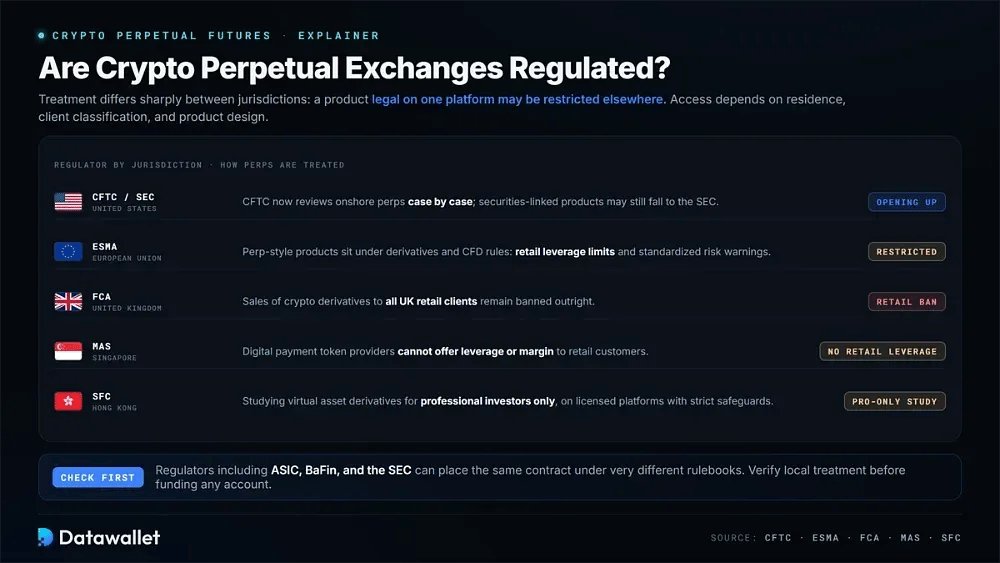
Perpetual futures regulation differs sharply between jurisdictions. A product available legally on one platform may be restricted elsewhere. In the United States, futures oversight rests with the CFTC, which now reviews onshore perpetuals case by case. Securities-linked products may still fall within the SEC's remit.
Across Europe and the UK, perpetual-style products often sit under existing derivatives or CFD rules rather than bespoke crypto-only frameworks. The ESMA framework imposes retail CFD leverage limits and standardized risk warnings. The FCA, meanwhile, continues to ban sales of crypto derivatives to all UK retail clients outright.
Rules across Asia are also fragmented. Singapore's MAS has prohibited digital payment token providers from offering leverage or margin to retail customers. Hong Kong's SFC is studying virtual asset derivatives for professional investors only, subject to strict licensed-platform safeguards and tighter conduct requirements.
For traders, access ultimately depends on residence, client classification, and product design. Regulators including ASIC, BaFin, and the SEC can place the same contract under very different rulebooks. Local treatment should therefore be checked before funding any trading account.
How the United States Opened Up to Perps
Within a single month, US access to perpetuals moved from prohibited to regulated, a shift The Block covered as it unfolded. The change helps explain the structural differences now separating onshore products from their offshore counterparts.
The CFTC Decision
Michael Selig, confirmed as CFTC Chairman in December 2025, signalled the change at the Milken Institute in March. He said US-listed perpetuals were coming within roughly a month. The Commission delivered on 29 May.
Approval was only part of the significance. For the first time, the CFTC classified perpetual contracts as futures rather than swaps. That placed them under designated contract market rules instead of a much heavier regulatory regime.
The Commission also issued a separate policy statement establishing case-by-case review for other asset classes, while staff guidance covered foreign-listed perpetuals and customer margin. Kalshi has since filed for perps on a US large cap equity index and copper.
By August, that regulatory direction had hardened. Trump hosted a White House crypto summit attended by Selig and SEC Chair Paul Atkins, along with executives from Coinbase, Ripple, Kraken, Nasdaq and CME. He pressed lawmakers to pass the CLARITY Act.
The following day, the CFTC convened its first Innovation Advisory Committee meeting, covering crypto assets, artificial intelligence and prediction markets. Selig had said in June that this type of onchain technology will transform markets and that regulators want to create a compliant path for it.
What Onshore Perps Cannot Match
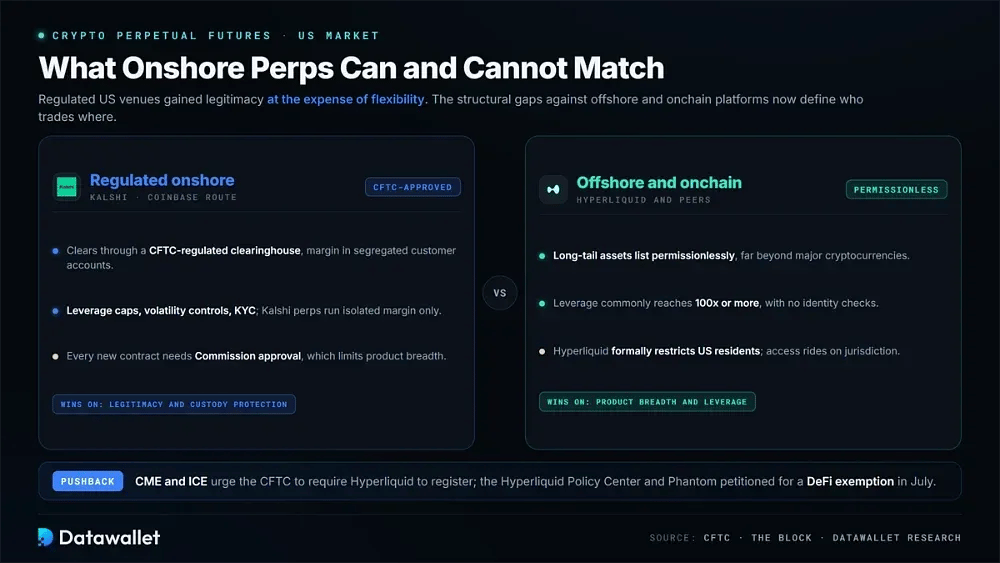
Regulated venues gain legitimacy at the expense of flexibility. Kalshi contracts clear through a CFTC-regulated clearinghouse, with margin held in segregated customer accounts. Every new contract also requires Commission approval before it can be listed.
That requirement limits product breadth. Offshore and onchain venues can list long-tail assets permissionlessly, leaving traders who want exposure beyond major cryptocurrencies looking to platforms such as Hyperliquid, which formally restricts US residents.
There is also a sharp leverage gap. Onshore contracts include volatility controls and identity verification, whereas offshore leverage commonly reaches 100x or more. Kalshi's perpetual products currently operate with isolated margin only.
Incumbent exchanges have pushed back. CME and ICE have urged the CFTC to require Hyperliquid to register, citing gaps in customer surveillance and manipulation risk involving oil contracts. In July, the Hyperliquid Policy Center and Phantom petitioned for a DeFi exemption.
Perp DEXs Against Perp CEXs
The difference between centralised and onchain perpetual venues now extends beyond market size. They attract different types of traders and carry different forms of risk, a split reflected in DefiLlama's derivatives data.
Where Each Model Wins
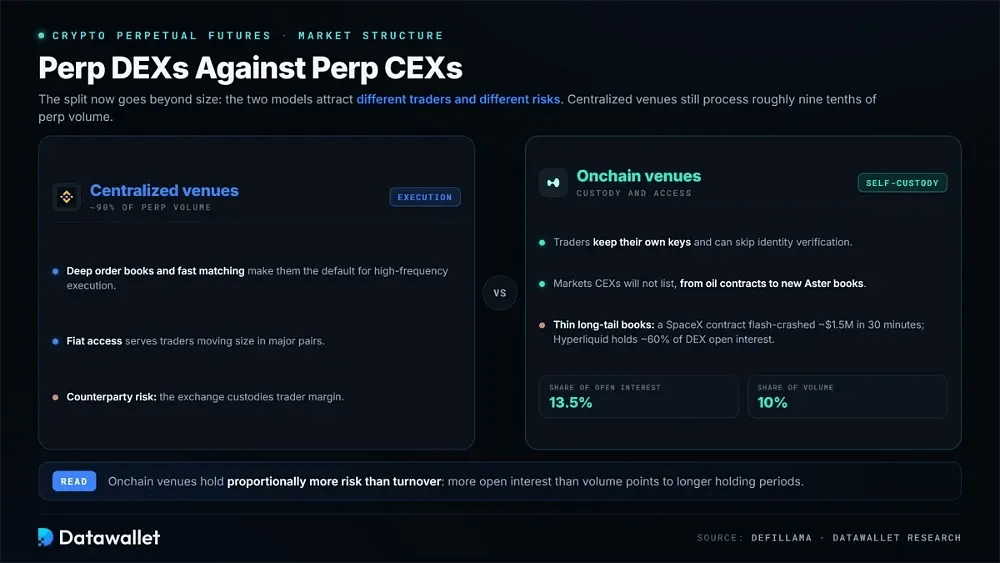
Centralised exchanges still process roughly nine tenths of perpetual volume. Their deep order books and fast matching make them the default for high-frequency execution, while fiat access serves traders moving size in major pairs.
Onchain venues compete through custody and access instead. Traders retain their own keys and can skip identity verification. They also gain access to markets centralised exchanges will not list, including oil contracts and newer books available on Aster.
Open interest shows the clearest difference between the two models. Onchain venues account for 13.5% of open positions but only 10% of volume. Holding proportionally more risk than turnover suggests points to longer holding periods.
The Risks Onchain Venues Carry
Long-tail contracts can become dangerous when liquidity is thin. In one example, a flash crash in Hyperliquid's SpaceX valuation contract erased roughly $1.5 million in notional value within thirty minutes after an outsized position encountered an empty book.
Permissionless listing creates a related trade-off. The same frameworks that allow anyone to create a market can produce contracts with almost no depth. In those conditions, one trade may move the price far beyond what the underlying valuation would justify.
There is also substantial concentration within the segment. Hyperliquid alone holds close to 60% of perp DEX open interest, leaving the market heavily dependent on a single protocol operating without incident, as our Hyperliquid statistics page tracks.
Risks of Trading Perpetual Futures
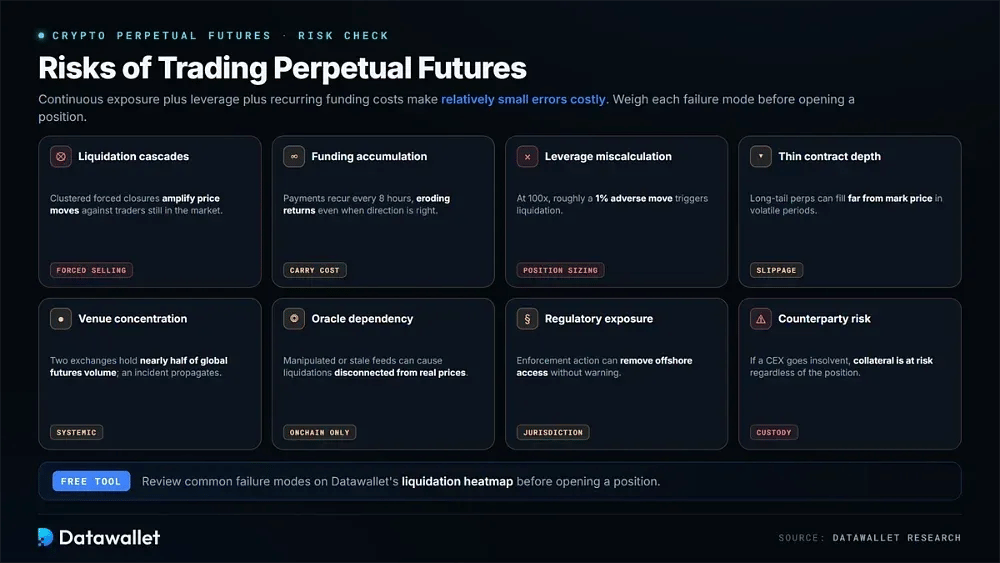
Perpetuals combine continuous exposure with leverage and recurring funding costs, making relatively small errors costly. Before opening a position, traders can review common failure modes on a liquidation heatmap at no cost.
Weigh each of these risks before trading perpetual contracts:
- Liquidation cascades: Positions using leverage close automatically when margin becomes insufficient. When liquidations cluster, they can amplify price moves against traders still in the market.
- Funding accumulation: Funding payments recur every eight hours, eroding returns over extended holding periods even when the trader gets the eventual price direction right.
- Leverage miscalculation: Higher multiples reduce the adverse move required to wipe out a position. At 100x leverage, roughly a 1% move against the trader triggers liquidation.
- Thin contract depth: During volatile periods, long-tail perpetuals can fill far from the mark price, producing materially worse executions than modelled entries.
- Venue concentration: Two exchanges account for nearly half of global futures volume, so an incident at either can propagate across the market.
- Oracle dependency: Onchain perpetuals rely on oracle feeds for pricing. Manipulated or stale data can therefore cause liquidations disconnected from real market prices.
- Regulatory exposure: Offshore platforms apply jurisdictional restrictions, and enforcement action can remove access without warning.
- Counterparty risk: Centralised exchanges custody trader margin. If an exchange becomes insolvent, collateral remains at risk regardless of the position's performance.
Final Thoughts
Perpetual futures occupy the centre of crypto market structure. Trading volume runs several times higher than spot, derivatives increasingly lead price discovery, and perpetual contracts have expanded beyond cryptocurrency into commodities and equities.
Two structural changes defined the past year. Centralised trading volume fell sharply even as onchain venues captured more held risk. At the same time, American regulators moved perpetuals from prohibited to approved within a matter of weeks.
Headline figures still require caution. Reported volume varies widely according to which venues each source includes, while wash trading can inflate activity. Comparing inverse and linear contract venues by open interest therefore provides a more honest picture.
Our Methodology
These statistics were compiled from primary market data rather than aggregated summaries. Sources include CoinGecko Research, Coinglass, The Block, DefiLlama and CFTC filings, with figures cross-checked wherever sources disagreed.
Five principles shaped what appears here:
- Primary sourcing: Every figure can be traced to an exchange dashboard, research report or regulatory filing rather than secondary reporting.
- Scope disclosure: Because volume totals change with venue coverage, the publisher is named alongside each figure.
- Open interest weighting: We consider open interest more reliable than volume because wash trading distorts turnover more easily than held positions.
- Regulatory verification: Details on US perpetuals are based on CFTC orders and press releases rather than exchange marketing materials.
- Date anchoring: Each figure uses the measurement period stated by its source because perpetual market data can change substantially from week to week.
Derivatives data changes quickly as volatility moves and venues gain or lose market share. Verify current figures on live dashboards before acting on anything here.