




Top 8 Hyperliquid Statistics and Trends
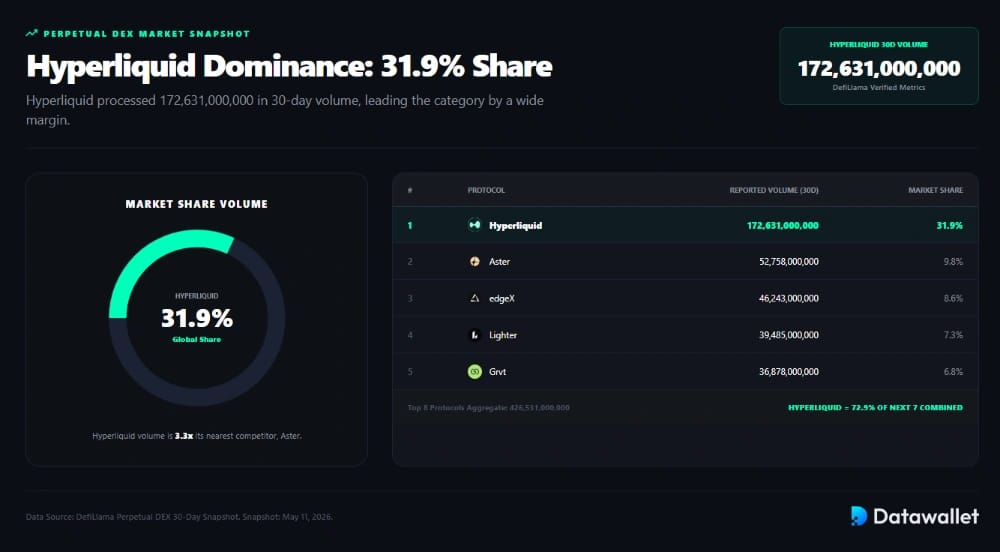
1. Hyperliquid Holds 31.9% of Perp DEX Volume
Hyperliquid processed $172.631 billion of $540.842 billion in 30-day perpetual DEX volume, making it the clear category leader in DefiLlama’s latest perps snapshot.
Key market-share signals from the latest 30-day snapshot:
- Market share: Its $172.631 billion volume equals 31.9% of total tracked perp DEX activity, based on the $540.842 billion 30-day market across listed exchanges.
- Lead over Aster: Hyperliquid’s 30-day volume was 3.3 times Aster’s $52.758 billion, giving it a $119.873 billion advantage over the second-largest perp DEX.
- Top-three comparison: Hyperliquid exceeded Aster and ApeX Protocol combined, with its $172.631 billion topping their aggregate $87.775 billion by $84.856 billion.
- Competitive gap: The next seven listed perp DEXs generated $236.899 billion combined, meaning Hyperliquid alone produced 72.9% of their collective 30-day volume.
2. Hyperliquid Peaked Near $400B Monthly Perp Volume
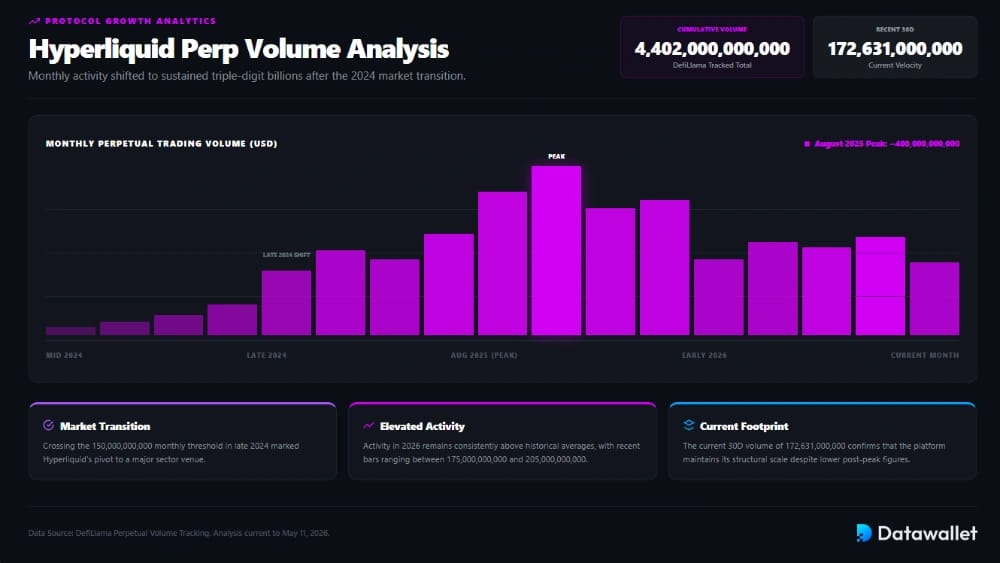
Hyperliquid’s monthly perp volume moved from relatively small bars in 2023 and early 2024 to sustained triple-digit billions by late 2024. The chart shows volume crossing roughly $150 billion in late 2024, marking the point where Hyperliquid became the most popular perp DEX.
Momentum accelerated through 2025, with monthly volume staying mostly above $170 billion and peaking near $400 billion around August. DefiLlama currently tracks $4.402 trillion in cumulative Hyperliquid perp volume, confirming that the platform’s growth was not limited to one isolated spike.
The 2026 trend shows cooling from the 2025 peak but still elevated activity, with recent monthly bars around the $175 billion to $205 billion range before the latest partial month. DefiLlama’s current 30-day figure of $172.631 billion suggests Hyperliquid remains structurally large despite lower post-peak volume.
3. Hyperliquid Generated $56.92M in 30-Day Fees
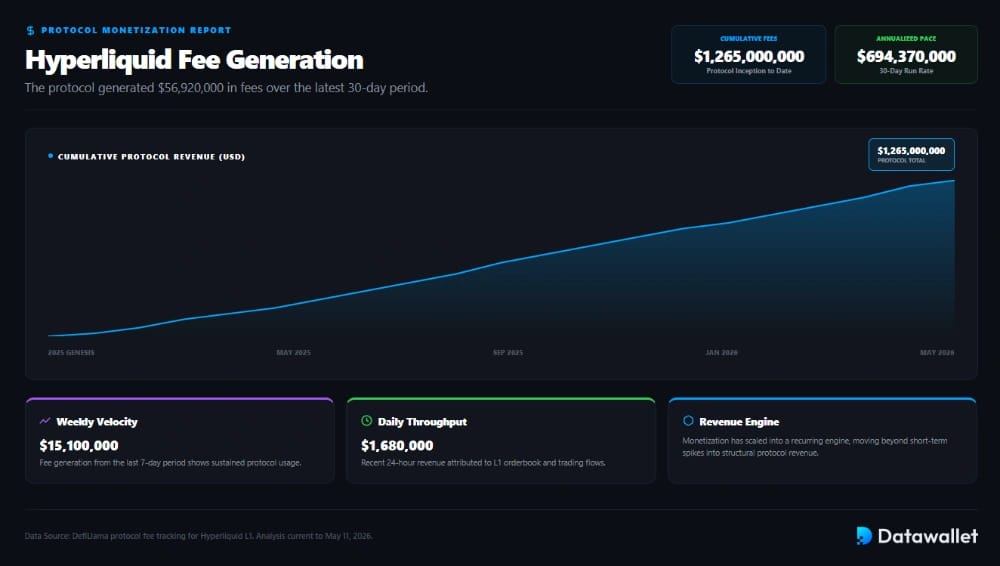
Hyperliquid generated $56.92 million in fees over the latest 30-day period, with DefiLlama annualizing that pace at $694.37 million. Its cumulative fees now stand at $1.265 billion, showing that fee generation has scaled beyond short-term trading spikes into a recurring protocol-level revenue engine.
DefiLlama also reports $15.1 million in 7-day fees and $1.68 million in 24-hour fees for Hyperliquid, all attributed to Hyperliquid L1. That places recent daily activity below its annualized average pace, but still indicates strong monetization from perps, spot orderbook activity, and related trading flows.
4. Hyperliquid Added 609K Users During 2025
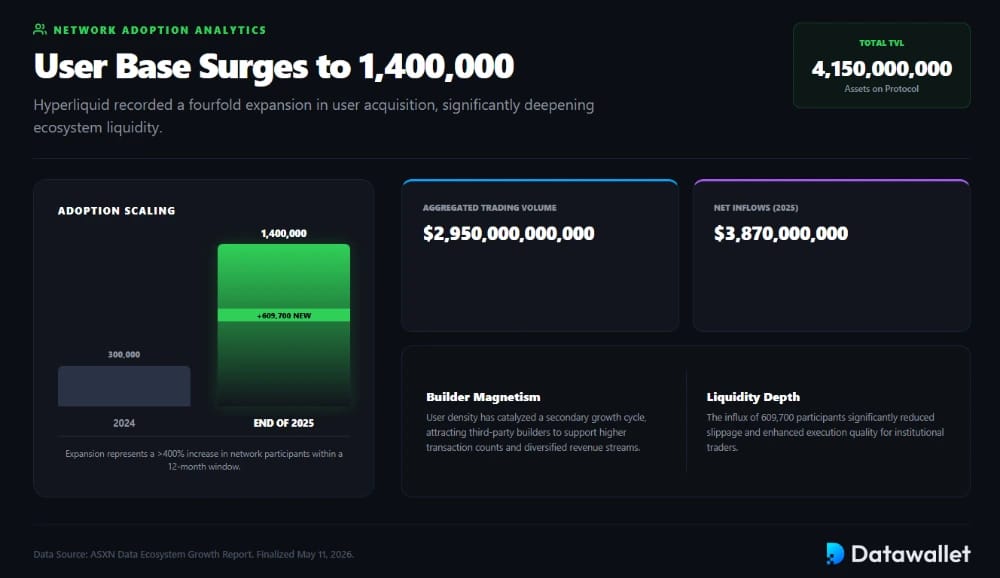
Hyperliquid reached 1.4 million total users after adding about 609,700 new users in 2025, making user acquisition one of its strongest growth metrics. ASXN Data also linked that expansion to $2.95 trillion in trading volume, $3.87 billion in net inflows, and $4.15 billion in TVL.
The growth curve was especially sharp versus 2024, when Hyperliquid reportedly had roughly 300,000 users, implying more than a fourfold increase by the end of 2025. That user expansion helped deepen liquidity, attract builders, and support higher transaction, revenue, and trading-volume activity across the Hyperliquid ecosystem.
5. Hyperliquid Open Interest Stands at $9.17B
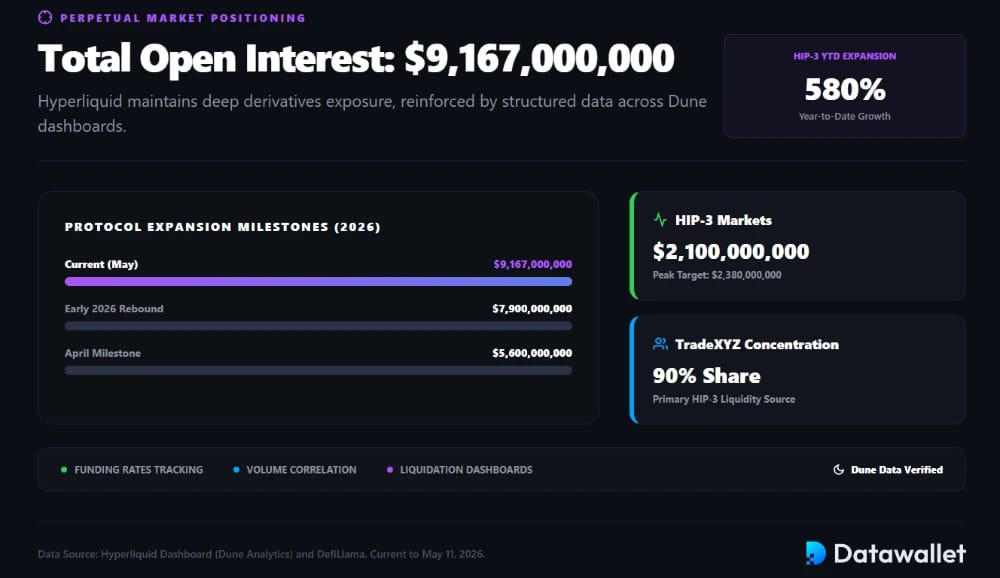
Hyperliquid’s open interest reached $9.167 billion, showing deep outstanding perp positioning alongside its high-volume trading profile and expanding Dune-tracked market data coverage.
Key open-interest signals from Dune and market dashboards:
- Total OI: Hyperliquid’s $9.167 billion open interest shows substantial live derivatives exposure, reinforcing its role as a major platform for active perp positioning.
- Market-data coverage: Dune’s Hyperliquid dataset includes historical trading data, open interest, funding rates, and volume, giving analysts structured access to perp-market positioning trends.
- Dashboard tracking: Dune dashboards monitor Hyperliquid open interest across time, helping traders compare positioning intensity with volume, revenue, liquidations, and market-share changes.
- HIP-3 growth: Dune reported HIP-3 open interest rising from roughly $280 million early in 2026 to $2.1 billion, up about 580% year-to-date.
- HIP-3 peak: HIP-3 markets hit a record $2.38 billion in open interest before easing to $2.1 billion after a 12% pullback.
- April milestone: Another Dune-based snapshot showed Hyperliquid open interest crossing $5.6 billion in April 2026, highlighting rapid expansion before later reaching $9.167 billion.
- Broader rebound: Public Dune-cited reporting placed Hyperliquid open interest near $7.9 billion in early 2026, before the latest DefiLlama reading moved higher.
- Protocol concentration: TradeXYZ reportedly accounted for over 90% of HIP-3 open interest, showing that new Hyperliquid market growth remains heavily concentrated.
6. HIP-3 OI Surged 100x to $1.43B
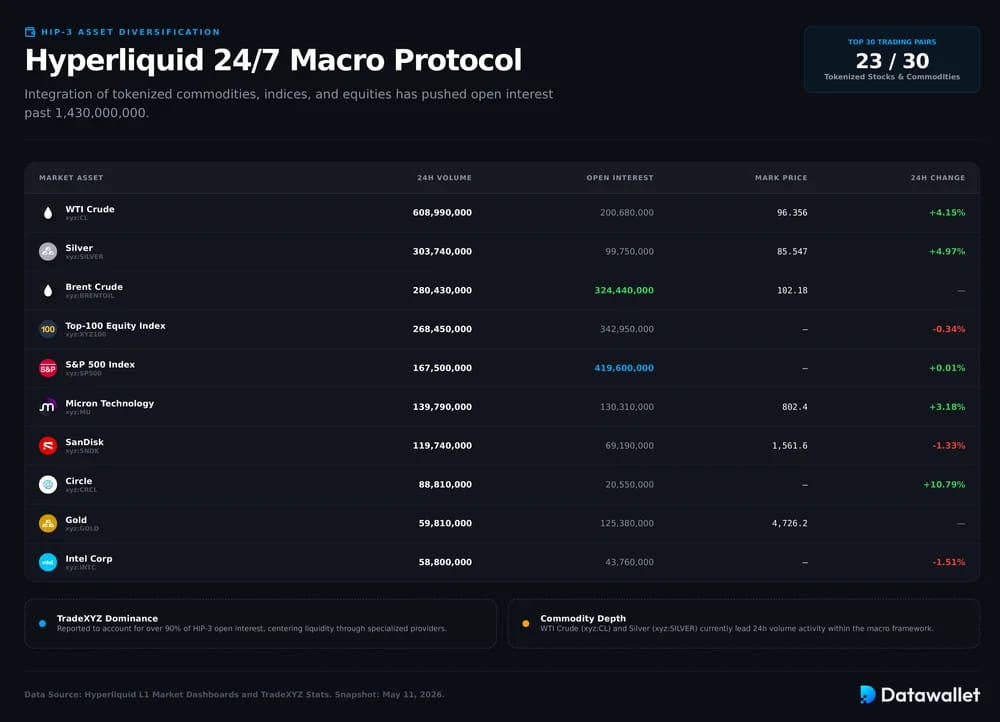
HIP-3 turned Hyperliquid into a 24/7 macro protocol, with open interest climbing past $1.43 billion only months after launch, driven by tokenized commodities, indices, and equities. TradeXYZ reportedly represented most HIP-3 open interest, while tokenized stocks and commodities made up 23 of Hyperliquid’s top 30 trading pairs.
Top 10 HIP-3 markets by 24-hour volume:
- xyz:CL: WTI crude led activity with $608.99 million in 24-hour volume, $200.68 million open interest, a $96.356 mark price, and +4.15% daily move.
- xyz:SILVER: Silver ranked second with $303.74 million in daily volume, $99.75 million open interest, a $85.547 mark price, and +4.97% daily gain.
- xyz:BRENTOIL: Brent crude showed the deepest OI among oil markets at $324.44 million, alongside $280.43 million volume and a $102.18 mark price.
- xyz:XYZ100: The top-100 equity index market held $342.95 million open interest, traded $268.45 million in 24 hours, and slipped -0.34%.
- xyz:SP500: The S&P 500 market had the largest listed OI at $419.6 million, with $167.50 million volume and a nearly flat +0.01% daily move.
- xyz:MU: Micron posted $139.79 million in 24-hour volume, $130.31 million open interest, a $802.4 mark price, and a strong +3.18% daily gain.
- xyz:SNDK: SanDisk traded $119.74 million over 24 hours, with $69.19 million open interest, a $1,561.6 mark price, and -1.33% daily performance.
- xyz:CRCL: Circle was the biggest mover in this group, rising +10.79% while posting $88.81 million volume and $20.55 million open interest.
- xyz:GOLD: Gold remained a major commodity market with $125.38 million open interest, $59.81 million daily volume, and a $4,726.2 mark price.
- xyz:INTC: Intel rounded out the top 10 with $58.80 million in volume, $43.76 million open interest, and a -1.51% daily move.
7. Hyperliquid Kept 89% of Q1 Revenue as Profit
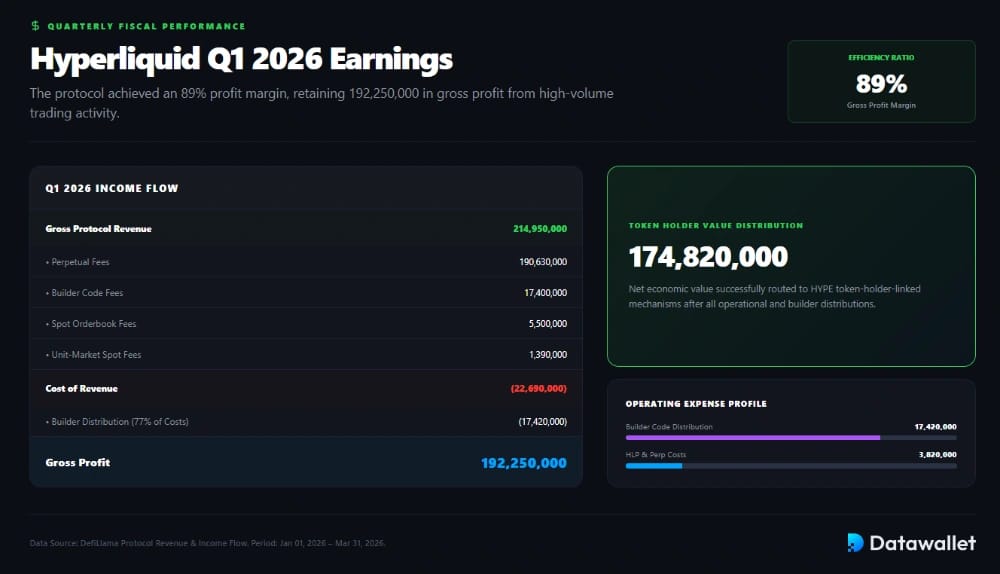
DefiLlama’s Q1 2026 income-flow view shows Hyperliquid generating $214.95 million in gross protocol revenue, led by $190.63 million from perp fees. Builder code fees added $17.4 million, while spot fees contributed $5.5 million and Unit-market spot fees added another $1.39 million.
After $22.69 million in cost of revenue, Hyperliquid retained $192.25 million in gross profit, equal to 89% of gross protocol revenue. The largest expense was $17.42 million in builder code distribution costs, followed by $1.88 million in perp fee costs and $1.94 million in HLP costs.
DefiLlama’s flow also classifies the full $192.25 million as earnings, then routes $174.82 million to token-holder value distribution after builder-code distribution. That means roughly 77% of costs came from builder code distribution, while most economic value still flowed back to HYPE token-holder-linked mechanisms.
8. HIP-4 Launched With BTC Prediction Markets
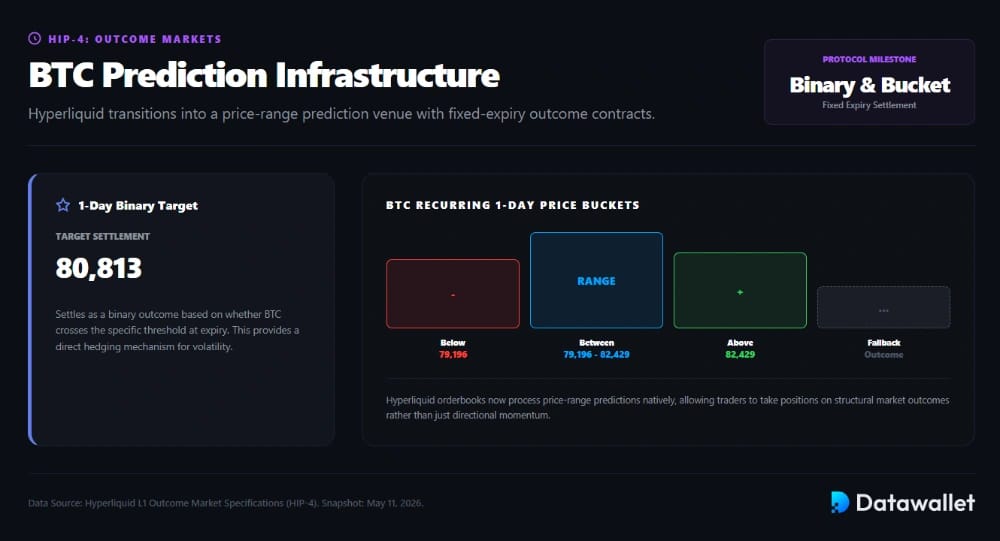
HIP-4 added outcome markets to Hyperliquid, starting with BTC-based prediction contracts that settle at fixed expiries. The first live screen shows two markets: a 1-day binary BTC target at $80,813 and a recurring 1-day BTC price-bucket market.
The BTC recurring market splits expiry into four outcomes: below $79,196, between $79,196 and $82,429, above $82,429, plus a fallback outcome. That turns Hyperliquid’s orderbook into a price-range prediction venue, rather than only a perp and spot trading platform.
HYPE Token Statistics
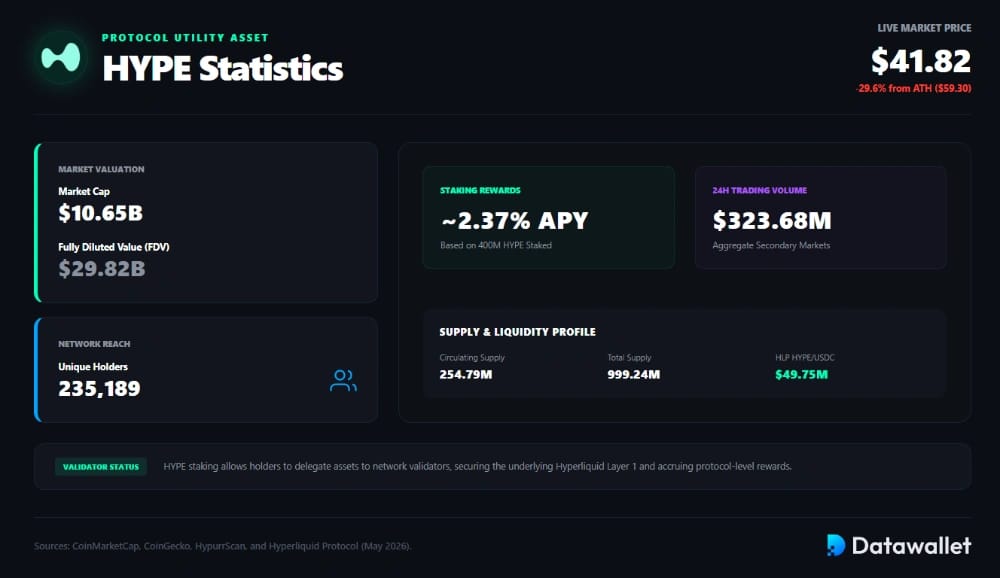
HYPE has become one of crypto’s largest protocol tokens, combining a top-tier market cap, rising holder base, active staking, and deep secondary-market liquidity.
Key HYPE token metrics to know:
- Market cap: HYPE trades around a $10.65 billion market cap on CoinMarketCap, with about 254.79 million circulating tokens and a $41.82 live price.
- Holders: HypurrScan shows 235,189 HYPE holders, alongside a $29.82 billion token-level market cap and 999.24 million total supply on its tracker.
- Staking: Hyperliquid staking lets holders delegate HYPE to validators for rewards; documentation models roughly 2.37% yearly rewards at 400 million HYPE staked.
- Historical high: CoinGecko lists HYPE’s all-time high at $59.30, with the token trading about 29.6% below that peak in its latest snapshot.
- Trading volume: HYPE recorded $323.68 million in 24-hour trading volume on CoinGecko, with Hyperliquid’s HYPE/USDC pair contributing nearly $49.75 million.
Is Hyperliquid Safe?
Hyperliquid is generally viewed as a serious derivatives venue, but “safe” depends on the risk measured. Its official bridge docs say deposits and withdrawals require signatures from more than two-thirds of staking power, while Zellic has published bridge security findings.
The platform also uses protocol-level controls around margining, liquidations, vaults, and validator consensus, but it is not risk-free. A OneKey security review separates Hyperliquid’s main risks into bridge, validator, execution, custody, oracle, liquidation, and user-key-management exposure.
Historically, the largest red flags were market-manipulation events rather than confirmed bridge hacks. In March 2025, CoinDesk reported that Hyperliquid delisted JELLYJELLY after its HLP vault was squeezed by roughly $13.5 million during suspicious trading activity.
There were also concerns around North Korea-linked wallets in late 2024, which Hyperliquid denied was a hack, while Bloomberg reported wallet activity and outflow concerns. Later, CoinDesk reported a POPCAT manipulation loss near $4.9 million.
How is Hyperliquid Regulated?
Hyperliquid is not regulated like a centralized broker or futures exchange. It operates as a decentralized, self-custodial derivatives protocol, and its Terms of Use place responsibility on users to follow local laws, avoid restricted jurisdictions, and understand whether trading perps is legal where they live.
Its interface restricts access for U.S. persons, Ontario residents, sanctioned jurisdictions, and other “Restricted Persons,” according to Hyperliquid’s terms. That means regulation is mainly handled through geofencing, user eligibility rules, and self-custody, rather than traditional licensing, account approval, or exchange-style KYC onboarding.
What's Next For Hyperliquid?
Hyperliquid’s next phase is about expanding beyond perps into builder-led markets, prediction contracts, HyperEVM apps, and broader token-driven infrastructure demand.
Key developments shaping Hyperliquid’s next chapter:
- HIP-3 expansion: HIP-3 lets builders launch perp markets by staking 500,000 HYPE, pushing Hyperliquid toward permissionless listings and more asset coverage.
- Tokenized markets: Trade.xyz has already used HIP-3 to scale tokenized stocks and commodities, with HIP-3 open interest surpassing $1.43 billion.
- HIP-4 prediction markets: HIP-4 adds fully collateralized outcome contracts, giving Hyperliquid native prediction markets and options-style products without leverage or liquidation risk.
- HyperEVM growth: HyperEVM turns Hyperliquid from an exchange into a programmable financial layer, allowing smart contracts to interact with HyperCore liquidity and trading primitives.
- Builder distribution: Builder Codes open third-party frontends and integrations, helping platforms route users into Hyperliquid while sharing fees across builders and the ecosystem.
- HYPE utility: HYPE demand should increasingly depend on staking, market deployment, validator participation, fee flows, and whether new HIP-3 and HIP-4 markets keep scaling.
Final Thoughts
Hyperliquid’s 2026 statistics show a protocol that has moved beyond early DEX growth, with $172.63 billion in 30-day perp volume and $9.17 billion open interest.
The bigger story is expansion: HIP-3 markets pushed open interest above $1.43 billion, while HIP-4 adds outcome markets that broaden Hyperliquid beyond standard spot and perpetuals.
Still, Hyperliquid’s momentum comes with risks, from regulation and validator assumptions to market manipulation and liquidation design. Its next stage depends on whether growth continues without compromising trust, liquidity, or user safety.
Our Methodology
This article combines live protocol dashboards, market-share trackers, token data platforms, Dune analytics, ASXN ecosystem dashboards, official Hyperliquid documentation, security reporting, and regulatory materials to evaluate Hyperliquid’s 2026 growth.
How The Data Was Compiled:
- DefiLlama dashboards: Used for Hyperliquid perp volume, fees, revenue, TVL, open interest, chain activity, financial breakdowns, and market-share comparisons across perpetual DEXs.
- Dune dashboards: Used for Hyperliquid open interest, HIP-3 market activity, market-type splits, historical trading data, and ecosystem-level analytics from public SQL dashboards.
- ASXN dashboards: Used for Hyperliquid user statistics, ecosystem activity, HIP-3 market rankings, trading volume, open interest, and market-level breakdowns.
- Token trackers: Used CoinGecko, CoinMarketCap, and HypurrScan for HYPE market cap, token price, trading volume, holder counts, supply figures, and historical price highs.
- Official materials: Reviewed Hyperliquid documentation, HIP-3 and HIP-4 proposal pages, bridge documentation, staking materials, and terms of use to verify protocol mechanics and user restrictions.
- Security reporting: Reviewed news coverage and public incident reporting on JELLYJELLY, POPCAT, bridge concerns, market manipulation, liquidation events, and broader safety debates.
- Regulatory research: Reviewed Hyperliquid’s terms, restricted-jurisdiction language, self-custody model, and derivatives-access limitations to explain how regulation applies differently from centralized exchanges.
- Snapshot caveat: Many figures come from live dashboards, so values can change as market prices move, traders rotate capital, HIP markets expand, and protocol revenue updates.