Compare the Top Tokenized Stock Platforms
1. Kraken
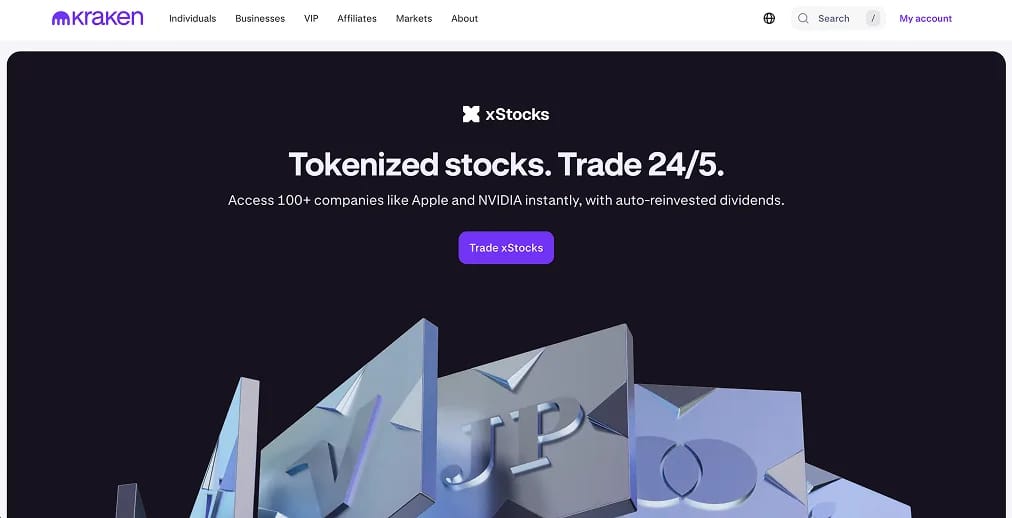
Kraken takes the top spot because it controls the supply chain. Late in 2025 it acquired Backed Finance, so the tokens, the custody structure, and the trading venue all sit under one roof. The catalog shows it: xStocks has grown from 60 names at launch to 100 tokenized US stocks and ETFs, with a target of more than 500 by the end of 2026.
The edge is what happens after you buy. Each xStock is backed one to one by the underlying share, held by a licensed custodian in a bankruptcy-remote structure, and you can withdraw it to a self-custody wallet on Solana or Ethereum, then use it as collateral or in lending, which no brokerage can match. Our test withdrawal to a Solana wallet landed in seconds.
Liquidity is the other draw. xStocks has cleared $25 billion in volume across centralized and decentralized venues since June 2025, with over $3.5 billion onchain and more than 80,000 holders. The same tokens trade on Bybit, Gate, KuCoin, and wallets like Phantom, and recently listed on Deutsche Börse's 360X regulated venue. Our best Solana wallets guide covers where to store them.
Pros
- Owns the xStocks issuer, giving it the widest catalog and a clear path to 500+ names.
- Tokens are 1:1 backed and can be withdrawn to self-custody for DeFi use.
- Deepest liquidity in the category, spread across many venues and now a regulated European exchange.
Cons
- Not available to US residents.
- Token holders get economic exposure, not shareholder voting rights.
- Instant Buy carries a wider spread than trading on the Pro interface.
2. Ondo Global Markets
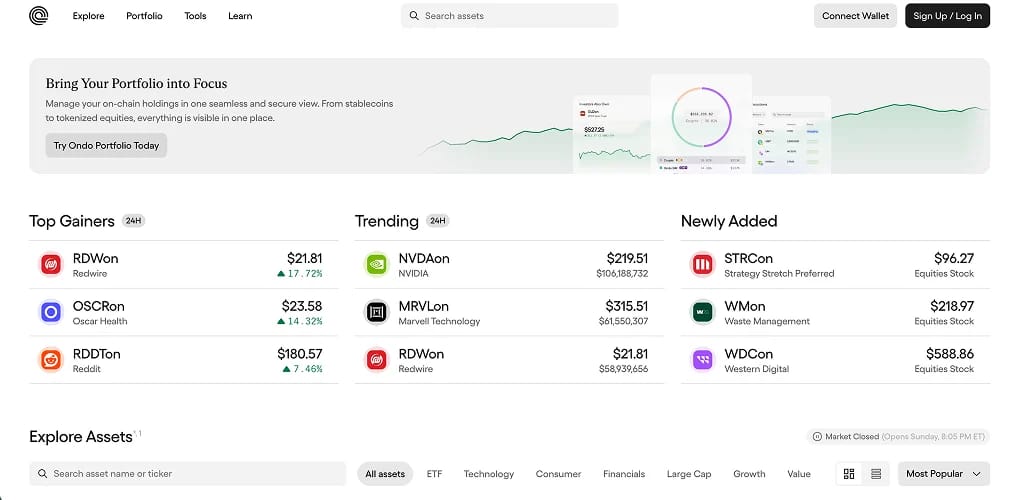
Ondo Global Markets is the platform xStocks watches most closely. Launched in September 2025, it became the first tokenized stock platform to cross $1 billion in total value locked, in May 2026, with cumulative volume past $18 billion and more than 70% issuer market share by value locked, per RWA.xyz. The two leaders just measure different things: xStocks leads on transaction volume and holders, Ondo on assets parked onchain.
Its edge is reach. Ondo lists more than 260 tokenized US stocks and ETFs across Solana, Ethereum, and BNB Chain, with the shares held by Alpaca Securities, a US-registered broker-dealer. Instead of running its own front end, it distributes through partners, so you trade via Binance, Bitget, MetaMask, Blockchain.com, and DEXs like Jupiter and PancakeSwap. We bought a tokenized ETF on a Solana DEX and the price tracked the reference closely in market hours, with Chainlink feeds underneath. Our Ondo Finance explainer covers the issuer.
The newest piece is leverage. Ondo Perps went live on 9 June 2026, letting non-US users trade tokenized stock and ETF perpetuals with up to 20x, moving Ondo from issuance into active trading. Two limits: the tokens are an SPV claim, not direct ownership, and trading runs on a 24/5 window, Sunday to Friday evening US Eastern, though transfers stay open around the clock.
Pros
- Largest tokenized equity platform by value locked, with 260+ assets across three chains.
- Distributed through major exchanges, wallets, and DEXs rather than locked to one venue.
- Now offers leveraged exposure through Ondo Perps for non-US traders.
Cons
- No single polished app, since access depends on third-party venues.
- Tokens represent a contractual SPV claim, not the share itself.
- Closed to US users, and trading pauses on the 24/5 schedule.
3. Bybit
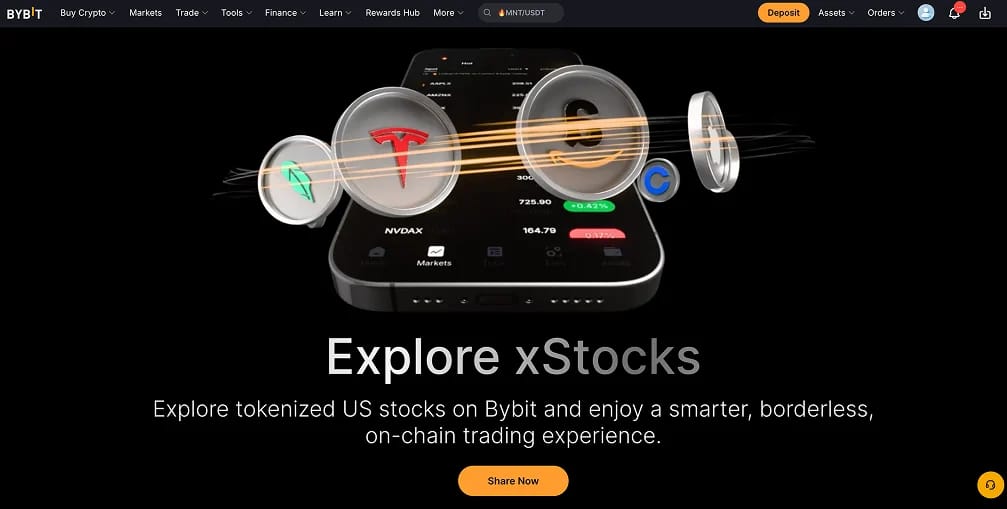
Bybit suits traders who want tokenized stocks next to their crypto in one terminal. The world's second-largest exchange by volume, with over 80 million users, it lists more than 100 xStocks on Bybit Spot against USDT, the same Backed-issued tokens found on Kraken, structured as fully collateralized tracker certificates under a MiFID II prospectus rather than derivatives.
The appeal is the single balance. We moved between a Bitcoin position and a tokenized Nvidia buy in one account, settling in USDT, and the order book felt as responsive as Bybit's crypto pairs. Because the assets are xStocks, they transfer onchain, so you are not locked into the exchange like a CFD. Our Bybit review covers how it handles spot and derivatives.
The constraints are geographic. Bybit does not serve the US, and it is rebuilding UK access through FCA-regulated Archax. Spot fees sit near 0.1% before volume discounts, fine for active trading but worth weighing against a zero-commission broker if you are buying to hold.
Pros
- Trades the same 1:1 backed xStocks, transferable to self-custody.
- Unified USDT balance covers both crypto and tokenized equity positions.
- Deep spot liquidity and a fast interface suited to active trading.
Cons
- Closed to US residents, with UK access still being rebuilt.
- USDT-only pairs mean you carry stablecoin exposure.
- Less suited to buy-and-hold investors than a commission-free broker.
4. Gemini
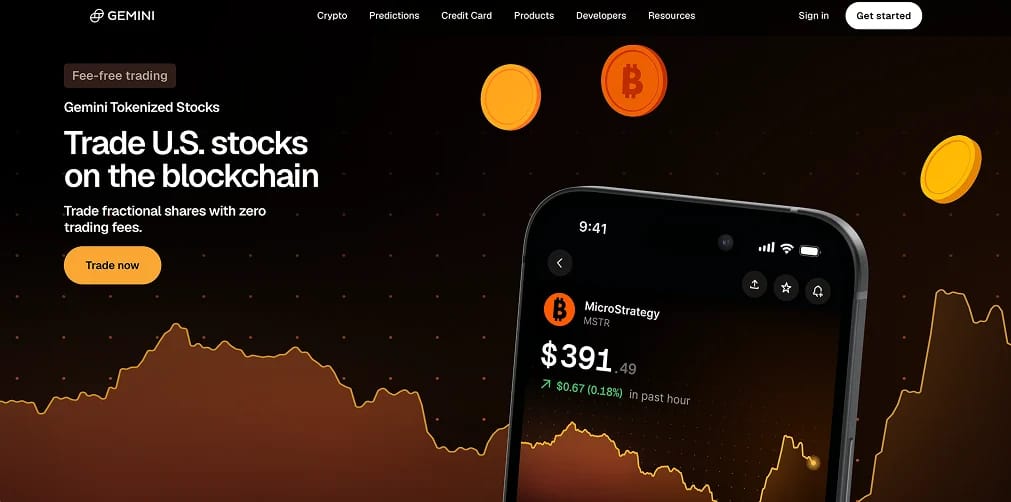
Gemini takes the regulated-EU slot through Dinari, a US securities firm whose tokenized shares, called dShares, pass through the same economic rights as the backing security where permitted, a stronger claim than most tracker tokens make. Gemini launched in the EU with Strategy, formerly MicroStrategy, on Arbitrum, and has added names since.
Gemini's case rests on compliance and its status as a public company: it safeguards roughly $8 billion in customer assets and trades on the NASDAQ, a transparency offshore venues lack. For an EU user who wants tokenized equities inside a regulated, audited exchange rather than a DeFi-first setup, that matters. The trade-off is range. Dinari's onchain footprint is still small, a few million dollars across its dShares, so the catalog runs narrower than xStocks or Ondo and a given name may not be listed. Confirm access through our Gemini restricted countries guide.
Pros
- Regulated, NASDAQ-listed operator with a strong custody and audit record.
- Dinari dShares pass through economic rights of the backing security where permitted.
- Clean integration that keeps crypto and tokenized stocks in one app.
Cons
- Catalog is smaller and still expanding versus the market leaders.
- Availability centers on the EU.
- Less DeFi composability than Solana-based xStocks.
5. Robinhood
Robinhood took tokenized stocks mainstream, switching on more than 200 US stock and ETF tokens for EU and EEA users at a Cannes event in mid-2025, the broadest catalog of any issuer. The tokens live in the Robinhood Crypto app on Arbitrum, with a dedicated Layer 2, Robinhood Chain, on the Arbitrum Orbit stack set to take over settlement once it ships. Each token is a wrapper claim on a share held by a US broker-dealer, trading commission-free on a 24/5 schedule.
For anyone already on Robinhood, the experience is the smoothest here, and zero commissions remove the fee anxiety beginners fixate on, though FX and spread costs apply. The headline feature is the controversial one: separate tokens for private companies like OpenAI and SpaceX. Those are not equity. They are derivative exposure to a special-purpose vehicle holding private shares, which drew a public rebuke from OpenAI, which said it did not authorize or endorse the tokens, and a review by the Bank of Lithuania, Robinhood's lead EU regulator.
The limits matter. Tokens cannot yet be withdrawn to an external wallet the way xStocks can, so you hold them inside Robinhood, and access is restricted to EU and EEA residents. Treat the private-company tokens as high-risk synthetic exposure, not a stake in the business.
Pros
- Familiar, commission-free app with 200+ stock and ETF tokens for EU users.
- Unusual access to private-company exposure like OpenAI and SpaceX.
- Dedicated Layer 2 in development to support self-custody and 24/7 trading.
Cons
- Tokens cannot yet be withdrawn to a private wallet.
- Private-company tokens are SPV derivatives, not equity, and face regulatory scrutiny.
- Available only to EU and EEA residents, on a 24/5 schedule.
6. Coinbase
Coinbase makes the list for where it is heading, not what we could test. It announced its tokenized equities push in December 2025 under its "Everything Exchange" strategy, with settlement planned on Base, its Ethereum Layer 2. We could not trade the product because it is not live, and the reason is regulatory.
Coinbase has pushed hardest for a US framework, seeking SEC approval to offer tokenized equities and arguing third-party tokenization should not require issuer consent. The SEC under Chair Paul Atkins previewed an innovation exemption for late May 2026, then shelved it after Nasdaq, NYSE, and Cboe objected, with no firm timeline since. Until that clears, US retail has no compliant route, and Coinbase has no live offering.
The reason to watch it is distribution. As the largest US exchange, with the regulatory relationships and Base already built, Coinbase is the most credible candidate to bring tokenized stocks onshore the moment rules allow. In the meantime, our guide to the best crypto exchanges in the USA covers what is legally available.
Pros
- Strongest position to serve US users once a framework exists.
- Base settlement and existing compliance relationships are already in place.
- Leading public advocate for a workable US tokenization rulebook.
Cons
- No live tokenized stock product to test as of mid-2026.
- Dependent on an SEC exemption that was delayed with no new date.
- Roadmap timing is outside Coinbase's control.
What Are Tokenized Stocks?
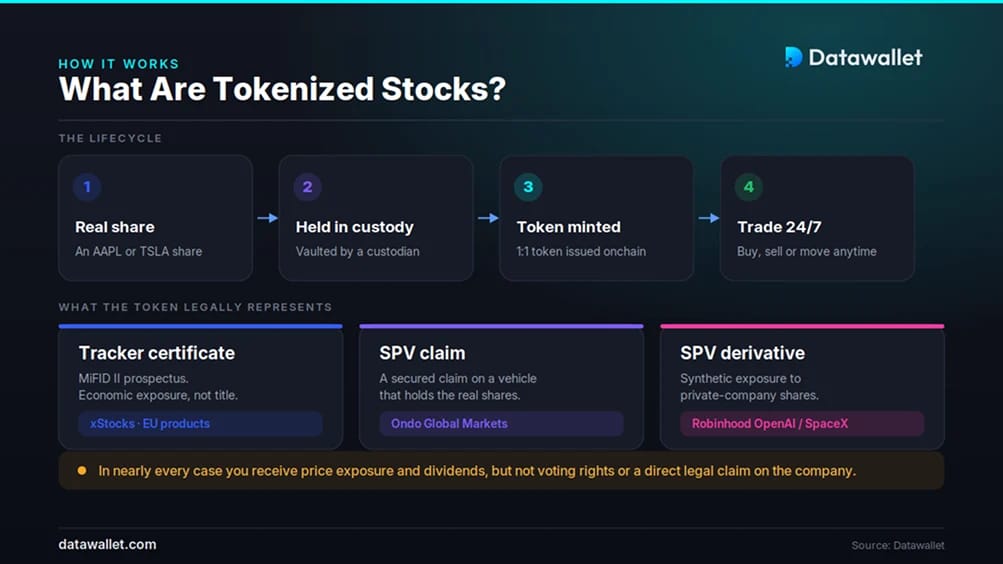
A tokenized stock is a blockchain token that tracks a real equity, with each token corresponding to a share held by a regulated custodian. Buying one gives you price exposure and, in most structures, the dividends, without a broker or legacy settlement. The appeal is mechanical: round-the-clock trading, fractional sizing down to a few dollars, near-instant settlement, and the option to move the token into self-custody wallets.
What you actually own varies by issuer. Most tokens are backed one to one, but the legal wrapper differs. xStocks and many EU products are tracker certificates issued under a MiFID II prospectus, giving economic exposure rather than direct title. Ondo's tokens are a secured claim on a special-purpose vehicle that holds the shares. Robinhood's private-company tokens are SPV-based derivatives, which is why OpenAI publicly distanced itself from them.
That distinction is the thing to grasp before buying. In nearly every case you get the price movement and dividend value, but not voting rights or a direct legal relationship with the company; US regulators stress that tokenizing a security does not change what it is. A few emerging models, where the token is the registered share recorded onchain by a transfer agent, point to where the market is heading, though they remain the exception. For how equities fit into the real-world asset wave, see our overview of the best RWA projects.
How to Choose a Tokenized Stock Platform
The right platform depends first on where you live, then on how you intend to use the tokens. These are the checks we run before funding an account.
Step 1: Confirm You Are Eligible
Eligibility does more filtering than any feature comparison. The largest products, xStocks and Ondo Global Markets, exclude US residents, Robinhood and Gemini's tokenized stocks are EU-centric, and Coinbase has nothing live for anyone. Verify your country is supported before you go further, because a strong platform you cannot legally use is no use at all.
Step 2: Decide Whether You Need Self-Custody
If you want to move tokens into your own wallet or use them in DeFi, choose a platform built on transferable tokens like xStocks on Kraken or Bybit, or Ondo's onchain assets. If you would rather keep everything inside a regulated app and never touch a wallet, Robinhood or Gemini fit better. Check our best crypto wallets guide if self-custody is the goal.
Step 3: Match the Asset List to Your Targets
Catalogs differ widely. Ondo lists 260-plus names, xStocks 100 and climbing, while Gemini and Robinhood carry their own ranges. If you want a specific ticker or a niche ETF, confirm it is listed on the platform before committing, since coverage is still uneven across issuers.
Step 4: Read the Legal Structure
Find out exactly what the token represents: a MiFID II tracker certificate, an SPV claim, or a registered share. This determines your dividend treatment, whether you hold any rights at all, and what happens to your claim if the custodian fails. A platform that publishes its custody and backing arrangements clearly is worth more than one that leaves the structure vague.
Step 5: Total Up the Costs
Compare trading fees, spreads, and any mint or redeem charges, then add network fees if you plan to move tokens onchain. A commission-free broker can still cost more through spread than a 0.1% exchange fee, so price a representative trade end to end rather than reading the headline rate.
Tokenized Stock Trading Risks
Tokenized equities carry the risks of both the stock market and the blockchain stack at once. Review these before committing capital.
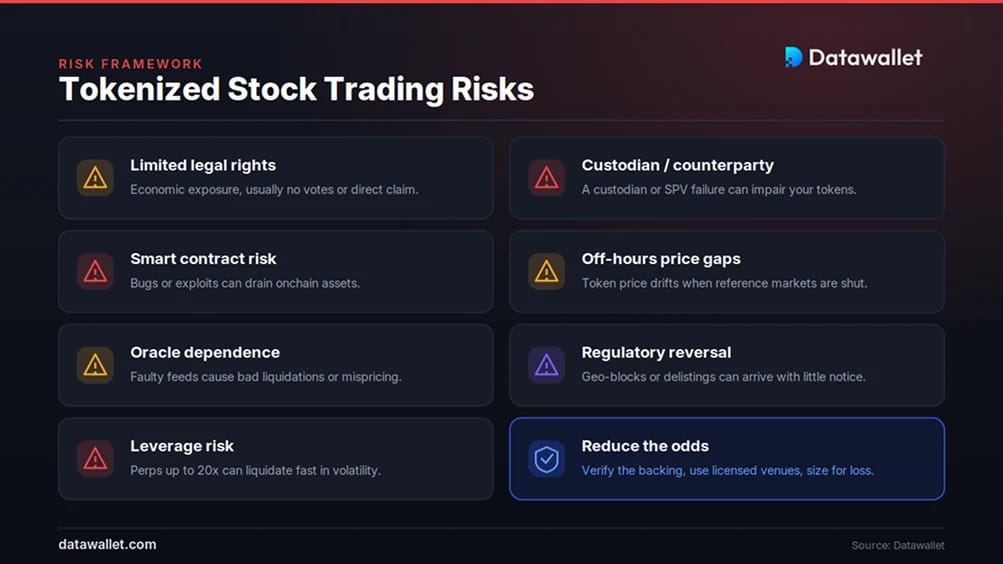
- Limited legal rights: Most tokens give economic exposure, not ownership. You typically have no voting rights and no direct claim against the company, only against the issuer or custodian.
- Custodian and counterparty risk: The model depends on a third party holding the real shares. If that custodian or SPV fails, the strength of your bankruptcy-remote protections, not the token itself, determines whether you recover value.
- Smart contract risk: Onchain tokens can be exposed to bugs or exploits in the underlying code. Audits and time in market reduce but do not remove this, as covered in our look at smart contract auditing companies.
- Off-hours price gaps: Tokens trade when the reference market is closed, so a price can drift from the last official quote, and liquidity thins outside US hours, widening spreads and slippage.
- Oracle dependence: Pricing relies on data feeds. A faulty or manipulated oracle can trigger bad liquidations on leveraged products or mispriced trades.
- Regulatory reversal: Rules are unsettled. A platform can geoblock your region or delist an asset with little notice, as the EU scrutiny of Robinhood's private-company tokens showed.
- Leverage risk: Products like Ondo Perps offer up to 20x, which can liquidate a position quickly in volatile conditions. Our guide to the best decentralized perpetuals exchanges explains how these mechanics behave.
Tokenized Stocks and Regulation in 2026
The defining feature of the market right now is a split between an open offshore market and a stalled US one. Outside the United States, MiFID II prospectuses in the EU and licensed custodians in Switzerland and the US have given issuers a workable path, which is why xStocks, Ondo, Gemini, and Robinhood all serve non-US users today.
Inside the US, the picture shifted repeatedly in early 2026. On 28 January, the SEC staff confirmed that tokenizing a security does not change its regulatory treatment, so federal securities laws apply by economic substance, not format. Nasdaq and NYSE secured approvals for tokenized trading in March and April. Then the innovation exemption, a conditional sandbox to let firms issue and trade tokenized securities without full registration, was delayed in late May after the major exchanges objected on investor-protection grounds, with no replacement timeline.
The infrastructure piece is moving on its own track. The DTCC plans to begin limited production trades of tokenized securities in mid-2026, with a broader rollout targeted for later in the year, and the CLARITY Act continues to work through Congress, which our CLARITY Act explainer breaks down. The reading for a US resident is straightforward: the plumbing is being laid, but the retail on-ramp is not open yet, and anyone promising compliant US tokenized stock trading today should be treated with suspicion.
The 2026 Tokenization Outlook
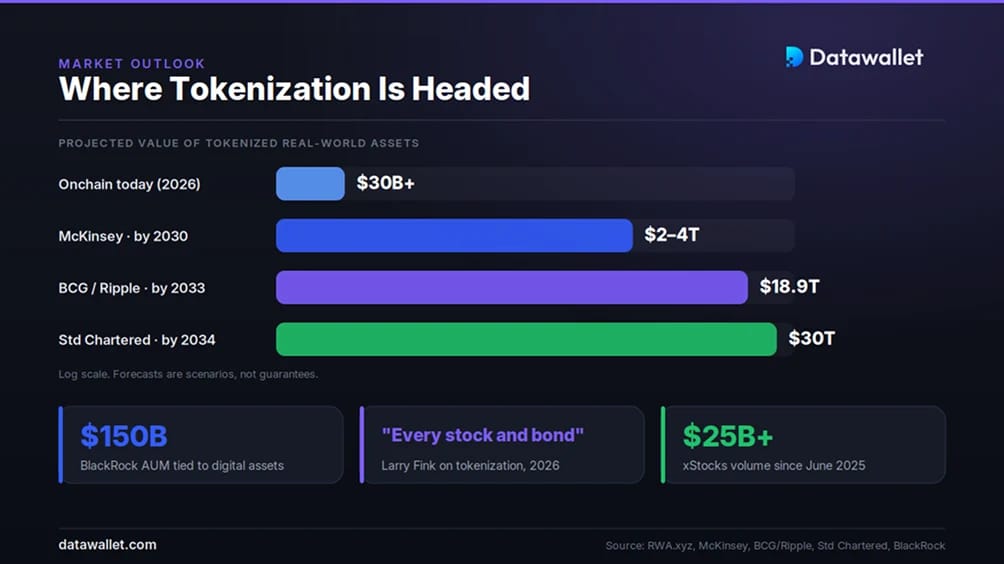
The institutional case got its loudest endorsement yet in Larry Fink's 2026 chairman's letter, which framed tokenization as the way to update the plumbing of global finance. It carries weight: BlackRock already runs the largest tokenized fund and has nearly $150 billion in AUM tied to digital assets, so Fink is describing a market the firm is building from inside, not one it hopes to enter.
The size estimates remain wide and worth treating with caution. The broader tokenized real-world asset market has grown past $30 billion, and forecasts range from McKinsey's $2 trillion to $4 trillion by 2030 to a BCG and Ripple projection of $18.9 trillion by 2033. These are scenarios, not guarantees, and tokenized stocks are only one slice of a market still dominated by tokenized treasuries. Our tokenization statistics page tracks the live figures.
For 2026, three things look likely. Catalogs keep widening, with Kraken targeting 500-plus xStocks and Ondo expanding across chains. Leverage and structured products spread now that Ondo Perps has opened tokenized-stock perpetuals to non-US traders. And the US stays the swing factor: if an exemption or DTCC settlement lands, Coinbase and the regulated exchanges move fast; if not, the action stays offshore. The direction is set, the pace depends on Washington.
Final Thoughts
For most readers outside the US, Kraken is the default. It owns the issuer, carries the widest live catalog, settles to self-custody, and sits at the center of the deepest liquidity in the category. Ondo Global Markets is the alternative when asset count and onchain value matter most, Bybit suits crypto-native traders who want one balance, and Gemini and Robinhood are the cleaner regulated routes for EU users who prefer an app over a wallet.
The honest caveat is structural. You are almost always buying economic exposure, not a share with rights, through a chain of custodians and issuers whose strength you should verify rather than assume. US residents have no compliant retail option today, regardless of any platform's marketing. Confirm your eligibility, read what the token legally represents, and size positions for the chance that a custodian or a regulator, not the stock, is what moves against you.
Our Methodology
Where the product was live and our region allowed it, we funded accounts, bought tokenized stocks, and, where supported, withdrew tokens to a self-custody wallet and traded them onchain. For platforms we could not access directly, including Coinbase, which has nothing live, we assessed the offering against the issuer's disclosures and onchain data, and flagged that in the review.
Each platform was rated on five factors:
- Asset range. How many stocks and ETFs are actually listed.
- Backing and custody. What the token legally represents, and who holds the underlying shares.
- Price tracking. How closely the token followed the share during and outside US market hours.
- Total cost. Trading fees, spreads, and network costs across a full round trip.
- Availability. Which regions can legally use the platform.
Ratings reflect each platform's live product as of mid-2026, and we state clearly where an offering had not launched.