



What is the Bybit New User Bonus?
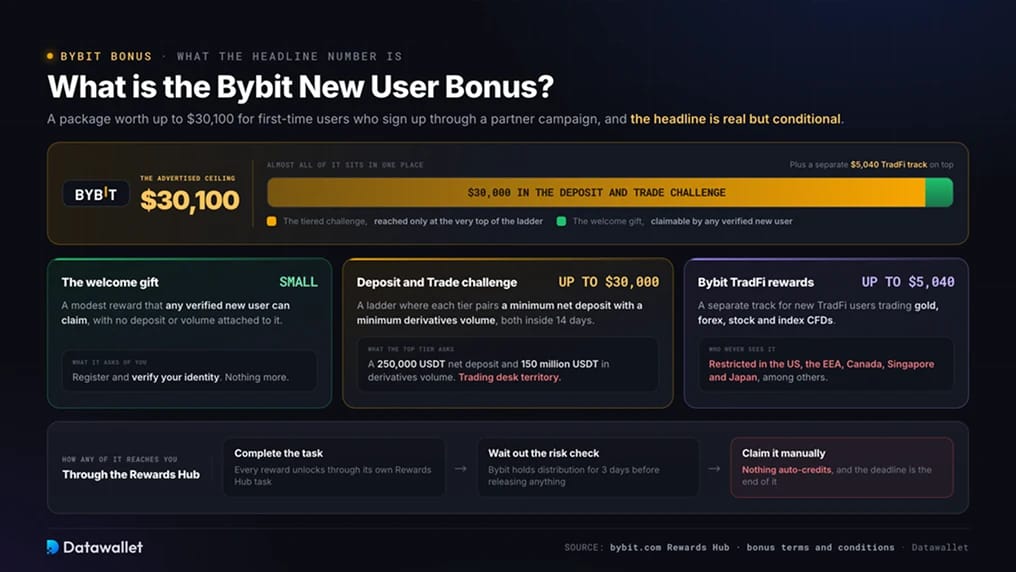
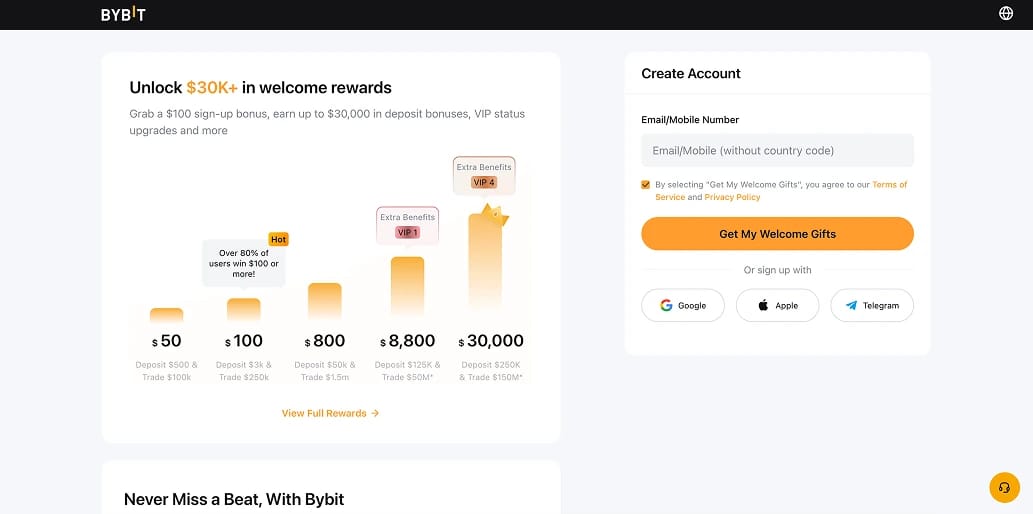
The Bybit new user bonus is a package of rewards worth up to $30,100, plus up to $5,040 in separate credits for Bybit TradFi, available to first-time users who sign up through a partner campaign such as Datawallet's Bybit link. Signing up directly without a partner link unlocks a smaller standard package.
The headline number is real but conditional. It combines a small welcome gift that any verified new user can claim, a Deposit & Trade challenge that scales up to a $30,000 bonus, and rewards for new Bybit TradFi users who fund and trade gold, forex, stock, and index CFDs.
Each reward unlocks through tasks in the Rewards Hub, Bybit's central claiming page. Bybit distributes rewards after a 3-day risk check, and users claim them manually before the stated deadline. Tasks refresh periodically, so the exact tier amounts shown in your Rewards Hub take precedence over any third-party summary, ours included.
How the Bybit Bonus Ladder Works
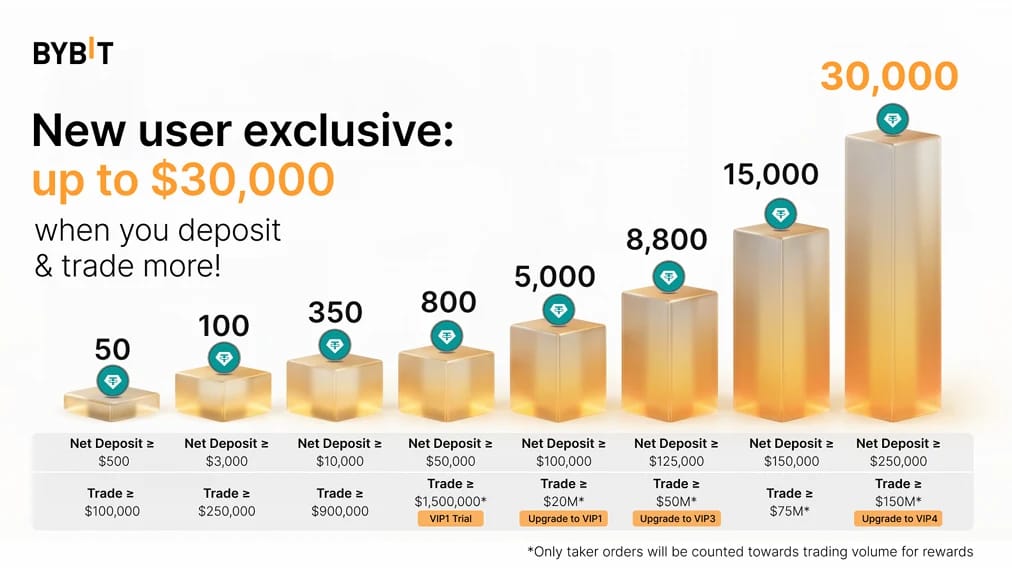
The bonus operates as a ladder where each tier pairs a minimum net deposit with a minimum derivatives trading volume, both completed within 14 days of the tasks appearing in your Rewards Hub. Meeting one requirement without the other unlocks nothing for that tier.
The current ladder starts around 20 USDT for a 100 USDT deposit with matching starter volume, and climbs through mid tiers in the hundreds and thousands to the top tier. The $30,000 tier requires a 250,000 USDT net deposit and 150 million USDT in derivatives trading volume, which places it in professional trading desk territory.
Four rules in the fine print decide who qualifies:
- Net deposits are what count: Bybit calculates your figure as total deposits in eligible assets minus anything withdrawn during the event period. Crypto deposits, One-Click Buy purchases, and P2P trades count toward it.
- Only derivatives volume qualifies: Spot trades and fiat deposits are excluded from the volume calculation. Only perpetual and futures trades move it.
- Taker volume only at higher tiers: For rewards of $800 and above, only taker orders count, meaning orders that fill immediately against the order book at Bybit's standard 0.055% taker fee. Resting limit orders that pay the cheaper maker fee do not accumulate qualifying volume. Our maker vs taker fees guide explains the distinction.
- Deposits must stay put: Withdrawing any deposited funds within 3 days after the 14-day calculation period ends triggers automatic disqualification, even if the tier requirements were already met.
Bybit Reward Types and How Each One Behaves
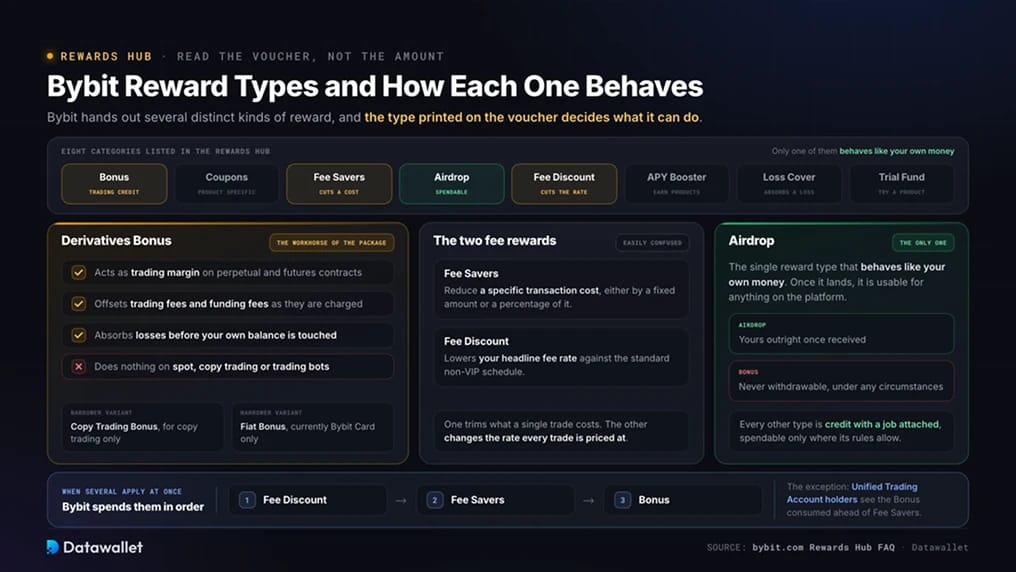
Bybit's Rewards Hub distributes more than one kind of reward, and the type printed on the voucher determines what it can do. The Rewards Hub FAQ lists Bonus, Coupons, Fee Savers, Airdrop, Fee Discount, APY Booster, Loss Cover Voucher, and Trial Fund as distinct categories.
A Derivatives Bonus is the workhorse of the welcome package. It acts as trading margin, offsets trading and funding fees, and absorbs losses on perpetual and futures contracts. Bybit spends it before touching your own funds. Copy Trading and Fiat variants exist with narrower uses. The Fiat Bonus currently applies only to Bybit Card transactions.
Fee Savers reduce specific transaction costs, either by a fixed amount or a percentage, while a Fee Discount lowers your headline fee rate against the standard non-VIP schedule. An Airdrop is the only reward that behaves like your own money, usable for anything once received. When several rewards apply to the same trade, Bybit applies the Fee Discount first, then Fee Savers, then the Bonus, although Unified Trading Account holders see the bonus consumed before Fee Savers.
The New TradFi Rewards
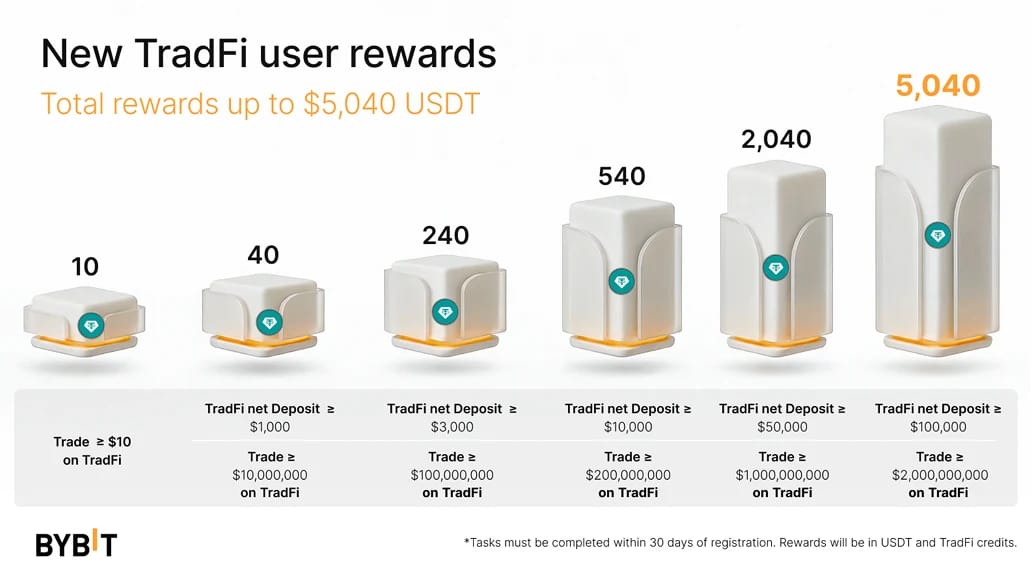
Bybit has added a separate reward track worth up to $5,040 for new users of Bybit TradFi, its platform for trading contracts for difference (CFDs) on gold, forex pairs, commodities, stocks, and global indices alongside crypto. The credits unlock through their own deposit and TradFi volume tasks and serve as margin for TradFi products, with profits from credit-funded trades remaining withdrawable.
The catch is availability. Bybit restricts TradFi in a long list of jurisdictions, including the United States, the European Economic Area, Canada, Singapore, and Japan, so users in those regions will see the crypto rewards but not the TradFi track. Since CFDs are leveraged derivative products, losses can mount quickly for anyone treating the credits as free experimentation money.
How to Claim the Bybit Bonus
Claiming works the same way at every tier, and missing a step is the most common reason users complete the trading requirements yet receive nothing.
- Register through an eligible link: Sign up as a new user via Datawallet's partner link so the campaign attaches to your account. This campaign is not offered on Bybit EU, so EEA residents sign up through Bybit's MiCAR-licensed European platform and receive its own smaller welcome rewards, which we cover alongside the licensing detail in our Bybit restricted countries guide.
- Complete Identity Verification: Bybit requires at least Identity Verification Lv. 1 before any reward can be claimed, per its Rewards Terms and Conditions.
- Make your first deposit: Fund the account within the campaign window using crypto, One-Click Buy, or P2P so the deposit counts toward your net deposit figure.
- Complete the trading tasks: Build qualifying derivatives volume within 14 days of the tasks appearing in your Rewards Hub, remembering the taker-only rule above $800.
- Wait out the risk check: Bybit holds distribution for 3 days after task completion to screen for wash trading, multi-account farming, and matched trades, all of which trigger disqualification.
- Claim manually in the Rewards Hub: Rewards never auto-credit. Open the Rewards Hub, claim before the deadline, then note the separate expiry date attached to the claimed reward.
Can You Withdraw a Bybit Bonus?
No. Bybit states in its Rewards Terms and Conditions that bonuses are non-withdrawable under any circumstances, cannot be transferred or exchanged, and cannot offset withdrawal fees. What you can withdraw is profit generated while trading with the bonus, once your account meets the normal withdrawal conditions.
Expiry is the rule that catches people after claiming. Unused bonuses are forfeited on their expiration date with no refund, and a bonus being used as margin for an open position is also forfeited when it expires, which can push that position closer to liquidation. Bybit's one concession is that if forfeiting the bonus would cause immediate liquidation, the reward is maintained to protect the position, though the exchange advises monitoring open trades closely as expiry approaches.
Is Chasing the Bonus Worth It?
The honest answer depends on the tier, because the taker-only rule attaches a real cost to qualifying volume. At Bybit's standard 0.055% taker fee, 150 million USDT in volume generates roughly 82,500 USDT in trading fees, well above the $30,000 reward it unlocks. Even at discounted VIP taker rates, the fee bill on that much volume exceeds the bonus. The top tier only makes sense for desks that would be trading that size anyway and want the bonus as a partial rebate on that activity.
The economics look far better lower down. A mid tier requiring around 50,000 USDT in taker volume costs roughly 27.50 USDT in fees for a reward measured in the hundreds, and the entry tiers cost almost nothing to unlock. Climbing Bybit's VIP levels compounds the value further, since higher tiers cut the taker rate that qualifying volume is charged at.
For most new users, the realistic play is claiming the welcome gift immediately, then letting the trading they intended to do anyway unlock whichever challenge tier it reaches. Manufacturing volume to hit a bonus target is how the fee bill ends up larger than the reward.
Final Thoughts
The Bybit bonus rewards deliberate users and quietly penalizes careless ones. The package is one of the largest headline offers among major exchanges, and the lower tiers pay for themselves, but every dollar of it is trading credit governed by deposit windows, taker-only volume rules, risk checks, and expiry dates.
Read the task details in your Rewards Hub before depositing, keep funds untouched through the holding period, and claim promptly once rewards distribute. If you are still deciding whether the platform suits you before committing capital, our Bybit review covers fees, security, and product depth in detail.