




What Are Prediction Markets?
A prediction market lets people trade the outcome of an uncertain future event. Each market poses a precise question, such as which candidate wins an election or whether inflation prints above a set level, and turns the possible answers into contracts traders can buy and sell.
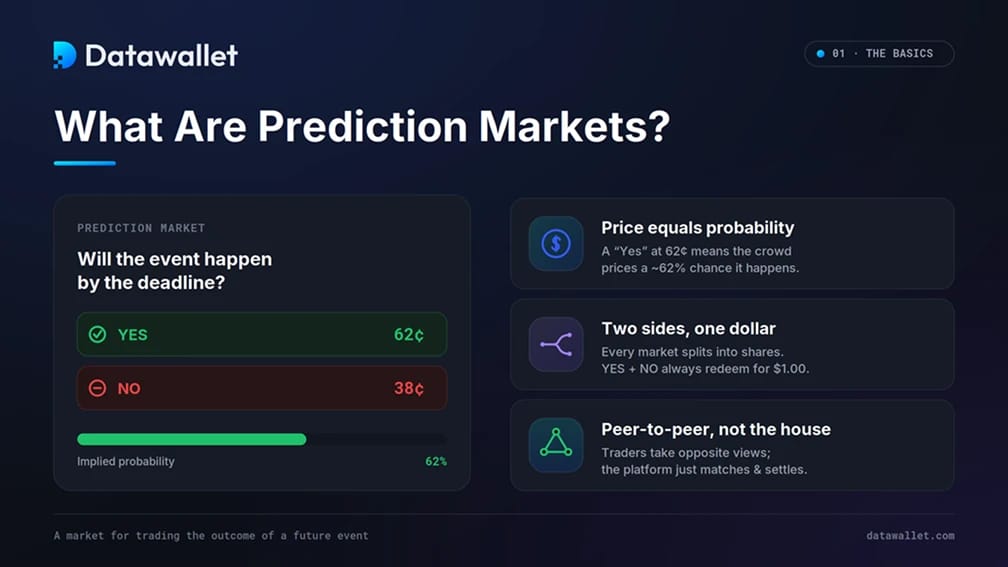
The defining feature is that price equals probability. In a yes-or-no market, a contract trades between 0 and 1, often shown as 0 to 100 cents. A "Yes" at 0.62 implies the crowd sees roughly a 62% chance the event happens. Once the question settles, the winning side pays 1 and the losing side pays 0.
This sets them apart from polls and from betting. A poll captures what people say they will do; a market captures what they will risk money on. And unlike a sportsbook, where the house sets the odds and takes the other side, most prediction markets are peer-to-peer, with traders on opposite sides and the platform supplying the venue, matching, and settlement.
You will also see them called event contracts, information markets, or event derivatives. The label changes, but the mechanism does not: a question about the future becomes a priced claim that resolves once the outcome is known.
How Do Prediction Markets Work?
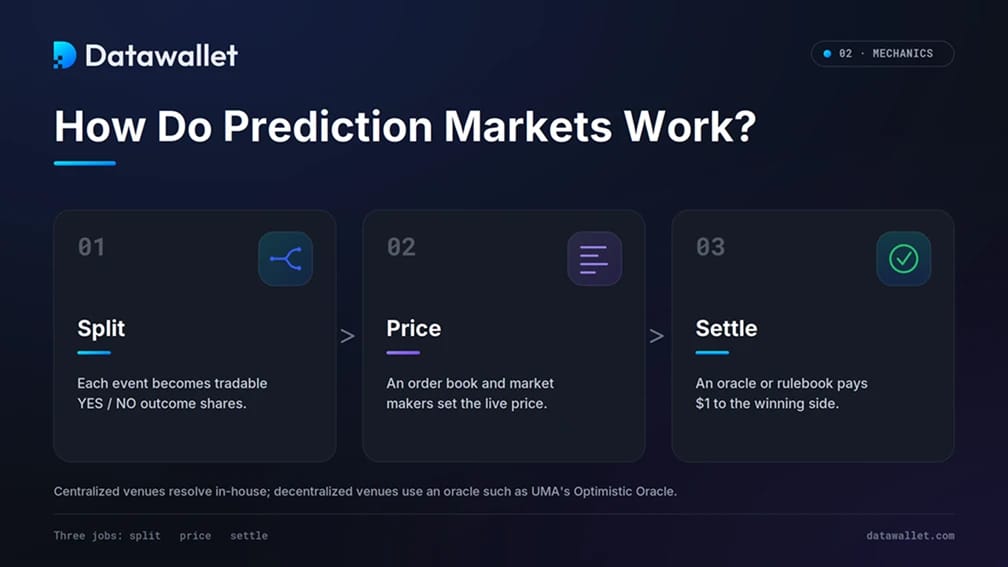
Behind the interface, a prediction market does three jobs - it splits an event into shares, finds a price for them, and settles the result once the outcome is known. Each step works differently depending on whether the venue runs on a traditional exchange or a blockchain.
1. Outcome Shares and Probability Pricing
Every market splits an event into outcome shares. A binary market has two, "Yes" and "No," and one of each always redeems for exactly $1. So the two prices must add up to one: if "Yes" trades at $0.62, "No" sits near $0.38.
That $1 cap is what makes the price behave like a probability. Traders bid an outcome up when they think it is underpriced and sell it down when overpriced, pulling the number toward the crowd's best estimate. Anyone spotting a mispriced pair can arbitrage it, which keeps both sides in line.
2. Order Books and Market Makers
Finding the price in the first place is harder. Early on-chain markets used automated market makers, where a pooled formula quoted both sides. The catch is that binary shares settle at $1 or $0, which tends to lock in losses for whoever supplies that liquidity, so pure pools struggled to attract capital.
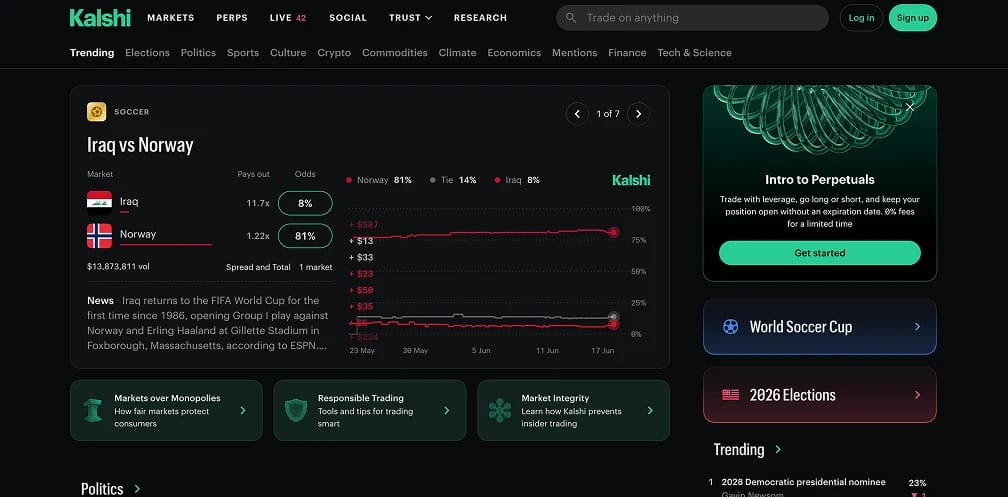
Most venues moved on. Polymarket switched to a central limit order book in late 2022, matching buyers and sellers through limit orders like a normal exchange and paying makers to keep quotes tight. Kalshi runs its own off-chain order book. That shift is part of why the biggest venues now feel closer to trading a stock than playing a casino game.
3. Settlement and Oracles
After the event, the market resolves: winning shares get paid and losing shares expire worthless. Centralized venues handle this in-house, applying a published rulebook, with Kalshi confirming results through an outcome review process before payouts.
Decentralized venues hit an extra hurdle, since a blockchain cannot see real-world events and needs an oracle to report the answer on-chain. Polymarket uses UMA's Optimistic Oracle, where a proposer posts a bond and asserts the outcome, opening a roughly two-hour window for disputes.
If no one challenges, the result stands and winning shares redeem for $1 in USDC. If someone disputes it, UMA token holders research and vote on the outcome. Uncontested markets usually clear within hours; contested ones can take days.
A Brief History of Prediction Markets
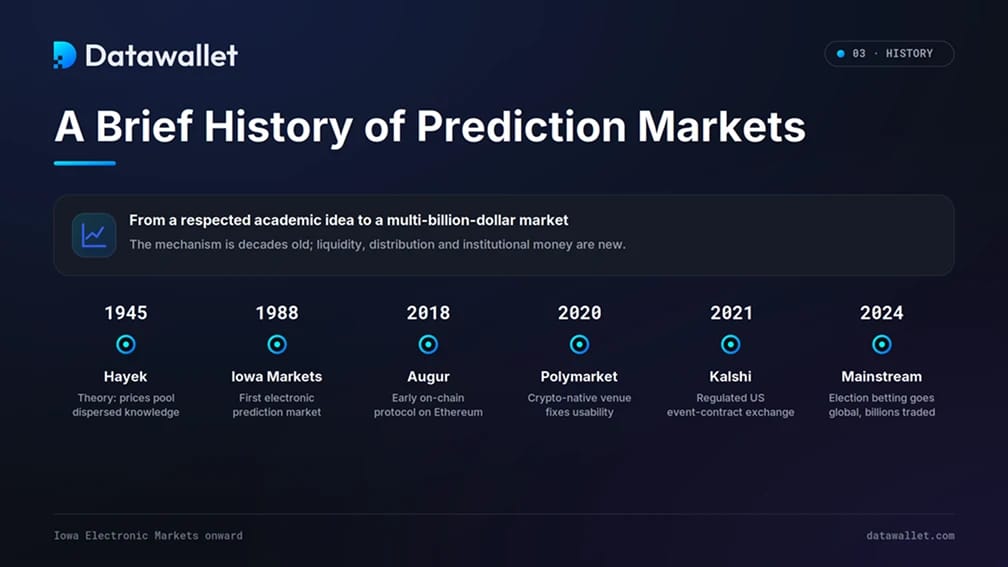
The idea predates crypto by centuries. People bet on papal elections in Renaissance Italy, and election-betting markets ran openly in the United States into the early 1900s. Economist Friedrich Hayek gave the logic its modern footing in 1945, arguing that prices are an efficient way to pool knowledge scattered across many people that no single person holds.
The electronic version arrived in 1988 with the Iowa Electronic Markets, a small-stakes academic exchange run by the University of Iowa for research and teaching. Over the following decades its election prices often landed closer to the result than the polls did, building a credible track record. Journalist James Surowiecki popularized the broader theme in his 2004 book on the wisdom of crowds.
Crypto turned the concept into open infrastructure. Augur launched on Ethereum in 2018 as an early decentralized protocol, using a token-holder oracle to report outcomes, though clunky design capped its reach. Polymarket, founded by Shayne Coplan in 2020, fixed the usability problem, and the 2024 US presidential election pushed it mainstream as traders staked billions on the result. Kalshi, launched in 2021, took the opposite path, chasing federal approval first to build a regulated home for event contracts.
Centralized vs. Decentralized Prediction Markets
The market splits into two models, and the difference comes down to who holds the funds and who decides the outcome.
Centralized venues like Kalshi and PredictIt, plus the prediction features now built into brokerage and sportsbook apps, run like regulated exchanges. The operator holds user money, checks identity, enforces a rulebook, and resolves each market. That brings cleaner fiat access and a clearer compliance story, but more gatekeeping and tighter limits on which markets exist.
Decentralized venues like Polymarket push most of that on-chain. Users connect a wallet, trade shares settled in stablecoins, and rely on an oracle instead of a company to confirm the result. The trade-off is the mirror image: wider access and fewer middlemen, but exposure to smart-contract bugs and oracle disputes.
For how specific venues compare on fees, chains, and settlement, see our guide to the best decentralized prediction markets, our explainer on how Kalshi works as a regulated alternative, and our latest platform reviews for hands-on breakdowns.
The 2026 Prediction Market Boom
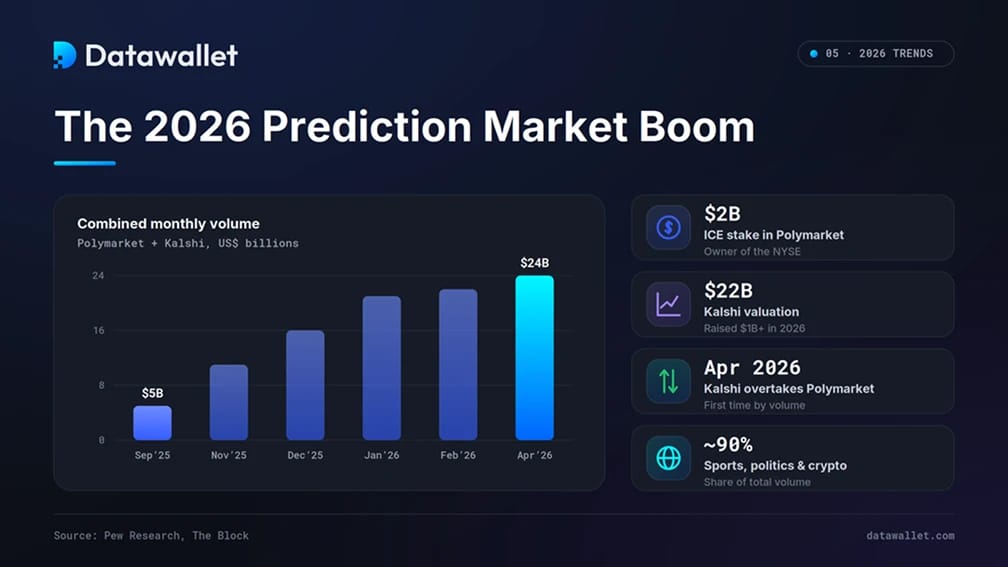
The biggest story is scale. Combined monthly trading on the two largest platforms jumped from under $5 billion in September 2025 to about $24 billion by April 2026, per a Pew Research Center analysis and detailed further in our prediction market statistics, turning a fringe product into a real corner of finance in under a year. Several trends are driving that growth.
- A real two-horse race: Polymarket set the early pace, but Kalshi's volume pulled ahead for the first time in April 2026, driven mostly by sports. Across both, sports, politics, and crypto account for roughly nine in ten dollars traded, with sports dominating Kalshi.
- Wall Street buys in: Intercontinental Exchange, owner of the New York Stock Exchange, committed $2 billion to Polymarket, valuing it near $9 billion before later rounds pushed it higher. ICE also distributes Polymarket's probability data to institutions, reframing crowd forecasts as a financial signal.
- A regulated heavyweight: Kalshi raised more than $1 billion at a reported $22 billion valuation on an estimated $1.5 billion in annual revenue, cementing its place as the regulated leader.
- Polymarket's US return: After years locked out, Polymarket bought CFTC-licensed exchange QCEX for $112 million and relaunched a regulated US app in late 2025. A long-awaited POLY token, expected in 2026 with part reserved for an airdrop, is the next catalyst traders watch.
- Brokerages and sportsbooks pile in: Robinhood added event contracts through Kalshi, reported more than a million users trading billions of contracts, and is building its own derivatives stack. DraftKings, FanDuel, and Fanatics each launched rivals, often to reach states where sports betting is still illegal.
- Trading agents arrive: Autonomous AI agents now place many of the trades. Projects like Olas have run thousands of automated trades on Polymarket, and Robinhood lets users hand execution to AI, hinting at a future where much of the crowd is software.
- A push for integrity: As scrutiny grew, the major platforms rolled out controls in early 2026 to curb insider trading, and several added short delays on live sports orders to stop traders with a real-time edge from picking off market makers.
The pattern is clear: prediction markets have moved from internet curiosity to financial product, with institutional money, mainstream distribution, and the regulatory heat that follows both.
What Can You Use Prediction Markets For?
They look like betting apps, but prediction markets serve several different purposes depending on who uses them.
- Forecasting: Read the price as a probability. A market at 0.70 on a rate cut or an election gives a fast, money-backed estimate that updates the moment news lands.
- Hedging: Because a contract pays out when a specific event occurs, it can offset real risk. A business exposed to a policy decision, or a producer exposed to weather, can take a position that cushions the bad outcome.
- Speculation: Plenty of activity is plain directional trading, including arbitrage between venues and trading live sports as a game unfolds.
- Signal and media: Market prices have become a newsroom input, with major data and media platforms now showing prediction-market probabilities next to traditional financial data.
- Decision-making: Companies have used internal markets for years, sometimes producing sharper forecasts than standard management projections.
How Accurate Are Prediction Markets?
The case for accuracy rests on incentives. When real money is at stake, people weigh information more carefully than in a free poll, and the price aggregates that effort. The strongest evidence comes from the Iowa Electronic Markets. A study of 964 polls across five US presidential elections from 1988 to 2004 found the market beat the polls about 74% of the time, with election-eve errors averaging just over one percentage point.
The structure helps. Prices update continuously instead of in periodic snapshots, anyone with better information has a reason to trade on it, and the market rewards being right rather than being loud.
The caveats matter too. Accuracy depends on liquidity, a diverse set of traders, and clean resolution rules; thin markets can misprice badly, and even famous markets have missed big calls. Critics add that a price reflects speculation under specific rules, not a guaranteed forecast, and that concentrated capital can sway lightly traded markets. Prediction markets are often a strong signal, but a signal is not a crystal ball.
Regulation and Legal Status of Prediction Markets
Prediction markets are caught in a federal-versus-state standoff. Federal regulators treat event contracts as financial products, a growing number of states call them gambling, and the courts have yet to settle it.
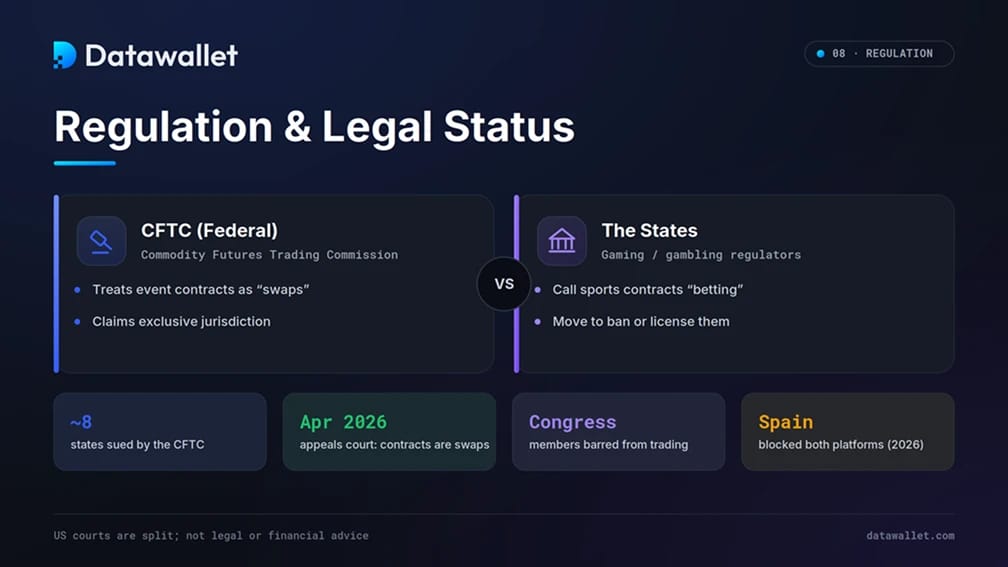
The CFTC calls these contracts "swaps" under the Commodity Exchange Act, which would put them under federal authority rather than state gambling law. Kalshi built on that reading and won designation as a regulated contract market in 2020. Polymarket got there the hard way, settling with the CFTC in 2022, paying a penalty and blocking US users before buying a licensed route back in.
Sports is the sharpest fight, with several states calling these contracts online betting by another name and moving to ban them. The CFTC has sued those states to defend its jurisdiction, roughly eight suits by mid-2026, but the courts have split. A federal appeals court backed the CFTC in April 2026, treating Kalshi's contracts as swaps beyond state reach, while other judges ruled the opposite way, a divide that could reach the Supreme Court.
Washington has piled on too: Congress barred its own members and staff from trading, other bills would outlaw contracts on elections, war, and sports, and at least one major sports league has pushed operators to delist contracts it finds objectionable. Abroad is just as uneven, with Spain blocking Polymarket and Kalshi in 2026 while it weighed whether they needed gambling licenses.
Because rules shift by country and even by state, check local restrictions, such as our Polymarket restricted countries guide, before funding an account. None of this is legal or financial advice.
Risks of Prediction Markets
Prediction markets can be useful, but they carry real risks that are easy to overlook when a market looks busy and the interface feels like a game.
- Regulatory and access risk: A platform available today can be restricted tomorrow when a regulator reclassifies it or a court shifts the ground. Sudden geoblocks can trap funds or freeze accounts.
- Resolution and oracle risk: A correct prediction can still lose if the wording is vague or the outcome is contested. Optimistic-oracle markets have seen disputed settlements, including cases where concentrated voting power overrode the obvious answer.
- Liquidity risk: Headline markets are deep, but niche ones are often thin, with wide spreads and prices that jump on small trades. Quoted fees can understate the true cost of entering or exiting.
- Manipulation and insider risk: A single large trader can push a thin market, and event contracts are exposed to people holding non-public information, which is why platforms and lawmakers have tightened the rules.
- Smart contract risk: On decentralized venues, funds move through code. A bug, exploit, or malicious approval in the underlying smart contracts can put capital at risk regardless of how the prediction plays out.
- Stablecoin and crypto risk: Most on-chain markets settle in stablecoins, so bridges, wallets, network fees, and the reliability of the chosen stablecoin add exposure beyond the trade itself.
- Behavioral risk: Real money plus fast, gambling-style interfaces can drive compulsive use, which is part of why the derivative-versus-gambling debate is more than semantics.
- Tax and reporting: Profits are generally taxable, and reporting differs between regulated US platforms that issue tax forms and decentralized venues where you self-report.
Final Thoughts
Prediction markets have crossed a threshold. The core mechanism, turning a question into priced shares that track the crowd's probability estimate, is decades old, but in 2026 it finally has the liquidity, distribution, and institutional backing to work at scale.
That growth has a cost. The capital and mainstream reach also drew intense regulatory conflict, harder scrutiny of integrity and resolution, and a louder argument over whether these are forecasting tools or gambling in new packaging.
The sensible starting point is not the busiest market but the fundamentals: how a venue resolves outcomes, where it is legal, how deep its liquidity actually runs, and what happens to your money if a result is disputed. Approached that way, prediction markets offer a useful window into what a crowd really expects, as long as the risks get as much attention as the signal.