




What Is the Binance VIP Program?
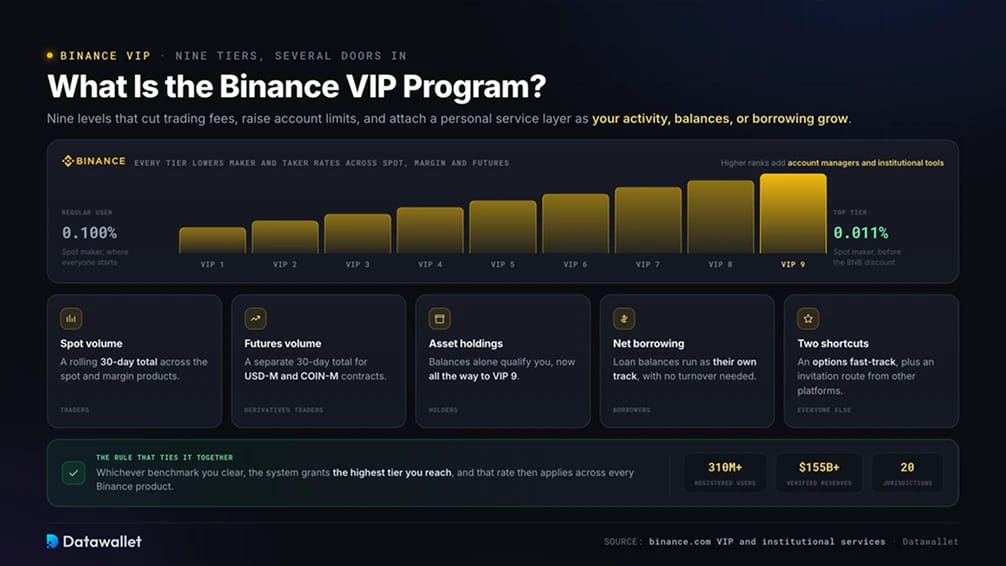
The Binance VIP program is a nine-level scheme that rewards the exchange's most active users with cheaper trading, larger limits, and a personal service layer. Each tier lowers the maker and taker rates across spot, margin, and futures markets, and higher ranks add dedicated account managers, private event invitations, and institutional tools.
What separates Binance from most rivals is how many ways you can qualify. Traders reach a tier through 30-day spot or futures volume, holders through their account balances, and borrowers through their loan balances. Options traders have a dedicated shortcut, and users active on other platforms can migrate their status through an invitation scheme. Whichever benchmark you clear, the system grants the highest tier you reach.
The program sits on considerable scale. Binance serves more than 310 million registered users, publishes over $155 billion in verified reserves, and holds regulatory approvals across 20 jurisdictions, including the first global exchange license granted under Abu Dhabi's ADGM framework.
How Binance Calculates Your VIP Level
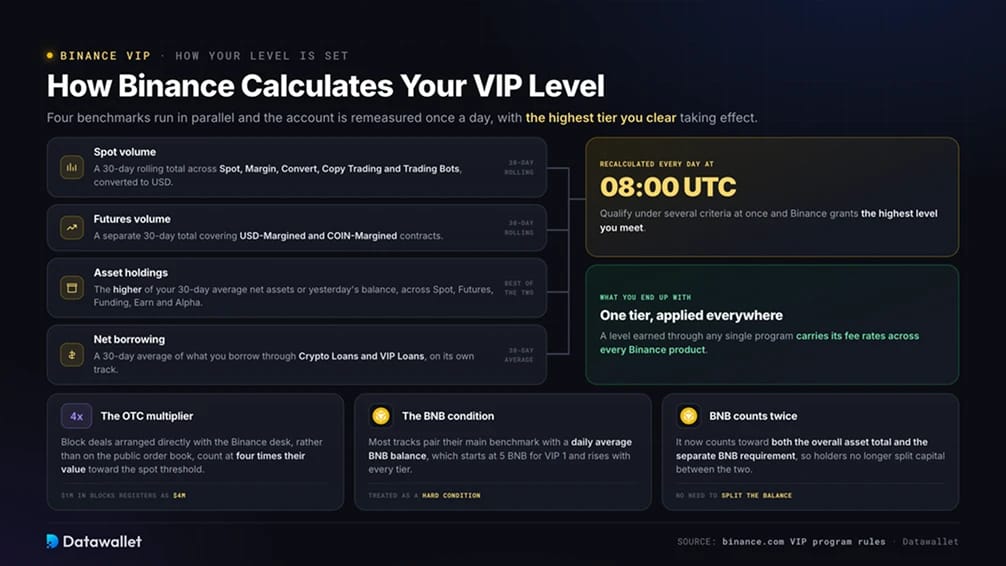
Binance recalculates every account's tier once a day at 08:00 UTC, and users who qualify under several criteria at once receive the highest level they meet.
- Spot volume: Your 30-day rolling total across Spot, Margin, Convert, Copy Trading, and Trading Bots, converted to a USD value.
- Futures volume: A separate 30-day total covering USD-Margined and COIN-Margined contracts.
- Asset holdings: The higher of your 30-day average net assets or the previous day's balance, counted across Spot, Futures, Funding, Earn, and Alpha accounts.
- Net borrowing: The 30-day average of what you borrow through Crypto Loans and VIP Loans qualifies you on its own track.
- OTC multiplier: Over-the-counter spot trades, meaning large block deals arranged directly with the Binance desk rather than on the public order book, count at four times their value toward the spot threshold.
- BNB requirement: Most tracks pair their main benchmark with a daily average BNB balance, starting at 5 BNB for VIP 1.
- Universal benefits: A tier earned through any single program applies its fee rates across every Binance product.
Because BNB now counts toward both the overall asset total and the separate BNB requirement, holders no longer need to split capital between the two conditions.
What Changed in the VIP Program This Year
Binance rebuilt large parts of the program in 2026, and the old thresholds many traders still quote are gone. In March, the exchange cut the BNB requirements for the first three tiers from 25, 100, and 250 BNB to 5, 25, and 100 BNB. Futures volume requirements fell harder. VIP 1 dropped from $15 million to $5 million, VIP 2 from $50 million to $10 million, and VIP 3 from $100 million to $50 million, with VIP 1 and VIP 2 futures fees nudged upward to balance the easier entry.
The same refresh rebuilt the Holder track. Asset-based qualification previously stopped at VIP 4, whereas holders and Earn investors can now climb to VIP 9, which takes $1 billion in average net assets. Binance also introduced VIP Rising Star, a pre-VIP designation for accounts holding a $30,000 average balance including at least 5 BNB. Rising Stars receive personalized support and curated event access before they clear a full tier.
A second round followed in July. Binance reduced the Holder VIP 3 asset requirement from $3 million to $1 million and removed the VIP 4 ceiling on OTC-based qualification, so block traders can now progress through every tier. A limited-time promotion also counts stock and bStocks trading at three times its value toward the spot threshold, though the offer excludes users in the European Economic Area (EEA).
Binance VIP Level Requirements
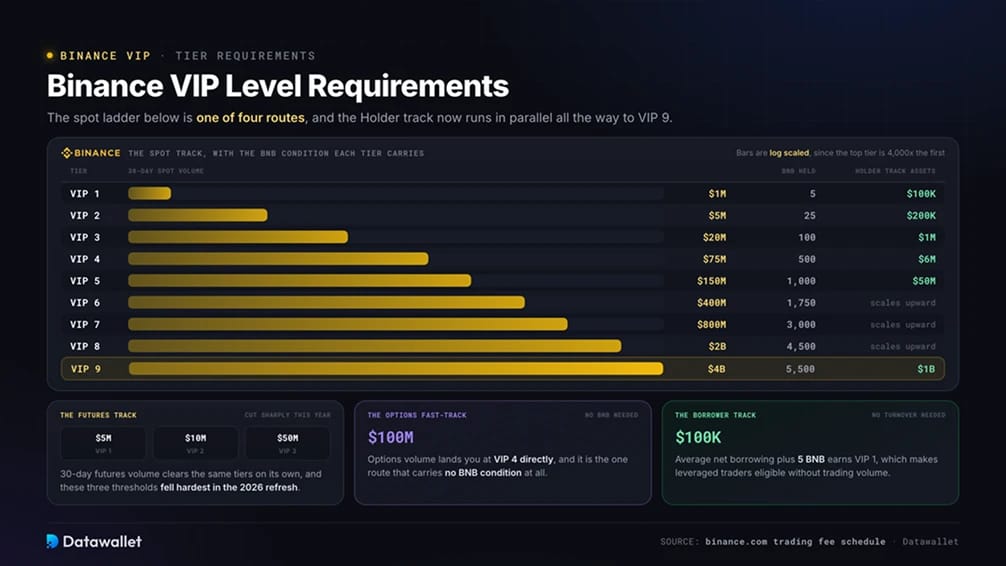
The spot track below shows the full ladder of volume and BNB requirements. Each tier can also be reached through futures volume, asset holdings, or borrowing.
- VIP 1: Trade $1 million in 30-day spot volume, or $5 million in futures, and hold a 5 BNB daily average balance.
- VIP 2: Trade $5 million in spot volume, or $10 million in futures, alongside 25 BNB.
- VIP 3: Trade $20 million in spot volume, or $50 million in futures, alongside 100 BNB.
- VIP 4: Trade $75 million in spot volume and hold 500 BNB, the level where options traders can also fast-track with $100 million in options volume and no BNB.
- VIP 5: Trade $150 million in spot volume alongside 1,000 BNB.
- VIP 6: Trade $400 million in spot volume alongside 1,750 BNB.
- VIP 7: Trade $800 million in spot volume alongside 3,000 BNB.
- VIP 8: Trade $2 billion in spot volume alongside 4,500 BNB.
- VIP 9: Trade $4 billion in spot volume alongside 5,500 BNB.
The Holder track runs in parallel with the same BNB requirements. It starts at $100,000 in average net assets for VIP 1, then $200,000 for VIP 2, $1 million for VIP 3, $6 million for VIP 4, and scales from $50 million at VIP 5 to $1 billion at VIP 9. Borrowers enter the program from $100,000 in average net borrowing plus 5 BNB, which makes leveraged traders eligible without any minimum turnover.
Binance VIP Trading Fees by Level
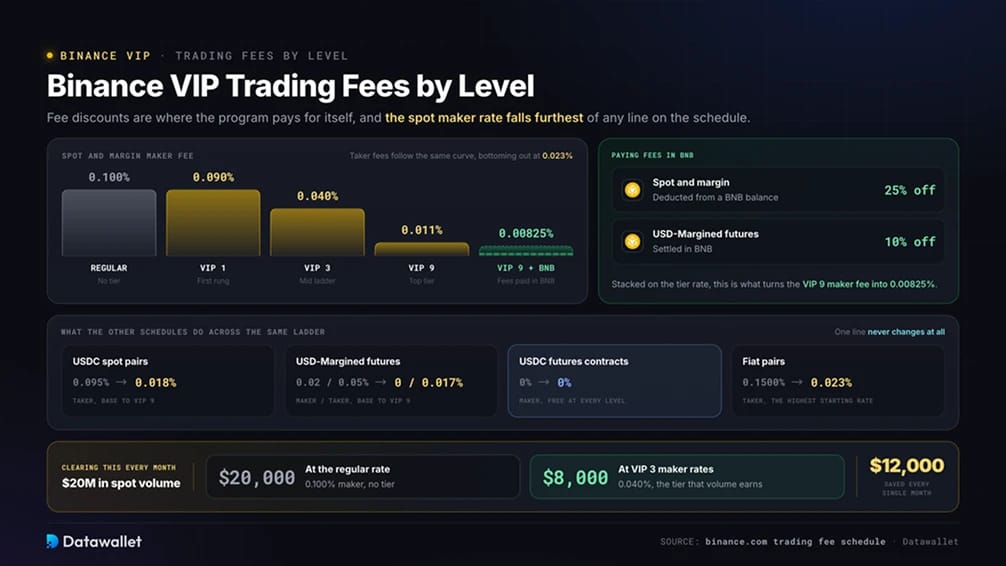
Fee discounts are where the program pays for itself. If the maker and taker distinction is new to you, our guide to maker vs taker fees explains which orders fall into each bucket.
- Spot and margin: Base users pay 0.100% on both sides. Maker fees step down through 0.090% at VIP 1 and 0.040% at VIP 3 before reaching 0.011% at VIP 9, while taker fees bottom out at 0.023%.
- BNB spot discount: Paying fees from a BNB balance takes 25% off spot and margin rates, bringing the VIP 9 maker fee to 0.00825%.
- USDC spot pairs: Taker fees on USDC-quoted pairs run slightly below the standard schedule, falling from 0.095% at base to 0.018% at VIP 9.
- USD-Margined futures: Regular users pay 0.02% maker and 0.05% taker. VIP 3 trades at 0.012% and 0.032%, and VIP 9 reaches a 0% maker fee with a 0.017% taker rate.
- USDC futures contracts: Maker fees sit at 0% at every level, regular users included, an incentive aimed at liquidity providers.
- BNB futures discount: Settling futures fees in BNB deducts a further 10% on USD-Margined contracts.
- Fiat pairs: These carry a higher base taker rate of 0.1500%, and the ladder compresses it to 0.023% at the top tier.
Clearing $20 million a month in spot volume at VIP 3 maker rates costs $8,000 in fees, whereas the same activity at the base rate costs $20,000. We break down the wider fee picture in our Binance review.
Binance VIP Benefits Beyond Trading Fees
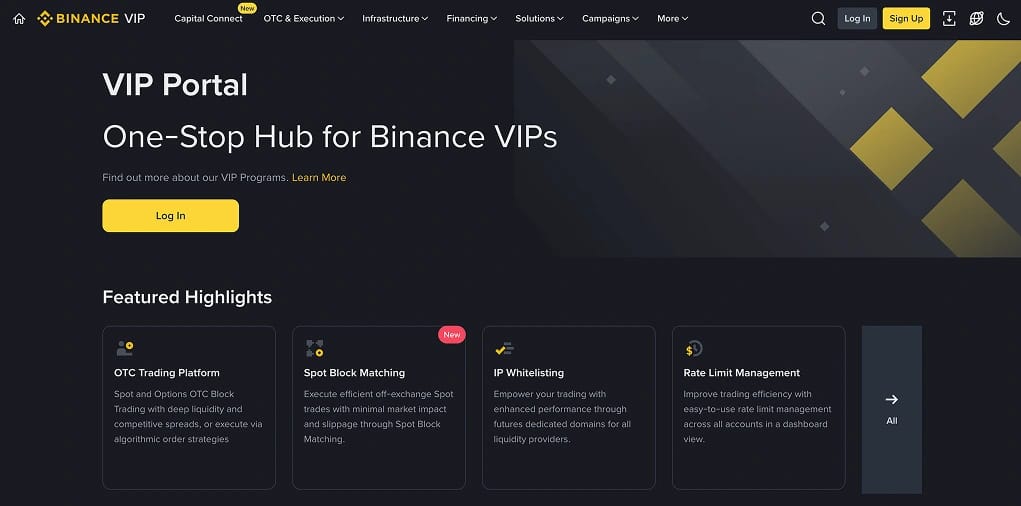
The service layer changes as much as the pricing. Every VIP receives 24/7 priority support, and higher tiers are assigned dedicated key account coverage, meaning a named contact who handles escalations, product questions, and custom limit requests. Members track everything through two dedicated hubs, the My VIP section of the mobile app and the web-based VIP Portal, which bundles reporting, OTC desk access, and account configuration.
Operational headroom scales with rank too. VIPs can request customized withdrawal ceilings, elevated API rate limits, and expanded sub-account structures, which matter more than fee savings for anyone moving large amounts. Members also receive exclusive research and market intelligence, invitations to private events, product clinics run by Binance staff, and curated gift packs.
Institutional clients unlock a deeper toolset. That includes off-exchange custody through Ceffu, Banking Triparty arrangements that let firms post collateral with a regulated bank while trading on Binance, portfolio margin across accounts, and credit through the VIP Loan desk. Firms trading large blocks can lean on the OTC and execution desk, an area we cover in our guide to the best crypto OTC brokers.
The VIP Invitation Program for Traders on Other Exchanges
You do not need to build your record on Binance from zero. The VIP Invitation Program accepts verified proof of your latest 30-day trading volume from other platforms, and eligibility extends beyond crypto exchanges to traditional brokers, prime brokers, and FX brokers.
Approved applicants receive a tier one level above what their external volume would normally earn, held for two months, plus a welcome bonus. No BNB holding is required during the invitation period. The two-month window gives migrating traders discounted fees immediately while their on-platform activity catches up to the standard requirements. For desks weighing a move, it removes the cold-start penalty that usually makes switching venues expensive.
Individual vs Institutional VIP
Binance splits its VIP servicing into two profiles, and the difference is the shape of the support rather than the fee schedule. Individual VIPs get the retail-facing perks, covering a dedicated account manager, private events, live product clinics, gift packs, and the in-app My VIP hub.
Institutional VIPs are onboarded by relationship managers and given infrastructure instead. Sub-account governance, asset management tooling, custom reporting, API integrations, and an invitation to the annual Binance Institutional Summit sit on this side of the program.
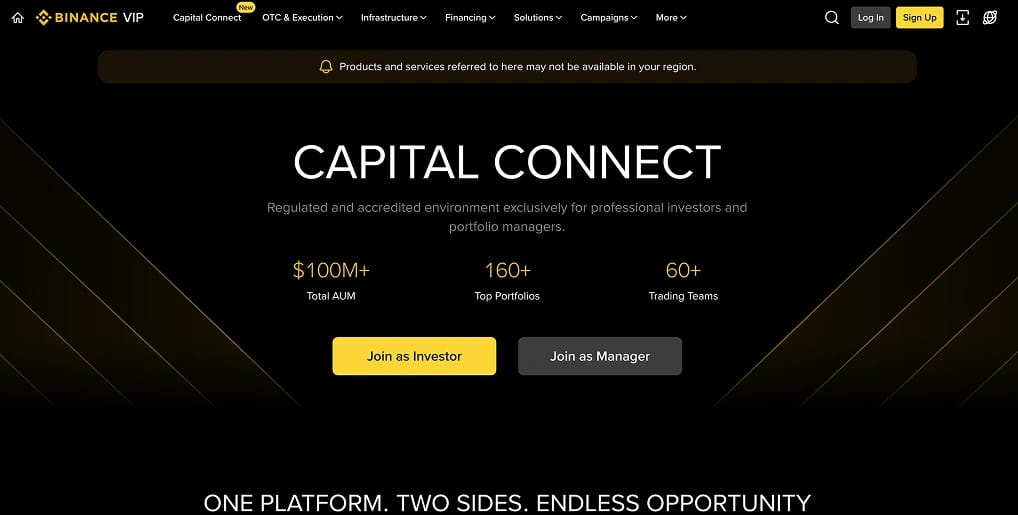
The exchange has also built out adjacent services for this audience, including Capital Connect for fund discovery, Binance Wealth for wealth managers onboarding clients, and a white-label Crypto-as-a-Service offering, a lineup that points toward full prime-brokerage coverage rather than a simple fee discount club.
How to Join the Binance VIP Program
Qualification is automatic once your numbers clear a threshold, so joining is mostly a matter of positioning your account.
- Create and verify an account: Register on Binance and complete identity verification, which Binance requires before full trading access.
- Pick your track: Decide whether volume, holdings, or borrowing is the cheapest benchmark for you to hit. A $100,000 average balance plus 5 BNB earns VIP 1 with no trading requirement.
- Hold the BNB minimum: Keep the required daily average BNB balance for your target tier, starting at 5 BNB, since most tracks treat it as a hard condition.
- Concentrate your activity: Spot volume pools across Margin, Convert, Copy Trading, and Trading Bots, OTC blocks count at 4x, and stock trading currently counts at 3x, so consolidating on one account accelerates progress.
- Check My VIP daily: Levels refresh at 08:00 UTC, and the hub shows your live volume, balance, and distance to the next tier.
- Or apply through the Invitation Program: Submit proof of your 30-day volume from another exchange or broker and receive a two-month tier boost while you transition.
New users can also stack a fee rebate by registering with our Binance referral code.
Final Thoughts
The through-line of this year's changes is access. Requirements that once made Binance VIP a professionals-only club, such as 25 BNB and $15 million in futures volume for VIP 1, have been cut to a fraction of their old levels, and the Holder track now runs the full ladder. A holder with $100,000 on the platform gets the same VIP 1 fee schedule as an active trader, which was not true a year ago.
Our read is that the Options fast-track and the 4x OTC multiplier are the two levers most underused by eligible traders. Both can vault an account several tiers past what its order-book volume alone would earn, and both were either new or newly uncapped this cycle. Derivatives-focused users should also weigh the schedule against rivals, and our breakdown of Bybit's VIP levels is the closest comparison, since Bybit leans on asset balances where Binance leans on volume.
For anyone already trading heavily elsewhere, the Invitation Program makes the decision straightforward. Two months of upgraded fees with no BNB requirement is enough time to test whether the liquidity advantage justifies the move.