



Can You Get Free Hyperliquid Testnet Tokens?
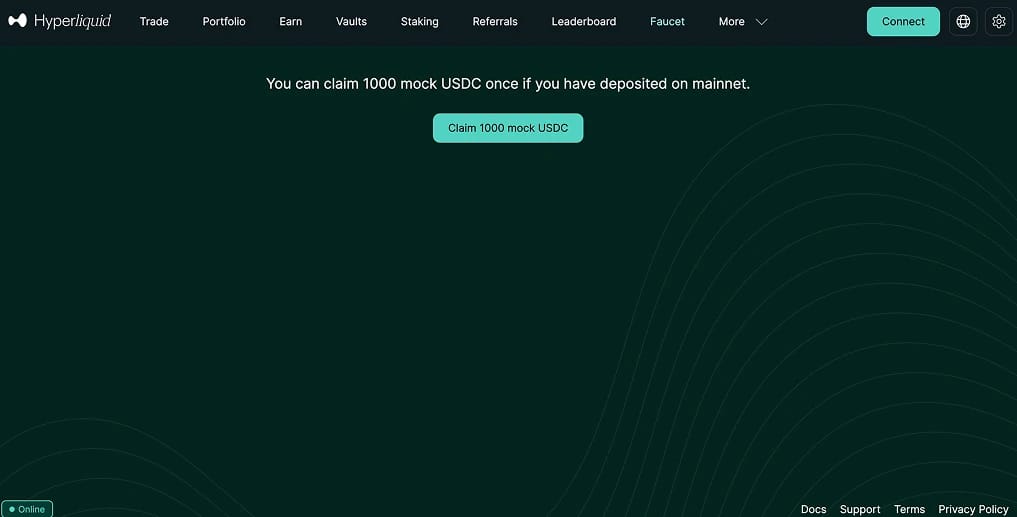
Yes, and there are several working paths. The official faucet hands out 1,000 mock USDC every four hours, with one catch: the docs require a mainnet deposit on the same address before the faucet pays out. That gating keeps bots out and reflects how tightly testnet identity is bound to mainnet activity.
The mock USDC lives on HyperCore. To get gas for HyperEVM, you either swap that USDC for testnet HYPE on the testnet trading interface and bridge it across, or skip the workflow with a third-party HYPE faucet. Both paths are covered below.
For builders, the second route is faster. Chainstack and QuickNode each run dedicated HyperEVM faucets, and im0xPrince's community faucet has been the default community option since it launched in December 2024.
How to Get Testnet USDC From the Official Faucet
This is the path the Hyperliquid team recommends and the one that gets you the largest mock balance. You need a Web3 wallet, a small mainnet deposit on the same address, and around five minutes.
- Set up a wallet for Hyperliquid. Rabby and MetaMask both work. Use a dedicated testing wallet rather than importing your mainnet seed phrase.
- Make a small mainnet deposit. The faucet checks for prior mainnet activity from the same address. A small USDC deposit through the Arbitrum bridge is enough. If you log in via email, Privy generates a different wallet for testnet, so export the mainnet wallet and import it into Rabby or MetaMask first.
- Switch to testnet. Open app.hyperliquid-testnet.xyz, connect your wallet, and confirm the network change.
- Claim 1,000 mock USDC. Click the drip button. Tokens land in your HyperCore balance within seconds.
- Repeat every four hours. The cooldown is enforced per address.
That mock USDC lets you trade testnet perps and spot pairs on HyperCore immediately. To use it on HyperEVM, the next section covers the bridging step.
How to Get Testnet HYPE on HyperEVM
HyperEVM gas is paid in HYPE, and there are two ways to fund a wallet. Pick the one that fits your workflow.
Path 1: Swap and bridge from HyperCore. Once you have mock USDC, sell it for testnet HYPE on the testnet trading interface. Then send the HYPE from HyperCore to HyperEVM by transferring it to 0x2222222222222222222222222222222222222222, the native bridge address. The transfer settles in the same block on both sides.
Path 2: Use a HYPE-direct faucet. Skip the swap and pull HYPE straight to your HyperEVM address. Three options work in 2026:
- Chainstack faucet: 1 HYPE every 24 hours, no Twitter authentication, requires a Chainstack API key.
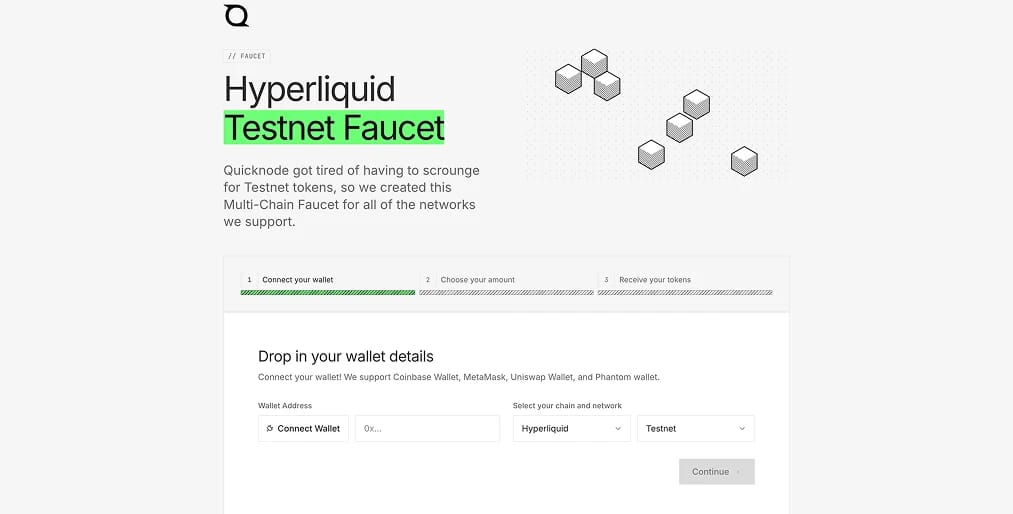
- QuickNode multi-chain faucet: Single HYPE drop in exchange for a tweet, plus an Ethereum mainnet balance check.
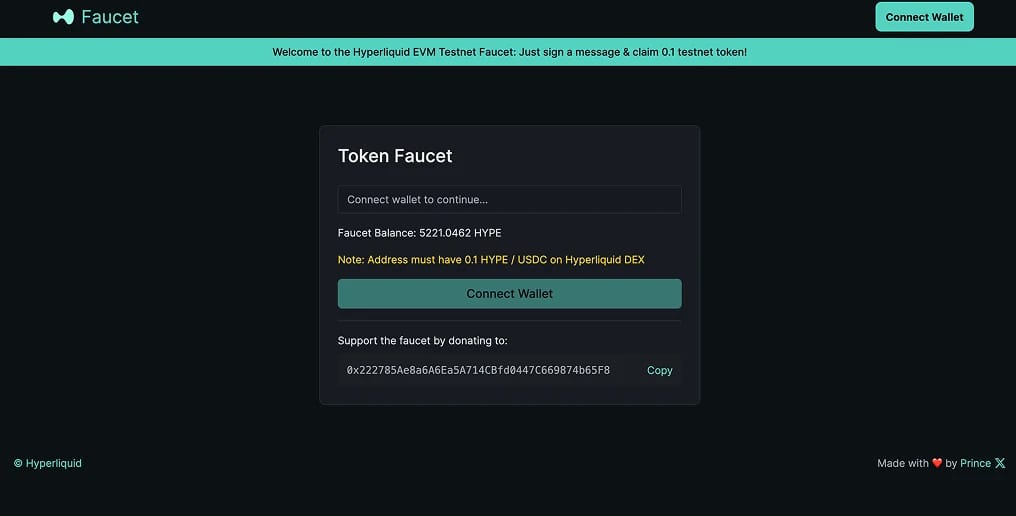
- im0xPrince community faucet: The original Hyperliquid testnet HYPE faucet. The connected wallet must hold at least 0.1 HYPE or USDC on mainnet, an anti-bot measure added in late 2024.
Before claiming, add HyperEVM to MetaMask. The testnet details are Chain ID 998, RPC URL https://rpc.hyperliquid-testnet.xyz/evm, currency symbol HYPE, and explorer testnet.purrsec.com. Adding via Chainlist is the fastest way to avoid typos.
What Is the Hyperliquid Testnet?
The Hyperliquid testnet is a parallel version of mainnet where HYPE, USDC, and all listed assets carry no monetary value, letting builders deploy contracts and traders rehearse strategies risk-free. It mirrors mainnet's dual architecture: HyperCore handles the order book, and HyperEVM runs Solidity contracts under the same HyperBFT consensus.
Both layers share state, so a smart contract on HyperEVM testnet can read live order book prices from HyperCore via read precompiles and submit orders through write system contracts. That composability went live with the CoreWriter upgrade in July 2025 and is the defining feature of building on Hyperliquid versus a generic L1.
The testnet is where most new Hyperliquid features ship first. HIP-3, the permissionless perpetual market deployment framework, ran on testnet for months before its October 2025 mainnet launch. HIP-4, which introduced fully collateralized prediction markets, followed the same pattern in early 2026.
Understanding HyperEVM Block Architecture
HyperEVM uses dual-block architecture, one of the few EVM execution models that does. Small blocks arrive every second with a 2 million gas limit and handle routine transactions. Big blocks arrive every minute with a 30 million gas limit, designed for heavy operations like contract deployment.
User-level transactions land in small blocks automatically. To deploy a contract larger than 2M gas, switch your wallet to big-block mode using a LayerZero composer or the block toggle UI. It's a detail you only encounter the first time a deployment fails, and worth working through on testnet rather than mainnet.
What Can You Do With Hyperliquid Testnet Tokens?
Mock USDC on HyperCore and testnet HYPE on HyperEVM cover most of what mainnet Hyperliquid offers.
- Trade perps and spot: Open positions on testnet versions of BTC, ETH, SOL, and the listed altcoin perps with up to 40x leverage. Useful for rehearsing portfolio margin behaviour or testing market-making bots without risking capital.
- Deploy smart contracts on HyperEVM: Solidity contracts compile and deploy with the same Foundry, Hardhat, and Remix toolchains used on Ethereum. The testnet block explorer supports verification through Sourcify.
- Test HIP-3 perp deployment flows: Builder-deployed perps require staking 500,000 HYPE on mainnet, but the deployment logic itself can be exercised on testnet first. Several teams use it to dry-run market launches before paying the mainnet stake.
- Build trading bots and indexers: The HyperEVM testnet RPC at
https://rpc.hyperliquid-testnet.xyz/evmis rate-limited to 100 requests per minute on the public endpoint, a cap introduced in August 2025. For heavier workloads, Alchemy, Chainstack, and QuickNode offer private testnet endpoints. - Explore HyperEVM dApps: Most live HyperEVM protocols, including the lending and liquid staking projects covered in our top HyperEVM projects roundup, maintain testnet deployments. Trying lending markets, vaults, or LST minting on testnet is a fast way to evaluate a protocol before committing real HYPE.
Other Hyperliquid Testnet Faucets
When the official faucet is on cooldown or you can't satisfy the mainnet deposit requirement, a few backups cover the gap.
- Chainstack faucet is the most consistent third-party option. 1 HYPE per 24 hours, no social verification, just a Chainstack API key.
- QuickNode multi-chain faucet drops a single HYPE per claim in exchange for a tweet. Useful as a one-time top-up rather than a daily source.
- im0xPrince community faucet was the first dedicated HyperEVM faucet and remains the easiest entry point if you already meet its 0.1 HYPE or USDC mainnet threshold.
- Stakely Hyperliquid faucet is a Twitter-gated alternative that has been stable through 2026, useful when others are rate-limited.
For a wider look at faucets across other networks, see our best crypto faucets roundup.
Final Thoughts
Hyperliquid's testnet is more involved than a typical EVM faucet because the protocol runs two layers. The official faucet covers HyperCore with mock USDC, and HyperEVM gas comes from a separate set of community and infrastructure provider faucets. Once both are funded, testing behaves close to mainnet, with sub-second finality and the same precompile system that makes HyperCore liquidity readable from Solidity.
If you're new to Hyperliquid, an hour spent placing testnet orders, deploying a small contract, and watching how HyperCore and HyperEVM communicate is the fastest way to grasp why the chain is structured the way it is. When you're ready for real capital, our bridge to Hyperliquid guide covers moving USDC in from Ethereum and other networks, and the Hyperliquid referral code cuts trading fees by 4% on your first $25 million in volume.