




What are Coinhako Fees?
Coinhako occupies an awkward spot in the Singapore market. It is the easiest local platform to fund with Singapore dollars, it holds the highest tier of MAS payment license, and it also charges the steepest headline rate of any licensed venue serving retail customers here.
Its ownership changed on 16 July 2026, when Japanese financial group SBI Holdings completed the purchase of a majority stake, with wholly owned unit SBI Ventures Asset handling the transaction. Coinhako is now a consolidated subsidiary of a listed parent with a regional tokenization and stablecoin agenda, which makes the current fee schedule worth reading closely.
Below is every charge the platform applies, where the unpublished cost sits, and what the same trade costs elsewhere.
How Coinhako Prices a Trade
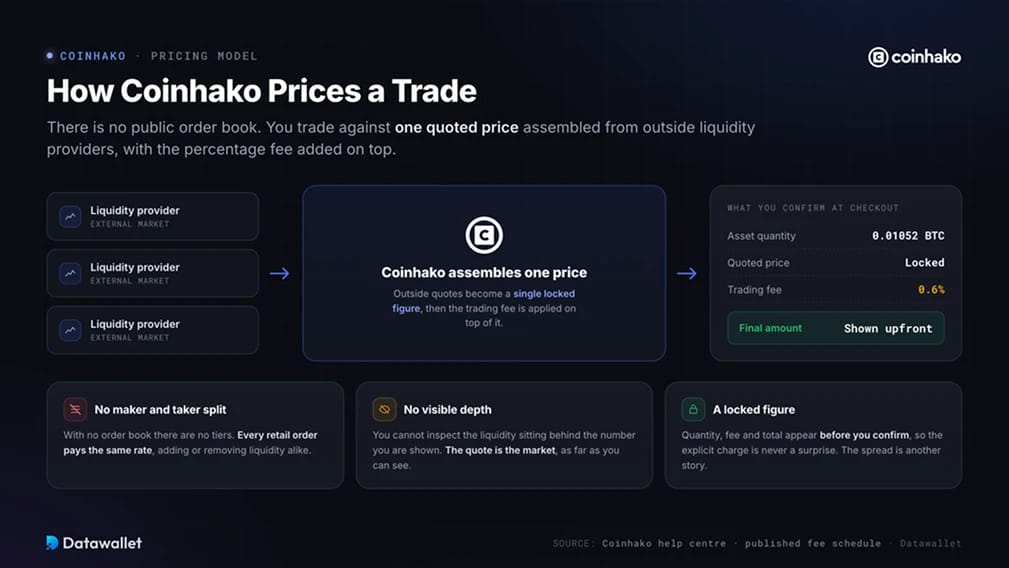
Coinhako has no public order book for retail customers. You buy and sell against a price the platform quotes, assembled from outside liquidity providers, and the percentage fee is applied on top of that quote. This one design choice drives almost everything else about its cost structure.
Because there is no order book, there is no maker and taker split. Every retail order pays the same rate whether it would have added liquidity or removed it, which is why Coinhako's schedule looks nothing like the tiered maker and taker grids used by global exchanges. It also means you cannot inspect the depth sitting behind the number you are shown.
What you do get is a locked figure. Coinhako displays the asset quantity, the percentage fee, and the final amount before you confirm, so the explicit charge is never a surprise. The implicit charge is a separate question, and the section below covers it.
Coinhako Trading Fees
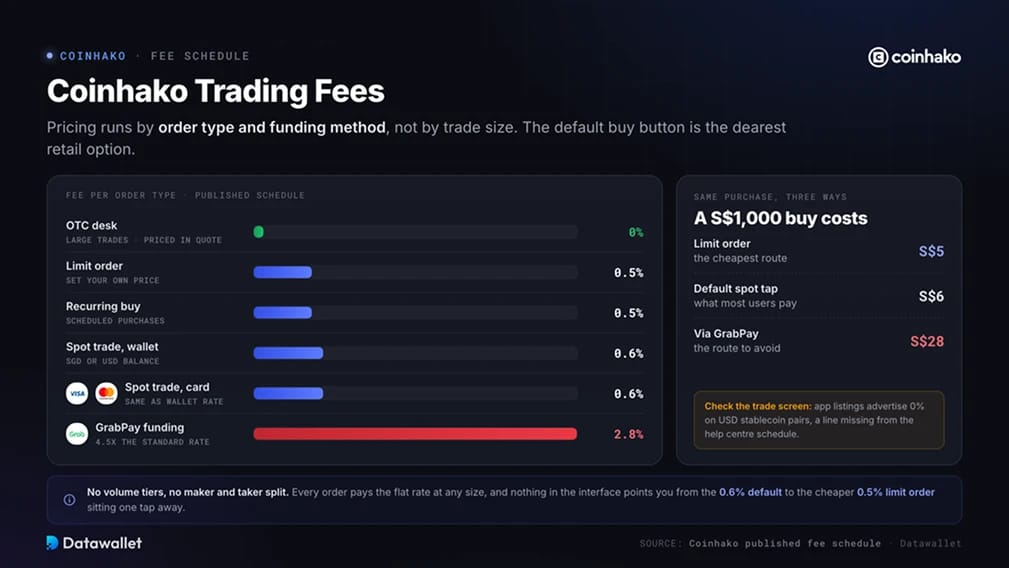
Coinhako prices by order type and funding method rather than by trade size. These rates come from the platform's published fee schedule.
- Spot trade in SGD or USD from your Coinhako wallet: 0.6%
- Spot trade in SGD funded by card: 0.6%
- Spot trade in SGD funded by GrabPay: 2.8%
- Limit order: 0.5%
- Recurring buy: 0.5%
- OTC desk: 0%
What the schedule means in practice:
- The default is the dearest retail option: Tapping buy on the trade screen puts you on the 0.6% spot rate, and nothing in the interface pushes you toward the cheaper alternatives.
- Limit orders now exist and cost less: Coinhako added limit orders after years of market-only trading, and they carry 0.5%. Setting a price you are willing to pay is the simplest way to shave a sixth off the fee on a single purchase.
- Recurring buys match that rate: Scheduled purchases also run at 0.5%, so anyone averaging into a position monthly is already paying the lower number.
- Card funding no longer carries a penalty: Card-funded spot trades sit at the same 0.6% as wallet-funded ones. Older comparisons that quote a 2.8% instant funding charge on cards are out of date.
- GrabPay is the outlier: Funding a trade from a GrabPay wallet costs 2.8%, roughly four and a half times the standard rate, which makes it the most expensive way to buy on the platform.
- OTC carries no percentage: The institutional desk quotes large trades with no fee line, pricing the service into the quote instead.
On a S$1,000 purchase, the spot rate costs S$6 and a limit order costs S$5. The same S$1,000 through GrabPay costs S$28. Coinhako's app listings also advertise 0% on USD stablecoin trades, a line that does not appear in the help center schedule, so check the breakdown on the trade screen before assuming it applies to your pair.
Coinhako’s Spread Costs
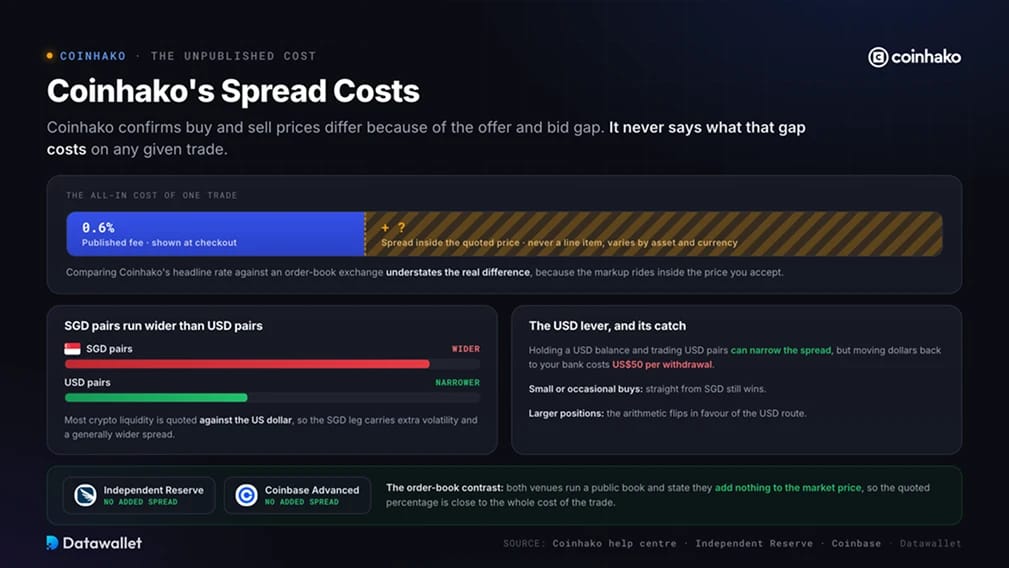
In its own help centre, the platform explains that buy and sell prices differ because of the gap between the quoted offer and bid, and says it works with market partners to pass on competitive pricing. That describes a brokerage model honestly. It does not tell you what the gap costs on any given trade.
Two consequences follow. First, the all-in cost is 0.6% plus an unstated markup, so comparing headline rates against an order-book exchange understates the difference. Second, the markup varies by asset and currency. Coinhako notes that SGD pairs carry more volatility than USD pairs because most crypto liquidity is quoted against the dollar, so the SGD leg is generally wider.
Singapore buyers have a lever here. Holding a USD balance and trading USD pairs can narrow the spread, at the cost of US$50 whenever you move dollars back to your bank. For small or occasional purchases, buying straight from SGD still wins. On larger positions, the arithmetic flips.
Order-book exchanges work differently. Independent Reserve says outright that its book is public and that it adds nothing to the market price, and Coinbase makes the same claim for its Advanced interface. On those platforms, the quoted percentage is close to the whole cost.
Coinhako Deposit and Withdrawal Fees
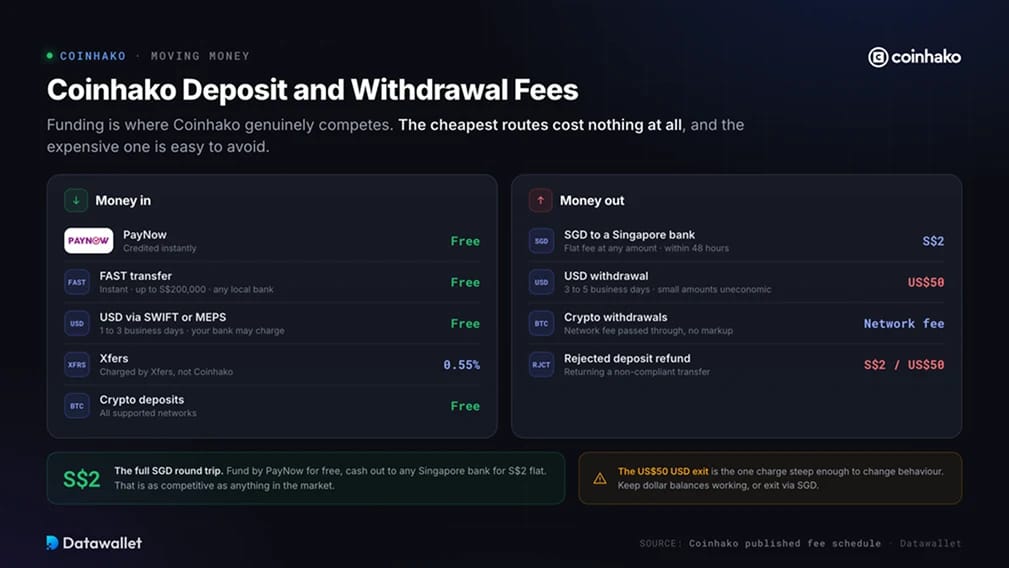
Funding is where Coinhako genuinely competes, and the cheapest options cost nothing at all.
- PayNow deposits: Free and credited instantly, which is the reason most Singapore users pick the platform in the first place.
- FAST deposits: Free, instant, and supported up to S$200,000 from any local bank account, including DBS, OCBC, UOB and Standard Chartered.
- USD deposits: No Coinhako charge on incoming SWIFT or MEPS transfers, though your own bank will usually take a cut and settlement runs one to three business days.
- Xfers deposits: Still listed at 0.55%, charged by Xfers rather than by Coinhako.
- SGD withdrawals: A flat S$2 regardless of amount, normally processed within 48 hours.
- USD withdrawals: US$50 per transaction, taking three to five business days, which is steep enough to make small dollar withdrawals uneconomic.
- Rejected deposit refunds: Returning a non-compliant SGD deposit costs S$2 and a USD one costs US$50, an easy charge to miss until it lands.
- Crypto transfers: Deposits are free. Withdrawals pass through the network fee, which Coinhako sets to cover blockchain costs rather than marking up.
For anyone funding by PayNow and cashing out to a Singapore bank, moving money in and out costs S$2 per round trip. That is competitive with anything in the market and cheaper than Independent Reserve's SGD 1.50 FAST withdrawal only in the sense that both are trivial.
Coinhako Fees Against Other MAS-Licensed Exchanges
Every platform below holds a Major Payment Institution license from MAS and supports Singapore dollar funding, so the comparison is like for like on regulation.
The gap widens the more you trade. A S$1,000 buy costs S$6 on Coinhako, S$5 on Independent Reserve before any volume discount, and S$1 on OKX at the entry taker rate. Run that monthly for a year, and the difference is S$60 against S$12, before counting the spread Coinhako does not print and the others do not add.
The premium does buy something. Coinhako is a homegrown platform with local support, SingPass-based verification, ISO 27001 and SOC 2 certification, and a decade of operating history under MAS supervision.
For a first-time buyer moving a few hundred dollars, that case holds. For anyone building a position, the arithmetic points elsewhere, which is why execution quality sits alongside the headline rate in our ranking of Singapore's best crypto exchanges.
Anyone comparing beyond the city-state can weigh the field in our list of the lowest-fee exchanges, and our Coinbase fee breakdown covers the closest global equivalent.
GST and Tax on Coinhako Trading Costs
Singapore's tax treatment is favorable, with one wrinkle that matters for fees. Since 1 January 2020, the supply of digital payment tokens has been exempt from GST, so buying Bitcoin with Singapore dollars does not attract the 9% rate on the tokens themselves.
IRAS is explicit, however, that the exemption does not extend to intermediaries such as exchanges, wallets and brokers, whose services remain taxable even when they relate to token transactions. If a platform bills you a separate commission, the tax position on that line is not automatically exempt, so read the fee breakdown at checkout rather than assuming.
On income tax, Singapore levies no capital gains tax, and gains from holding tokens as a long-term personal investment fall outside the net. IRAS applies the badges of trade in its e-Tax guide on digital tokens to decide whether activity is investment or trade, weighing frequency, holding period, organization and intent.
The practical upshot for an ordinary investor is that Coinhako's 0.6% is a pure cost with no tax offset, which is a further argument for minimizing it. Anyone whose trading pattern might be assessed as a business should keep the fee records, and our overview of low-tax crypto jurisdictions gives the wider regional picture. Nothing here is tax advice.
Final Thoughts
Coinhako is not expensive everywhere, but it is expensive in the place most users spend. Free PayNow funding and a S$2 withdrawal are as good as the market offers. The 0.6% default trade, plus a spread the platform acknowledges and never sizes, is where the money goes.
The two levers that matter are simple. Switching from spot to limit orders or recurring buys takes the rate to 0.5% immediately, and moving larger flows to an order-book venue takes it far lower than that. The rewards program, after two rounds of regulatory tightening, no longer moves the needle.
We would frame the decision by trade size. If you are buying a few hundred dollars occasionally and value a Singapore-licensed platform with local support and instant SGD access, the premium is small in absolute terms and defensible.