


Compare the Best USDT Exchanges
1. OKX
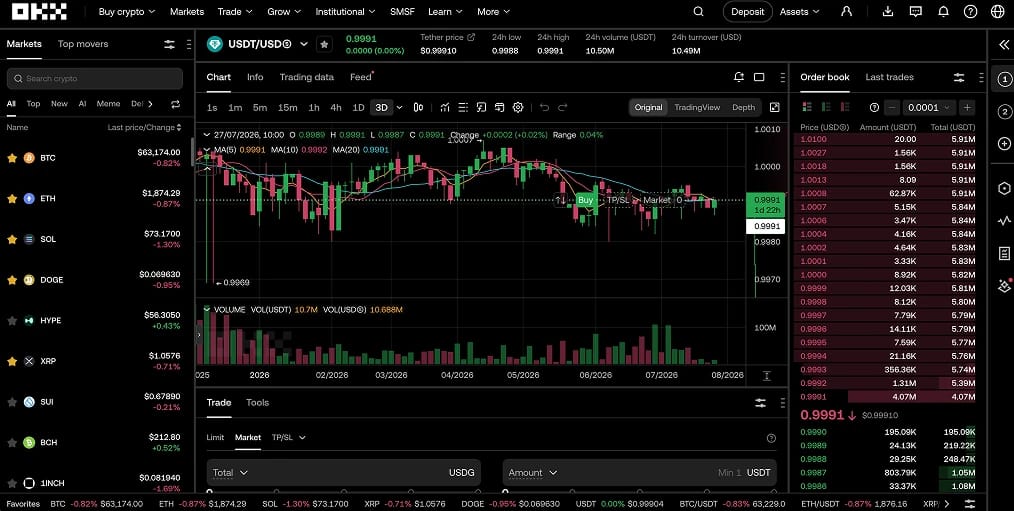
OKX tops this list by combining the lowest headline fees of any major USDT venue with the widest licensed footprint. Spot trades cost 0.08% maker and 0.10% taker at the base tier, hundreds of pairs quote directly in USDT, and separately regulated entities serve the EEA under a Malta MiCA licence, the UAE under a Dubai VARA permit, Singapore under an MAS Major Payment Institution licence, and the US through a dedicated platform relaunched in April 2025.
The licences cut both ways. OKX Europe cannot list USDT at all under MiCA, and until mid-July it froze USDT sent to European accounts by mistake, before adding a one-way conversion into USDC. Everywhere else, USDT remains the quote currency for most of the order book, backed by monthly Merkle-tree proof-of-reserves publications.
The record carries one large asterisk. An OKX affiliate paid the US Department of Justice more than $500 million in February 2025 for operating an unlicensed money-transmitting business, the settlement that preceded its compliant US relaunch. The rebuilt entity structure is stronger for it, and our OKX review tracks the full picture.
Pros
- Base spot fees of 0.08% maker and 0.10% taker undercut every other exchange here.
- Licensed entities in the EEA, UAE, Singapore, Australia, and the US.
- Monthly proof-of-reserves publications and a built-in Web3 wallet spanning 100+ chains.
Cons
- USDT cannot be traded on OKX Europe, and mistaken deposits there are frozen pending conversion or return.
- The February 2025 DOJ settlement remains a blemish on the compliance history.
- The US platform lists a narrower asset range than the global exchange.
2. Bybit
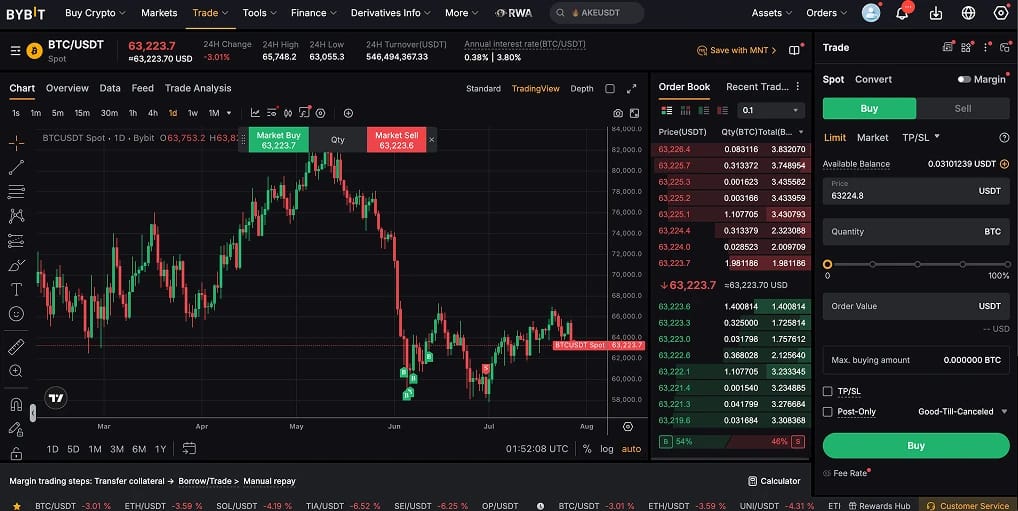
Bybit is where USDT works hardest as collateral. The exchange lists around 700 USDT-margined perpetual contracts alongside 400+ spot pairs, ranks second globally by trading volume, and fills flagship pairs like BTC/USDT with depth only Binance consistently beats. Spot fees start at 0.10% and fall through VIP levels, and idle USDT earns in flexible savings products between trades.
Its security history deserves a direct account. In February 2025, North Korean state hackers stole roughly $1.5 billion in Ether from Bybit, the largest crypto theft on record. Bybit covered the loss from its own reserves and bridge financing, kept withdrawals open, and no customer lost funds, a response that strengthened its standing.
Europe is the other caveat. Bybit is restricting its global platform for EEA residents and directing them to Bybit EU, a Vienna-based entity licensed under MiCAR in Austria that offers spot trading only and, like every licensed EU venue, no USDT. Traders elsewhere get the full derivatives range, which our Bybit review covers in depth.
Pros
- Around 700 USDT-margined perpetual contracts, the deepest derivatives coverage on this list.
- Absorbed the largest hack in crypto history without passing a single loss to customers.
- Copy trading, a unified trading account, and USDT earn products round out the toolkit.
Cons
- The February 2025 breach showed that even multi-signature cold storage arrangements can fail.
- EEA residents lose the global platform and get a spot-only licensed alternative without USDT.
- Spot maker pricing at the base tier trails OKX and Binance.
3. Kraken
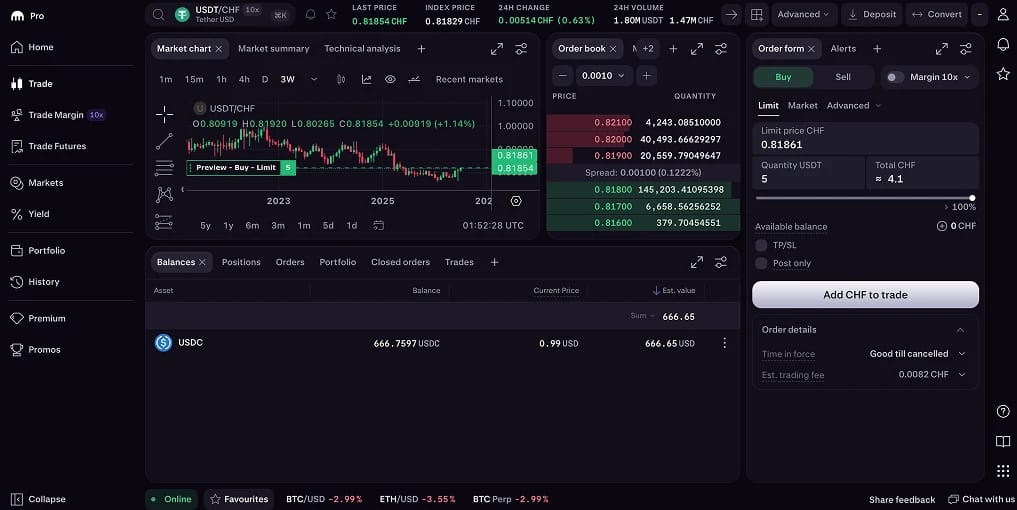
Kraken earns third place by solving the problem most USDT guides ignore, turning Tether back into money in a bank account. USDT/USD is routinely Kraken's single most active market by public volume data, so large conversions clear against a genuine order book rather than a spread-marked quote. Kraken Pro charges 0.25% maker and 0.40% taker at the base tier, and the exchange serves US customers outside New York and Maine, plus the UK, Australia, and Canada.
Funding is the practical strength. Free or near-free deposits run over ACH in the US, Faster Payments in the UK, SEPA in Europe, and PayID in Australia. Proof-of-reserves attestations date back to 2014, and no customer funds have ever been lost to a platform breach. Kraken is the venue we point to for holding USDT briefly and exiting cleanly to fiat.
The European limitation is structural. Kraken's EU arm, Payward Europe Solutions, holds a MiCA licence and therefore wound down USDT support for EEA clients through a staged sell-only period ending in March 2025. US access also carries a long-range question mark, since the GENIUS Act's safe harbour for foreign-issued stablecoins expires in July 2028. Our Kraken review has the full platform detail.
Pros
- USDT/USD is among the deepest regulated Tether-to-dollar order books anywhere.
- Free or low-cost local funding across ACH, Faster Payments, SEPA, and PayID.
- Proof of reserves since 2014 and a security record without a customer-fund breach.
- USDT trades directly against seven fiat currencies, including USD, EUR, GBP, CHF, and AUD.
Cons
- No USDT for EEA clients, a consequence of holding a MiCA licence.
- Unavailable to residents of New York and Maine.
- Pro fees at the base tier cost more than OKX, Bybit, or Binance for active traders.
4. Coinbase
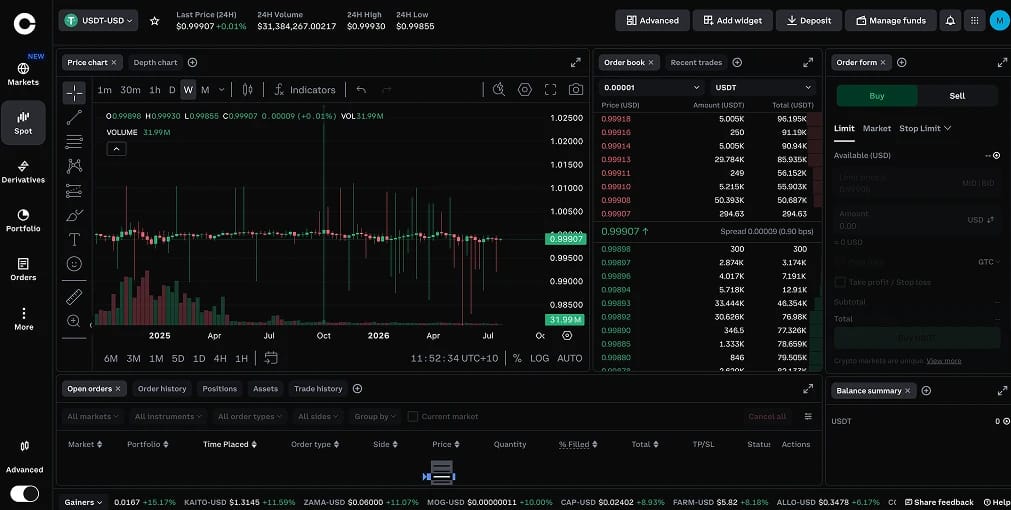
Coinbase is the pick for anyone who wants USDT exposure inside the most heavily supervised account in crypto. The S&P 500 company holds a New York BitLicense, files audited public accounts, and lists USDT for US customers on Coinbase Advanced, where dollar deposits by ACH are free and tradable within minutes. For a large USDT position, no rival on this list matches its disclosure obligations.
Coinbase co-founded USDC alongside Circle and earns revenue from USDC balances, so its product pushes users toward Tether's main competitor, and its USDT markets are conversion venues more than trading venues. It was also the first major exchange to delist USDT for EEA users, in December 2024, well before the MiCA deadline forced the issue.
Pricing is where the case weakens. Coinbase Advanced opens at 0.40% maker and 0.60% taker, the highest base order-book fees here, and simple buys stack a spread on top. For occasional conversions under strong regulation the pricing is tolerable, and our Coinbase review weighs where it stops making sense.
Pros
- Public-company disclosure, a NY BitLicense, and free ACH funding for US customers.
- USDT remains listed for Americans while many regulated rivals reduce support.
- The gentlest interface on this list for a first stablecoin purchase.
Cons
- Base fees of 0.40% and 0.60% are the highest order-book rates in this comparison.
- Its USDC economics mean USDT sits awkwardly in the product, with thin pair coverage.
- No USDT access for EEA customers since December 2024.
5. BloFin
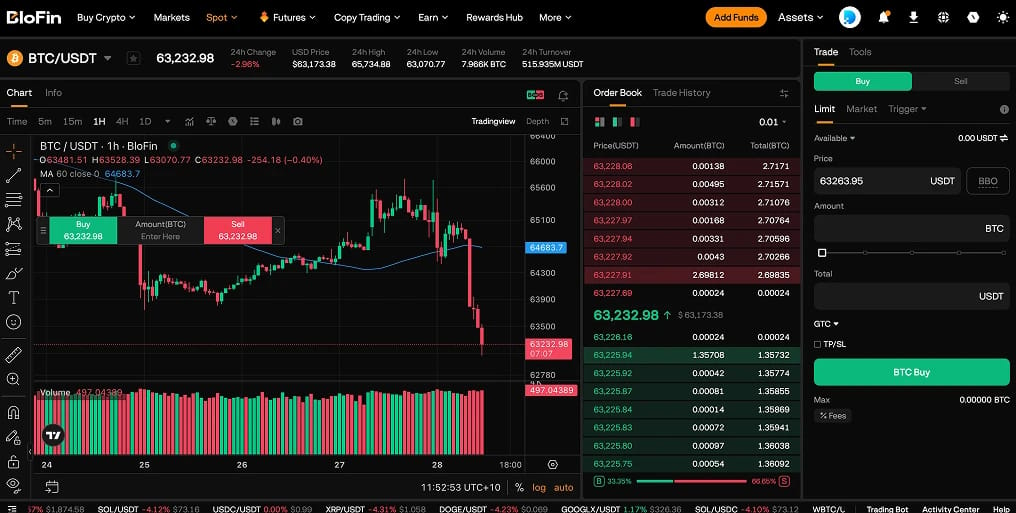
BloFin is on this list for one capability, weighed here against its risks. The derivatives-first exchange lets anyone trade 350+ USDT-margined perpetual contracts and 400+ spot pairs with nothing more than an email address, and unverified accounts can withdraw up to 20,000 USDT per day. Spot fees start at 0.10%, futures at 0.02% maker and 0.06% taker, and leverage stretches to 150x on majors.
Classify the risk before the convenience. BloFin holds no licence from any major financial regulator, operates through an offshore corporate structure, and offers no supervisory authority to appeal to if something goes wrong. Security infrastructure is real, but infrastructure is not oversight. Fiat purchases run through third-party processors that impose their own identity checks, so the no-KYC experience applies only to crypto-funded accounts.
Availability has hard edges too, with the US, Canada, and Singapore among 40+ excluded jurisdictions listed in our BloFin restricted countries guide. For traders who accept unregulated counterparty risk in exchange for privacy, it leads the field we cover in our no-KYC USDT guide. Treat position sizes accordingly.
Pros
- Full spot and 150x futures access with no identity documents, up to 20,000 USDT in daily withdrawals.
- Competitive futures pricing at 0.02% maker and 0.06% taker.
- Fireblocks MPC custody, ISO 27001 certification, and recurring proof-of-reserves publications.
Cons
- No licence from any major financial regulator and no authority to escalate disputes to.
- Restricted in 40+ jurisdictions including the US, Canada, and Singapore.
- Cash purchases rely on third-party processors charging roughly 3.5% to 5%, with their own KYC.
6. Binance
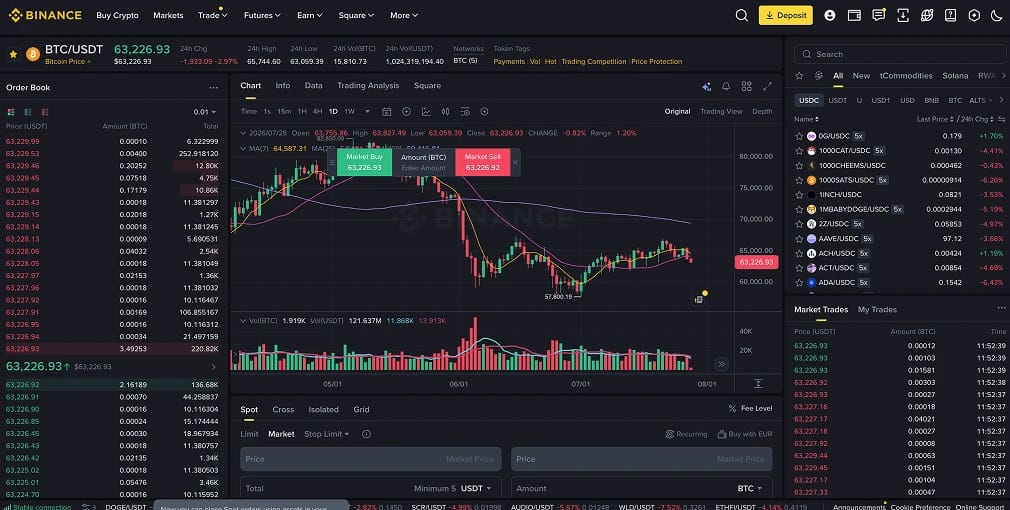
Binance still runs the deepest USDT markets in existence. BTC/USDT alone regularly clears more than $1 billion in daily volume, more than 400 spot pairs quote in Tether, spot fees sit at 0.10% or 0.075% paid in BNB, and the P2P desk matches buyers and sellers across 100+ local currencies. In markets where banks will not touch crypto, from Turkey to Nigeria to Argentina, that P2P network is the reason USDT functions as a savings currency at all.
Sixth place reflects jurisdiction risk. Binance withdrew its Greek licence application in late June and stopped serving EEA residents on 1 July, leaving European users withdrawal-only access while it seeks authorisation elsewhere. The 2023 US Department of Justice settlement of $4.3 billion still shadows the compliance record, and Americans are limited to the separate Binance.US platform.
Outside those two regions the calculus is simpler. Nothing matches its combination of USDT liquidity, pair coverage, and earn products, and our Bybit vs Binance comparison shows how narrow the gap to its closest rival has become. We treat it as an execution venue first and diversify custody elsewhere.
Pros
- The deepest BTC/USDT and ETH/USDT order books available anywhere.
- P2P trading across 100+ local currencies keeps USDT accessible where banking is hostile.
- Broad earn products put idle USDT balances to work.
Cons
- No EEA service since 1 July, with existing European users limited to withdrawals.
- The 2023 DOJ settlement remains the largest enforcement action in crypto history.
- US residents must use the separate, smaller Binance.US platform.
How to Choose a USDT Exchange
Choosing a USDT exchange starts with where you live, because regulation now decides availability before fees or features matter.
- Check your jurisdiction first: EEA residents cannot buy USDT on any licensed venue, Americans have access with a 2028 compliance horizon, and UK, Australian, Gulf, and most Asian and Latin American users face no restriction. Confirm your country against each exchange's restricted list before opening an account.
- Price the full round trip: A 0.10% spot fee means little if the withdrawal costs more. Sending USDT on Tron typically costs about 1 USDT, while Ethereum withdrawals can run several times that, a difference we explain in our TRC-20 USDT guide. Add the exit spread when you eventually convert back to fiat.
- Match funding to your bank: Free local transfers beat cards everywhere, whether that is ACH, SEPA, Faster Payments, or PayID. App-based banks are often the smoothest path, and our guides to buying crypto with Revolut and Monzo cover what each permits for UK buyers.
- Weigh licences against the products you need: Regulated venues restrict leverage and delist assets when rules demand it, while offshore venues offer everything and answer to no one. Decide which failure mode you can live with before real money is on the line.
- Plan the exit before the entry: Confirm withdrawal limits, especially on no-KYC tiers, check which networks the exchange supports for USDT, and make sure your bank will accept the eventual fiat proceeds without freezing the account.
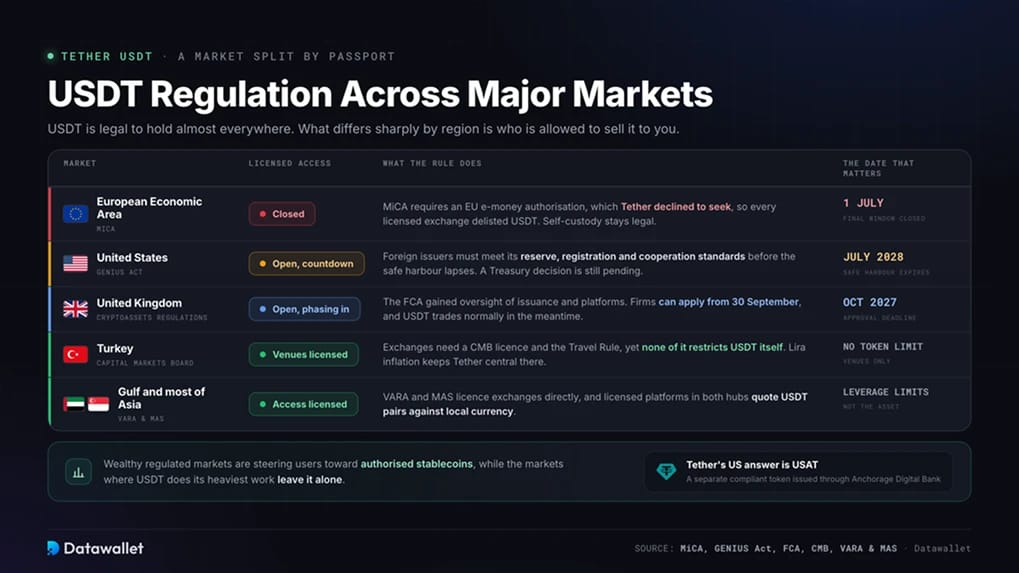
USDT Regulation Across Major Markets
USDT itself is legal to hold almost everywhere, but the rules governing who may sell it to you now differ sharply by region.
- The EEA is closed at the licensed venue level: MiCA requires stablecoin issuers to hold an EU e-money authorisation, which Tether declined to seek, so every MiCA-licensed exchange had delisted USDT by the time the final transition window closed on 1 July. Holding, transferring, and self-custody remain legal, and our guides to buying USDT in Europe and the MiCA-licensed exchanges map what still works.
- The US is open with a countdown running: The GENIUS Act of July 2025 created the first federal stablecoin framework, and foreign issuers like Tether must meet its reserve, registration, and cooperation standards before the safe harbour expires in July 2028 to stay on US platforms. Tether's answer so far is USAT, a separate US-compliant token issued through Anchorage Digital Bank this January, while a Treasury reciprocity decision for USDT itself remains pending. Our guide to buying USDT in the USA covers the practical picture.
- The UK stays open while its regime phases in: Parliament passed the Cryptoassets Regulations in February, handing the FCA oversight of stablecoin issuance and crypto platforms. Firms can apply for authorisation from 30 September, and any platform without approval by October 2027 must wind down UK operations. USDT trades normally on UK exchanges in the meantime, as our UK USDT guide details.
- Turkey licenses the venues, not the token: Exchanges serving Turkish users must hold a Capital Markets Board licence, meet capital requirements, and apply the Travel Rule to transfers, yet none of it restricts USDT itself. Persistent lira inflation keeps Tether central to Turkish crypto activity, covered in our Turkey USDT guide.
- The Gulf and most of Asia regulate access, not the asset: Dubai's VARA and Singapore's MAS licence exchanges directly, and licensed platforms in both hubs quote USDT pairs against local currency. Restrictions in the region tend to target derivatives leverage and marketing rather than the stablecoin.
Wealthy regulated markets are steering users toward authorised stablecoins, while the markets where USDT does its heaviest work leave it alone.
Where USDT Liquidity Sits
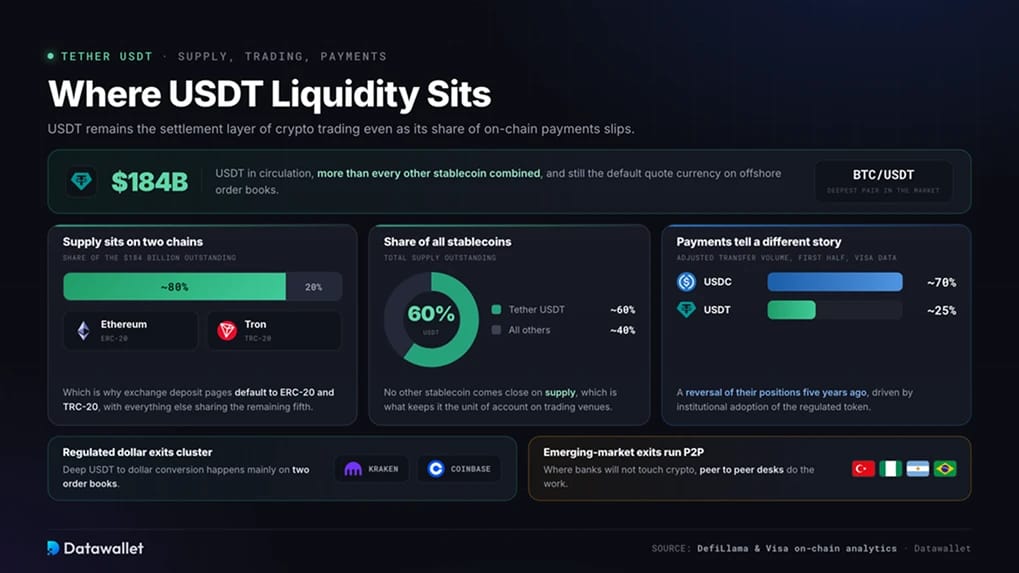
USDT remains the settlement layer of crypto trading even as its share of on-chain payments slips.
- Supply concentrates on two chains: Of the roughly $184 billion outstanding, Ethereum and Tron carry about 80% between them, which is why exchange deposit pages default to ERC-20 and TRC-20.
- Exchange trading still runs on Tether: USDT holds around 60% of total stablecoin supply and remains the default quote currency on offshore order books, with BTC/USDT the single deepest trading pair in the market.
- Payments tell a different story: Adjusted on-chain transaction data compiled by Visa showed USDC handling about 70% of stablecoin transfer volume in the first half of the year against roughly 25% for USDT, a reversal of their positions five years ago, driven by institutional adoption of the regulated token.
- Fiat exits cluster on a few order books: Deep, regulated USDT-to-dollar conversion happens mainly on Kraken and Coinbase, while emerging-market exits run through P2P desks. Full supply, chain, and volume figures live on our USDT statistics page.
USDT buys the tightest spreads on the way in, and the exit deserves as much planning as the entry.
How to Buy USDT
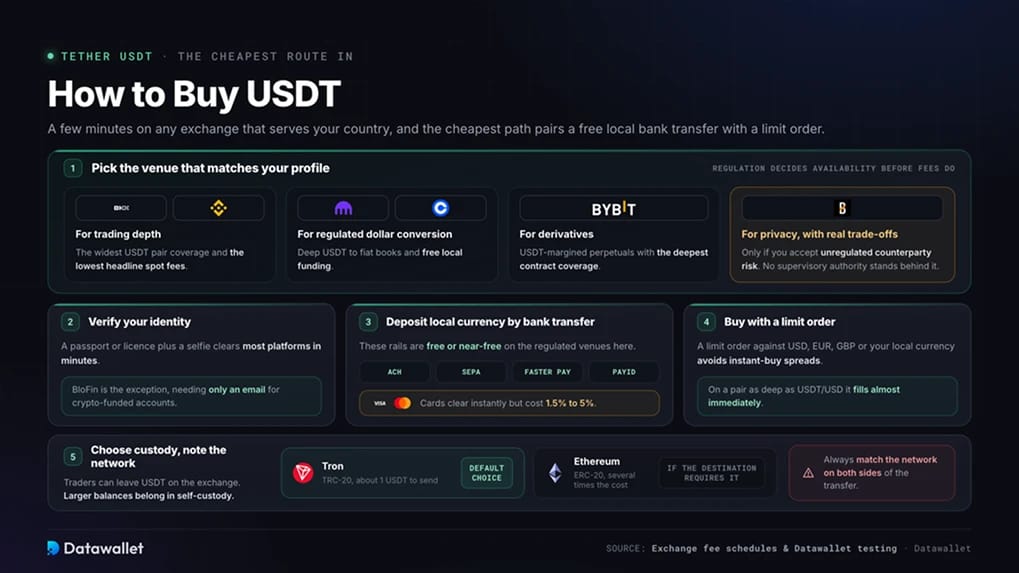
Buying USDT takes a few minutes on any exchange that serves your country, and the cheapest path pairs a free local bank transfer with a limit order.
- Pick the venue that matches your profile: OKX or Binance for trading depth, Kraken or Coinbase for regulated dollar conversion, Bybit for derivatives, BloFin only if you accept unregulated counterparty risk for privacy.
- Verify your identity where required: A passport or licence plus a selfie clears most platforms in minutes. BloFin is the exception, needing only an email for crypto-funded accounts.
- Deposit local currency by bank transfer: ACH, SEPA, Faster Payments, and PayID are free or near-free on the regulated venues here. Cards clear instantly but cost 1.5% to 5% depending on platform and processor.
- Buy with a limit order on the USDT market: A limit order against USD, EUR, GBP, or your local currency avoids instant-buy spreads, and on a pair as deep as USDT/USD it fills almost immediately.
- Choose custody and note the network: Leaving USDT on a regulated exchange suits active traders, while larger balances belong in self-custody, compared in our best USDT wallets guide. Withdraw on TRC-20 for low fees unless the destination requires another network, and always match the network on both sides.
Final Thoughts
OKX takes the top slot for pairing the cheapest major-venue fees with a licence map that survived the year's regulatory sorting. Bybit owns USDT-margined derivatives, Kraken and Coinbase convert Tether into supervised dollars better than anyone, BloFin serves the privacy niche for those who price its risks honestly, and Binance remains the execution benchmark everywhere it is still allowed to operate.
The deeper shift is that USDT's footprint and crypto's regulatory map are pulling apart. Europe has legislated the world's largest stablecoin off its licensed venues, Washington has started a compliance clock, and demand keeps compounding in the markets regulation reaches last. Whichever exchange you choose, the sensible test stays small. Move a modest amount in, trade it, withdraw it on a cheap network, and convert a slice back to fiat.
The round trip will reveal more about the platform than any feature list.
Our Methodology
We assessed each exchange against the criteria that matter specifically for USDT, verifying every claim against primary sources during July.
- Trust Score: Our proprietary rating out of 5, weighting regulatory standing, custody and reserve transparency, security history, enforcement record, and longevity.
- USDT Market Depth: Compared pair counts, headline volumes, and order book depth on flagship USDT markets using public exchange and aggregator data.
- Regulatory Standing: Verified licence claims against regulator registers and official exchange disclosures, including MiCA authorisations, US registrations, and Gulf and Asian permits, and recorded every enforcement action.
- Funding and Exit Paths: Confirmed supported deposit methods, fees, and withdrawal networks against each platform's published schedules, and how cheaply USDT converts back to fiat.
- Fee Structure: Compared published maker and taker schedules, native-token discounts, and network withdrawal costs across Tron and Ethereum.
- Security Record: Reviewed breach history, proof-of-reserves cadence, custody arrangements, and certifications, and how each platform responded when incidents occurred.
We excluded venues without meaningful USDT liquidity, platforms with unresolved solvency questions, and exchanges that restrict USDT everywhere they operate.