



Can I Buy USDT Without KYC?
Yes, through optional-KYC centralised exchanges, peer-to-peer marketplaces, or decentralised exchanges. The first treats no-KYC as a tier setting that can flip mid-withdrawal. The other two are structurally no-KYC by design.
BloFin, MEXC, and BYDFi are the main optional-KYC CEXs. Email signup unlocks spot trading and perpetuals, with unverified daily withdrawal caps that vary by platform. All sit outside major regulators' protection and can demand verification once balances scale.
For structural no-KYC, the routes are peer-to-peer marketplaces and DEXs. Hodl Hodl, Bisq, and RoboSats handle the P2P side through multisig escrow, Tor-only desktop trading, and Lightning Network swaps. Uniswap, 1inch, Curve, and Jupiter cover on-chain swaps from a self-custody wallet, though you need existing crypto since fiat onramps run their own KYC.
How to Buy USDT With No KYC
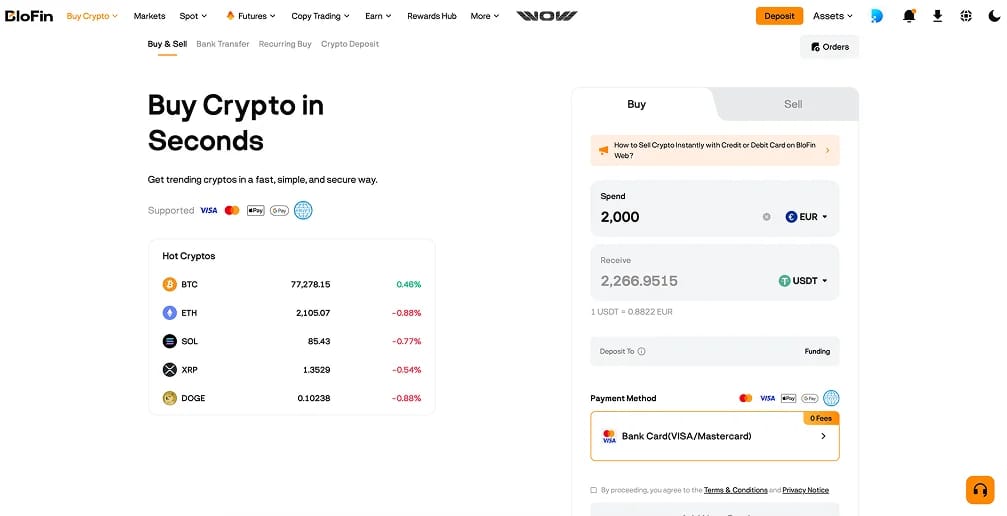
The best method is funding BloFin with crypto from an existing exchange or wallet, then either holding USDT or swapping at spot. If you are starting from fiat, the realistic options are buying BTC or ETH on a KYC venue and bridging across, or accepting KYC at a fiat onramp like MoonPay before swapping on a DEX.
I tested BloFin's signup end-to-end recently: from email confirmation to a funded spot wallet ready to trade ran under four minutes. The choke point was waiting for two confirmations on a TRC-20 USDT deposit, not anything on BloFin's side.
Steps to buy USDT on BloFin without verification:
- Create a BloFin account: Sign up at BloFin with an email address and a strong password, then confirm via the verification email. No ID upload, liveness check, or proof of address. Enable two-factor authentication via Google Authenticator or a hardware key before depositing.
- Deposit crypto: Open Assets, click Deposit, pick the asset and network. TRC-20 USDT costs around $1 in network fees and clears in two to three minutes. Sending BTC or ETH and swapping later adds a spot conversion step. Source-exchange Travel Rule prompts asking for destination wallet name: BloFin is a personal exchange wallet you control.
- Swap or hold: USDT deposits land in your spot wallet ready to use. For other assets, open Spot Trading, find the relevant USDT pair (BTC/USDT, ETH/USDT), and execute a market or limit order. Spot fees are 0.10% maker and 0.10% taker at tier zero, with discounts for volume or BLF token holdings.
- Move to self-custody or trade: USDT can sit in spot for trading, move into BloFin Earn (around 5.5% APY on flexible USDT as of April 2026), or withdraw to a self-custody wallet. The unverified daily withdrawal cap is 20,000 USDT across all networks. Minimum withdrawal is 10 USDT on TRC-20 with a $1 network fee.
No-KYC USDT Fees
All-in cost depends on deposit method, spread, network fees, and venue liquidity. Headline trading fees are only one piece.
Deposits and Onramps
- Crypto deposit to BloFin or MEXC: Free on the exchange side. You pay the source network fee. TRC-20 USDT around $1, Solana SPL under $0.10, BEP-20 under $0.50, ERC-20 between $2 and $15 depending on gas.
- Card purchase via Banxa, Mercuryo, or MoonPay: 3% to 5% all-in, and triggers KYC at the processor. This breaks the no-KYC premise unless you specifically need a fiat onramp.
- DEX swap via Uniswap, 1inch, or Curve: 0.05% to 0.30% pool fee depending on pair (Curve stable-to-stable runs 0.04% to 0.05%), plus gas. No platform fee on top.
- P2P via Hodl Hodl: 0.6% total (0.3% buyer plus 0.3% seller), with merchant spreads of 0.5% to 2% over mid-market depending on payment method and fiat. Bisq runs around 1.3% in trading fees plus BTC mining fees.
Trading
- BloFin Spot Maker / Taker: 0.10% / 0.10% at Level 0, dropping to 0.06% / 0.08% at Level 3 with 30-day volume above $1M.
- BloFin Futures Maker / Taker: 0.02% / 0.06%, competitive with Binance and Bybit.
- MEXC Spot Maker / Taker: 0% / 0.05% as a permanent baseline, the lowest of any liquid no-KYC venue.
- Uniswap V3 pool fees: 0.01%, 0.05%, 0.30%, or 1.00% by pair. Stablecoin swaps typically route through 0.01% or 0.05%.
Withdrawals
- Crypto from BloFin: Network fee only. TRC-20 USDT around $1, Solana SPL under $0.10, ERC-20 $2 to $15.
- No fiat withdrawal without KYC. BloFin, MEXC, and KCEX have no fiat off-ramp at the unverified tier. The realistic exit is holding USDT, swapping to BTC, or selling P2P.
All-in cost for an unverified BloFin user buying $5,000 of USDT from existing crypto sits around 0.15%.
Best No-KYC USDT Platforms
The table below ranks the venues most useful for buying USDT without verification, weighted on actual no-KYC scope, liquidity, fee structure, and security. For a broader ranking covering the best no-KYC crypto exchanges across all use cases, the DataWallet research desk maintains a separate piece.
Practical hierarchy: BloFin and MEXC for a familiar CEX UX without verification, Hodl Hodl for P2P with payment-method flexibility, Uniswap for fully on-chain self-custody swaps, and Bisq where structural decentralisation matters more than liquidity. Each makes a different tradeoff. None gives you both deep USDT liquidity and full regulatory protection.
Regulatory Status of No-KYC USDT in 2026
The regulatory perimeter around no-KYC crypto has tightened across 2024 and 2025 even though no-KYC venues themselves remain legal in most jurisdictions. Pressure comes from three directions.
The practical effect for no-KYC users concentrates at the off-ramp. Buying USDT without verification works in most countries. Converting that USDT back to fiat through a regulated bank is where the framework bites. Banks rely on Travel Rule data, and unexplained inflows from "unhosted wallets" or offshore exchanges trigger SAR filings under the Bank Secrecy Act and equivalent statutes elsewhere.
Tether's enforcement posture compounds this. Through partnerships with TRM Labs and the T3 Financial Crime Unit (joint with Tron Foundation), Tether proactively freezes addresses linked to OFAC SDN designations, sanctions evasion, and law enforcement requests. A September 2025 policy shift now publishes every blacklist event in real time.
Regional accessibility is the third pressure point. US residents are geoblocked from every meaningful no-KYC CEX (BloFin, MEXC, KCEX, BYDFi all reject US IDs and IPs). EEA users can reach BloFin and MEXC but neither holds MiCA authorisation, so MiCA's prudential and disclosure protections do not apply. UK residents can technically use them, but the FCA's financial promotions regime prohibits marketing them to UK consumers, which limits practical recourse.
Tax Implications of No-KYC USDT
No-KYC does not mean tax-free. Identity verification at the exchange affects information reporting, not your underlying tax obligations. Every major jurisdiction treats USDT trading like any other crypto transaction.
- Buying USDT with another crypto is a taxable disposal in most jurisdictions. Under the US (IRS Notice 2014-21), UK (HMRC Cryptoassets Manual), Australia (ATO TD 2014/26), and Canada (CRA T2125), swapping BTC or ETH into USDT is a taxable event valued at fair market value in local currency at trade time.
- Holding USDT generates no taxable event. Stablecoin holdings sit outside disposal events by virtue of being held, although yield on USDT (BloFin Earn, Aave, exchange savings) is taxable as income at receipt.
- Selling USDT for fiat is a disposal. Gain or loss between cost basis and disposal price is reportable. For users buying and selling at peg, gain is near zero, but the reporting obligation still applies.
- CARF rolls out from 2027. The OECD Crypto-Asset Reporting Framework requires participating jurisdictions to automatically exchange user crypto activity data. Tax authorities are increasingly cross-referencing on-chain analysis (Chainalysis, TRM, Elliptic) with banking records to identify undeclared activity.
- The off-ramp triggers audit risk. Selling USDT back to fiat is where banking AML, tax reporting, and on-chain analytics converge. Unexplained fiat inflows are independently reportable by your bank under SAR regimes regardless of where the USDT came from.
Keep transaction records (CSV exports from BloFin, wallet histories from Etherscan or Tronscan, P2P trade IDs) and consult a tax professional before any large realisation. Koinly, CoinTracker, and Awaken Tax all support BloFin, MEXC, and DEX activity through CSV or address imports.
Why Users Choose No-KYC USDT
Demand for no-KYC USDT runs along four specific lines.
- Geographic blocks. US residents in New York or Maine cannot use Kraken's main spot exchange. Residents of OFAC-sanctioned jurisdictions (Iran, North Korea, Cuba, Syria, Crimea) cannot reach any major regulated exchange. For these users, no-KYC venues are the only practical access point, though BloFin, MEXC, and most CEXs also geoblock US IPs entirely.
- Speed. A first BloFin trade can clear in under five minutes from signup. KYC on Kraken, Coinbase, or Binance typically clears in 10 to 60 minutes for standard cases, but stretches to days during high-volume periods or for edge-case ID documents.
- Privacy preference. Users in jurisdictions with weak data protection, who have experienced data leaks, or who simply want to limit their digital footprint, value minimising the number of platforms holding their passport, address, and biometrics. The 2024 WazirX exchange hack and 2025 Coinbase customer data leak show why this preference is rational rather than paranoid.
- Capital controls. In jurisdictions with formal or de facto restrictions on foreign currency (Argentina before 2024, Nigeria, Turkey, parts of Africa), USDT is the only practical dollar instrument, and no-KYC venues are how users access it without bank flagging. The fastest-growing region for stablecoin volume in the Chainalysis 2025 Global Crypto Adoption Index is Asia-Pacific, with sub-Saharan Africa close behind.
Final Thoughts
BloFin is the most usable no-KYC venue for USDT in 2026. Email signup, no ID upload, 20,000 USDT per 24-hour withdrawal cap at the unverified tier, FinCEN MSB and CIMA registrations, and Fireblocks-insured custody. For users who specifically need a no-KYC CEX, that is the working choice.
For fully decentralised access, Uniswap, 1inch, Curve, and Jupiter handle USDT swaps directly from a self-custody wallet with no signup. Hodl Hodl and Bisq cover the P2P case where structural no-KYC matters more than liquidity.
Treat balances on any no-KYC venue as operational capital, not long-term storage. Move USDT to a self-custody hardware wallet (Ledger, Trezor) once positions settle, and screen counterparty addresses through Phalcon Compliance or Chainalysis Reactor before transacting with unknown wallets, given Tether's active blacklisting.
For EEA users where MiCA blocks USDT on regulated CASPs, USDC is the working substitute on any MiCA-authorised venue. Circle's licensing and USDC's reserve attestations are at least as strong as Tether's, and on most use cases other than ultra-deep liquidity, USDC works identically.