



OKX Futures lets traders take long or short exposure on crypto and tokenized traditional assets through perpetual and expiry contracts, settled in stablecoins, fiat-linked USD, or the underlying coin. Leverage, funding, and margin behavior shift by product and account mode.
This OKX Futures review covers contract types, leverage tiers, maker-taker fees, funding mechanics, liquidation safeguards, security history, and regional access. It also weighs OKX against rivals like Binance and Bybit, so you can judge fit.
Review the key details below. 👇
What Is OKX Futures?
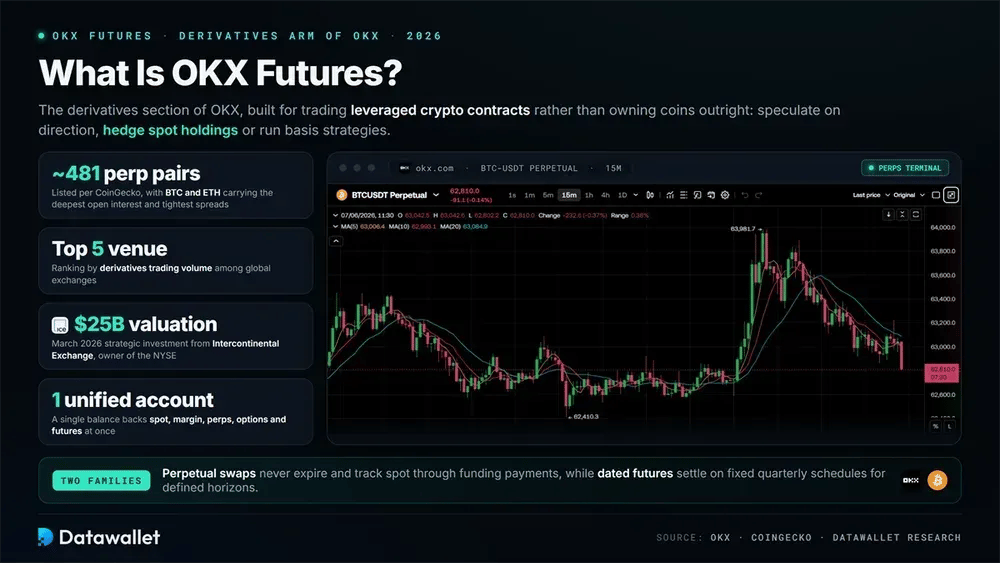
OKX Futures is the derivatives section of OKX, built for trading crypto contracts with leverage rather than owning coins outright. Traders speculate on price direction, hedge spot holdings, or run basis strategies across perpetual and dated markets settled in several collateral types.
The platform splits futures mainly into perpetual swaps and expiry futures. Perpetuals never expire and use funding payments to track spot, while dated futures settle on fixed quarterly or bi-quarterly schedules, giving traders defined horizons for calendar spreads, hedging, and event-driven positioning.
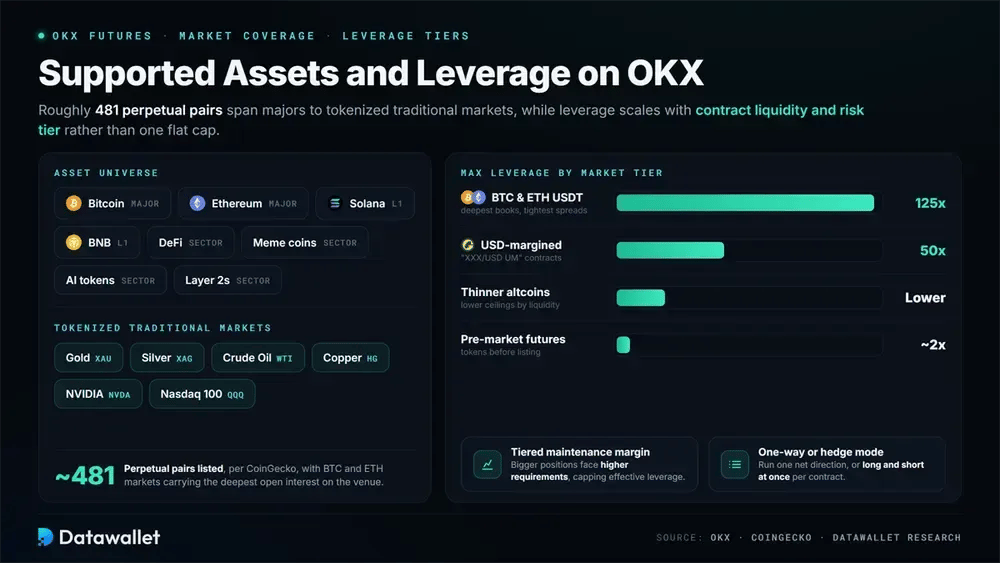
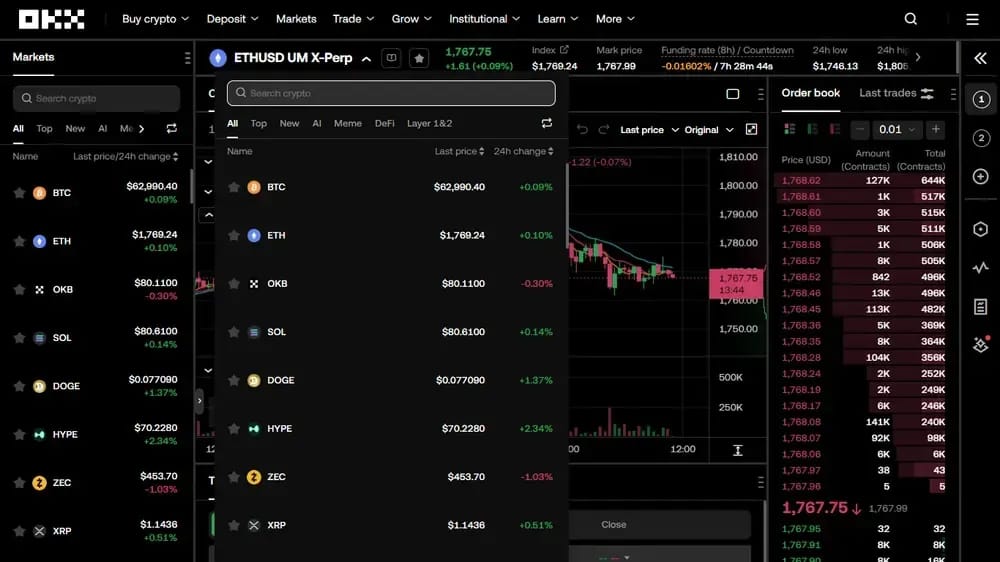
OKX operates a Unified Account, so a single balance can back spot, margin, perpetuals, options, and futures at once. According to CoinGecko, OKX Futures lists around 481 perpetual pairs, with BTC and ETH markets carrying the deepest open interest and tightest spreads on the venue.
In March 2026, OKX drew a strategic investment from Intercontinental Exchange, the owner of the New York Stock Exchange, at a reported $25 billion valuation. That backing, alongside a top-five ranking by trading volume, signals rising institutional weight behind the derivatives business.
How to Use OKX Futures
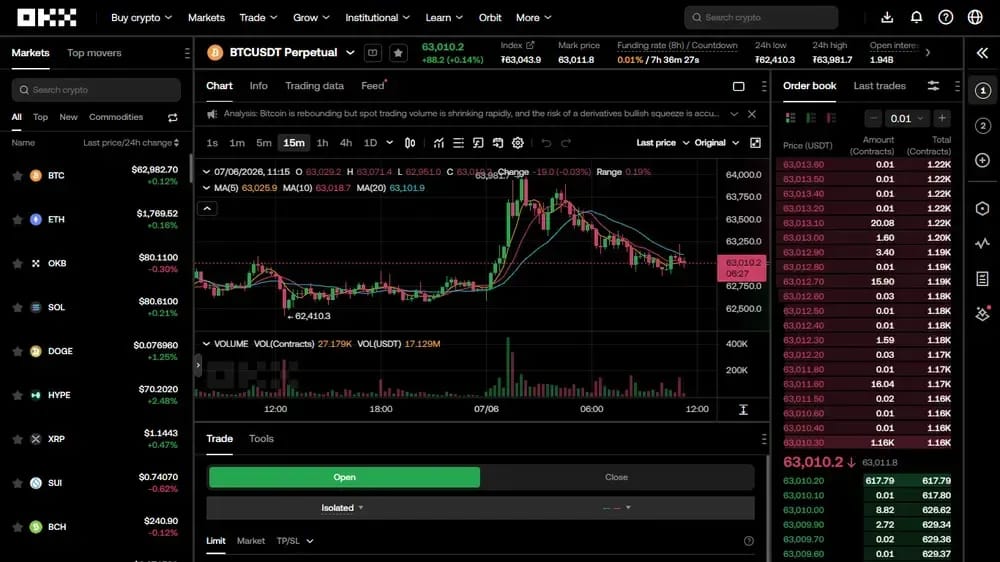
Trading OKX Futures moves from eligibility and verification through account funding, contract selection, margin configuration, execution, and disciplined position monitoring before and after any leveraged order is placed.
Work through these steps before opening a live futures position:
- Register: Create an OKX account, confirm your region permits derivatives, and finish identity verification, since KYC level directly shapes futures access and withdrawal limits.
- Verify: Complete both KYC tiers upfront, because partial verification can trigger delays or holds precisely when you need to fund, trade, or exit a position quickly.
- Fund: Deposit crypto or supported fiat, then transfer collateral into your trading account so the balance is usable as futures margin across the unified structure.
- Select: Choose a contract by margin type, whether USDT-margined, USDC-margined, USD-margined, or crypto-margined, and confirm it is perpetual or a dated expiry product.
- Configure: Pick a margin mode, using isolated to ringfence risk per position or cross to share collateral, and decide between one-way or hedge positioning.
- Adjust: Set leverage for the chosen contract manually, remembering that higher multiples shrink the price move needed to reach your liquidation threshold considerably.
- Analyze: Review the order book, mark price, funding context, and the built-in position calculator to estimate liquidation price and maintenance margin before committing.
- Order: Choose a market, limit, or advanced order type such as OCO or chase limit, enter size, check margin impact, then confirm.
- Monitor: Track unrealized PnL, margin ratio, liquidation price, funding costs, and any ADL indicator, adjusting stops or collateral whenever your risk plan demands it.
- Close: Exit with a market or limit order, let TP/SL triggers fire, then review trade history to refine future entries, sizing, and execution.
Types of Futures Contracts on OKX
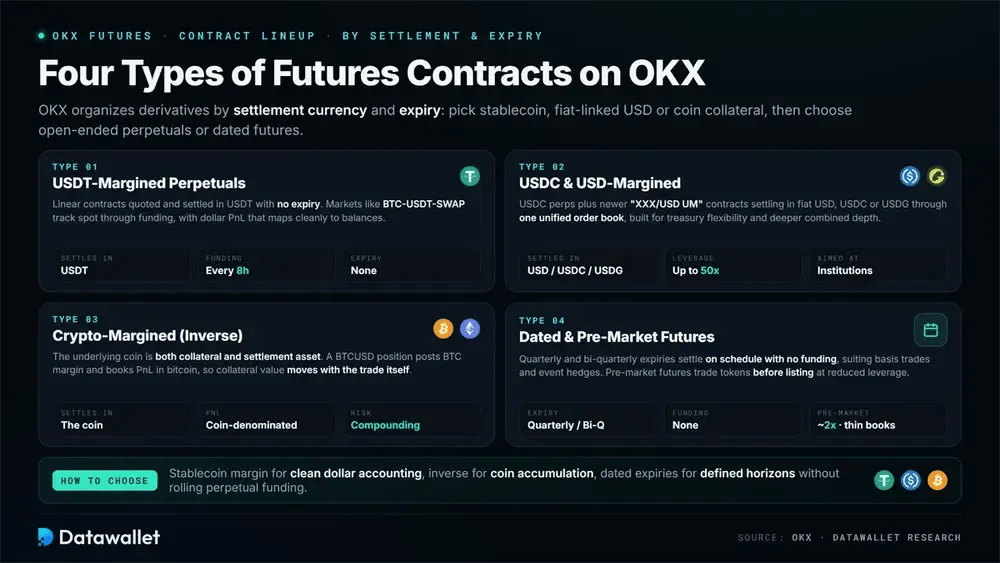
OKX organizes its derivatives by settlement currency and expiry. Traders choose stablecoin, fiat-linked USD, or coin collateral, then decide between open-ended perpetuals and dated futures depending on strategy, hedging needs, and treasury preferences.
1. USDT-Margined Perpetual Futures
USDT-margined perpetuals are linear contracts quoted and settled in USDT, with no expiry date. Positions stay open while margin holds, and popular markets like BTC-USDT-SWAP and ETH-USDT-SWAP track spot through funding paid every eight hours by default.
These contracts suit traders who prefer dollar-denominated PnL that maps cleanly to account balances. Because settlement uses USDT rather than the underlying coin, collateral value stays stable, simplifying position sizing, fee tracking, and profit calculation across a broad range of listed altcoin markets.
2. USDC and USD-Margined Futures
USDC-margined perpetuals settle in USDC, while OKX's newer USD-margined (UM) linear contracts let institutions settle in fiat USD, USDC, or USDG through a unified order book. That consolidation reduces liquidity fragmentation and lets larger desks manage several dollar assets under one market.
USD-margined perpetuals generally support up to 50x leverage and appear on the interface as "XXX/USD UM," separating them from inverse crypto-margined products. This design targets treasury flexibility and execution efficiency, especially for traders holding multiple dollar-pegged assets who want deeper combined depth.
3. Crypto-Margined (Inverse) Futures
Crypto-margined perpetuals use the underlying coin as both collateral and settlement asset. A BTCUSD contract posts BTC margin, quotes against USD, and calculates PnL in bitcoin, appealing to holders who want exposure without converting coins into stablecoins first.
This structure changes the payoff because collateral value moves with the asset itself. It rewards traders comfortable with coin-denominated accounting and precise sizing, but it adds compounding risk when both the position and the margin asset swing sharply during volatile sessions.
4. Dated and Pre-Market Futures
OKX lists expiry futures with quarterly and bi-quarterly settlement dates, useful for basis trades, hedging known events, or holding defined-horizon exposure instead of rolling perpetual funding. These contracts settle automatically on schedule rather than exchanging periodic funding payments between longs and shorts.
Pre-market futures let traders speculate on tokens before official listing, typically at reduced leverage such as 2x. Liquidity is thin and pricing can gap violently, so OKX treats these as high-risk instruments where position sizing and information gaps deserve extra caution before entering.
OKX Supported Assets and Leverage
OKX Futures spans majors, Layer 1 and Layer 2 networks, DeFi, meme coins, AI tokens, and a growing set of tokenized traditional markets, including gold, silver, crude oil, copper, and equity-linked perpetuals such as NVDA and QQQ.
Leverage scales with contract liquidity and risk tier. The most liquid pairs like BTC-USDT and ETH-USDT reach up to 125x, while USD-margined perpetuals cap near 50x and thinner altcoin or tokenized-asset markets carry lower ceilings to contain volatility exposure.
OKX applies tiered maintenance margin, so larger positions face higher margin requirements and effectively lower maximum leverage. This mechanism discourages oversized concentration in a single market and improves position stability during fast moves, protecting both the trader and the wider liquidation system.
Position mode adds further control. One-way mode holds a single net direction per contract, while hedge mode lets a trader run simultaneous long and short positions on the same instrument, supporting spread strategies and more granular exposure management within the unified account.
OKX Futures Fees and Funding Rates
OKX futures costs blend maker-taker commissions, VIP-tier reductions, OKB payment discounts, and funding transfers on perpetuals. Separating fixed trading fees from variable funding is essential before estimating the true net cost of any leveraged strategy.
Base Trading Fees
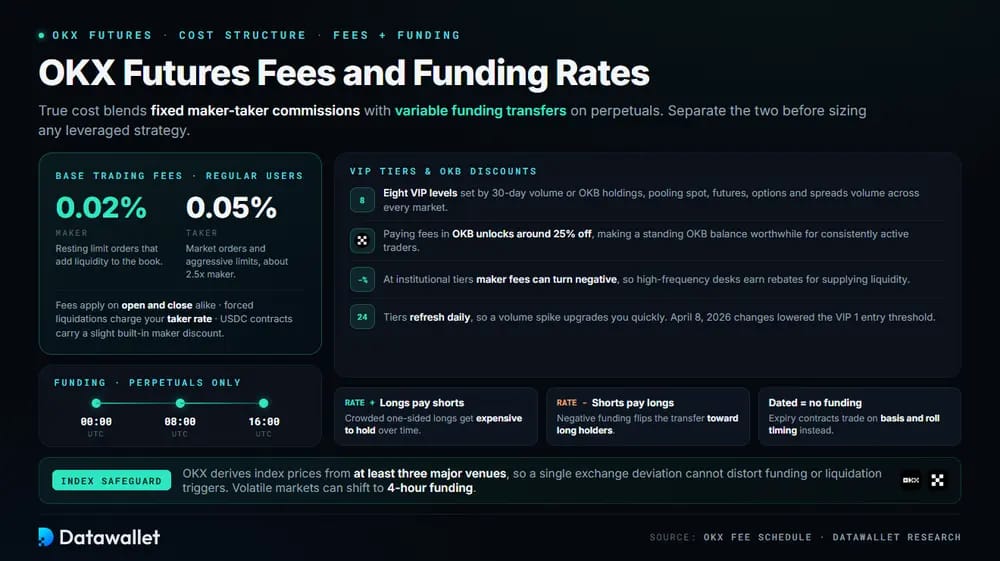
Regular users pay 0.02% maker and 0.05% taker on perpetual and futures contracts, where maker orders add resting liquidity and taker orders remove it immediately. USDC-margined contracts carry a slight built-in maker discount worth noting for flexible traders.
Key base-fee points to weigh before placing orders:
- Maker: Limit orders resting in the book qualify for the lower 0.02% maker rate, rewarding patient traders who provide liquidity rather than crossing the spread.
- Taker: Market orders and aggressive limits fill instantly at the higher 0.05% taker rate, roughly 2.5 times the maker cost across many contracts.
- Basis: Fees apply equally on opening and closing, calculated on executed order size against your current tier's taker or maker rate.
- Liquidation: Forced-liquidation fees are charged at your current taker rate, adding cost precisely when a position is being closed involuntarily.
VIP Tiers and OKB Discounts
OKX runs eight VIP levels set by 30-day trading volume or OKB holdings, recalculated daily. On April 8, 2026, the exchange lowered the VIP 1 entry threshold and adjusted early-tier rates, favoring makers while nudging low-tier taker costs upward.
These reductions can materially reshape active-trader economics:
- Volume: Tiers pool spot, futures, options, and spreads volume, so your highest qualifying level applies across every market you trade on OKX.
- OKB: Paying fees with OKB unlocks an additional discount of around 25%, making a standing OKB balance worthwhile for consistently active traders.
- Rebates: At institutional tiers, maker fees can turn negative, meaning high-frequency and algorithmic desks earn credits for supplying liquidity to the book.
- Daily: Because tiers refresh daily, a volume spike upgrades you quickly rather than locking a poor rate for a full month.
Funding Rates
Funding rates apply to perpetuals, not dated futures, transferring payments between longs and shorts to keep contract prices anchored to spot. OKX charges funding every eight hours by default, at 00:00, 08:00, and 16:00 UTC, unless a contract specifies otherwise.
Funding costs hinge on direction, rate level, and interval:
- Direction: Positive funding means longs pay shorts, negative funding flips that, so crowded one-sided trades can become expensive to hold over time.
- Interval: Most contracts settle every eight hours, though certain volatile or tokenized-asset markets shift to four-hour intervals when conditions warrant tighter anchoring.
- Index: OKX derives index prices from at least three major venues, applying safeguards so a single exchange's deviation cannot distort funding or liquidation triggers.
- Dated: Expiry contracts skip funding entirely, so traders there focus on basis, roll timing, and settlement rather than recurring perpetual payments.
Risk Management Tools and Liquidation
OKX combines margin modes, mark-price liquidation, an insurance fund, and auto-deleveraging to contain leveraged risk before losses exceed posted collateral or spill onto profitable counterparties during stressed market conditions.
Margin Modes and Order Controls
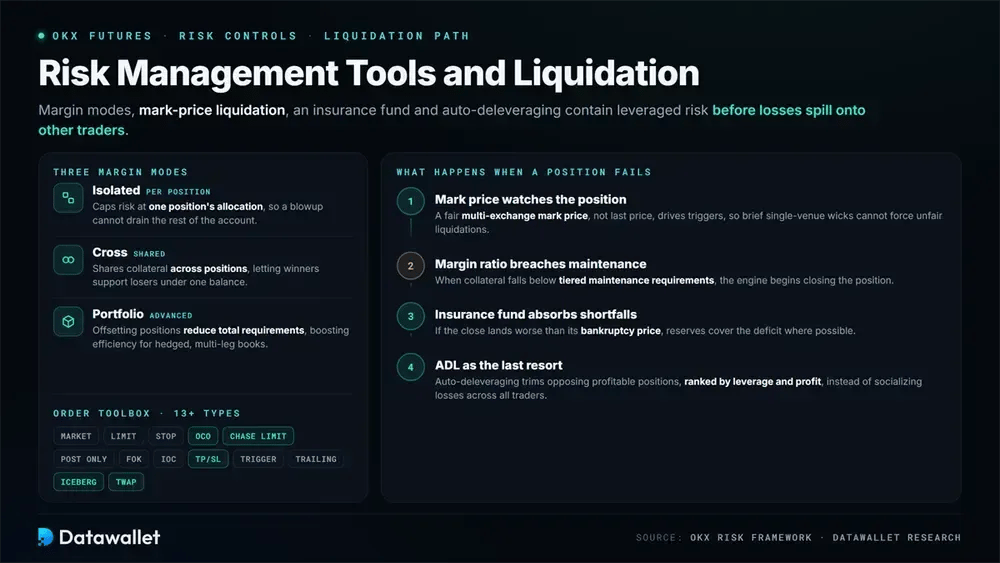
OKX offers isolated margin to cap risk at one position's allocation, cross margin to share collateral across positions, and portfolio margin for advanced users whose offsetting positions can reduce total requirements, boosting capital efficiency for hedged or multi-leg strategies.
Order tooling is extensive, spanning market, limit, stop, OCO, chase limit, Post Only, FOK, IOC, TP/SL, trigger, trailing stop, Iceberg, and TWAP orders. This depth lets traders automate entries and exits, control fee treatment, and stagger execution to limit slippage on larger sizes.
Liquidation Engine and Insurance
OKX liquidates when the margin ratio falls below maintenance requirements, using a fair multi-exchange mark price rather than last price to curb manipulation and avoid unfair liquidations from brief, exchange-specific price wicks during thin or volatile trading.
When a liquidated position closes worse than its bankruptcy price, the insurance fund absorbs the shortfall where possible. If reserves cannot cover the deficit, auto-deleveraging reduces opposing profitable positions, ranked by leverage and profit, instead of socializing losses across all traders.
OKX Security and Regulatory Standing
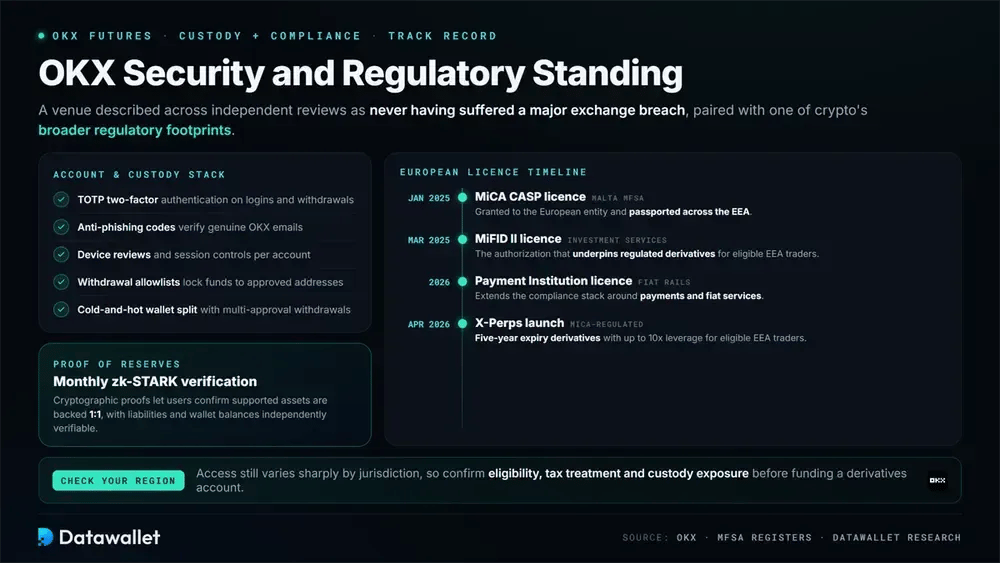
OKX carries a notable security record, described across independent reviews as never having suffered a major exchange breach. Account protections include TOTP two-factor authentication, anti-phishing codes, device reviews, and withdrawal allowlists, layered over a cold-and-hot wallet split with multi-approval withdrawals.
For transparency, OKX publishes monthly Proof of Reserves using zk-STARK cryptographic verification, letting users confirm that supported assets are backed on a 1:1 basis. Independent verification of liabilities and wallet balances strengthens custody confidence relative to opaque venues.
OKX Futures Availability in Europe
European access to OKX Futures runs through a dedicated licensed entity rather than the global platform. OKX Europe holds a MiCA CASP licence from Malta's MFSA, granted in January 2025 and passported across all 30 EEA states, plus a separate MiFID II licence from March 2025 covering regulated derivatives.
That MiFID II authorization underpins X-Perps, OKX's MiCA-regulated derivatives launched in April 2026. Structured as five-year expiry perpetual-style contracts, they offer up to 10x leverage to eligible retail and institutional EEA traders, with negative balance protection and a mandatory appropriateness test before access is granted. Launch pairs include BTC, ETH, SOL, XRP, and DOGE.
European derivatives access differs sharply from OKX's global 125x offering, reflecting stricter consumer-protection standards under EU law. The 1 July 2026 MiCA deadline ended the grandfathering window for unlicensed exchanges, so traders should confirm they are served by OKX's European entity or another MiCA-licensed exchange rather than an offshore arm.
Note that USDT trading is restricted for EU users, since Tether lacks MiCA authorization, leaving USDC and USDG as the compliant settlement options.
Which Traders OKX Futures Suits Best
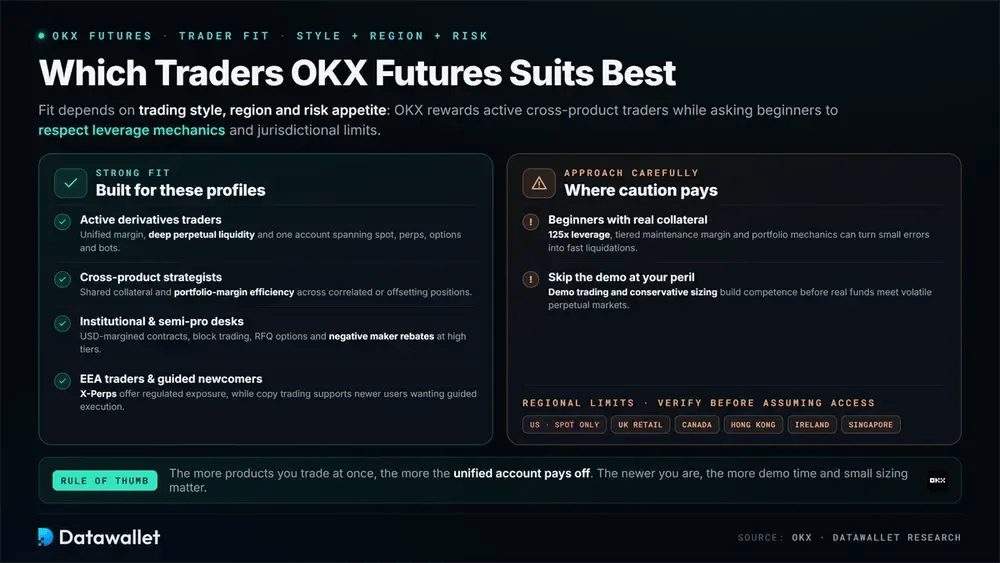
Beyond raw specifications, fit depends on trading style, region, and risk appetite. OKX rewards active, cross-product traders while asking beginners to respect leverage mechanics and jurisdictional limits that shape what they can actually access.
Best Fit Profiles
OKX Futures works well for active derivatives traders who value unified margin, deep perpetual liquidity, and a single account spanning spot, perps, options, and bots. Cross-product strategists benefit most from shared collateral and portfolio-margin efficiency across correlated or offsetting positions.
Institutional and semi-professional desks also gain from USD-margined contracts, block trading, RFQ options, and negative maker rebates at high tiers. EEA traders seeking regulated exposure can use X-Perps, while copy trading supports newer users wanting guided execution.
Who Should Be Cautious
Beginners should approach carefully, since 125x leverage, tiered maintenance margin, and portfolio-margin mechanics can turn small errors into fast liquidations. Demo trading and conservative sizing help build competence before real collateral is ever exposed to volatile perpetual markets.
Regional restrictions also matter. US users access spot only, while UK, Canadian, Hong Kong, Irish, and Singaporean retail traders face derivatives limits. Anyone in a restricted market should verify eligibility rather than assume the full futures suite is available.
OKX Futures vs Other Platforms
OKX competes with centralized leaders and decentralized perpetual exchanges on liquidity, leverage, fees, and access. It leads on unified margin and product breadth, though pair count and headline leverage vary widely across rivals.
OKX Futures vs Binance
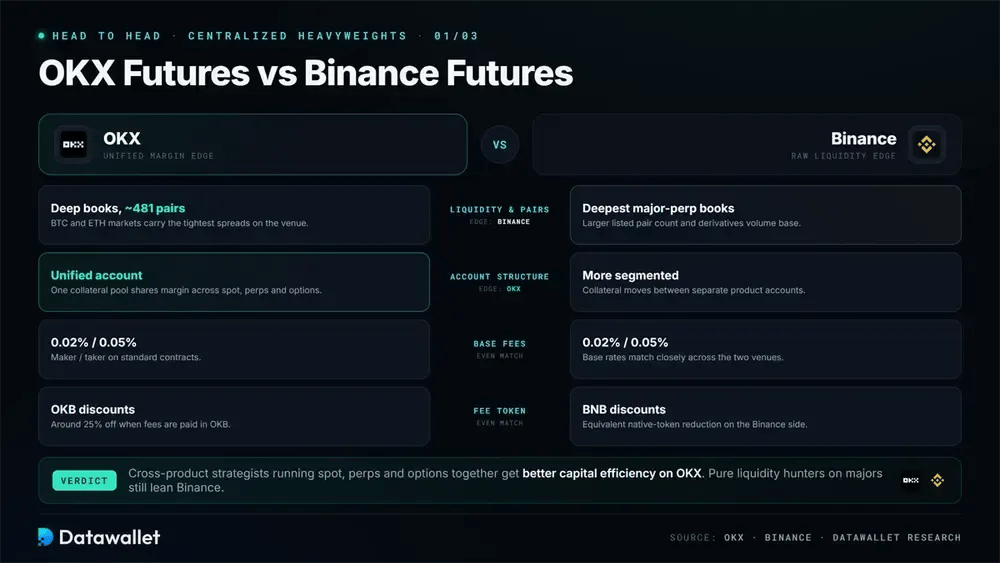
Binance Futures edges ahead on raw liquidity and listed pair count, posting the deepest books on major perpetuals and a larger derivatives volume base. OKX counters with a unified margin system that shares collateral across products more efficiently than Binance's more segmented account structure.
Base fees match closely at 0.02% maker and 0.05% taker, with Binance offering BNB discounts and OKX using OKB. For cross-product strategists running spot, perps, and options together, OKX's single-account model can improve capital efficiency and simplify collateral movement.
Read our detailed Binance vs OKX comparison to see how they stack up across every category.
OKX Futures vs Bybit
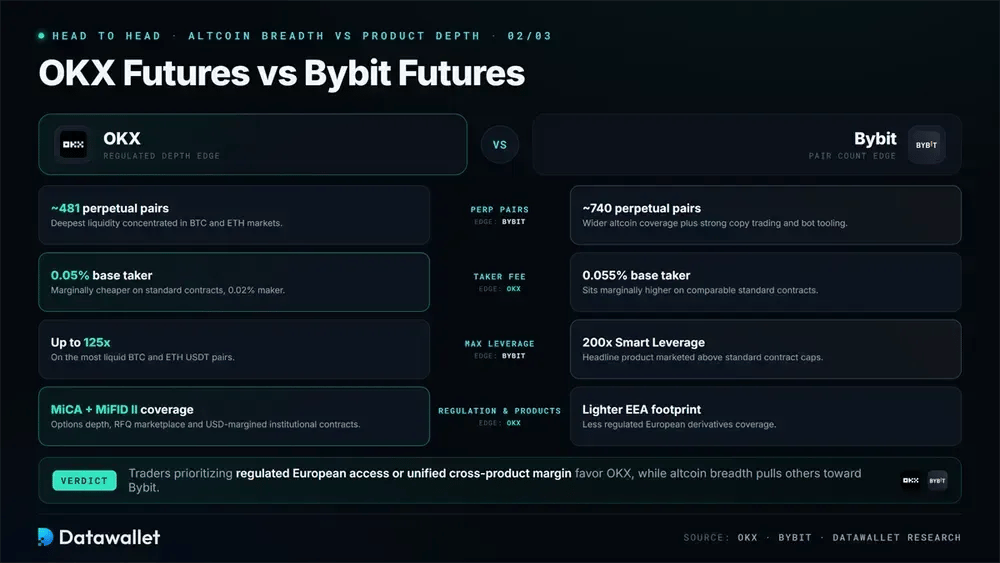
Bybit Futures lists more perpetual pairs, around 740 versus OKX's 481, and markets a 200x Smart Leverage product alongside strong copy trading and bot tooling. Its base taker fee sits marginally higher at 0.055% compared with OKX's 0.05% on standard contracts.
OKX differentiates through its options depth, RFQ marketplace, USD-margined institutional contracts, and broader EEA regulatory coverage via MiCA and MiFID II. Traders prioritizing regulated European access or unified cross-product margin often favor OKX, while altcoin breadth can pull others toward Bybit.
See how Bybit and OKX compare in every category by reading our thorough comparison.
OKX Futures vs Hyperliquid
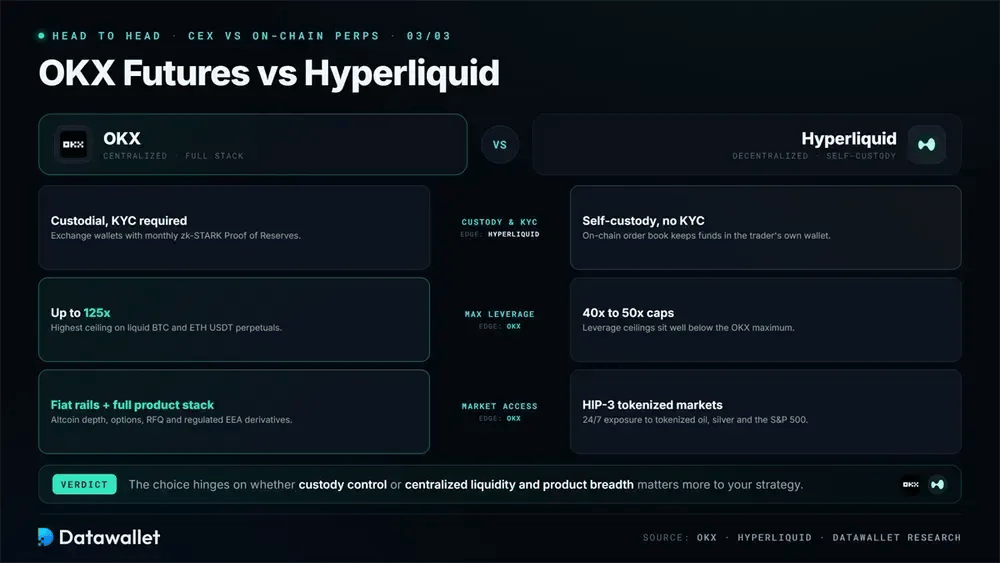
Hyperliquid represents the decentralized challenge, running an on-chain order book with self-custody, no KYC, and HIP-3 markets that extend into tokenized oil, silver, and the S&P 500. Its leverage caps lower at 40x to 50x, below OKX's 125x ceiling.
OKX still leads on fiat rails, altcoin depth, options, and regulated derivatives, while Hyperliquid appeals to traders wanting self-custody and 24/7 tokenized macro exposure. The choice hinges on whether custody control or centralized liquidity and product breadth matters more.
Final Thoughts
OKX Futures ranks among the strongest crypto derivatives venues in 2026, combining a unified account, deep perpetual liquidity, USD-margined institutional contracts, and one of the broader regulatory footprints backed by ICE's strategic investment and monthly Proof of Reserves.
Experienced traders who understand margin, funding, and liquidation will find precise tooling and competitive costs. Beginners should lean on demo trading, modest leverage, and careful region checks, since fast markets and complex margin mechanics can amplify mistakes quickly.