Crypto OTC Brokers Compared
1. Bybit OTC
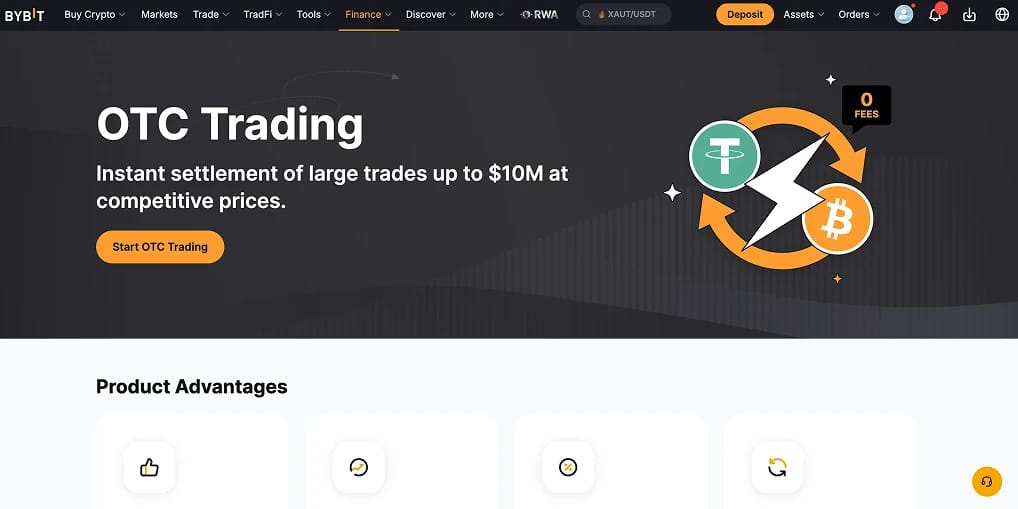
Bybit pairs a zero-fee conversion tool with a full request-for-quote system, giving it the widest execution range of any desk we tested. OTC Trading locks a firm price on large spot conversions and credits the proceeds instantly, while Bybit RFQ collects quotes from competing liquidity providers across spot, futures, and options.
The RFQ module handles multi-leg structures, so a fund can sell spot and open a hedge in one negotiated package executed away from the public order book. Accepted quotes fill at the exact price shown, even in volatile markets, and nothing prints against visible depth. The provider network includes specialist options firms such as Orbit Markets, which joined in May 2026.
Access requires full identity verification, and RFQ is open to institutions, VIP clients, and retail traders who clear the per-product minimums. Our Bybit review covers the wider platform, including the earn and derivatives products OTC proceeds can enter without leaving the exchange.
Pros
- The widest execution range we tested, spanning instant conversions and multi-leg RFQ across spot, futures, and options.
- Spread-only pricing with no desk fee and instant settlement into the exchange account.
- Open beyond institutions, since VIP tiers and qualifying retail traders can request quotes after verification.
Cons
- No published flat minimum, so per-product RFQ thresholds must be checked before quoting.
- The February 2025 hack, the largest exchange theft on record, sits in its recent past even though every customer was made whole.
- Unavailable to United States residents.
2. Coinbase Prime OTC
Coinbase Prime executes OTC orders on an agency basis only, meaning the desk works each order for the client and never trades against it. The Prime platform aggregates pricing from exchanges, market makers, and other desks through its Smart Order Router, then layers on RFQ plus algorithmic strategies such as TWAP and VWAP for orders worked over time.
Custody is the other pillar. Coinbase Custody Trust Company operates as a qualified custodian under New York state supervision, so assets bought over the counter settle into segregated cold storage that boards and auditors accept. Financing, staking, and reporting sit on the same platform, which shortens the operational chain for funds that would otherwise juggle three vendors.
Onboarding runs at corporate depth, covering entity documents, beneficial ownership, and banking verification. The client base skews toward ETF issuers, asset managers, corporates, and treasuries that answer to regulators and shareholders.
Pros
- Agency-only execution with no proprietary trading against client orders.
- Qualified custodian status under New York state oversight, plus financing, staking, and reporting on one platform.
- TWAP, VWAP, and adaptive algorithms with post-trade files built for auditors and compliance teams.
Cons
- Institutional onboarding only, with no path for individual traders.
- Pricing is negotiated rather than published, making costs hard to compare in advance.
- A May 2025 contractor data breach exposed personal details of roughly 69,000 accounts, though no funds were taken.
3. Kraken OTC
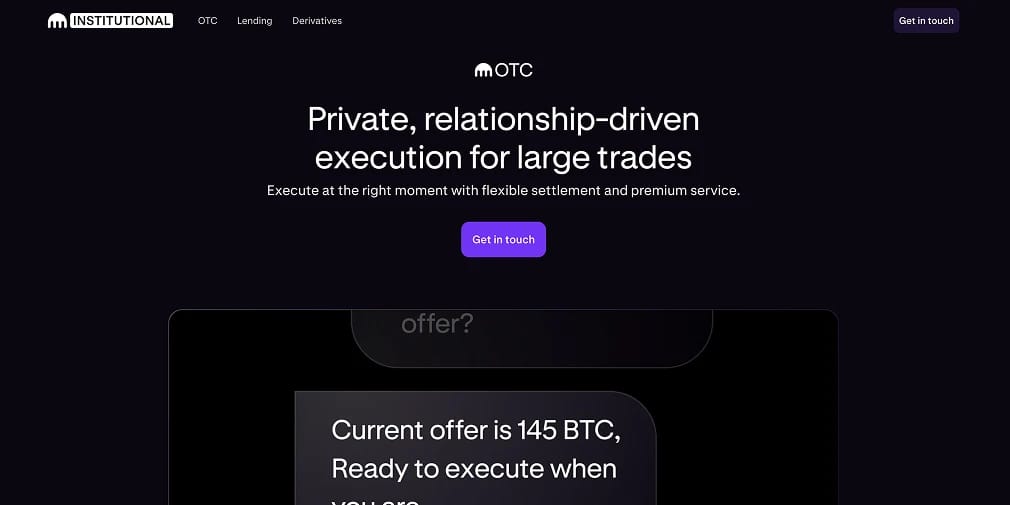
Kraken's desk charges no fee at all, earning only the spread on each quote, and lists a minimum of $100,000 equivalent with case-by-case exceptions below that. Eligible clients trade over chat with named traders, where no maximum size applies, or through an automated RFQ in the OTC Portal that returns executable quotes within seconds.
Flexible settlement lets approved counterparties trade first and settle within 24 hours using a Kraken account, a bank, or an external wallet. The desk holds no client assets itself, keeping execution risk separate from storage risk, and custody clients can send RFQ trades directly from their vaults around the clock.
Kraken also quotes OTC derivatives, including options and structured products, which few regulated venues offer at block size. Our guide to the best crypto options exchanges covers the listed alternatives.
Pros
- Zero desk fees with revenue earned only through the quoted spread, and no maximum size over chat.
- Flexible settlement within 24 hours to a Kraken account, bank, or external wallet for approved counterparties.
- OTC options and structured products, which few regulated venues quote at block size.
Cons
- The $100,000 minimum shuts out smaller tickets unless an exception is granted.
- Spread-only quotes mean there is no published fee schedule to benchmark against.
- OTC derivatives are limited to eligible counterparties in permitted jurisdictions.
4. Binance OTC
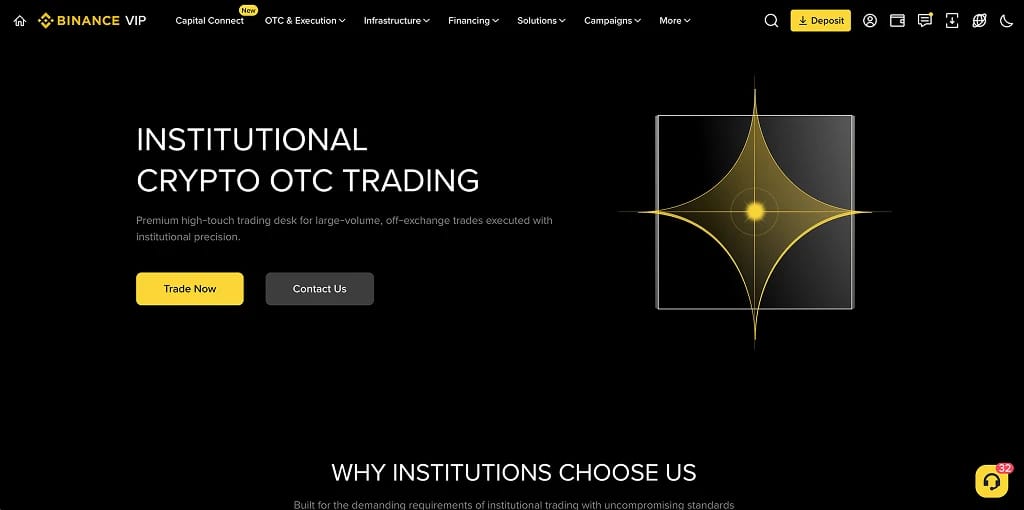
Binance OTC and Execution Solutions draws on the largest spot order books in the market, so its quotes on big tickets are consistently among the tightest available. The Spot RFQ platform sets a $200,000 minimum trade size and returns firm quotes on web, mobile, or API. Algorithmic execution adds TWAP and volume-based strategies for orders better worked gradually.
Binance recently consolidated quoting and execution into a single Execution Services dashboard, replacing a workflow that split live prices, messenger chats, and order status across separate screens. The desk also quotes options with expiries up to one year through a dedicated RFQ interface, and approved clients can access collateralized credit lines to trade first and settle afterwards.
Service targets jurisdictions outside the United States, where the separate Binance.US portal operates with far smaller minimums and a reduced asset list. Programmatic clients connect through REST APIs for request-for-quote and streaming price feeds.
Pros
- Quotes anchored to the deepest spot order books in crypto, keeping big-ticket pricing tight.
- A unified Execution Services dashboard with TWAP algos, options RFQ, and API connectivity.
- Collateralized credit lines allowing approved clients to trade first and settle later.
Cons
- The $200,000 Spot RFQ minimum is the highest published entry point on this page.
- Unavailable to US users, who are limited to the smaller Binance.US portal.
- A 2023 settlement with US authorities over compliance failures still shadows the wider group.
5. OKX Liquid Marketplace
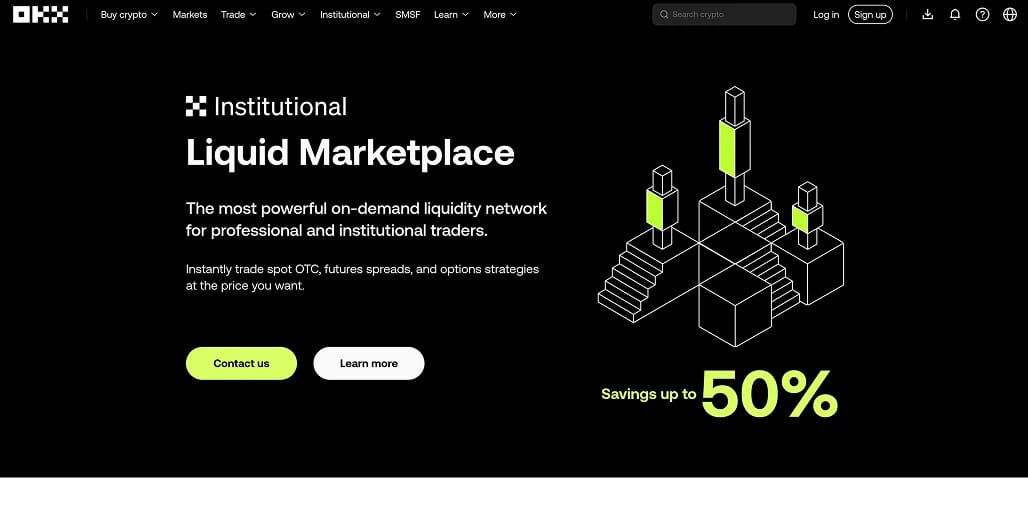
OKX runs block trading through its Liquid Marketplace, where clients build single-leg or multi-leg RFQs and receive two-way quotes from the market makers they select. Counterparties never learn which side the requester intends to take, which pushes them to price both directions tightly, and requests expire after two minutes to keep quotes current.
The venue covers spot, perpetual swaps, futures, and options in a single request, letting a portfolio rotation that would otherwise need four trades settle as one negotiated package. Nitro Spreads extends this by executing both legs of a basis trade through a central order book simultaneously, so neither leg can fill without the other.
Everything clears through standard OKX accounts under the exchange's portfolio margin model, which offsets opposing positions on the same underlying asset. The tooling assumes professional users and suits proprietary firms and systematic strategies best.
Pros
- Anonymous two-way quoting that stops dealers from skewing prices against the requester.
- Multi-leg requests across spot, perpetual swaps, futures, and options, plus Nitro Spreads with zero leg risk.
- Portfolio margin that offsets opposing positions on the same underlying asset.
Cons
- The tooling assumes professional users and offers no white-glove chat desk.
- Two-minute quote windows demand quick decisions in fast markets.
- US residents cannot access the full Liquid Marketplace product set.
6. Crypto.com OTC
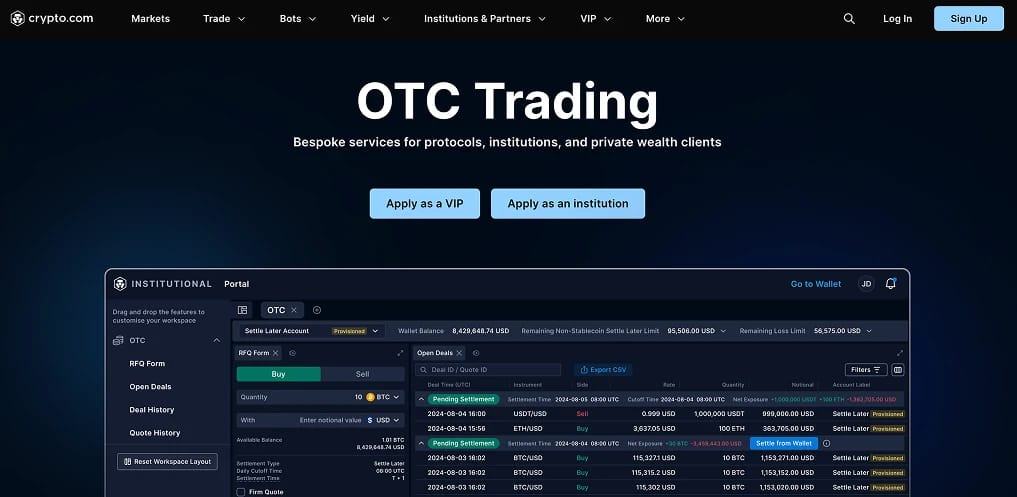
Crypto.com's portal accepts deals from as little as $100 up to $5,000,000, making it the most accessible desk on this list by a wide margin. Selected VIP and institutional users qualify automatically, quotes hold for at least ten seconds, and anything above the cap goes through direct desk contact.
A Settle Later option gives approved clients breathing room between execution and delivery, and an OTC API serves traders who want programmatic quotes rather than portal clicks. United States institutions use a separate registered service with its own asset list and a $1,000 entry point.
The trade-off is the ceiling. Institution-only desks will quote far beyond $5,000,000 in one ticket, so the portal suits affluent individuals and smaller firms more than funds moving eight-figure blocks.
Pros
- The lowest entry point of any desk here, quoting deals from $100.
- Settle Later deferred delivery and an OTC API for programmatic quoting.
- A separate registered US institutional service from $1,000.
Cons
- The $5,000,000 portal ceiling rules out eight-figure blocks without direct desk negotiation.
- Quotes holding ten seconds leave little room for hesitation in volatile markets.
- Portal access is gated to selected VIP and institutional users rather than open to all.
What Is Crypto OTC Trading?
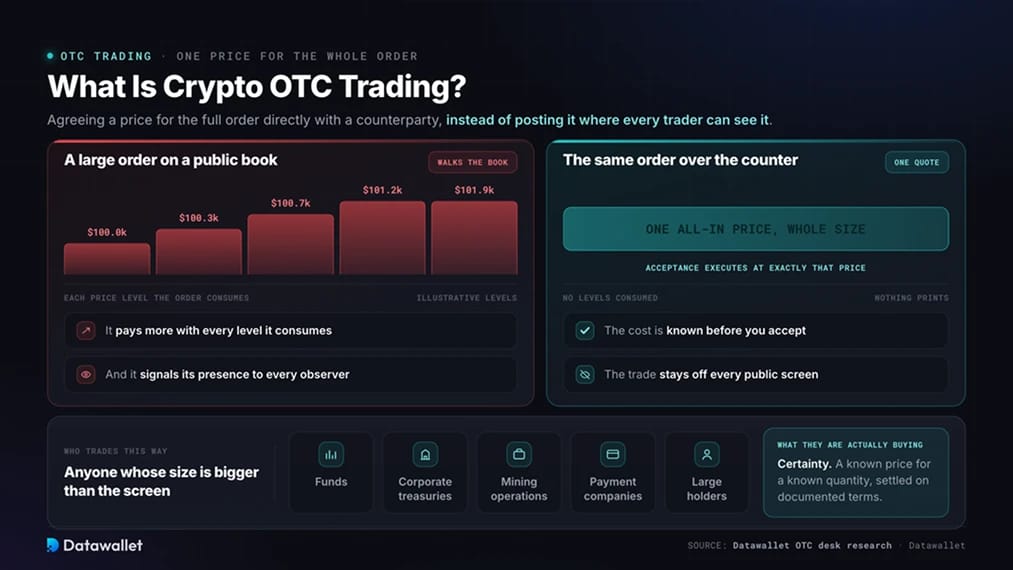
Over-the-counter trading means agreeing a price for the full order directly with a counterparty instead of posting it where every trader can see it. A desk or RFQ system returns one all-in quote covering the whole amount, and acceptance triggers execution at exactly that price.
The approach exists because public markets punish size. A large market order walks through successive price levels in the order book, paying more with each level consumed and signaling its presence to every observer. Private execution removes both problems by taking the entire trade off-screen.
Typical users include funds, corporate treasuries, mining operations, payment companies, and individuals holding positions too large for on-screen depth. What they buy is certainty, a known price for a known quantity, settled on documented terms.
How Do Crypto OTC Trades Work?
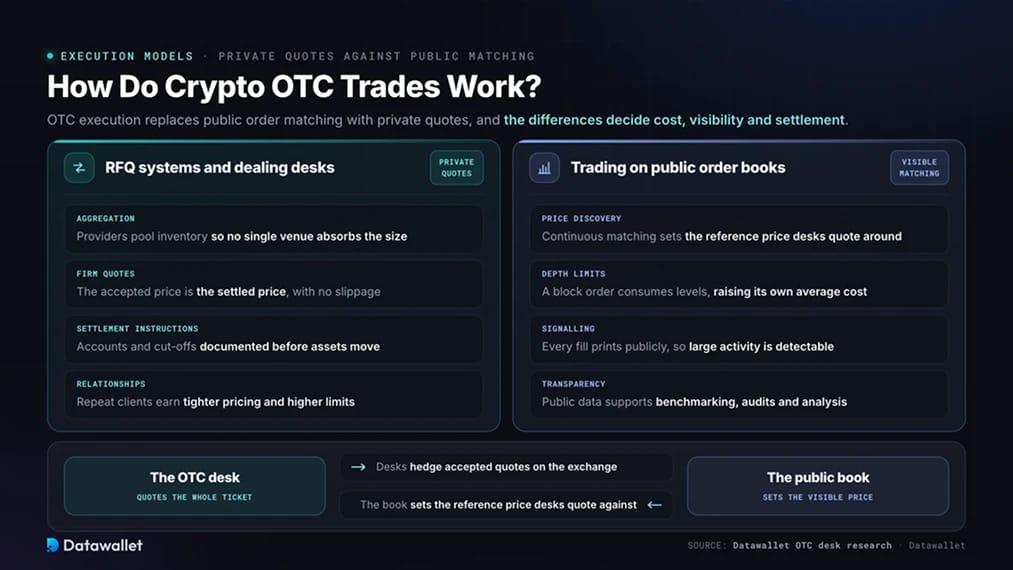
OTC execution replaces public order matching with private quotes, and the differences decide cost, visibility, and settlement.
RFQ Systems and Dealing Desks
A request for quote names the asset, the size, and sometimes multiple legs, then goes out to one or more liquidity providers. Each provider responds with a firm price valid for a short window, the client accepts or passes, and accepted trades settle on pre-agreed instructions covering custody accounts, bank wires, or internal transfers.
Key elements of RFQ and desk execution:
- Aggregation: Providers pool inventory from multiple sources, filling sizes no single venue could absorb alone.
- Firm quotes: The accepted price is the settled price, removing slippage between decision and execution.
- Settlement instructions: Timing, accounts, and cut-off windows are documented before any assets move.
- Relationships: Repeat clients earn tighter indicative pricing, higher limits, and direct lines to traders.
Trading on Public Order Books
Exchange trading matches visible bids and asks in a shared limit order book, and execution quality depends on the resting depth near the current price. Fees follow the maker and taker model, where posting liquidity costs less than consuming it.
Key elements of public order book execution:
- Price discovery: Continuous matching of visible orders sets the reference price OTC desks quote around.
- Depth limits: A block-sized market order consumes multiple price levels, raising its own average cost.
- Signaling: Every fill prints publicly, letting other participants detect and trade against large activity.
- Transparency: Full public data supports benchmarking, audits, and execution analysis after the fact.
The two systems feed each other. Desks hedge accepted quotes on exchanges, and exchanges reference OTC volume when courting institutional clients, so pricing rarely drifts far apart.
How Big Has the OTC Market Become?
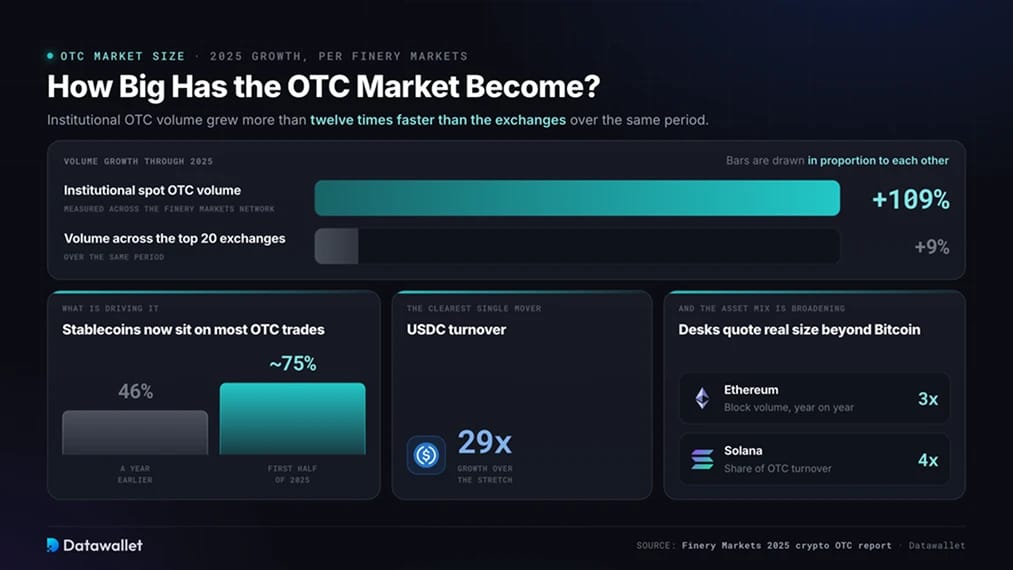
Institutional spot OTC volume grew 109% in 2025 according to Finery Markets, a network processing millions of institutional trades annually, while volume across the top 20 exchanges rose roughly 9% over the same period. That gap is reshaping how brokers build their products.
Stablecoins drive much of it. Three quarters of OTC trades in the first half of 2025 involved a stablecoin leg, up from 46% a year earlier, as payment firms and treasuries adopted dollar-pegged tokens for settlement rather than speculation.
USDC turnover rose 29-fold over that stretch, helped by European rules that pushed several venues to restrict its largest rival. Our stablecoin statistics page tracks the wider issuance picture.
Asset mix is broadening too. ETH block volume tripled year on year, and SOL's share of OTC turnover quadrupled, signs that desks are quoting real size well beyond BTC. For context on exchange activity, see our crypto exchange statistics roundup.
Are OTC Prices Better Than Exchange Prices?
An OTC spread can look wide next to the pennies-tight quote on an exchange screen, but the screen price only applies to small size. Push $1,000,000 through a visible order book and the order may absorb 0.50% to 1.00% in cumulative slippage, while a desk might quote the same ticket at an all-in 0.15% over the reference price.
The honest comparison is total execution cost rather than headline spread. Sophisticated clients benchmark desk quotes against time-weighted exchange prices for the same window, then give repeat business to whichever channel wins consistently.
Are Crypto OTC Brokers Legal?
OTC brokers operate legally where they hold the required money service, virtual asset, or trust licenses and run full KYC and AML programs on every counterparty. The desks in this guide are attached to major exchanges because those groups already maintain licensing across dozens of jurisdictions.
Scrutiny of large private transfers keeps rising, particularly in Europe under the MiCA framework and in the United States as federal market structure rules take shape. Institutions favor licensed, exchange-affiliated desks because they provide signed agreements, auditable records, and a regulated entity to pursue if settlement fails.
Risks of OTC Trading
Moving off-exchange trades certainty of price for exposure to counterparties and process. The main risks worth planning around:
- Counterparty default: A desk or provider failing to deliver assets or funds can produce losses with no exchange guarantee fund behind them.
- Settlement gaps: When one leg settles before the other, the waiting party carries market and credit exposure until delivery completes.
- Quote expiry: Firm prices last seconds to minutes, and hesitation in fast markets means requoting at worse levels.
- Spread opacity: Without published fees, the true cost sits inside the quote, and infrequent traders may pay more than they realize.
- Regulatory change: New rules can cut off assets, jurisdictions, or counterparties mid-relationship, forcing rushed migrations.
- Operational error: A mistyped wallet address or misread term sheet is far harder to reverse than an exchange order cancellation.
- Concentration creep: Easy access to size can tempt traders into positions larger than their risk framework would otherwise allow.
Written procedures, address whitelisting, and dual approval on settlement instructions remove most operational failure modes.
Final Thoughts
Speed and governance now define the field. Exchange-integrated desks like Bybit and OKX turn block execution into a product feature that settles in seconds, while prime-broker builds like Coinbase wrap it inside custody and reporting that compliance teams can sign off.
Our advice is to match the desk to the constraint that binds you. If settlement speed and product breadth matter most, start with Bybit. If a board or auditor reviews every trade, the regulated model at Coinbase Prime or Kraken justifies its heavier onboarding.