


Top 8 Prediction Market Statistics and Trends
1. Prediction Market Volume Topped $45 Billion Monthly
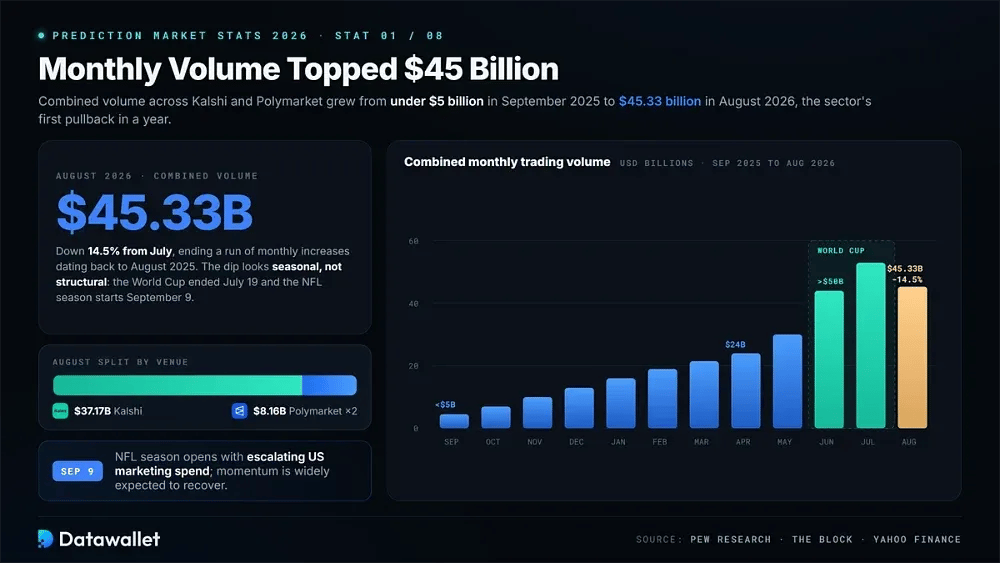
Few financial categories have scaled as quickly as prediction markets. A Pew Research Center analysis of The Block data shows combined monthly volume across Kalshi and Polymarket rising from under $5 billion in September 2025 to roughly $24 billion by April 2026. World Cup trading then lifted summer totals past $50 billion.
August brought the first cooldown in a year. Combined volume across Kalshi, Polymarket, and Polymarket US fell 14.5% to $45.33 billion. Kalshi generated $37.17 billion, while the two Polymarket venues contributed $8.16 billion, ending a run of monthly increases that dated back to August 2025.
The pullback appears more seasonal than structural. The FIFA World Cup ran from June 11 through July 19 and lifted summer totals. With the NFL season beginning September 9, both platforms are escalating US marketing spend ahead of opening week, and momentum is widely expected to recover.
2. Kalshi Now Controls Over 80% of Monthly Volume
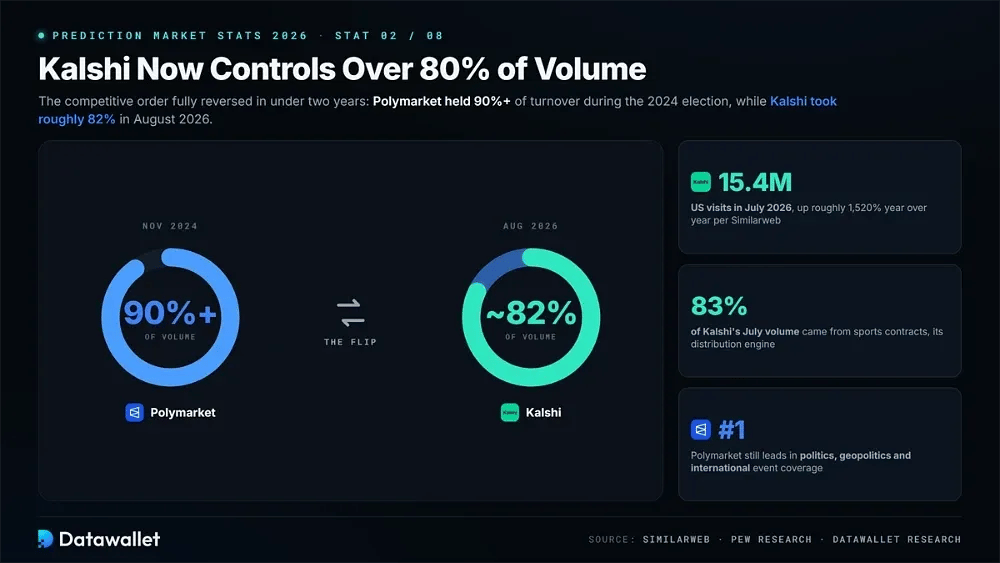
Kalshi has completely reversed the sector's competitive order. Its $37.17 billion in August volume represents roughly 82% of combined activity. In November 2024, by contrast, Polymarket controlled more than 90% of monthly prediction-market turnover during the presidential election cycle that first pushed the category into the mainstream.
Distribution accounts for much of the change. Kalshi recorded 15.4 million US visits in July 2026, roughly 1,520% more than a year earlier according to Similarweb data. Sports contracts generated 83% of its July volume. Polymarket still leads clearly in politics, geopolitics, and internationally oriented event coverage.
Those differences now shape where traders concentrate capital. Our Polymarket vs Kalshi comparison examines the CFTC-regulated exchange and the crypto-native platform across fees, settlement rails, and category mix.
3. Kalshi and Polymarket Valuations Passed $20 Billion Each
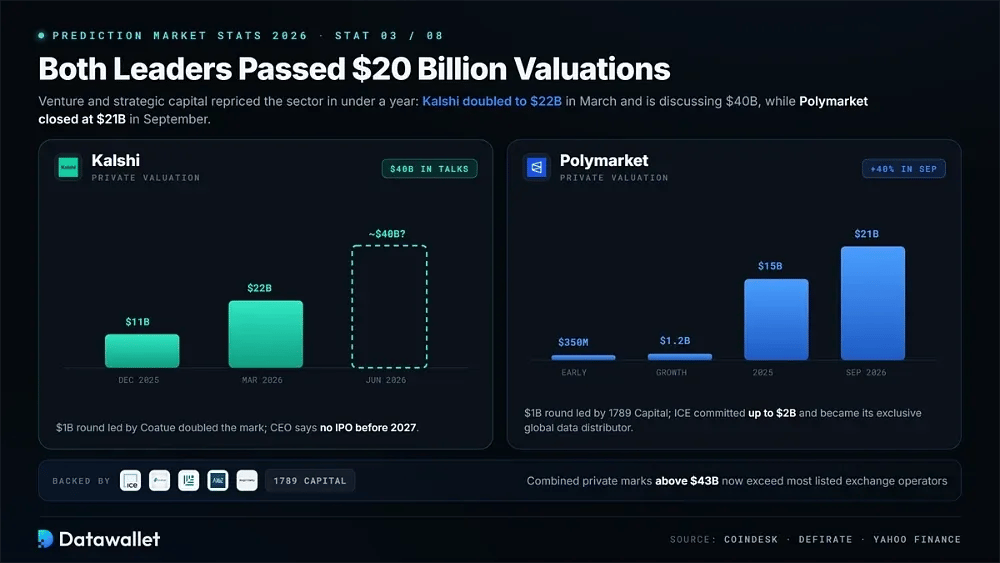
Venture and strategic investors repriced the sector in less than a year. Both market leaders now hold private valuations above $20 billion, supported by Wall Street institutions that treated event contracts as a novelty only last year.
Key Funding Milestones That Reshaped Prediction Market Valuations:
- ICE Investment: Intercontinental Exchange committed up to $2 billion to Polymarket from October 2025, completing a $600 million follow-on in March 2026 while becoming its exclusive global data distributor.
- Kalshi $22B: A $1 billion round led by Coatue in March 2026 doubled Kalshi's valuation from $11 billion in December, with Sequoia, a16z, and Morgan Stanley all participating.
- $40B Talks: By June, Kalshi was reportedly seeking capital near a $40 billion valuation, while its CEO signaled that any initial public offering would not arrive before 2027.
- Polymarket $21B: In early September, Polymarket reportedly closed a $1 billion round led by 1789 Capital at a $21 billion valuation, a 40% jump from its prior $15 billion mark.
- Founder Disclosures: CEO Shayne Coplan revealed earlier raises of $55 million at a $350 million valuation and $150 million at $1.2 billion, showing how violently the platform repriced.
- Sector Effect: Combined private marks above $43 billion now exceed most listed exchange operators, pulling dedicated prediction-market venture funds, terminals, and infrastructure startups into the category behind them.
4. Sports Contracts Dominate Both Major Platforms
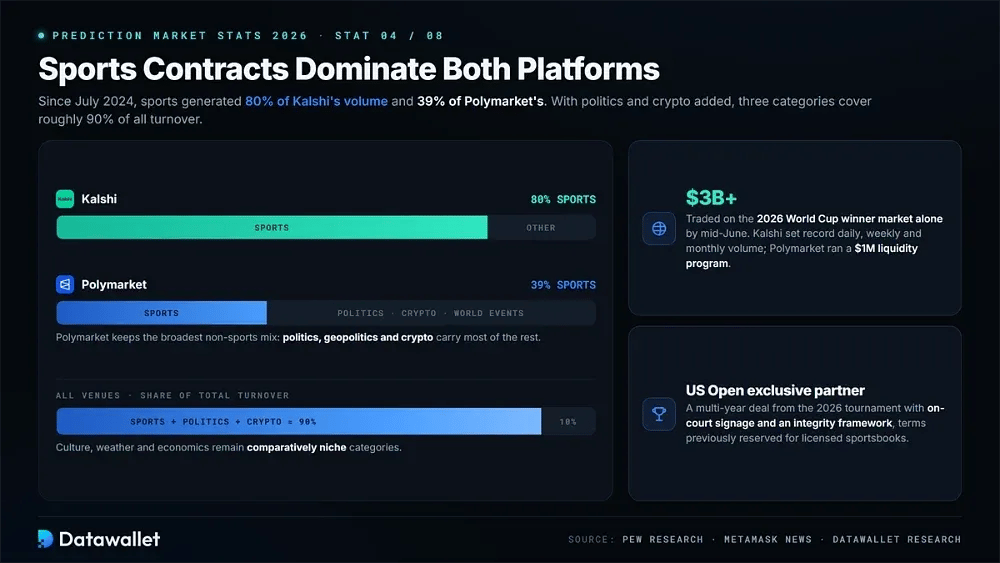
Sports sits at the center of prediction-market activity. Pew's platform analysis found that sports accounted for 80% of Kalshi's volume and 39% of Polymarket's since July 2024. Across both venues, sports, politics, and crypto together represented roughly 90% of turnover, leaving culture, weather, and economics as comparatively niche categories.
The 2026 FIFA World Cup showed how high event-driven demand can climb. By mid-June, the tournament-winner market alone had attracted over $3 billion in volume. Kalshi reached record daily, weekly, and monthly figures, while Polymarket operated a $1 million liquidity incentive program across its World Cup contracts.
Institutional legitimacy followed. Kalshi signed a multi-year agreement making it the US Open's exclusive prediction-market partner beginning with the 2026 tournament. The deal includes on-court signage and an integrity framework, an arrangement previously reserved exclusively for licensed sportsbooks and traditional betting operators.
5. Perpetual Futures Became the Sector's Biggest Product Pivot
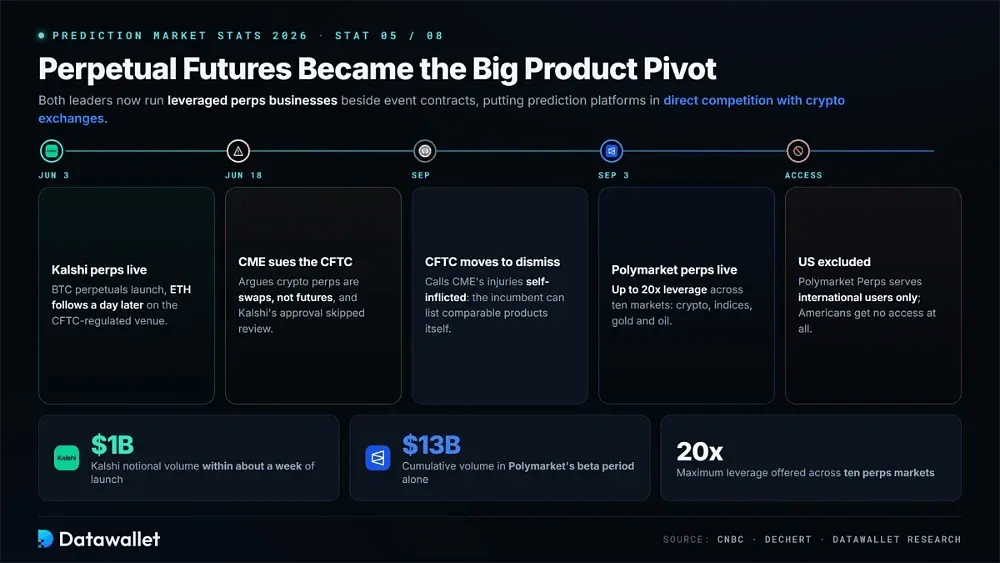
Perpetual futures became the year's most significant product expansion. By adding leveraged derivatives alongside event contracts, prediction platforms moved into direct competition with crypto exchanges. Both market leaders now operate perps businesses in parallel with their core products.
How the Perpetuals Race Unfolded Across Both Platforms in 2026:
- Kalshi Launch: Bitcoin perpetuals went live on June 3 with Ethereum following a day later, and Kalshi's perpetual contracts crossed $1 billion in notional volume within roughly a week.
- CME Lawsuit: CME Group sued the CFTC on June 18, arguing crypto perpetuals are swaps rather than futures and that Kalshi's approval arrived without adequate regulatory review.
- CFTC Response: The regulator moved to dismiss in September, calling CME's claimed injuries self-inflicted and noting the incumbent exchange remains free to list comparable perpetual products itself.
- Polymarket Perps: After announcing the push in April, Polymarket fully launched perpetuals on September 3, offering up to 20x leverage across ten markets spanning crypto, indices, gold, and oil.
- Beta Demand: Polymarket's beta period reportedly drew $13 billion in cumulative volume, clear evidence that its existing event-contract audience overlaps heavily with the leveraged trading demand crypto exchanges serve.
- Access Limits: Polymarket Perps serves international users only, excluding Americans entirely; our detailed guide to Polymarket's restricted countries covers exactly which jurisdictions can access each product line.
6. Polymarket Cumulative Fees Crossed $330 Million
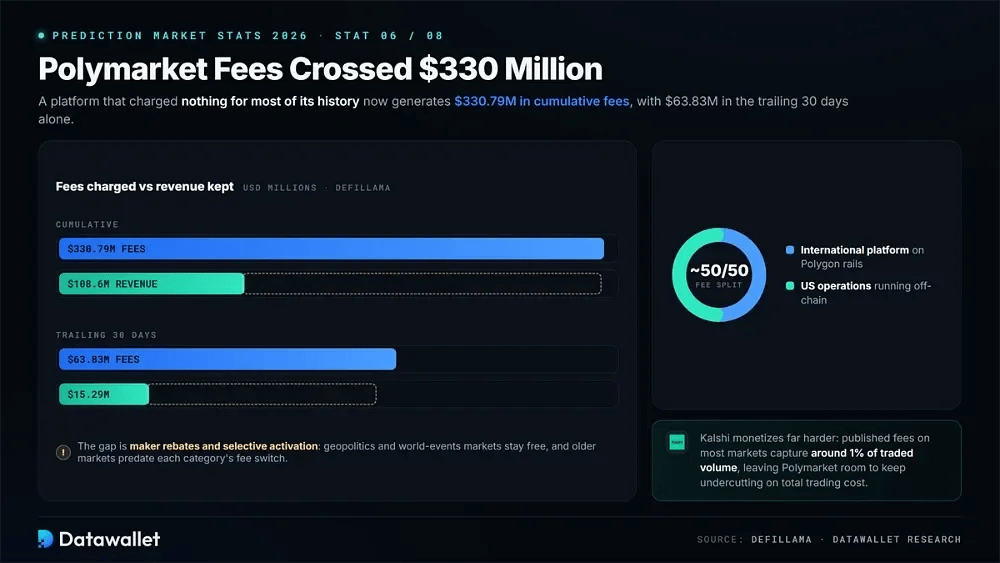
Monetization has matured alongside trading volume. DefiLlama data shows Polymarket generating $330.79 million in cumulative fees, including $63.83 million over the trailing 30 days. Those fees are split almost evenly between its Polygon-based international platform and off-chain US operations, a notable shift for a platform that charged nothing through most of its history.
Headline fees are rising faster than revenue capture. Polymarket booked $15.29 million in 30-day revenue and $108.6 million cumulatively. Maker rebates and selective fee activation explain the gap: geopolitics and world-events markets remain free, while older markets predate each category's fee switch.
Kalshi uses a much more aggressive monetization model. It charges transaction fees across most markets under a published schedule and reportedly captures around 1% of traded volume. That structural difference leaves Polymarket with room either to raise fees over time or continue undercutting its regulated rival on total trading cost.
7. Sportsbooks and Brokerages Piled Into Prediction Markets
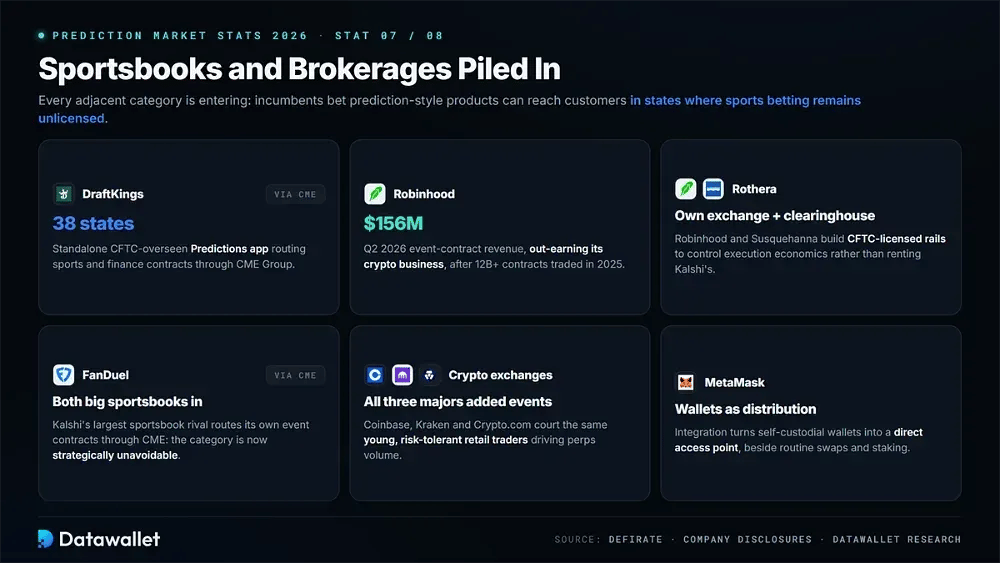
Success has drawn competitors from every adjacent category. Sportsbooks and brokerages now offer event contracts, as do crypto exchanges. Their bet is that prediction-style products can reach customers in states where traditional sports betting remains unlicensed.
The Biggest Incumbent Entries Into Prediction Markets So Far:
- DraftKings Predictions: The sportsbook launched a standalone CFTC-overseen app in 38 states, routing sports and finance contracts through CME Group with Railbird Exchange integration planned afterward.
- Robinhood Scale: Event contracts produced $156 million in Q2 2026 revenue, out-earning Robinhood's crypto trading business, after more than 12 billion contracts traded during 2025 alone.
- Rothera Venture: Robinhood and Susquehanna are building a CFTC-licensed exchange and clearinghouse together, giving the brokerage control over execution economics rather than renting Kalshi's existing rails.
- FanDuel Entry: Kalshi's largest sportsbook rival routes its own event contracts through CME Group, confirming that both dominant US sportsbooks now treat the category as strategically unavoidable.
- Crypto Exchanges: Coinbase, Kraken, and Crypto.com all added prediction or event-contract products over the past year, courting the same young, risk-tolerant retail traders driving perpetuals volume.
- Wallet Distribution: MetaMask's integration turned self-custodial wallets into a direct prediction-market access point, folding event trading into everyday DeFi activity alongside routine token swaps and staking flows.
8. A Circuit Split Puts Prediction Markets on a Supreme Court Path
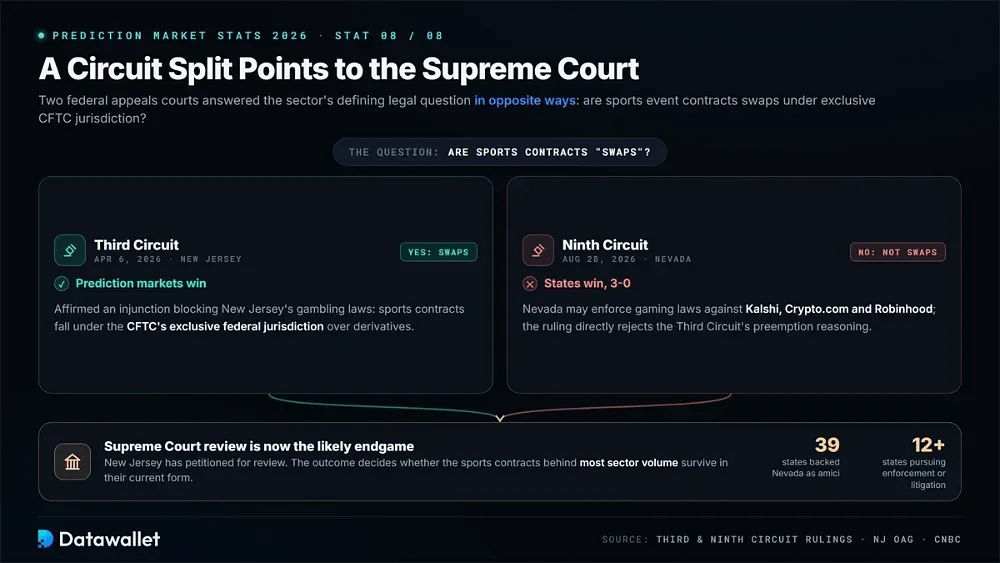
The federal judiciary is now divided over the legal question underlying the boom. On April 6, the Third Circuit affirmed an injunction blocking New Jersey from enforcing gambling laws against Kalshi. The court held that sports event contracts qualify as swaps and therefore fall under the CFTC's exclusive federal jurisdiction over derivatives.
The Ninth Circuit reached the opposite conclusion on August 28. In a 3-0 ruling, it found that sports contracts do not satisfy the swap definition, allowing Nevada to enforce its gaming laws against Kalshi, Crypto.com, and Robinhood. The unanimous decision directly rejected the Third Circuit's core preemption reasoning.
That split creates a clear path toward Supreme Court review. New Jersey has petitioned for review, while more than a dozen states continue to pursue enforcement actions or litigation. The eventual outcome will determine whether the sports contracts responsible for most sector volume can survive in their current legal form.
Why Prediction Markets Keep Growing in 2026
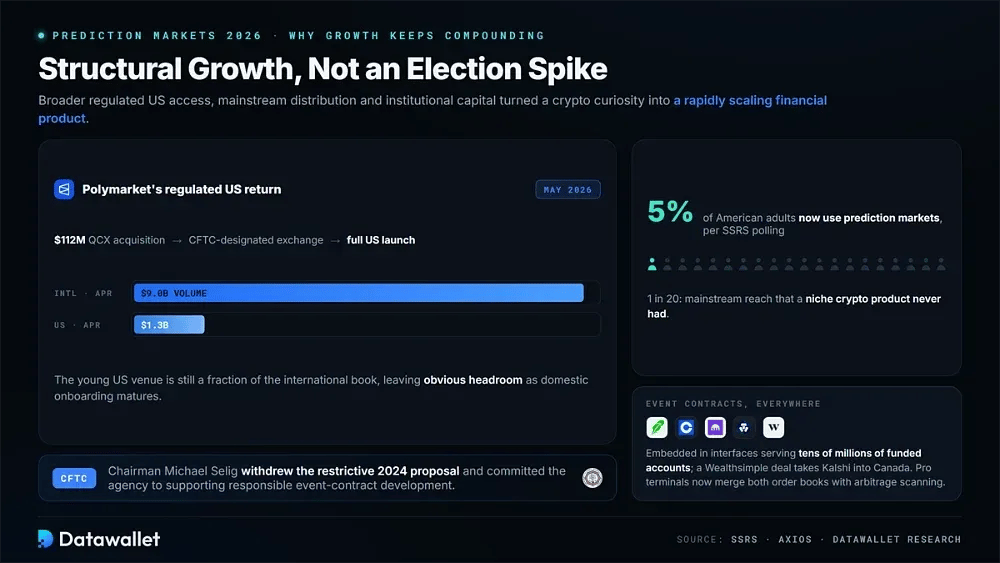
The sector's 2026 expansion reflects structural change rather than dependence on a single election cycle. Regulated US access became broader, mainstream distribution improved, and institutional capital moved into event contracts, turning what had been a crypto curiosity into a rapidly scaling financial product.
Event-driven spikes still matter, but they are distinct from the underlying growth engine. World Cups and elections pass. Onboarding rails, brokerage integrations, and regulatory clarity can continue compounding in the background regardless of the news cycle.
Regulated US Access Went Mainstream
Polymarket's long-awaited return to the US became one of the year's central developments. After acquiring CFTC-designated exchange QCX for $112 million, Polymarket restored US access and fully launched its regulated domestic exchange in May 2026. The US operation recorded $1.3 billion in April volume, compared with $9 billion on the larger international platform.
Adoption data points in the same direction. An SSRS poll found that 5% of American adults now use prediction markets. At the regulatory level, CFTC Chairman Michael Selig withdrew the restrictive 2024 event-contract proposal and publicly committed the agency to supporting responsible development of event contract markets across the entire category.
For newcomers, our guide to how prediction markets work explains contract mechanics, probability pricing, and outcome resolution in detail. Our roundup of the best decentralized prediction markets covers the crypto-native alternatives competing for liquidity beneath the two dominant platforms.
Distribution Deals Put Event Contracts Everywhere
Prediction-market access expanded well beyond native applications. Robinhood, Coinbase, Kraken, and Crypto.com embedded event contracts into interfaces already serving tens of millions of funded accounts. Kalshi also reached Canadian investors through a Wealthsimple partnership, taking regulated event trading into a new national market beyond the US.
Retail expansion was quickly followed by professional tooling. Trading terminals now combine Polymarket and Kalshi order books with cross-platform arbitrage scanning and whale tracking. Our breakdown of the top Polymarket trading strategies covers the systematic methods leaderboard accounts actually use to consistently compound their edge.
How Accurate Are Prediction Markets as Forecasting Tools?
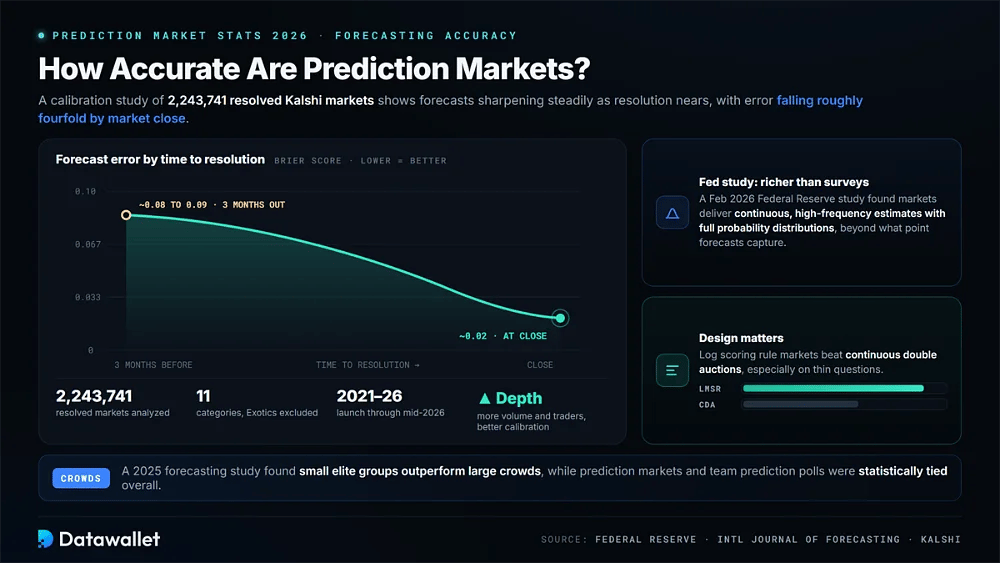
Prediction markets are increasingly being studied as forecasting tools rather than simply trading venues. A February 2026 Federal Reserve study on Kalshi and macro markets compared Kalshi-implied forecasts with traditional surveys and other market-based measures. The researchers found that prediction markets can provide continuously updated, high-frequency estimates with full probability distributions, giving economists and policymakers information that conventional point forecasts do not capture.
Accuracy still depends on market design and the quality of participants. A 2025 International Journal of Forecasting study indexed by RePEc found that small groups of elite forecasters outperformed larger, less selective crowds, while prediction markets and team-based prediction polls were statistically tied overall. Market structure mattered too: logarithmic market scoring rule markets produced more accurate forecasts than continuous double-auction markets, particularly on questions with limited activity.
Large-scale platform data also shows how forecasts sharpen as events approach resolution. An August 2026 Kalshi calibration study examined 2,243,741 resolved markets across eleven categories from 2021 through mid-2026. Excluding Exotics, the reported Brier score improved from roughly 0.08 to 0.09 at a three-month horizon to about 0.02 at market close. Calibration also improved as trading volume and the number of unique traders increased, suggesting that deeper participation is associated with more reliable probability estimates.
How US Regulation Is Reshaping Prediction Markets
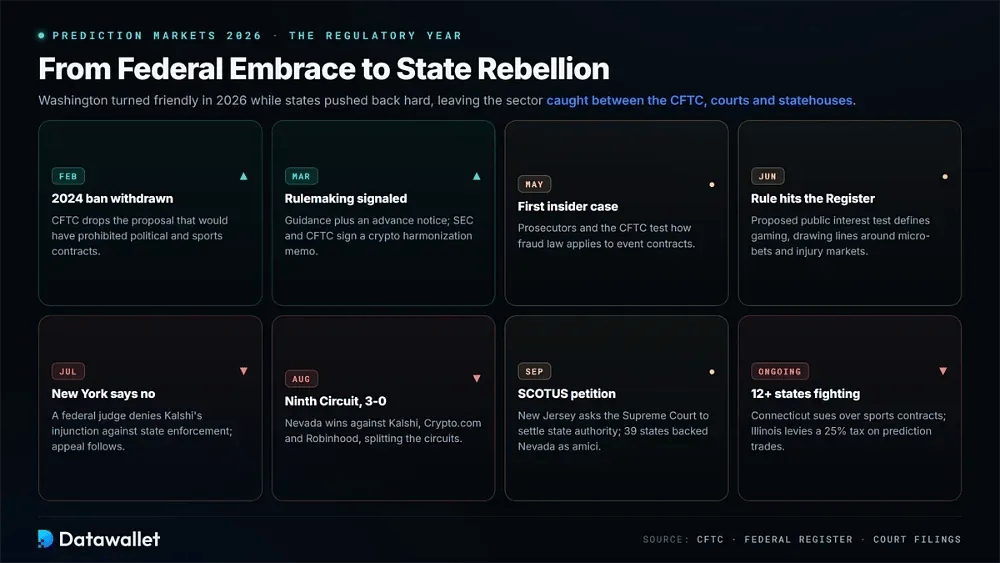
US regulation moved through several distinct phases in 2026. Hostility gave way to accommodation at the federal level, followed by open conflict among the CFTC, states, courts, and incumbent exchanges.
The Regulatory Milestones That Defined Prediction Markets in 2026:
- February 2026: The CFTC formally withdrew its 2024 proposal that would have prohibited political and sports event contracts, signaling a decisively friendlier federal posture toward the sector.
- March 2026: The Commission issued guidance and an advance rulemaking notice, while the SEC and CFTC also signed a harmonization memorandum coordinating their overlapping crypto oversight responsibilities.
- May 2026: Federal prosecutors and the CFTC brought the first-ever prediction-market insider trading case, directly testing how fraud and commodities law apply to modern event contracts.
- June 2026: A formal proposed rule on public interest determinations reached the Federal Register, formally defining gaming and drawing regulatory lines around micro-bets and injury markets.
- July 2026: A New York federal judge denied Kalshi's injunction against state enforcement there, prompting an immediate Second Circuit appeal over the scope of the CFTC's exclusive jurisdiction.
- August 2026: The Ninth Circuit unanimously sided with Nevada against Kalshi, Crypto.com, and Robinhood, creating a direct doctrinal conflict with the Third Circuit's April preemption ruling.
- September 2026: New Jersey formally asked the Supreme Court to resolve whether states can regulate sports contracts, with 39 states having previously backed Nevada as amici.
- Ongoing Friction: More than a dozen states maintain active enforcement or litigation, including Connecticut's new lawsuit over sports contracts and Illinois's 25% tax on prediction trades.
What to Watch Before the 2026 Midterms
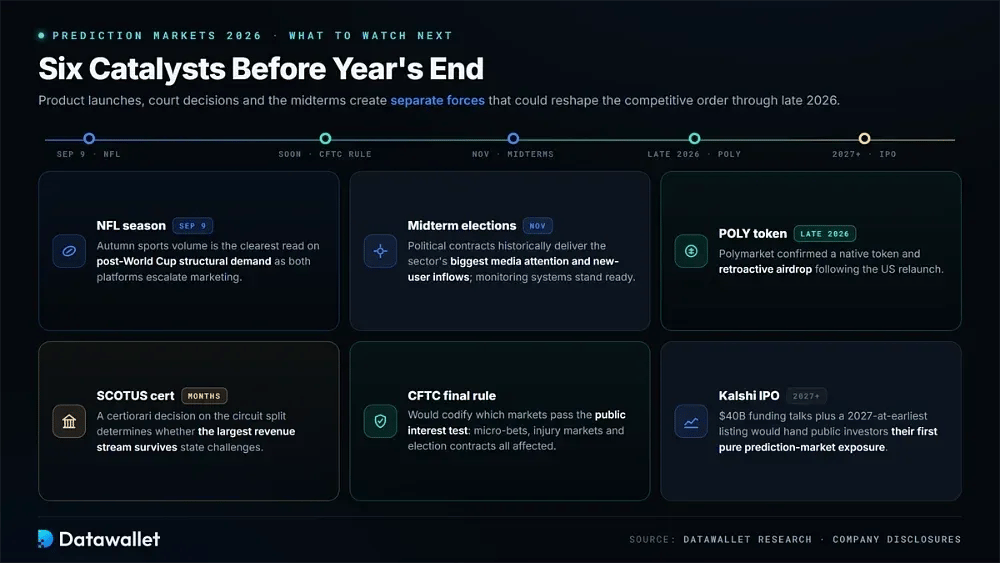
November's midterm elections will test how far the sector has matured since 2024. They arrive as product launches, court decisions, and token speculation create separate forces that could reshape the competitive landscape before the end of the year.
Six Catalysts Likely to Move Prediction Markets Through Late 2026:
- Midterm Volumes: Polymarket says its monitoring systems are ready for election-driven surges, and political contracts historically deliver the sector's biggest mainstream media attention and new-user inflows.
- POLY Token: Polymarket has publicly confirmed a native token and retroactive airdrop will follow its US relaunch, with community expectations now clustering around a late-2026 distribution window.
- Supreme Court: A certiorari decision on the sports-contract circuit split could arrive within months, ultimately determining whether the category's single largest revenue stream survives ongoing state challenges.
- CFTC Rule: Finalized event-contract rules could soon codify which markets clear the public interest test, simultaneously affecting micro-bets, injury markets, and election contracts across every major platform.
- NFL Season: Football kicks off September 9 with both platforms escalating marketing spend, making autumn sports volume the clearest available read on post-World Cup structural demand.
- Kalshi IPO: Reported $40 billion funding talks and a 2027-at-earliest listing timeline mean any concrete IPO progress would hand public investors their first pure prediction-market exposure.
Final Thoughts
Prediction markets spent 2026 demonstrating that they are neither a fad nor a sideshow. Monthly volumes above $45 billion and twin valuations beyond $20 billion show how far the category has moved into mainstream finance. At Robinhood, event-contract revenue has even surpassed crypto trading.
The main unresolved issue is legal. If the Supreme Court rejects the swap classification, sports contracts, the sector's largest source of volume, would lose federal protection. A favorable ruling would effectively federalize event trading and likely prompt another wave of incumbent entry and aggressive capital formation.
Whatever the courts decide, the infrastructure is already in place. Regulated venues and leveraged products now sit alongside institutional data pipelines and looming token incentives. Prediction markets' crowd-priced probability engine is permanently embedded in how traders, journalists, and policymakers interpret the world around them.
Our Methodology
This article evaluates the evolution of prediction markets through 2026 using volume dashboards and protocol revenue data, together with funding disclosures, survey research, and primary legal records.
How the Data Was Compiled:
- Volume Trackers: Used The Block's aggregated dashboard figures, as reported widely across financial media, for monthly platform volumes, market share splits, and the August 2026 sector pullback.
- DefiLlama Data: Used for Polymarket fee, revenue, and cumulative monetization metrics tracked across both its Polygon-based international platform and its separate off-chain US exchange operations.
- Survey Research: Drew on Pew Research Center's May 2026 analysis and independent SSRS polling for category shares, monthly growth trajectories, and US adult adoption rates.
- Primary Legal Records: Reviewed circuit court opinions, Federal Register filings, and official state attorney general releases to construct the complete 2026 regulatory and litigation timeline.
- Company Disclosures: Cross-referenced funding reports, quarterly earnings releases, and official platform announcements for private valuations, perpetuals launches, sports partnerships, and product rollout dates.
- Snapshot Caveat: Several metrics reflect live dashboards and reported private-market figures, so exact values will shift as markets settle, funding rounds close, and litigation progresses.