




What is Kalshi?
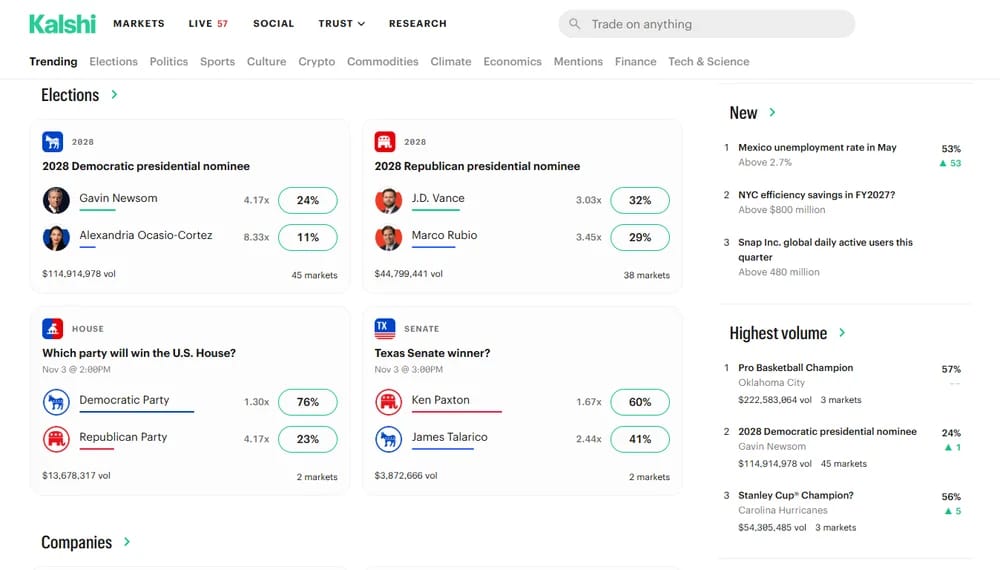
Kalshi is a US-based prediction market platform where users trade event contracts tied to real-world outcomes, such as economics, politics, weather, culture, and sports. The company was founded in 2018 by MIT classmates Tarek Mansour and Luana Lopes Lara, according to Kalshi’s official company profile.
Headquartered in New York, Kalshi presents itself as an exchange rather than a sportsbook, because users buy and sell “yes” or “no” contracts whose prices reflect market-implied probabilities. In simple terms, traders are speculating on whether a specific future event will happen.
A major differentiator is regulation. In November 2020, the Commodity Futures Trading Commission granted KalshiEX LLC designated contract market status, making it a federally regulated exchange for event contracts in the United States. DCMs operate under CFTC oversight, similar to traditional futures exchanges.
Kalshi publicly launched in 2021 and has since become one of the best-known prediction market brands, backed by investors including Sequoia, Y Combinator, and others. Its growth has also brought scrutiny, especially around election, sports, and cross-border regulation, showing how new this market category remains.
How Does Kalshi Work?
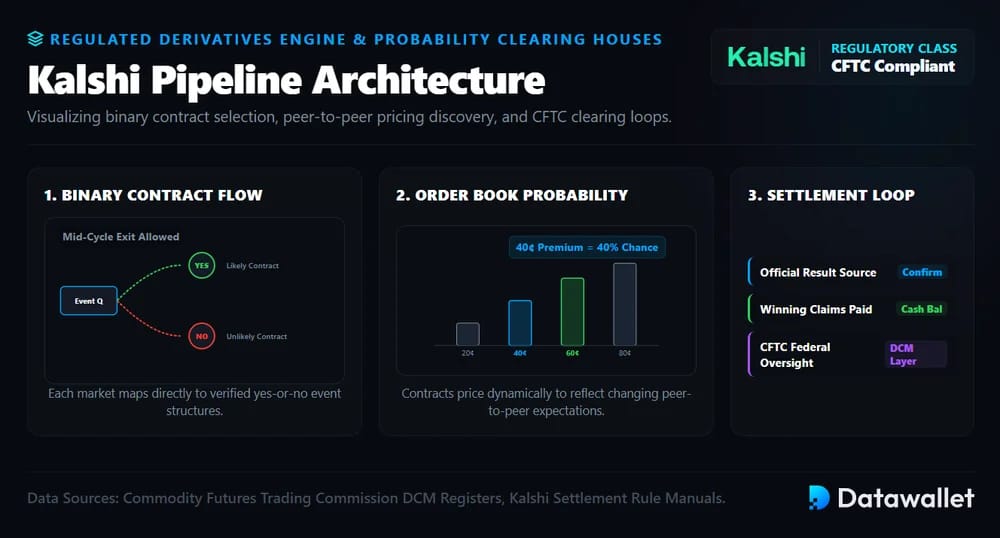
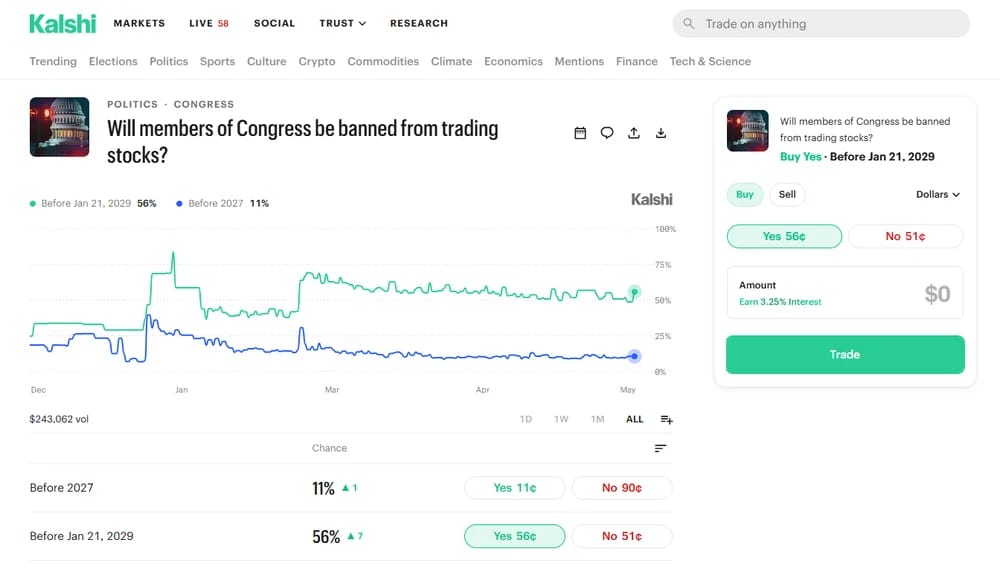
Kalshi works by letting users trade contracts based on real-world event outcomes. Each market asks a specific yes-or-no question, prices reflect changing market expectations, and winning contracts are paid after the official result is confirmed.
1. Event Contracts
Kalshi markets are built around event contracts, which let users take a position on whether a clearly defined future event will or will not happen.
Core parts of each event contract include:
- Question: Each market starts with a specific yes-or-no question, giving traders a clear outcome to evaluate before buying, selling, or holding a position.
- Outcome: Users choose “Yes” if they believe the event will happen, or “No” if they expect the stated outcome not to occur.
- Price: Prices represent market-assigned probability, moving between unlikely and likely as traders react to new information, demand, and changing expectations.
- Contract: Each position is a tradable contract, meaning users can enter, hold, sell, or exit before the final market settlement.
- Expiration: Every market has an end point, so traders know when trading stops and when the outcome review process begins.
- Rules: Market rules explain how the outcome will be judged, including the official source or criteria used for final settlement.
2. Trading and Pricing
Kalshi operates as a peer-to-peer exchange, so users trade against other participants rather than against the platform itself. A “Yes” contract gains value when traders believe the event is more likely, while a “No” contract gains value when the opposite view becomes stronger.
Prices are designed to reflect the market’s collective probability estimate. For example, a contract trading near 40 cents suggests the market views that outcome as roughly 40% likely. Users may hold until settlement or sell early to manage risk.
3. Settlement and Regulation
After an event occurs, Kalshi reviews the official outcome source, finalizes the result, and pays winning contracts into users’ cash balances after settlement.
Important settlement and oversight details include:
- Confirmation: Kalshi waits for the official result before finalizing a market, helping ensure the outcome matches the contract’s published resolution criteria.
- Settlement: Once confirmed, the market settles, winning contracts are paid, and losing contracts expire without receiving the final payout.
- Balance: Winning payouts are credited to the user’s cash balance, making settled funds available under Kalshi’s normal account and withdrawal rules.
- Oversight: Kalshi is regulated by the Commodity Futures Trading Commission as a Designated Contract Market, placing it under federal derivatives-market supervision.
- Compliance: Its regulated status distinguishes Kalshi from unregulated prediction markets, although certain event categories remain restricted under CFTC rules.
- Disputes: Some state-level disputes have emerged around sports-related contracts, showing that prediction-market regulation is still evolving in practice.
How to Trade on Kalshi
Trading on Kalshi begins with a verified account, funded balance, and chosen market. From there, users select Yes or No contracts, manage exposure, and exit or withdraw.
Follow these steps from signup to settlement and withdrawals:
- Sign Up: Create a Kalshi account with your email, birthday, and personal details, then complete identity checks required before trading regulated event contracts on the platform.
- Verify Account: Confirm your identity and eligibility, because Kalshi operates under CFTC oversight as a regulated Designated Contract Market rather than an offshore prediction-market operator.
- Add Funds: Link a supported bank account, debit card, crypto wallet, or other available payment method, then deposit funds before entering any live market.
- Browse Markets: Search available categories, review contract questions, compare prices, and read each market’s rules so you understand exactly how the outcome will resolve.
- Choose Side: Select “Yes” if you think the event will happen, or “No” if you believe the stated outcome will not occur.
- Place Order: Enter your contract quantity, then use a quick order for immediate execution or a limit order to set your preferred maximum price.
- Monitor Position: Track price changes as news, data, and trader demand shift the market’s probability estimate, then decide whether to hold or adjust.
- Close Position: Sell contracts before resolution to lock in gains, reduce losses, or free capital, instead of waiting for the final settlement result.
- Settle Trade: If you hold through resolution, winning contracts pay $1 each, while losing contracts expire worthless after Kalshi confirms the official outcome.
- Cash Out: After settlement, withdraw available funds through Kalshi’s supported payout methods, such as bank transfer, debit card, crypto, PayPal, or Venmo.
Note 1: Kalshi’s standard account limits are commonly structured around position caps of up to $25,000 per market, though some contracts may have different limits and larger institutional or market-maker activity can involve higher approved limits.
Note 2: After trades settle, earnings beyond deposited amounts are generally withdrawable immediately; debit card withdrawals typically arrive within 30 minutes, while bank withdrawals usually take a few business days.
Kalshi Restricted Countries
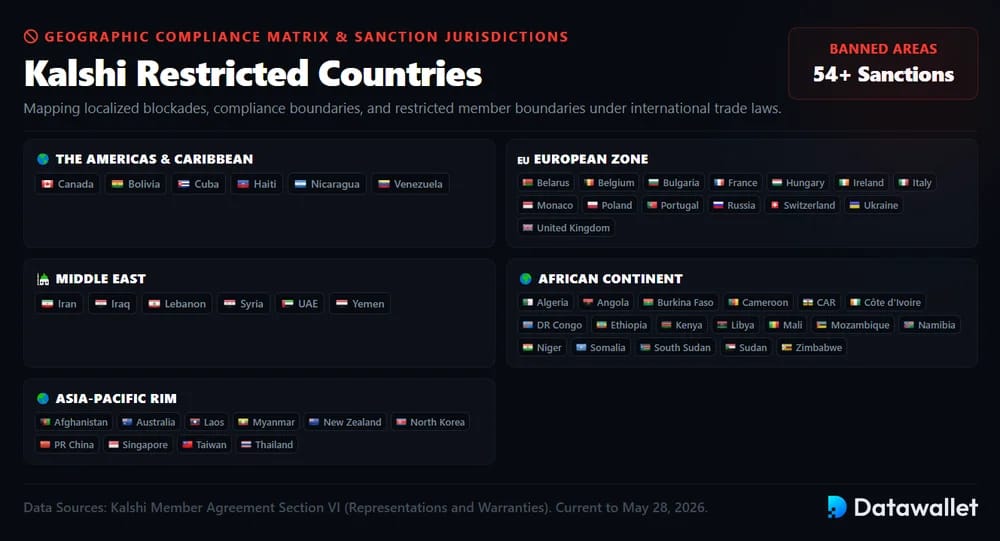
Kalshi’s official restricted-country list appears in Section VI, “Representations and Warranties,” of the Kalshi Member Agreement. Counting the named jurisdictions in that section, there are 54 restricted jurisdictions, plus any jurisdiction or territory subject to broad US economic sanctions.
List of Kalshi’s restricted countries:
- North America: Canada.
- Europe: Australia is not in Europe; European restricted jurisdictions include Belarus, Belgium, Bulgaria, France, Hungary, Ireland, Italy, Monaco, Poland, Portugal, Russia, Switzerland, Ukraine, and the United Kingdom.
- Middle East: Iran, Iraq, Lebanon, Syria, United Arab Emirates, and Yemen.
- Africa: Algeria, Angola, Burkina Faso, Cameroon, Central African Republic, Côte d’Ivoire, Democratic Republic of the Congo, Ethiopia, Kenya, Libya, Mali, Mozambique, Namibia, Niger, Somalia, South Sudan, Sudan, and Zimbabwe.
- Asia-Pacific: Afghanistan, Australia, Laos, Myanmar (Burma), New Zealand, North Korea, People’s Republic of China, Singapore, Taiwan, and Thailand.
- Latin America and Caribbean: Bolivia, Cuba, Haiti, Nicaragua, and Venezuela.
Users or entities from these regions cannot open accounts, deposit funds, or trade on Kalshi under current policy and applicable law. Their best alternative would be to look at Polymarket's supported country list and see if they are eligible to participate in prediction markets there.
Kalshi Supported Countries
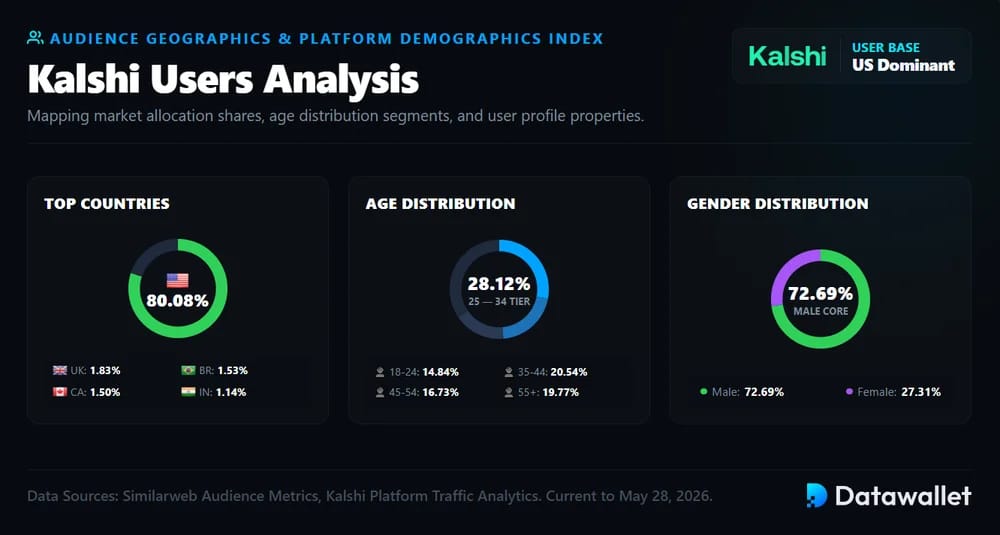
Kalshi’s country availability page is reported to list 143 supported countries, while Kalshi’s help center says international eligibility depends on the Member Agreement, country restrictions, and verification checks. Similarweb’s April 2026 traffic data shows Kalshi’s largest audiences from the United States, United Kingdom, Brazil, Canada, and India.
For funding, Kalshi supports debit card, ACH bank transfer, PayPal, Venmo, Cash App deposits, crypto, and wire transfer, but international users have fewer options. International deposits can be made by debit card, crypto, or wire, while international withdrawals are limited to debit card and crypto.
Kalshi accounts trade in US-dollar-based event contracts, so international users should expect currency conversion from local banks, cards, or payment providers. Crypto deposits and withdrawals are available for both US and international users, though crypto withdrawals may require prior crypto deposit and document verification.
Kalshi Licenses
Kalshi’s core licensing comes from the US Commodity Futures Trading Commission, not state gambling regulators. Its exchange entity, KalshiEX LLC, is registered as a Designated Contract Market, while Kalshi Klear LLC is registered as a Derivatives Clearing Organization.
Below is an overview of Kalshi’s official licenses and related regulatory registrations:
- DCM License: KalshiEX received CFTC Designated Contract Market status in November 2020, allowing it to operate a federally regulated exchange for event contracts.
- CFTC Oversight: As a DCM, Kalshi is supervised by the CFTC, which oversees US derivatives markets and enforces exchange compliance obligations.
- DCO Registration: Kalshi Klear received CFTC Derivatives Clearing Organization registration in August 2024, allowing Kalshi-affiliated clearing for eligible event-contract transactions.
- Clearing Role: The DCO license lets Kalshi Klear clear trades, manage collateral, and support settlement obligations after event contracts are executed on KalshiEX.
- Federal Framework: Kalshi contracts are treated as derivatives under the Commodity Exchange Act, placing core exchange activity within the federal commodities regulatory system.
- Rulebook Duties: Kalshi must follow CFTC-approved exchange rules covering trading, market integrity, risk controls, member conduct, trade cancellations, and settlement procedures.
- No-Action Relief: CFTC staff has granted limited no-action relief for certain reporting and recordkeeping requirements involving fully collateralized binary option transactions.
- State Conflicts: Some states have challenged Kalshi’s sports-related markets under gambling laws, creating ongoing legal tension between federal derivatives oversight and state gaming regulation.
- Market Limits: Kalshi’s licenses do not mean every contract is automatically allowed; listed markets must still comply with CFTC rules and prohibited-category restrictions.
- Public Filings: Kalshi’s regulatory filings, rulebooks, certifications, and CFTC actions are publicly available, making its licensing status more transparent than offshore prediction markets.
These licenses allow Kalshi to list, trade, and clear federally regulated event contracts under the Commodity Exchange Act, although state-level disputes around sports-related markets continue in some jurisdictions.
Kalshi Funding
Kalshi has raised several major venture rounds as prediction markets moved into the financial mainstream. In June 2025, it announced a $185 million Series C led by Paradigm at a $2 billion valuation, with Sequoia, Multicoin, Neo, Bond, and others participating.
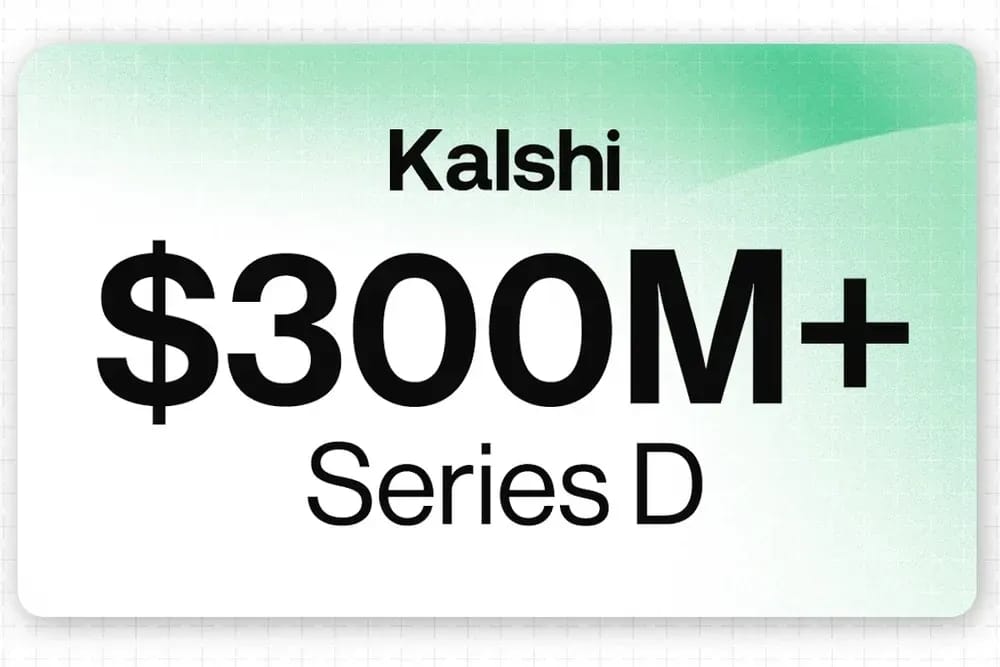
The company’s valuation climbed quickly afterward. In October 2025, Kalshi raised over $300 million in a round led by Sequoia and Andreessen Horowitz, reaching a $5 billion valuation. By December 2025, it announced a $1 billion Series E led by Paradigm at $11 billion.
Kalshi’s latest reported valuation reached $22 billion in 2026, after another funding round reported by Reuters and the Wall Street Journal. Reports tied the surge to growing investor demand for prediction markets, international expansion, sports-event trading, and institutional interest in event-based financial products.
Is Kalshi Safe?
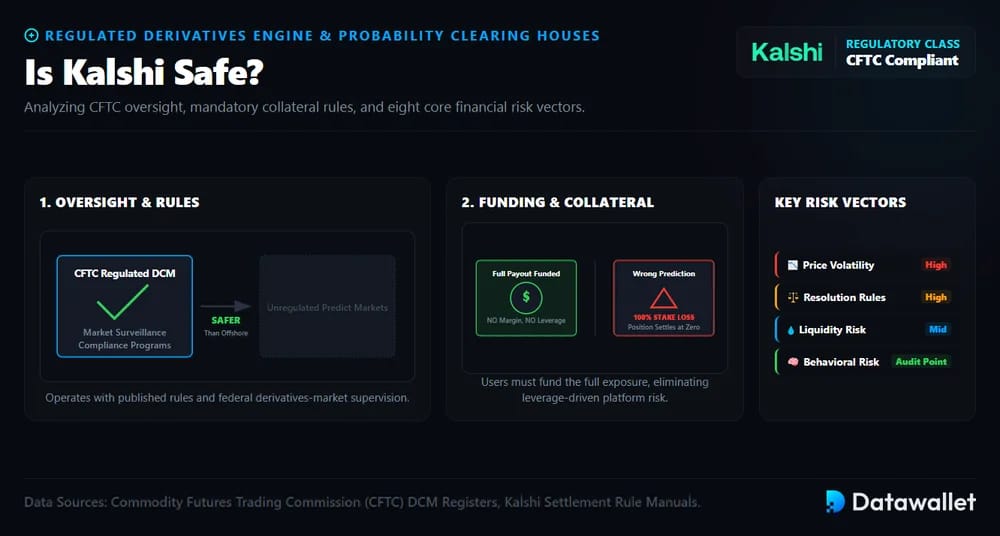
Kalshi is safer than many offshore prediction markets because it operates as a CFTC-regulated platform, with published rules, compliance obligations, and market-surveillance programs. That does not make trades risk-free, since event contracts remain speculative financial products.
Kalshi also uses fully collateralized trading, meaning users must fund the full exposure needed for a position instead of trading on margin. Still, traders can lose their entire stake if their prediction is wrong, and fees may reduce returns.
Kalshi Risks
Kalshi is regulated and transparent, but its markets still involve financial, legal, liquidity, behavioral, and outcome-resolution risks that every trader should understand first.
Key risks to consider before trading include:
- Market Loss: Event contracts can settle at zero, meaning a wrong prediction may cause the trader to lose the full amount committed to that position.
- Price Volatility: Prices can move quickly when news, data releases, injuries, weather changes, or political developments alter expectations before a market reaches settlement.
- Liquidity Risk: Some markets may have limited buyers or sellers, making it harder to enter, exit, or close a position at a fair price.
- Resolution Rules: Each contract has specific settlement criteria, so misunderstanding the official data source, timing, or wording can create unexpected losses.
- Fee Impact: Trading fees can reduce returns, especially for frequent traders, small positions, or strategies relying on narrow price movements.
- Legal Changes: Prediction-market rules are evolving, and sports, election, or gaming-related contracts may face court challenges, state restrictions, or regulatory changes.
- Behavioral Risk: Simple yes-or-no markets can feel like betting, which may encourage overconfidence, chasing losses, or risking more than planned.
- Platform Risk: Kalshi monitors markets for suspicious activity, but surveillance, compliance systems, outages, or account reviews cannot eliminate every operational or integrity risk.
- Information Risk: Traders with faster access to news, data, or specialized knowledge may react before casual users, creating disadvantages in fast-moving markets.
Legal Battle and Court Victories
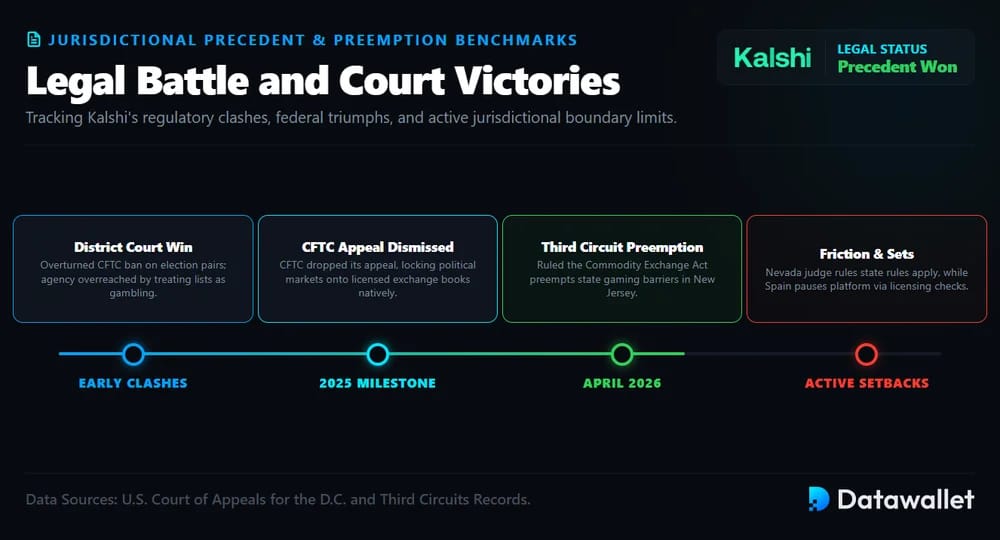
Kalshi’s biggest early legal fight centered on election contracts. After the CFTC blocked congressional-control markets, Kalshi sued and won in federal district court, with the court finding the agency had wrongly treated those contracts as gaming or gambling. The D.C. Circuit later denied a stay.
That victory became more important in 2025, when the CFTC voluntarily dismissed its appeal, leaving Kalshi’s district-court win in place. The result strengthened Kalshi’s position that federally regulated event contracts can include political outcomes when listed through a licensed derivatives exchange.
Kalshi then faced state-level challenges over sports-related event contracts. New Jersey regulators tried to stop Kalshi from serving residents, but the Third Circuit ruled in April 2026 that the Commodity Exchange Act governed Kalshi’s sports contracts and preempted New Jersey gaming law.
The legal picture is not entirely one-sided. A Nevada federal judge ruled Kalshi was subject to state gaming rules, while Spain temporarily blocked Kalshi during a gambling-license investigation. These setbacks show Kalshi has won major cases, but prediction-market law remains contested.
Kalshi vs Other Prediction Markets
Kalshi competes with Polymarket and Hyperliquid’s HIP-4 outcome markets, but each platform uses a different model: federally regulated event contracts, crypto-native prediction markets, or validator-settled onchain outcome trading.
Here is how the main platforms compare:
Final Thoughts
Kalshi is one of the most important prediction market platforms because it combines event-based trading with CFTC oversight, public rulebooks, and growing institutional interest. Its latest funding and valuation also show how quickly the category is maturing.
Still, Kalshi is not risk-free. Event contracts can lose their full value, and the legal environment remains unsettled across some jurisdictions, especially where regulators view prediction markets as gambling rather than federally regulated derivatives.