



Which Countries Does BitMart Restrict?
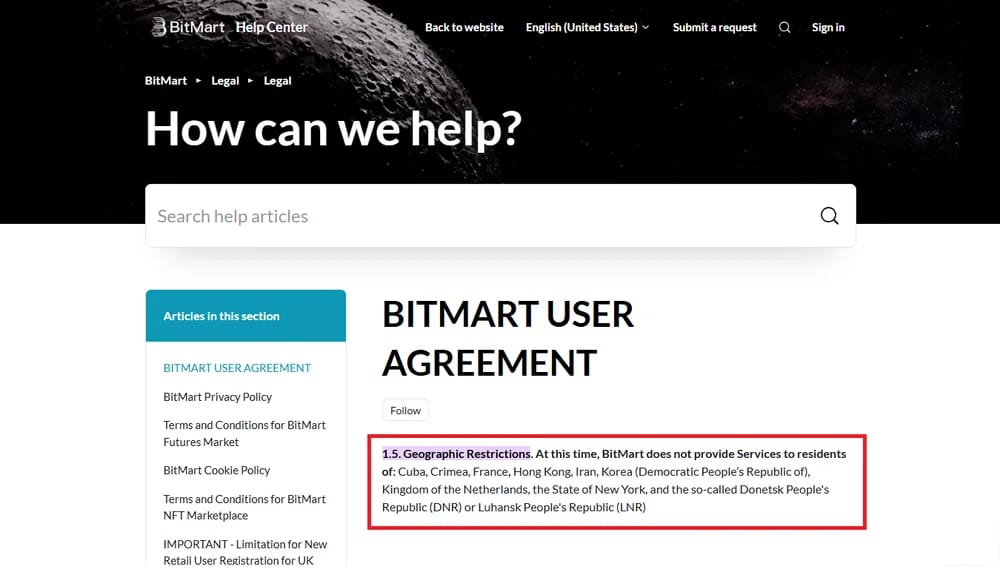
BitMart officially restricts about 10 jurisdictions in 2026. Section 1.5 of its User Agreement names Cuba, Crimea, Hong Kong, Iran, North Korea, the Netherlands, New York, DNR, and LNR.
BitMart Restricted Countries List in 2026
Below is the 2026 BitMart restricted jurisdictions list, grouped by region based on the platform’s current Geographic Restrictions clause in its User Agreement.
Why Does BitMart Restrict These Countries?
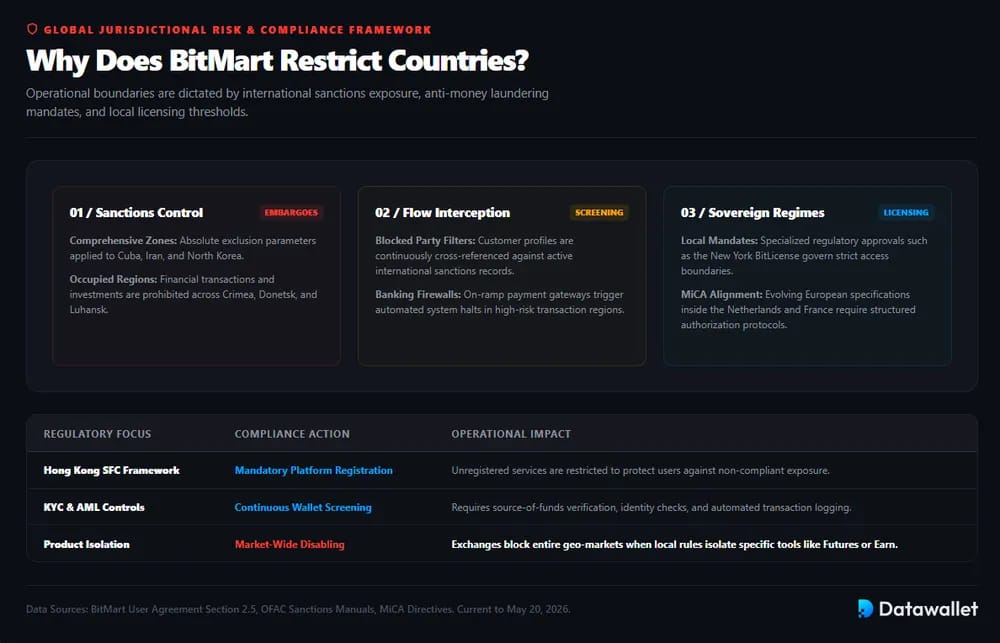
BitMart restricts these countries because exchange access depends on sanctions exposure, AML controls, licensing obligations, and consumer-protection rules.
1. Sanctions And Embargo Exposure
Some restrictions reflect sanctions risk, especially where US, international, or platform compliance teams may treat crypto transfers as prohibited financial services or property transactions.
Key sanctions-related drivers include:
- Comprehensive Sanctions: Users in Cuba, Iran, and North Korea face broad sanctions that can affect exchange access, payments, custody, and transfers.
- Occupied Regions: Crimea, Donetsk, and Luhansk are restricted because covered-region sanctions can prohibit new investment, services, imports, exports, and related financial activity.
- Blocked Parties: Exchanges must screen customers against sanctions lists, so restricted jurisdictions increase the risk of serving blocked persons, sanctioned entities, or prohibited counterparties.
- Transaction Monitoring: Crypto platforms may block high-risk regions when wallet flows, withdrawals, or deposits could trigger sanctions alerts, compliance reviews, or asset-freezing duties.
- Cross-Border Payments: Fiat ramps, card payments, and banking partners often apply sanctions controls, making some jurisdictions commercially or legally difficult to support.
- Platform Liability: BitMart can restrict or suspend access where sanctions exposure creates legal risk, even when individual users are not personally sanctioned.
2. Local Licensing And Regulatory Risk
Other restrictions come from licensing regimes, registration duties, marketing limits, or regulator supervision that can make serving residents expensive, uncertain, or legally sensitive.
Key licensing-related drivers include:
- State Licensing: New York requires virtual currency businesses serving residents to obtain BitLicense approval or a limited-purpose trust charter before operating.
- EU Authorization: The Netherlands applies MiCA authorization rules for crypto-asset service providers, raising compliance obligations for exchanges targeting local users.
- French Transition: France has MiCA transition deadlines, so platforms may restrict access until they meet authorization, notification, or local continuity requirements.
- Hong Kong Licensing: Hong Kong requires virtual asset trading platforms serving investors to appear under the SFC’s licensing framework.
- KYC Controls: Jurisdictions with strict crypto rules often require identity verification, source-of-funds checks, transaction monitoring, complaint handling, and suspicious activity reporting.
- Product Limits: Futures, Earn, loans, cards, and other crypto products may face separate local restrictions, so exchanges can block entire markets instead of individual features.
- Changing Rules: BitMart reserves discretion to refuse, suspend, or terminate accounts, which lets it respond quickly when laws or regulator expectations change.
BitMart Supported Countries
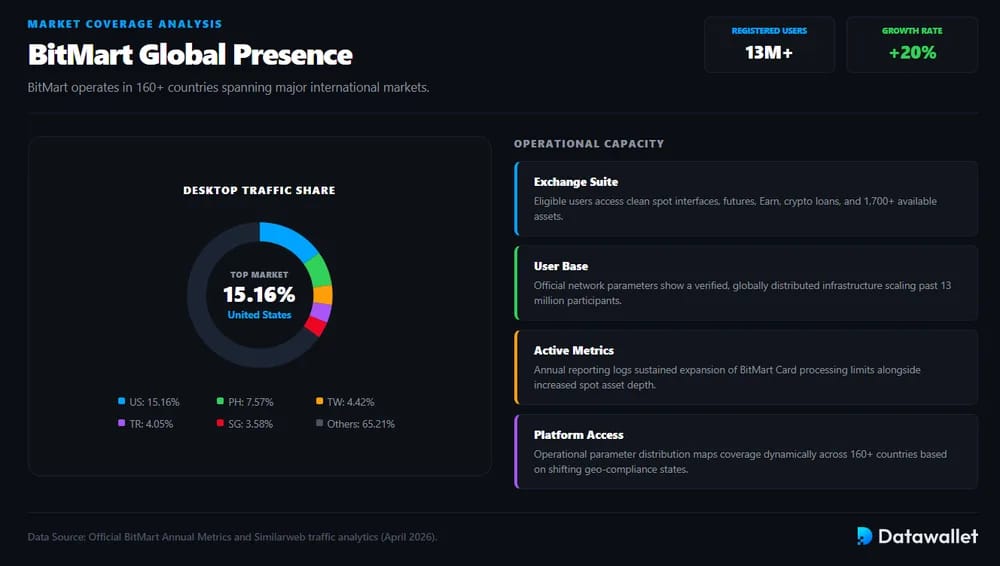
BitMart is available in 160+ countries where its services are not restricted by local law or the platform’s own geographic rules. Its User Agreement only names excluded jurisdictions, while BitMart’s website promotes access to spot trading, futures, Earn, crypto loans, fiat purchases, and 1,700+ cryptocurrencies.
BitMart’s global footprint is supported by its 2025 growth data: the exchange reported more than 13 million registered users, a 20% increase from the previous period, plus higher spot and futures activity. Its annual report also says BitMart Card coverage reached 160+ countries and regions.
Similarweb’s April 2026 desktop traffic data shows BitMart’s largest audience sources were the United States at 15.16%, the Philippines 7.57%, Taiwan 4.42%, Turkey 4.05%, and Singapore 3.58%, while other countries together accounted for 65.21% of visits.
Can I Use BitMart in the USA?
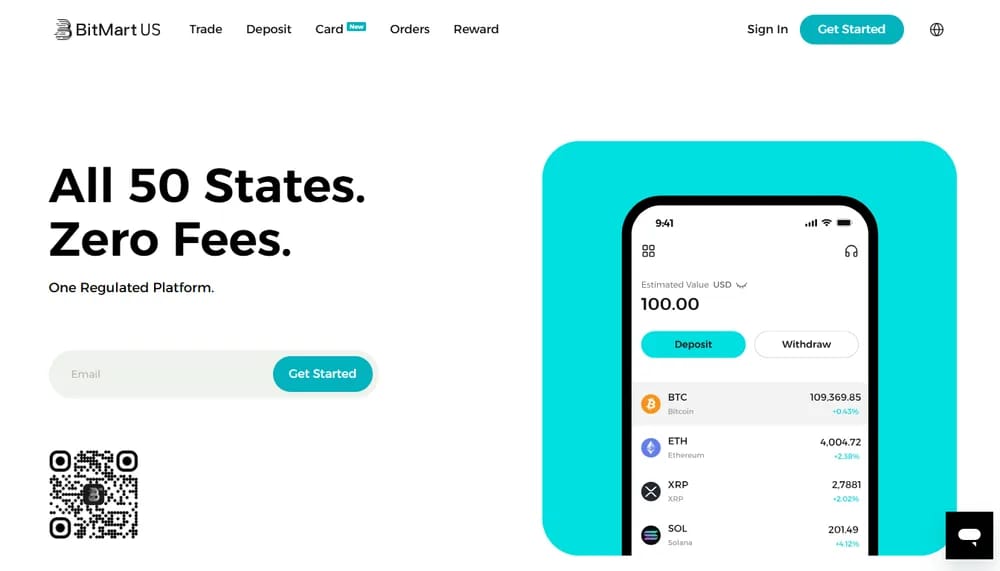
Yes, US users can access BitMart through BitMart US, its dedicated American platform. In 2026, BitMart US says it operates across all 50 states and US territories, with account creation, USD deposits and withdrawals, and crypto trading available after onboarding.
However, users should distinguish BitMart US from the global BitMart platform. BitMart’s global User Agreement still lists the State of New York as restricted, so the safest wording is that Americans should use BitMart US and complete KYC rather than assuming every global BitMart product is available.
What Fiat Currencies Does BitMart Support?
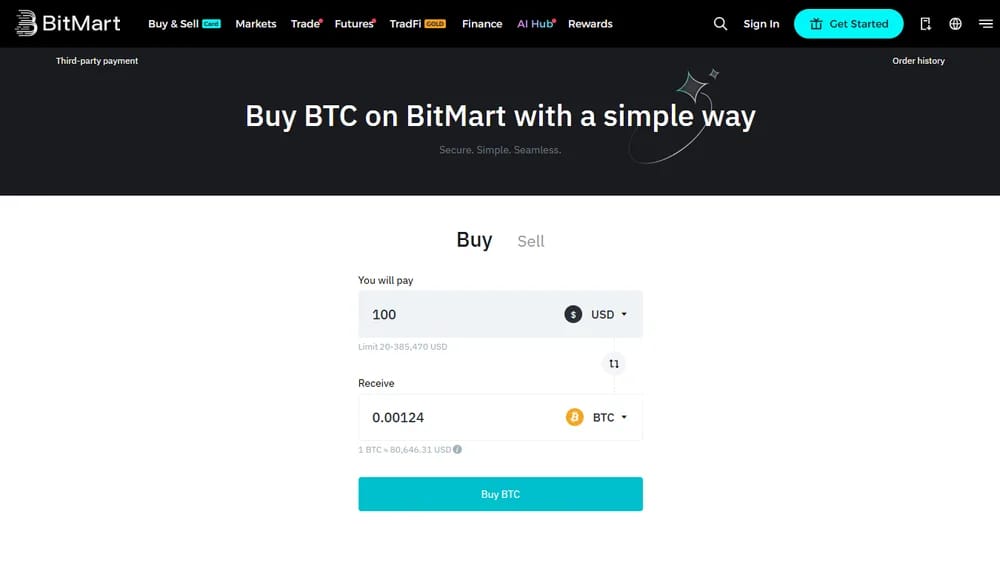
BitMart supports fiat onboarding mainly through third-party gateways, card payments, bank-transfer options, PayPal in some flows, and partner checkout services. Its fiat gateway page says users can buy 60+ cryptocurrencies with 50+ fiat currencies, including USD, EUR, CAD, AUD, GBP, and BRL.
Key fiat currencies and onboarding routes include:
- US Dollar (USD): Supported through BitMart’s buy-crypto flow, credit/debit card options, selected bank-transfer routes, PayPal availability, and third-party providers such as MoonPay, Banxa, Simplex, Alchemy Pay, and Legend Trading.
- Euro (EUR): Available across BitMart fiat gateway purchases and MoonPay-supported checkout routes, with access depending on country eligibility, provider coverage, verification level, and payment method.
- British Pound (GBP): Listed among BitMart’s supported fiat gateway currencies, with GBP routes appearing in card or third-party checkout flows for eligible users in supported regions.
- Canadian Dollar (CAD): Supported in BitMart’s card and fiat gateway flows, including pages that reference up to 42 fiat currencies for credit/debit card and PayPal purchases.
- Australian Dollar (AUD): Included among BitMart’s named fiat gateway currencies, giving eligible users a local-currency option when buying supported crypto through partner payment providers.
- Brazilian Real (BRL): Listed by BitMart as one of its 50+ fiat gateway currencies, with availability tied to local payment support and third-party provider coverage.
- Hong Kong Dollar (HKD): Supported through MoonPay-related BitMart fiat-to-crypto guidance, though access may vary because BitMart separately restricts some jurisdictions under its User Agreement.
- Chinese Yuan (CNY): Listed in BitMart’s MoonPay fiat-to-crypto tutorial, but users should treat availability as provider-dependent and subject to BitMart’s jurisdiction and compliance restrictions.
BitMart Licenses and Regulation
BitMart’s clearest current licensing claim is BitMart US, which announced full US operations in February 2026 with licensing across all 50 states and US territories. Earlier, BitMart said it registered with FinCEN as an MSB, but FinCEN registration is not an SEC license.
In Europe, BitMart announced crypto-related licenses in Lithuania in 2023, but Lithuania has since moved toward MiCA/CASP licensing under Bank of Lithuania supervision. BitMart’s global User Agreement also states it is not registered with the US Securities and Exchange Commission.
BitMart also lost or abandoned one major licensing path in Hong Kong: the SFC list shows Spread Technologies Hong Kong Limited, trading as BitMart, filed a VATP application on June 27, 2025, and withdrew it on August 28, 2025.
Does BitMart Require KYC?
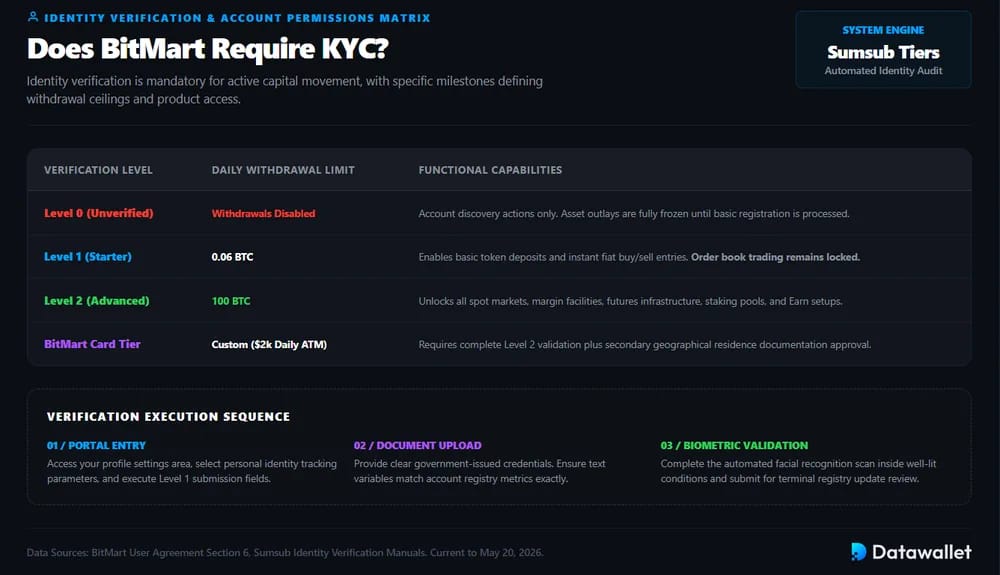
Yes. BitMart requires KYC for core account functions: unverified Level 0 accounts cannot withdraw, Level 1 unlocks limited deposits, withdrawals, and buy/sell access, while Level 2 is required for trading and fuller platform use.
1. BitMart KYC Limits
BitMart uses tiered verification, where each level changes account permissions, withdrawal access, and product eligibility. Higher verification generally means broader trading access and larger usable limits.
Main BitMart KYC limits to know:
- Level 0: Unverified BitMart accounts cannot withdraw assets, so users must complete at least basic identity verification before making their first withdrawal.
- Level 1: Basic verification allows deposits, crypto buying and selling, and withdrawals up to 0.06 BTC daily, but does not unlock trading access.
- Level 2: Advanced verification is required to become a trading user, giving access to platform trading features after completing the next identity-check step.
- Full Features: BitMart says KYC is needed for all features, including spot trading, futures trading, Earn, staking, and higher deposit or withdrawal limits.
- Card Access: BitMart Card applicants must complete Level 2 KYC and may need to provide extra documents before the application can be approved.
- Limit Changes: BitMart’s User Agreement says withdrawal and trading limits can depend on the identity verification level completed by the account holder.
2. How to Complete BitMart KYC
BitMart identity verification is completed from the account area on the website or app, with Level 1 and Level 2 requiring different information, documents, and checks.
Steps to complete BitMart KYC:
- Log In: Sign in to BitMart, open the account menu, then go to the identity verification page from your profile or security area.
- Start Verification: Choose personal identity verification, not institutional verification, unless you are applying for a company or organization account.
- Complete Level 1: Enter the required personal details and submit the basic information needed to unlock deposits, withdrawals, and buy/sell access.
- Continue To Level 2: Select the next verification level when you need trading access, higher limits, card access, or broader platform functionality.
- Upload Documents: Provide the requested identity documents clearly, making sure your name, document number, photo, and personal details match your account information.
- Wait For Review: Submit the application and wait for BitMart to approve it, reject it, or ask for additional information before upgrading your account permissions.
About BitMart
BitMart launched in 2018 under founder Sheldon Xia and grew into a global crypto exchange focused on spot markets, altcoin access, futures, Earn, fiat onboarding, and mobile trading. In April 2025, Xia became Group President, while Nenter “Nathan” Chow took over as Global CEO.
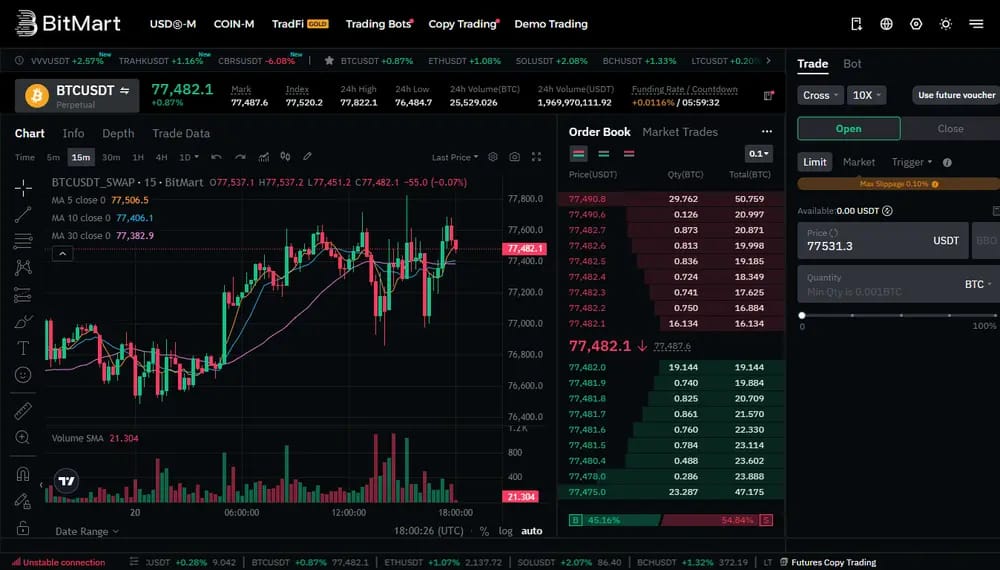
BitMart is especially geared toward active traders, not just basic spot users. Its 2025 annual report highlights nearly 500 tradable futures pairs after adding 265 futures assets, plus leverage up to 200x on selected contracts, alongside copy trading, staking, LaunchPrime, crypto loans, AI insights, DEX access, and BitMart Card features.
Recent development has centered on US expansion, compliance, and transparency. BitMart US launched nationwide operations in 2026, while the global platform publishes wallet-address transparency information and continues using diversified asset storage instead of presenting a complete proof-of-reserves system.
Final Thoughts
BitMart is broadly accessible, but availability depends on jurisdiction, KYC approval, and product type. Its 2026 picture is more nuanced: BitMart US covers American users, while the global platform still applies geographic restrictions and compliance-based account limits.
Before opening or using an account, confirm your local eligibility, complete identity verification, and check whether spot, futures, Earn, card, or fiat services are available in your region. BitMart’s rules can change as licensing, sanctions, and regulator expectations evolve.