



Who is Shayne Coplan?
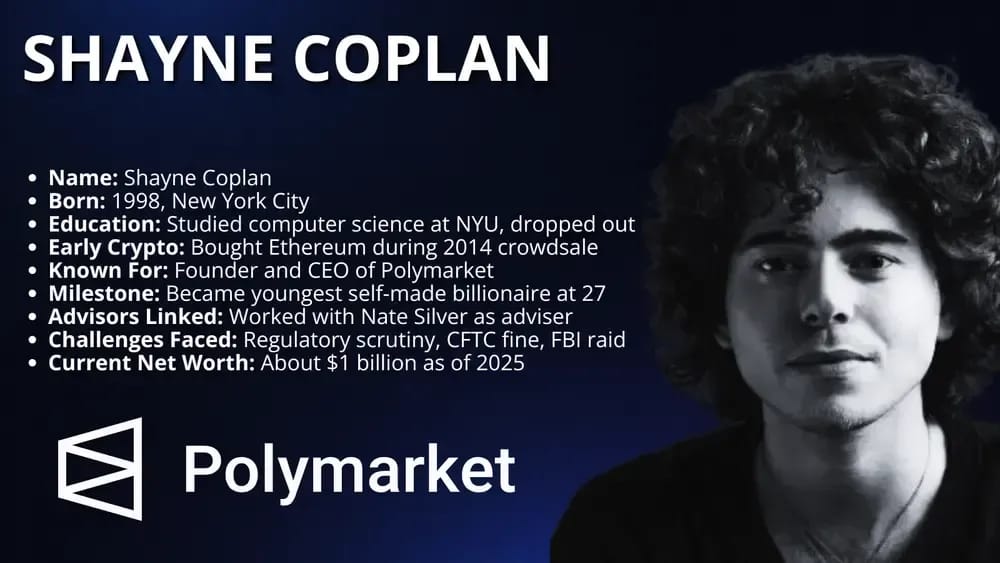
Shayne Coplan is an American entrepreneur best known as the founder and CEO of Polymarket, a prediction market platform where users trade on the likelihood of real-world events. By his late twenties, he had become one of the most closely watched figures in crypto, fintech, and political betting.
Coplan’s public profile is tied to Polymarket’s rise from a niche crypto project into a mainstream information platform. Forbes describes him as Polymarket’s founder and CEO, while the company presents itself as a large prediction market for trading forecasts on politics, sports, culture, economics, and current events.
Unlike many startup founders who become known through consumer apps or social networks, Coplan built his reputation around prediction markets: platforms that turn public expectations into tradable prices. That made him a notable figure among crypto investors, political observers, online traders, and people interested in alternative forecasting tools.
Today, Shayne Coplan is often discussed as both a young tech founder and a controversial market innovator. Supporters see him as someone who helped popularize real-time forecasting, while critics focus on the legal, regulatory, and ethical questions surrounding event-based betting and crypto-powered prediction markets.
Shayne Coplan's Background
Shayne Coplan’s background combines New York upbringing, early programming curiosity, crypto exposure, and a college dropout path shaped by markets, technology, and internet culture.
1. Early Life in New York
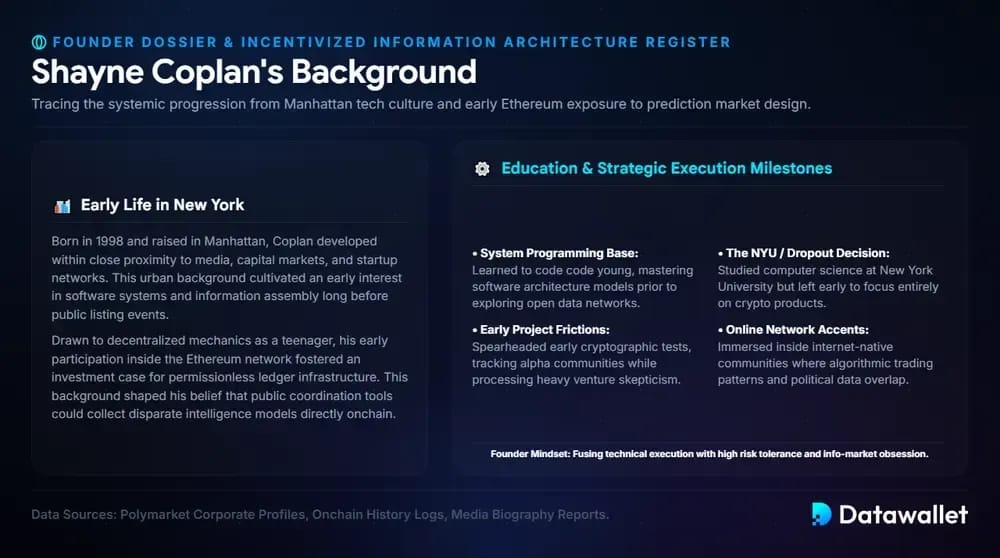
Shayne Coplan was born in 1998 and grew up in New York City, an environment that placed him near finance, media, technology, and startup culture from an early age. Reports describe him as a Manhattan-raised founder whose interest in markets and software developed before Polymarket existed.
His upbringing is often framed as urban, independent, and intellectually curious. Rather than following a traditional corporate path, Coplan appeared drawn to systems that explained how people make decisions, price uncertainty, and coordinate information. Those ideas later became central to his interest in crypto and prediction markets.
Before becoming known publicly, Coplan was part of the generation that encountered cryptocurrency as teenagers. He has described being involved with Ethereum early, which gave him exposure to decentralized networks, online communities, and the belief that financial tools could be rebuilt through blockchain-based infrastructure.
2. Education and Early Tech Interests
Coplan attended New York University to study computer science, but left early to pursue crypto projects and entrepreneurial ideas outside the classroom.
Before Polymarket, his path already showed several themes:
- Programming: Coplan learned to code young, giving him the technical foundation to explore software, crypto networks, and market-based applications before becoming a public founder.
- Ethereum: His early exposure to Ethereum introduced him to decentralized systems, smart contracts, and crypto communities that later influenced Polymarket’s blockchain-based design.
- NYU: Coplan studied computer science at New York University, but his time there was brief because he became more focused on building independently.
- Dropping Out: Leaving college positioned him closer to the familiar startup archetype of a young founder choosing experimentation, risk, and speed over formal credentials.
- Crypto Projects: Before Polymarket gained traction, Coplan reportedly worked on earlier crypto ideas, giving him experience with products, communities, and investor skepticism.
- Market Curiosity: His interests were not limited to coding; he was also drawn to markets as tools for collecting information and measuring public expectations.
- Online Culture: Coplan’s career developed inside internet-native communities where memes, trading, crypto, politics, and real-time news often overlap and move quickly.
- Founder Mindset: By his early twenties, Coplan had the technical skills, risk tolerance, and market obsession that later shaped his reputation as Polymarket’s founder.

How Did Shayne Coplan Create Polymarket?
Shayne Coplan created Polymarket by combining pandemic-era uncertainty, crypto infrastructure, prediction-market theory, and a belief that markets could organize public expectations better than commentary.
1. The Original Idea Behind Polymarket
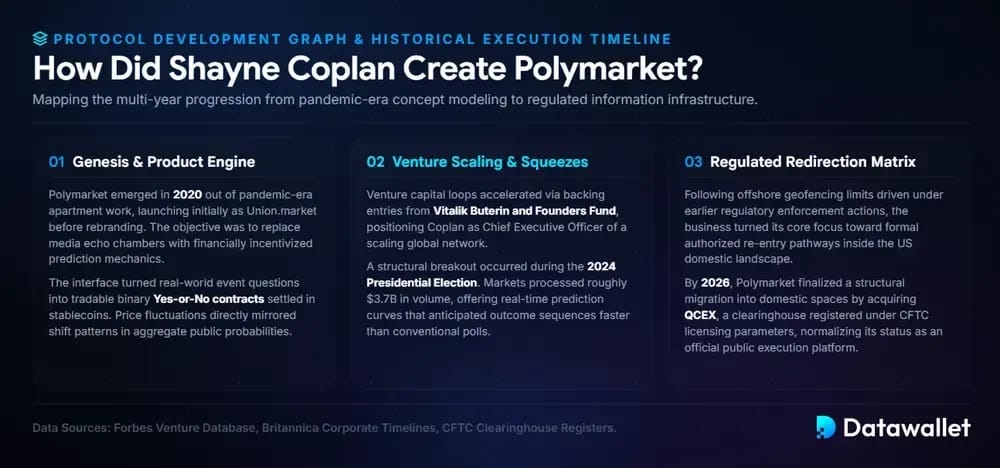
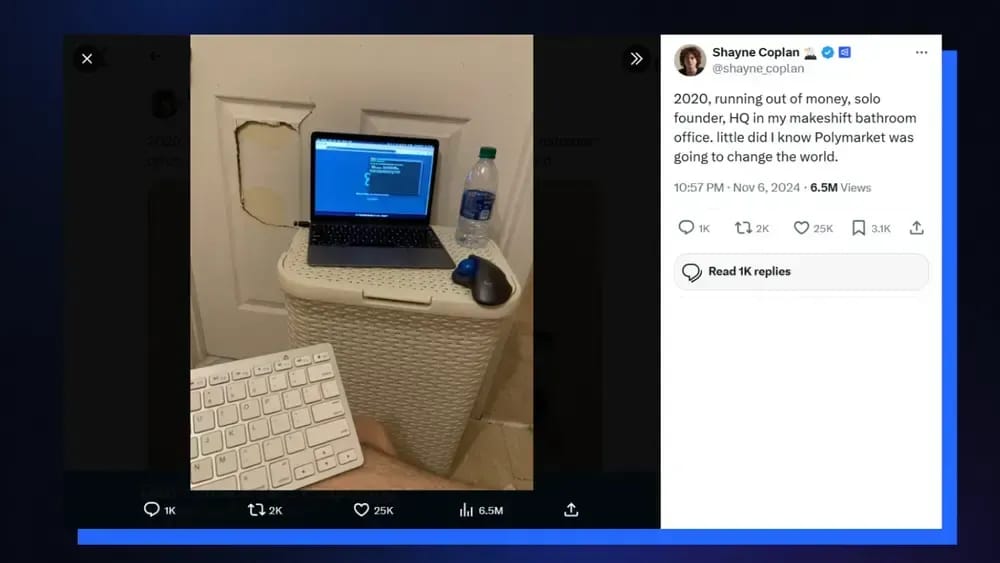
Polymarket began in 2020, when Coplan was working from his apartment during the early COVID-19 period. Britannica reports that the project started as Union.market, later Union Marketplace, before becoming Polymarket, with an initial focus on using market prices to fight confusion and misinformation.
The core idea was simple but ambitious: let users trade on the likelihood of future events, then use those prices as public probability signals. Instead of relying only on pundits, polls, or social media arguments, Coplan wanted financial incentives to reward people who made accurate forecasts.
That idea fit naturally with crypto culture, where users were already comfortable with digital wallets, decentralized infrastructure, and internet-native finance. By building around blockchain-based settlement, Coplan could create a market that felt global, transparent, and programmable, while still centered on everyday questions people wanted answered.
2. Turning the Concept Into a Product
Polymarket turned forecasts into tradable contracts, letting users buy and sell outcome shares whose prices reflected changing crowd expectations about real-world events.
The product came together through several key pieces:
- Event Markets: Polymarket listed questions about politics, economics, culture, sports, and breaking news, turning public uncertainty into markets users could trade directly.
- Yes-or-No Shares: Many markets allowed users to buy “Yes” or “No” positions, with prices acting like implied probabilities for the outcome.
- Crypto Settlement: The platform used crypto rails, including USDC and blockchain-based settlement, to move money and resolve trades in an internet-native way.
- Market Prices: Coplan’s model treated prices as information, arguing that traders with money at risk could produce useful real-time forecasts.
- User Demand: The pandemic, elections, and major news cycles gave users constant questions to trade on, helping the platform find early relevance.
- Simple Interface: Polymarket’s consumer-facing design made prediction markets easier to understand than academic forecasting platforms or complex derivatives markets.
- Liquidity Growth: As more traders joined, markets became deeper, prices updated faster, and Polymarket became more useful as a forecasting signal.
- Public Attention: Viral markets around elections, geopolitics, culture, and breaking news helped Polymarket move beyond crypto circles into mainstream conversation.
3. Early Funding and Growth
After launch, Polymarket attracted attention from crypto investors and later major venture backers. Forbes reported that the company raised funding from names including Vitalik Buterin and Founders Fund, while Coplan’s role shifted from solo founder to CEO of a fast-growing prediction-market startup.
Its growth accelerated as prediction markets became more visible during major news cycles, especially politics and elections. Polymarket positioned itself not just as a trading venue, but as a real-time information platform where market prices could compete with polls, analysts, and media narratives.
4. The 2024 Election Breakout and US Return
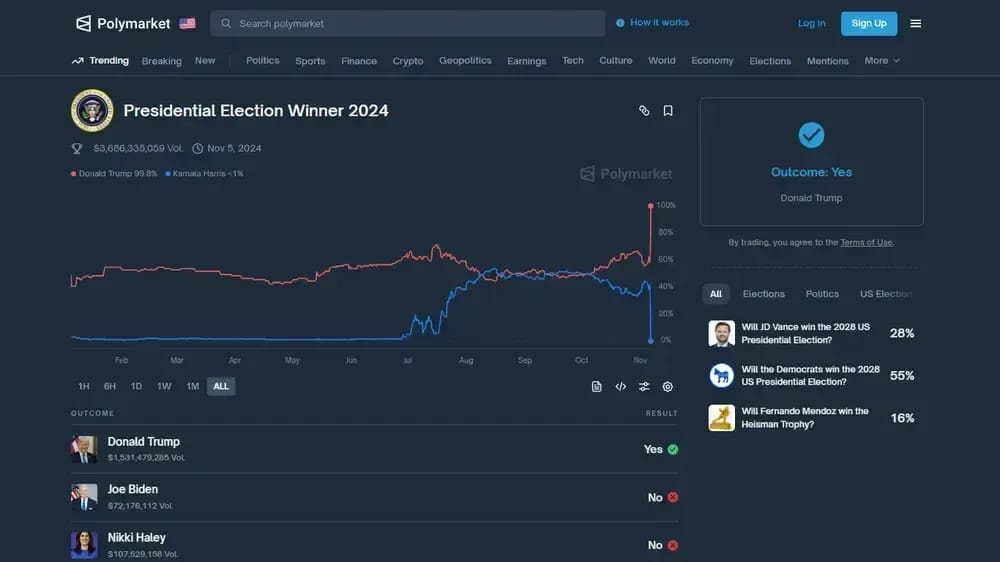
Polymarket’s major breakout came during the 2024 US presidential election cycle, when its markets gave Donald Trump stronger odds than many traditional forecasts before his victory. The platform’s 2024 presidential market ultimately drew about $3.7 billion in trading volume, making it a defining moment for Coplan’s company.
Elon Musk amplified that attention in October 2024 when he said betting markets were “more accurate than polls” because real money was involved. That comment helped push Polymarket into a broader political and media conversation, especially among people questioning whether prediction markets could outperform polling.
The election cycle also sharpened regulatory attention because Polymarket had previously been restricted from serving US users. Even so, its accuracy narrative gave Coplan a powerful comeback story: Polymarket was no longer just a crypto app, but a platform that many people were watching for real-time election signals.
By 2026, Polymarket’s planned US re-entry had become a central part of its growth story. After acquiring the CFTC-licensed exchange and clearinghouse QCEX in 2025, the company positioned itself to return to the American market through a regulated structure rather than the offshore-access model that drew earlier scrutiny.
Shayne Coplan's Net Worth in 2026
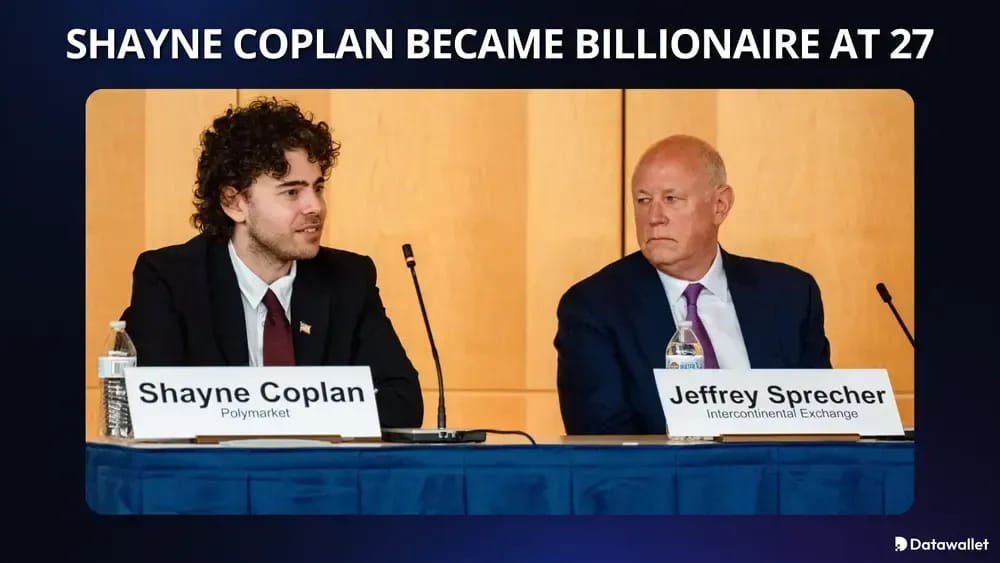
As of 2026, Shayne Coplan’s net worth is generally estimated at about $1 billion, according to Forbes’ billionaire tracking. That estimate is tied mainly to his reported 11% stake in Polymarket, which became far more valuable after major institutional investment and rising prediction-market demand.
The biggest driver was Intercontinental Exchange’s Polymarket investment, which valued the company at roughly $9 billion post-money. Because most of Coplan’s wealth appears tied to private-company equity, his exact liquid fortune is uncertain, but his paper net worth made him one of tech’s youngest self-made billionaires.
Kalshi provides a useful comparison. Forbes estimates cofounders Tarek Mansour and Luana Lopes Lara each own about 12% of Kalshi, after funding reportedly valued the company at $22 billion and lifted each founder’s fortune near $2.6 billion.
Why Was Shayne Coplan Raided By The FBI?
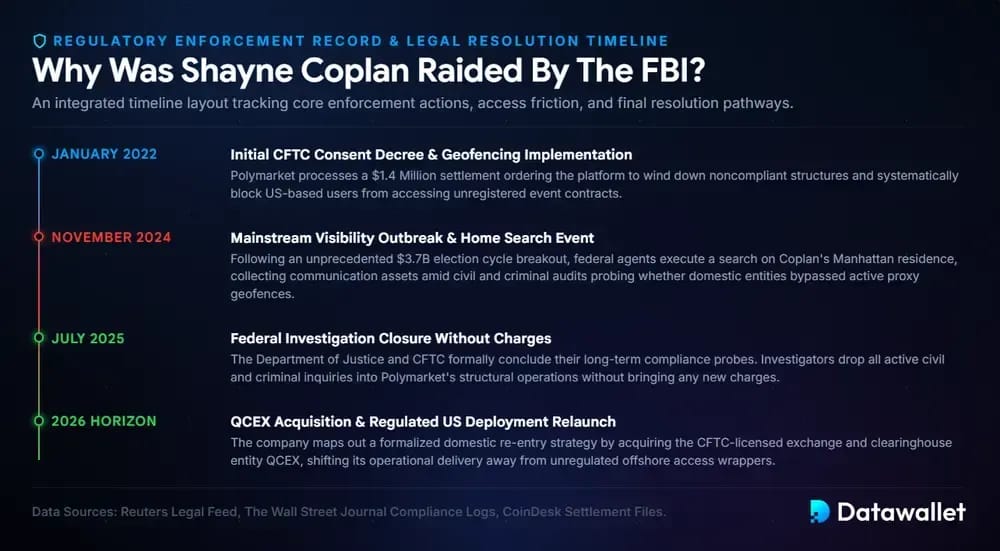
The FBI raid on Shayne Coplan was tied to broader scrutiny over Polymarket’s US access, prior CFTC settlement, and event-contract compliance after the 2024 election.
The timeline shows regulation, access disputes, and legal resolution:
- January 2022, CFTC Settlement: The CFTC ordered Polymarket to pay $1.4 million, wind down noncompliant markets, and stop offering unregistered event-based binary options to US customers.
- 2022, US User Restrictions: After the settlement, Polymarket was expected to block US users, creating the compliance issue later central to federal scrutiny and media reporting.
- 2024 Election Surge: Polymarket gained mainstream attention during the presidential race, where large trading volumes and Trump-favoring odds made it politically visible beyond crypto circles.
- November 2024, FBI Search: Federal agents searched Coplan’s Manhattan home and seized electronics, according to Reuters, amid criminal and civil investigations involving Polymarket’s operations.
- Prior Settlement Question: ABC News reported investigators were examining whether Polymarket violated its earlier settlement by allowing American-based users to access the platform.
- Company Pushback: Polymarket denied wrongdoing and described the raid as politically motivated, while Reuters noted the company framed it as post-election retaliation.
- US Access Concerns: TIME later described the raid as part of an apparent inquiry into whether US-based users placed bets illegally.
- Wider Compliance Concerns: The Wall Street Journal reported prosecutors were also examining whether Polymarket violated laws designed to prevent money laundering.
- July 2025, Probes Dropped: CoinDesk reported that the Justice Department and CFTC dropped investigations into Polymarket without bringing new charges.
- US Return Pathway: Polymarket later acquired QCEX and received CFTC clearance for a US relaunch, with Reuters describing it as a regulated return after years outside the American market.
Final Thoughts
Shayne Coplan’s rise reflects the speed of crypto-era entrepreneurship. Polymarket turned prediction markets into a mainstream conversation during elections, regulation debates, and major breaking-news cycles.
His 2026 profile combines wealth, controversy, and influence. Forbes estimates his net worth at about $1 billion, tied largely to his ownership stake in Polymarket.
The FBI raid, dropped probes, and US return plans now shape Coplan’s public image. His next challenge is proving Polymarket can grow inside regulated markets.