




Looking to trade prediction markets but unsure whether Polymarket or Kalshi is the better choice? This guide compares the industry's two leading platforms, helping you choose based on market selection, fees, regulation, and overall trading experience.
Both platforms grew exponentially in 2025 and 2026, processing billions in monthly trading volume. Polymarket dominates the crypto-native prediction market sector, while Kalshi continues expanding its regulated footprint across sports, politics, economics, and financial events.
Compare both platforms side by side below. 👇
Polymarket vs Kalshi: Overview
Polymarket is a blockchain-based prediction market founded in 2020 by Shayne Coplan and headquartered in New York City. It lets users trade event outcomes across politics, crypto, sports, finance, weather, and culture, with the main benefit being fast market creation, crypto settlement, and transparent probability discovery.
Kalshi is a regulated event-contract exchange founded in 2018 by Tarek Mansour and Luana Lopes Lara, also based in New York City. Its main advantages are CFTC oversight, US accessibility, fiat funding, centralized compliance, and a familiar exchange-style experience for users who prefer regulated financial infrastructure.
Here is a quick side-by-side comparison of both platforms:
Prediction Market Products Compared
Polymarket and Kalshi both turn uncertain events into tradable contracts, but their product design differs sharply. Polymarket feels crypto-native and global, while Kalshi resembles a regulated US derivatives exchange with mainstream funding and compliance.
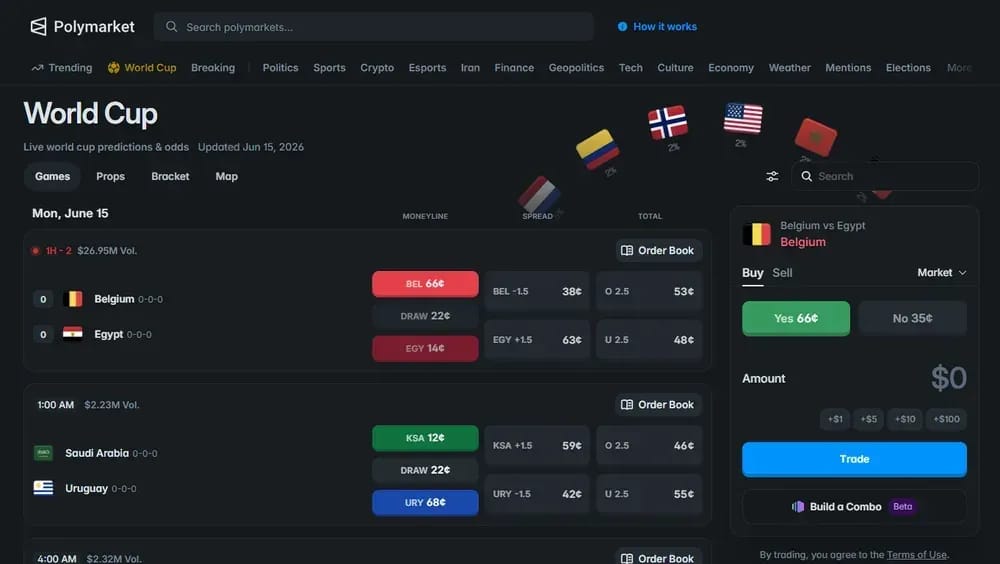
Polymarket Features
Polymarket focuses on open-ended event markets, fast-moving narratives, and wallet-based trading. Its products are built around binary outcome shares, market probabilities, crypto deposits, and transparent settlement infrastructure.
Key Polymarket product features include:
- Markets: Polymarket lists events across politics, crypto, sports, finance, culture, technology, AI, weather, elections, and geopolitical themes, giving traders broad topical exposure.
- Wallets: Users can access markets through wallet-linked accounts, allowing crypto-native onboarding, self-directed asset movement, and a familiar workflow for Web3 traders.
- Collateral: Deposits are routed through supported chains and converted into pUSD on Polygon, creating a standardized trading balance for prediction-market positions.
- CLOB: Its central limit order book supports bids, asks, liquidity discovery, and peer-to-peer execution while settlement remains connected to blockchain infrastructure.
- Resolution: Markets settle according to published rules, official data sources, and oracle-based mechanisms, helping convert real-world outcomes into redeemable yes/no shares.
- Analytics: Public market pages, APIs, and third-party dashboards make Polymarket useful for traders, journalists, researchers, and builders tracking crowd-implied probabilities.
- Speed: New markets can appear quickly around breaking news, letting traders express views before traditional financial products can react.
- Culture: Polymarket’s biggest advantage is cultural relevance, especially during elections, crypto volatility, geopolitical crises, sports events, and viral internet moments.
- Transparency: Onchain settlement and public market data give advanced users stronger visibility into trade history, liquidity, and wallet-level activity.
- Access: The global platform remains restricted in some jurisdictions, while Polymarket US separates regulated American access from the larger offshore product.
Kalshi Features
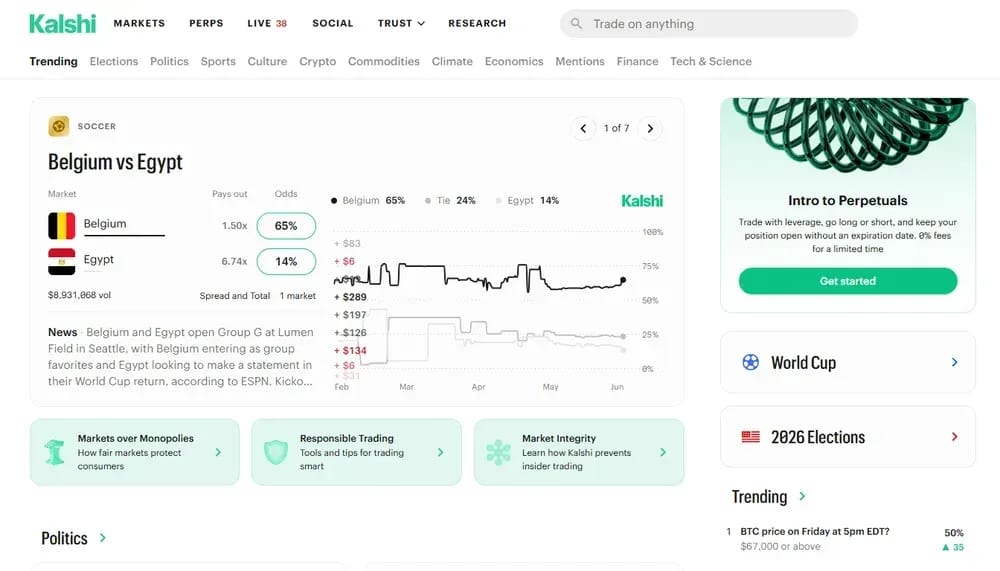
Kalshi emphasizes regulation, standardized event contracts, and mainstream exchange design. Its products are aimed at users who want event trading without managing wallets, bridges, or offshore access restrictions.
Key Kalshi product features include:
- Contracts: Kalshi lists federally regulated event contracts tied to sports, politics, economics, inflation, rates, entertainment, weather, corporate events, and crypto prices.
- Regulation: The platform operates as a CFTC-designated contract market, giving users a clearer compliance framework than offshore or purely onchain alternatives.
- Clearing: Kalshi Klear supports regulated clearing, making the exchange model closer to futures infrastructure than decentralized prediction-market protocols.
- Funding: Users can fund through familiar channels such as ACH, debit cards, wire transfers, and supported crypto pathways, depending on availability.
- KYC: Account creation requires identity checks, eligibility screening, and compliance workflows, which may slow onboarding but improve regulatory certainty.
- Orderbook: Kalshi uses traditional exchange-style books, allowing users to place orders, manage bids and offers, and trade yes/no contracts directly.
- Perps: Kalshi has expanded beyond binary event contracts into CFTC-approved perpetual futures, starting with crypto assets such as Bitcoin.
- Integrity: Employment checks, insider-risk scoring, and reporting tools strengthen market surveillance for sensitive contracts and high-risk information events.
- Mainstream: Its regulated design makes Kalshi easier for US partners, institutions, brokerages, and media companies to integrate or reference.
- Limitations: Compliance requirements and approved-market constraints may reduce speed or market variety compared with Polymarket’s global crypto-native model.
Polymarket vs Kalshi: Markets
According to Dune’s prediction-markets dashboard, the sector shifted from niche volumes to multi-billion-dollar weekly activity through late 2025 and early 2026. Combined Polymarket and Kalshi weekly notional volume reached roughly the $5 billion range, showing that event contracts now compete with major retail speculation channels.
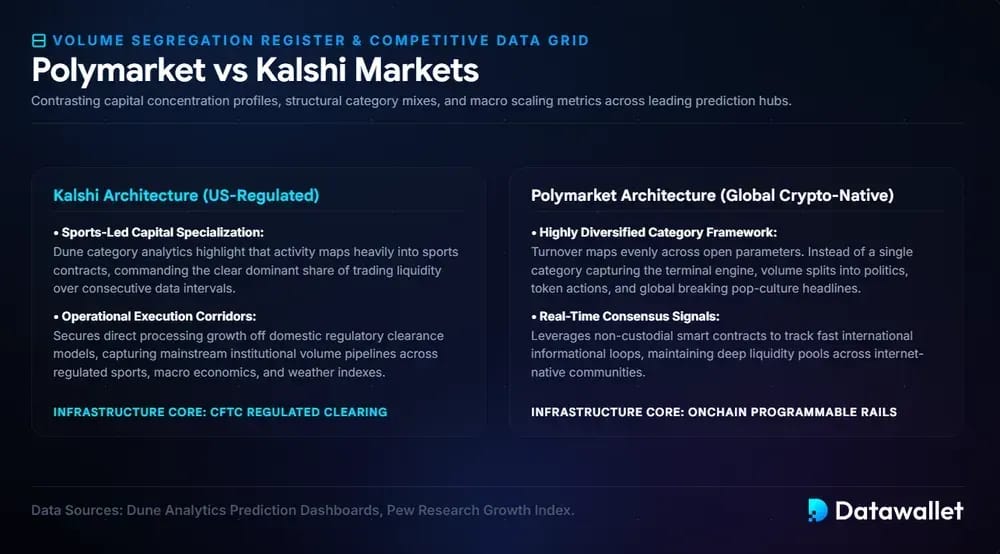
The market mix differs by venue. Kalshi’s recent Dune category breakdown has been heavily sports-led, with sports around the dominant share of activity in several snapshots. Polymarket’s volume is more diversified, with sports, crypto, and politics each contributing meaningful activity rather than one category controlling the full platform.
Pew’s 2026 analysis shows broader momentum: combined monthly global volume on Kalshi and Polymarket rose from under $5 billion in September 2025 to about $24 billion in April 2026. That scale makes prediction markets comparable with major consumer trading and betting ecosystems.
Category concentration matters for strategy. Kalshi benefits from US-regulated sports, macro, and event-contract growth, while Polymarket benefits from crypto, politics, and fast global narratives. Dune’s dashboards show that both platforms can spike around elections, crypto price action, sports calendars, and geopolitical events.
Polymarket vs Kalshi: Perps
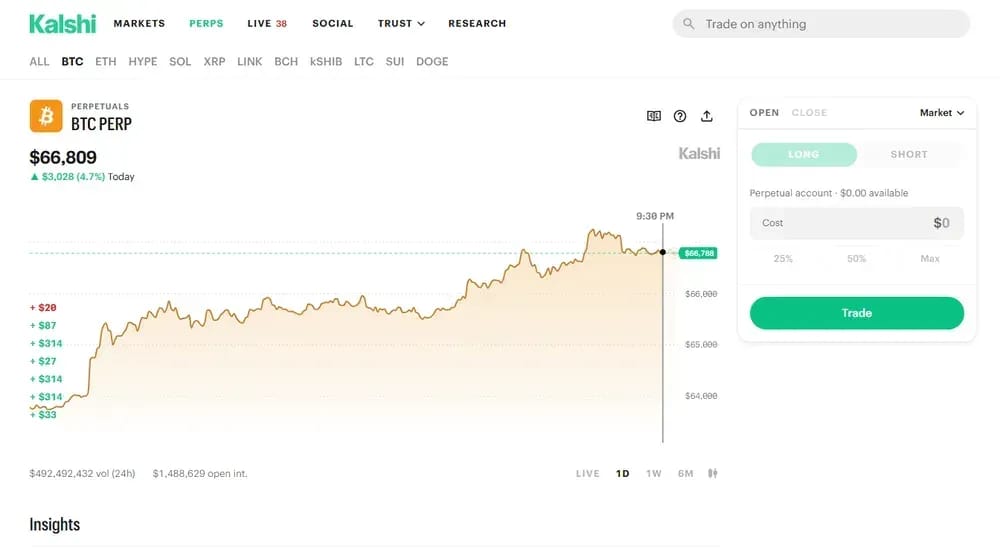
Perps, or perpetual futures, are no-expiry leveraged contracts that track an underlying asset price. They are different from prediction markets because traders go long or short price direction rather than buying yes/no event outcomes.
Kalshi currently has the stronger regulated perps position. The CFTC approved KalshiEX’s BTCPERP contract in May 2026, and Kalshi has promoted US-regulated crypto perpetuals as an expansion beyond event contracts. This gives Kalshi a more formal route into leveraged crypto markets under federal derivatives oversight.
Polymarket is also signaling a move into perps, with a dedicated page inviting users to join early access. Its advantage would be crypto-native distribution, wallet familiarity, and existing trader attention. However, the public-facing perps product appears less mature than Kalshi’s CFTC-approved route.
Is Polymarket or Kalshi Safer?
Safety depends on the risks users care about most: custody, fraud, insider information, regulatory protection, market manipulation, and technical infrastructure. Polymarket offers transparency and wallet-based control, while Kalshi offers centralized compliance, identity checks, and regulated surveillance.
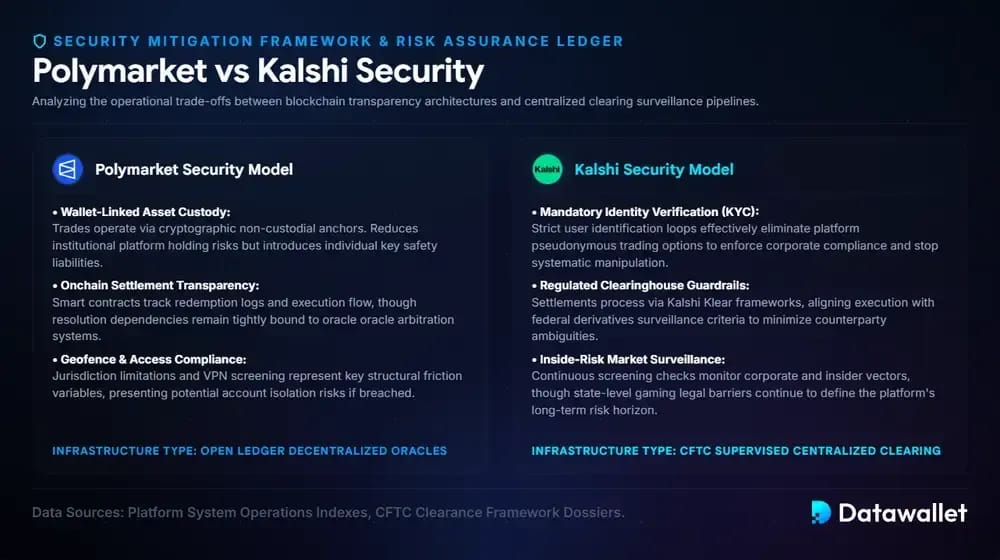
Polymarket Security
Polymarket’s security model is built around blockchain settlement, wallet access, market transparency, and public data. The trade-off is that users must understand crypto risks, chain selection, bridge mechanics, and jurisdiction restrictions.
Security points for Polymarket include:
- Custody: Users interact through wallet-linked systems and crypto balances, reducing reliance on traditional account custody but increasing personal responsibility for wallet safety.
- Settlement: Onchain settlement gives traders visibility into market mechanics, token redemption, and transaction history that centralized platforms usually do not expose.
- Rules: Every market needs clear resolution rules, because vague wording can create disputes, delayed settlement, or controversy around edge-case outcomes.
- Oracles: Oracle-based settlement helps translate real-world events into blockchain outcomes, though disputed markets can still depend on governance and evidence quality.
- Geofencing: Restricted jurisdictions, VPN bans, and compliance monitoring are key security concerns because access violations may create account or fund risk.
- Transparency: Public data supports independent analysis, wallet tracking, and market auditing, but it does not eliminate manipulation or insider-information risk.
- Errors: Wrong-chain deposits, incorrect addresses, and unsupported tokens remain practical user risks, especially for traders unfamiliar with multichain crypto transfers.
- Compliance: Polymarket’s US pathway improves legitimacy, but users must distinguish between the global crypto platform and regulated Polymarket US.
Kalshi Security
Kalshi’s security model relies on regulation, KYC, surveillance, clearing, and centralized controls. That makes it easier for mainstream users but less private and less crypto-native than Polymarket.
Security points for Kalshi include:
- KYC: Mandatory identity verification helps deter fraud, sanctions violations, and repeat abuse, but users give up the anonymity associated with wallet-only platforms.
- Clearing: Regulated clearing through Kalshi Klear reduces counterparty ambiguity and aligns event-contract settlement with US derivatives-market standards.
- Surveillance: Kalshi monitors suspicious trades, insider-risk markets, and manipulation concerns, especially in sensitive political, corporate, and national-security contracts.
- Controls: Employment verification and risk scoring can block potential insiders before they trade, strengthening institutional credibility for high-risk markets.
- Funding: ACH and bank-linked funding reduce crypto transfer mistakes, though debit, wire, and third-party payment methods may introduce separate costs or delays.
- Disputes: Centralized rules and regulatory oversight can simplify user recourse, but they also mean Kalshi controls market listing and operational decisions.
- Privacy: Users gain regulated protection but sacrifice pseudonymity, since account identity and some employment data may be required for sensitive markets.
- State Risk: Federal regulation does not remove every legal dispute, as state-level gaming challenges remain part of Kalshi’s risk profile.
Polymarket vs Kalshi: Fees
Fees can change by product category, market type, and payment method. Polymarket’s cost profile is shaped by crypto rails, network expenses, and fee-enabled markets, while Kalshi’s fee profile is shaped by exchange formulas and banking methods.
Polymarket Fees
Polymarket introduced a broader taker-fee model in 2026 after years of operating with minimal direct trading fees. Today, fees vary by market category and probability level.
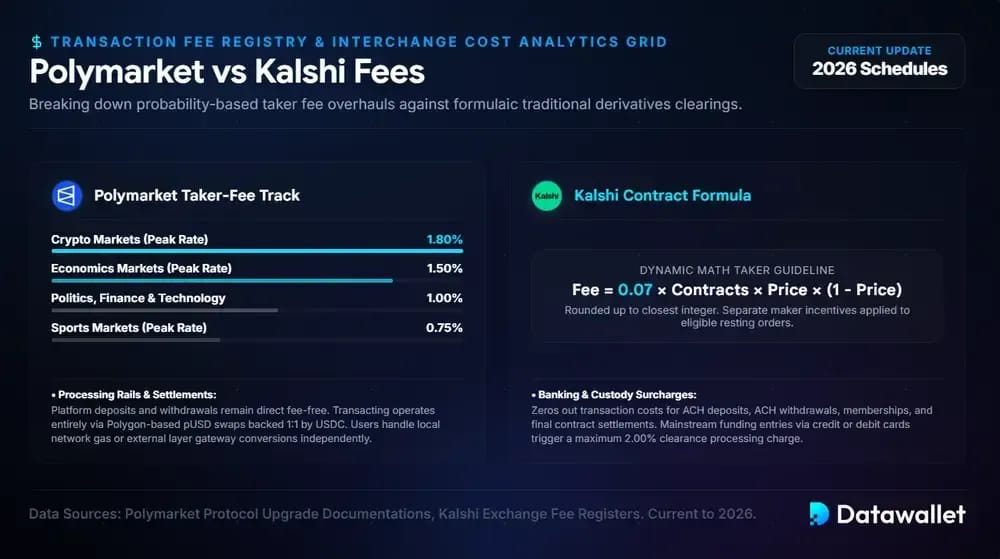
Sports markets have a peak fee of 0.75%, while Politics, Finance, and Tech markets peak at 1.00%. Economics markets reach 1.50%, and Crypto markets carry the highest peak fee at 1.80%, with fees generally highest around the 50/50 probability point.
Polymarket does not charge deposit or withdrawal fees directly. Instead, users may incur Polygon network gas costs or third-party payment-provider fees when bridging assets. Trading collateral is denominated in pUSD, a Polygon-based token backed 1:1 by USDC, with conversions between pUSD and USDC occurring without platform fees.
Kalshi Fees
Kalshi charges trading fees using a variable formula based on expected earnings, contract price, and contract count. Its 2026 fee schedule lists the general formula as 0.07 × contracts × price × (1-price), rounded up, with separate maker-fee treatment for eligible resting orders.
Funding fees are more familiar to traditional users. Kalshi lists no ACH deposit or withdrawal fee, no settlement fee, and no membership fee, while card deposits may carry a maximum 2% charge. Crypto deposits or withdrawals may include third-party processor costs disclosed before transaction.
Polymarket vs Kalshi: Regulations & Licenses
Regulation is the biggest difference between the two platforms. Kalshi was built around CFTC approval from the beginning, while Polymarket first scaled as a crypto-native venue, settled with the CFTC, and later pursued US re-entry through licensed infrastructure.
Polymarket Regulations & Licenses
Polymarket’s regulatory story has two tracks: the global crypto platform and the newer US-regulated pathway. That distinction is essential when comparing access, compliance, and legal certainty.
Regulatory points for Polymarket include:
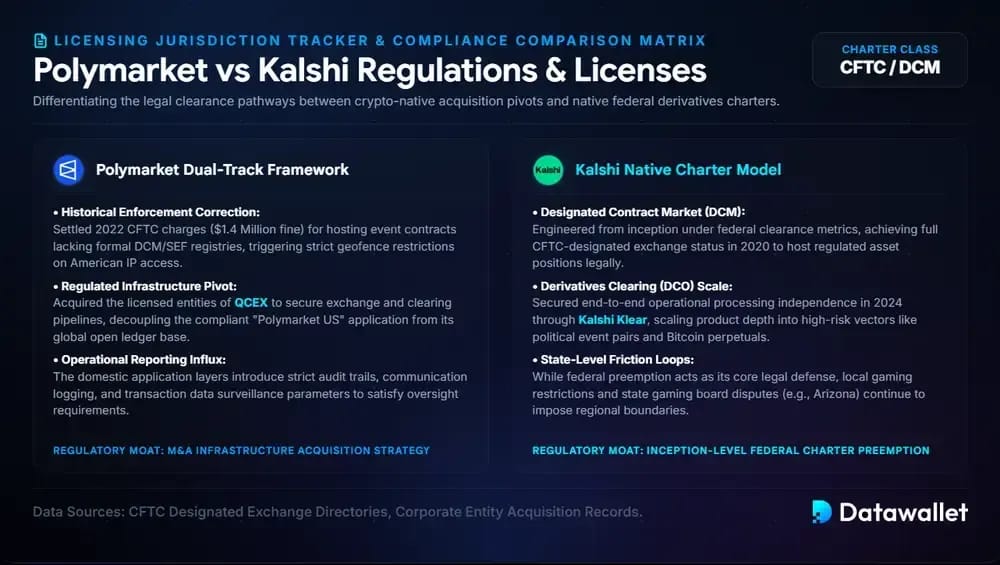
- Settlement: In 2022, Polymarket settled CFTC charges for operating event-based binary options without proper DCM or SEF registration.
- Penalty: The CFTC order required a $1.4 million penalty, wind-down of noncompliant markets, and a cease-and-desist commitment.
- Restriction: The main Polymarket platform restricted US users after the settlement, making US access a central compliance issue.
- Acquisition: Polymarket acquired QCEX entities, including exchange and clearing infrastructure, to support a regulated US relaunch pathway.
- US App: Polymarket US gives the company a more compliant American route, but it remains separate from the larger global crypto venue.
- Reporting: The regulated US framework brings surveillance, recordkeeping, and reporting duties that differ from the global onchain product.
- Jurisdictions: Global availability remains uneven because many countries and regions impose gambling, derivatives, sanctions, or online-betting restrictions.
- Outlook: Polymarket’s challenge is preserving crypto-native speed while satisfying regulatory standards for US users, partners, and institutional data buyers.
Kalshi Regulations & Licenses
Kalshi’s regulatory moat is its defining feature. It operates through a CFTC-designated contract market and has expanded its clearing and product approvals over time.
Regulatory points for Kalshi include:
- DCM: KalshiEX received CFTC designated contract market status in 2020, allowing it to list federally regulated event contracts.
- DCO: Kalshi Klear became a registered derivatives clearing organization in 2024, strengthening its end-to-end regulated market structure.
- Elections: Court wins and regulatory shifts helped Kalshi expand political event contracts, making election markets a major product category.
- Sports: Sports contracts have fueled growth but also increased tension with state gaming regulators and traditional betting authorities.
- States: Arizona and other state-level disputes show that CFTC regulation does not fully eliminate conflict with local gambling-law interpretations.
- Preemption: Kalshi argues federal derivatives regulation preempts inconsistent state enforcement, a position that may shape the industry’s legal future.
- Perps: Kalshi’s CFTC-approved Bitcoin perpetual contract extends the platform beyond binary events into regulated leveraged derivatives.
- Compliance: KYC, surveillance, employment checks, and market-risk controls help Kalshi position itself as the safer institutional-grade option.
Private Funding Rounds Compared
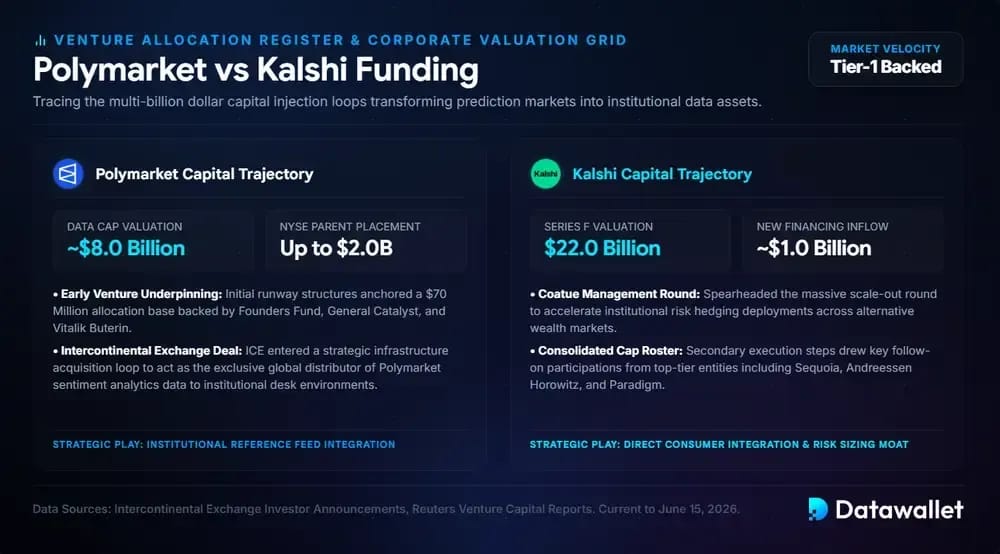
Polymarket’s funding story shows how quickly prediction markets moved from crypto niche to institutional finance. In 2024, it announced $70 million across rounds backed by Founders Fund, General Catalyst, Vitalik Buterin, and other investors, strengthening its capital base before the 2024 election cycle.
The biggest Polymarket milestone came when ICE, the parent company of the New York Stock Exchange, announced an investment of up to $2 billion at an approximately $8 billion pre-money valuation. Reuters covered the deal as a strategic move tied to Polymarket’s US re-entry and market-data potential: Reuters on ICE and Polymarket.
Kalshi’s funding accelerated even faster in 2025 and 2026. Reuters reported an $11 billion valuation in late 2025, followed by reporting that Kalshi secured a $22 billion valuation with about $1 billion in new financing led by Coatue: Reuters on Kalshi’s $22B valuation.
Is Polymarket Better than Kalshi?
Polymarket is better for crypto-native traders who want broader market variety, fast narrative coverage, transparent data, wallet-based access, and a global prediction market culture. It is especially strong for politics, crypto, geopolitical events, internet trends, and markets where speed matters more than regulated financial structure.
Kalshi is better for eligible US users who prioritize regulation, fiat funding, formal KYC, exchange-style order books, and CFTC-supervised products. It is the stronger choice for traders who want compliance clarity, banking rails, regulated clearing, and access to newer US-approved products such as perpetual futures.
Final Thoughts
Polymarket and Kalshi are no longer simple prediction-market startups. They are competing models for the future of event trading: one crypto-native and culturally fast, the other regulated and institutionally scalable.
Polymarket’s edge is breadth, speed, and transparent market data. Kalshi’s edge is licensing, US access, and compliance infrastructure. Traders should choose based on jurisdiction, funding method, product needs, and risk tolerance.
The best platform depends on the user. Crypto traders may prefer Polymarket’s open market culture, while US users seeking regulated exposure may prefer Kalshi’s event contracts, banking access, and CFTC framework.