




What is the Fomo App?
Fomo is a self-custodial crypto trading app for buying and selling tokens across several blockchains from one balance. It was built by FOMO Labs, a San Francisco company targeting users who want on-chain access without having to learn wallet mechanics.
The company was founded in 2025 by three former dYdX employees. Paul Erlanger, Sae Young Park and Prashan Dharmasena left the derivatives exchange to build a product for ordinary users rather than professional traders. Fomo launched publicly in May of that year.
The idea is to make on-chain trading feel unlike traditional crypto software. There are no seed phrases to record or chain-switching menus to navigate. Users do not need to approve bridge transactions or buy a native gas token before completing their first trade.
Growth has been fast. Fomo says on its site that it has more than 500,000 traders. Coverage of its Series B put daily signups at around 3,500 while the company employed roughly 17 people, a ratio that says a lot about how much of the stack it outsources.
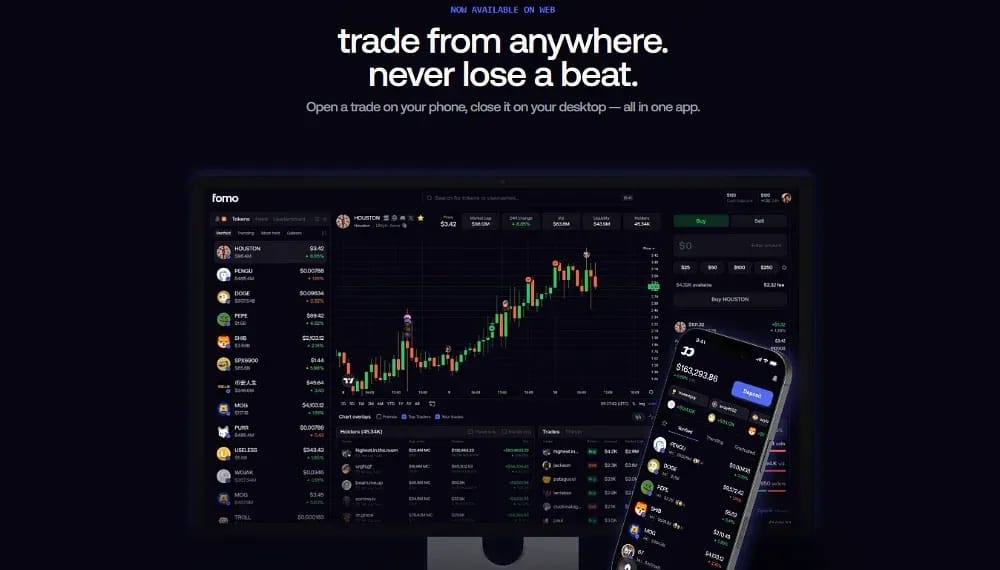
How Does the Fomo App Work?
Fomo acts as an interface layer over infrastructure it does not own. Funds remain in a wallet controlled only by the user. Behind the interface, specialist providers manage key infrastructure, order execution and fiat conversion.
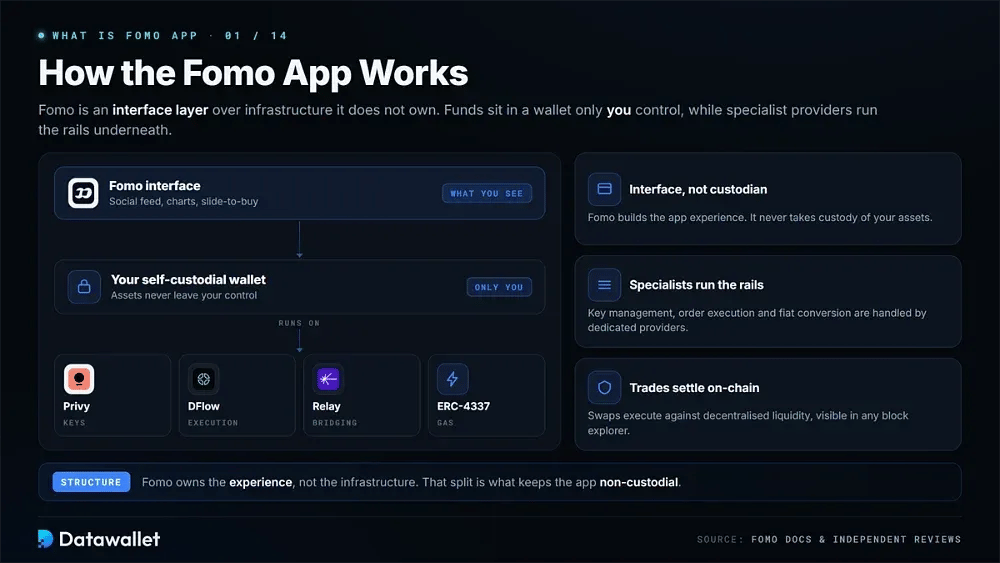
Wallets and Key Management
Creating an account generates a self-custodial wallet through embedded wallet provider Privy. Users never see a seed phrase, removing the most common way retail users lose funds. Authentication instead takes place through email or Apple ID.
Key material is split using Shamir's Secret Sharing. The method divides a private key into separate shares stored across different systems. Because no single party can reconstruct the full key independently, Fomo cannot move your assets. The key can also be exported to any compatible wallet.
That structure has an unavoidable consequence: Fomo cannot reverse transactions, restore access to a lost device or compensate you if a token collapses because it never takes custody.
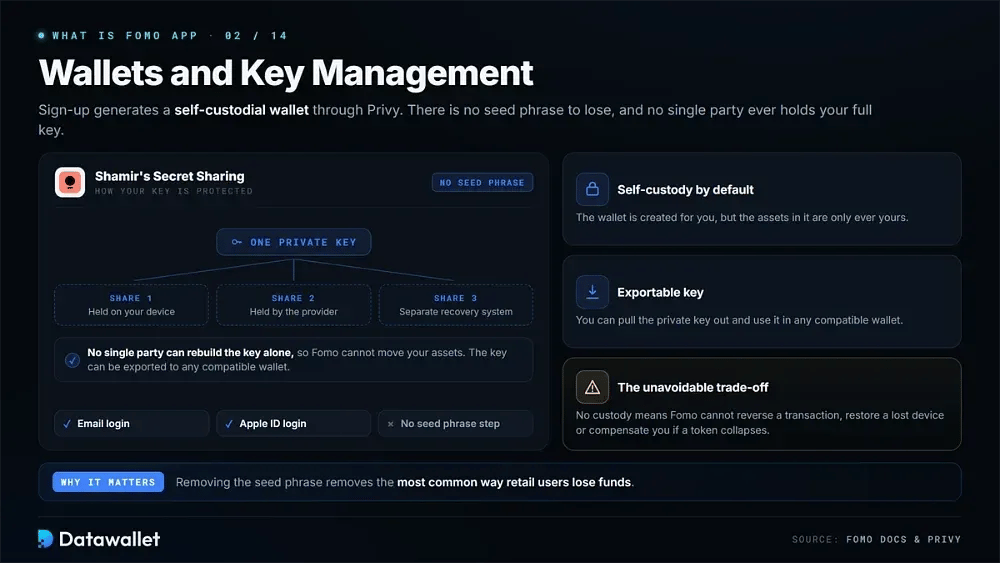
Trade Execution and Order Handling
Swaps are executed on-chain against decentralised liquidity rather than through an internal order book. Fomo has used DFlow for order handling, which protects against front-running bots that might otherwise sandwich retail trades on public mempools.
For cross-chain transfers, Fomo relies on Relay's bridging infrastructure. This lets one balance cover assets on different networks. You select a token and confirm the transaction; bridging occurs without a separate approval step or second wallet.
Network fees are sponsored through account abstraction under the ERC-4337 standard. A paymaster contract pays gas on the user's behalf. Batching several operations into one on-chain call helps make that model economically viable at scale.
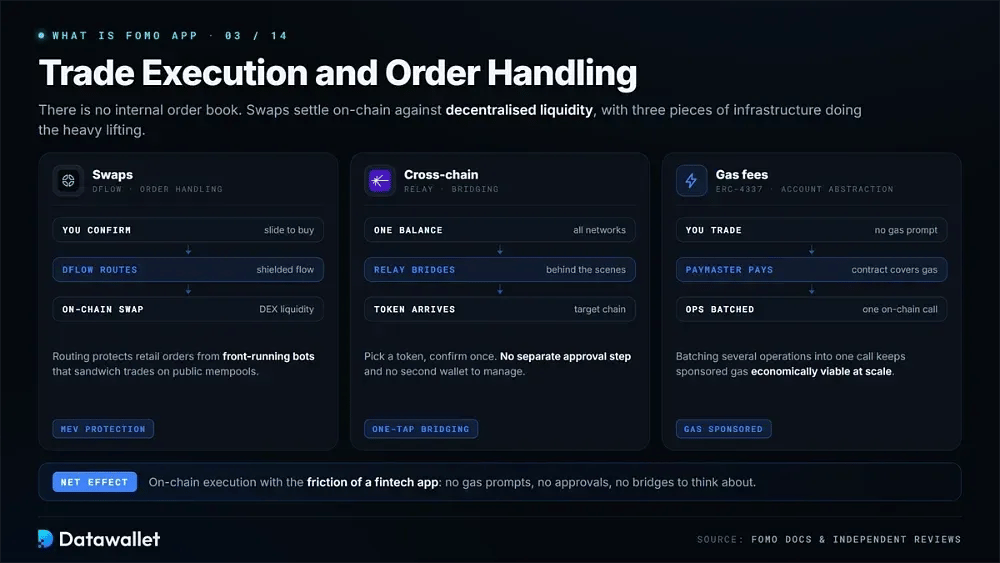
The Social Layer
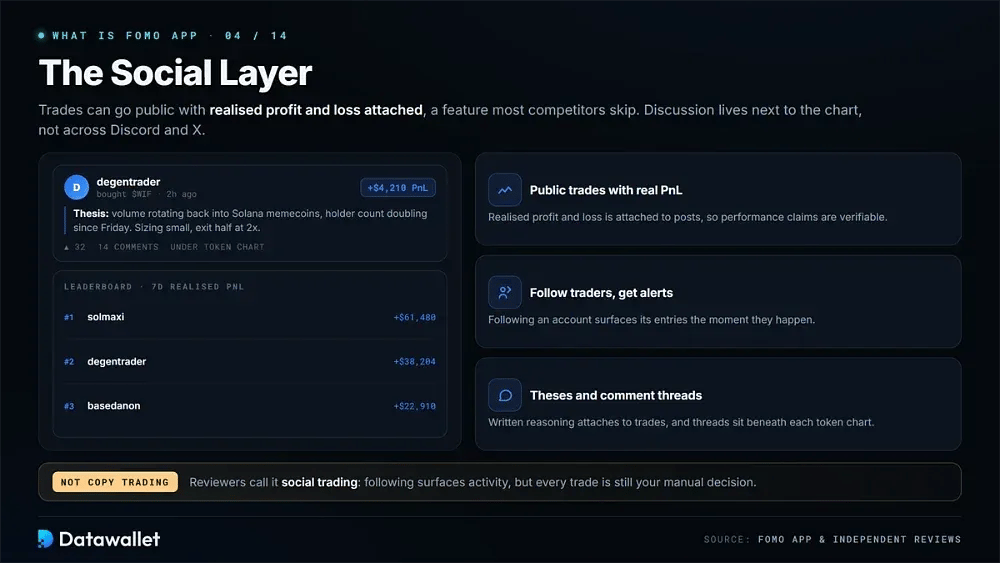
Trades can appear publicly with realised profit and loss attached, a feature most competitors do not offer. Leaderboards rank accounts by performance. Users can also follow traders and receive alerts when those accounts enter positions.
A written "thesis" can be attached to a trade to explain the reasoning behind it. Comment threads appear beneath token charts, keeping discussion around a position beside the relevant price action rather than spread across Discord and X.
Fomo should not be confused with automated copy trading. Reviewers have described it as social trading rather than automated copy trading: following someone surfaces their activity, but you still decide manually whether to act on it.
Supported Chains and Assets
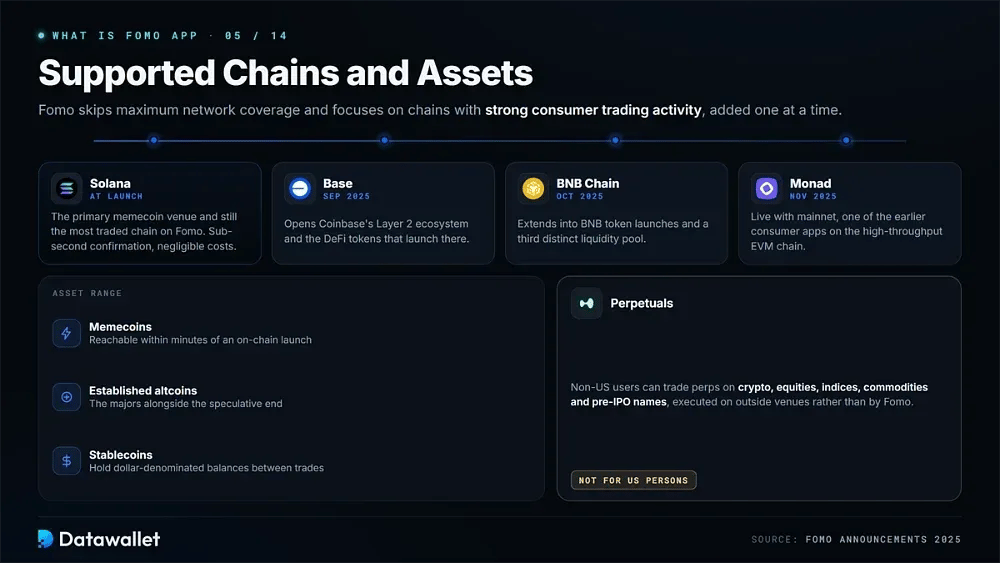
Rather than aiming for maximum network coverage, Fomo focuses on chains with strong consumer trading activity. The current lineup and what each contributes:
- Solana: The primary venue for memecoin activity, added at launch and still the chain most Fomo users trade, offering sub-second confirmation and negligible network costs.
- Base: Full support arrived in September 2025, opening access to Coinbase's Layer 2 ecosystem and the DeFi tokens that launch there rather than on Solana.
- BNB Chain: Added in October 2025, extending the app into the BNB ecosystem's token launches and giving users a third distinct liquidity pool.
- Monad: Support went live with the chain's mainnet in November 2025, making Fomo one of the earlier consumer apps trading assets on the high-throughput EVM network.
- Asset range: Coverage spans memecoins, established altcoins and stablecoins, so the app functions for both speculative trades and holding dollar-denominated balances.
- Perpetuals: Non-US users can trade perps covering crypto, equities, indices, commodities and pre-IPO names, executed on outside venues rather than by Fomo.
Fomo App Fees Explained
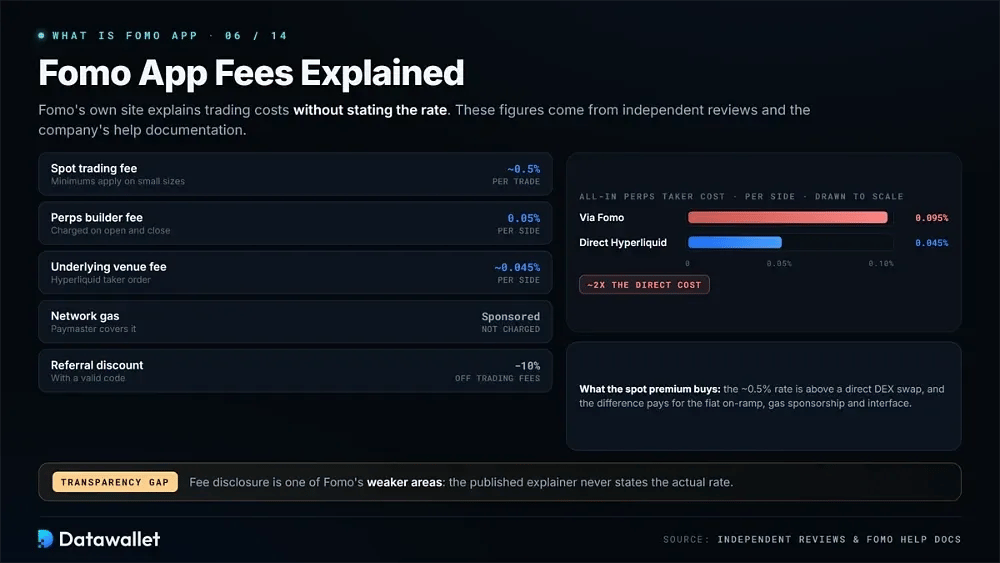
Fee transparency is one of Fomo's weaker areas. Its own website publishes an explainer on trading costs but does not state the rate. The figures below come from independent reviews and the company's help documentation.
The spot rate is higher than the cost of swapping directly on a decentralised exchange. That difference pays for the fiat on-ramp, gas sponsorship and interface.
Perpetuals are less favourable on cost. Fomo's 0.05% builder fee is added to Hyperliquid's own rate, bringing the all-in taker cost to about 0.095% per side. That is close to twice the cost of trading directly on Hyperliquid.
How to Use the Fomo App
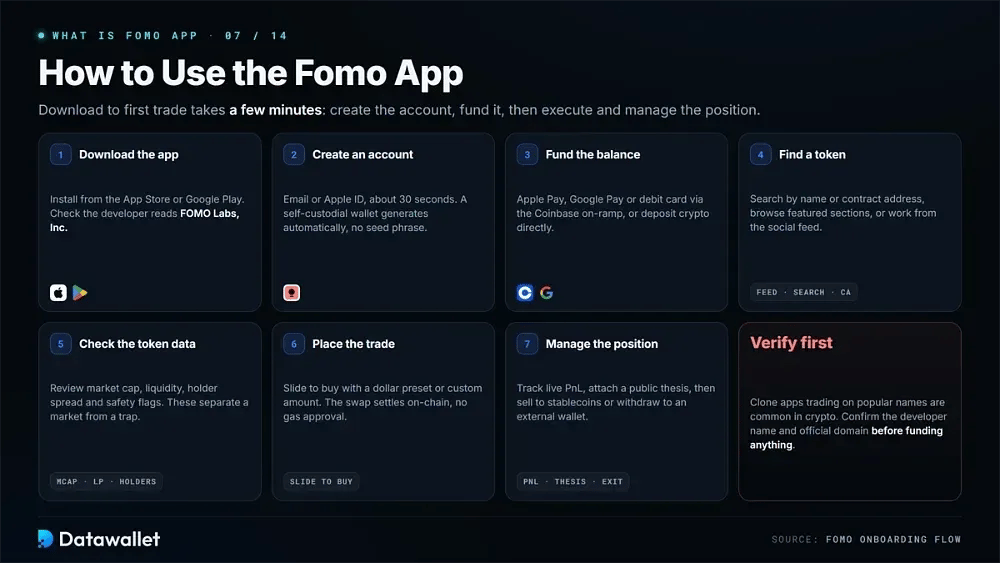
Moving from download to a first trade takes a few minutes. The process covers account creation, funding and execution:
- Download the app: Install from the Apple App Store or Google Play, confirming the developer reads FOMO Labs, Inc., since clone apps trading on popular names are common in crypto.
- Create an account: Sign up with email or Apple ID in roughly 30 seconds, after which a self-custodial wallet generates automatically without any seed phrase step.
- Fund the balance: Add money through Apple Pay, Google Pay or a debit card via the Coinbase-powered on-ramp, or deposit crypto directly from an external wallet.
- Find a token: Search by name or contract address, browse featured sections, or work from the social feed to see what traders you follow are currently buying.
- Check the token data: Review market cap, liquidity, holder distribution and any safety warnings the app flags, since these signals separate a functioning market from a trap.
- Place the trade: Use the slide-to-buy interface with a dollar preset or custom amount, and the swap settles on-chain without a separate gas approval.
- Manage the position: Track live profit and loss on the chart, add a written thesis if you want it public, then sell back to stablecoins or withdraw to an external wallet.
Fomo Perpetuals and Hyperliquid
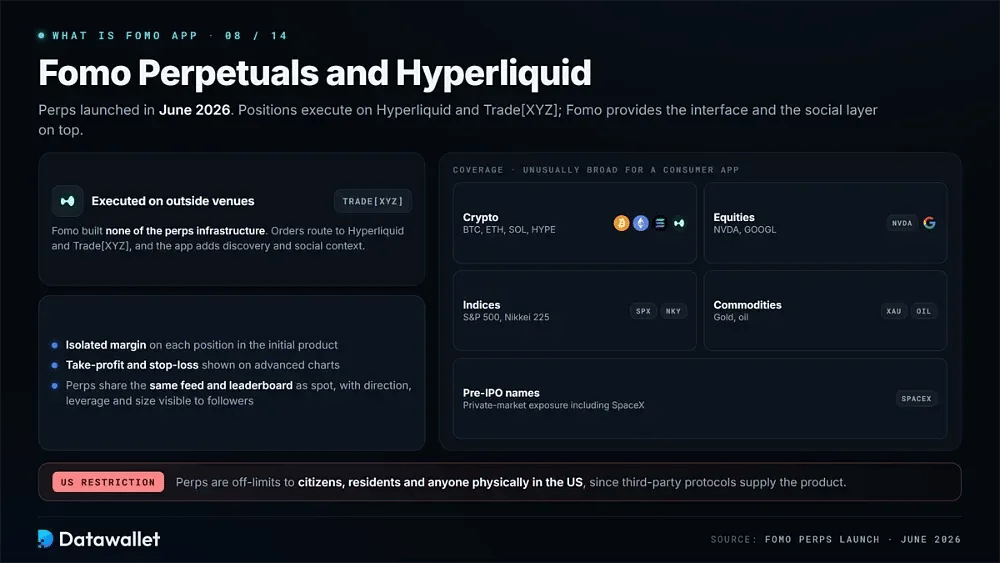
Fomo moved beyond spot trading with the launch of perpetuals in June 2026. Positions are executed on Hyperliquid and Trade[XYZ], not infrastructure built by Fomo. The app provides the interface and social layer.
Coverage is unusually broad for a consumer product. Users can trade crypto perps on BTC, ETH, SOL and HYPE. Equity perps include NVDA and GOOGL, while index exposure covers the S&P 500 and Nikkei 225. Commodities such as gold and oil are available, along with pre-IPO exposure including SpaceX.
Each position in the initial product uses isolated margin. Take-profit and stop-loss orders are shown on advanced charts. Perps also appear in the same feed and leaderboard as spot trades, allowing followers to see direction, leverage and notional size.
One restriction is absolute: perpetuals are not available to US persons. Because third-party protocols supply the product, the restriction applies to citizens, residents and anyone physically located in the United States. That removes a large share of the app's likely audience from the product.
Funding, Backing and Company Track Record
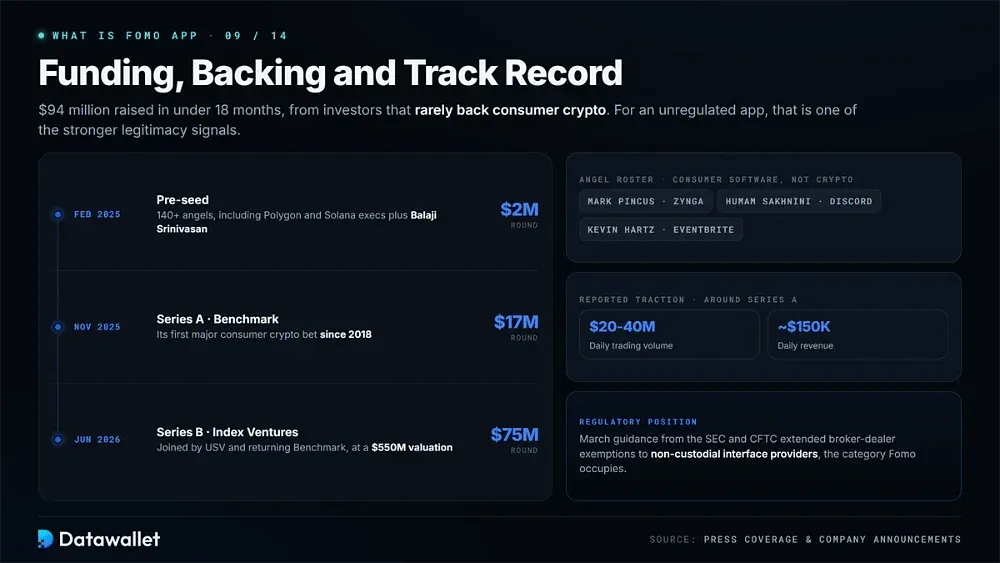
Fomo has raised capital quickly from investors that rarely back consumer crypto products. For an app operating without regulatory supervision, that backing is one of the stronger available legitimacy signals:
- Pre-seed (February 2025): A $2 million round backed by more than 140 angel investors, including executives from Polygon Labs and Solana plus former Coinbase CTO Balaji Srinivasan.
- Series A (November 2025): Benchmark led a $17 million round, its first significant consumer crypto investment since 2018, bringing total funding to $19 million.
- Series B (June): Index Ventures led a $75 million round at a $550 million valuation, joined by Union Square Ventures and returning investor Benchmark.
- Angel roster: Later rounds drew Zynga co-founder Mark Pincus, Discord CEO Humam Sakhnini and Eventbrite co-founder Kevin Hartz, names from consumer software rather than crypto.
- Reported traction: Around the Series A, coverage cited daily trading volume between $20 million and $40 million against roughly $150,000 in daily revenue.
- Regulatory position: Guidance issued in March by the SEC and CFTC extended broker-dealer registration exemptions to non-custodial interface providers, the category Fomo occupies.
Fomo vs Other Trading Apps
Fomo sits between two categories: mobile memecoin apps and full exchanges. Which comparison matters most depends on what you are optimising for.
Fomo vs Moonshot
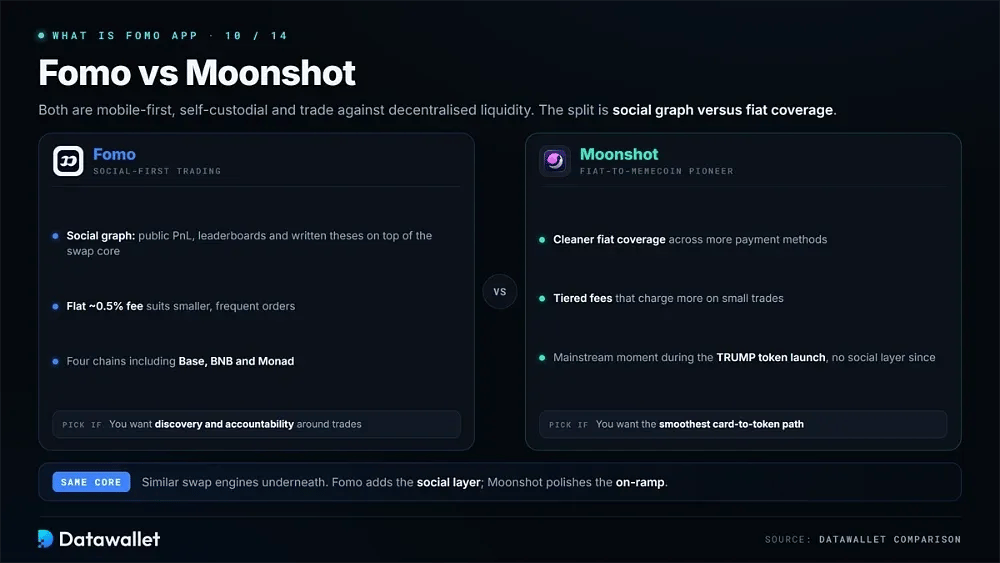
Moonshot established itself around the same fiat-to-memecoin model and gained mainstream attention during the TRUMP token launch. Like Fomo, it is mobile-first, self-custodial and executes trades against decentralised liquidity.
The main difference is Fomo's social graph. Moonshot provides cleaner fiat coverage across more payment methods. Fomo instead adds public profit and loss, leaderboards and written theses to similar core swap functionality.
Their fee structures differ as well. Moonshot uses a tiered model that charges more on small trades. Fomo's flatter percentage is better suited to smaller, frequent orders than a fee that scales against trade size.
Fomo vs Centralised Exchanges
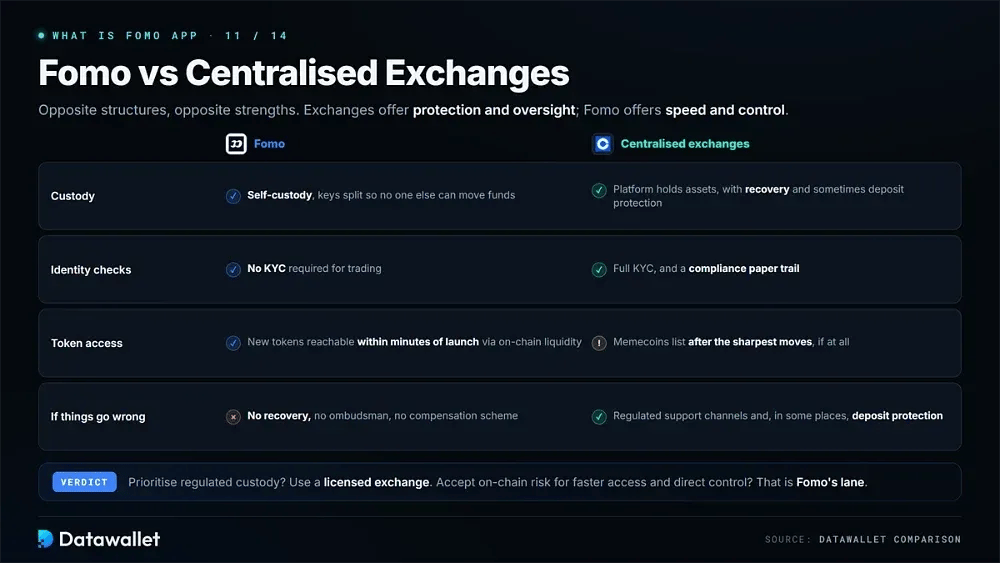
Centralised exchanges hold customer assets, conduct KYC checks and operate under regulatory oversight. That structure can provide account recovery and, in some jurisdictions, deposit protection. Fomo provides neither and does not require identity verification for trading.
Token access works in the opposite direction. New memecoins often do not appear on exchanges until after the sharpest price moves. Through on-chain liquidity, Fomo can reach tokens within minutes of launch.
Anyone who prioritises regulated custody and a compliance paper trail should use a licensed exchange instead. Fomo is better suited to traders willing to accept on-chain risk for faster access and direct control.
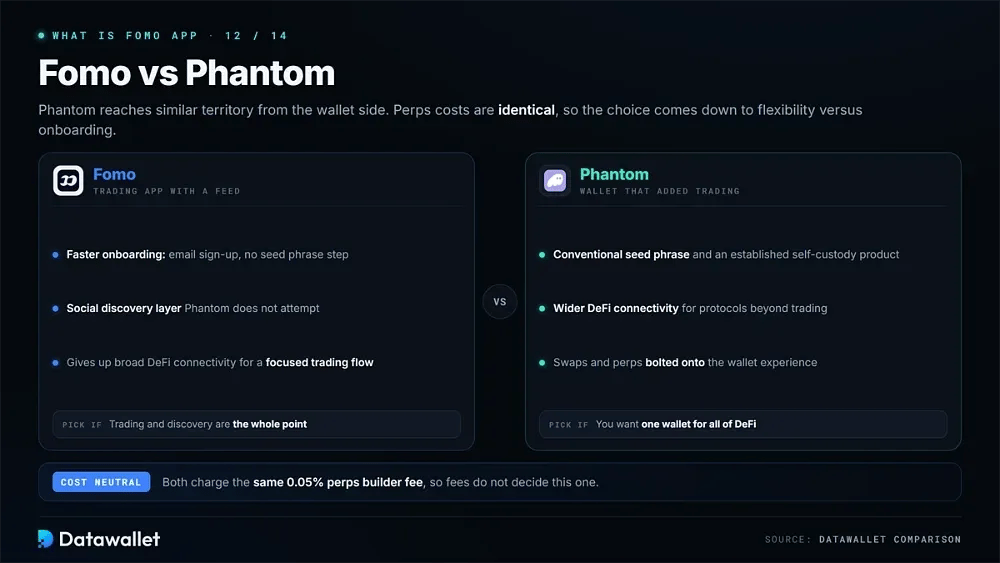
Fomo vs Phantom
Phantom enters similar territory from the wallet side, having added swaps and perps to an established self-custody product. Its perps carry the same 0.05% builder fee, leaving the cost comparison neutral.
Phantom provides a conventional seed phrase and wider DeFi connectivity, which better suits users who want to interact with protocols beyond trading. Fomo gives up that flexibility in exchange for faster onboarding and a social discovery layer that Phantom does not attempt.
Risks and Limitations
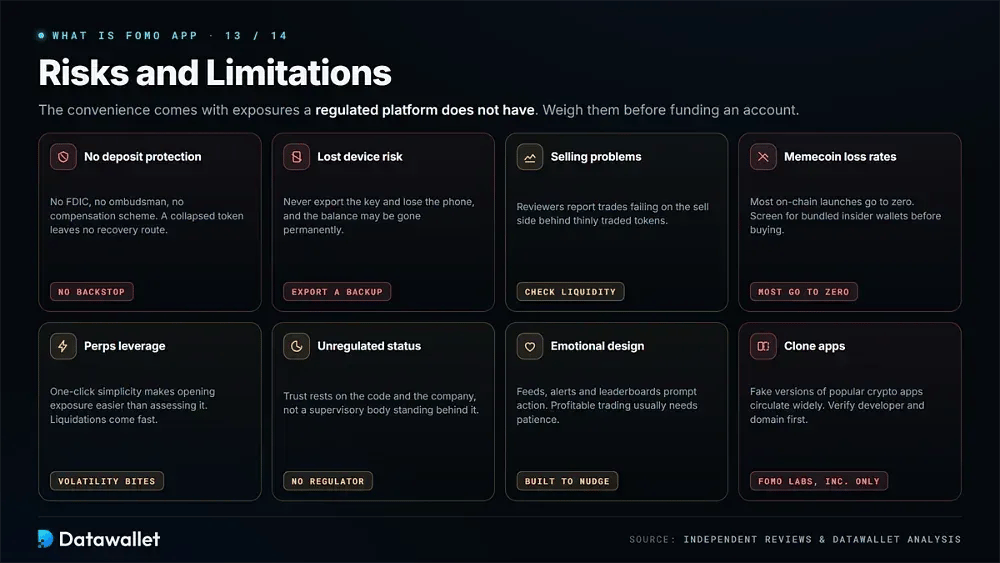
Fomo's convenience comes with exposures that do not exist on a regulated platform. Consider them before funding an account:
- No deposit protection: Self-custody means no FDIC coverage, no ombudsman and no compensation scheme, so a failed trade or collapsed token leaves no avenue for recovery.
- Lost device risk: Fomo cannot restore access without a backup, and while key export is possible, users who never export and lose their device may lose the balance permanently.
- Selling and liquidity problems: Reviewers report trades that failed on the sell side despite easy buying, raising questions about executable liquidity behind thinly traded tokens.
- Memecoin loss rates: Most tokens launched on-chain go to zero, and checking for bundled insider wallets before buying screens out the most obvious traps.
- Perps leverage: Leveraged positions liquidate quickly during volatility, and an interface designed for one-click simplicity makes it easier to open exposure than to assess it.
- Unregulated status: Fomo operates outside broker-dealer registration, so trust rests on the code and the company rather than any supervisory body standing behind it.
- Emotional trading design: Feeds, alerts and leaderboards are built to prompt action, and that structure works against the patience most profitable trading requires.
- Clone apps: Fake versions of popular crypto apps circulate widely, so verifying the developer name and official domain before funding matters more than usual here.
Is the Fomo App Safe and Legitimate?
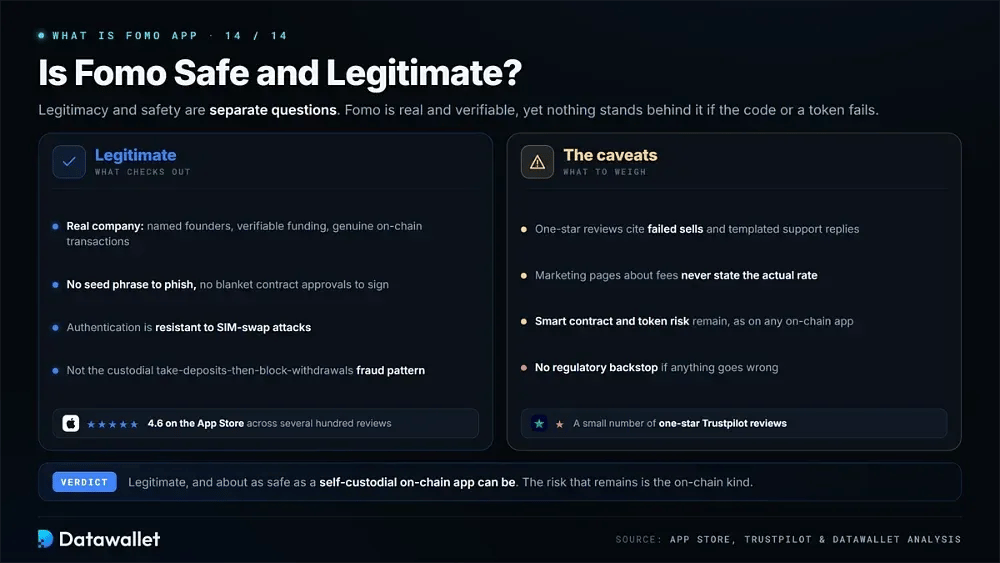
Fomo is a real company with named founders, verifiable funding and a product that executes genuine on-chain transactions visible in a block explorer. It is not a scam in the sense that most crypto fraud operates, where custodial platforms take deposits and then refuse withdrawals.
Several common attack vectors are removed by its security architecture. There is no seed phrase to phish or blanket contract approval to sign, while authentication is resistant to SIM-swap attacks. The app also carries a 4.6-star App Store rating across several hundred reviews.
The caveats are different. Trustpilot has a small number of one-star reviews that mention failed sells and templated support responses. The company also publishes marketing pages about fees without stating the actual rate, leaving a clear transparency gap.
Legitimacy and safety are separate questions. Fomo is legitimate and about as safe as a self-custodial on-chain app can be. It still carries smart contract risk and token risk, with no regulatory backstop.
Final Thoughts
Fomo has solved a genuinely difficult problem: making on-chain trading usable by a non-technical person without the process becoming a barrier. Removing seed phrases, bridges and gas management addresses real friction rather than merely repackaging it.
The social layer may be the more interesting part of the product. Verified public profit and loss introduces accountability that influencer-driven crypto content has historically lacked. At the same time, it can amplify the same impulse that gives the app its name.
The practical recommendation for anyone considering Fomo is straightforward. Start with an amount you can lose entirely and export your wallet key, storing it safely. Check the token safety data before every buy. Treat the feed as a discovery tool, not as a signal to follow.