


.svg)
What is the Moonshot App on Solana?
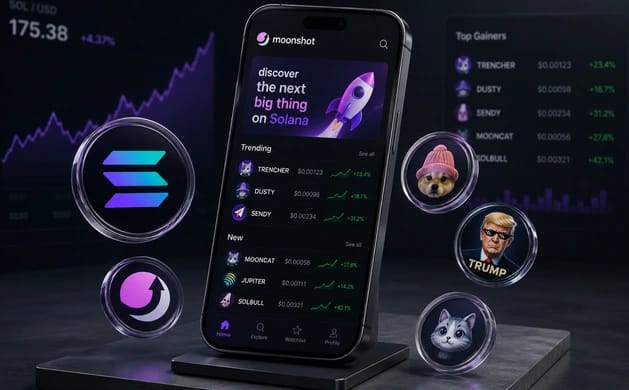
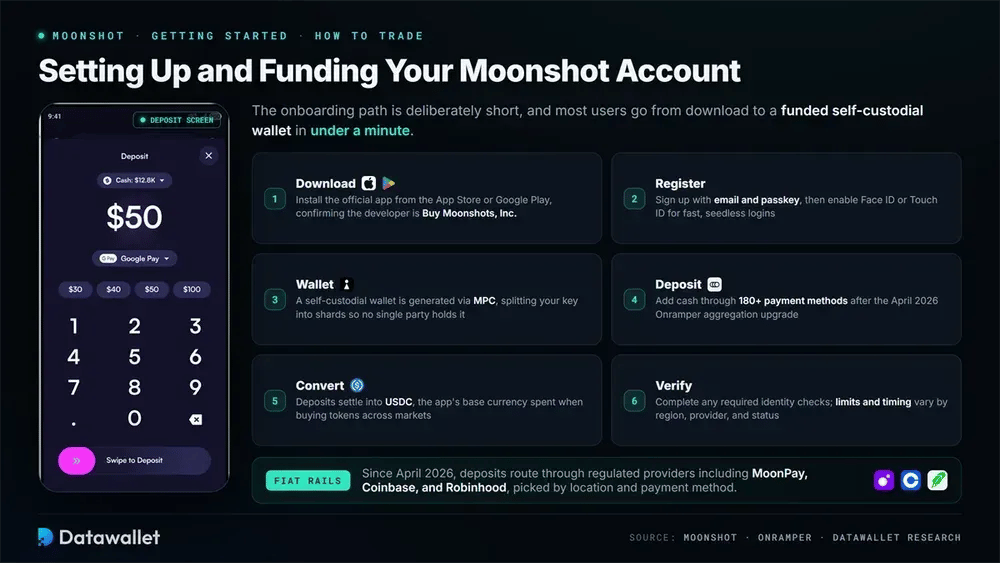
Moonshot is a self-custodial memecoin wallet and trading app built by Buy Moonshots, Inc., available on iOS and Android. It acts as a visual front-end to decentralized exchanges, routing orders through Solana liquidity venues while users retain full ownership of their private keys and funds.
The app rose to mainstream attention in January 2025, when the launch of the $TRUMP memecoin pushed Moonshot to the top of the US Apple App Store finance charts and into the overall top ten. That surge onboarded hundreds of thousands of new users within a single day and cemented its reputation as a beginner-friendly on-ramp.
Under the hood, Moonshot removes the friction that keeps newcomers away from traditional Web3 wallets. Rather than forcing manual seed-phrase management, it generates a wallet using Multi-Party Computation through infrastructure partner Turnkey, so people can sign in with email and biometrics while still holding their own keys.
By April 2026, the platform reported surpassing two million users and reaching the top of app stores across multiple countries, according to a Morningstar-syndicated announcement. That growth reflects steady demand for simple fiat-to-memecoin access rather than a single viral spike.
How Moonshot Connects to Decentralized Exchanges
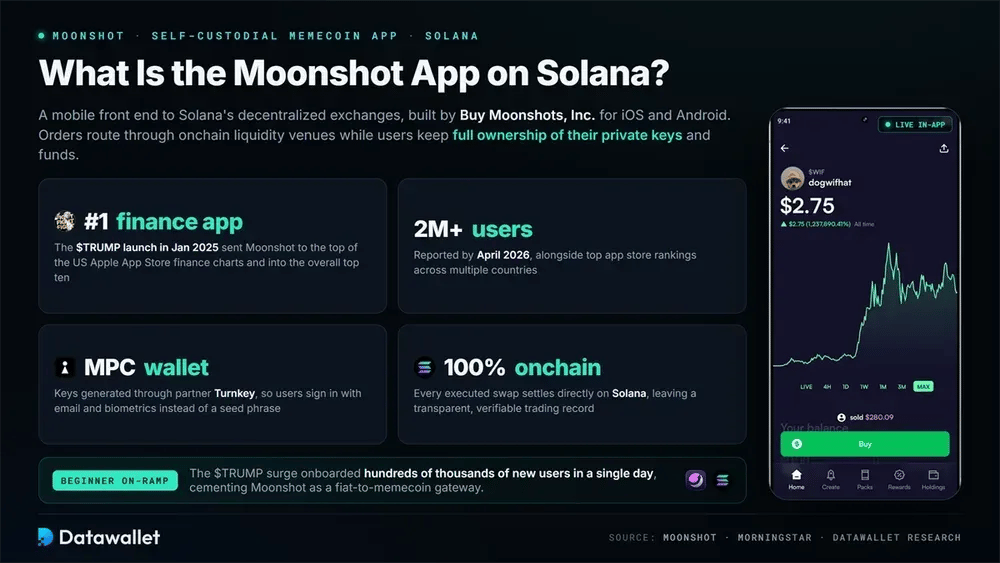
Moonshot itself is not an exchange; it is an interface that submits swaps to onchain venues. Trades are routed through established Solana protocols so users receive competitive pricing without manually navigating a separate DEX or bridging assets between wallets first.
The order flow interacts with several core Solana infrastructure providers, including:
- Raydium: A dominant automated market maker where many graduated memecoins gain their initial deep liquidity pools and pricing.
- Jupiter: Solana's leading aggregator, which sources the best available route across multiple pools to reduce slippage on each swap.
- Meteora: A dynamic liquidity protocol frequently used for newer tokens, offering concentrated pools that tighten spreads during volatile launches.
- Pump.fun: The bonding-curve launchpad where a large share of new Solana memecoins originate before migrating to open markets.
- Verified badges: Curated labels that flag audited or established tokens, helping newer traders avoid obvious imitations and low-quality listings.
- Onchain settlement: Every executed swap finalizes directly on Solana, giving users a transparent, verifiable record of their trading history.
The routing layer touches the busiest corners of the Solana ecosystem, and understanding those venues helps clarify where liquidity actually comes from.
How to Trade Memecoins on Moonshot
Moonshot is designed for the mobile-native trader who wants to move from cash to onchain positions in minutes. The workflow below reflects the current app experience, though exact screens shift with updates.
Setting Up and Funding Your Account
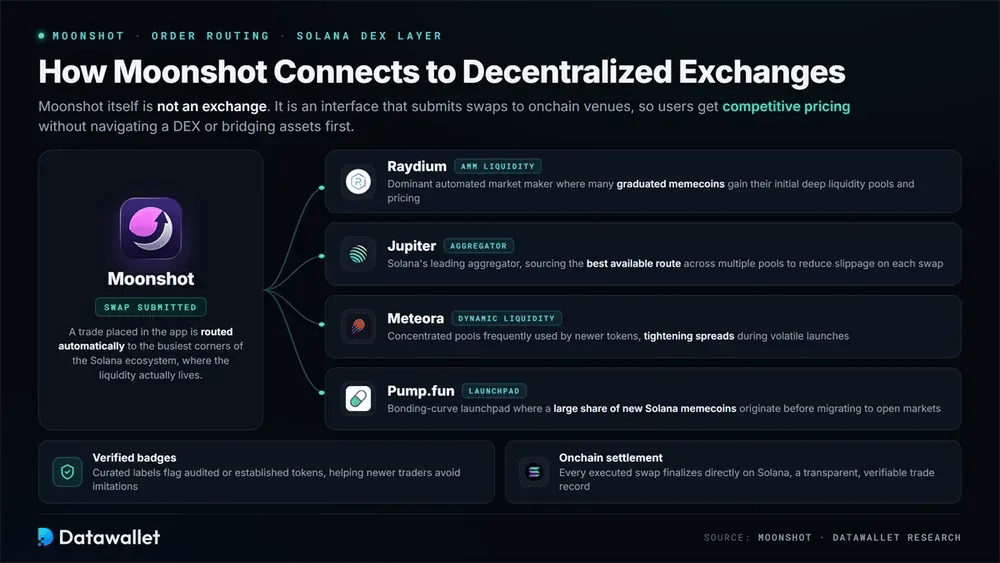
The onboarding path is deliberately short, and most users complete it in under a minute. Follow these steps to get started with a funded wallet:
- Download: Install the official Moonshot app from the Apple App Store or Google Play, confirming the developer is Buy Moonshots, Inc.
- Register: Sign up with an email and passkey, then enable Face ID or Touch ID for fast, seedless authentication on future logins.
- Wallet: A self-custodial wallet is generated automatically via MPC, splitting your key into shards so no single party can access funds.
- Deposit: Add cash through supported fiat rails, which now span 180+ payment methods after the platform's Onramper aggregation upgrade in April 2026.
- Convert: Deposits settle into USDC, the app's base currency, which you then spend when buying tokens across supported markets.
- Verify: Complete any required identity checks, since limits and processing times vary by region, provider, and verification status.
Since April 2026, Moonshot's fiat-to-crypto conversions have been handled by a mix of regulated providers including MoonPay, Coinbase, and Robinhood, with routing chosen automatically based on your location and chosen payment method. This aggregation approach widens global coverage while keeping deposits inside a single, consistent flow.
Buying, Tracking, and Selling Tokens
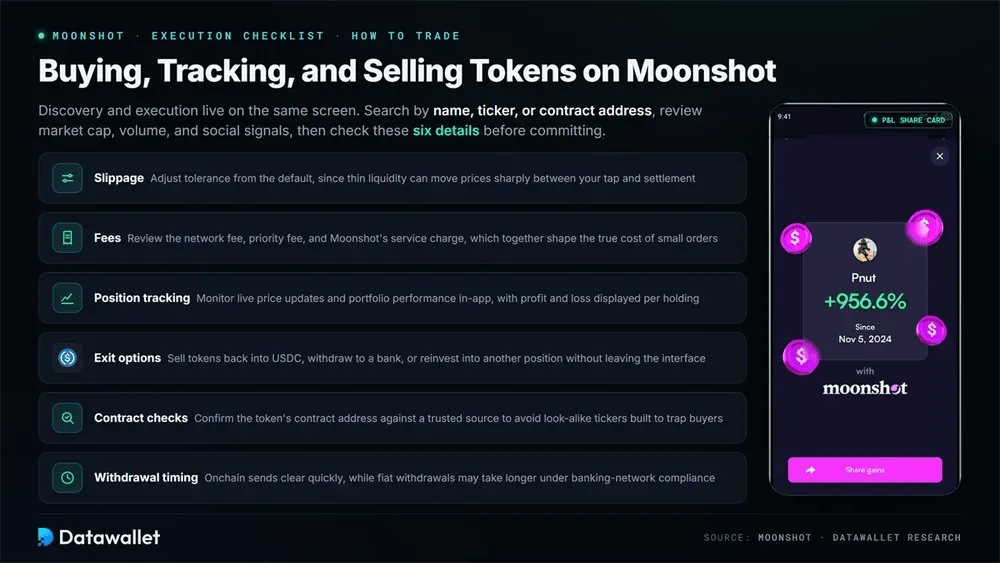
Once funded, discovery and execution happen on the same screen. You can search tokens by name, ticker, or contract address, then review market cap, volume, and social signals before committing to a position.
Before confirming a trade, keep these execution details in mind:
- Slippage: Adjust tolerance from the default before confirming, since thin liquidity can move prices sharply between your tap and settlement.
- Fees: Review the network fee, priority fee, and Moonshot's service charge, which together shape the true cost of small orders.
- Position tracking: Monitor live price updates and portfolio performance directly in-app, with profit and loss displayed per holding.
- Exit options: Sell tokens back into USDC, withdraw to a bank, or reinvest into another position without leaving the interface.
- Contract checks: Confirm the token's contract address against a trusted source to avoid look-alike tickers created to trap buyers.
- Withdrawal timing: Expect onchain sends to clear quickly while fiat withdrawals may take longer depending on banking-network compliance.
Moonshot Fees Explained in 2026
Fees are the single most debated aspect of Moonshot, and they changed meaningfully as the platform scaled. Understanding the full cost stack helps you decide whether the convenience is worth the premium over a manual Solana wallet and DEX workflow.
Each swap carries three cost layers, broken down below:
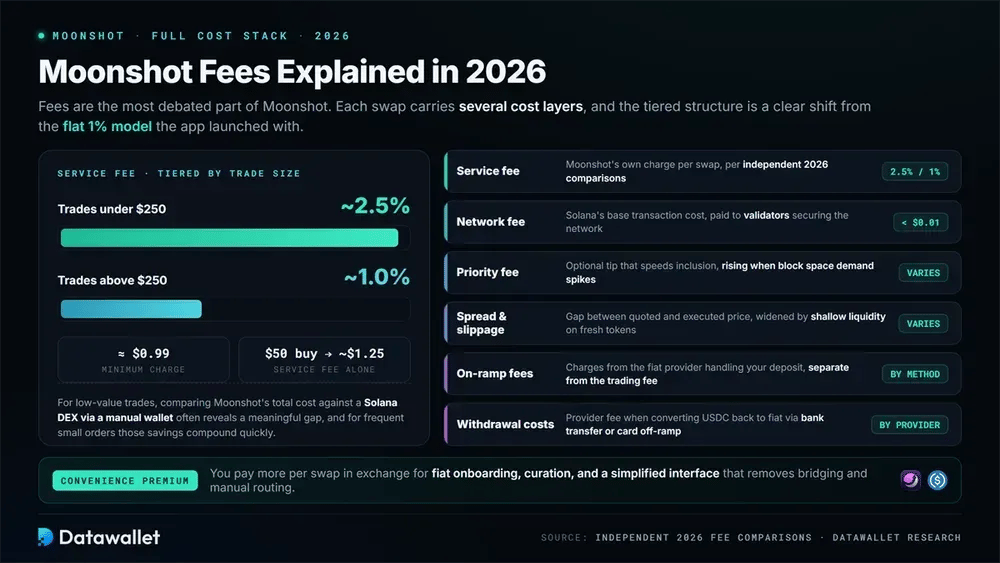
- Service fee: Roughly 2.5% for trades under $250 and 1% for larger trades, per independent 2026 comparisons, with a minimum charge near $0.99.
- Network fee: Solana's base transaction cost, typically a fraction of a cent, paid to validators securing the network.
- Priority fee: An optional tip that speeds inclusion during congestion, which rises when demand for block space spikes.
- Spread and slippage: The gap between quoted and executed price, widened by shallow liquidity on freshly launched tokens.
- On-ramp fees: Charges from the fiat provider handling your deposit, separate from the trading fee and varying by payment method.
- Withdrawal costs: Any provider fee applied when converting USDC back to fiat through a bank transfer or card off-ramp.
The tiered structure is a clear shift from the flat 1% model the app launched with, and it explains recurring complaints that small buys lose a large percentage to fees. For low-value trades, comparing Moonshot's total cost against a Solana DEX accessed through a self-custodial wallet often reveals a meaningful gap.
For active traders placing frequent small orders, those savings compound quickly. Moonshot's pricing is best understood as a convenience premium: you pay more per swap in exchange for fiat onboarding, curation, and a simplified interface that removes bridging and manual routing.
New Products: Leverage, Tokenized Stocks, and Multi-Chain
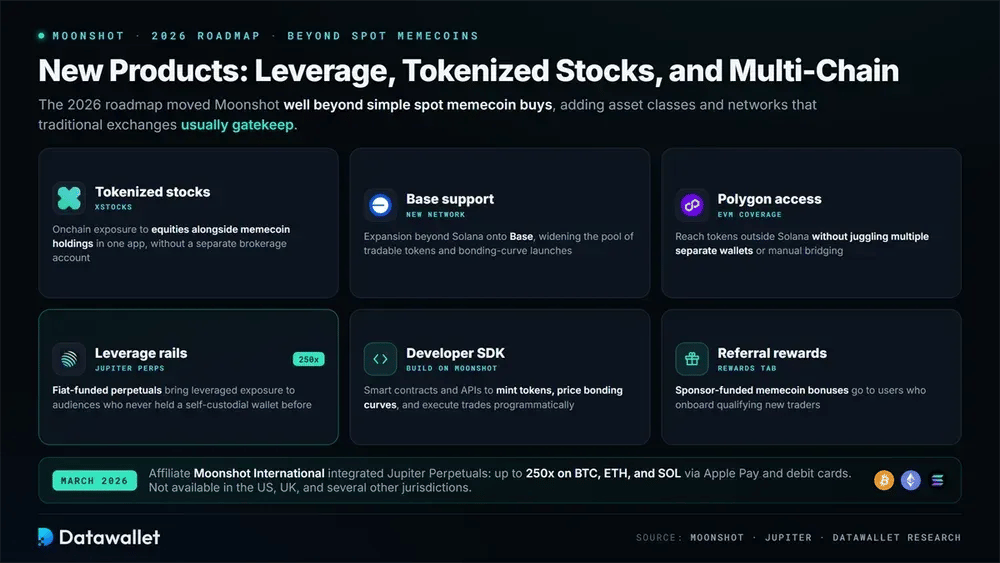
Moonshot's 2026 roadmap moved it well beyond simple spot memecoin buys. The clearest signal is the arrival of leverage through a separately branded affiliate, alongside asset classes that traditional exchanges usually gatekeep.
Beyond derivatives, the app expanded its asset and network coverage to:
- Tokenized stocks: Moonshot added xStocks, letting users gain onchain exposure to equities alongside their memecoin holdings in one app.
- Base support: The platform extended beyond Solana onto Base, widening the pool of tradable tokens and bonding-curve launches.
- Polygon access: Additional EVM coverage lets users reach tokens outside Solana without juggling multiple separate wallets.
- Developer SDK: A set of smart contracts and APIs lets builders mint tokens, price bonding curves, and execute trades programmatically.
- Leverage rails: Fiat-funded perpetuals bring leveraged exposure to mainstream audiences who never held a self-custodial wallet before.
- Referral rewards: A rewards tab distributes sponsor-funded memecoin bonuses to users who onboard qualifying new traders.
In March 2026, Moonshot International, an affiliate entity, integrated Jupiter Perpetuals to offer up to 250x leverage on Bitcoin, Ethereum, and Solana, funded through familiar rails like Apple Pay and debit cards. Notably, that leverage product excludes the United States, United Kingdom, and several other jurisdictions.
Moonshot Supported Countries
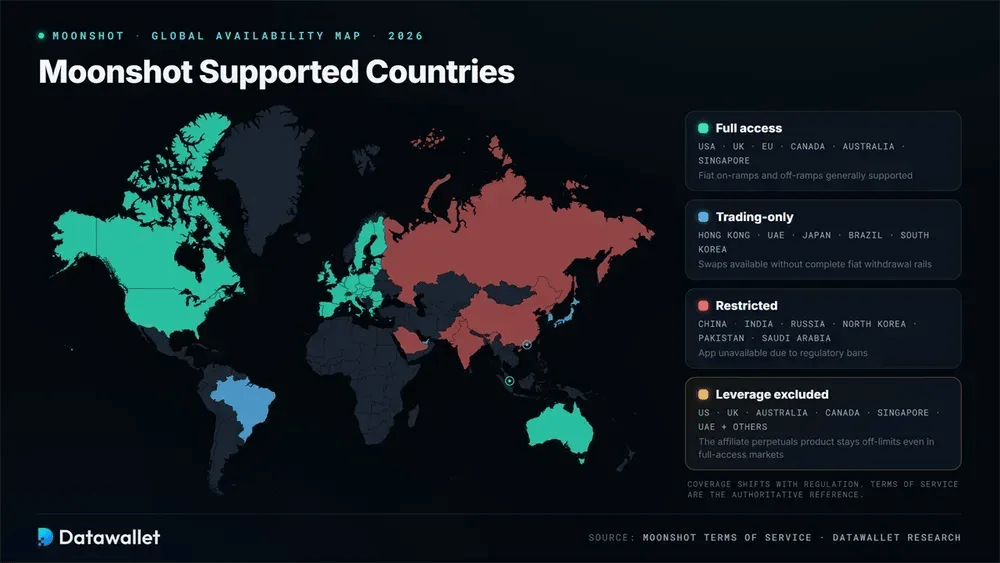
Moonshot operates in regions where crypto trading and self-custodial wallets are legal, though the exact feature set depends on jurisdiction. Full functionality, including fiat deposits and withdrawals, is generally available across major Western and Asia-Pacific markets.
Availability splits into tiers, and it is worth checking:
- Full access: Markets such as the USA, UK, EU, Canada, Australia, and Singapore typically support both fiat on-ramps and off-ramps.
- Trading-only: Regions including Hong Kong, the UAE, Japan, Brazil, and South Korea may offer swaps without complete fiat withdrawal rails.
- Leverage exclusions: The affiliate perpetuals product is unavailable in the US, UK, Australia, Canada, Singapore, the UAE, and others.
- Restricted: The app is unavailable in China, India, Russia, North Korea, Pakistan, and Saudi Arabia due to regulatory bans.
- Provider-dependent: Payment options shift by country because on-ramp routing selects from different regulated fiat partners per region.
- Subject to change: Coverage evolves as regulations tighten or loosen, so the app's terms of service remain the authoritative reference.
Because access rules change frequently, always confirm current availability in Moonshot's official terms of service before funding an account or attempting a withdrawal.
Is the Moonshot App Legit and Safe?
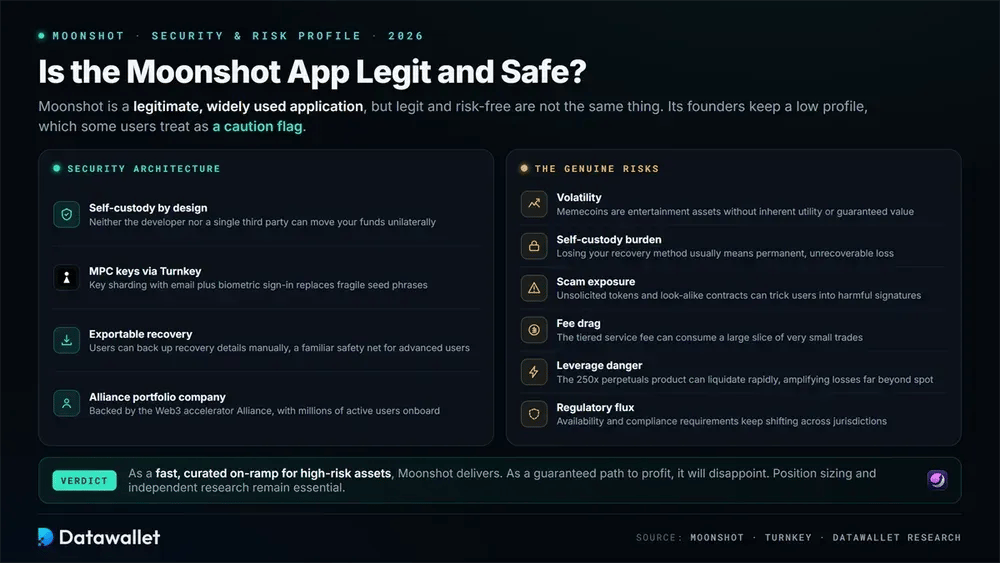
Moonshot is a legitimate, widely used application, but "legit" and "risk-free" are not the same thing. The app is a portfolio company of the Web3 accelerator Alliance, and its founders have historically kept a low profile, which some users treat as a caution flag.
Its security architecture rests on self-custody and MPC key management through Turnkey, meaning neither the developer nor a single third party can move your funds unilaterally. Users can also export their recovery details for manual backup, providing a familiar safety net for more advanced participants.
The genuine risks are:
- Volatility: Memecoins are highly speculative, described by the app itself as entertainment assets without inherent utility or guaranteed value.
- Self-custody burden: Losing access to your recovery method usually means permanent, unrecoverable loss of funds, with no support desk able to reverse it.
- Scam exposure: Unsolicited tokens and look-alike contracts can trick users into signing harmful transactions the app cannot undo.
- Fee drag: The tiered service fee can consume a large slice of very small trades, eroding returns before any price move.
- Leverage danger: The 250x perpetuals product can liquidate positions rapidly, amplifying losses far beyond a simple spot buy.
- Regulatory flux: Product availability and compliance requirements are shifting as the company builds infrastructure for regulated jurisdictions.
Treated as a fast, curated on-ramp for high-risk assets, Moonshot delivers on its promise. Treated as a guaranteed path to profit, it will disappoint, so responsible position sizing and independent research remain essential regardless of how smooth the interface feels.
Final Thoughts
Moonshot's evolution from a viral memecoin app into a multi-chain trading surface with leverage and tokenized stocks shows how quickly consumer crypto is maturing. Its core appeal endures: fiat in, onchain positions out, with users holding their own keys throughout the process.
The trade-offs are equally clear. Convenience carries a fee premium, self-custody demands personal responsibility, and the newest products introduce leverage risks that dwarf ordinary memecoin volatility.
For anyone weighing whether to trade here, factoring in Solana gas fees, regional restrictions, and total cost against a manual wallet setup is the difference between an informed decision and an expensive lesson.