

Compare the Best Crypto Launchpad Platforms
1. Pump.fun
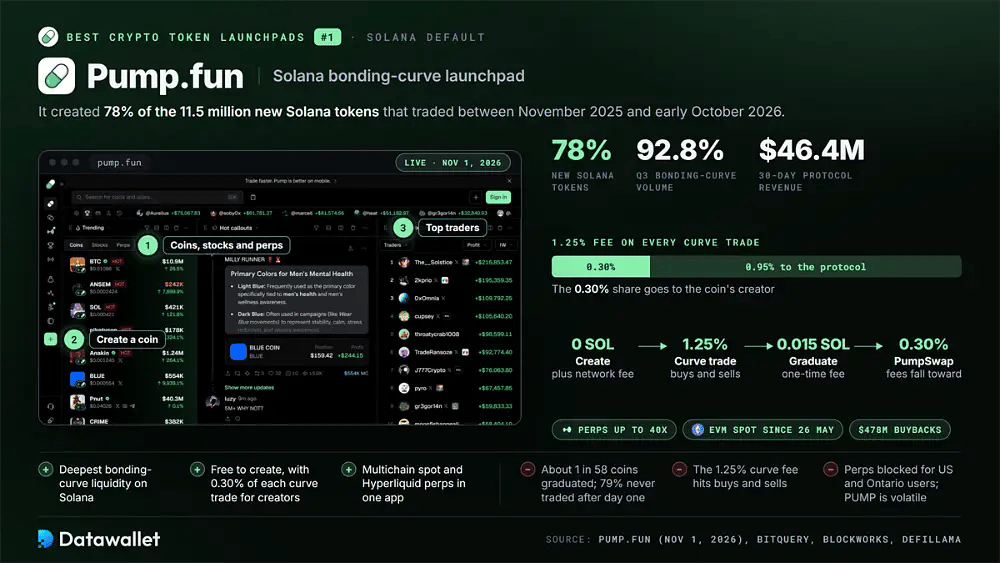
Pump.fun remains Solana's default launchpad. It created 78% of the 11.5 million new Solana tokens that traded from November 2025 to early October 2026, per Bitquery. Blockworks credits it with 92.8% of Q3 bonding-curve volume, and DefiLlama shows $46.4 million of protocol revenue over 30 days.
Creating a coin costs 0 SOL plus the network fee. Every bonding-curve trade carries a flat 1.25% fee, with 0.30% paid to the creator and 0.95% to the protocol, according to Pump.fun's fee schedule. Graduating coins move to PumpSwap for a one-time 0.015 SOL fee, where tiered fees fall toward 0.30%.
The app has grown beyond launches. Since 26 May it supports trading on Ethereum, Base and BNB Chain using SOL, and on 16 October it added Hyperliquid-powered perpetual futures with up to 40x leverage, blocked for US and Ontario users. Cumulative PUMP buybacks reached $478 million by early October; see our Pump.fun guide.
Pros
- Holds the deepest bonding-curve liquidity on Solana, so graduated tokens reach a large pool of active traders quickly.
- Charges nothing to create a coin and pays creators 0.30% of every curve trade, plus tiered fees after graduation.
- Combines multichain spot trading and Hyperliquid perpetuals in one app, reducing the need for separate trading terminals.
Cons
- Only about 1 in 58 coins graduated over 11 months, and 79% never traded after launch day.
- The 1.25% curve fee applies to both buys and sells, which compounds quickly for active traders.
- Perpetual futures are unavailable to US and Ontario users, and the PUMP token remains highly volatile.
2. Pons
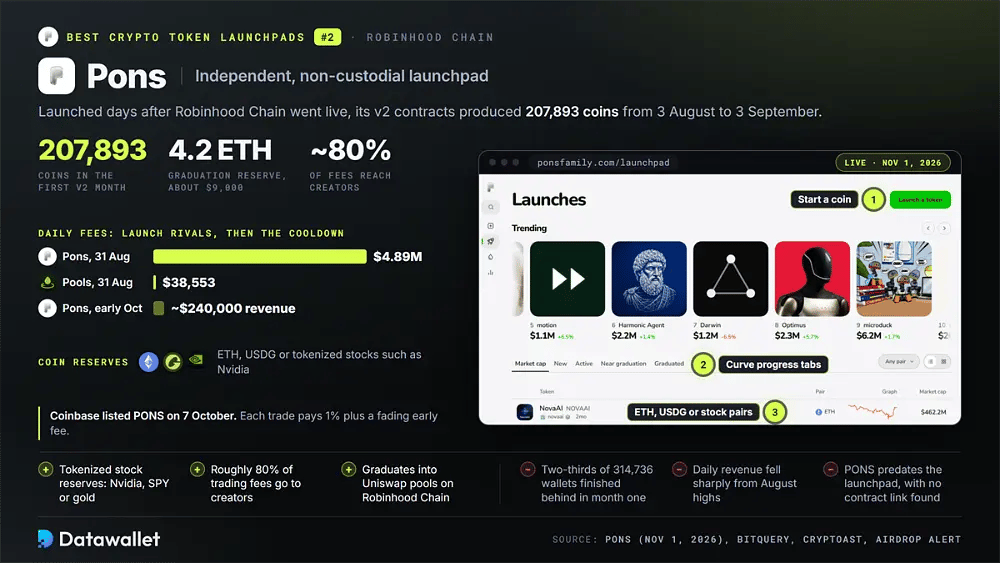
Pons launched days after Robinhood Chain's mainnet went live on 1 July 2026 and quickly became the chain's busiest application. Operated by Pons Labs, LLC, it is an independent, non-custodial launchpad rather than a Robinhood product. Its v2 contracts produced 207,893 coins between 3 August and 3 September, per Bitquery.
Each coin sells on a bonding curve until its reserve reaches 4.2 ETH, roughly $9,000, then moves to a Uniswap pool. Creators can back coins with ETH, the USDG stablecoin or tokenized stocks such as Nvidia. Pons charges 1% per trade plus a fading early fee, and about four-fifths goes to creators.
Competition has been fierce. Uniswap Labs launched Pools.trade on 5 August, yet on 31 August Pons collected $4.89 million in daily fees against $38,553 for its rival, per Cryptoast. Activity has since cooled, with daily revenue falling to about $240,000 by early October. Coinbase listed PONS on 7 October; see our Pons explainer.
Pros
- Offers tokenized stock reserves, letting creators price new coins against assets such as Nvidia, SPY or gold.
- Directs roughly 80% of trading fees to coin creators, among the most generous splits of any major launchpad.
- Graduates tokens into Uniswap pools, giving them immediate access to Robinhood Chain's main exchange liquidity.
Cons
- Two-thirds of the 314,736 wallets that traded Pons coins finished behind during its first month.
- Daily revenue fell sharply from August highs, showing how quickly launchpad activity can rotate away.
- The PONS token predates the launchpad, and Bitquery found no contract link between the two.
3. StonkFun
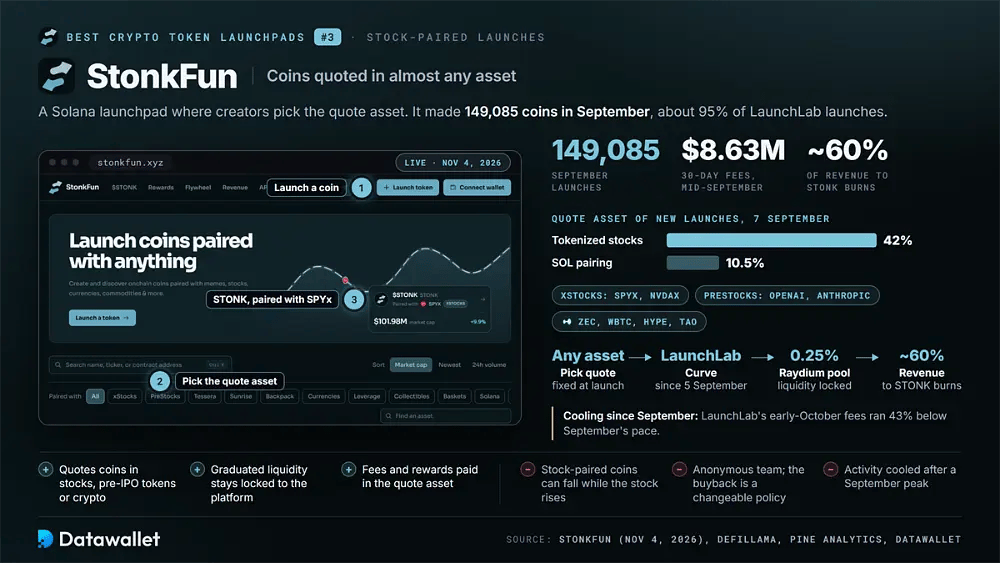
StonkFun is a Solana launchpad where creators choose what a new coin trades against. Instead of the standard SOL pairing, a coin can be quoted in tokenized stocks such as SPYx and NVDAx, pre-IPO tokens such as OPENAI and ANTHROPIC, or crypto assets including ZEC, WBTC, HYPE and TAO. On 7 September, tokenized stocks quoted 42% of new launches against 10.5% for SOL.
StonkFun moved all launches onto Raydium LaunchLab on 5 September and created 149,085 coins that month, roughly 95% of all LaunchLab launches. Each curve raises its target in the chosen quote asset, then migrates into a Raydium pool on the 0.25% fee tier, with the liquidity locked to the platform rather than the creator. By mid-September it had processed $1.47 billion of cumulative volume and $8.63 million of fees over 30 days, per DefiLlama.
Creators set the pool fee at launch and receive their share automatically in the quote asset, and some launches add holder rewards paid in that asset. Roughly 60% of platform revenue funds STONK buybacks and burns. Activity has slowed since September, with LaunchLab's early-October fees running 43% below September's daily pace. Our StonkFun explainer covers the platform in detail.
Pros
- Lets creators quote coins in tokenized stocks, pre-IPO tokens or crypto assets, the widest pairing menu of any launchpad here.
- Locks graduated liquidity to the platform, so a creator cannot drain the Raydium pool after graduation.
- Pays creator fees and holder rewards in the quote asset and routes about 60% of revenue to STONK buybacks and burns.
Cons
- Stock-paired coins carry layered exposure, can fall even while the paired stock rises, and confer no share rights.
- The team is anonymous, and the buyback is a stated policy that can change without notice.
- Activity cooled after its September peak, and the platform has only a few months of operating history.
4. BONK.fun
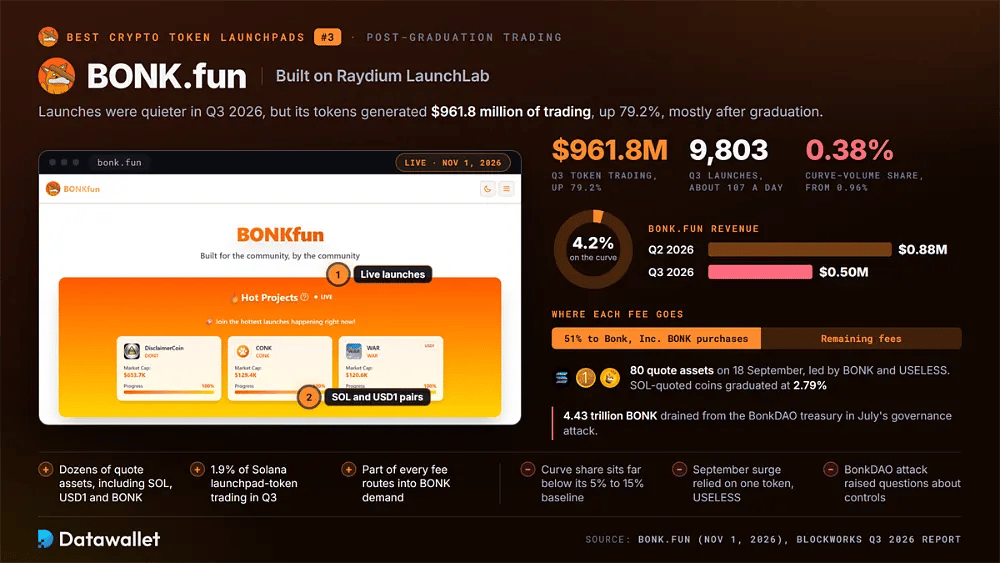
BONK.fun is the BONK community's Solana launchpad, built on Raydium LaunchLab. It briefly overtook Pump.fun in mid-2025, but Q3 2026 was quieter. Blockworks counted 9,803 launches, about 107 a day, and $0.50 million of revenue, down from $0.88 million in Q2, with 0.38% of Solana curve volume.
Its strength shows after graduation. Tokens launched on BONK.fun generated $961.8 million of trading in Q3, up 79.2%, with only 4.2% occurring on the curve. On 18 September alone, launches were quoted against 80 assets, led by BONK and USELESS. SOL-quoted coins graduated at 2.79% during the quarter.
Fees feed the BONK economy. The Blockworks Q3 report states that 51% of BONK.fun fees fund Bonk, Inc.'s BONK treasury purchases, and ecosystem products burn tokens through separate programs. In July, a governance attack drained 4.43 trillion BONK from the BonkDAO treasury, though BONK said its other operations were unaffected.
Pros
- Supports dozens of quote assets, including SOL, USD1 and BONK, giving creators more pairing options than Pump.fun.
- BONK.fun tokens held 1.9% of all Solana launchpad-token trading in Q3, well above its curve share.
- Routes part of every fee into BONK demand, aligning the launchpad with one of Solana's largest communities.
Cons
- Curve-volume share fell to 0.38% in Q3 from 0.96%, far below its 5% to 15% baseline.
- September's trading surge depended almost entirely on one token, USELESS, which makes activity fragile.
- The BonkDAO governance attack raised questions about controls across the wider BONK ecosystem.
5. SunPump
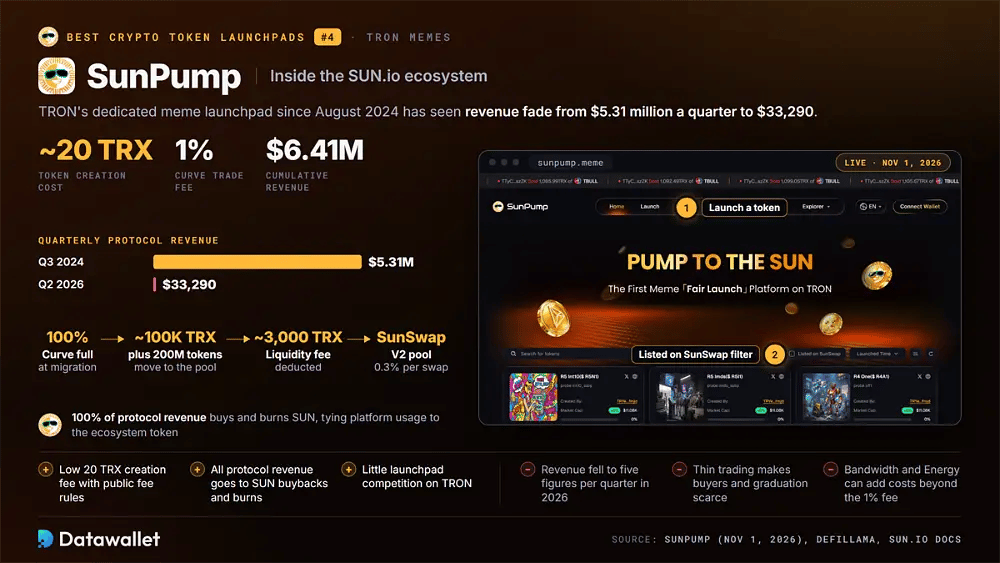
SunPump is TRON's dedicated meme launchpad, run within the SUN.io ecosystem since August 2024. It once out-earned Pump.fun on single days, but activity has faded sharply. DefiLlama shows $33,290 of revenue in Q2 2026 against $5.31 million in Q3 2024, with $6.41 million earned cumulatively.
Costs are low. Creating a token costs about 20 TRX, and curve trades carry a 1% fee, according to SUN.io documentation. At 100% of the curve, roughly 100,000 TRX and 200 million tokens migrate to SunSwap V2, with about 3,000 TRX deducted as a liquidity fee.
SUN.io directs 100% of SunPump protocol revenue to buying and burning SUN. The platform suits creators targeting TRON's large stablecoin user base, given how much TRC-20 USDT moves on the network. Low competition helps a new token stand out, but thin liquidity also makes exits harder. Our TRON wallet guide covers setup.
Pros
- Charges a low 20 TRX creation fee and documents its curve, migration and fee rules publicly.
- Sends all protocol revenue to SUN buybacks and burns, tying platform usage directly to the ecosystem token.
- Faces little launchpad competition on TRON, so new tokens are less likely to be buried within minutes.
Cons
- Protocol revenue collapsed from $5.31 million in Q3 2024 to five figures per quarter in 2026.
- Thin trading activity means many tokens struggle to find buyers or reach SunSwap graduation.
- TRON's resource model can burn TRX for Bandwidth and Energy, adding costs beyond the 1% fee.
6. Raydium LaunchLab
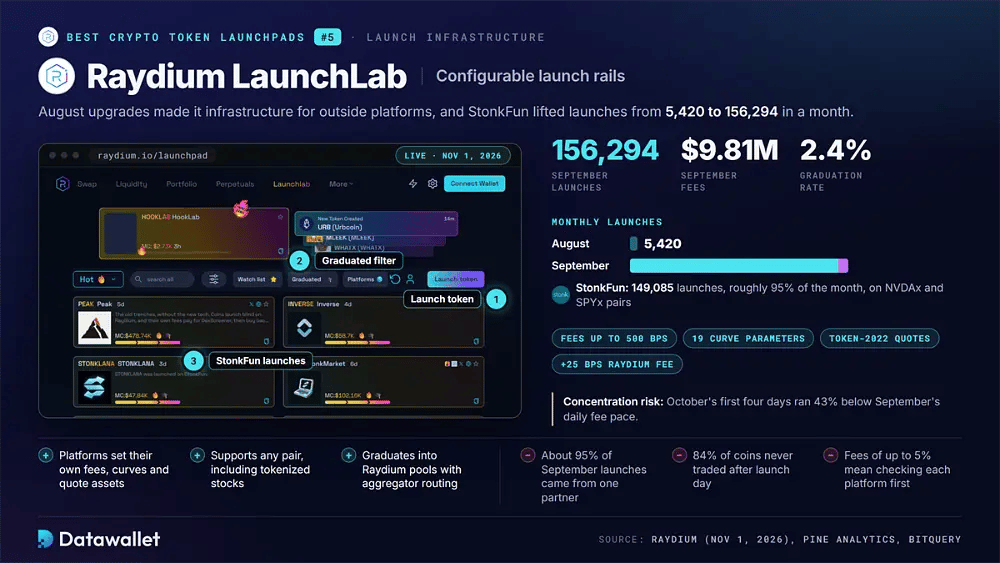
Raydium LaunchLab launched in April 2025 after Pump.fun moved graduations to its own exchange. In August 2026, five upgrades turned it into infrastructure that outside platforms configure, with custom fees up to 500 basis points, Token-2022 quote assets and 19 curve parameters, according to Pine Analytics.
StonkFun moved all launches onto LaunchLab on 5 September, pairing new tokens with tokenized stocks such as NVDAx and SPYx. LaunchLab jumped from 5,420 launches in August to 156,294 in September, StonkFun accounting for 149,085. September LaunchLab fees reached $9.81 million, and its graduation rate was 2.4%.
Direct creators can still launch on Raydium's own interface, choose SOL or another quote token and earn a share of post-graduation trading fees. Raydium adds a 25 basis point protocol fee on curve trades. Concentration is the risk: October's first four days ran 43% below September's daily fee pace. Our Raydium guide explains RAY.
Pros
- Lets launch platforms set their own fees, curves and quote assets, which suits builders wanting custom launch economics.
- Supports any token pair, including tokenized stocks, after the September 2026 upgrade that StonkFun adopted first.
- Graduates tokens into Raydium pools, one of Solana's established exchanges with deep aggregator routing.
Cons
- Roughly 95% of September launches came from one partner, so activity depends heavily on StonkFun.
- Bitquery found 84% of LaunchLab coins never traded after launch day, worse than Pump.fun's 79%.
- Custom fee settings of up to 5% mean buyers must check each platform's charges before trading.
7. Four.meme
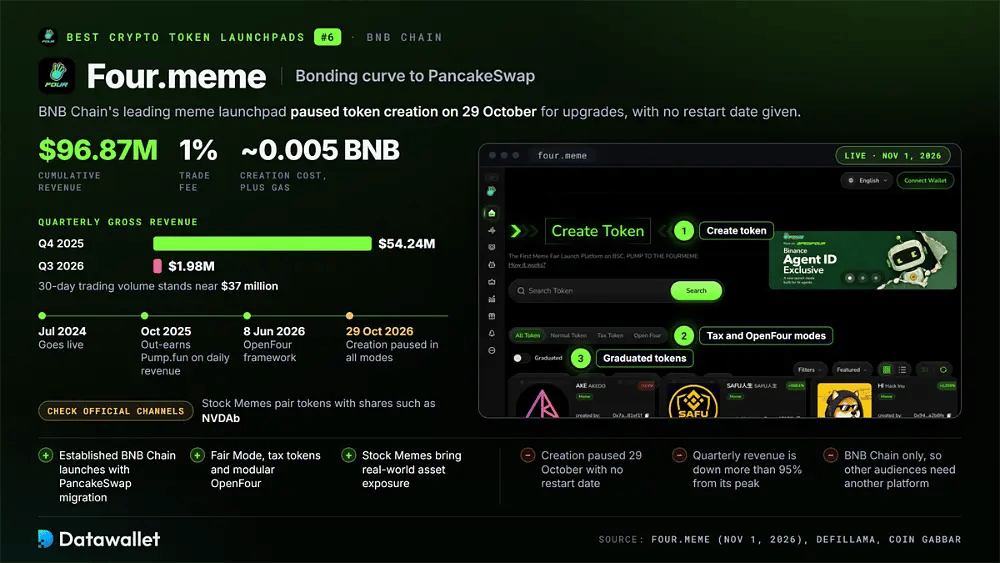
Four.meme is BNB Chain's leading meme launchpad, live since July 2024. It sells new tokens on a bonding curve and migrates completed curves to PancakeSwap. Creation costs roughly 0.005 BNB plus gas, and trades carry a 1% fee. DefiLlama shows $96.87 million of cumulative revenue.
Activity peaked during the October 2025 BNB meme season, when Four.meme briefly out-earned Pump.fun on daily revenue. It has cooled since: gross revenue fell from $54.24 million in Q4 2025 to $1.98 million in Q3 2026, and 30-day trading volume stands near $37 million on the same dashboard.
The team keeps experimenting. OpenFour, a modular launch framework, went live on 8 June 2026, and Stock Memes now pair tokens with tokenized shares such as NVDAb. On 29 October, Four.meme paused token creation across all modes for upgrades, without giving a restart date, so check its official channels before launching.
Pros
- Offers the most established memecoin launch venue on BNB Chain, with direct PancakeSwap migration once the curve fills.
- Supports multiple launch modes, including Fair Mode, tax tokens and the modular OpenFour framework for builders.
- Pairs Stock Memes with tokenized shares, bringing real-world asset exposure to BNB Chain launches.
Cons
- Token creation was paused on 29 October 2026 with no announced restart date.
- Quarterly revenue has fallen more than 95% from its Q4 2025 peak, signalling much thinner activity.
- Supports BNB Chain only, so creators targeting Solana or Robinhood Chain traders need another platform.
8. CoinList
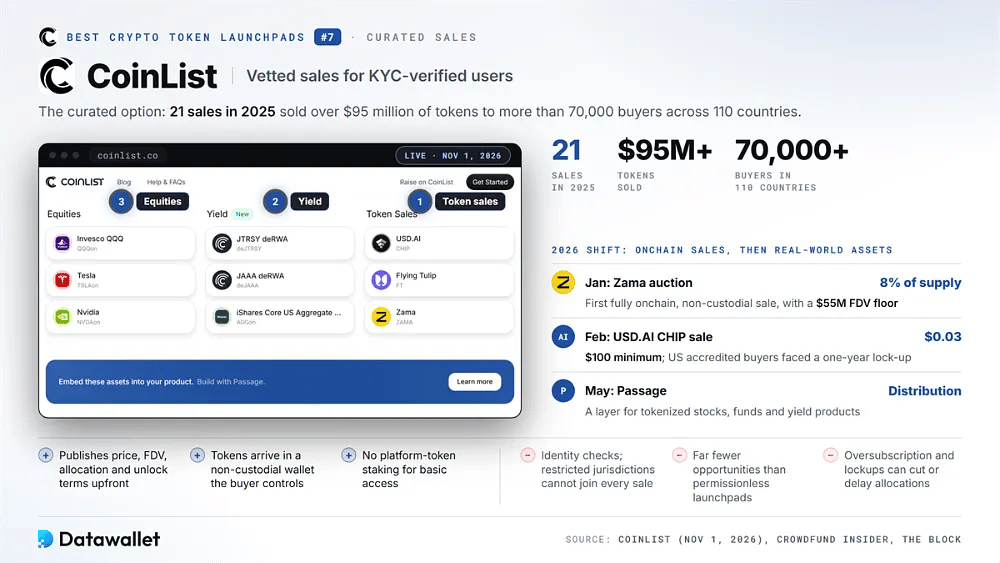
CoinList is the curated option. Instead of permissionless memecoins, it runs vetted token sales for KYC-verified users, and its history includes early distributions for Solana and Filecoin. In 2025 it hosted 21 sales that sold over $95 million of tokens to more than 70,000 buyers across 110 countries, per Crowdfund Insider.
In January 2026, CoinList ran its first fully onchain, non-custodial sale for Zama, a sealed-bid Dutch auction of 8% of supply with a $55 million FDV floor. Every account now includes a non-custodial wallet. February's USD.AI sale priced CHIP at $0.03 with a $100 minimum.
Deal flow has slowed industry-wide, and in May 2026 CoinList launched Passage, a distribution layer for tokenized stocks, funds and yield products, per The Block. Sales vary in eligibility, lockups and payment tokens; US accredited buyers in the USD.AI sale faced a one-year lock-up. Our token unlock calendar tracks vesting.
Pros
- Vets projects and publishes price, FDV, allocation and unlock terms before each sale opens.
- Runs sales through non-custodial wallets, so purchased tokens arrive directly in a wallet the buyer controls.
- Requires no platform-token staking for basic access, unlike many tier-based launchpads.
Cons
- Requires identity verification, and residents of restricted jurisdictions cannot join every sale.
- Offers far fewer opportunities than permissionless launchpads, with 21 sales across all of 2025.
- Allocations can be oversubscribed or locked, so buyers may receive less than committed or wait for unlocks.
How to Choose a Crypto Launchpad Platform
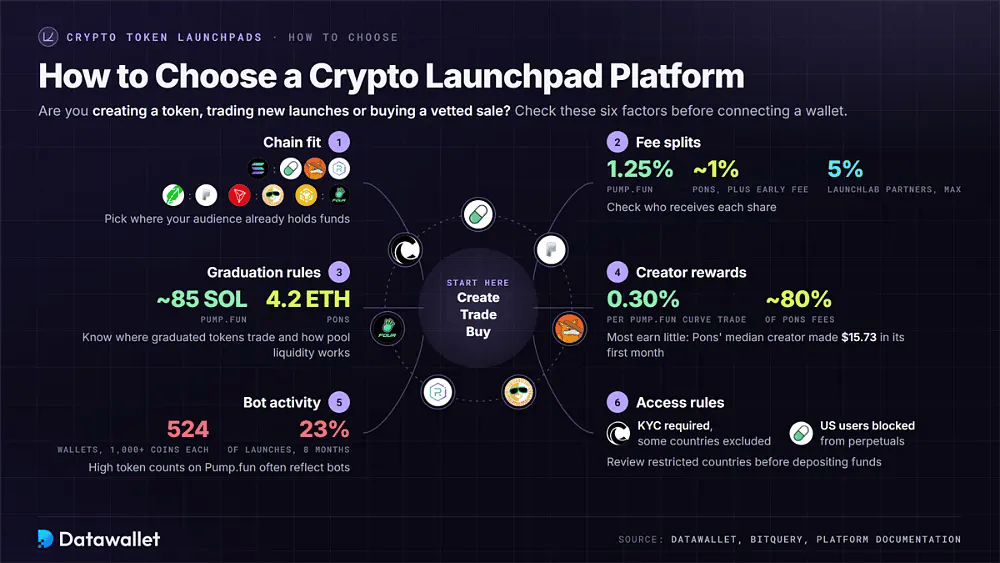
The right launchpad depends on whether you are creating a token, trading new launches or buying into a vetted sale. Chain, fees and graduation rules matter more than front-page hype.
Check these six factors before connecting a wallet:
- Chain fit: Pump.fun, BONK.fun and LaunchLab run on Solana, Pons on Robinhood Chain, SunPump on TRON and Four.meme on BNB Chain. Pick where your audience already holds funds.
- Fee splits: Pump.fun charges 1.25% per curve trade, Pons about 1% plus an early fee, and LaunchLab partners up to 5%. Check who receives each share.
- Graduation rules: Thresholds differ, from about 85 SOL on Pump.fun to 4.2 ETH on Pons. Our DEX guide explains where graduated tokens trade and how pool liquidity works.
- Creator rewards: Creators earn 0.30% per Pump.fun curve trade and roughly 80% of Pons fees, but most earn little. Pons' median creator made $15.73 in its first month.
- Bot activity: High token counts often reflect bots. Bitquery found 524 wallets each made over 1,000 Pump.fun coins, together producing 23% of launches over eight months.
- Access rules: CoinList requires KYC and excludes some countries, while Pump.fun blocks US users from perpetuals. Review our Pump.fun restricted countries list before depositing funds anywhere.
Bonding Curves, Graduation and Creator Fees Explained
Every permissionless launchpad here follows the same basic sequence: a fixed supply, a price formula, a graduation threshold and a migration into an exchange pool. The details decide who earns fees and how quickly buyers can exit.
How a Bonding Curve Prices a New Token
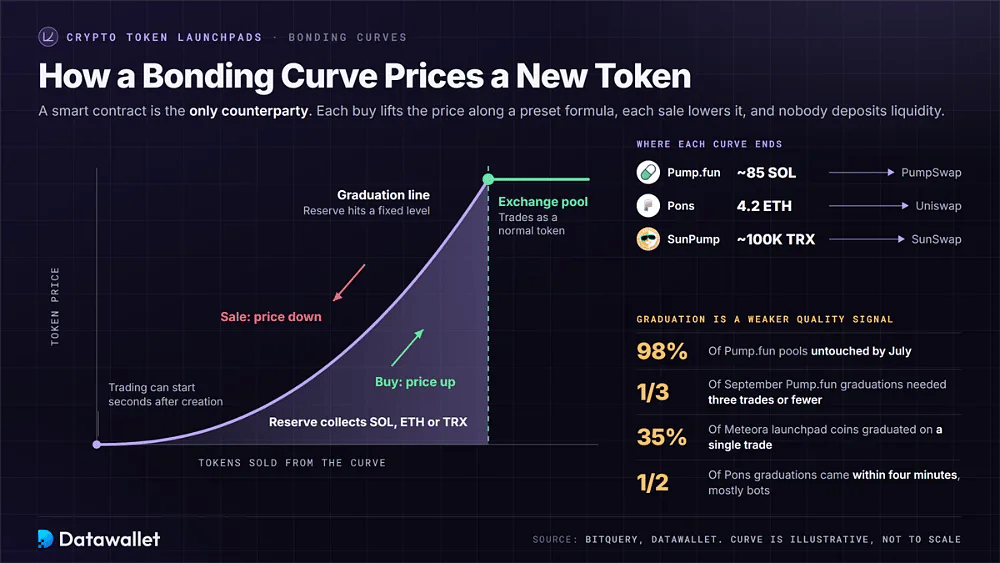
A bonding curve is a smart contract that acts as the only counterparty. Each purchase raises the price along a preset formula and each sale lowers it, while buyers' SOL, ETH or TRX collects in a reserve. Nobody needs to deposit liquidity, so trading can begin seconds after creation.
Graduation happens when the reserve hits a fixed line. On Pump.fun, the SOL and remaining tokens form a PumpSwap pool holding about 85 SOL, and Bitquery found 98% of those pools untouched by July. Pons migrates at 4.2 ETH, while SunPump moves roughly 100,000 TRX into SunSwap.
Graduation is a weaker quality signal than it used to be. In September, a third of Pump.fun graduations needed three trades or fewer, and on Meteora's launchpad 35% of coins graduated on a single trade. Half of Pons graduations happened within four minutes of creation, mostly driven by automated buyers.
Launchpad Fee Structures Compared
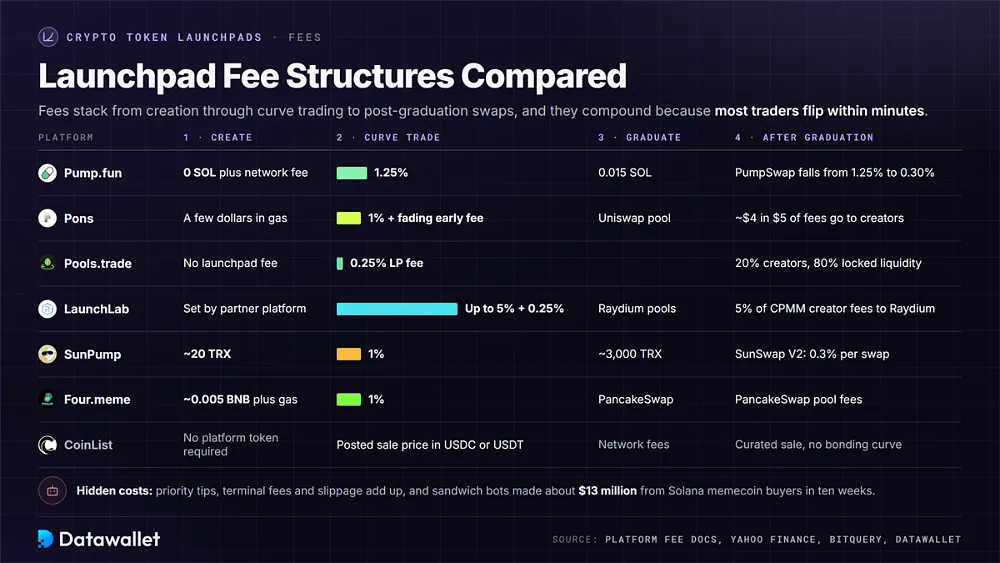
Fees on launchpads stack across several stages, from creation through curve trading to post-graduation swaps. Small percentages compound because most traders buy and sell the same token several times within minutes.
Here is what each platform charges at each stage:
- Pump.fun: Creation is free, curve trades cost 1.25% split between creator and protocol, graduation costs 0.015 SOL, and PumpSwap fees then fall from 1.25% toward 0.30%.
- Pons: Launching costs a few dollars in gas. Each curve trade pays 1% plus a fading early charge, with roughly four dollars in five going to creators.
- Pools.trade: Uniswap's rival on Robinhood Chain charges no launchpad fee. Its 0.25% LP fee splits 20% to creators and 80% back into permanently locked liquidity.
- Raydium LaunchLab: Partner platforms set curve fees up to 5%, and Raydium adds 25 basis points per curve trade. Since 1 October, 5% of CPMM creator fees go to Raydium.
- SunPump: Creation costs about 20 TRX, curve trades cost 1%, graduation deducts roughly 3,000 TRX, and SunSwap V2 then charges 0.3% per swap after migration.
- Four.meme: Creating a token costs about 0.005 BNB plus gas, trades on the curve carry a 1% fee, and graduated tokens trade under PancakeSwap's pool fees.
- CoinList: Buyers pay the posted sale price in stablecoins such as USDC or USDT, plus network fees, with no platform token required for basic access.
- Hidden costs: Priority tips, trading-terminal fees, slippage and sandwich bots add further costs. Bitquery found sandwich bots made about $13 million from Solana memecoin buyers in ten weeks.
Memecoin Launchpads vs Curated Token Sale Platforms
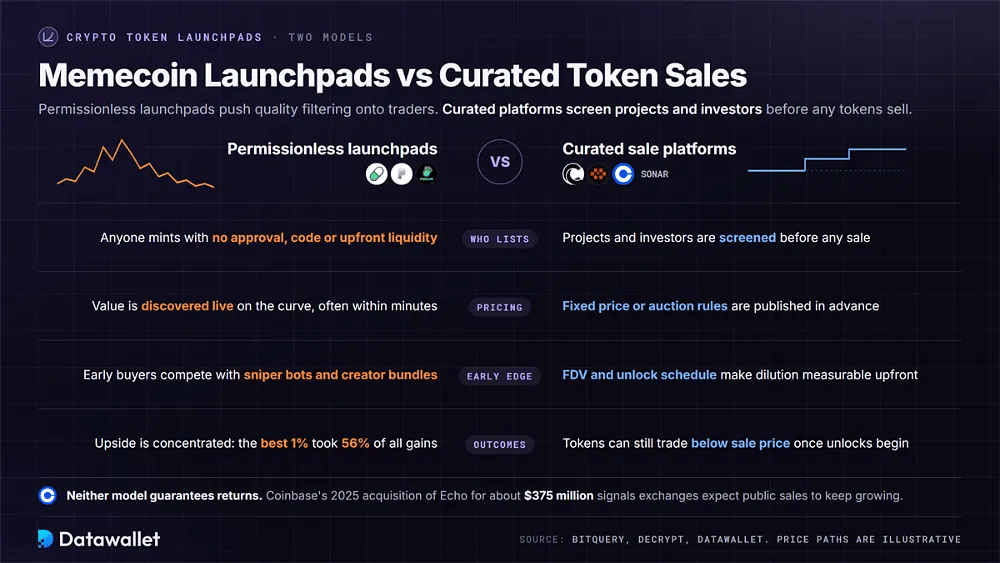
Permissionless launchpads and curated sale platforms solve different problems. Pump.fun, Pons and Four.meme let anyone mint a token without approval, code or upfront liquidity, so supply is unlimited and quality filtering falls entirely on traders. CoinList, Legion and Coinbase's Sonar-based sales screen projects and investors before any tokens are sold.
Pricing also works differently. A memecoin's value is discovered live on the curve, often within minutes, and early buyers compete with sniper bots and creator bundles. A curated sale publishes a fixed price or auction rules, a fully diluted valuation and an unlock schedule in advance, making dilution measurable before committing.
Neither model guarantees returns. Curated tokens can still trade below sale price once unlocks begin, while memecoin upside is concentrated: Bitquery found the best 1% of Solana memecoin buyers captured 56% of all gains. Coinbase's 2025 acquisition of Echo for about $375 million signals that exchanges expect public sales to keep growing.
Crypto Launchpad Market Trends in 2026
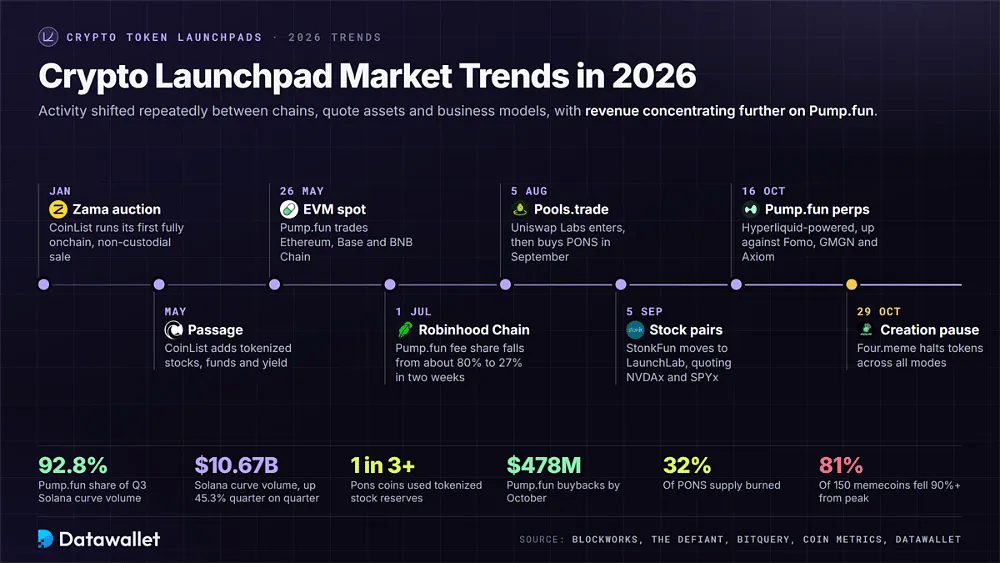
Launchpad activity in 2026 has shifted repeatedly between chains, quote assets and business models. Revenue concentrated further on Pump.fun even as Robinhood Chain and tokenized stocks created fresh competition from July onwards.
These developments shaped the launchpad market through October 2026:
- Pump.fun dominance: Pump.fun held 92.8% of Solana bonding-curve volume in Q3, and Solana launchpad curve volume rose 45.3% quarter on quarter to $10.67 billion, according to Blockworks Advisory.
- Robinhood Chain: Robinhood Chain's mainnet opened on 1 July, and The Defiant reported Pump.fun's launchpad fee share falling from about 80% to 27% within two weeks.
- Stock pairs: Launchpads began pricing tokens against tokenized equities. More than a third of Pons coins used stock reserves, and StonkFun quoted most launches in NVDAx or SPYx.
- Exchange entry: Uniswap Labs launched Pools.trade on Robinhood Chain in August, then bought PONS in September to align with its rival, blurring lines between exchanges and launchpads.
- Trading apps: Pump.fun added EVM spot trading in May and Hyperliquid perpetuals in October, competing directly with terminals such as Fomo, GMGN and Axiom for active traders.
- Buybacks: Most launchpad tokens now recycle revenue. Pump.fun buybacks reached $478 million by October, Pons burned 32% of PONS supply and SunPump routes all revenue to SUN.
- Onchain sales: Token sales moved onchain and toward regulated access. CoinList ran its first non-custodial auction with Zama, then launched Passage for tokenized real-world assets in May.
- Survival odds: Bitquery found 79% of Pump.fun coins never traded after launch day, and Coin Metrics found 81% of 150 studied memecoins fell at least 90% from peak.
Activity remains cyclical, and single-partner surges can reverse quickly, as LaunchLab's October slowdown showed. Our Robinhood Chain statistics and tokenization statistics track how stock-paired launches fit into the wider onchain market.
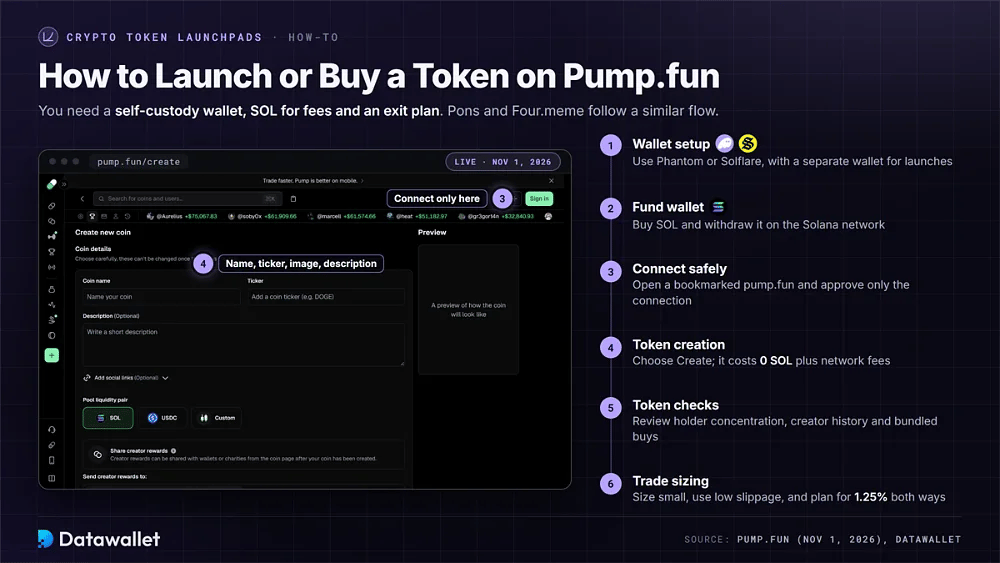
How to Launch or Buy a Token on Pump.fun
You need a self-custody wallet, the chain's native token for fees, and a clear exit plan before buying. These steps use Pump.fun on Solana; Pons and Four.meme follow a similar flow.
- Wallet setup: Install Phantom or Solflare, store the recovery phrase offline, and use a separate wallet for launches. Our Phantom wallet review covers security settings in detail.
- Fund wallet: Buy SOL on an exchange and withdraw it on the Solana network. Funds held on another chain can move over with our Solana bridging guide.
- Connect safely: Open pump.fun from a bookmarked address, connect the wallet, and approve only the connection request. Lookalike domains and fake support messages are common phishing routes.
- Token creation: Choose Create, add a name, ticker, image and description, and optionally make a first buy in the same transaction. Creation costs 0 SOL plus network fees.
- Token checks: Before buying someone else's token, check holder concentration, creator wallet history and bundled buys. Our guide to tracking Solana wallets explains the warning signs in more detail.
- Trade sizing: Set a small position size, use the lowest workable slippage, and remember the 1.25% fee applies to both buys and sells. Plan the exit before entering.
If transactions fail during busy launches, our guide to fixing failed Solana transactions covers priority fees. On Robinhood Chain, add the network to MetaMask and bridge ETH first. Keep records of every buy and sell for tax reporting.
Risks of Using Crypto Launchpads
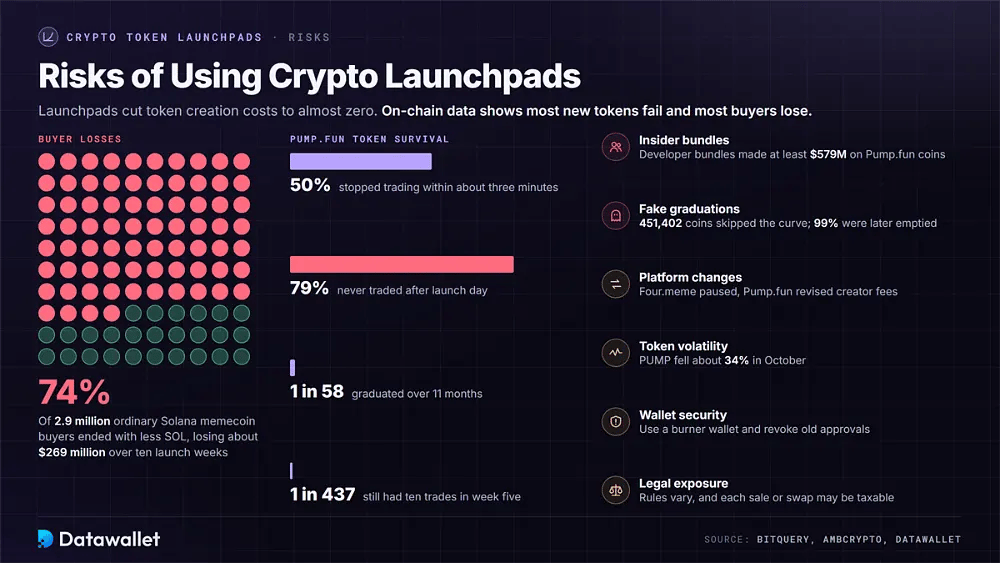
Launchpads lower the cost of creating tokens to almost zero, which also lowers the cost of creating bad ones. On-chain data shows most new tokens fail and most buyers lose.
Weigh these risks before your first trade or launch:
- Buyer losses: Bitquery tracked 2.9 million ordinary Solana memecoin buyers across ten launch weeks and found 74% ended with less SOL, collectively losing about $269 million.
- Token survival: Half of Pump.fun launches stopped trading within about three minutes, and only 1 in 437 still had ten trades in its fifth week after launch.
- Insider bundles: Creators often buy their own coins through linked wallets. Bitquery estimated developer bundles made at least $579 million on Pump.fun coins launched from late 2025 to June 2026.
- Fake graduations: Bitquery counted 451,402 Solana coins that skipped the curve through dev-opened pools; 99% were later emptied, with the first withdrawal a median 12 minutes after opening.
- Platform changes: Launchpads change terms quickly. Four.meme paused creation on 29 October, Pump.fun revised creator fees in 2026, and LaunchLab depends heavily on one partner for activity.
- Token volatility: Launchpad tokens such as PUMP, PONS and SUN swing sharply with platform revenue. PUMP fell about 34% in October despite leading weekly protocol revenue rankings.
- Wallet security: Drainer links, fake support accounts and malicious token approvals target launchpad users. Use a burner wallet and regularly revoke token permissions you no longer need.
- Legal exposure: Launchpad rules vary by country. Pump.fun restricts perpetuals in the US and Ontario, CoinList screens jurisdictions, and each sale or swap may be taxable.
Treat memecoin launches as high-risk speculation, size positions so a total loss is affordable, and never commit funds you need for other purposes.
Final Thoughts
Pump.fun ranks first for its 92.8% share of Solana curve volume, free token creation and deepest post-graduation liquidity. Pons is the clear choice on Robinhood Chain, with stock-backed reserves and creator-friendly fee splits. BONK.fun suits creators wanting alternative quote assets and alignment with the BONK community.
SunPump remains TRON's dedicated launchpad, though activity is now minimal. Raydium LaunchLab is the builder's tool, letting platforms set their own fees and curves. Four.meme leads BNB Chain but has paused token creation, while CoinList serves investors who prefer vetted, KYC-gated sales with published valuations and unlock schedules.
Whichever platform you choose, the base rates are harsh: most tokens stop trading within minutes and most buyers finish behind. Use a separate wallet, start with small amounts and treat launches as speculation. For wider context, see our best meme coins and best Solana wallets guides.
Our Methodology
We assessed crypto launchpad platforms on 1 November 2026, using six criteria.
- Trust Score: Ratings out of 5 reflect operating history, contract transparency, published fee documentation, security record and how consistently each platform has applied its stated rules.
- Activity data: We used DefiLlama revenue dashboards, Blockworks and Pine Analytics quarterly reports, and Bitquery on-chain investigations for launch counts, trading volumes and market share figures.
- Total costs: We compared creation fees, curve trading fees, graduation charges and post-migration fees from official documentation, including Pump.fun's fee page and SUN.io's SunPump docs where available.
- Creator economics: We reviewed how much of each fee reaches token creators and how often those rewards translate into meaningful income, using Bitquery's Pons creator payout data.
- Buyer outcomes: We weighted graduation rates, token survival and wallet profit-and-loss studies, because launch counts alone overstate genuine demand on bot-heavy Solana and Robinhood Chain launchpads.
- Access and risk: We checked KYC requirements, restricted jurisdictions, recent pauses, governance incidents and token buyback policies that could affect users, creators or platform continuity over time.
Rankings follow the category assigned to each platform rather than raw volume alone. We did not launch tokens on every platform, and launchpad figures change quickly. Our editorial methodology explains the full process.