
What Are Solana Bundles and Why Should Traders Care?
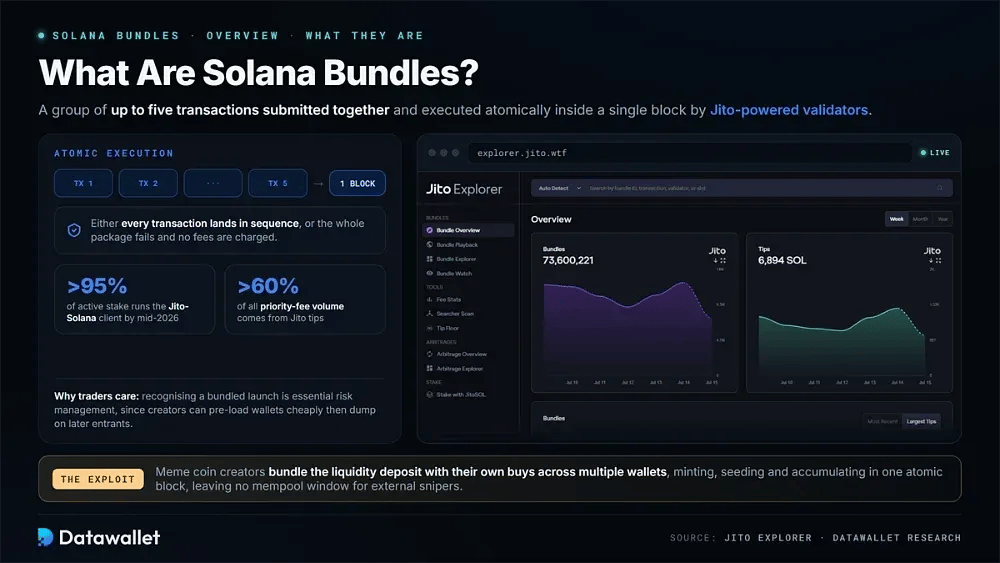
A Solana bundle is a group of up to five transactions submitted together and executed atomically inside a single block by Jito-powered validators. Either every transaction in the bundle lands in sequence, or the whole package fails and no fees are charged, giving creators precise control over what happens at launch.
The infrastructure behind this is now nearly universal on Solana. By mid-2026 the Jito-Solana validator client ran under more than 95% of active stake, and Jito tips accounted for over 60% of all priority-fee volume on the network, making the bundle auction the production path for almost any transaction that needs guaranteed execution during congestion.
Meme coin creators exploit this at launch. By bundling the liquidity deposit with their own buy orders across multiple wallets, they mint, seed liquidity, and accumulate supply in the same atomic block, leaving no mempool window for external snipers to insert themselves between token creation and the developer's purchases.
For traders, recognising a bundled launch is essential risk management. Creators often pre-load fresh wallets with tokens at the lowest possible price, then dump on later entrants once momentum builds, and they scatter holdings across dozens of addresses to fake decentralization while quietly retaining insider control of the float.
How to Check for Solana Bundles
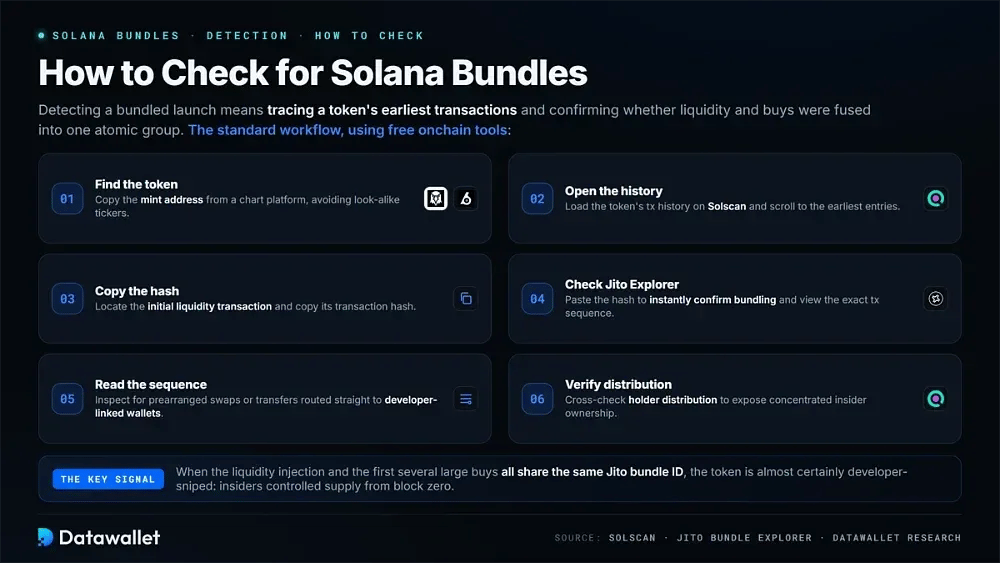
Detecting a bundled launch means tracing a token's earliest transactions and confirming whether liquidity and buys were fused into one atomic group. Here is the standard workflow using free onchain tools:
- Find the token: Copy the token's mint address from a chart platform like DexScreener or Birdeye, ensuring you have the exact contract to avoid look-alike tickers designed to trap careless buyers.
- Open the history: Load the token's transaction history on Solscan and scroll to the earliest entries, where the liquidity-add and first buys reveal how the launch was actually structured.
- Copy the hash: Locate the initial liquidity transaction, then copy its transaction hash, which serves as the key for checking whether that action was part of a coordinated bundle.
- Check Jito Explorer: Paste the hash into Jito's Bundle Explorer to instantly confirm bundling status and view the exact sequence of transactions and wallets involved.
- Read the sequence: If a bundle exists, inspect the included transactions for prearranged swaps or token transfers routed straight to developer-linked wallets right after liquidity was seeded.
- Verify distribution: Cross-check holder distribution on Solscan or a wallet tracker to see whether bundled tokens were spread across many addresses to disguise concentrated insider ownership.
The key signal is timing. When the liquidity injection and the first several large buys all share the same Jito bundle ID, the token is almost certainly developer-sniped, and you are looking at a market where insiders controlled the supply from block zero rather than an organic community launch.
Practicle Example
To show the process in action, we randomly selected a recent Pump.fun launch, “EZ Coin”, and ran every check ourselves using nothing but free explorers. The same four steps apply to any token contract on Solana, and our walkthrough shows exactly what a bundled deployer footprint looks like onchain.
1. Locate the Liquidity Transaction Hash
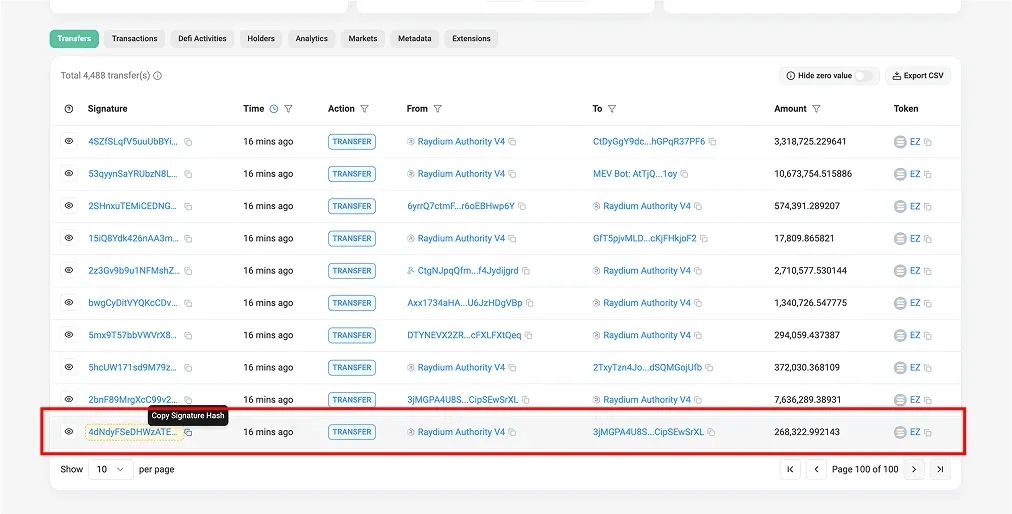
We began by finding the token's first liquidity-add transaction. Navigating to the EZ Coin transaction history on Solscan, we scrolled back to the earliest entry and copied the transaction hash beside it using the copy button.
2. Input the Hash into Jito Bundle Explorer
We then pasted that hash into the search bar on Jito's Bundle Explorer. The tool immediately returned the bundling status, telling us whether the liquidity add ran as a standalone action or was fused into a coordinated atomic group alongside the developer's own trades.
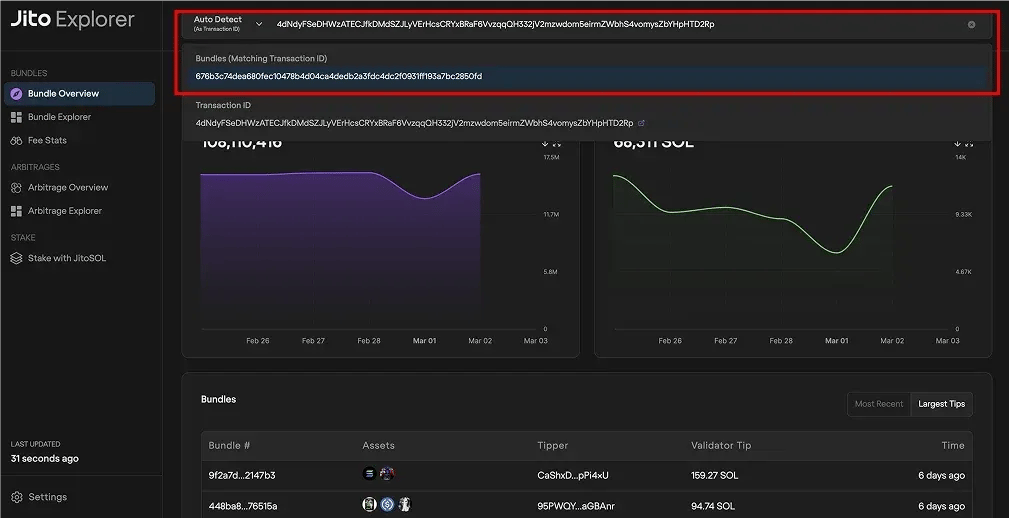
3. Inspect the Bundled Transaction Details
With a bundle confirmed, Jito Explorer laid out the full sequence of transactions and every wallet involved.
We scanned the included transactions for prearranged swaps and transfers to developer-linked addresses, and found the deployer had bundled several swaps, including sending themselves 6,159,099 EZ for 2.193 SOL. Reviewing the full "Included Transactions" list exposed every recipient wallet they seeded.
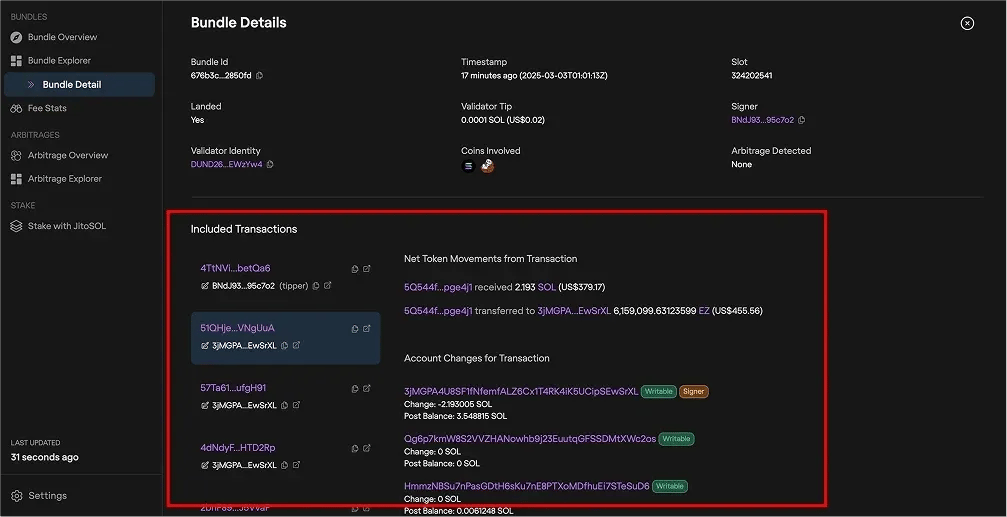
4. Verify Holder Distribution on Solscan
Finally, we traced where those tokens went. Following the deployer wallet that received the 6.15 million EZ, we discovered it offloaded the position almost immediately for roughly 2.69 SOL, a quick insider profit that later buyers effectively funded. That rapid sell is the tell-tale sign of a bundled launch working exactly as designed.
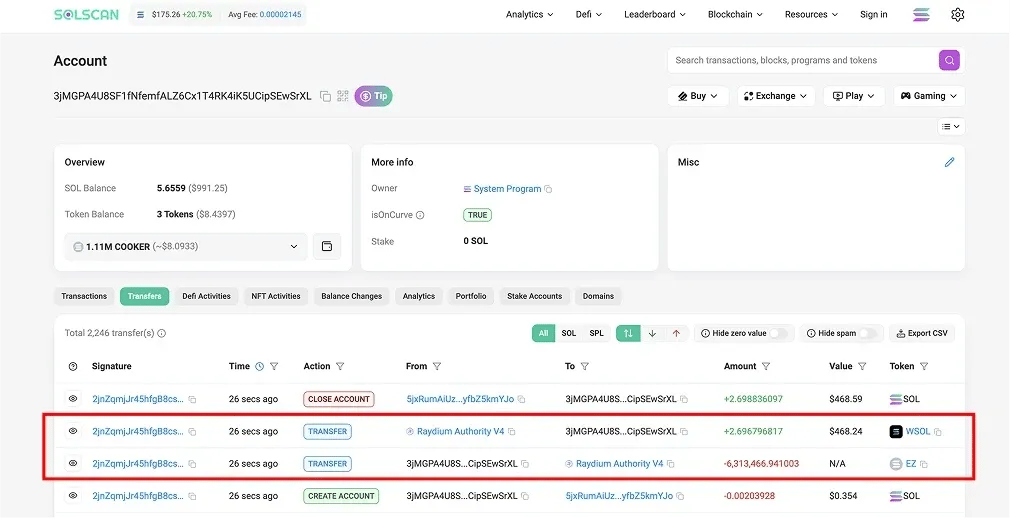
Modern Solana Bundle Detection Tools
The tooling has advanced well beyond manual hash-checking, and several purpose-built scanners now quantify bundle risk in seconds. These are the platforms traders rely on in 2026:
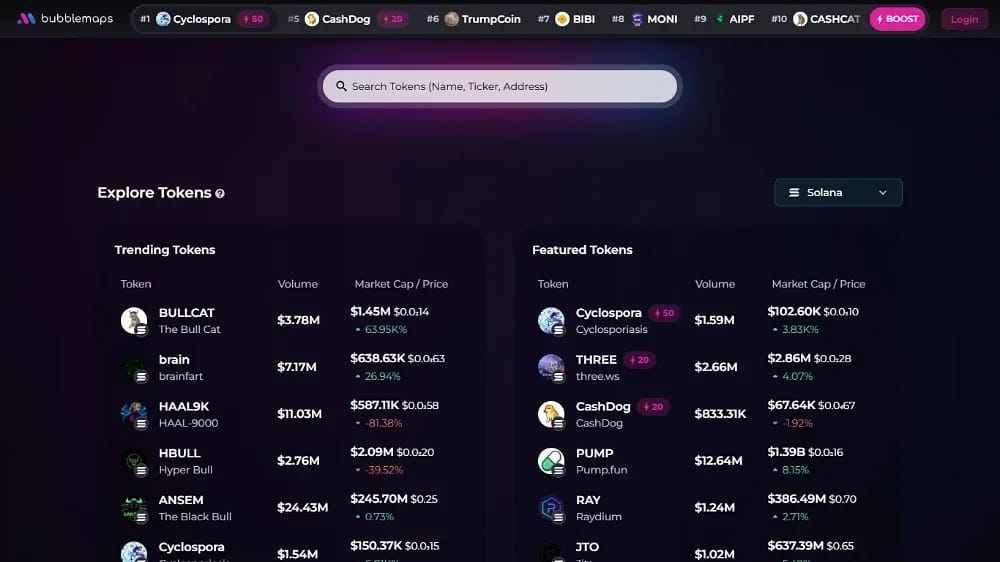
- Trench Bot: A Telegram scanner at trench.bot that reports how much supply was bundled, across how many wallets, and how much those wallets still hold, plus an interactive bubble-map viewer.
- Birdeye: A charting front-end whose bubble maps and top-holder tabs let you visually spot clusters of wallets funded by a single source before the token was even created.
- Jito Explorer: The ground-truth verifier, used to confirm whether a flagged transaction genuinely shared a bundle ID rather than merely landing in the same slot by coincidence.
- RugCheck: A risk-scoring scanner analysing holder distribution, mint authority, and liquidity locks, surfacing a single trust score alongside bundle and insider warnings.
- Axiom: A forensic platform favoured by power users for deep historical verification of wallet funding trails and coordinated accumulation across a token's full lifecycle.
- Solscan: The core block explorer underpinning every check, essential for tracing where bundled tokens moved and whether recipient wallets dumped immediately after launch.
How to Deploy and Bundle Tokens on Solana
Bundling is not inherently malicious, and understanding how a launch is assembled helps traders read the resulting on-chain footprint. Purpose-built bundlers automate the entire mint-and-buy sequence across many wallets, seeding liquidity on Solana DEXs in the same atomic action.
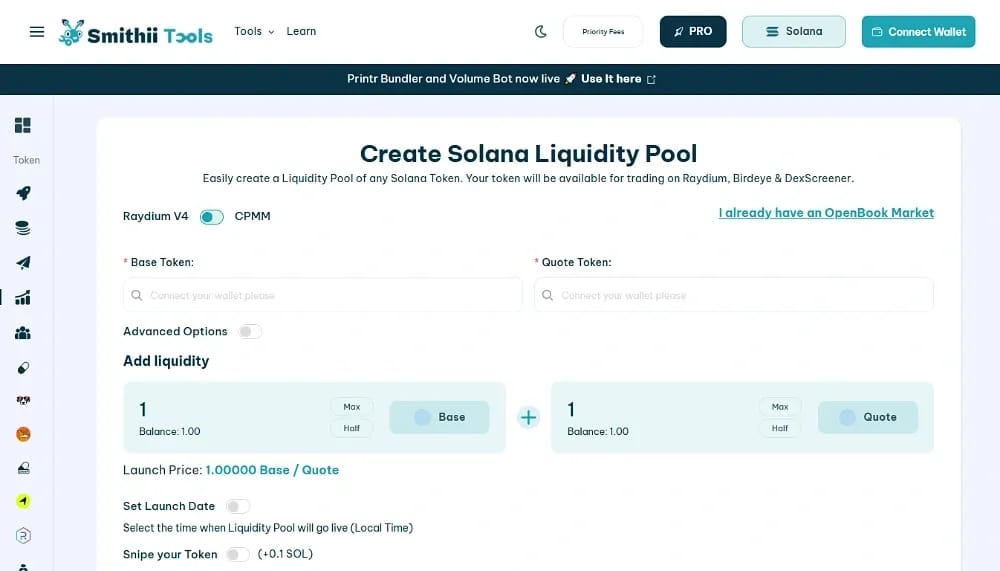
The most established tool is SlerfTools, a no-code Solana toolkit that has processed over six million transactions and offers a "Bundled Buy" feature pairing a Raydium liquidity deposit with simultaneous purchases across multiple wallets in one Jito bundle. Newer alternatives like Smithii offer a comparable bundler that spreads first buys across up to five wallets alongside pool creation.
The atomic guarantee is the whole point. Because the mint and every bundled buy execute at the same timestamp, there is no gap for external snipers to exploit, and if the bundle fails to land due to congestion or an insufficient tip, the entire package reverts without charging fees.
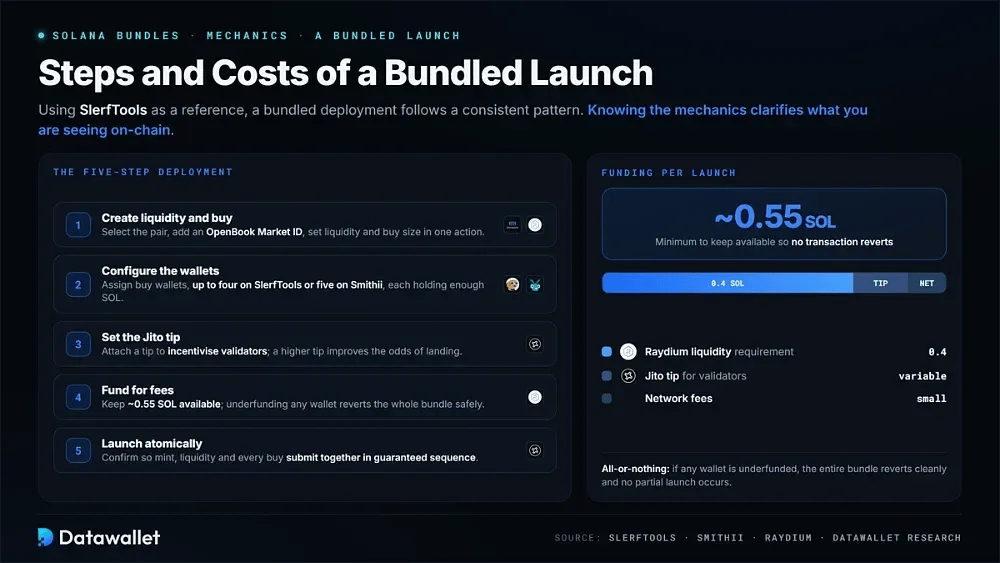
Steps and Costs of a Bundled Launch
Using SlerfTools as a reference, a bundled deployment follows a consistent pattern, and knowing the mechanics clarifies what you are seeing when you inspect one on-chain. The core steps are:
- Create liquidity and buy: Select the token pair, add or choose an existing OpenBook Market ID, then specify the liquidity amount and the buy size, packaging the pool deposit and first purchase into one action.
- Configure the wallets: Assign the wallets that will execute the buys, up to four at once on SlerfTools or five on Smithii, and confirm each holds enough SOL so no transaction in the bundle fails.
- Set the Jito tip: Attach a tip to incentivise validators to prioritise the bundle, since a higher tip materially improves the odds of landing during network congestion.
- Fund for fees: Keep at least roughly 0.55 SOL available, covering Raydium's 0.4 SOL liquidity requirement plus network and tip costs, since underfunding any wallet reverts the whole bundle safely.
- Launch atomically: Confirm the transaction so the mint, liquidity deposit, and every wallet buy submit together in guaranteed sequence, securing supply before the public ever sees the token.
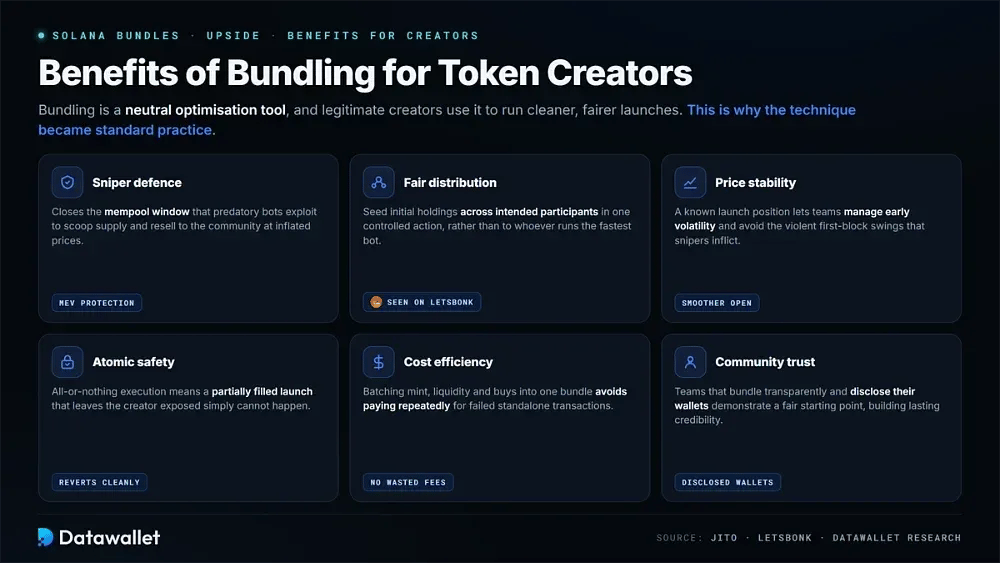
Benefits of Bundling for Token Creators
Bundling is a neutral optimisation tool, and legitimate creators use it to run cleaner, fairer launches. Understanding the upside explains why the technique became standard practice rather than a pure red flag:
- Sniper defence: Bundling closes the mempool window that predatory bots exploit, preventing them from scooping large supply chunks and immediately reselling to genuine community buyers at inflated prices.
- Fair distribution: Creators can seed initial holdings across intended participants in one controlled action, establishing a deliberate starting distribution as seen on launchpads like LetsBonk rather than surrendering it to whoever runs the fastest bot.
- Price stability: Securing a known launch position lets teams manage early volatility and avoid the violent first-block swings that erratic sniper activity typically inflicts on new tokens.
- Atomic safety: The all-or-nothing execution means a partially filled launch that leaves the creator exposed cannot happen, since any failed transaction reverts the entire bundle cleanly.
- Cost efficiency: Batching mint, liquidity, and buys into one bundle avoids paying repeatedly for failed standalone transactions during the congestion that surrounds a hyped launch.
- Community trust: Teams that bundle transparently and disclose their wallets can demonstrate a fair starting point, building the credibility that sustains a token beyond its first day.
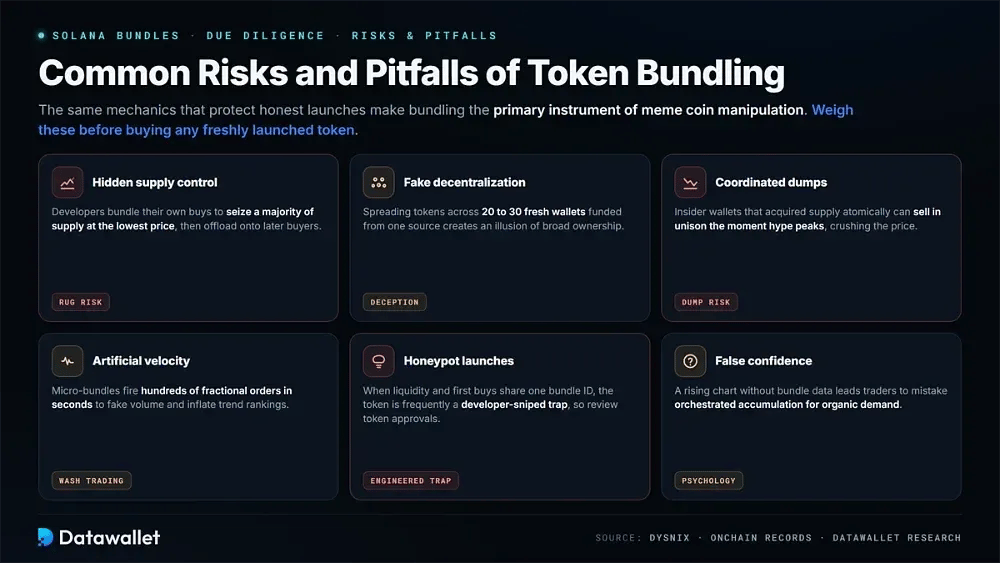
Common Risks and Pitfalls of Token Bundling
The same mechanics that protect honest launches make bundling the primary instrument of meme coin manipulation. These are the dangers traders must weigh before buying any freshly launched token:
- Hidden supply control: Developers bundle their own buys to seize a majority of supply at the lowest price, then offload onto later buyers, triggering sharp price collapses and heavy retail losses.
- Fake decentralization: Spreading bundled tokens across 20 to 30 fresh wallets funded from one source creates an illusion of broad ownership while a single coordinator retains control of the float.
- Coordinated dumps: Because insider wallets acquired supply atomically at launch, they can sell in unison the moment hype peaks, leaving unaware traders holding a rapidly depreciating asset.
- Artificial velocity: Micro-bundles fire hundreds of fractional buy and sell orders within seconds to fake trading volume, inflating a token up trend rankings while the real unique-holder count stays tiny.
- Honeypot launches: When liquidity and the first large buys share one bundle ID, the token is frequently a developer-sniped trap, so reviewing token approvals and knowing how to revoke permissions protects you from engineered exit-liquidity schemes.
- False confidence: Traders who see a rising chart without checking bundle data mistake orchestrated insider accumulation for organic demand, entering positions precisely when insiders prepare to sell.
How BAM Is Changing Solana's Bundle Architecture
Jito's dominance over bundling drew criticism because its block engine was a closed-source, centralised auctioneer. The Block Assembly Marketplace, or BAM, is Jito's answer, and it reshapes how transactions are ordered on Solana.
BAM introduces privacy and verifiability to a process that was previously opaque, which matters directly for how bundles and MEV behave at the point of launch.
What BAM Actually Does
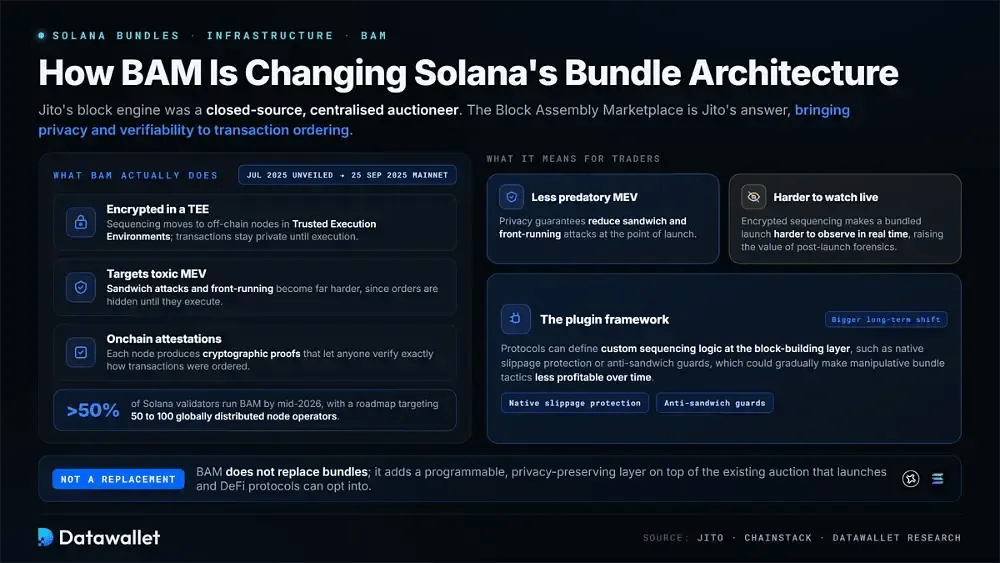
BAM, first unveiled by Jito in July 2025, rolled out on Solana mainnet on 25 September 2025 as the most significant change to the chain's block production since Jito itself. It moves transaction sequencing into a network of off-chain BAM nodes that run inside Trusted Execution Environments, hardware enclaves that keep transactions private until the moment of execution.
The design targets toxic MEV directly. Because transactions stay encrypted inside the enclave until they execute, sandwich attacks and opportunistic front-running become far harder, and each node produces onchain attestations, cryptographic proofs that let anyone verify exactly how transactions were ordered.
Adoption has moved quickly, with more than half of Solana validators running BAM by mid-2026 and a roadmap targeting 50 to 100 globally distributed node operators. Notably, BAM does not replace bundles; it adds a programmable, privacy-preserving layer on top of the existing auction that launches and DeFi protocols can opt into.
What It Means for Traders
For meme coin traders, BAM cuts both ways. Its privacy guarantees reduce some predatory MEV, but the same encrypted sequencing can make a bundled launch harder to observe in real time, placing even more weight on post-launch forensic tools that read the settled onchain record.
The plugin framework is the bigger long-term shift. Protocols can define custom sequencing logic, such as native slippage protection or anti-sandwich guards, at the block-building layer, which could gradually make the manipulative bundle tactics common on meme coin platforms less profitable over time.
Final Thoughts
Solana bundles are a genuinely neutral technology that became the defining feature of the chain's meme coin economy. The same atomic execution that lets honest creators defend against snipers also lets bad actors control supply from block zero, so the tool itself is far less important than the intent behind any given launch.
For traders, the practical takeaway has not changed even as the tooling has. Checking a token's bundle footprint before buying, through Jito Explorer, a scanner like Trench Bot, or a bubble map, remains the single most effective way to avoid becoming exit liquidity for a coordinated insider group.
The context keeps shifting underneath all of this. BAM is rewriting how blocks are built, detection tools grow sharper each quarter, and launchpads iterate constantly, so anyone trading Solana meme coins should treat bundle analysis as a permanent habit rather than a one-time check.