


Top 10 Robinhood Chain Statistics and Trends
1. Robinhood Chain Daily DEX Volume Hit $1.6 Billion
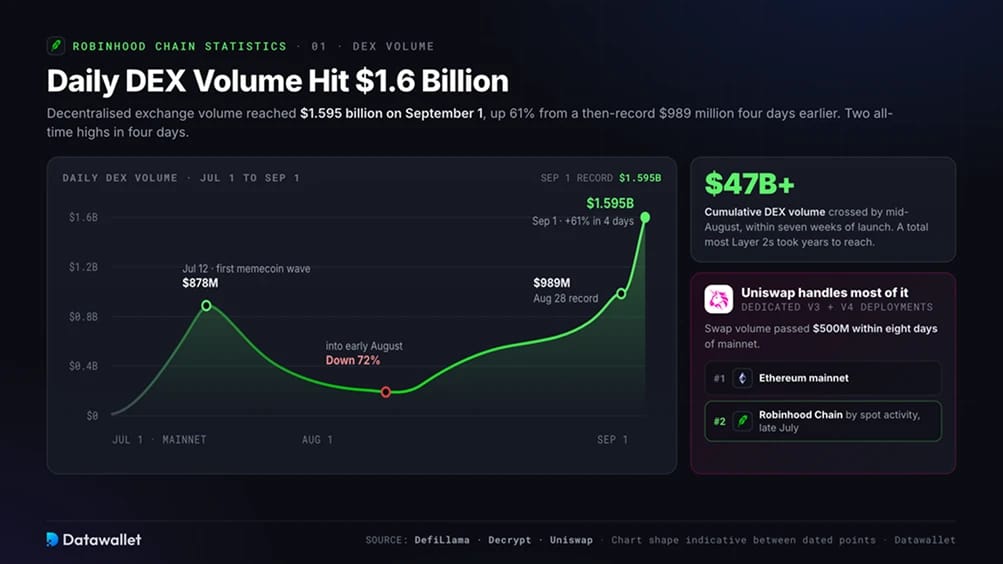
Decentralised exchange (DEX) volume on Robinhood Chain reached $1.595 billion on September 1, up 61% from a then-record $989 million on August 28, according to DefiLlama figures reported by Decrypt. The chain set two all-time highs in four days.
Trading peaked near $878 million on July 12 during the first memecoin wave, then fell as much as 72% into early August. Cumulative DEX volume still crossed $47 billion by mid-August, a total most Layer 2s took years to reach.
Uniswap handles most of that turnover through dedicated V3 and V4 deployments. Its swap volume passed $500 million within eight days of mainnet, and by late July Robinhood Chain was the second-largest Uniswap venue by spot activity behind Ethereum mainnet.
2. Transactions Averaged 11.6 Million a Day
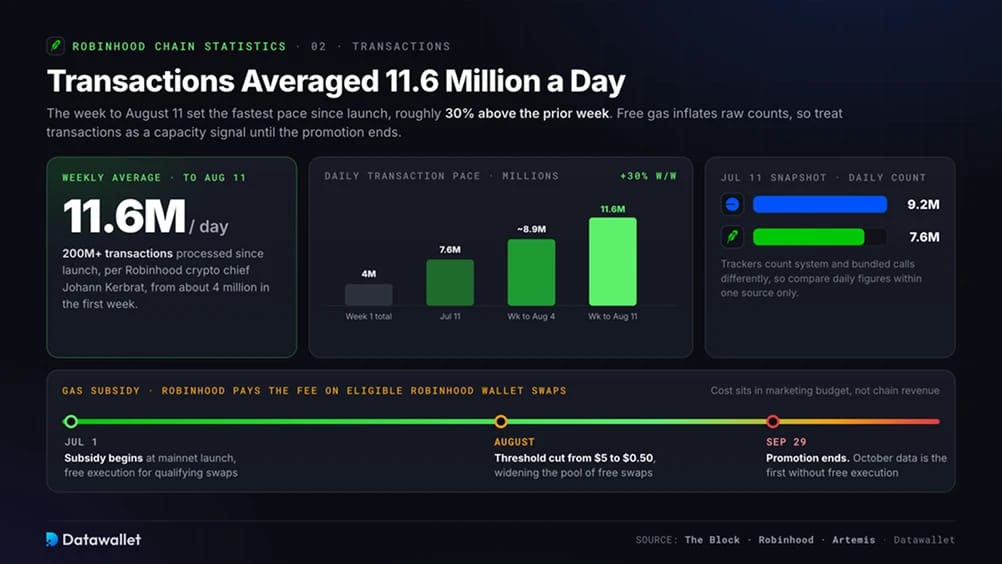
Robinhood Chain averaged 11.6 million daily transactions during the week to August 11, according to The Block. This was the highest weekly rate since launch and about 30% higher than the prior week. Robinhood crypto chief Johann Kerbrat separately said the network had processed more than 200 million transactions by August.
Approximately 4 million transactions cleared during the first week. On July 11, the daily total reached 7.6 million, compared with 9.2 million on Base. Because trackers classify system and bundled calls differently, daily transaction counts should only be compared using a consistent source.
Robinhood is paying the gas required to process eligible swaps through Robinhood Wallet until late September. It reduced the qualifying transaction threshold from $5 to $0.50 in August. Free execution raises raw activity counts, so we view transactions as an indicator of capacity until the promotion finishes.
3. Daily Active Users Passed Base at 323,969
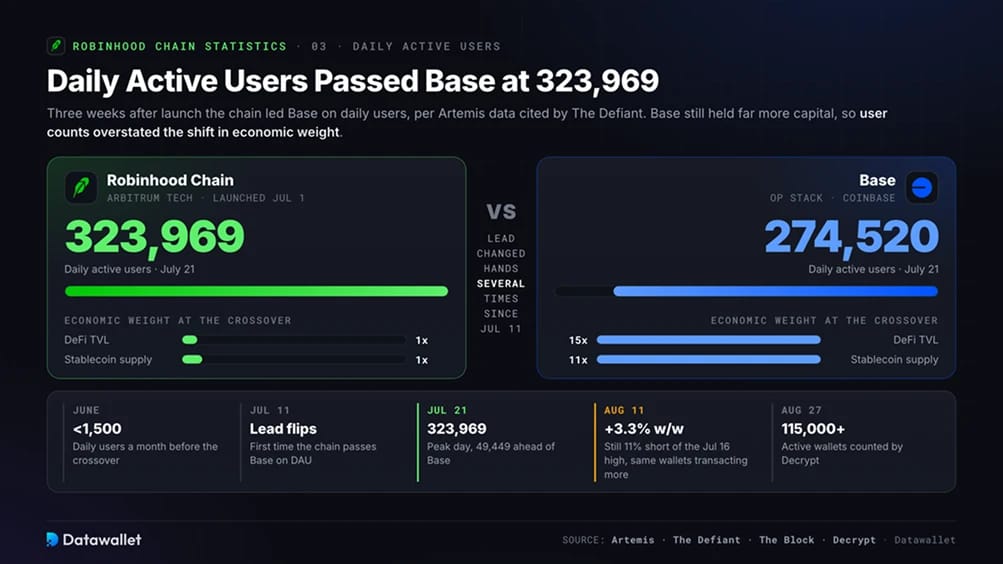
Artemis data cited by The Defiant shows that Robinhood Chain recorded 323,969 daily active users on July 21, compared with 274,520 on Base. The lead had moved between the two networks several times since July 11. One month earlier, Robinhood Chain had fewer than 1,500 daily users.
Capital continued to enter after user growth slowed. By August 11, average daily active accounts were only 3.3% higher for the week and remained 11% below the July 16 peak. The Block attributed the pattern to existing wallets transacting more frequently rather than new sign-ups. Decrypt reported more than 115,000 active wallets on August 27.
At the time of the July crossover, Base still held around 15 times more DeFi TVL and 11 times more stablecoin supply. User totals therefore exaggerated the change in economic weight between the networks. Our Coinbase versus Robinhood comparison examines their parent companies.
4. TVL Climbed From Under $5M to $738M
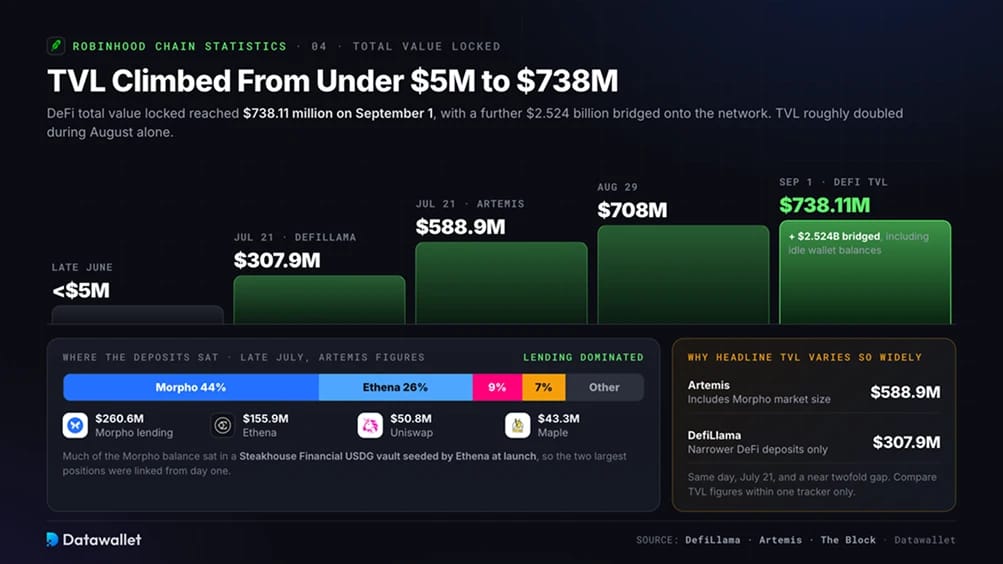
DeFi total value locked (TVL) measures assets deposited in a chain's applications. DefiLlama recorded $738.11 million on Robinhood Chain on September 1, alongside another $2.524 billion in assets bridged to the network. The Block placed TVL at $708 million on August 29, nearly twice the amount reported one month earlier.
Artemis measured less than $5 million in TVL during the final week of June. Its total rose to $588.9 million by July 21 under a methodology that includes Morpho market size. DefiLlama's narrower calculation stood at $307.9 million on the same date, explaining why reported TVL figures vary substantially between outlets.
Lending supplied most of the early deposits. Artemis figures from late July attributed approximately $260.6 million to Morpho, equal to a 44% share. Ethena held $155.9 million, followed by Uniswap at $50.8 million and Maple at $43.3 million. Much of Morpho's balance was held in a Steakhouse Financial USDG vault that Ethena seeded at launch. Our live TVL tracker compares Robinhood Chain with other networks.
5. USDe Overtook USDG as the Largest Stablecoin
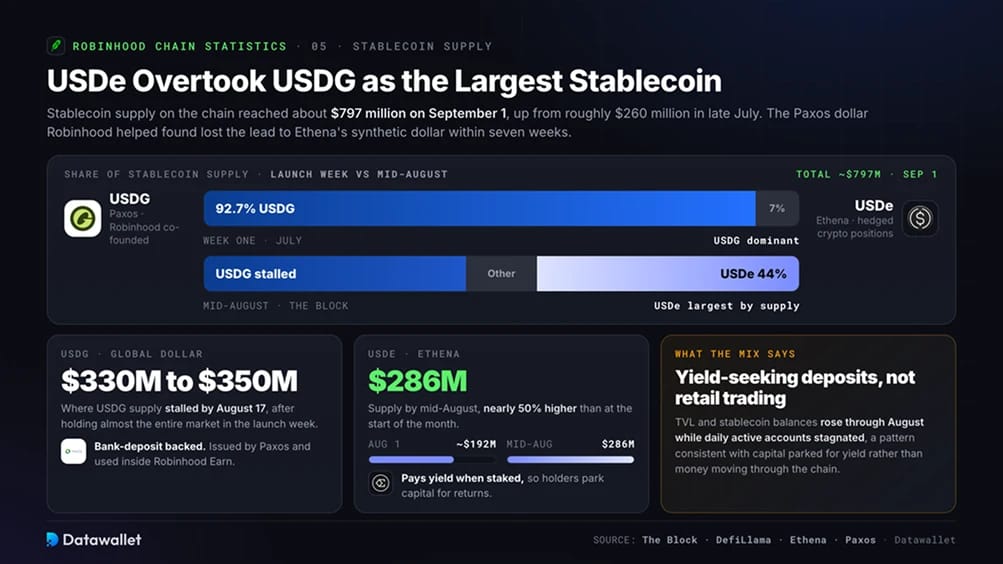
Stablecoin supply on Robinhood Chain increased from approximately $260 million in late July to about $797 million on September 1. USDG, the Paxos-issued dollar that Robinhood helped establish, represented 92.7% of supply during the first week. Its balance had levelled off between $330 million and $350 million by August 17.
Ethena's USDe accounted for much of the subsequent growth. Unlike a bank-deposit-backed stablecoin, USDe is supported by hedged crypto positions. Its supply reached $286 million by mid-August, almost 50% above its level at the beginning of the month. The Block reported that USDe then represented 44% of the chain's stablecoins. Because holders can earn yield by staking USDe, the increase points to capital being deposited for returns rather than used for transfers.
Throughout August, TVL and stablecoin balances rose while daily active account growth stalled. This pattern is consistent with yield-seeking deposits rather than retail trading. Our stablecoin statistics cover supply across all chains.
6. Tokenised RWAs Reached $41.9M Across 202 Assets
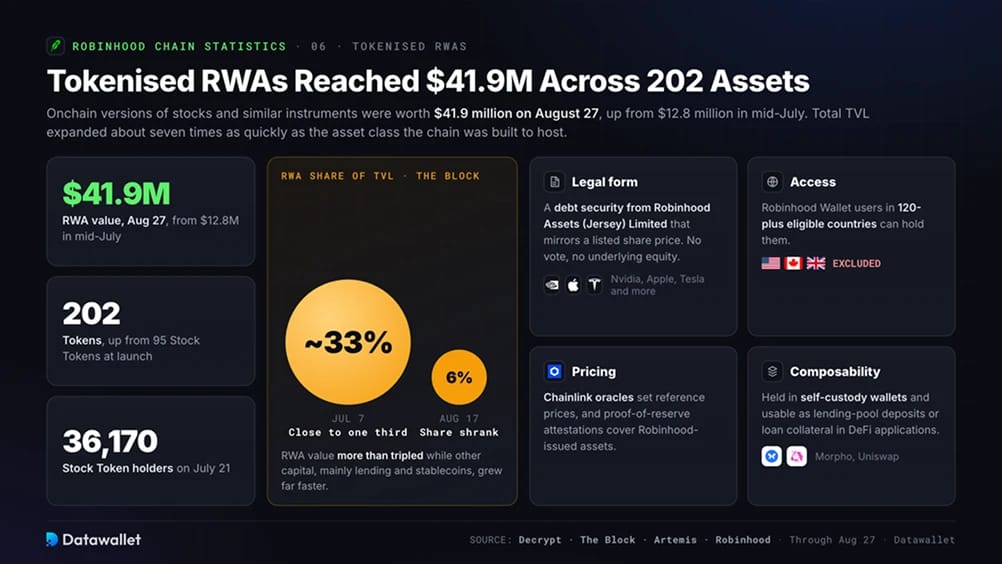
Tokenised real-world assets (RWAs) are onchain representations of stocks and similar instruments. Decrypt reported that Robinhood Chain held $41.9 million across 202 such tokens on August 27, up from $12.8 million in mid-July. Robinhood initially launched 95 Stock Tokens covering companies including Nvidia, Apple and Tesla. The total number has since more than doubled.
The Block calculated that RWAs made up close to one third of chain TVL on July 7. Their share had fallen to 6% by August 17, meaning overall TVL grew about seven times faster than the asset class the network was created to host. Stock Token holders totalled 36,170 on July 21.
Key features of the Stock Token product:
- Legal form: Each Stock Token is a debt security issued by Robinhood Assets (Jersey) Limited that tracks the price of a listed share. Holders do not own the underlying equity or receive voting rights.
- Access: Robinhood Wallet users in more than 120 eligible countries can hold Stock Tokens. US persons and users in Canada or the UK are excluded.
- Pricing: Chainlink oracles transmit market prices to the chain and provide the reference values. Proof-of-reserve attestations cover assets issued by Robinhood.
- Composability: The tokens can be held in self-custody wallets, deposited into DeFi lending pools or used as collateral for loans.
Data Sources: Decrypt, The Block, Artemis and Robinhood disclosures through August 27. Our tokenised stock trading guide compares competing issuers.
7. Stock Token Trading Set an $85.1M Daily Record
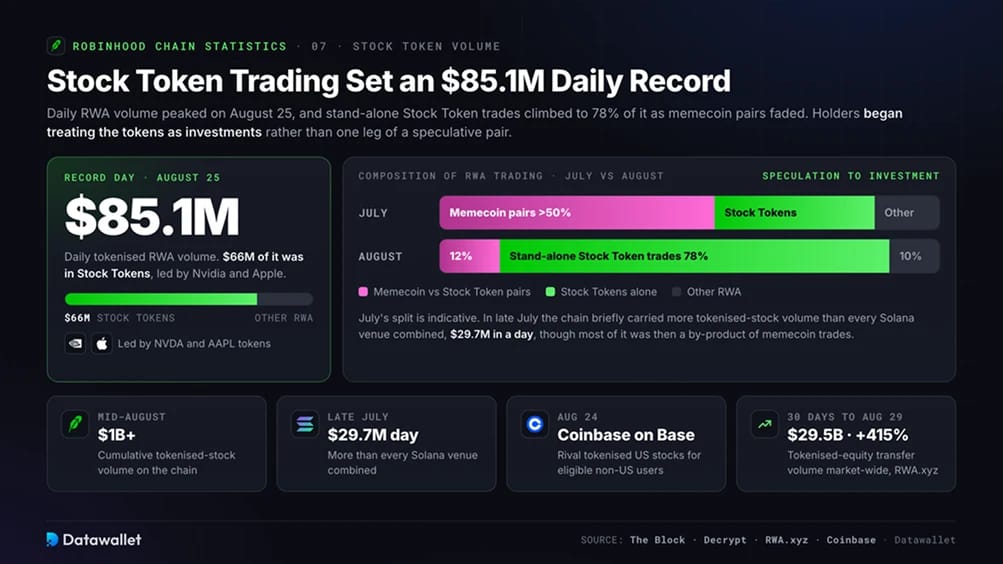
Tokenised RWA trading volume on Robinhood Chain set a daily record of $85.1 million on August 25. Stock Tokens contributed $66 million, with Nvidia and Apple leading the activity. Cumulative tokenised-stock volume had already exceeded $1 billion by mid-August.
Memecoin and Stock Token pairs accounted for more than half of RWA trading in July. By August, their share had dropped to 12%, while stand-alone Stock Token trades had risen to 78%. The shift suggests that holders increasingly treated the tokens as investments rather than one side of a speculative trading pair.
Robinhood Chain briefly processed more tokenised-stock volume than all Solana venues combined in late July, clearing $29.7 million in one day. Most of that activity was still generated as a by-product of memecoin trading. The broader market followed a similar direction. RWA.xyz recorded $29.5 billion in tokenised-equity transfer volume during the 30 days to August 29, an increase of 415%. Coinbase also introduced its own tokenised US stocks on Base on August 24. Our tokenisation statistics track the wider sector.
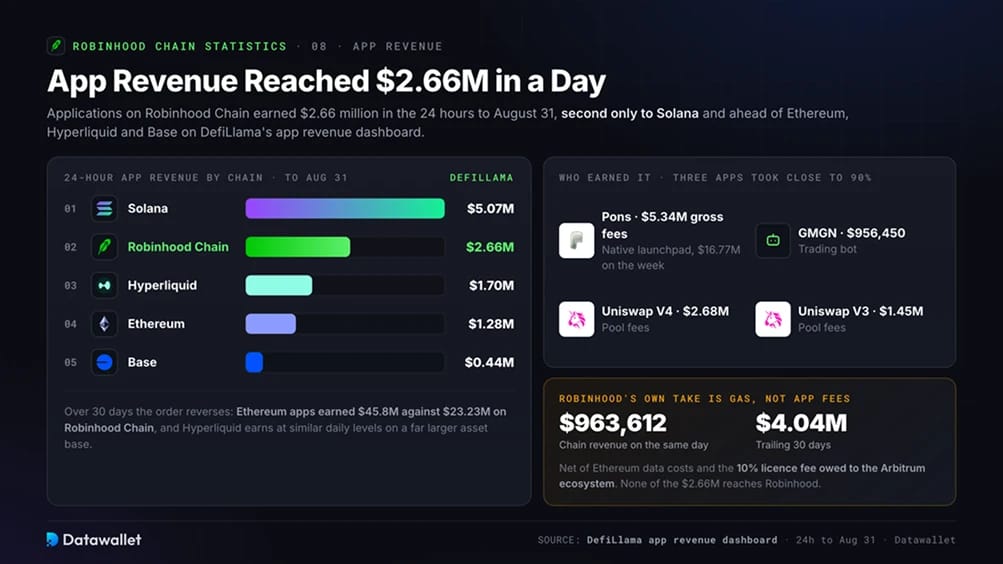
8. App Revenue Reached $2.66M in a Day
Applications on Robinhood Chain generated $2.66 million during the 24 hours to August 31, according to DefiLlama's app revenue dashboard. Solana ranked first with $5.07 million. Ethereum recorded $1.28 million, Hyperliquid generated $1.7 million and Base earned $438,882.
Nearly 90% of the total came from three applications. Pons, a chain-native launchpad, generated $5.34 million in gross daily fees and $16.77 million for the week. Trading bot GMGN collected $956,450. Uniswap's V4 and V3 pools earned $2.68 million and $1.45 million, respectively.
None of this application revenue goes to Robinhood. The company receives gas fees, which DefiLlama measured at $963,612 for the day and $4.04 million over the trailing month. Those figures are net of Ethereum data costs and the 10% licence fee payable to the Arbitrum ecosystem. Across 30 days, Ethereum applications generated $45.8 million compared with $23.23 million on Robinhood Chain. Hyperliquid earns comparable daily revenue from a much larger asset base.
9. Memecoins Built the Chain's First Economy
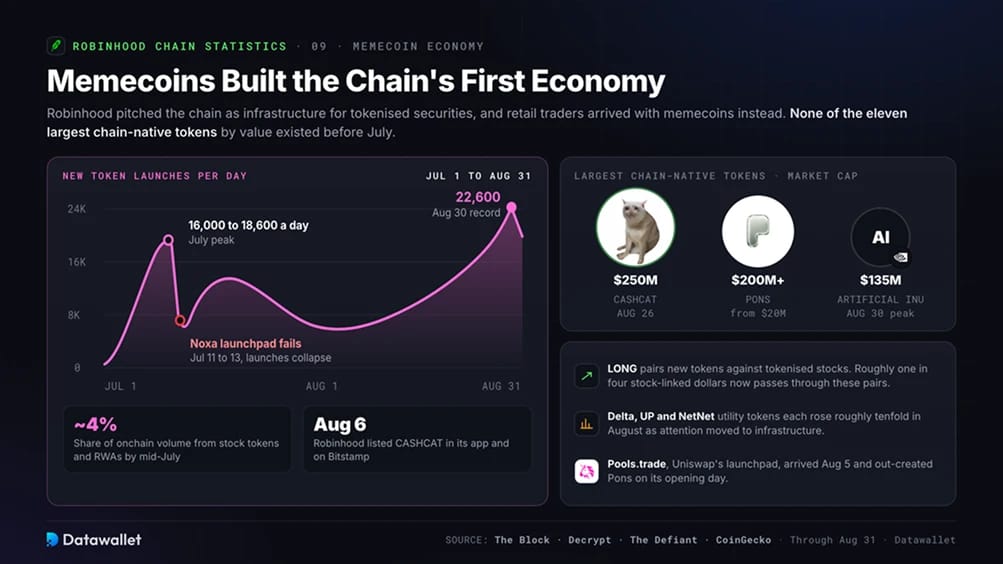
Robinhood positioned its chain as infrastructure for tokenised securities, but its first retail users concentrated on memecoins. Stock tokens and other RWAs represented about 4% of onchain volume by mid-July. Token launches reached approximately 16,000 to 18,600 per day in July, then collapsed when the Noxa launchpad failed between July 11 and 13. A new record of 22,600 launches followed on August 30.
The tokens and platforms behind that activity:
- CASHCAT: A community token named after the working title used by Robinhood's founders in 2010. Robinhood listed CASHCAT in its app and on Bitstamp on August 6. Its market capitalisation reached approximately $250 million on August 26. Our Cash Cat explainer covers the full story.
- PONS: The leading native launchpad. Its token increased from a $20 million market capitalisation to more than $200 million during August and secured a Gate.io listing.
- LONG: A launchpad that pairs newly created tokens with tokenised stocks rather than ETH. Around one quarter of stock-linked trading now occurs through these pairs.
- Artificial Inu (AI): The largest memecoin paired with a stock token, traded against tokenised NVDA. Its market capitalisation rose from $1.5 million on August 1 to a peak of $135 million on August 30. The NVDA pool contains $3.3 million in liquidity.
- Utility tokens: Delta, UP and NetNet operate liquidity, token-emission and bonding models. Each gained approximately tenfold in August as interest moved from pure memecoins toward infrastructure.
- Uniswap launchpad: Pools.trade launched on August 5 and created more tokens than Pons on its first day, illustrating how quickly launchpad activity divided across competing platforms.
Data Sources: The Block, Decrypt, The Defiant and CoinGecko through August 31.
10. Robinhood Posted $1.31B Revenue as Crypto Fell 38%
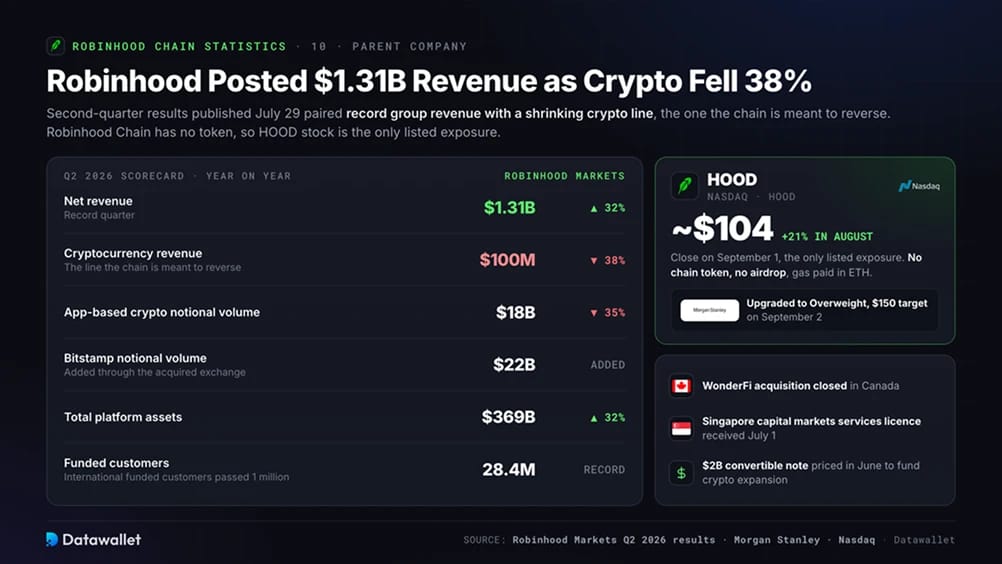
Robinhood Markets reported record second-quarter net revenue of $1.31 billion in results published on July 29, an increase of 32% year on year. Cryptocurrency revenue declined 38% to $100 million. Crypto notional volume in the Robinhood app fell 35% to $18 billion, while Bitstamp contributed another $22 billion.
The company reached 28.4 million funded customers and more than 1 million funded international customers. Total platform assets grew 32% to $369 billion. Robinhood also completed its WonderFi acquisition in Canada and received a capital markets services licence in Singapore on July 1. In June, it priced a $2 billion convertible note to finance further crypto expansion.
Robinhood Chain does not have a token, leaving HOOD stock as the only listed exposure. The shares closed near $104 on September 1 after rising more than 21% during August. Morgan Stanley upgraded the stock to Overweight the next day and assigned a $150 target. Our Robinhood Chain explainer examines the network's place within the broader corporate strategy.
What Is Robinhood Chain?
Robinhood Chain is a permissionless, Ethereum-compatible Layer 2 that provides fast, inexpensive trades while anchoring its transaction record to Ethereum. Built with Arbitrum's dedicated chain framework, it processes activity on a separate network before posting compressed records to Ethereum for settlement. Users pay gas in ETH, and the network has no native token.
The design is tailored to tokenised real-world assets. Blocks are produced roughly every 100 milliseconds. Transactions are ordered strictly by arrival time through a single Robinhood-operated server known as the sequencer. The official documentation describes the network as optimised for equities, ETFs and private assets. Its chain ID is 4663, which spells HOOD on a numeric keypad.
Robinhood first issued Classic Stock Tokens to EU customers through Arbitrum One in June 2025. It opened a public testnet in February, where more than 100 million transactions were processed, before moving to mainnet on July 1 during its "The World Is Flat" event in London. Developers can deploy contracts without approval, allowing memecoins to appear within hours of launch.
How Robinhood Chain Makes and Shares Money
App revenue and chain revenue differ because separate participants collect fees at each layer. Robinhood controls one of those income streams. It also earns through Robinhood Wallet, Stock Token issuance and Robinhood Earn rather than relying solely on the chain.
The revenue layers behind the statistics above:
- Chain revenue: Robinhood receives gas fees paid in ETH. Before reporting chain revenue, DefiLlama subtracts the cost of posting data to Ethereum. The resulting figure was $4.04 million for the 30 days to August 31.
- Arbitrum licence fee: The Arbitrum Expansion Program directs 10% of net chain fees to the Arbitrum ecosystem. The Arbitrum Foundation factsheet allocates 8% to the Arbitrum DAO and 2% to the Developer Guild. ARB gained by double digits when the agreement was confirmed.
- App revenue: Exchanges, trading bots and launchpads retain the fees generated by their own applications. Pons keeps 30% of swap fees on most pools, for example, and charges 0.0005 ETH to create a token.
- Gas subsidy: Robinhood has covered gas for qualifying swaps made through Robinhood Wallet since July 1. The promotion ends on September 29, with the expense recorded under Robinhood's marketing budget rather than chain revenue.
This structure resembles zero-commission brokerage. Low execution costs attract users, while the parent company earns from related products. FalconX estimated in April that six-month chain fees would reach approximately $1.1 million, a projection already surpassed during the subsidised launch.
Stock Tokens Versus Memecoins
The balance between speculation and tokenised equities determines whether Robinhood Chain's headline figures reflect its intended purpose. Kerbrat describes the strategy as feeding "two wolves": conventional financial products and the speculative assets that attract crypto traders. So far, the data shows which side has received more attention.
Memecoin trading produced most of the volume. An analysis of the first $9 billion in activity found that more than 80% came from memecoin speculation. The late-August increase that lifted app revenue above Ethereum was driven almost entirely by launchpads and trading bots. These platforms have been reducing Pump.fun's share of launchpad fees since July.
Stock Tokens offer the network its distinctive use case. No other Layer 2 pairs newly issued tokens with tokenised Nvidia shares or distributes stock tokens to memecoin holders. Vlad Tenev highlighted this behaviour in late August and said Robinhood had not planned it. The August record for stand-alone Stock Token trading indicates that conventional tokenised assets are beginning to attract activity of their own.
Base followed a similar early trajectory. The remaining question is whether memecoin liquidity stays on Robinhood Chain long enough for tokenised-equity markets to establish independent depth. RWA value has more than tripled since mid-July even though its share of chain TVL has declined. Stock Token volume as a percentage of total DEX trading is therefore the clearest metric to monitor.
Robinhood Chain vs Base and Other Corporate Chains
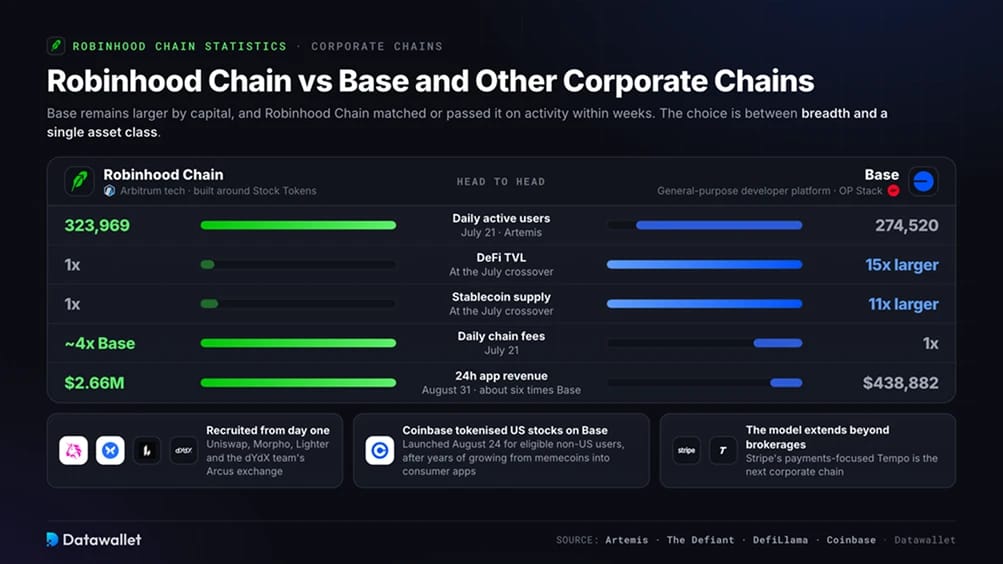
The two largest corporate-backed Layer 2 networks serve different priorities. Base provides broader application coverage and continues to hold more capital. Robinhood Chain is focused on one asset class, yet matched or surpassed Base on several activity measures within weeks.
Base uses Optimism's OP Stack as a general-purpose platform for developers. Over several years, it expanded beyond memecoins into consumer and social applications. Robinhood Chain runs on Arbitrum technology and was designed around Stock Tokens. Uniswap and Morpho were available from the beginning, alongside Lighter and Arcus, the exchange developed by the dYdX team. Our Layer 2 rankings compare both networks with the wider market.
Coinbase introduced tokenised US stocks on Base for eligible non-US users on August 24. Stripe's payments-oriented Tempo shows that the corporate-chain model is also expanding beyond brokerages. Although Base maintained substantial leads in DeFi TVL and stablecoin supply, Robinhood Chain generated almost four times its daily chain fees on July 21 and approximately six times its app revenue on August 31.
Robinhood Chain Regulation
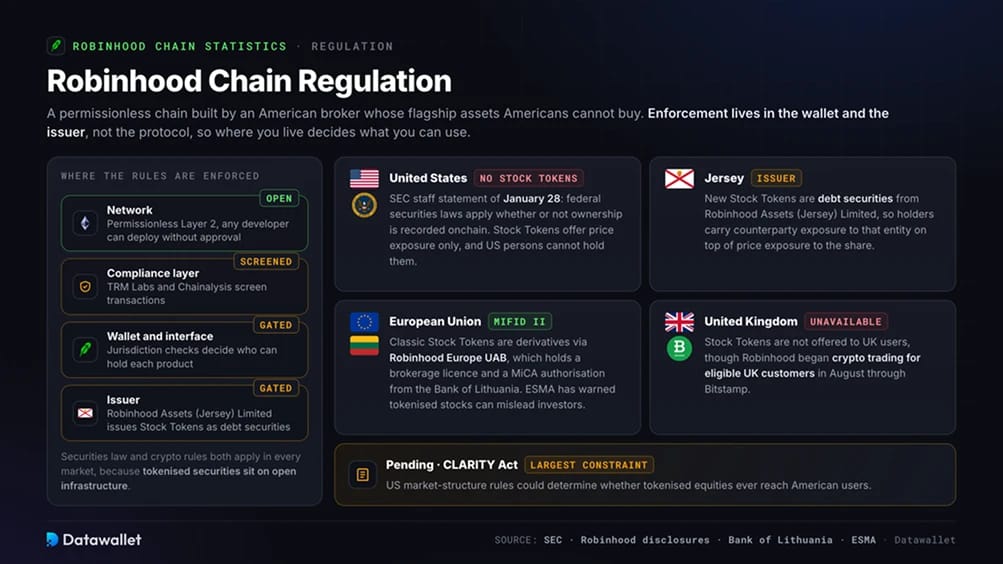
Access to Robinhood Chain products depends on the user's location. Because the network carries tokenised securities over open infrastructure, both securities and crypto rules apply in each market. Its present structure excludes the flagship product from Robinhood's home country.
How regulators are treating the chain and its assets:
- United States: SEC staff issued a joint staff statement on tokenised securities on January 28. It confirmed that federal securities laws apply regardless of whether ownership is recorded onchain. The statement distinguishes between issuer-sponsored tokens representing ownership and third-party instruments that provide price exposure only. Robinhood's Stock Tokens fall into the second category and remain unavailable to US persons.
- Jersey: Robinhood Assets (Jersey) Limited issues new Stock Tokens as debt securities. Holders therefore face counterparty exposure to the entity in addition to changes in the referenced share price.
- European Union: Robinhood Europe UAB offers Classic Stock Tokens as derivatives under MiFID II, the EU investment services framework. The company holds a brokerage licence and a MiCA crypto-asset authorisation from the Bank of Lithuania. Following the 2025 OpenAI dispute, the regulator requested clarification about the token structure. ESMA has also warned that tokenised stocks may give investors an inaccurate understanding of what they own.
- United Kingdom: UK users cannot access Stock Tokens. Robinhood began providing crypto trading to eligible UK customers through Bitstamp in August. Our Robinhood restricted countries guide covers current availability.
- Compliance layer: TRM Labs and Chainalysis screen transactions. Jurisdictional checks are applied through the issuer and user interfaces while the underlying network remains open.
- Pending legislation: US market-structure legislation under the CLARITY Act may determine whether tokenised equities become available to American users. Their current exclusion is the product's largest single constraint.
Robinhood has therefore built a permissionless chain whose core assets remain unavailable to Americans. Enforcement occurs through the issuer and wallet interfaces rather than at the protocol level.
Risks of Using Robinhood Chain
Robinhood Chain settles to Ethereum and relies on audited infrastructure supplied by Arbitrum and Chainlink. Its Earn product also carries Lloyd's-backed insurance. The network is still young, however, and presents several distinct risks.
Weigh each of these before committing capital to the chain:
- Subsidy cliff: The free-gas promotion ends on September 29. Transaction counts, DEX volume and user totals have not yet been observed without the subsidy. October data should indicate how much early activity came from genuine demand rather than promotional incentives.
- Memecoin dependence: Speculative tokens generate most of the network's volume, app revenue and launchpad activity. Their valuations can decline as quickly as they increased, and none of the eleven largest chain-native tokens by market value existed before July.
- Issuer exposure: Stock Tokens are debt instruments issued by Robinhood Assets (Jersey) Limited. Their value depends on the issuer meeting its obligations, while holders have no ownership claim over the underlying shares.
- Sequencer control: Robinhood runs the only sequencer. An outage or a decision to block transactions would halt trading because no permissionless fallback is available.
- Oracle and gap risk: Chainlink feeds determine token prices, but the referenced equity markets remain closed for most of the week. Stock Token collateral is therefore valued using estimates until markets reopen on Monday, when a large price movement could trigger liquidations.
- Variable yield: Robinhood Earn advertises an estimated 7% yield tied to borrowing demand on Morpho. The rate can fall significantly, and insurance covers technical failures rather than credit or market losses.
What's Next for Robinhood Chain
The next quarter should provide evidence that the opening two months could not. Robinhood's gas subsidy expires on September 29, while its third-quarter results in late October will be the first to include a full quarter of mainnet activity.
Arcus is introducing more leveraged trading pairs and collateral types. Lighter has added perpetual futures to Robinhood Wallet. DefiLlama measured $353.96 million in daily perpetuals volume on September 1, up from $13.5 million in late July. Our decentralised perpetuals rankings cover the relevant venues.
By the end of June, agentic trading accounts had attracted almost 100,000 customers and more than $100 million in assets. These accounts allow AI agents to execute trades using Robinhood's tools. A second in-app listing for a chain-native token would offer another indication of the sectors Robinhood intends to support. Sequencer decentralisation and a route for Stock Tokens to reach US users remain the main structural developments still outstanding.
Final Thoughts
Robinhood Chain has delivered the fastest early growth of any Layer 2 during this cycle. Daily DEX volume has exceeded $1.5 billion, DeFi deposits are close to $740 million, and its applications generated more revenue than Ethereum applications for one day. Most networks take years to reach those levels. Robinhood's distribution through a brokerage with 28 million funded customers is visible across the data.
The source of that activity remains the main qualification. Memecoins and yield-focused stablecoin deposits account for most value, while tokenised stocks represent about 6% of TVL. Every metric has also been recorded during the gas subsidy. The decisive test will be whether Stock Token volume continues gaining a larger share of activity after September 29.
Users should understand the legal structure of Stock Tokens, regard launchpad assets as high-risk speculation and compare data within the same dashboard. Our guides explain how to bridge to Robinhood Chain and add it to MetaMask.
Our Methodology
Each figure in this article comes from a live dashboard, company filing or dated report that cites its underlying source. DefiLlama, Artemis, Dune and Token Terminal provided chain metrics. Corporate and technical information came from Robinhood's investor relations website and developer documentation. The Block, Decrypt and The Defiant supplied dated observations when historical dashboard data was unavailable.
Five rules governed the selection:
- Source separation: We report DeFi TVL, bridged TVL and Artemis-style TVL separately because they measure different balances and can vary threefold on Robinhood Chain.
- Date anchoring: Each figure includes the date on which it was measured. The chain's data has changed by double-digit percentages within individual weeks.
- Revenue attribution: App revenue is kept separate from chain revenue because only the latter is received by Robinhood.
- Subsidy disclosure: Transaction and volume figures are presented alongside the gas promotion. No available data yet reflects a market where users cover their own fees.
- Regulatory verification: Statements about legal structure are based on SEC staff guidance, Robinhood disclosures and licences held by Robinhood Europe rather than secondary interpretations.
Metrics from a two-month-old network can change rapidly. Check the live dashboards before relying on any figure.