




Gate vs Kraken: Overview
Kraken was launched in 2013 under Payward, Inc., which Jesse Powell co-founded in 2011. As of 2026, it has surpassed 15 million registered users. Payward reported $508 million in Q2 2026 revenue. The group also owns NinjaTrader, the futures broker it bought in 2025.
Founded as Bter in 2013, Gate remains led by Dr. Han (Lin Han). Registered users passed 61 million by October 2026. Its Q2 2026 report counted more than 4,800 digital assets. By September, Gate's stock service covered over 12,800 shares and ETFs.
Acquisitions have shaped Kraken's growth in the US and Europe, adding a futures broker, a futures exchange, and a bank charter. Gate has expanded the markets on its global platform while establishing licensed companies for specific regions.
Key Developments at Gate and Kraken in 2026
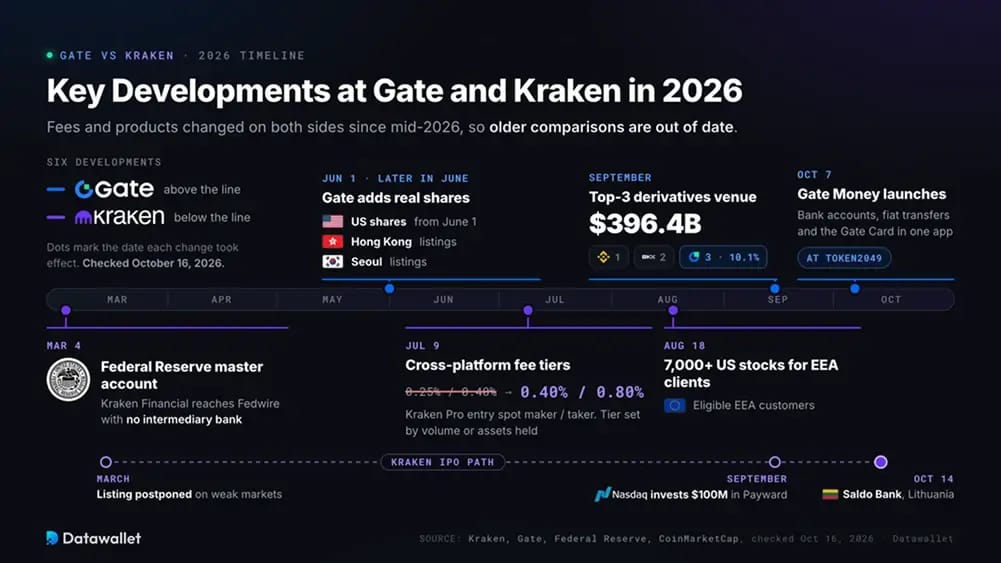
Both exchanges have changed their fees and products since mid-2026, leaving older comparisons out of date. Six developments matter most.
- Kraken changed its fee tiers: On July 9, 2026, Kraken introduced cross-platform fee tiers. Accounts qualify using whichever gives the best tier: 30-day spot volume, 30-day futures volume, or assets held on Kraken. Entry spot fees are now 0.40% maker and 0.80% taker. Guides quoting 0.25% and 0.40% are out of date.
- Kraken connected to the Federal Reserve: The group's Wyoming bank, Kraken Financial, received a Federal Reserve master account on March 4, 2026. This gives it direct access to Fedwire without an intermediary bank.
- Kraken delayed its share listing: Weak markets led Kraken to postpone its planned initial public offering (IPO) in March. Nasdaq agreed to invest $100 million in Payward in September. On October 14, Payward announced a deal to buy Saldo Bank in Lithuania.
- Gate became a top-three derivatives venue: September derivatives trades totaled $396.4 billion, giving Gate a 10.1% share and third place behind Binance and OKX.
- Both exchanges added real shares: Gate introduced US shares on June 1, followed by shares listed in Hong Kong and Seoul later that month. Kraken opened trading in over 7,000 US stocks to eligible EEA customers on August 18.
- Gate launched Gate Money: Gate announced the app on October 7 at TOKEN2049. It brings together personal bank accounts for eligible users, fiat transfers, and the Gate Card.
Gate vs Kraken: Products
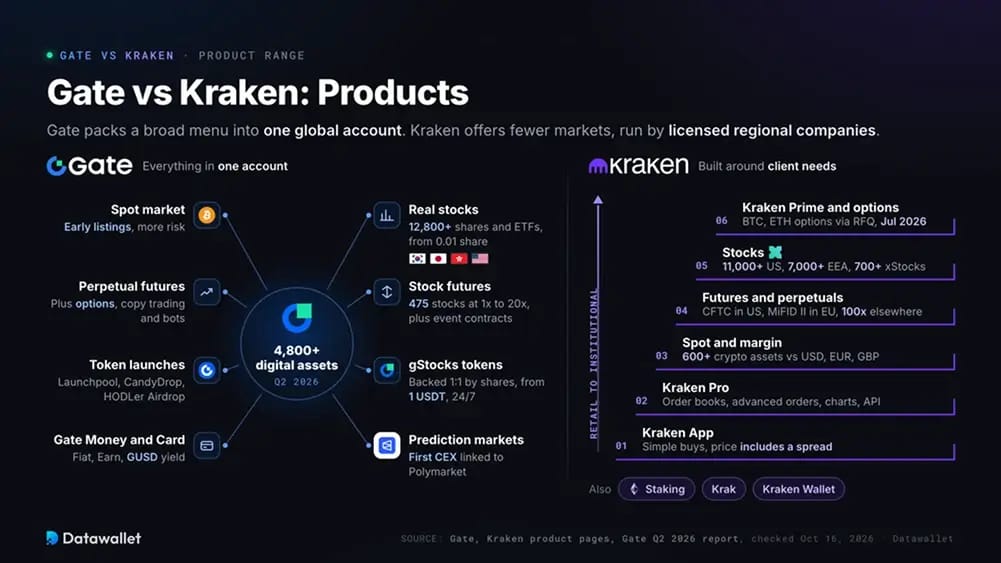
Both platforms offer spot crypto and margin loans, alongside perpetual futures, staking, and share exposure. Gate puts a broad product range into one global account. Kraken offers fewer markets, with more services run by licensed regional companies.
Gate Products
Gate lists more products than most centralized exchanges. Learning its interface takes time.
- Spot Market: Gate offers over 4,800 digital assets. Many small tokens reach the platform before larger exchanges list them, though these assets also carry higher price risk.
- Perpetual Futures: USDT-margined and coin-margined contracts cover major coins and small tokens as well as commodities and stocks. Options, copy trading, and bots are also available.
- Real Stocks: Eligible users can purchase as little as 0.01 of a share across more than 12,800 companies and ETFs from South Korea, Japan, Hong Kong, and the US. Dividends are paid in USDT.
- Stock Futures and Event Contracts: Gate Futures' stock section reached 475 stocks on October 13, 2026, offering 1x to 20x leverage. Stock Event Contracts let users bet on price direction over 5 or 15 minutes without leverage.
- gStocks: Backed one-to-one by real shares, gStocks tokens trade at all hours and cost as little as 1 USDT.
- Prediction Markets: Gate was the first centralized exchange to connect to Polymarket. It also runs its own event contracts.
- Token Launch Programs: Users who stake GT or meet trading targets can receive new tokens through Launchpool, CandyDrop, and HODLer Airdrop.
- Gate Money, Gate Card, and Earn: Gate Money connects fiat accounts with crypto and payments. Gate also offers Simple Earn, staking, and the GUSD yield product.
Kraken Products
Kraken organizes its services around client needs, from a simple trading app to dedicated institutional products.
- Kraken App and Kraken Pro: Prices in the app include a spread, the gap between the buying and selling price. Kraken Pro provides full order books and advanced order types, plus charts and an API for automated trading.
- Spot and Margin: More than 600 crypto assets trade against national currencies, including the US dollar, euro, and British pound.
- Futures and Perpetuals: BTC and ETH perpetuals offer up to 100x leverage outside the US and EU. EU clients trade on a MiFID II derivatives platform. In the US, clients have access to CFTC-regulated perpetual futures.
- US Stocks and ETFs: Eligible US clients can trade more than 11,000 US-listed shares and ETFs without commission. Eligible EEA clients gained access to over 7,000 US shares on August 18, 2026.
- xStocks: Kraken offers more than 700 xStocks outside the US. These tokens track real shares one-to-one and trade at all hours.
- Staking: Where local rules permit, clients can stake Ethereum, Solana, and other proof-of-stake coins.
- Krak and Kraken Wallet: Krak supports money and crypto transfers between users. With the self-custody Kraken Wallet, users hold their own private keys.
- Kraken Prime and Options: Institutions use Kraken Prime. For professional clients, Kraken introduced USD-settled BTC and ETH options through a request-for-quote system in July 2026.
Gate vs Kraken: Fees
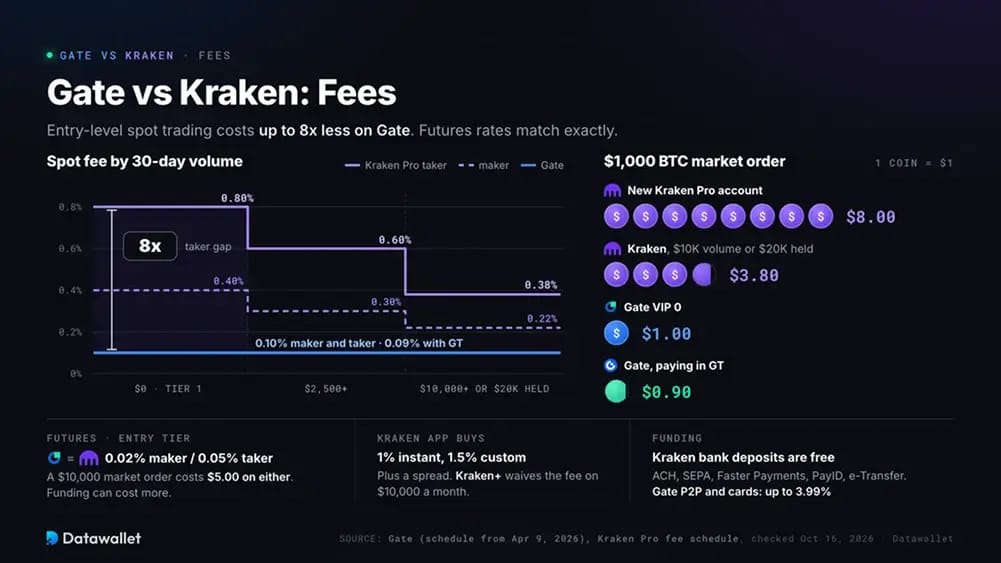
Entry-level spot trading costs far less on Gate. Futures rates match. Makers post limit orders that wait for another trader, while takers accept prices already posted. Our maker vs taker fees guide explains the distinction.
Spot Trading Fees
- Gate: Under the schedule in force since April 9, 2026, VIP 0 users pay 0.10% as both makers and takers. Paying with GT reduces each rate to 0.09%. At VIP 16, the highest of 17 levels, makers pay nothing, and takers pay 0.0175%.
- Kraken Pro: The official fee schedule starts Tier 1 at 0.40% maker and 0.80% taker. After $2,500 in 30-day volume, those rates fall to 0.30% and 0.60%. At $10,000, they drop to 0.22% and 0.38%. Clients can also qualify for Tier 3 by holding $20,000 on Kraken.
- Kraken stablecoin and FX pairs: At the lowest tier, trades between two currencies or stablecoins, such as USDT/USD, cost 0.20% on either side.
Fee example: A $1,000 BTC market order costs $1.00 on Gate, or $0.90 when paying with GT. The same order costs $8.00 for a new Kraken Pro account. That falls to $3.80 for Kraken clients with $10,000 in monthly volume or $20,000 held on the platform.
Futures Fees
- Gate: USDT-margined perpetuals begin at 0.02% maker and 0.05% taker. VIP 16 takers pay 0.016% on the most traded contracts.
- Kraken: Starting futures rates are also 0.02% maker and 0.05% taker. Pro 5 makers receive a 0.006% rebate, while takers pay 0.0125%.
- Taker example: At the entry level, opening a $10,000 futures position with a market order costs $5.00 on either platform.
- Funding payments: At fixed intervals, perpetual holders pay or receive funding to keep the contract close to its spot price. Funding can exceed the trading fee when many traders take the same side. Current rates appear in our funding rates tracker.
App Purchases and Subscriptions
- Kraken app: Instant and recurring purchases carry a 1% fee; custom orders cost 1.5%. A spread applies to both. Kraken+ removes the trading fee on up to $10,000 in monthly app purchases, though the spread remains. Our Kraken fees guide covers every product.
- Gate: Card purchases are handled by payment partners, which display their fees before confirmation. Most users fund Gate with crypto or purchase USDT from other users in its P2P (peer-to-peer) section.
Deposits and Withdrawals
- Kraken: Free bank deposits include US ACH and Fedwire, euro SEPA, British pound Faster Payments, Australian PayID and Osko, and Canadian e-Transfer. Sending banks may charge their own fees.
- Gate: Available fiat methods depend on the regional company. Eligible users can get personal bank accounts through Gate Money. P2P and cards remain the main funding methods on the global platform, with fees up to 3.99%.
- Crypto transfers: Neither exchange charges for incoming crypto. Withdrawal fees are fixed by coin and network, making USDT transfers on TRON much cheaper than on Ethereum.
Gate vs Kraken: Futures, Leverage and Options
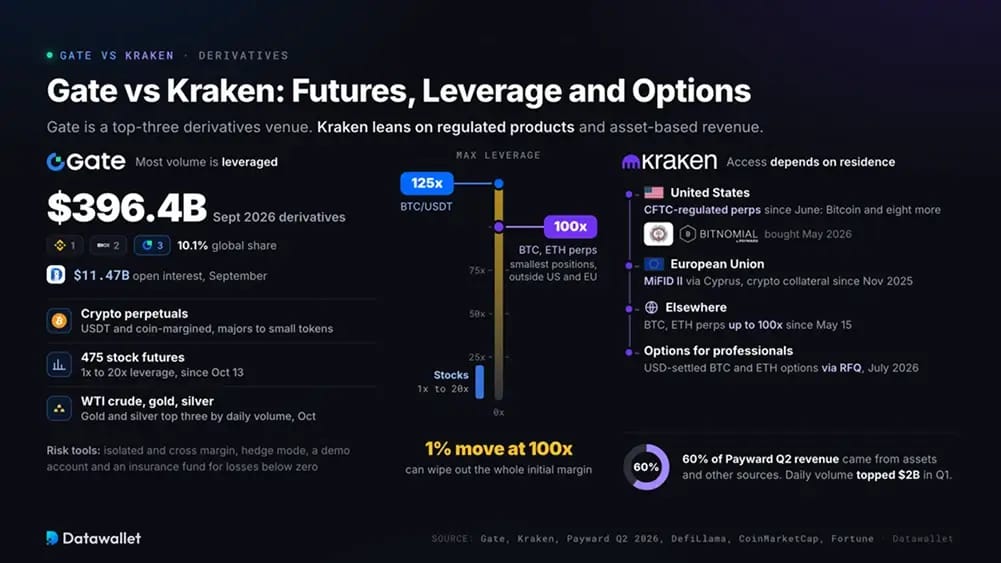
Most of Gate's volume comes from leveraged contracts. Kraken depends less on trading revenue: Payward reported that asset-based and other sources generated 60% of its Q2 2026 revenue.
Markets Available
- Gate: Alongside crypto perpetuals and stock futures, Gate lists contracts for WTI crude oil, gold, and silver. The BTC/USDT perpetual permits up to 125x leverage. In October 2026, its gold and silver futures ranked in the top three by daily volume.
- Kraken outside the US and EU: Kraken raised maximum leverage on BTC and ETH perpetuals to 100x on May 15, 2026. That limit applies to the smallest positions, with leverage decreasing as positions grow.
- Kraken in the EU: The MiFID II derivatives platform operates through a Cyprus-licensed company. It has accepted crypto as collateral since November 2025.
- Kraken in the US: In June 2026, eligible US clients gained access to perpetual futures supervised by the CFTC, the US derivatives regulator, initially covering Bitcoin and eight other assets. The contracts are listed by Bitnomial, the CFTC-licensed exchange Payward bought in May 2026.
Volume and Depth
- Gate: With $396.4 billion in September 2026 derivatives volume, Gate ranked third worldwide. Open interest, the value of positions that remain open, exceeded $11.47 billion that month, according to DefiLlama.
- Kraken: Fortune reported that average daily trading volume exceeded $2 billion in Q1 2026. Kraken's derivatives business remains much smaller than Gate's.
Risk Controls
- Gate: Available controls include isolated and cross margin, hedge mode, and a demo account. Gate's insurance fund covers the shortfall when a liquidated position closes below zero.
- Kraken: US clients use one collateral pool for spot, margin, CME futures, and perpetuals. The Equity Protection Process prevents futures balances from falling below zero.
A 1% adverse price move at 100x leverage can wipe out a position's entire initial margin. Read our perpetual vs spot trading explainer for the risks, or compare other platforms in our futures exchange guide.
Gate vs Kraken: Stocks and Tokenized Equities
Real shares provide ownership and dividends. Stock perpetuals follow the price without providing ownership. A tokenized share is a blockchain token backed by a real share.
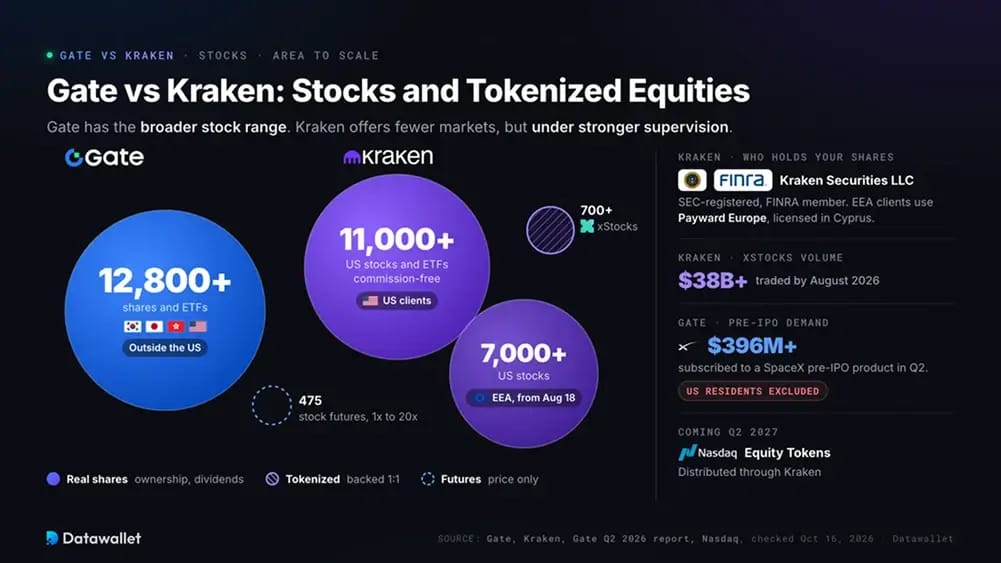
Gate has the broader stock range, covering more than 12,800 shares and ETFs from four countries. Its Q2 report recorded over $396 million in subscriptions to a SpaceX pre-IPO product. None of these products are available to US residents, who are excluded from Gate's global platform.
Kraken offers fewer stock markets, but with stronger supervision. US clients purchase shares through Kraken Securities LLC, an SEC-registered firm and FINRA member. Payward Europe Digital Solutions, an investment firm licensed in Cyprus, handles EEA clients. By August 2026, total transaction volume for Kraken's xStocks had passed $38 billion.
Nasdaq and Payward expect to launch Nasdaq Equity Tokens in Q2 2027, with distribution through Kraken. More providers are compared in our list of tokenized stock exchanges.
Gate vs Kraken: Security and Proof of Reserves
Proof of reserves checks whether an exchange holds at least as many coins as its clients own. Gate and Kraken both publish these reports. Each also faced a security problem in 2026.
Gate Security Measures and History
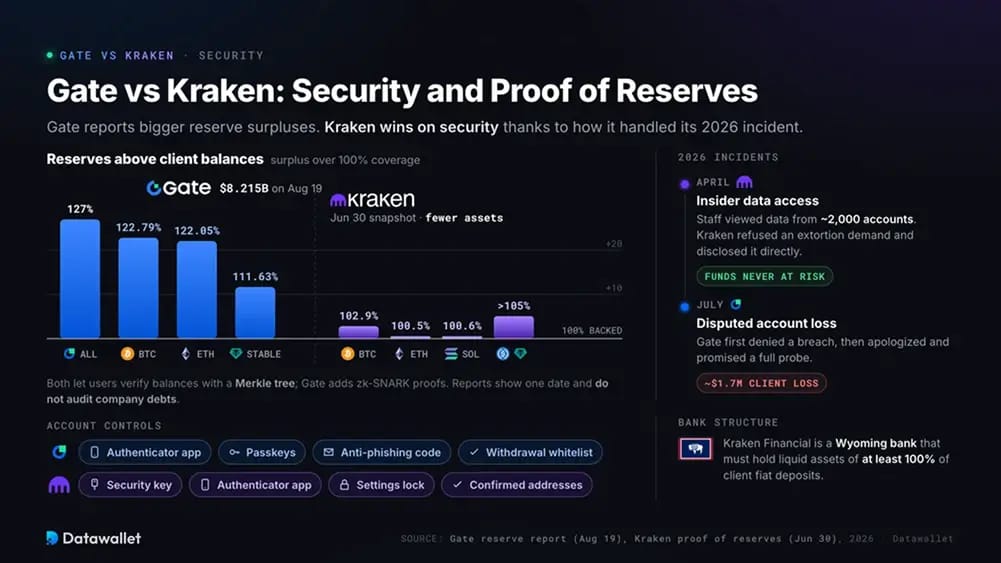
- Proof of reserves: The August 19, 2026 report showed $8.215 billion in reserves and 127% total coverage. Coverage was 122.79% for BTC, 122.05% for ETH, and 111.63% for stablecoins. Users can check their balances without seeing anyone else's through a Merkle tree and zk-SNARK cryptography.
- July 2026 dispute: A verified user reported that about $1.7 million left their account after its security settings were reset. Gate initially denied a platform breach, saying all actions had passed its verification checks. Public criticism was followed by an apology and a promise to investigate fully.
- Account controls: Gate supports an authenticator app and passkeys. Users can also set an anti-phishing code and block unknown withdrawal addresses with a whitelist.
Kraken Security Measures and History
- Proof of reserves: An independent accountant uses a Merkle tree to check client balances. Kraken's June 30, 2026 snapshot reported coverage of 102.9% for BTC, 100.5% for ETH, 100.6% for SOL, and more than 105% for USDC and USDT. The report covers fewer assets than Gate's.
- April 2026 insider incidents: In two separate cases, support staff improperly viewed data from about 2,000 client accounts. A criminal group later demanded payment to keep videos of internal systems private. Chief Security Officer Nick Percoco said Kraken would not pay and that client funds had never been at risk.
- Bank structure: As a Wyoming special purpose depository institution, Kraken Financial must hold liquid assets equal to at least 100% of client fiat deposits.
- Account controls: Clients can protect accounts with hardware security keys or an authenticator app. Kraken also provides a global settings lock and saved withdrawal addresses that require confirmation.
Kraken wins on security. Its 2026 incident affected account data rather than client funds, and the company disclosed it directly. Gate reported higher reserve coverage, but its initial public response to a client's loss reduced trust.
Reserve reports show holdings on a single date and do not audit company debts. Keep only trading funds on an exchange and move long-term coins to a self-custody wallet.
Gate vs Kraken: Regulation and Country Access
Your country of residence can matter more than fees or product choice. Licenses generally bring capital requirements, separate client accounts, and ongoing supervision. Registration imposes lighter requirements, mainly around reporting suspicious payments.
Gate Licenses
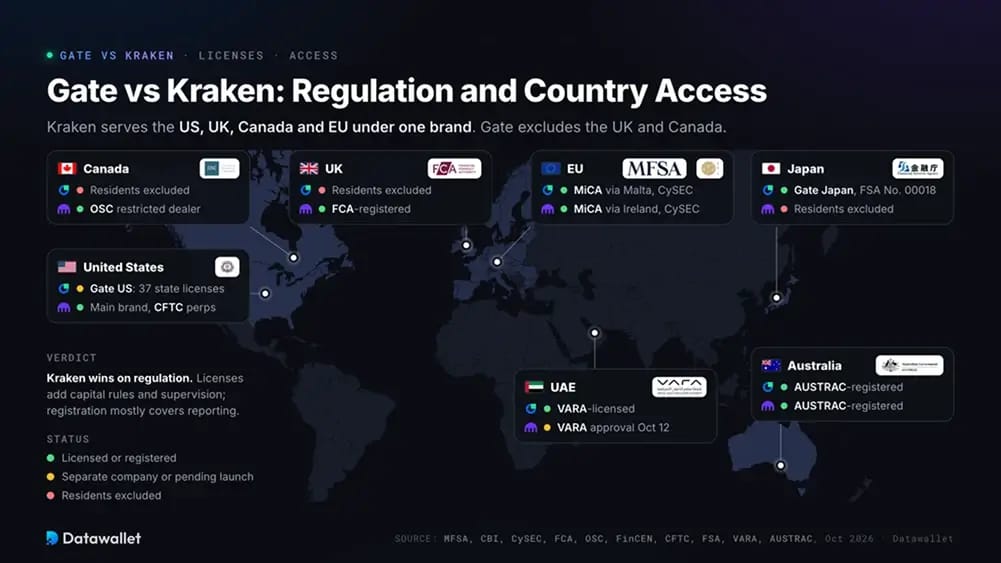
- European Union: Malta's financial regulator, the MFSA, authorized Gate Technology Ltd under MiCA, which establishes a common set of EU crypto rules. It also granted the company a payment institution license. Both permissions are valid in 29 EEA states, according to the Gate license register. Gate Securities (Cyprus) Ltd holds CySEC license 395/20.
- United States: Gate US, Inc. operates separately from the global exchange. Its 36 state money transmitter licenses covered 47 US jurisdictions in July 2026. A Massachusetts license raised the total to 37 in September. Gate US lists more than 370 cryptocurrencies.
- Other regions: Gate Japan K.K. appears on Japan's Financial Services Agency register under No. 00018. Dubai's crypto asset regulator, VARA, licenses Gate Technology FZE. In Australia, Gate Information Pty Ltd is registered with the financial intelligence agency AUSTRAC.
- Restrictions: Residents of the United States, Canada, the United Kingdom, and several other markets cannot use the global platform. See our Gate supported countries page for the list.
Kraken Licenses
- United States: Payward Interactive, Inc. holds state money transmitter licenses and is registered with FinCEN, the US Treasury's financial crimes office. Kraken Derivatives US is a CFTC-registered futures broker. Kraken Financial operates under a Wyoming bank charter.
- European Union: Kraken received a MiCA license from the Central Bank of Ireland in June 2025. Derivatives and stocks are handled by a Cyprus company holding CySEC license 342/17.
- United Kingdom: Payward Limited is registered as a cryptoasset business with the UK Financial Conduct Authority.
- Canada: Kraken secured restricted dealer registration with the Ontario Securities Commission in April 2025.
- Australia: Kraken's local operator, Bit Trade Pty Ltd, holds an AUSTRAC registration.
- United Arab Emirates: On October 12, 2026, Payward received full market approval from VARA. It plans to launch in the following weeks.
- Restrictions: Japan and sanctioned regions are excluded. The full list appears in our Kraken countries guide.
Kraken wins on regulation, serving the US, UK, Canada, and EU under its main brand. Gate operates through a separate US company and excludes the UK and Canada.
Is Kraken Better Than Gate?
Long-term investors and residents of the US, UK, and Canada are better suited to Kraken, as are those who prioritize regulation over cost. Kraken connects directly to the US payment system and publishes reserve checks. Cost is its main weakness: new Kraken Pro accounts pay up to eight times Gate's spot rate.
For active traders outside those three countries, Gate offers cheaper trading and more coins, along with a larger selection of futures and stock products. Thin order books on small tokens and its handling of the July 2026 dispute are the main drawbacks.
- Long-term holders: Use Kraken for regulated custody and free bank deposits, then transfer large balances to a wallet you control.
- Frequent spot traders: Gate is cheaper unless your Kraken holdings qualify you for a lower fee tier.
- Futures traders: Gate offers more contracts and greater volume. US clients seeking CFTC-regulated perpetuals are better suited to Kraken.
- Stock investors: Kraken's regulated brokers provide real shares to US and EEA clients. Gate caters to users elsewhere who want Asian stocks.
- New token buyers: Listings arrive earlier on Gate, but small tokens have high price risk and may be delisted.
Final Thoughts
During 2026, Kraken moved closer to a regulated financial company. It gained a Federal Reserve account and a US futures exchange, then extended US share trading to EEA clients and agreed to buy a European bank. Gate expanded faster in volume and products. It now ranks among the three largest derivatives exchanges.
We rate Kraken higher because its licenses cover more of our readers and fewer security issues remain unresolved. Where available, Gate works well as a second account for cheaper trades and a broader asset selection. Our Kraken vs Binance and Gate vs Binance comparisons assess both against the largest platform.
Check country eligibility and complete identity verification before depositing. Secure the account with an authenticator app or security key, and restrict withdrawals to approved addresses. Test a small withdrawal first. Transfer larger amounts only after it arrives. This page provides general information and is not financial advice.