




Gate vs Binance: Overview
Both companies now describe themselves as multi-asset financial platforms, which is why this comparison includes stocks and options alongside crypto. Binance leads on every volume measure. Gate has grown spot volume faster in 2026 and holds licenses in markets where Binance cannot operate.
Changpeng Zhao founded Binance in 2017; Richard Teng and Yi He now lead it as joint chief executives. At its ninth anniversary in July 2026, Binance reported more than 323 million registered users. The global platform has operated through three entities licensed by the Financial Services Regulatory Authority in Abu Dhabi Global Market since January 5, 2026.
Lin Han founded Gate as Bter in 2013. The exchange moved to Gate.com in 2025, and registered users passed 60 million on September 2, 2026. It supports more than 5,100 digital assets, plus 12,800 stock assets across the US, Japan, Hong Kong, and South Korea. CryptoQuant's September report named Gate the fastest-growing major platform by 30-day spot volume.
Gate vs Binance: Products
Binance built a large trading engine, then added traditional assets to it. Gate expanded through separate businesses for equities, prediction markets, payments, and AI tools. Both now sell far more than crypto, but Gate's approach has produced a longer product list and a more crowded interface.
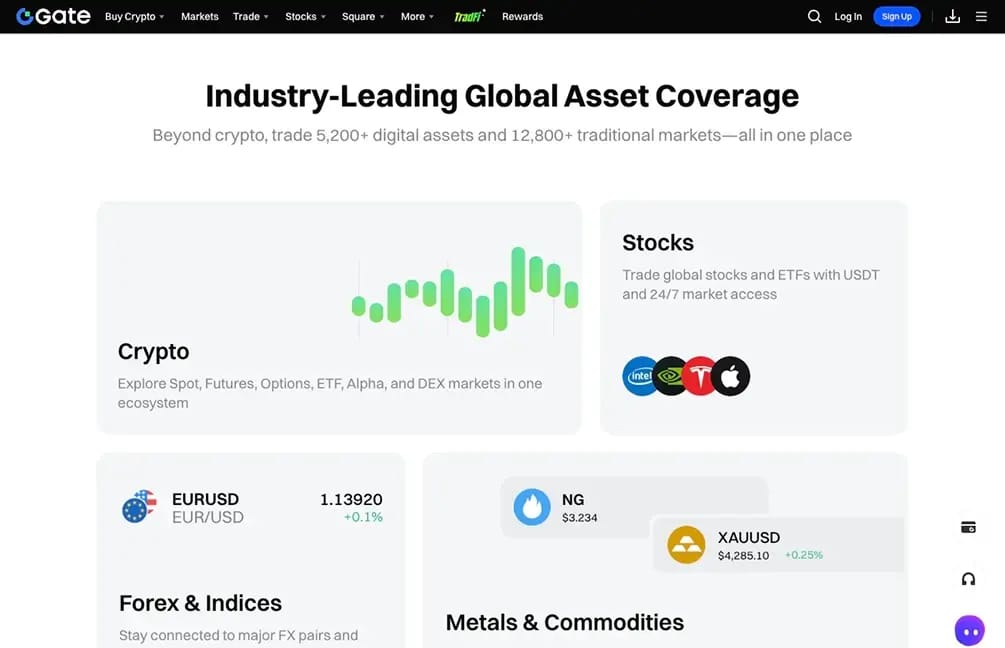
Gate Products
New users need time to learn Gate's product list, which is longer than any rival's.
- Spot and Margin: More than 5,100 digital assets, often with new tokens listed weeks ahead of larger rivals. Both sides of the USDC/USDT pair trade at 0%.
- Futures and Options: Several hundred USDT-margined perpetuals sit alongside coin-margined and dated contracts. Gate also offers European-style vanilla options and leveraged ETF tokens. With CrossEx, one margin balance supports positions across connected platforms.
- Real Stocks and IPO Access: Eligible customers can own actual US, Hong Kong, South Korean, and Japanese shares from 0.01 of a share, with dividends paid in USDT. IPO Access accepts subscriptions for new listings and pre-IPO names such as SpaceX.
- Stock Derivatives: Stock perpetuals allow 1x to 20x leverage, with Palantir, Robinhood, and Coinbase among the 12 US names added on September 3. US stock options opened for nine assets on September 2. A CFD section covers gold, indices, forex, and commodities.
- Tokenized Stocks: One real share backs each gStocks token. Holders receive dividends automatically and can borrow against the tokens or use them as unified-account margin.
- Prediction Markets: Event Contracts cover price moves, while a direct Polymarket integration adds access to its markets. Gate reported an event contract market share above 36% in July.
- Launch Programs: GT holders and frequent traders receive newly issued tokens through Launchpool, CandyDrop, HODLer Airdrop, and Alpha Points.
- Earn, Payments, and AI: Simple Earn, staking, and crypto loans are available alongside the treasury-backed GUSD yield product. The platform also includes Gate Pay, the Gate Card, Gate Wallet, and the Gate AI assistant.
Binance Products
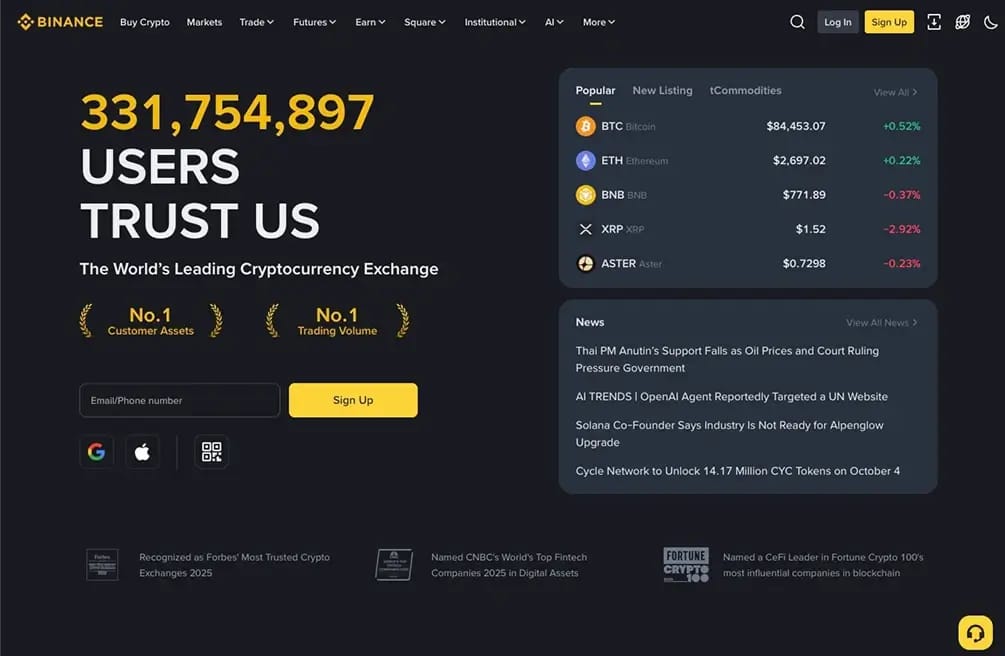
Most Binance products share one account. Collateral and fee discounts therefore apply across spot and futures, as well as traditional-asset trading.
- Spot Trading: More than 500 coins trade across 1,700+ pairs, quoted in stablecoins, Bitcoin, and several fiat currencies. Binance has the deepest order books on the main pairs, so even large market orders barely shift the price.
- Futures Suite: Perpetuals use stablecoin margin (USDⓈ-M) or the traded coin (COIN-M), with quarterly delivery contracts and crypto options also available. Bitcoin contracts permit up to 125x leverage. Portfolio margin offsets hedged positions across accounts.
- US Stocks and bStocks: Since June 1, eligible non-US users have been able to trade more than 7,000 US stocks and ETFs at zero commission, buying fractional shares from $5. bStocks followed on June 11 as tokenized securities backed by real shares.
- Stock Options: Physically settled options on more than 1,000 US stocks and ETFs launched on September 1. Contract exercise delivers the underlying shares.
- TradFi Perpetuals: USDT-settled contracts track gold, silver, US equities, indices, ETFs, and pre-IPO names such as SpaceX and OpenAI. August volume alone reached about $433.4 billion.
- Margin, Earn, and Launchpool: Cross and isolated margin borrowing are available alongside Simple Earn, staking, and structured yield products. Launchpool and HODLer Airdrops distribute new tokens to BNB holders.
- Copy Trading and Bots: Lead portfolios cover spot and futures. Grid, DCA, and TWAP bots automate order placement, and we score the copy trading marketplace against rivals in our copy trading platforms ranking.
- Alpha, Wallet, and Pay: Early on-chain tokens appear on Binance Alpha before spot listing. Binance Wallet provides self-custody, while Binance Pay and P2P support payments and local currency trades.
Gate vs Binance: Fees
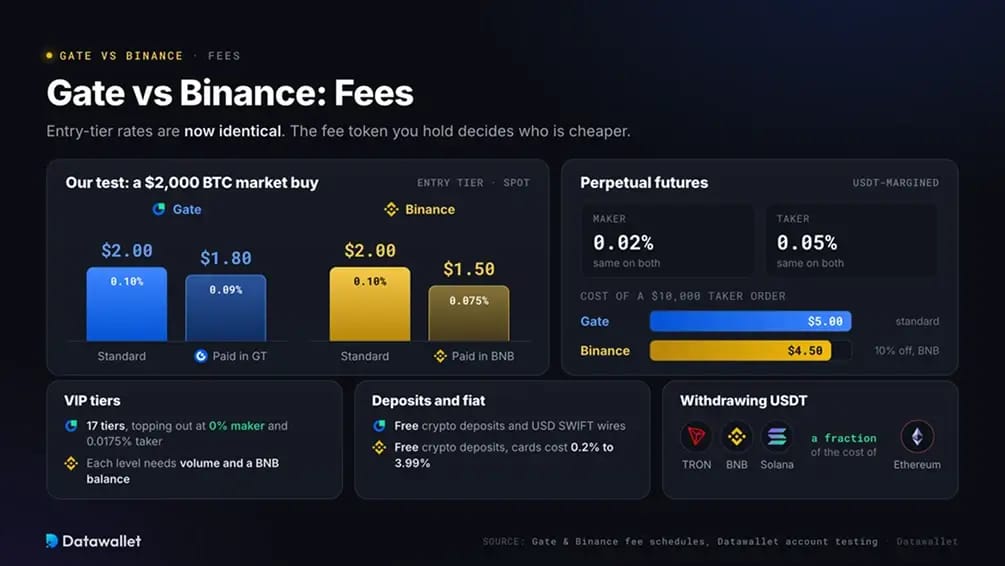
With entry-tier fees now almost identical, token discounts and order type account for much of the difference. The withdrawal network matters too. As our maker vs taker explainer shows, a limit order that waits in the order book usually costs less than a market order.
Spot Trading Fees
- Gate: Under the fee restructure effective April 9, 2026, VIP 0 makers and takers pay 0.10%, falling to 0.09% with GT fee payment. There are seventeen tiers based on 30-day volume or GT holdings. The highest tier charges 0% maker and 0.0175% taker.
- Binance: The published schedule charges regular users 0.10% on both sides. A 25% BNB discount brings that to 0.075%. Qualification for VIP levels requires both 30-day volume and a BNB balance.
Fee test: A $2,000 BTC purchase at market price cost us $2 in fees on each platform at the entry tier. Enabling BNB fee payment reduced Binance's charge to $1.50; GT deduction brought Gate's to $1.80. Check the live schedule in your account, since older articles still list a 0.20% Gate taker rate.
Futures Fees
- Gate: Entry-tier USDT-margined perpetual fees are 0.02% for makers and 0.05% for takers. Since September 1, TradFi perpetuals have followed a separate schedule that starts at those rates and ends at 0% maker and 0.012% taker.
- Binance: Stablecoin-margined contracts also charge 0.02% maker and 0.05% taker, reduced by another 10% with BNB payment. Coin-margined contracts start at 0.01% maker and 0.05% taker.
For a $10,000 taker order, either exchange charges $5, or $4.50 on Binance with BNB. Funding payments between long and short positions can exceed commissions on both platforms during crowded trends.
Deposits and Withdrawals
- Gate: Crypto deposits and USD SWIFT transfers are free, with SWIFT settlement within five business days. Euros and Australian dollars pass through the Maltese and Australian companies. P2P coin purchases must remain in the account for 24 hours.
- Binance: Crypto deposits are free, and P2P trades have no platform fee. Card and third-party fiat purchases cost 0.2% to 3.99%, depending on the method.
Both exchanges set withdrawal fees as fixed amounts for each coin and network. Sending USDT over TRON, BNB Chain, or Solana costs a fraction of an equivalent Ethereum transfer.
Gate vs Binance: Futures and Liquidity
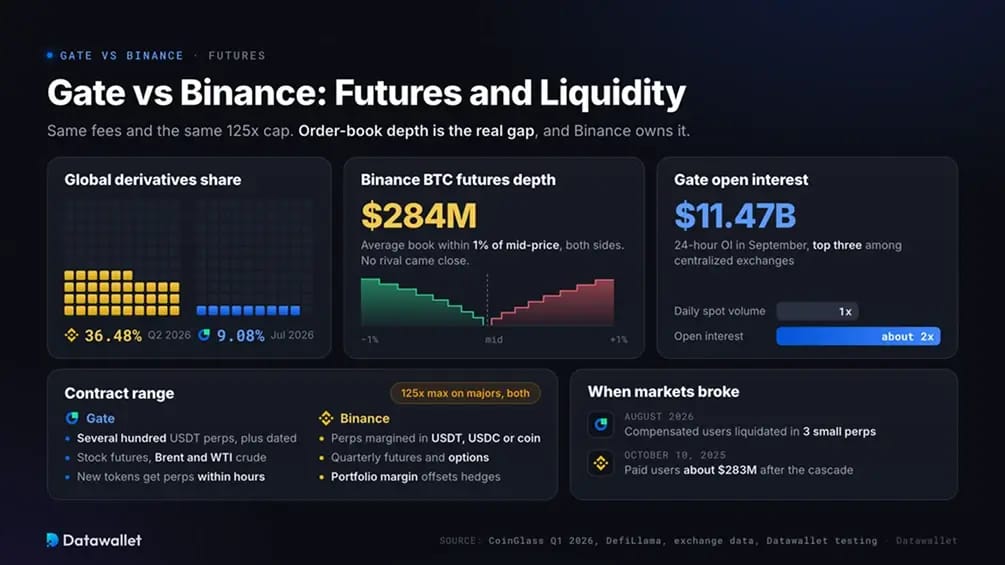
About three-quarters of trading volume at both companies comes from perpetual futures. Binance accounts for more than a third of global derivatives volume, with depth marking the biggest difference between the two exchanges. Gate offers more small-token contracts, but each has a much thinner order book. Both appear in our best crypto futures exchanges ranking.
Available Markets
- Gate: Several hundred USDT perpetuals are available alongside coin-margined and dated contracts, stock futures, and commodity contracts such as Brent and WTI crude oil. New tokens often receive a perpetual contract within hours of their spot listing.
- Binance: Perpetuals settle in USDT, USDC, or the traded coin. The range also includes quarterly futures and options. Major pairs allow 125x leverage, though tiered risk limits sharply reduce the maximum as positions grow.
Execution and Depth
- Gate: September data from DefiLlama showed more than $11.47 billion in 24-hour open interest, placing Gate among the top three centralized exchanges. Open interest is about twice daily spot volume, indicating heavy leverage among its users.
- Binance: CoinGlass put average BTC futures order-book depth at roughly $284 million in Q1 2026, measuring both sides within 1% of the mid-price. No rival came close. Our tests also found tighter spreads on mid-cap contracts than on Gate.
Risk Controls
- Gate: The unified account offers isolated and cross margin, hedge mode, and demo trading, with risk limits that scale to position size. Gate compensated users liquidated by abnormal price moves in three small perpetual contracts in August. The payments showed goodwill but also reflected thin markets.
- Binance: Risk tools include portfolio margin and multi-asset collateral mode, alongside an insurance fund and auto-deleveraging queues. Binance changed its pricing of wrapped and staked collateral after the October 10, 2025 liquidation cascade, paying about $283 million to affected users.
Binance's depth, margin tools, and options make it the stronger futures venue. Gate is worth using when it has a contract unavailable elsewhere. Read our comparison of perpetual and spot trading before opening a leveraged position.
Gate vs Binance: Stocks, Options and Prediction Markets
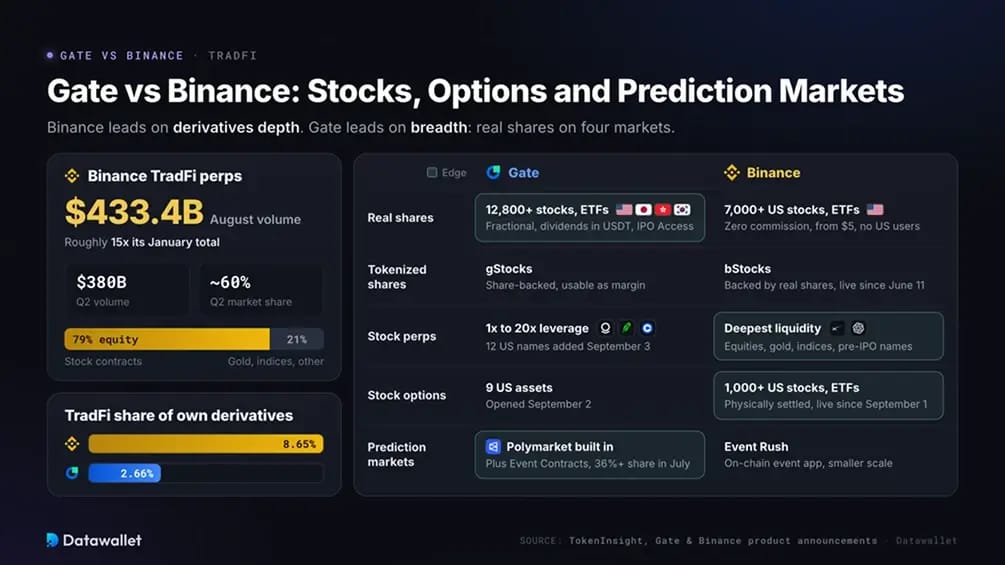
Traditional-asset products are the fastest-growing part of both businesses. Binance prioritizes derivatives volume and has one US broker relationship. Gate offers real shares in four countries with derivatives alongside them.
Industry-wide monthly TradFi perpetual volume rose from $52 billion in January to $268 billion by June, according to TokenInsight. Binance captured about 60% of that market in Q2, recording $380 billion in quarterly volume. These contracts accounted for 8.65% of Binance's derivatives activity, compared with 2.66% at Gate.
Binance's August figure of $433.4 billion in TradFi perpetual volume was roughly 15 times January's total. Equity contracts contributed 79%. Nest Trading, an ADGM broker-dealer, runs the stock and options products, with US-registered Alpaca Securities executing orders and holding the shares. None of these products are available to US residents.
Gate's TradFi section covers more markets. It offers fractional purchases in more than 12,800 stocks and ETFs across the US, Japan, Hong Kong, and South Korea, paying dividends in USDT. Stock futures permit up to 20x leverage, and US stock options launched on September 2. Traders can also use gStocks tokenized shares as collateral.
Prediction markets show a clearer difference. Gate has a direct Polymarket integration and its own Event Contracts, with a reported market share above 36% in July. Binance's on-chain event-trading application, Event Rush, operates on a smaller scale. Our prediction markets explainer describes how these contracts settle.
Gate vs Binance: Security and Proof of Reserves
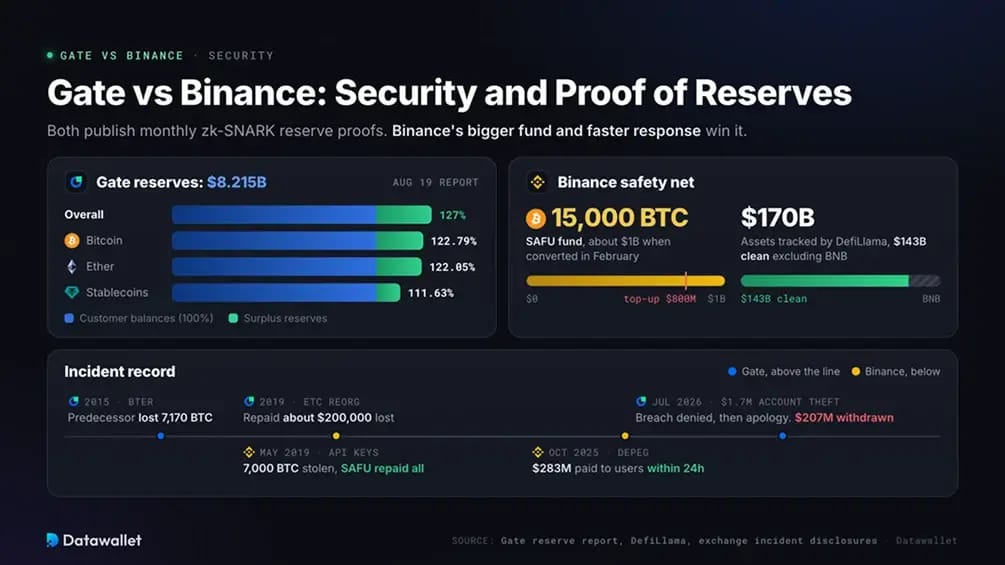
Both exchanges use monthly reserve proofs with zero-knowledge cryptography, and each has repaid customer losses from its own capital. Their responses to recent incidents distinguish them in 2026.
Gate Security Measures and History
- Reserve proof: Gate's August 19 report recorded $8.215 billion in reserves at 127% coverage. Bitcoin holdings exceeded customer balances by 22.79% and Ether by 22.05%, while stablecoin coverage was 111.63%.
- July incident: A verified user reported losing about $1.7 million after unauthorized changes to the account's security settings. Gate initially denied any platform breach, then apologized. The victim said no progress had been made forty days after filing a criminal case. In the week after the claim became public, the exchange recorded $207 million in net withdrawals.
- Earlier incidents: Bter, Gate's predecessor under the same founder, lost 7,170 BTC in 2015. Gate repaid about $200,000 lost in a 2019 Ethereum Classic chain reorganization. Researchers have also alleged a larger loss in 2018, though it remains unconfirmed.
- Account controls: Accounts support two-factor authentication with hardware keys, anti-phishing codes, and a withdrawal address whitelist. Gate Vault is available for longer-term holdings, and the company holds ISO 27001 certification.
Binance Security Measures and History
- SAFU Fund: Binance converted its Secure Asset Fund for Users (SAFU) to a 15,000 BTC holding in February 2026. The fund was then worth about $1 billion, with a promised top-up if its value falls below $800 million.
- Reserve proof: Users can confirm that their balances appear in a monthly Merkle-tree snapshot backed by zk-SNARK proofs. DefiLlama tracks about $170 billion in assets and classifies $143 billion as clean after excluding BNB.
- Incident history: Phished API keys led to a May 2019 breach that cost about 7,000 BTC. SAFU repaid the full loss. During the October 2025 cascade, three collateral tokens (USDe, BNSOL, and wBETH) briefly traded far below their pegs on Binance. The exchange paid affected users about $283 million within 24 hours.
- Account controls: Passkeys and device management sit alongside anti-phishing codes, withdrawal whitelists, and API IP restrictions. Binance added Withdraw Protection in 2026.
Binance wins on security. Its protection fund alone is worth more than $1 billion, and it handled the October depeg quickly and publicly. Gate's verification tools are well engineered. Still, two days of denial before an apology was the wrong response to a customer losing funds with every security setting enabled. Our assessment of whether Gate is safe examines the full record.
Reserve proofs confirm holdings on a particular date; they do not audit either company. Keep trading balances on an exchange and the rest in a self-custody wallet.
Gate vs Binance: Regulation and Country Access
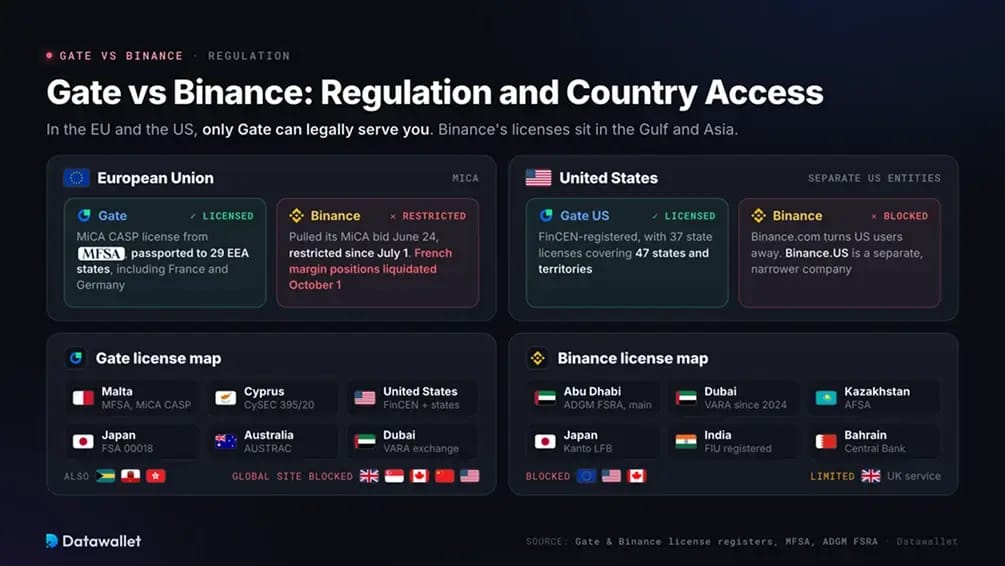
For readers in Europe and the United States, regulation decides the comparison. Gate has a passported EU license and a licensed US business. Binance holds full UAE authorization and many registrations elsewhere, but cannot legally serve either market.
Gate's Licenses
- European Union: Gate Technology Ltd holds Malta Financial Services Authority authorization under MiCA as a CASP (crypto-asset service provider), plus separate payment institution authorization. Both permissions are passported to 29 EEA states, including France and Germany, according to the group license register.
- Cyprus: Gate Securities (Cyprus) Ltd holds CySEC investment firm license 395/20. It may execute client orders and trade for its own book, as well as manage portfolios and advise on investments.
- United States: Gate US operates through its own FinCEN-registered company. Its Massachusetts money transmitter license in September brought state authorizations to 37, with coverage across 47 states and territories.
- Asia-Pacific and Middle East: Japan FSA registration 00018 covers Gate Japan K.K., while Gate Information Pty Ltd is registered with AUSTRAC. In Dubai, Gate Technology FZE holds a VARA exchange license. The group also has approvals in the Bahamas, Gibraltar, and Hong Kong.
- Restrictions: Residents of the United Kingdom, Singapore, Canada, mainland China, and the United States cannot use the global platform, though local companies serve some of these markets. See our Gate supported countries page for the list.
Binance's Licenses
- Abu Dhabi: ADGM's Financial Services Regulatory Authority licensed three Nest companies to operate the exchange, provide clearing and custody, and act as a broker-dealer. Binance.com has used this structure since January 5, 2026.
- Dubai: Binance FZE has held a VARA license since April 2024, allowing Dubai retail clients to use exchange and broker-dealer services. Derivatives are restricted to qualified investors.
- European Union: Binance pulled its MiCA application in Greece on June 24, 2026, then restricted EU services a week later. Talks with France's AMF have been reported. French users' open margin positions and loans face automatic liquidation on October 1.
- Other markets: The Kazakhstan business holds an Astana Financial Services Authority license, and Binance Japan is registered with the Kanto Local Finance Bureau. Further approvals cover India's Financial Intelligence Unit and the Central Bank of Bahrain.
- United States: American residents cannot open accounts on Binance.com. They are served instead by Binance.US, a separate company with its own management, state money transmitter licenses, and a narrower product range than the global platform.
- Restrictions: Binance withdrew from Canada in 2023, and its UK service is limited. Our Binance restricted countries guide lists the current restrictions.
Gate wins this section with MiCA authorization to serve EU residents and a licensed business in the American market. Binance remains excluded from both.
Which Exchange Fits Your Trading Style?
- Major-Pair Traders: For BTC, ETH, and SOL, Binance is the better venue. Deeper order books and portfolio margin reduce the cost of frequent trading, with further savings from the BNB discount.
- Altcoin Hunters: Choose Gate when it lists a new token first, but size positions for thinner liquidity. Its small-cap contracts have required compensation after abnormal price moves.
- EU Residents: Only Gate has a MiCA license in force. EU Binance users should withdraw idle balances and close leveraged positions ahead of forced liquidation dates.
- US Residents: Gate US covers 47 states and territories. Binance.com is unavailable, while the separate Binance.US company is smaller. Our USA exchange ranking lists lawful alternatives.
- Stock Traders: Binance combines deeper stock perpetual liquidity with physically settled options. Gate provides real shares in four countries and IPO subscriptions, plus tokenized stocks that can be used as collateral.
- Airdrop and Yield Seekers: A faster listing pace accompanies Gate's Launchpool, CandyDrop, and HODLer Airdrop campaigns. Binance Simple Earn covers a larger range of major assets.
- Long-Term Holders: Keep long-term positions in a wallet you control. Protection funds and reserve proofs reduce counterparty risk but cannot remove it.
Final Thoughts
For readers outside the EU and the US, Binance is the better main exchange. It has the deepest available order books, and futures fees match Gate's at the entry tier before the BNB discount makes them cheaper. No other exchange has matched its 15,000 BTC protection fund as a safety net. Adding stocks, ETFs, and options in 2026 has made Binance a credible multi-asset platform.
Three groups should open a Gate account. EU residents can be served legally under its Malta license, which Binance lacks. For US residents, Gate US is available in 47 jurisdictions. Traders seeking newly listed tokens, launch campaigns, or real shares on Japanese and Korean markets get products Binance does not offer.
Keeping both accounts makes sense: use Binance for the larger balance and Gate for discovery and regional access. Start by completing identity verification. Then enable hardware 2FA and withdrawal whitelists, and test a small withdrawal before moving more. For more detail, read our Gate review and Binance review, or the Bybit vs Gate comparison.