




Compare Top Crypto Copy Trading Platforms
1. Bybit
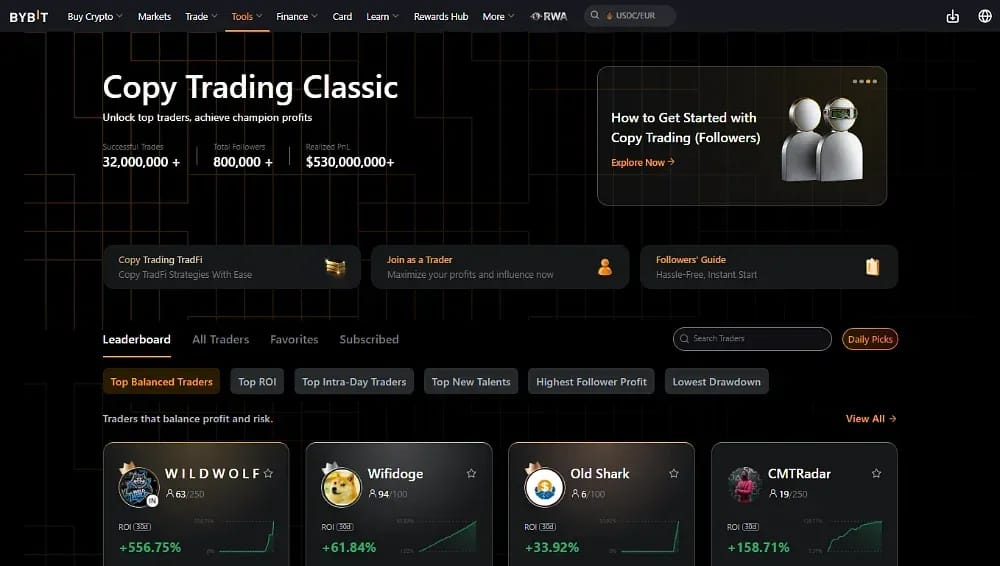
Bybit runs the most complete copy trading stack in 2026, splitting the product into Classic, Pro, and TradFi modes that serve everyone from casual followers to fund-style investors. Roughly 90,000 Master Traders operate across its leaderboards, filterable by ROI, drawdown, win rate, and assets under management.
Classic remains the practical entry point, with a 100 USDT minimum per Master and the ability to follow ten traders at once. Testing Smart against Advanced mode, we found the sizing logic transparent, and we liked that the weekly profit share is refunded whenever the period nets a loss.
The Pro and TradFi products push further: Pro sells shares in NAV-tracked strategies with strict entry criteria, while TradFi copies MT5 multi-asset trading under a High Water Mark model where fees apply only at new equity peaks. Deep top-three derivatives liquidity keeps copied fills close to the leader's entries.
Pros
- Three products: Classic, Pro, and TradFi cover simple mirroring, fund-style NAV strategies, and multi-asset MT5 copying in one venue.
- Fair settlement: Weekly profit share is pre-deducted but refunded whenever the follower's net weekly result is a loss.
- Deep liquidity: Top-three derivatives volume means copied futures orders fill with minimal slippage even in volatile sessions.
Cons
- Higher minimum: The 100 USDT Classic floor per Master is double Bitget's entry and stacks up fast across several traders.
- Perp-centric: Classic copying focuses on USDT perpetuals, so spot-first followers get a narrower product than on Binance.
- Regional limits: Bybit is unavailable in the US and several other major markets, so always confirm local access first.
2. Bitget
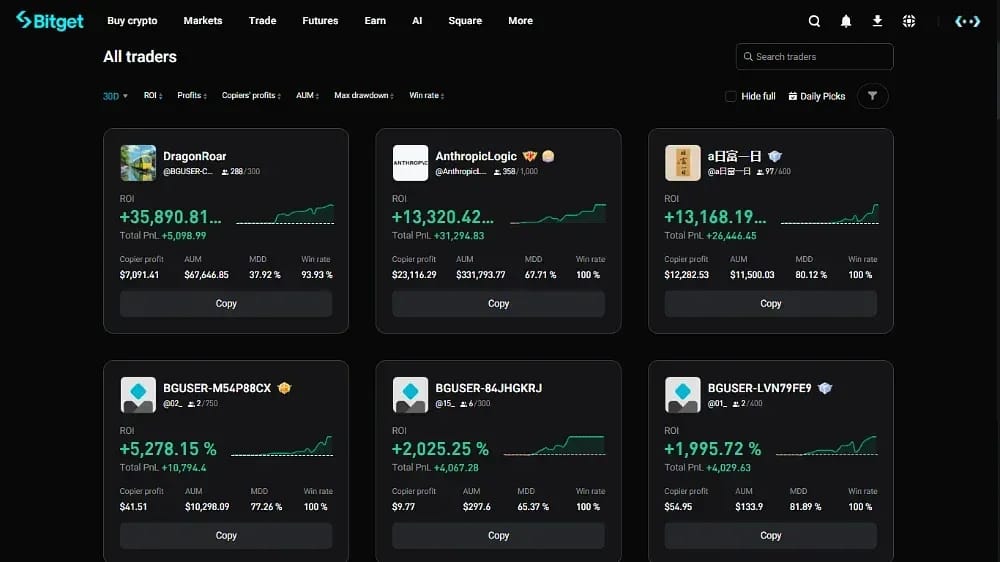
Bitget operates the industry's largest copy trading network, with a roster of over 130,000 elite traders and more than 800,000 active copiers spanning futures, spot, and automated bots. For followers who value choice, no other venue offers a deeper or more searchable pool of strategies.
Its real differentiator is risk-control granularity, and this is where we saw the clearest edge over rivals. Followers set per-trader stop-losses, cap investment per copied trader, and configure daily loss limits independently, so one leader's drawdown never contaminates the rest of a diversified portfolio.
Entry is accessible at a 50 USDT minimum per trader, and profit sharing runs a competitive 4-10% set by each elite trader. A six-month badge system verifies track records more honestly than the 30-day snapshots most leaderboards rely on, and bot copying adds grid and DCA automation.
Pros
- Largest roster: Over 130,000 elite traders give followers more strategies and styles to filter than any competing platform.
- Granular controls: Per-trader stop-losses, investment caps, and daily loss limits isolate risk across a multi-trader portfolio.
- Low profit share: The 4-10% elite trader commission undercuts the 10-15% standard at most rival venues.
Cons
- Quality variance: A huge trader pool includes plenty of short-track-record accounts, so filtering discipline matters more here.
- Offshore venue: Bitget operates without major-market licenses, leaving followers dependent on internal controls rather than regulation.
- Interface density: The sheer volume of tabs, bots, and campaigns can overwhelm first-time copiers during onboarding.
3. OKX
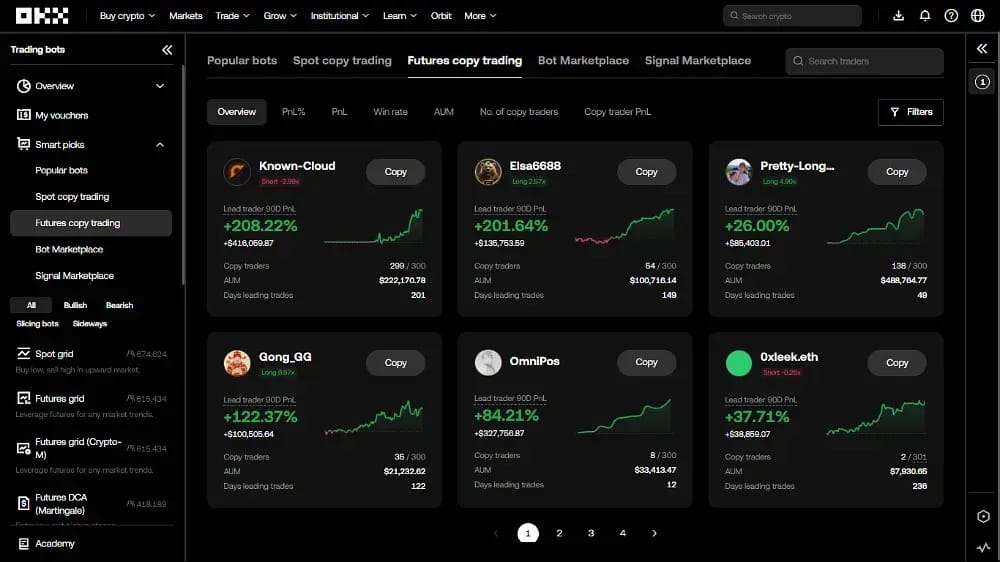
OKX takes the most data-driven approach to copy trading, pairing spot and futures copying with the best analytics dashboard among major exchanges. Trader discovery includes filters for Sharpe ratio, drawdown history, AUM capacity, holding time, and risk score, so followers match leaders to precise preferences.
Its standout 2026 feature is Smart Portfolio mode, which spreads capital across several leaders and rebalances automatically when one allocation grows disproportionately. Running it ourselves, we appreciated not having to manually trim winners, and Strategy Protection sensibly delays trade disclosure to deter front-running.
Entry costs are the lowest here, priced from 10 USDT per copied order rather than per trader, and profit share typically lands around 10% depending on the leader's level. Monthly Merkle-verified proof of reserves adds a transparency layer several rivals still lack.
Pros
- Best analytics: Sharpe ratios, drawdown history, and risk scores enable far sharper trader selection than basic ROI leaderboards.
- Smart Portfolio: Multi-trader allocation with automatic rebalancing keeps exposure aligned as individual leaders win or lose.
- Low entry: Copying priced from 10 USDT per order lets cautious followers test several leaders cheaply.
Cons
- Smaller roster: The lead trader pool trends well below Bitget's, limiting choice in niche strategy styles.
- Thinner per-copy controls: Published risk parameters per copy are lighter than Bybit's mode and margin options.
- Regional restrictions: Full copy trading features are unavailable in several jurisdictions, including for most US users.
4. Binance
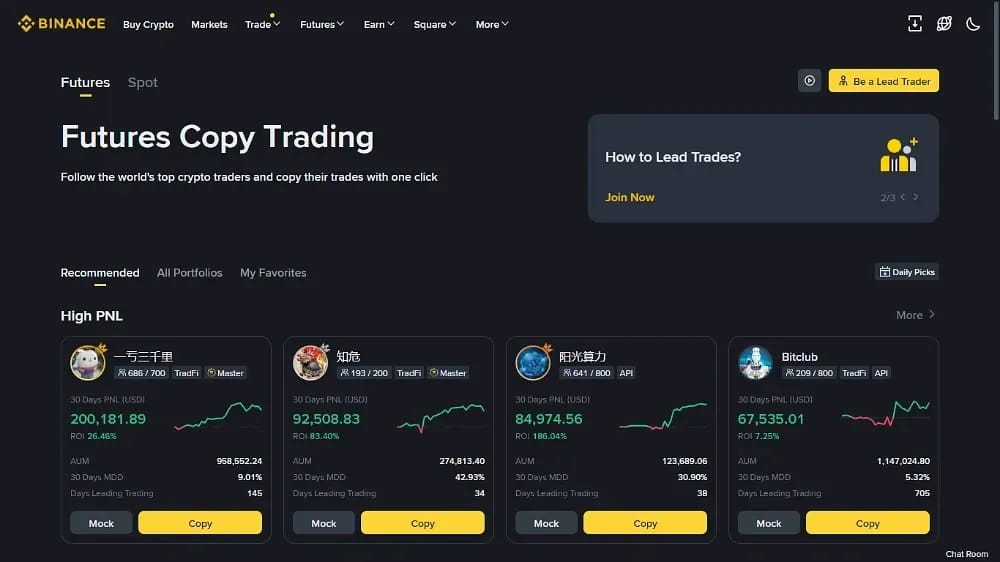
Binance folds copy trading into the deepest order books in crypto, which matters because slippage quietly erodes copied returns everywhere else. A copy portfolio opens from just 10 USDT, with Fixed Amount and Fixed Ratio modes covering both futures and spot markets.
Spot copying isolates funds in a dedicated mirror account that cannot be withdrawn while active, then returns assets automatically once copying ends. We found that separation reassuring during testing, and Lead Traders earn roughly 10% of profits, with Elite badges lifting top performers toward 30%.
The Mock Copy environment remains a genuinely useful differentiator, letting beginners rehearse allocations with virtual funds before risking capital. Risk tooling is solid but less granular than Bitget's, lacking per-trader daily loss caps, and US users are limited to the separate Binance.US product.
Pros
- Deepest liquidity: Copied orders fill on the largest books in crypto, keeping slippage minimal on majors and mid-caps.
- Lowest portfolio entry: Starting from 10 USDT makes Binance the cheapest venue to trial copy trading with real funds.
- Mock Copy: A virtual-funds simulator lets newcomers practice trader selection and sizing before committing capital.
Cons
- Coarser risk tools: No per-trader daily loss caps or conditional stop-copy triggers, unlike Bitget's granular framework.
- Complexity: The sprawling Binance interface buries copy trading among dozens of products, slowing first-time navigation.
- US limitations: Binance.US offers only a restricted feature set, so American users lose most copy functionality.
5. eToro
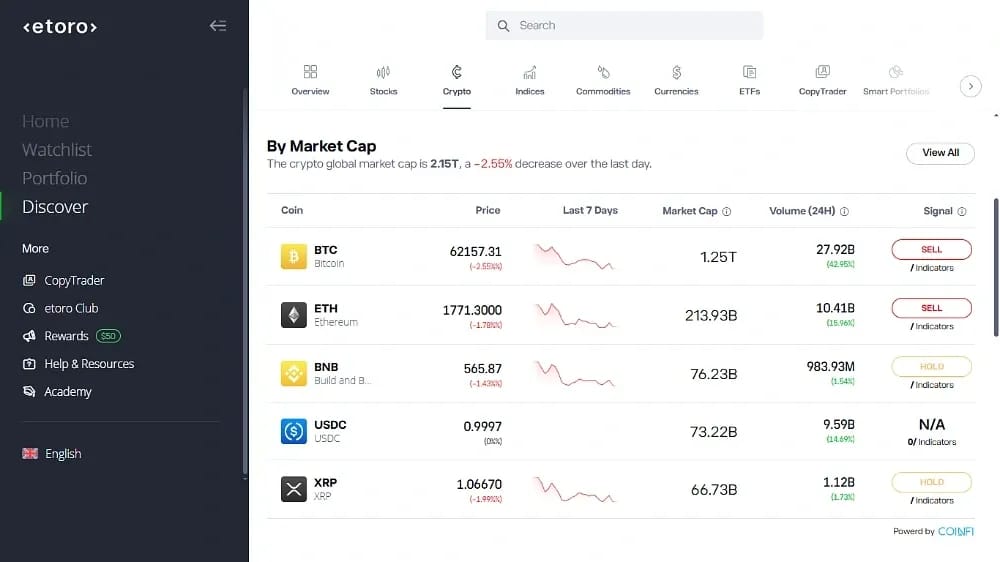
eToro remains the only heavyweight in this list operating as a regulated, multi-asset broker, with oversight across the US, UK, EU, and Australia and a Nasdaq listing since 2025. Its CopyTrader system mirrors Popular Investors across crypto, stocks, and ETFs from a $200 minimum per trader.
Copying is deliberately simple: pick an investor, set the allocation, and decide whether to mirror open positions or only new trades. We valued that choice, since inheriting a leader's existing drawdown is a common trap, and the Copy Stop Loss halts copying automatically at your defined threshold.
Instead of charging followers a profit share, eToro pays Popular Investors up to 2% of copied assets annually from its own pocket, so follower costs sit in spreads rather than commissions. The trade-off is limited leverage, fewer exotic pairs, and crypto spreads above exchange-native rivals.
Pros
- Regulated venue: Multi-jurisdiction licensing and a public listing offer accountability no offshore exchange in this list matches.
- No profit share: Followers pay spreads only, while eToro compensates Popular Investors from its own revenue.
- Multi-asset copying: One allocation can mirror a leader across crypto, equities, and ETFs for genuine diversification.
Cons
- Wider spreads: Crypto trading costs sit above exchange-native platforms, quietly compressing returns on active strategies.
- Higher minimum: The $200 per-trader floor doubles the cost of diversifying across leaders versus Bitget or OKX.
- Limited crypto depth: Fewer pairs and no high-leverage perpetuals restrict aggressive derivative strategies entirely.
6. BingX
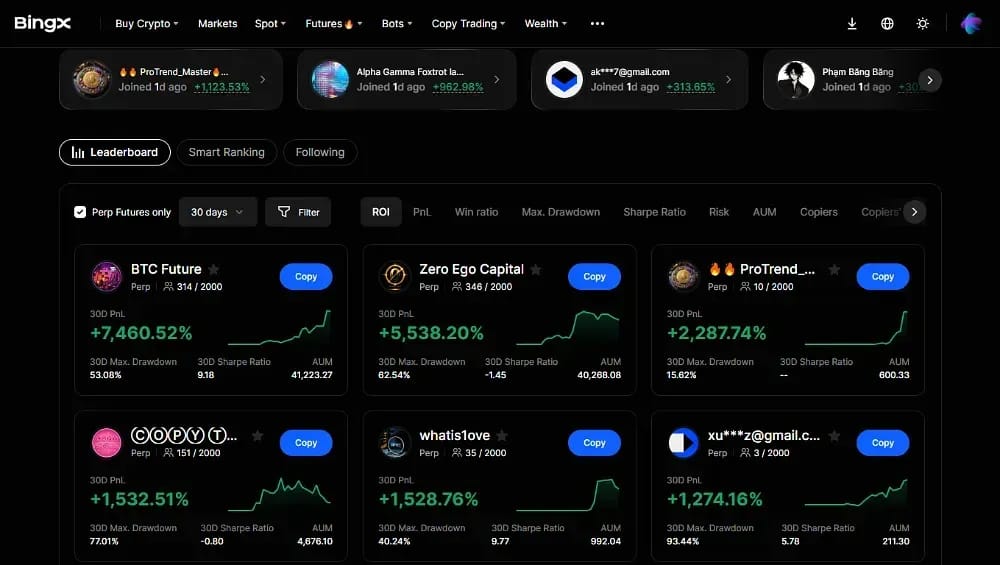
BingX continues iterating on its Copy Trading 2.0 architecture, routing each followed trader through dedicated sub-accounts with merged order execution. Reconciling our trade histories, we found this noticeably cleaner than pooled systems, and followers mirror perpetual futures and spot grid strategies across a 20-million-user network.
Copy configuration is flexible, with fixed-margin and position-ratio models deciding whether trades scale with capital or stay constant, plus grid copy extending automation into spot markets. Configurable take-profit, stop-loss, and copy caps keep follower exposure contained during unpredictable or volatile market stretches.
The profit-sharing spread is the widest anywhere, as private traders set commissions between 0% and 50% of net profits. That range rewards careful trader vetting: excellent leaders can be cheap to follow, while overpriced ones are easy to skip entirely.
Pros
- Clean accounting: Sub-accounts and merged orders make copied performance easier to audit than pooled follower systems.
- Flexible commissions: The 0-50% trader-set range means diligent followers can find skilled leaders at low cost.
- Grid copying: Spot grid strategies extend copy trading beyond directional futures into automated range trading.
Cons
- Commission ceiling: Careless followers can end up paying 50% profit shares that gut otherwise solid returns.
- Smaller ecosystem: Liquidity and trader depth trail the top four venues, widening slippage on less liquid pairs.
- Verification gaps: Trader vetting is lighter than Bitget's badge system, putting more diligence burden on followers.
7. Gate
Gate, rebranded from Gate.io, completes the list with copy trading across futures, spot, and bots, backed by over 3,600 listed tokens. Comparing Smart and Advanced mode side by side gave us a clear sense of how much control we actually wanted over sizing and leverage.
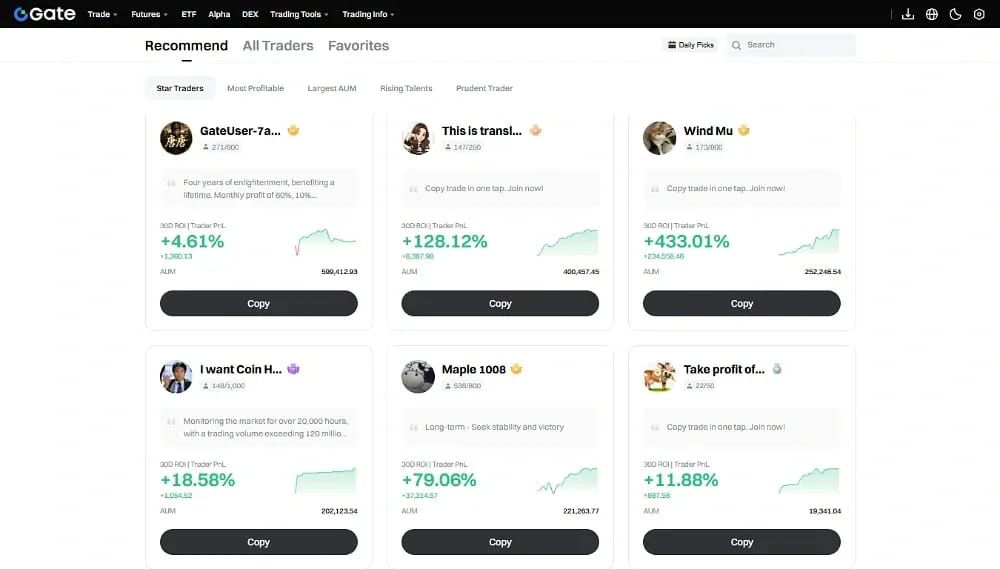
Trader selection leans on a revamped ROI algorithm that ranks leaders more fairly than raw return sorting, with profiles showing 30-day returns, Sharpe ratios, AUM, and maximum drawdowns. Followers can copy multiple traders in parallel, with trades executing proportionally while copy funds last.
Gate suits followers who want long-tail market exposure the majors do not list, since copied strategies can reach assets unavailable on Bybit or Binance. The trade-off is thinner liquidity on those tails and a leaderboard that rewards deeper due diligence before committing funds.
Pros
- Widest markets: Over 3,600 listed assets let copied strategies reach long-tail tokens unavailable on larger venues.
- Honest rankings: The reworked ROI algorithm surfaces consistent leaders instead of lucky short-streak accounts.
- Multi-copy depth: Following several traders in parallel with proportional execution supports diversified copy portfolios.
Cons
- Tail liquidity: Thin books on smaller tokens amplify slippage exactly where Gate's asset advantage lies.
- Variable fees: Trader-set profit shares lack a published cap, so costs demand checking before every follow.
- Less brand trust: Gate's transparency reporting trails the proof-of-reserves standards set by OKX and Binance.
What is a Crypto Copy Trading Platform?
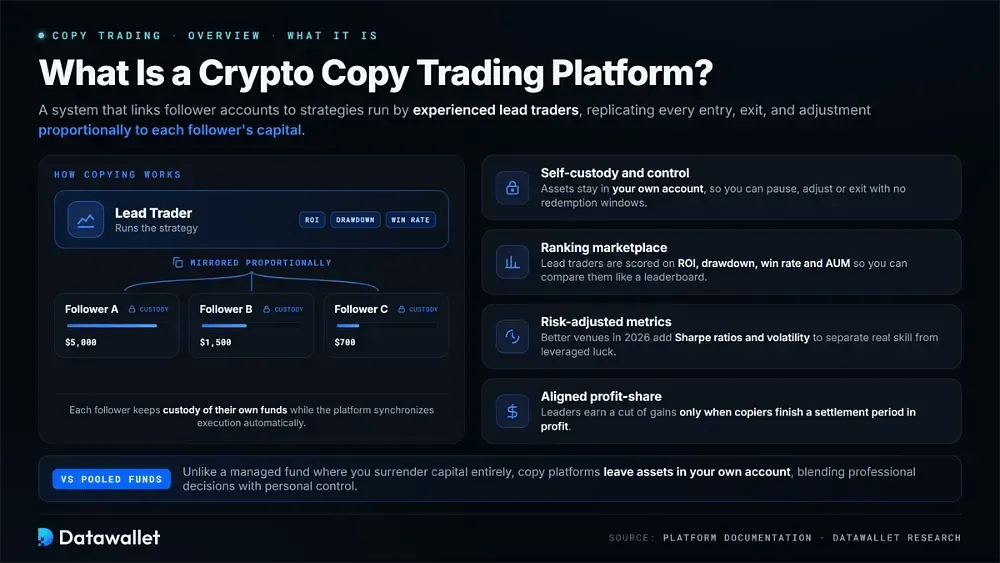
A crypto copy trading platform is a system that links follower accounts to strategies run by experienced lead traders, replicating every entry, exit, and adjustment proportionally to each follower's allocated capital. The follower keeps custody of funds while the platform synchronizes execution automatically.
This structure differs from pooled investment funds, where investors surrender capital to a manager entirely. Copy platforms leave assets in each user's own account, blending professional decision-making with personal control, and letting followers pause, adjust, or exit without waiting on fund redemption windows.
Modern platforms also operate as ranking marketplaces, scoring lead traders on ROI, drawdown, win rate, and assets under management. The better venues in 2026 now layer in risk-adjusted metrics such as Sharpe ratios and volatility profiles, helping followers distinguish sustainable skill from streaks of leveraged luck.
Profit-sharing aligns the incentives: leaders typically earn a percentage of follower gains, paid only when copiers finish a settlement period in profit. That model rewards consistency over volume, though as we cover below, it can also tempt some leaders toward excessive risk-taking.
How to Get Started With Copy Trading
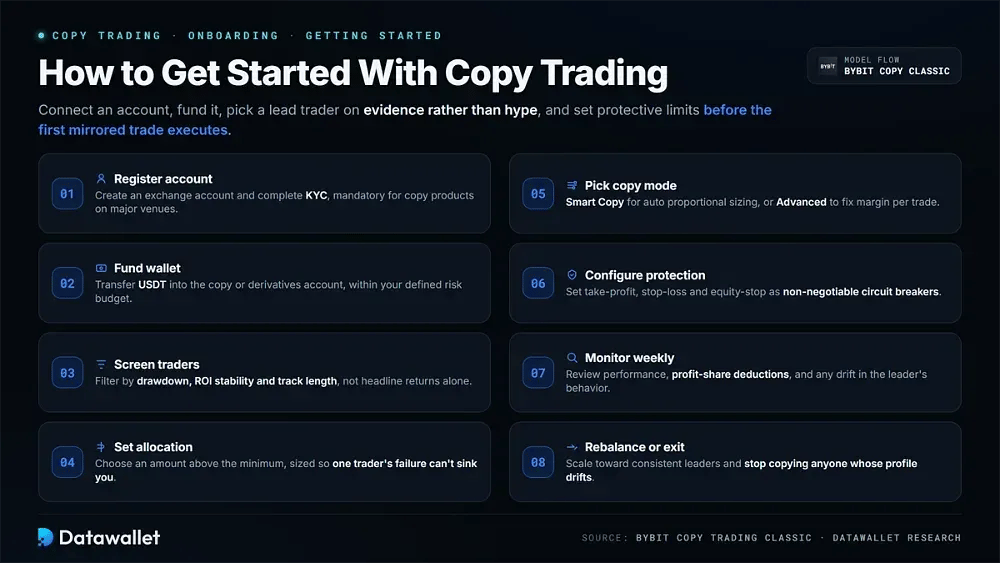
Starting with copy trading means connecting an account, funding it, selecting a lead trader on evidence rather than hype, and configuring protective settings before the first mirrored trade ever executes on your behalf.
Here is the standard workflow, using Bybit's Copy Trading Classic follower process as the model:
- Register account: Create an exchange account and complete identity verification, since KYC is mandatory for copy trading products on major venues.
- Fund wallet: Transfer USDT into the designated copy trading or derivatives account, keeping the amount within your defined risk budget.
- Screen traders: Filter the leaderboard by drawdown, ROI stability, and track-record length rather than sorting by headline returns alone.
- Set allocation: Choose an investment amount above the platform minimum, sized so one trader's failure cannot damage your overall portfolio.
- Pick copy mode: Select Smart Copy for automatic proportional sizing or Advanced mode to fix margin per trade manually.
- Configure protection: Define take-profit, stop-loss, and equity-stop thresholds before confirming, treating them as non-negotiable circuit breakers.
- Monitor weekly: Review copied performance, profit-share deductions, and whether the leader's behavior still matches the profile you originally selected.
- Rebalance or exit: Scale allocations toward consistent leaders and stop copying anyone whose risk profile drifts from their history.
How to Choose a Lead Trader Worth Copying
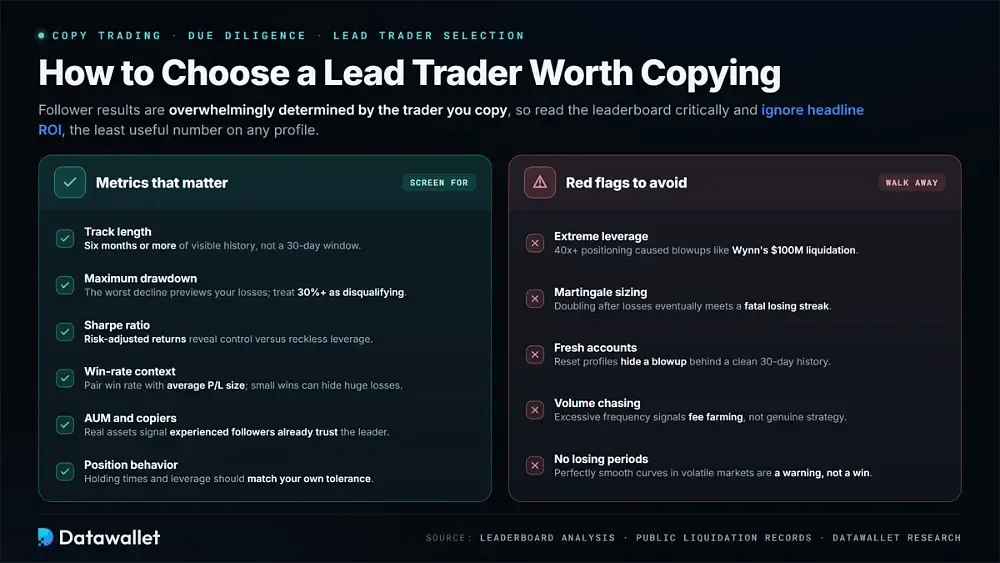
Platform choice matters less than most reviews admit, because follower results are overwhelmingly determined by the quality of the trader being copied. Learning to read a leaderboard critically, rather than trusting headline numbers, is the single highest-value skill a copier can develop.
Metrics That Actually Matter
Headline ROI is the least useful number on any trader profile, since short leveraged streaks can print spectacular returns right before catastrophic drawdowns. Evaluating leaders requires digging into the statistics that reveal how returns were generated.
Focus your screening on these indicators before allocating any capital:
- Track length: Prefer six months or more of visible history, since 30-day windows reveal luck far more often than skill.
- Maximum drawdown: A leader's worst historical decline previews your potential losses, so treat anything above 30% as disqualifying.
- Sharpe ratio: Risk-adjusted return metrics expose whether profits came from controlled positioning or reckless leverage spikes.
- Win-rate context: Pair win rate with average profit-loss size, because many small wins can hide rare account-destroying losses.
- AUM and copiers: Meaningful assets under management signal that experienced followers already trust the leader with real capital.
- Position behavior: Review holding times and leverage patterns to confirm the style matches your own risk tolerance.
Red Flags That Disqualify a Leader
Certain patterns reliably precede follower losses, and spotting them early costs nothing compared to learning them with real capital. Most damaging leaders share recognizable habits visible directly in their public statistics.
Walk away whenever you notice any of these warning signs:
- Extreme leverage: Consistent 40x-plus positioning produced disasters like James Wynn's $100 million liquidation, and followers inherit that exposure.
- Martingale sizing: Doubling position size after losses eventually meets a losing streak that no follower account survives.
- Fresh accounts: Leaders who reset profiles after blowups hide their true history behind a clean 30-day window.
- Volume chasing: Excessive trade frequency often signals fee farming or profit-share gaming rather than genuine strategy.
- No losing periods: Perfectly smooth equity curves in volatile markets suggest unsustainable risk or misleading reporting.
Copy Trading Fees and Profit Sharing Explained
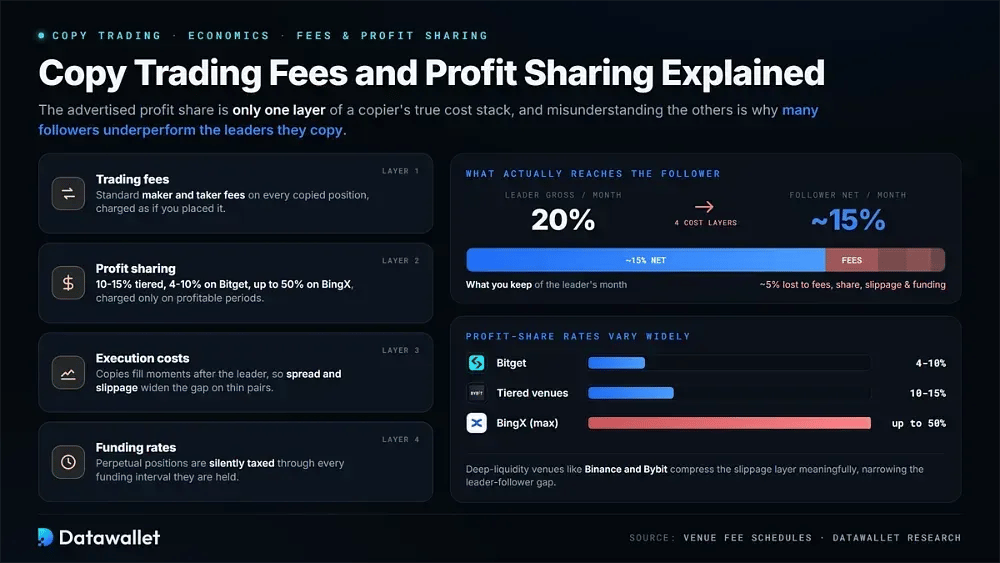
The advertised profit share is only one layer of a copier's true cost stack, and misunderstanding the others is why many followers underperform the leaders they copy. Every copied position carries the platform's standard maker and taker fees, charged exactly as if you had placed the trade yourself.
Profit sharing then applies on top, typically 10-15% of net gains at tiered venues, 4-10% on Bitget, and trader-set rates reaching 50% on BingX. Reputable platforms charge it only on profitable settlement periods, refunding pre-deducted amounts when a week nets out negative.
Execution costs form the third, least visible layer. Copied orders fill moments after the leader's, so spreads and slippage widen the gap between leader and follower returns, particularly on thin pairs and during volatility. Deep-liquidity venues like Binance and Bybit compress this drag meaningfully.
Funding rates complete the picture for perpetual strategies, silently taxing positions held through funding intervals. A leader's 20% gross month can realistically compress toward 15% for followers after all four layers, which is why cost structure deserves as much scrutiny as the trader selection itself.
Are There Decentralized Crypto Copy Trading Platforms?
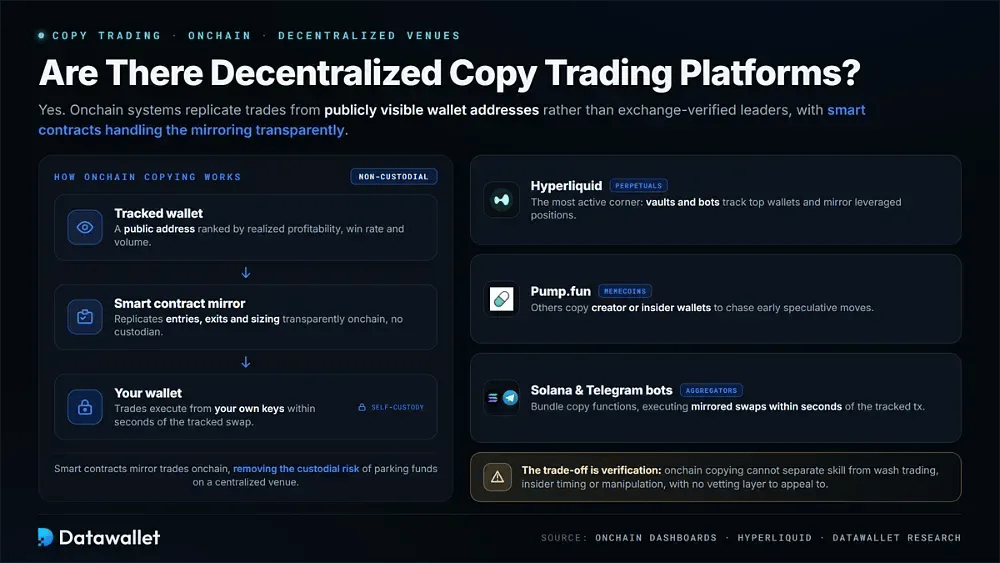
Yes, decentralized copy trading exists, generally structured as onchain systems that replicate trades from publicly visible wallet addresses rather than exchange-verified leaders. Smart contracts handle the mirroring transparently onchain, removing the custodial risk that comes with parking funds on a centralized venue.
The most active corner is perpetuals copying on Hyperliquid, where vaults and bots track top wallets and mirror entries, exits, and sizing across leveraged markets. Others monitor memecoin venues like Pump.fun, copying creator or insider wallets to chase early speculative moves.
Wallet-tracking tools have matured alongside this trend, with public dashboards ranking onchain traders by realized profitability, win rate, and volume stability. Solana aggregators and Telegram trading bots now bundle copy functions directly, executing mirrored swaps within seconds of the tracked wallet's transaction.
The trade-off is verification. Onchain copying cannot easily separate genuine skill from wash trading, insider timing, or manipulative wallet behavior, and there is no platform vetting layer to appeal to. Rigorous wallet filtering is essential before automating any capital behind an anonymous address.
Risks of Using Copy Trading in Crypto
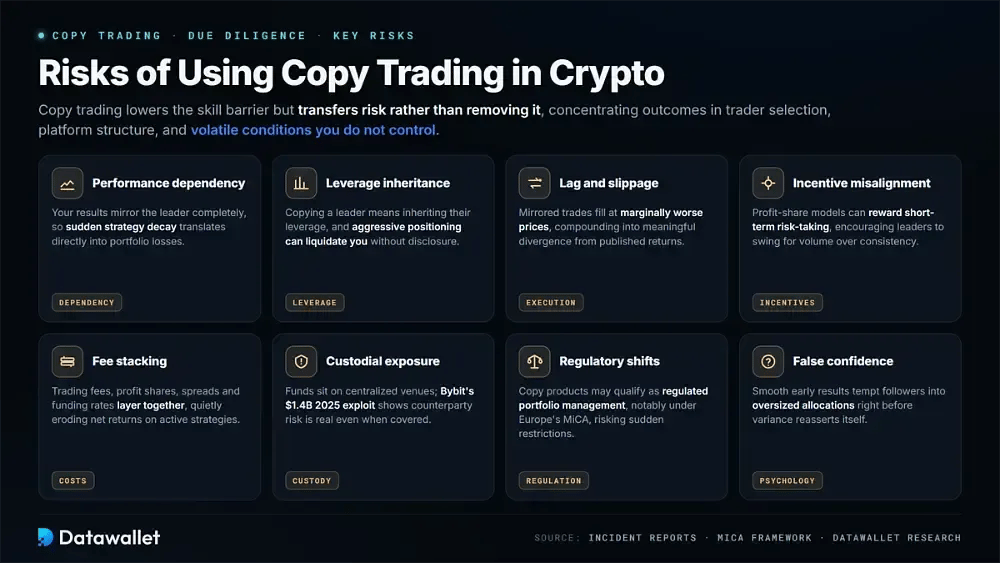
Copy trading lowers the skill barrier but transfers risk rather than removing it, concentrating outcomes in trader selection, platform structure, and volatile market conditions that the follower ultimately does not control.
The most consequential risks cluster around the following recurring patterns:
- Performance dependency: Follower results mirror the chosen leader completely, so sudden strategy decay translates directly into portfolio losses.
- Leverage inheritance: Copying a leader means inheriting their leverage, and aggressive positioning can liquidate followers without prior disclosure.
- Lag and slippage: Mirrored trades execute at marginally worse prices, compounding into meaningful divergence from the leader's published returns.
- Incentive misalignment: Profit-share models can reward short-term risk-taking, encouraging leaders to swing for volume over sustainable consistency.
- Fee stacking: Trading fees, profit shares, spreads, and funding rates layer together, quietly eroding net returns on active strategies.
- Custodial exposure: Funds sit on centralized venues, and incidents like Bybit's $1.4 billion 2025 exploit show counterparty risk is real even when losses are covered.
- Regulatory shifts: Copy products may qualify as regulated portfolio management in some regions, notably under Europe's MiCA framework, risking sudden service restrictions.
- False confidence: Smooth early results tempt followers into oversized allocations right before variance reasserts itself.
Final Thoughts
Copy trading in 2026 is more transparent and better tooled than it has ever been, but the fundamentals have not changed: platforms are increasingly interchangeable, while the trader you choose determines nearly everything about your outcome.
Bybit's three-product stack earns the top spot for range and execution, Bitget for roster depth and risk controls, and OKX for analytics that make honest trader selection genuinely possible. Regulated multi-asset copying keeps eToro relevant for cautious capital.
Treat copy trading as an educational supplement and diversification tool rather than passive income, size allocations so any single leader can fail without consequence, and audit your copied performance as critically as you screened the trader in the first place.
Our Methodology
We evaluated each platform by completing the full follower journey with real accounts: registering and verifying, funding a copy wallet, screening leaderboards, configuring risk settings, running live copies, and measuring how closely mirrored fills tracked the leader's entries.
Six criteria shaped the final ranking:
- Execution quality: We measured slippage between leader entries and copied fills across liquid and volatile sessions on each venue.
- Trader transparency: We compared leaderboard depth, track-record length, and whether risk-adjusted metrics like Sharpe ratios were disclosed.
- Risk controls: We assessed per-trader stop-losses, loss caps, equity stops, and how independently each copied allocation could be protected.
- Cost structure: We stacked profit shares, trading fees, spreads, and funding to estimate the realistic drag on follower returns.
- Copy flexibility: We tested mode options, minimums, multi-trader support, and how easily allocations could be adjusted or exited.
- Platform integrity: We weighed proof-of-reserves publication, regulatory standing, incident history, and how transparently past issues were handled.
Copy trading products evolve quickly as exchanges compete on features and fees, so our testing cycle ran from February through June 2026, with figures verified against each platform's published fee schedules and help documentation.