







Can I Buy USDT in Saudi Arabia?
Yes, with a caveat. No Saudi law bans crypto, and none authorises it. A 2018 standing committee led by the CMA, with the Saudi Central Bank (SAMA), declared virtual-currency trading unregulated and confirmed no party in the Kingdom is licensed to deal in it. The warning still holds in 2026.
It targets unlicensed brokerage and the marketing of crypto schemes, not the resident buying USDT for their own account. Private ownership falls in a gap no statute fills, so retail buyers face no penalty while local exchanges stay unlicensed.
The Kingdom still has no licensed exchange and no digital-asset rulebook, though a CMA-led framework is widely expected in 2026. Until it lands, Saudis reach USDT through offshore platforms that accept Saudi ID and SAR, with no local protection behind the trade.
How to Buy Tether (USDT) in Saudi Arabia
We fund a verified Bybit account in SAR, using P2P as the main rail and a mada card as backup. Verification needs a National ID or Iqama and a liveness check, clearing in under fifteen minutes.
When we tested One-Click Buy, the issuing bank declined the first mada top-up, common when a Saudi card hits a crypto-coded merchant. A SAR bank transfer on P2P cleared cleanly, so we default to P2P and keep the card for small, time-sensitive buys.
Steps to buy USDT on Bybit in Saudi Arabia:
- Create and verify your account: Sign up at Bybit and complete KYC with your National ID or Iqama. Match your profile name to your bank records exactly, since P2P sellers check the sender name against the transfer.
- Open the P2P market: Select Buy Crypto, then P2P Trading. Set the asset to USDT and fiat to SAR. Filter sellers by completion rate above 98% and high order count, then pick a method you hold, such as a bank transfer from Al Rajhi or SNB, STC Pay, or urpay.
- Place the order: Enter the SAR amount and confirm. The seller's USDT locks into Bybit escrow and their payment details appear.
- Send SAR and mark as paid: Transfer the exact amount through your banking app or wallet, using the seller's reference. Save the confirmation screenshot, then click Payment Completed.
- Receive your USDT: Once the seller verifies the funds, the USDT lands in your Bybit Funding Account, normally within minutes.
To skip P2P, One-Click Buy converts a mada card or Apple Pay balance into USDT in seconds at a higher cost, which suits a first small trade where speed beats price.
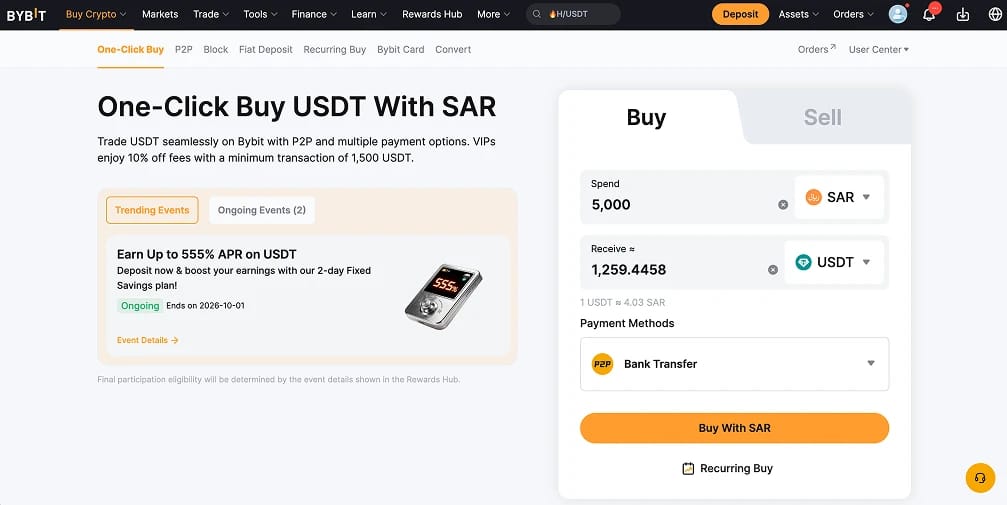
SAR to USDT Fees
Your real cost depends far more on funding method than on the headline trading fee. P2P is cheapest; cards are fastest but priciest.
Deposits
- Bank transfer via P2P (cheapest): 0% Bybit fee. You carry the seller's spread over the live USDT rate, roughly 0.3% to 1% during Saudi banking hours. SARIE transfers between local accounts are typically free for retail customers.
- STC Pay or urpay via P2P: Same zero-fee mechanics on Bybit's side. Liquidity is thinner than bank transfer, so spreads widen slightly, but settlement is near-instant.
- mada card or Apple Pay via One-Click Buy: 1% to 3% all-in once the processor markup is added, assuming the issuer clears it. Best for sub-SAR 2,000 buys needing instant USDT.
Trading and Conversion
- Spot on Bybit: 0.10% maker and 0.10% taker baseline, with VIP-tier reductions at higher volume.
- USDT withdrawal network fees: Tron (TRC20) around $1 and the default for most transfers, BNB Chain under $1, Solana under $0.10, Arbitrum and Polygon $0.10 to $0.50, Ethereum (ERC20) $1 to $10 depending on gas.
Selling Back to SAR
Selling reverses the buy. You take a sell offer on the P2P desk, the buyer sends SAR to your bank or wallet, you confirm receipt, and Bybit releases the USDT from escrow. A round trip through a bank-transfer P2P loop usually costs under 1.5% in spread, undercutting most cash money-changer markups in the Kingdom.
Best USDT Exchanges in Saudi Arabia
The table ranks the platforms Saudi residents actually use for USDT, weighted on SAR funding, regulatory standing, fees, and liquidity. For the wider picture, see our guide to the best crypto exchanges in Saudi Arabia.
The 2026 hierarchy is Bybit for the balance of liquidity, fees, and regulatory standing, Rain for buyers wanting a Gulf-licensed, Shariah-certified venue with native SAR rails, and Binance or OKX for the deepest P2P books. Gate suits users chasing assets far beyond the top 100, with a steeper learning curve.
Regulatory Status of USDT in Saudi Arabia
Saudi Arabia regulates crypto by warning, not by statute. There is no virtual-asset law, no exchange licensing regime, and no court precedent defining where USDT sits. Several authorities touch the space, each from a different angle.
The framework the CMA and SAMA are building is the signal to track. Reporting points to a regime that could license exchanges and define tax treatment for digital assets. Following the UAE model with domestic SAR on-ramps would open one of the region's largest untapped markets, given a population over 35 million with high smartphone penetration.
Until then, owning USDT is fine, running an unlicensed local exchange is not, and every retail buyer uses an offshore venue without recourse. Bybit's strongest credential here is its UAE SCA Virtual Asset Platform Operator Licence, the first full SCA approval for a crypto exchange (October 2025), on top of its EU MiCA authorisation. Neither is Saudi, since none exists, but both place it under real supervision in jurisdictions that trade heavily with the Kingdom.
Tax Implications of USDT in Saudi Arabia
Saudi Arabia offers one of the G20's most favourable positions for individual crypto holders, mainly because it levies no personal income tax.
- No personal income tax or capital gains tax. Individuals pay nothing on profit from buying, holding, or selling USDT, whether Saudi nationals, GCC citizens, or expats on an Iqama. ZATCA collects no personal income tax because the Kingdom imposes none.
- Zakat applies to Saudi and GCC nationals. The 2.5% annual charge on assessable wealth can capture crypto that meets the Nisab threshold and is held for a full lunar year (hawl), under most contemporary scholarly opinions. It is a religious obligation ZATCA facilitates, not a tax on gains.
- VAT does not hit pure trades. VAT at 15% covers services like exchange fees, but most practitioners treat buying or swapping USDT for investment as outside its scope, since ZATCA has issued no binding guidance classifying crypto as goods.
- Business activity differs. Trading that rises to a commercial operation can fall under 20% corporate tax for non-GCC-owned entities, and mining or staking income counts as business revenue. Watch that line if you scale.
- Keep records anyway. Zero tax on gains is not zero documentation. With a reporting framework on the horizon and AML rules already covering digital funds, a clean record of SAR-denominated buys and sells is worth holding.
For active users: the absence of capital gains tax is real, but anyone running business-like volume, or holding through a company, should consult a ZATCA-certified adviser before assuming the activity is tax-free. This is general information, not tax advice.
Why Saudis Use USDT
USDT demand looks different in Saudi Arabia because of the riyal itself. The currency has held its peg to the US dollar at 3.75 since 1986, backed by SAMA reserves above $400 billion, and it has never broken. The depreciation hedge that drives stablecoin demand in Turkey, Kazakhstan, or Egypt does not apply here. Saudi demand has other roots.
- Remittances. The largest driver. Around three-quarters of the labour force is foreign, and expats sent home roughly SR 98.6 billion in the first seven months of 2025, with monthly outflows often above $3.4 billion. For workers sending to India, Pakistan, the Philippines, Bangladesh, or Egypt, a USDT transfer over Tron settles in minutes for about a dollar, competing with money-changer rates and clearing faster than some corridors, especially where recipients want dollars.
- Access to global crypto markets. With no licensed local exchange, USDT is the entry point to almost everything. Nearly every non-fiat pair on a global venue is quoted against it, so a Saudi wanting exposure beyond large-cap coins needs USDT as the base currency first.
- Yield on idle dollars. Exchange earn products on USDT commonly quote 4% to 8% APY on flexible deposits, well above local SAR savings rates. For Saudis already holding dollars, that spread pulls. Our guide to stablecoin interest rates shows where those yields come from.
- Dollar access without a USD bank account. A dedicated USD account carries minimums and paperwork at most Saudi banks. USDT delivers self-custodied dollar exposure without it, which matters most for the large, lightly banked expat segment.
Crypto adoption in the Kingdom already ranks among the highest in MENA, with Chainalysis estimating well over ten million Saudi users. The pull is access and utility, not currency fear, and that distinction is what most generic guides to this market miss.
Final Thoughts
Bybit is where we land for Saudi USDT buyers in 2026. It combines the deepest practical SAR-to-USDT liquidity among global venues, a clean interface for first-time buyers, low spot fees, and the strongest regulatory footing reachable from the Kingdom through its UAE SCA licence and EU MiCA authorisation. In a market with no local oversight, that weighs heavily.
For buyers placing Gulf licensing and Shariah certification above asset selection, Rain is the considered alternative, regulated by the Central Bank of Bahrain with native SAR pairs. Binance and OKX stay strong for anyone optimising purely for P2P depth.
The picture should shift once the CMA's digital-asset framework lands, potentially bringing licensed local exchanges and SAR on-ramps that do not route offshore. Until then the playbook holds: pick a platform with real regulatory standing, run a small first trade to confirm your funding clears, verify P2P counterparties carefully, and keep records even though the tax on personal gains is currently zero.
%2520in%2520Saudi%2520Arabia.webp)