







Can I Buy Tether (USDT) in Belarus?
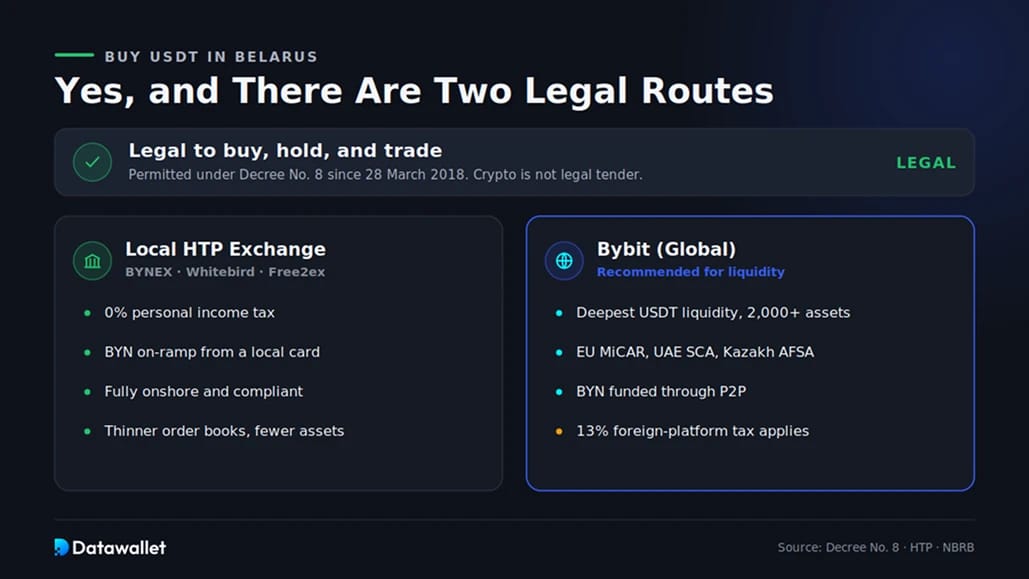
Yes. Buying, holding, and trading USDT is legal in Belarus, and has been since Decree No. 8 "On the Development of the Digital Economy" took effect on 28 March 2018. The decree legalised mining, trading, and exchanging tokens, treating them as property. Tokens are not legal tender, but individuals can own and trade them freely.
The catch is how you trade. Decree No. 367, in force since 20 September 2024, requires HTP-resident individuals and entrepreneurs to buy and sell crypto only through Belarusian HTP-resident exchanges. The stated aim was curbing capital flight, and the direction is clear: the state wants retail activity on licensed onshore venues like BYNEX, Whitebird, Dzengi, and Free2ex.
That pressure showed in December 2025, when the Ministry of Information added Bybit, OKX, Bitget, BingX, and Gate to the national restricted list under the Mass Media Act. Binance and KuCoin were left off. Bybit's block lifted within about a day, so it is reachable again, but the signal was unmistakable.
So in 2026: USDT is legal, the tax-free path is a local HTP exchange, and Bybit is the regulated global venue most active traders use once they outgrow local order books.
How to Buy USDT in Belarus
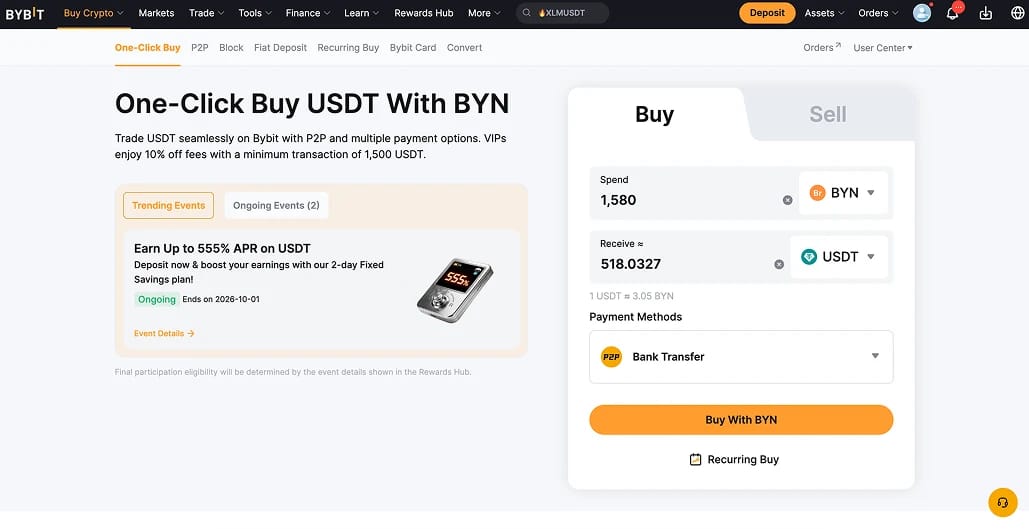
The realistic setup is a Bybit account funded via P2P, since Bybit offers no direct BYN bank deposit. This matters in Belarus, where locally issued Visa and Mastercard cards no longer work reliably for foreign payments after repeated EU sanctions. A P2P trade settling in BYN by local bank transfer sidesteps that.
The first time I ran a P2P order, the name field caught me out. Your Bybit profile name has to match the bank account you send rubles from. A mismatch lets the merchant cancel and refund, which on a local transfer takes a day or two to unwind.
Steps to buy USDT on Bybit via P2P in Belarus:
- Create a Bybit account and complete KYC. Register at Bybit and verify with your Belarusian passport or ID. Since the December 2025 episode, the mobile app is the more dependable access point.
- Add your BYN payment method. In P2P settings, add the local bank or card you will pay from (local transfer and BELKART-linked accounts are most accepted). Confirm the profile name matches your bank records exactly.
- Open the P2P market. Choose Buy, set the asset to USDT and currency to BYN. Sort merchants by completion rate, pick a high score with a payment method you hold, and enter your ruble amount.
- Pay the merchant in BYN. Send the exact amount from your bank app to the order details, mark it paid, and upload the receipt. Never release before you have saved proof of payment.
- Receive your USDT. The merchant confirms the transfer and releases USDT to your Funding Account, usually within minutes. From there you can trade, hold, or withdraw on-chain.
Many Belarusians use a second path on purpose. Buy USDT for BYN on a local HTP exchange like BYNEX or Whitebird, where the ruble on-ramp runs off a domestic card at 0% tax, then move that USDT to Bybit for the depth and pairs local books lack. One network fee keeps the fiat leg onshore.
BYN to USDT Fees
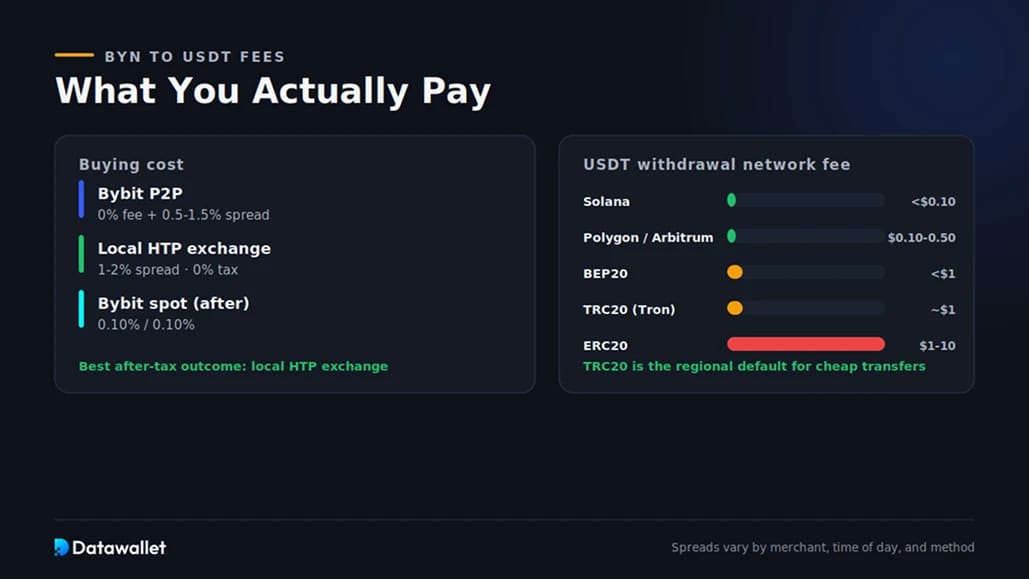
Belarus has an unusual fee picture, because the cheapest headline rate and the cheapest after-tax outcome sit on different venues. Here is how costs stack up.
Buying USDT
- Bybit P2P (best for liquidity): 0% Bybit fee on both sides. Your real cost is the merchant spread against the live rate, typically 0.5% to 1.5% by time of day and method. No deposit fee applies.
- Local HTP exchange (best for tax): BYNEX and Whitebird price as exchangers, so a fixed quote (generally a 1% to 2% spread) shows before you confirm. BYN settles via local cards, BELKART, and ERIP, and individual gains are taxed at 0%.
- Bybit spot (after you hold USDT): 0.10% maker and 0.10% taker, lower with VIP tiers and the platform token discount.
On-Chain Withdrawal Network Fees
- TRC20 (Tron): around $1, the standard choice for moving USDT cheaply across the region.
- BEP20 (BNB Chain): under $1.
- Solana (SPL): under $0.10.
- Polygon and Arbitrum: roughly $0.10 to $0.50.
- ERC20 (Ethereum): $1 to $10 depending on gas.
Off-Ramp Back to BYN
Selling USDT back to rubles favours the local exchanges. Whitebird converts USDT straight to a Belarusian bank card, and because the payment arrives from a regulated exchange rather than a private person, it draws less scrutiny than a P2P transfer. A local round trip runs roughly 1% to 2.5%, still beating parallel-market dollar spreads.
Best USDT Exchanges in Belarus
The table below ranks the top crypto exchanges in Belarus for USDT, weighted on BYN funding access, legal standing, fees, and liquidity.
The 2026 hierarchy: Bybit for liquidity and reach, a local HTP exchange like BYNEX or Whitebird for the tax-free ruble leg, and Binance as the second global venue that, unlike Bybit, escaped the December 2025 block.
Regulatory Status of USDT in Belarus
Belarus has one of the region's oldest crypto frameworks and, by 2026, one of its stricter enforcement postures. The system rests on Decree No. 8 (2017) and the Hi-Tech Park regime, overseen jointly by the HTP administration and the National Bank of the Republic of Belarus (NBRB).
Three developments define the current environment:
- Decree No. 367 (September 2024) required HTP-resident individuals and entrepreneurs to transact only through HTP-resident exchanges, pushing the retail market onshore. The government called it an anti-capital-flight measure.
- The December 2025 blocks added Bybit, OKX, Bitget, BingX, and Gate to the national restricted list under the Mass Media Act. None held HTP status, the common thread being that the state is steering volume to licensed local operators. Binance and KuCoin were untouched, and Bybit's block reversed within about 24 hours.
- Decree No. 19 (January 2026) created a framework for crypto banks, joint-stock firms combining token services with banking under dual NBRB and HTP supervision. The direction is deeper integration of crypto into formal finance, inside the HTP perimeter.
USDT trades freely on both local HTP and global venues. What differs is supervision and tax, not legality. An HTP-resident exchange is the cleanest position an individual can hold. A foreign platform is allowed for most users but carries reporting and tax duties, and HTP residents face the Decree No. 367 restriction directly.
Tax Implications of USDT in Belarus
Here Belarus diverges from its crypto-friendly reputation, and the choice of exchange carries a direct cost.
- 0% on HTP-resident exchanges. Individuals pay no personal income tax on crypto transactions through HTP-resident companies like BYNEX, Whitebird, Dzengi, and Free2ex. This exemption is how the state keeps activity onshore.
- 13% on foreign platforms. Since 1 January 2025, gains from foreign-platform crypto transactions face 13% personal income tax with an annual declaration. Trading USDT on Bybit falls here, so depth comes with a tax line the local exchanges avoid.
- HTP business rates apply to operators. HTP-resident companies pay 9% profit tax on crypto, against 20% to 25% for non-residents. These HTP benefits run through 2049, which is why the local exchange ecosystem is stable.
- Onshore venues feed the audit trail. Local HTP exchanges report to the NBRB and HTP, so their records reach authorities through formal channels. The 0% rate is a real exemption, not a reason to skip declarations.
💡 For active users: trading on Bybit, keep its transaction history and plan for the 13% line and the annual declaration. For 0% treatment, keep buying and selling on an HTP-resident exchange. A Belarusian tax adviser on the post-2025 rules is worth consulting before you scale. This is general information, not personal tax advice.
Why Belarusians Hold USDT
USDT demand in Belarus owes less to currency collapse than people assume. The ruble has held relatively firm against the dollar into 2026, near 2.7 to 2.9 BYN per USD with inflation around 5.6%. The pressures are structural, and three stand out.
- Sanctions and financial isolation. The dominant driver. Several Belarusian banks are cut from SWIFT, and locally issued Visa and Mastercard cards no longer work reliably across the EU, UK, and US. For a population walled off from Western rails, a TRC20 USDT transfer that settles in seconds for about a dollar is the practical way to hold and move value abroad.
- Cross-border trade and remittance. Belarus runs deep corridors with Russia, China, and Turkey. With traditional rails slow, costly, or closed, USDT has become a standard settlement layer, and tools like Whitebird that convert USDT to a Russian card while avoiding private-transfer blocks have made the corridor usable.
- Dollar access and savings. A dollar account at a Belarusian bank carries minimums and friction, and the ruble's long decline (down about 28% against the dollar over a decade) keeps demand for a stable dollar proxy. USDT is the cheapest way to hold dollars without a bank's gatekeeping.
The government's enforcement push is the clearest proof of how much USDT is used here. You do not write anti-capital-flight decrees around an asset nobody touches.
Final Thoughts
Bybit is where I would point a serious Belarusian trader first. An EU MiCAR licence, a full UAE SCA licence, and a Kazakh AFSA licence, paired with deep USDT liquidity and a Russian-language interface, give it a footing no other globally accessible exchange offers Belarusians. BYN funds through P2P, sidestepping the sanctioned-card problem, and the platform is supported for Belarusian users, not restricted.
The honest playbook uses both. For the lowest tax and cleanest legal position, run buying and selling through an HTP-resident exchange like BYNEX or Whitebird and accept thinner order books. For liquidity, asset range, and a real toolkit, use Bybit, keep records for the 13% tax, and treat the app as your main access point. Many Belarusians run both: local exchange for the ruble leg, Bybit for the rest.
The framework keeps moving, with Decree No. 19's crypto banks due in 2026 and the state intent on keeping volume onshore. For now, the two-track approach above is the one that holds up.
%20(1).webp)