



Who is Tarek Mansour?
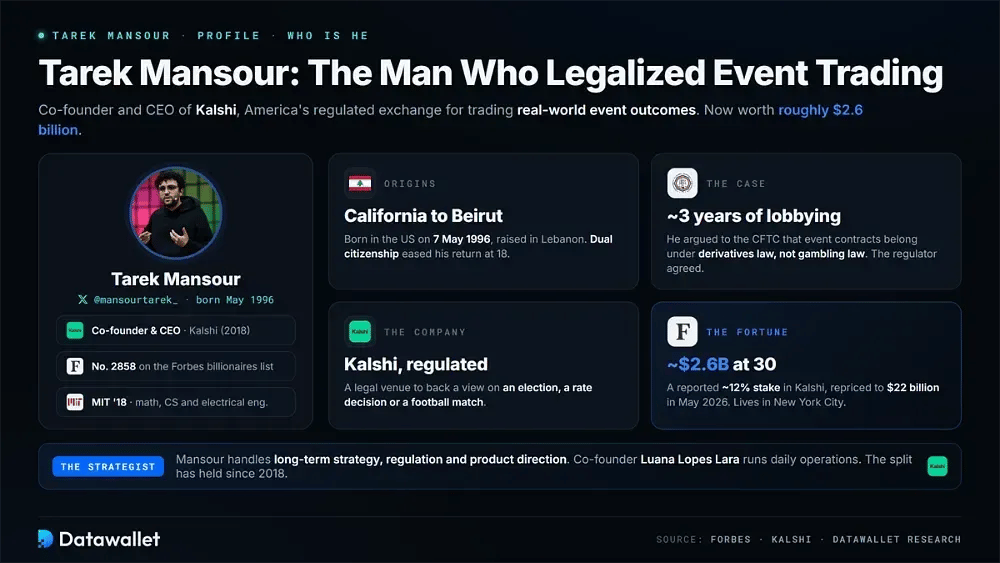
Tarek Mansour is the co-founder and chief executive of Kalshi, an American exchange for buying and selling contracts on future events. In practical terms, it gives people a legal venue to back a view on an election, an interest rate decision or a football match.
He was born in California and raised in Lebanon before returning to the United States to attend MIT. Mansour then spent nearly three years making the case to the Commodity Futures Trading Commission that event contracts should fall under derivatives law rather than gambling law.
At Kalshi, he oversees long-term strategy, regulation and product direction. Co-founder Luana Lopes Lara handles daily operations. Forbes ranks him number 2858 on its billionaires list.
Mansour keeps his family life private, lives in New York City and posts commentary on X as @mansourtarek_.
Tarek Mansour's Background
Mansour's route to Kalshi began in a Beirut classroom, continued through MIT and two of finance's most competitive trading desks, then led to the exchange he spent years making legal.
Early Life and Education
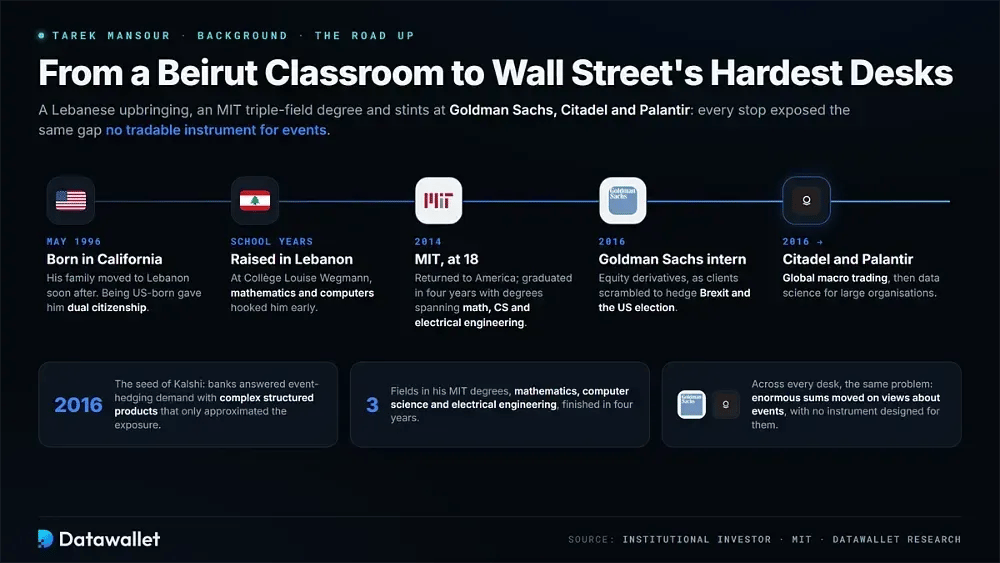
He was born in California on 7 May 1996. His family moved to Lebanon soon afterwards, where he attended Collège Louise Wegmann. Being born in California gave him dual citizenship and made his later return easier.
Mathematics and computers interested him from an early age. In 2014, he moved back to America to attend MIT, graduating four years later with degrees spanning mathematics, computer science and electrical engineering.
Trading Desks and the Hedging Gap
The idea behind Kalshi emerged during an equity derivatives internship at Goldman Sachs in 2016. Institutions wanted protection against Brexit and the American presidential race. Banks responded by selling complex structured products that only approximated those exposures.
Mansour later traded global macro at Citadel and worked at Palantir, applying data science to large organisations. Across those desks, he saw the same problem: enormous sums moved on views about events, yet there was no tradable instrument designed for them.
How Did Tarek Mansour Create Kalshi?
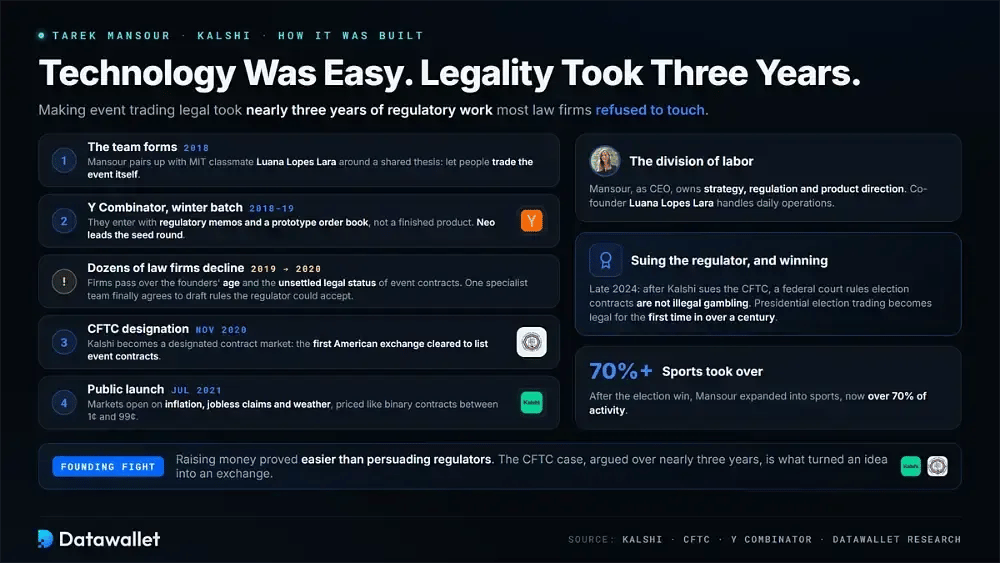
Technology was not the main obstacle. Before Kalshi could list a single contract, making event trading legal required nearly three years of regulatory work.
Mansour teamed up with MIT classmate Luana Lopes Lara in 2018. That winter, they entered the Y Combinator accelerator programme with regulatory memos and a prototype order book rather than a finished product, and Neo led their seed round.
Raising money proved easier than persuading regulators. Dozens of law firms refused the work because of the founders' age and the unsettled legal status of event contracts. Eventually, one specialist team agreed to draft rules the regulator could accept.
The process resulted in Kalshi receiving designation as a contract market in November 2020. That made it the first American exchange cleared to list event contracts. The platform opened to the public the following July with markets covering inflation, jobless claims and weather.
Winning the Election Contracts Fight
Kalshi's commercial breakthrough came after the company sued its own regulator. In late 2024, a federal court ruled that election contracts did not constitute illegal gambling, forcing the agency to abandon its opposition.
For the first time in more than a century, presidential election trading became legal. Volume surged through that November's vote. Mansour then expanded into sports, which now accounts for more than 70% of activity on the platform.
Tarek Mansour's Net Worth in 2026
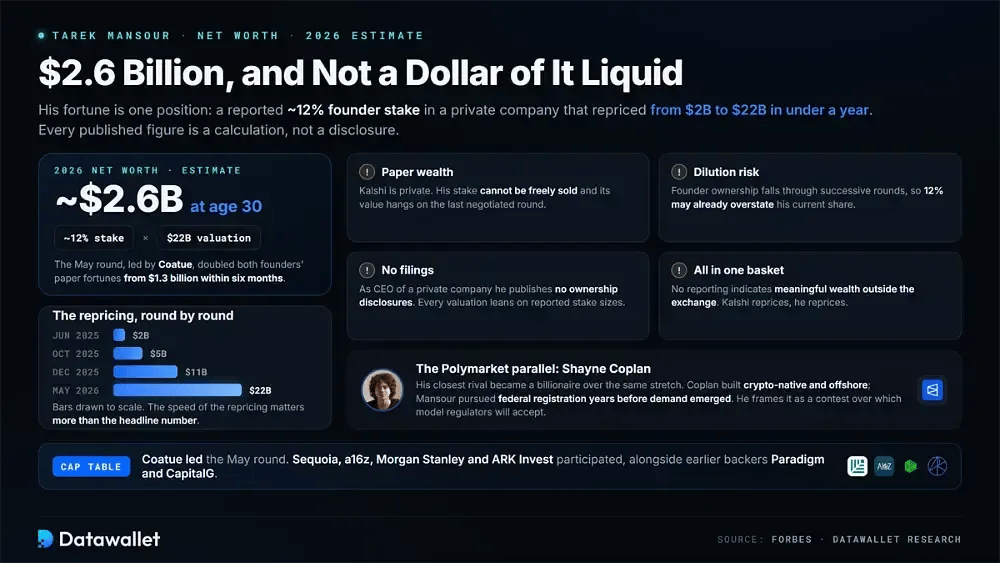
Tarek Mansour's net worth is estimated at roughly $2.6 billion in 2026. Almost all of it is tied to his stake in a private company rather than assets he can readily sell. None of the published figures is a disclosure; each is a calculation.
His fortune rests on a handful of documented inputs:
- Founder equity: Forbes estimates that he owns close to 12% of Kalshi, with no reporting indicating meaningful wealth outside the exchange.
- Latest valuation: The May funding round priced Kalshi at $22 billion, doubling both founders' paper fortunes from $1.3 billion within six months.
- Investor roster: Coatue led the round. Sequoia Capital, Andreessen Horowitz, Morgan Stanley and ARK Invest also participated, alongside earlier backers Paradigm and CapitalG.
- Paper wealth: Because Kalshi remains private, Mansour cannot freely sell his holding, and its value depends on the most recent negotiated funding round.
- Dilution risk: Founder ownership normally falls through successive funding rounds, so the 12% estimate may already overstate his current stake.
- No filings: As chief executive of a private company, Mansour publishes no ownership disclosures. Any valuation therefore depends on reported stake sizes.
More significant than the headline number is the speed of Kalshi's repricing. The company was valued at $2 billion in June 2025, rose to $5 billion by October and reached $11 billion in December before doubling again in the spring.
Comparing Mansour and Coplan
Mansour's closest rival is Shayne Coplan of Polymarket, who became a billionaire over a similar period. Mansour describes their competition as a contest over which model regulators and institutions will ultimately accept.
Their structures developed in opposite directions. Coplan built a crypto-native platform that settled in stablecoins and operated offshore before entering America. Mansour, by contrast, pursued federal registration years before demand emerged. Our Polymarket versus Kalshi comparison explains the practical differences.
What Is Driving Kalshi's Growth?
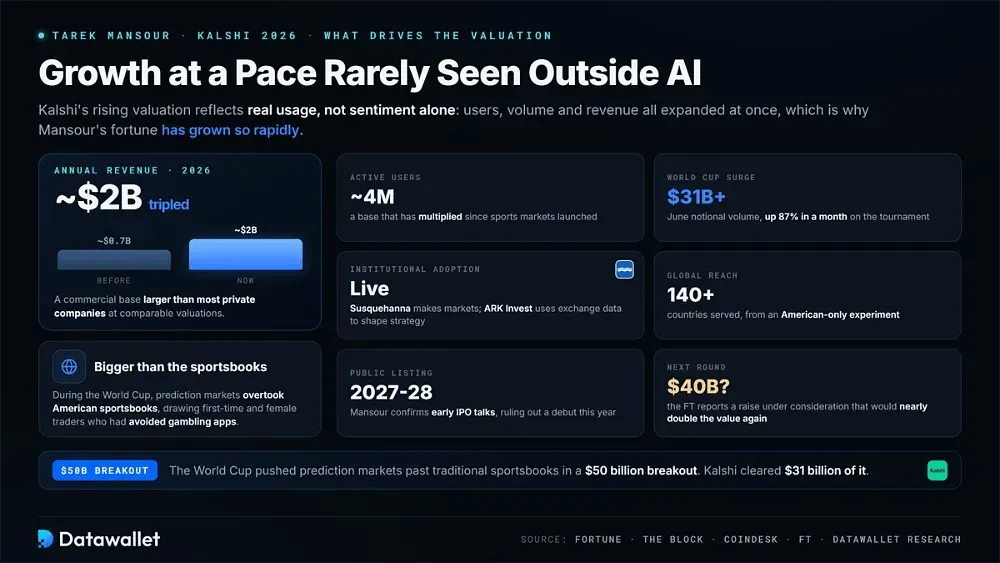
Kalshi's rising valuation reflects real usage rather than sentiment alone, helping explain why Mansour's fortune has grown so rapidly. User numbers, volume and revenue have all expanded at a pace rarely seen outside artificial intelligence.
Several forces are pushing the business forward:
- Revenue scale: Revenue tripled to around $2 billion, giving the exchange a commercial base larger than most private companies at comparable valuations.
- User base: Kalshi reports roughly four million active users. That base has multiplied since the platform introduced sports markets.
- World Cup surge: During June, the exchange cleared more than $31 billion in notional volume, an 87% monthly increase driven by the World Cup.
- Sportsbook crossover: Prediction markets overtook American sportsbooks during that period. They also attracted first-time and female traders who had previously avoided gambling apps.
- Institutional adoption: Susquehanna acts as a market maker and provides liquidity. ARK Invest uses exchange data to shape strategy and request new markets.
- Global reach: The platform, which started as an American-only experiment, is now available to traders in more than 140 countries.
- Public listing: Mansour has confirmed early IPO discussions, while ruling out a debut this year and pointing instead to 2027 or 2028.
This summer, the Financial Times reported that Kalshi was considering a new capital raise at a $40 billion valuation. Such a round would nearly double the company's value again within months.
The Brazil Expansion
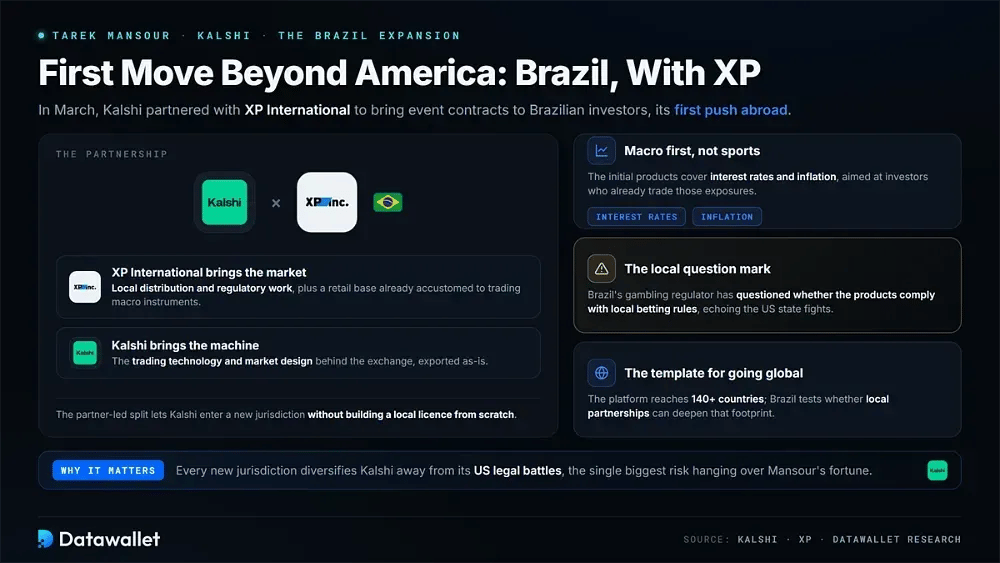
Kalshi made its first move beyond America in March through a partnership with XP International that brings event contracts to Brazilian investors. XP is responsible for local distribution and regulatory work; Kalshi provides the trading technology and market design.
The initial products focus on interest rates and inflation rather than sports. They target a retail investor base already accustomed to trading macroeconomic instruments. Brazil's gambling regulator has questioned whether the products comply with local betting rules.
Kalshi's Regulatory and Legal Battles
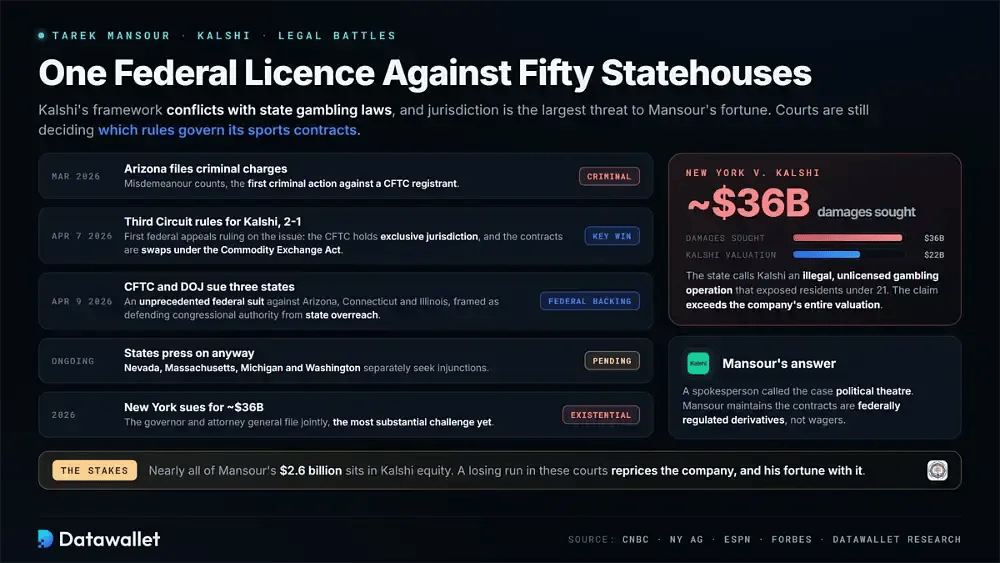
Jurisdiction poses the largest threat to Mansour's fortune. Kalshi operates under a federal licence, but that framework conflicts with state gambling laws. Courts around the country are still determining which rules govern its sports contracts.
A major victory came in April, when the Third Circuit ruled 2-1 that the Commodity Futures Trading Commission has exclusive jurisdiction over those contracts. It was the first federal appeals ruling on the issue and treated the contracts as swaps under the Commodity Exchange Act.
Federal agencies then pursued action of their own. The regulator and the Department of Justice sued Arizona, Connecticut and Illinois, an unprecedented move framed as a defence of congressional authority against state overreach.
States continued enforcement anyway. Arizona filed criminal misdemeanour charges in March, marking the first such action against a CFTC registrant. Nevada, Massachusetts, Michigan and Washington separately sought injunctions.
The New York Lawsuit
New York mounted the most substantial challenge by suing Kalshi. The attorney general described the platform as an illegal, unlicensed gambling operation that exposed residents below the state's legal betting age of 21 to financial harm.
According to court filings, the state is seeking roughly $36 billion in damages, more than Kalshi's entire valuation. A company spokesperson called the case political theatre. Mansour continues to argue that the contracts are federally regulated derivatives.
Criticisms Around Tarek's Kalshi
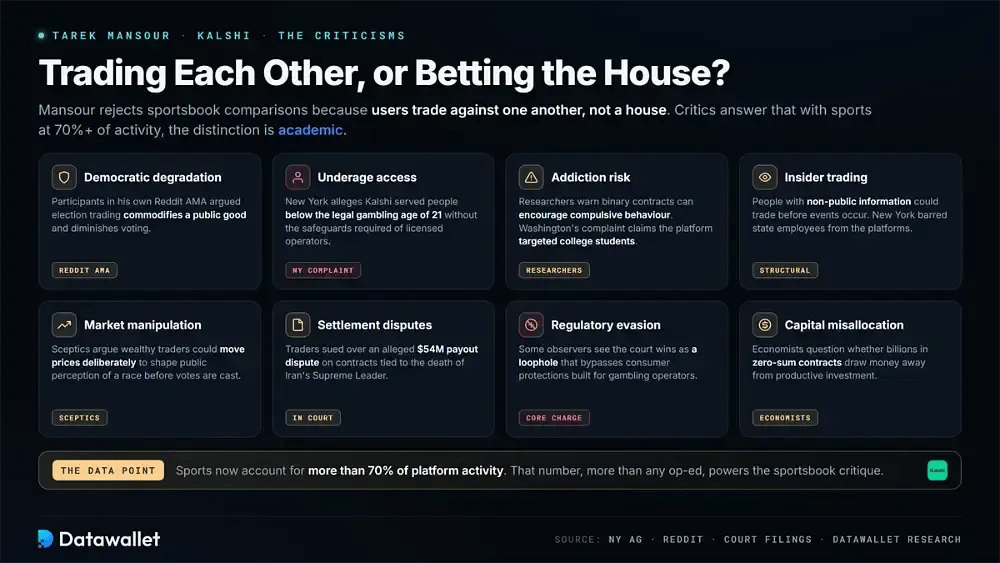
Mansour rejects comparisons with sportsbooks because Kalshi users trade against one another rather than against a house that sets the odds. Critics respond that sports now account for most platform activity, leaving the distinction academic in the eyes of regulators and consumer advocates.
Recurring ethical and legal objections include:
- Democratic degradation: Participants in a Reddit AMA argued that election trading commodifies a public good and diminishes voting.
- Underage access: New York alleges that Kalshi served people below the state's legal gambling age without applying the safeguards required of licensed operators.
- Addiction risk: Researchers warn that binary contracts can encourage compulsive behaviour. Washington's complaint also claimed that the platform targeted college students.
- Insider trading: Officials worry that people with non-public information could trade before events occur, leading New York to bar state employees from using these platforms.
- Market manipulation: Sceptics argue that wealthy traders could intentionally move prices to influence public perceptions of an electoral race before votes are cast.
- Settlement disputes: Traders sued over an alleged $54 million payout dispute involving contracts on the death of Iran's Supreme Leader, raising questions about resolution criteria.
- Regulatory evasion: Some observers view Kalshi's court victories as a loophole that bypasses consumer protections created for gambling operators.
- Capital misallocation: Economists have questioned whether directing billions into zero-sum contracts draws money away from productive investment.
Final Thoughts
Mansour turned a dorm-room observation about poorly priced risk into a $22 billion exchange. Before his thirty-first birthday, his personal stake was worth roughly $2.6 billion.
Much of that value depends on a single unresolved issue. Kalshi's valuation assumes that federal preemption will survive, while judges are still deciding whether its contracts qualify as derivatives or amount to bets in legal disguise.
The regulatory patience that allowed Kalshi to exist has become its defining asset. If preemption holds, Mansour has effectively written the rulebook for a new asset class. If it fails, America's most valuable prediction market would face fifty separate licensing problems overnight.