







Compare Top Malaysian Crypto Exchanges
1. MEXC
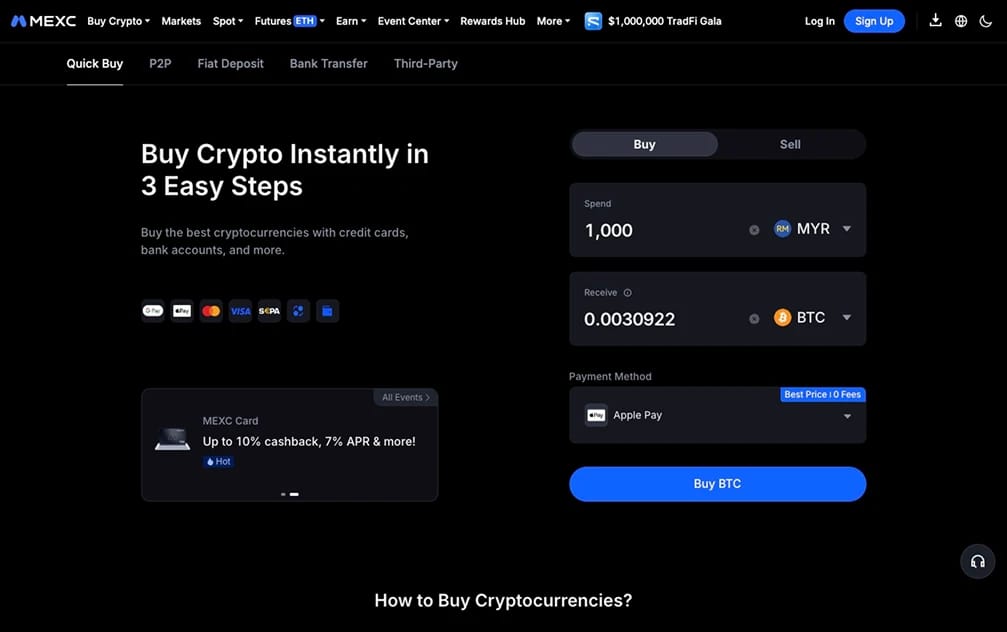
MEXC takes first place by addressing two practical concerns for Malaysian traders: affordable ringgit funding and low trading costs. Its P2P marketplace has the deepest MYR liquidity among global platforms accessible from Malaysia. Merchants accept DuitNow, FPX, Touch 'n Go, and Maybank2u, allowing ringgit to move from a local bank into a tradable balance within minutes. Card payments are available for users who prefer not to use P2P.
After funding the account, spot makers pay no trading fee, and takers pay 0.05%. That schedule undercuts every other platform in this ranking. The exchange lists more than 3,000 assets, over a hundred times the selection available on any SC-registered exchange. Futures, bots, copy trading, and demo accounts all run within the same app. Our MEXC review assesses the full product range.
The downside is that MEXC is not licensed by the SC. The regulator added MEXC Global to its Investor Alert List in September 2022 for operating without registration. Its trust measures include Merkle Tree Proof of Reserves audited by Hacken and a $100 million Guardian Fund. Investors seeking Malaysian legal protection should keep deposits and cash-outs with a registered platform, using MEXC as a low-cost trading venue.
Pros
- The deepest MYR P2P market among global exchanges, with DuitNow, FPX, Touch 'n Go, and Maybank2u transfers settling in minutes.
- Zero maker and 0.05% taker spot fees, paired with more than 3,000 listed assets, beat every competitor on cost and selection.
- Hacken-audited Proof of Reserves and a $100 million Guardian Fund provide independent support for its security claims.
Cons
- MEXC lacks an SC license and has appeared on the Investor Alert List since September 2022, leaving users outside Malaysian protections.
- Tokens can be listed quickly with limited screening, placing thin markets and volatile small caps within easy reach.
- P2P safety depends on merchant quality, making careless counterparty selection the main practical risk.
2. Kraken
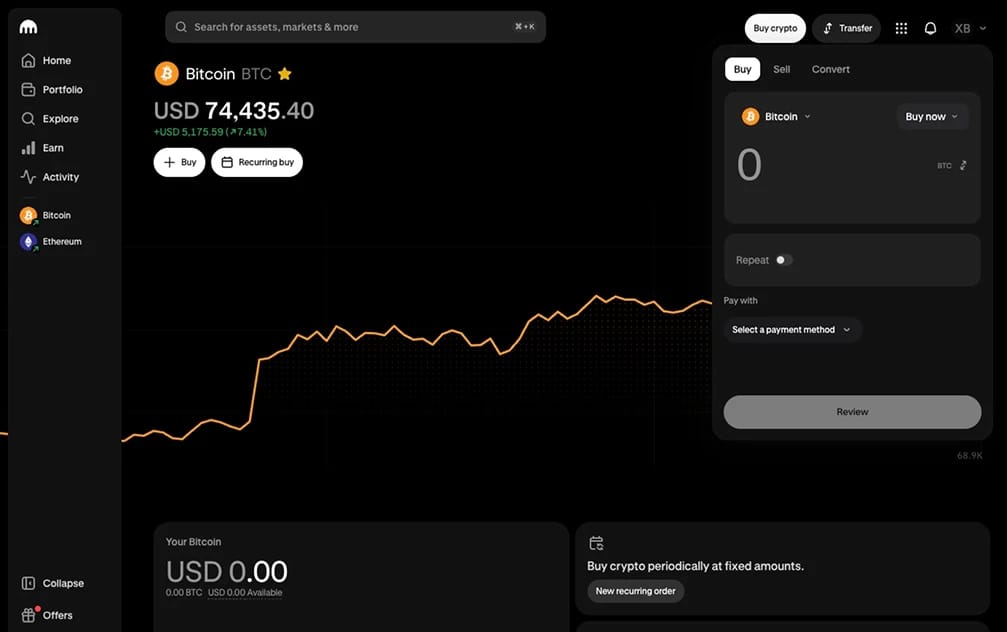
Kraken ranks second for execution quality and its security history. The platform has operated since 2011 without a major breach. Most customer funds remain offline in cold storage, while periodic Proof of Reserves attestations support reported balances. Its order books can absorb larger trades in major assets with less price movement than local exchanges, especially once an order reaches five figures in ringgit.
Base fees on Kraken Pro are 0.25% for makers and 0.40% for takers. Selected markets support up to 10x margin trading, and users also gain access to a full futures venue and a dependable API. Auto Earn pays yield on idle balances, while an OTC desk handles larger transactions. The complete product range is covered in our Kraken review.
Funding remains the main compromise. Kraken has no Malaysian bank channel, so direct ringgit purchases rely on cards with processor costs of roughly 2% to 3%. Buying USDT locally and transferring it to Kraken is the cheaper route for local investors. The additional step takes minutes rather than days and avoids the card markup.
Pros
- More than a decade of operation without a major platform breach, supported by Proof of Reserves attestations.
- Deep order books limit price impact on large BTC and ETH purchases compared with every local venue.
- Kraken Pro, margin, futures, and a robust API provide institutional-grade tools at base fees of 0.25% and 0.40%.
Cons
- Without direct MYR bank deposits, users must pay 2% to 3% by card or fund the account through a stablecoin transfer.
- Kraken has no SC registration, preventing disputes from being escalated through Malaysian channels.
- Both the interface and support are available only in English, with no Malay language setting.
3. Luno
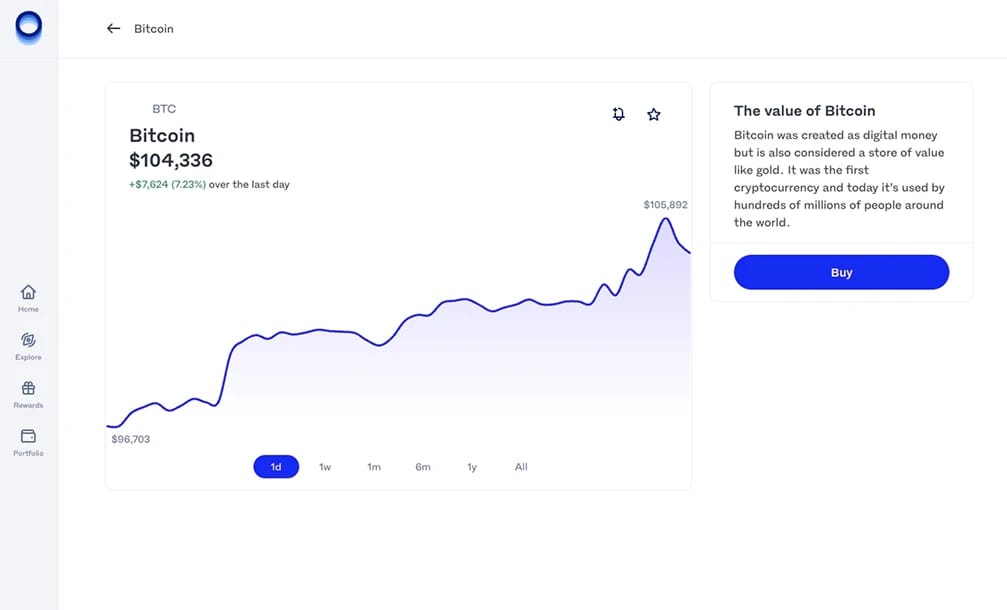
Luno is the default choice for Malaysians who want deposits, trading, and bank withdrawals handled inside the regulated system. Its regulatory footing places it third, ahead of the remaining offshore platforms. Luno has been registered with the SC as a Recognized Market Operator since 2019 and is Malaysia’s largest local exchange by market share. More than 50 cryptocurrencies trade against MYR.
Deposits made through FPX Instant Transfer or Touch 'n Go eWallet are free above RM100 and arrive immediately. Bank withdrawals cost RM0.10 and clear on the same business day. Staking is available for seven assets, including ETH, SOL, ADA, and AVAX, with Luno taking 20% to 40% of each reward. Bundles provide a rebalanced large-cap basket, while recurring buys automate scheduled purchases.
Fees vary sharply between interfaces. Instant Buy costs 2%, but placing the same transaction on the Luno Exchange reduces the entry-tier rate to 0.35% for makers or 0.60% for takers. This is considered high when compared to the industry average. Moving from the convenience screen to the order book produces the platform’s largest fee saving.
Pros
- Full SC registration since 2019 places deposits, custody, and conduct under Malaysian supervision, now with ombudsman access.
- Free instant FPX and Touch 'n Go deposits, plus RM0.10 same-day bank withdrawals, provide the smoothest ringgit route.
- Staking across seven assets and an automatic Bundle product give users regulated methods for earning on their holdings.
Cons
- The 2% Instant Buy charge makes regular purchases considerably more expensive than using the order book.
- Entry-tier Exchange fees of 0.35% and 0.60% are higher than the flat rates charged by major offshore platforms.
- Staking service fees take 20% to 40% of gross rewards, while a selection of around 50 coins may be too limited for altcoin traders.
4. BloFin
BloFin is aimed at Malaysians focused on privacy and derivatives. Registration requires only an email address, and users can trade without identity checks up to defined withdrawal limits. Our best no-KYC crypto exchanges guide compares this structure with other platforms. BloFin can also provide a backup if a primary exchange places an account under review.
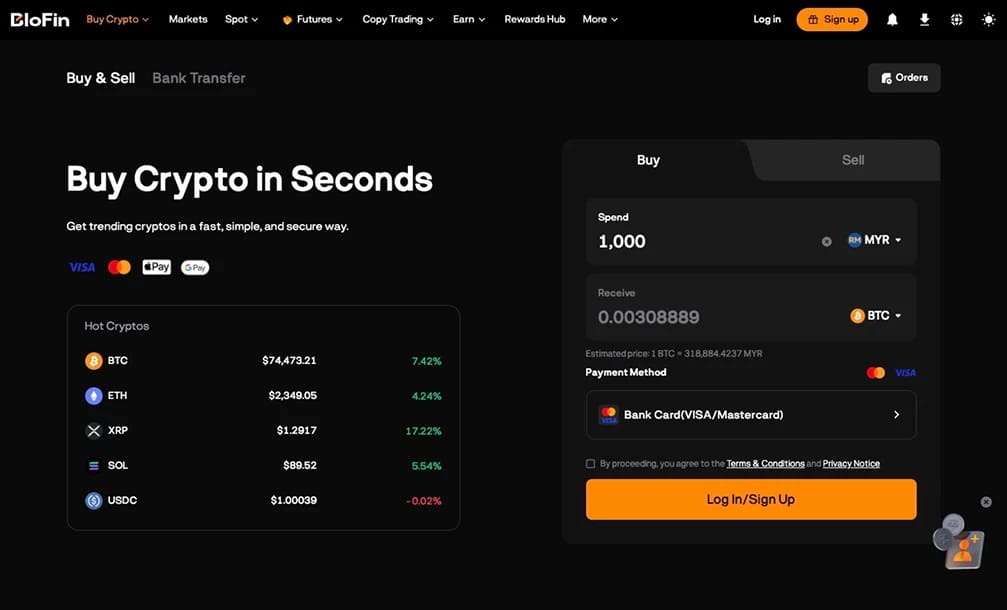
Perpetual futures form the core of the platform. These contracts have no expiry date and track the underlying asset’s price. BloFin lists more than 500 USDT-settled pairs, charging 0.02% for makers and 0.06% for takers, among the lowest rates in the category. Copy trading and bots are included, while a unified trading account allows one balance to collateralize every position.
Ringgit purchases depend on third-party processors that accept cards, Apple Pay, and Google Pay. Users should review the quoted markup before confirming payment. BloFin keeps client assets with Fireblocks and publishes reserve information, but it lacks a Malaysian license. Its short operating record since 2023 also supports keeping balances small.
Pros
- Email-only registration allows trading without identity documents up to specified withdrawal limits.
- Futures fees of 0.02% for makers and 0.06% for takers are lower than those of nearly every competing platform available to Malaysian traders.
- One unified trading account and a bot suite simplify active strategies across more than 500 USDT pairs.
Cons
- Larger withdrawals and some features still require verification, placing practical limits on no-KYC access.
- BloFin concentrates on leveraged derivatives, making it unsuitable as a starting point for new investors.
- Founded in 2023, the exchange has a shorter security and solvency history than the higher-ranked platforms.
5. Hata
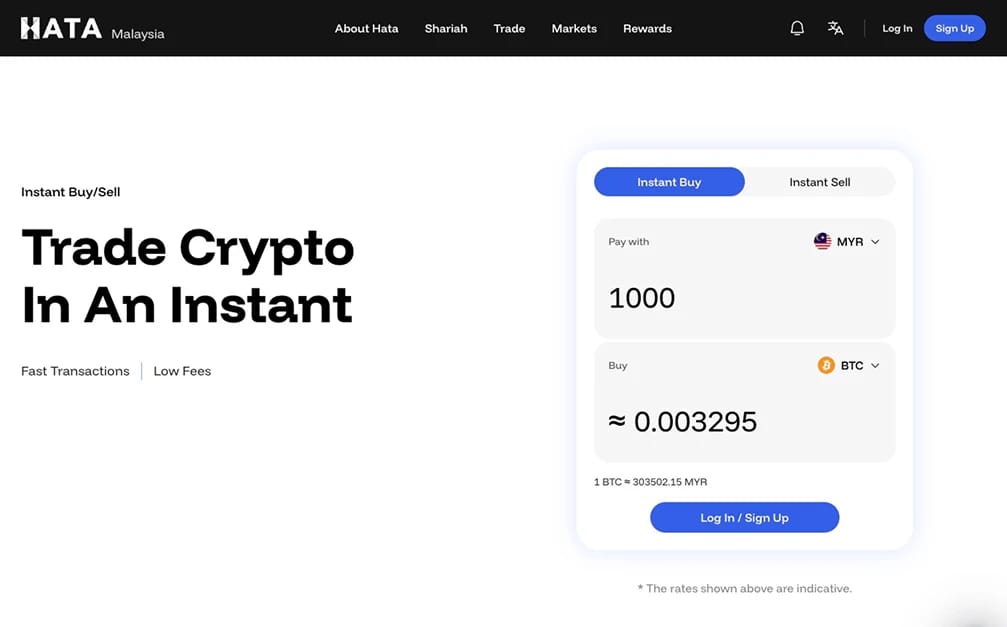
Hata is the strongest challenger among Malaysia’s licensed exchanges. It is the only local platform approved by two regulators: the SC, where it is registered as a Recognized Market Operator, and the Labuan Financial Services Authority, which licenses its global arm. Former Luno Asia-Pacific head David Low founded Hata. Within roughly two years of its retail launch, the platform reached more than 209,000 registered users.
Hata’s pricing is its main advantage. Makers pay no fee on the MYR order book, while taker rates range from 0.1% to 0.4%. Instant Buy costs 1%, half the equivalent charge at Luno. Hata is also the only local platform with instant MYR transfers in both directions. FPX and DuitNow support withdrawals as well as deposits. Staking is available, alongside an Auto-Invest schedule for recurring purchases.
The platform’s age brings several limitations. Its MYR market contains around two dozen SC-approved assets, and order books can be thinner than Luno’s during quiet periods. Support capacity and liquidity are still expanding with the new funding. For cost-conscious traders buying major assets, the lower fees can outweigh these restrictions.
Pros
- Dual SC and Labuan licensing, with client funds held one-to-one under a licensed trustee arrangement.
- Zero maker fees and a 1% Instant Buy rate undercut every other regulated Malaysian platform.
- Instant FPX and DuitNow transfers support deposits and withdrawals, which no other local exchange matches.
Cons
- Around 20 assets in the MYR market limit access for traders looking beyond approved large caps.
- Order book depth remains below Luno’s, allowing larger trades to move prices during slower periods.
- Hata has not yet operated through a full market cycle at scale.
6. MX Global
MX Global completes the ranking as the SC-registered exchange with the simplest ringgit setup. Based in Petaling Jaya, it has appeared on the regulator’s register since 2022. The platform prices a small selection of major assets directly in MYR, including BTC, ETH, XRP, SOL, and WLD pairs. Purchases therefore avoid a stablecoin conversion, and portfolio values remain denominated in ringgit from deposit to withdrawal.
Funding follows an equally direct process. Deposits arrive via FPX or manual bank transfer from the account holder’s own bank account, a requirement imposed by the exchange’s anti-money-laundering obligations. Withdrawals return to that same verified account. Cards, P2P merchants, and offshore intermediaries are excluded from the payment route, which may suit more cautious investors.
That narrow structure is also MX Global’s main weakness. Its roughly a dozen assets and 0.25% trading fee cannot match MEXC or Hata on selection or cost. The platform also lacks yield products for long-term holders. MX Global is best used as a compliant ringgit entry and exit point, paired with a larger exchange for active trading.
Pros
- Full SC registration places deposits, custody, and conduct under Malaysian supervision, including access to the new ombudsman channel.
- Direct MYR pairs for major assets remove the stablecoin step and keep balances denominated in ringgit.
- Strict own-account funding through FPX and bank transfers makes deposits and cash-outs predictable.
Cons
- A selection of roughly a dozen assets excludes traders seeking markets beyond the large caps.
- The 0.25% fee is several times higher than global platform rates and exceeds those of both local rivals.
- There are no staking, Earn, or automated investing features for idle holdings.
.webp)
How to Choose a Crypto Exchange in Malaysia
Five checks separate a sound Malaysian exchange decision from a poor one. Start with regulatory status and confirm that the funding method works with your bank. Then calculate the total cost of the deposit-to-withdrawal cycle rather than relying on the headline trading fee.
- Check the register, then the alert list: The SC maintains a list of registered Digital Asset Exchanges, currently comprising Hata, Luno, MX Global, SINEGY, and Kinetic DAX.
- Match funding to your bank account: Registered platforms accept FPX and DuitNow transfers from Maybank, CIMB, Public Bank, and all other local banks. Offshore exchanges generally rely on cards or P2P merchants.
- Price the whole transaction: Instant purchase screens can include a spread on top of the stated commission, while card processors apply separate markups. Compare a small order book trade with the instant quote for an identical amount. The difference is often the highest cost in the transaction.
- Keep P2P inside platform escrow: Use only high-volume merchants when trading P2P on an offshore exchange. Keep messages and receipts inside the app, and do not release crypto until the ringgit has cleared in your bank account. Escrow locks the seller’s crypto until the buyer’s payment is confirmed, but it offers no protection once the transaction moves outside the platform.
- Know where complaints go: Every registered DAX operator joins the Financial Markets Ombudsman Service this year. The service gives financial consumers access to free dispute resolution. Offshore platforms provide only their internal support desks, making escalation rights important when a withdrawal is frozen.
Crypto and Bitcoin Regulation in Malaysia
Malaysians have been allowed to own and trade crypto under a regulatory framework built in stages since 2014. The following milestones show how the current system developed:
- 15 January 2019: The Capital Markets and Services Order took effect, classifying qualifying digital assets as securities under Securities Commission Malaysia (SC) oversight. Revised Guidelines on Recognized Markets followed within weeks. In June, the SC registered Luno, SINEGY, and Tokenize as the first exchange operators.
- October 2020: The Guidelines on Digital Assets introduced rules for token fundraising through Initial Exchange Offerings, followed later by requirements for licensed custodians. Earlier that year, the SC’s Shariah Advisory Council resolved that trading on registered exchanges may be permissible, thereby opening the market to Islamic investors.
- June 2025: Bank Negara launched the Digital Asset Innovation Hub, a sandbox for programmable payments and ringgit-backed stablecoins. It later set out a three-year tokenization roadmap covering tokenized deposits and cross-border pilots involving Maybank, CIMB, and Standard Chartered.
- 2 March 2026: Revised ETF guidelines permitted digital currency ETFs. Bursa Malaysia began consulting on listing rules several days later. A January practice note had already allowed licensed intermediaries to provide digital asset broking.
- 20 May 2026: The revised Guidelines on Recognized Markets took effect. Registered exchanges can now list eligible tokens without seeking approval for each one. The rules also raise capital requirements, with a transition period lasting until May 2028, require institutional shareholders, and mandate membership in the Financial Markets Ombudsman Service.
Before sending money, match the account operator against the SC register of Digital Asset Exchanges and review the Investor Alert List. The register currently contains five operators. Brand recognition does not amount to Malaysian authorization.
.webp)
How Does Malaysia Tax Crypto?
Malaysia remains relatively favorable for long-term crypto investors because individuals pay no capital gains tax on these assets. The Inland Revenue Board has, however, made its treatment of other activities clearer.
- Passive investment gains are not taxed: Someone who buys crypto, holds it, and sells only occasionally realizes a capital gain outside Malaysian income tax. The capital gains tax introduced in 2024 covers unlisted shares, not digital assets held by individuals.
- Active trading is business income: The Inland Revenue Board (LHDN) uses eight badges of trade to determine whether someone is carrying on a business. These include trading frequency, holding period, and profit motive. Qualifying profits are reported on Form B and taxed at progressive resident rates from 0% to 30%, with related expenses deductible.
- The updated guidelines widened the net: The second edition of LHDN’s Guidelines on Tax Treatment of Digital Currency Transactions, reissued in December 2025, treats a crypto-to-crypto swap as a disposal of the first asset rather than a simple conversion.
- Mining and staking rewards count as income when carried on for profit: Rewards are valued in ringgit when received and taxed if the activity is systematic. The same principle extends to exchange yield products, making it safest to report Earn interest as income in the year of receipt.
- Records decide disputed cases: Without transaction histories, LHDN may be unable to separate long-term investing from business activity and could apply the less favorable treatment. Export records regularly. Businesses must retain them for seven years, and reconstructing past P2P transactions can be extremely difficult.
This information is general guidance rather than tax advice. Anyone trading meaningful volume should confirm their position with a Malaysian tax professional.
.webp)
Cryptocurrency Adoption in Malaysia
Crypto now accounts for a measurable share of Malaysian household investment, and regulated exchanges are handling a growing proportion of that activity.
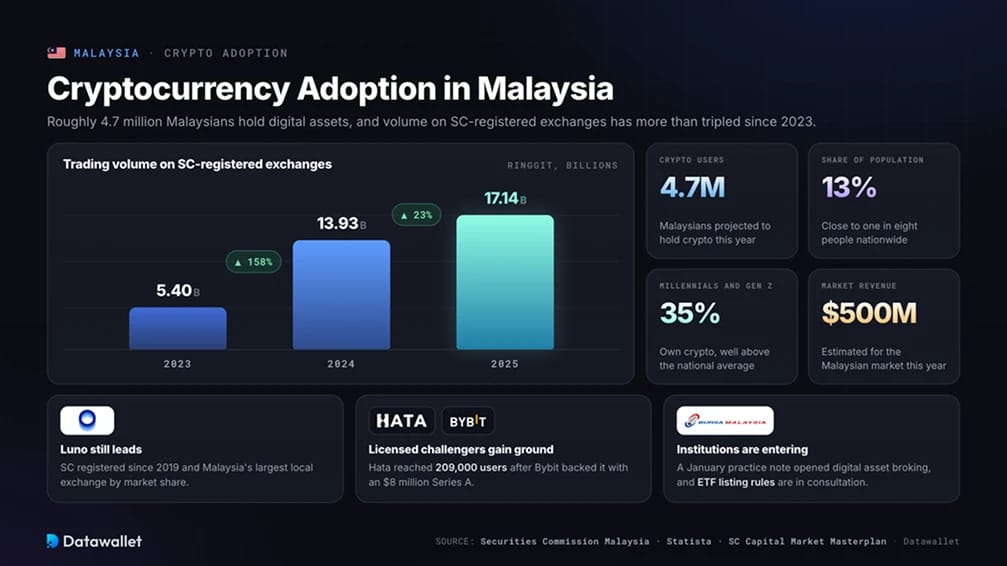
- Users approach five million: Statista projects about 4.7 million Malaysian crypto users this year, equal to roughly 13% of the population. Market revenue is estimated at close to $500 million. Survey figures cited in the SC’s Capital Market Masterplan show that about 35% of millennials and Gen Z own crypto, well above the national average.
- Regulated volume continues to compound: Trading across SC-registered exchanges increased from RM5.4 billion in 2023 to RM13.93 billion in 2024. It grew another 23% to RM17.14 billion in 2025. Luno remains the market leader, but Hata’s expansion to 209,000 users shows that licensed challengers can gain ground.
- Institutions are entering through licensed doors: A January practice note allows licensed capital markets intermediaries to provide digital asset broking. Bybit’s Hata investment brought global exchange capital into a local RMO, while forthcoming digital currency ETFs will offer a regulated instrument to retail brokers and funds.
Our crypto adoption statistics page compares these figures with dozens of other markets.
How to Buy Bitcoin in Malaysia
With the required documents available, buying Bitcoin in Malaysia can take less than half an hour. The cheapest process pairs a free local deposit with an order placed directly on the exchange.
- Choose your venue by priority: Use Luno or Hata for a regulated route with direct ringgit deposits. MEXC offers the lowest fees and the broadest selection, with funding via DuitNow or FPX P2P. Our best crypto exchanges in Asia guide explains how these platforms compare across the region.
- Verify with MyKad or passport: Most ranked platform requires a photo of an identity document and a liveness check. Approval usually takes only a few minutes. Differences between the verified name and the bank record are the most common reason deposits are delayed.
- Deposit ringgit through the cheapest working channel: FPX and DuitNow deposits on local exchanges are free or nearly free and arrive immediately. Cards are widely accepted but incur at least a 2% processing markup. P2P works for offshore exchanges as long as the transaction remains under platform escrow.
- Buy on the order book, not the instant screen: Place a limit order on the BTC/MYR market. Where the direct pair lacks depth, buy USDT first. Comparing the order book fill with an instant quote usually exposes the highest cost in the purchase.
- Decide on storage from day one: Funds needed for active trading can remain on the exchange, while long-term holdings are better placed in self-custody. We rank hardware and software products in our guide to the best crypto wallets. Exporting transaction records from the first trade will also make future tax reporting easier.
To sell, follow the same process in reverse and withdraw ringgit to the bank account registered on your profile.
Final Thoughts
MEXC ranks first for combining direct ringgit funding through DuitNow and FPX with Malaysia’s lowest fees and broadest asset selection. That recommendation depends on users accepting that the exchange operates without SC approval. Kraken is better suited to larger orders where market depth and security history carry more weight, while BloFin covers private derivatives trading.
The three local exchanges provide regulatory protection. Luno remains the most complete SC-registered platform. Hata charges lower fees and provides instant withdrawals for approved major assets, while MX Global offers the most straightforward supervised route between crypto and ringgit.
Malaysia’s direction is clear. Regulators are expanding what licensed platforms may offer, including self-approved listings and digital currency ETFs, while restricting access to the unregistered market through enforcement and advertising blocks. Keeping at least the ringgit deposit and withdrawal stages with a registered exchange is consistent with that direction.
Our Methodology
Every platform in this ranking was tested using a real Malaysian account. We completed verification and deposited ringgit through FPX, DuitNow, Touch 'n Go, cards, and P2P merchants. We then traded on the live markets and withdrew the funds to a local bank. Each score is based on six criteria.
- Trust Score: A rating out of 5 based on SC registration and overseas licensing, together with reserve transparency, incident history, and years of continuous operation.
- MYR Funding: The deposit and withdrawal channels that worked in practice, including transfer times, costs, and the frequency of compliance holds.
- Regulatory Standing: Each operator was checked against the SC’s DAX register and Investor Alert List. Foreign enforcement records were also reviewed for platforms without Malaysian approval.
- Security Record: We assessed past breaches, asset custody arrangements, publicly verifiable reserves, protection fund size, and safeguards such as 2FA and withdrawal allowlists.
- Assets and Liquidity: Real orders were placed on ringgit and USDT markets. We compared spreads and order book depth, then measured how closely fills tracked mid-market prices.
- Fees: Maker and taker schedules were assessed alongside instant purchase markups, card processor charges, withdrawal fees, and the total cost of converting ringgit into Bitcoin and back.
We excluded platforms that block Malaysian residents, lack a usable ringgit funding route, or remain subject to an active SC shutdown order. Bitget and KuCoin were removed after both added Malaysia to the prohibited jurisdictions in their terms of use. Testing concluded in August, and registration details were checked again against the SC register dated 20 July.
%20(1).webp)