Who is Luana Lopes Lara?
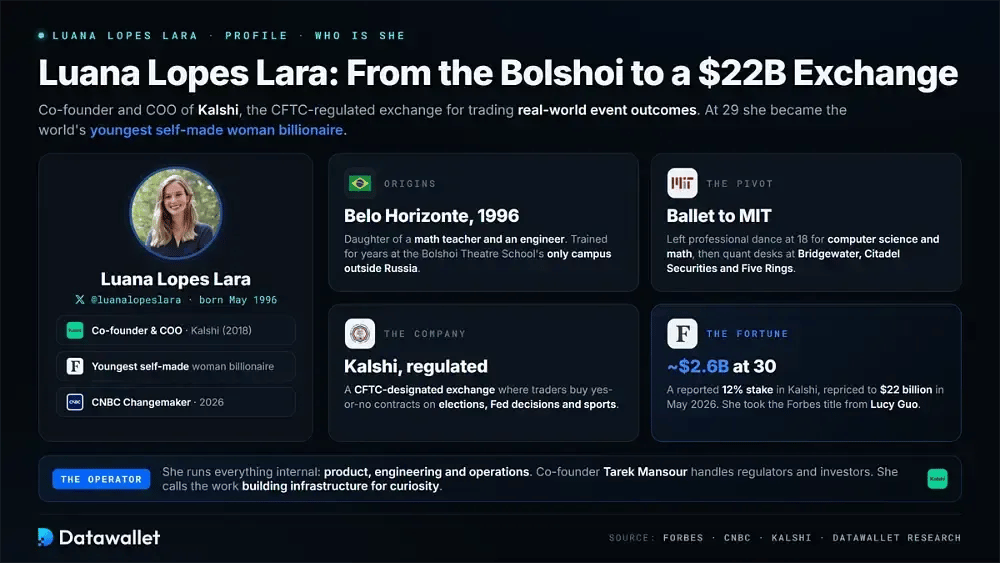
Luana Lopes Lara is a 30-year-old entrepreneur and the co-founder and chief operating officer of Kalshi, a CFTC-regulated exchange where traders buy and sell contracts on the outcomes of real-world events, from elections to Federal Reserve decisions.
Born in Belo Horizonte, she spent her teenage years in intensive ballet training at the Bolshoi Theatre School's only campus outside Russia before pivoting to computer science at MIT. That combination of artistic discipline and technical rigor defines her reputation as a methodical operator.
In December 2025, Forbes named her the world's youngest self-made woman billionaire at 29, a title she took from Scale AI's Lucy Guo. Kalshi's valuation has since doubled again, and CNBC named her a 2026 Changemaker.
Inside the company, she runs everything internal: product design, engineering, and operations, while co-founder Tarek Mansour handles regulatory affairs and investor relationships. On X she posts as @luanalopeslara, describing her work as building infrastructure for curiosity.
Luana Lopes Lara's Background
Lopes Lara's path runs from a Brazilian ballet academy through Olympiad medals and an MIT computer science degree, into quantitative trading internships that exposed the market gap Kalshi was built to fill.
Early Life and Ballet
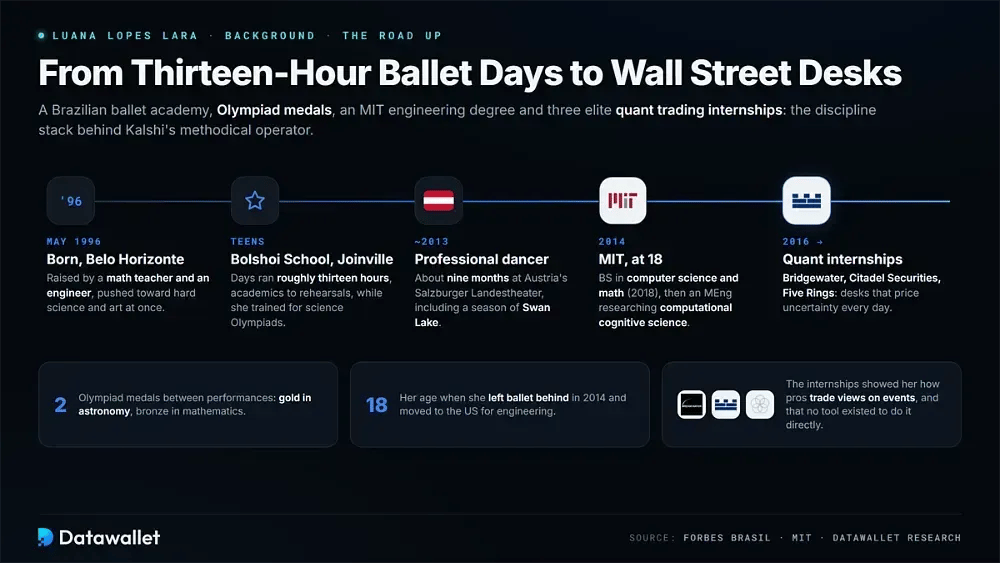
Born in May 1996 in Belo Horizonte, she grew up between Timóteo, Niterói, and Joinville as the daughter of a math teacher and an engineer. That household pushed her toward hard science and disciplined artistic training simultaneously, an unusual pairing she has credited throughout her career.
As a teenager she enrolled at the Escola do Teatro Bolshoi in Joinville, where days ran roughly thirteen hours from morning academics to evening rehearsals. Between performances she trained for competitions, winning gold in the Brazilian Astronomy Olympiad and bronze in mathematics.
After finishing school she danced professionally at the Salzburger Landestheater in Austria for about nine months, including a season of Swan Lake. At 18, in 2014, she left ballet behind and moved to the United States to pursue engineering.
MIT and Wall Street
At MIT she earned a bachelor's degree in computer science and mathematics in 2018, followed by a master's of engineering. She researched computational cognitive science under Josh Tenenbaum and Max Kleiman-Weiner, and worked in the university's artificial intelligence laboratory.
Alongside her studies she interned at three of the most competitive firms in quantitative finance: Bridgewater Associates, Citadel Securities, and Five Rings Capital. Those seasons on trading desks showed her how professionals price uncertainty, and where the tooling to express those views simply did not exist.
How Did Luana Lopes Lara Create Kalshi?
Lopes Lara and Tarek Mansour built Kalshi to close a specific market gap: the absence of any legal, straightforward way for ordinary people to trade directly on future events. Doing it legally required years of regulatory groundwork.
1. From Late-Night Walks to the Kalshi Idea
Lopes Lara met Mansour, a fellow computer science student, at MIT, where they bonded over overlapping finance internships. In 2018, walks between their New York intern apartments turned recurring debates about markets into a concrete concept for an event exchange.
They had watched traders reposition portfolios around elections, hurricanes, and Fed decisions, all implicit forecasts embedded in other instruments. No product let someone simply take a yes-or-no position on the event itself, which became Kalshi's founding thesis.

2. Turning a Dorm-Room Thesis Into a Regulated Startup
The pair incorporated Kalshi in 2018 and joined Y Combinator's Winter 2019 batch carrying regulatory memos and a prototype order book rather than a finished product. Neo led their seed round, backing an idea most Wall Street veterans considered unworkable.
Making the exchange legal proved harder than building it. They approached more than forty law firms, and nearly all declined, citing their age and the unsettled legal status of prediction markets. One specialist team agreed, beginning a multi-year push toward CFTC-ready rules.
3. Winning CFTC Approval and Launching
After nearly three years of regulatory back-and-forth, Kalshi secured designation as a contract market in November 2020, becoming the first US exchange authorized to list event contracts rather than conventional commodities, rate futures, or equity derivatives.
The platform opened publicly in mid-2021 with contracts on inflation prints, jobless claims, hurricane counts, and awards outcomes, each priced between one and ninety-nine cents. Lopes Lara oversaw risk limits, margin models, and the surveillance tooling regulators required.
4. The Election Breakthrough and Funding Surge
Kalshi's inflection point came in late 2024, when a federal court held that election contracts did not constitute illegal gambling, prompting the CFTC to reverse its opposition. That decision legalized presidential election trading for the first time in over a century.
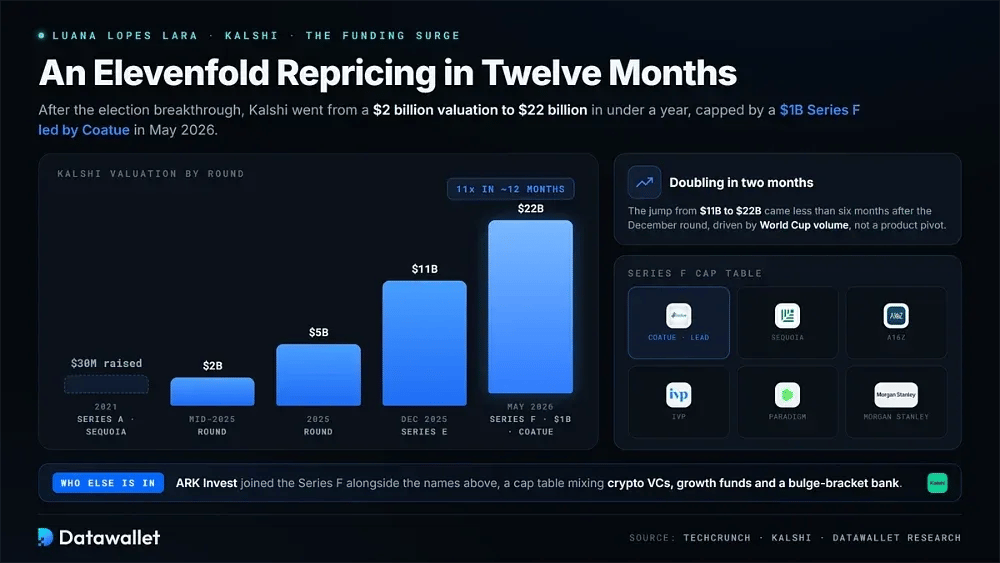
Funding accelerated sharply afterward. A $30 million Series A in 2021 was followed by rounds at $2 billion, $5 billion, and $11 billion valuations through 2025, before a $1 billion Series F led by Coatue doubled the company to $22 billion in May 2026.
Luana Lopes Lara's Net Worth in 2026
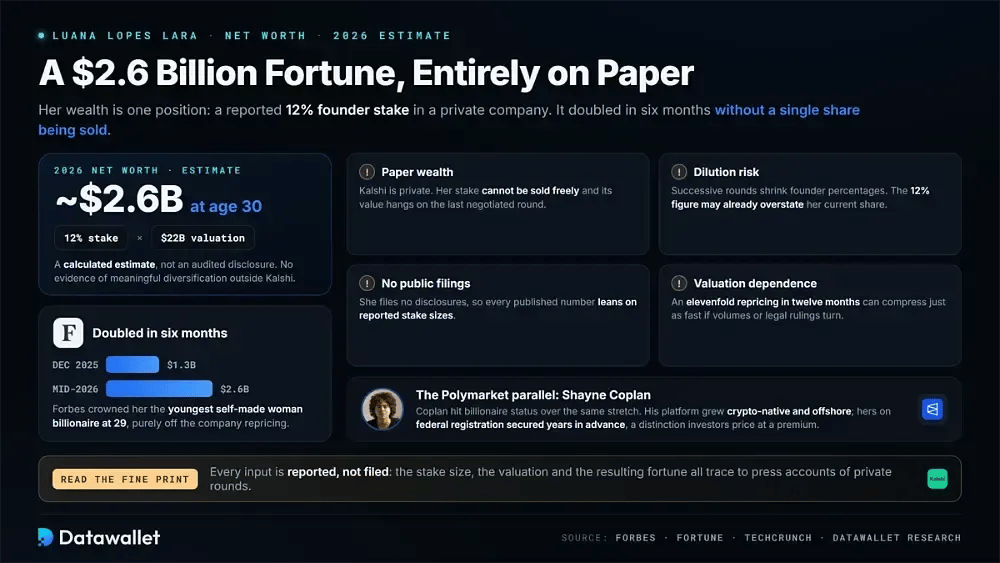
Luana Lopes Lara's net worth in 2026 is estimated at approximately $2.6 billion, derived from a reported 12% founder stake in Kalshi following the company's $22 billion valuation. The figure is a calculated estimate rather than an audited disclosure.
Her wealth in 2026 rests on a handful of documented inputs:
- Founder equity: A reported 12% stake in Kalshi is effectively her entire fortune, with no evidence of significant diversification outside the company she co-founded.
- Valuation multiple: Kalshi's price climbed from $2 billion in mid-2025 to $22 billion by May 2026, an elevenfold repricing inside twelve months.
- Series F round: The $1 billion raise led by Coatue drew Sequoia, Andreessen Horowitz, IVP, Paradigm, Morgan Stanley, and ARK Invest into the cap table.
- Paper wealth: Kalshi remains private, so her stake cannot be sold freely and its value depends entirely on the last negotiated funding round.
- Dilution risk: Successive rounds typically reduce founder percentages, meaning the 12% figure is an estimate that may already understate dilution.
- No public filings: Unlike listed-company founders, she files no disclosures, leaving every published number dependent on reported stake sizes.
The trajectory is remarkable even by venture standards. Her Forbes valuation stood at $1.3 billion in December 2025 and doubled within six months, purely because the company repriced rather than through any sale of shares.
How She Compares to Polymarket's Founder
Her ascent parallels that of Shayne Coplan, who reached billionaire status through Polymarket over a similar period. The two represent competing bets on how prediction markets should be built and regulated.
Coplan's fortune grew from a crypto-native platform that operated offshore before entering the US market. Lopes Lara's rests on federal registration secured years in advance, a distinction institutional investors have priced at a premium despite mounting state-level challenges.
Kalshi's 2026 Growth and the World Cup Effect
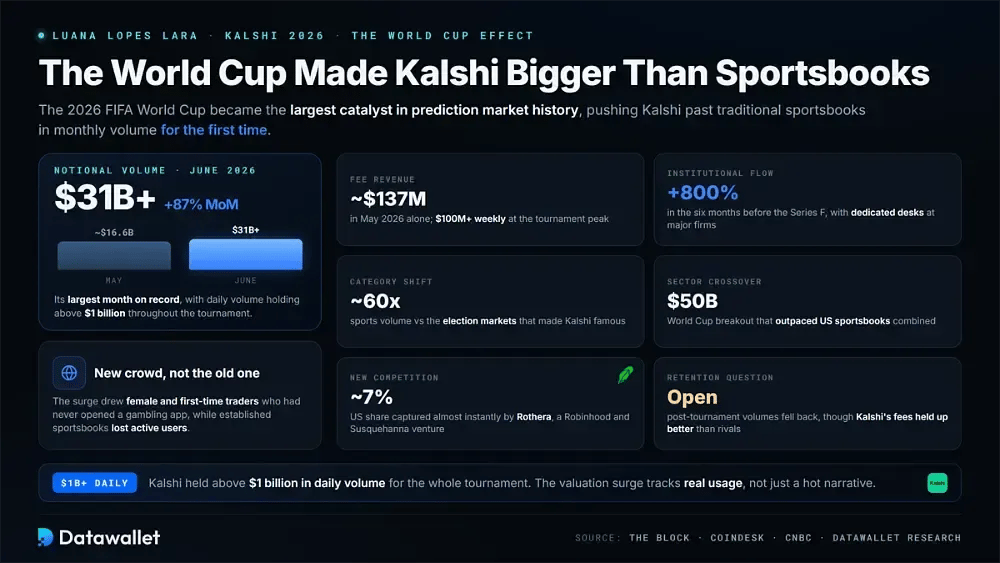
Kalshi's valuation surge tracks a genuine explosion in usage. The 2026 FIFA World Cup became the single largest catalyst in prediction market history, pushing the platform past traditional sportsbooks in monthly volume for the first time.
Key figures behind Kalshi's 2026 expansion include:
- Record volume: Kalshi processed over $31 billion in notional volume during June 2026, an 87% jump from May and its largest month on record.
- Sportsbook crossover: Combined prediction market volume outpaced US sportsbooks, with Kalshi attracting large numbers of female and first-time traders who had never used gambling apps.
- Fee revenue: Trading fees reached roughly $137 million in May 2026 alone, and weekly revenue surpassed $100 million at the tournament's peak.
- Institutional flow: Institutional trading volume rose approximately 800% in the six months preceding the May funding round, drawing dedicated desks at major trading firms.
- Daily consistency: The platform held above $1 billion in daily volume throughout the tournament, while established sportsbook apps lost active users.
- Category shift: Sports contracts now dwarf the election markets that made Kalshi famous, generating volumes roughly sixty times larger in its strongest months.
- New competition: Rothera, a Robinhood and Susquehanna venture, launched in June and captured about 7% of US prediction market volume almost immediately.
The retention question remains open. Post-tournament data showed volumes falling back toward pre-World Cup levels across the sector, though Kalshi's fee revenue held up better than competitors, suggesting stickier user behavior than rivals achieved.
Kalshi's Regulatory and Legal Battles
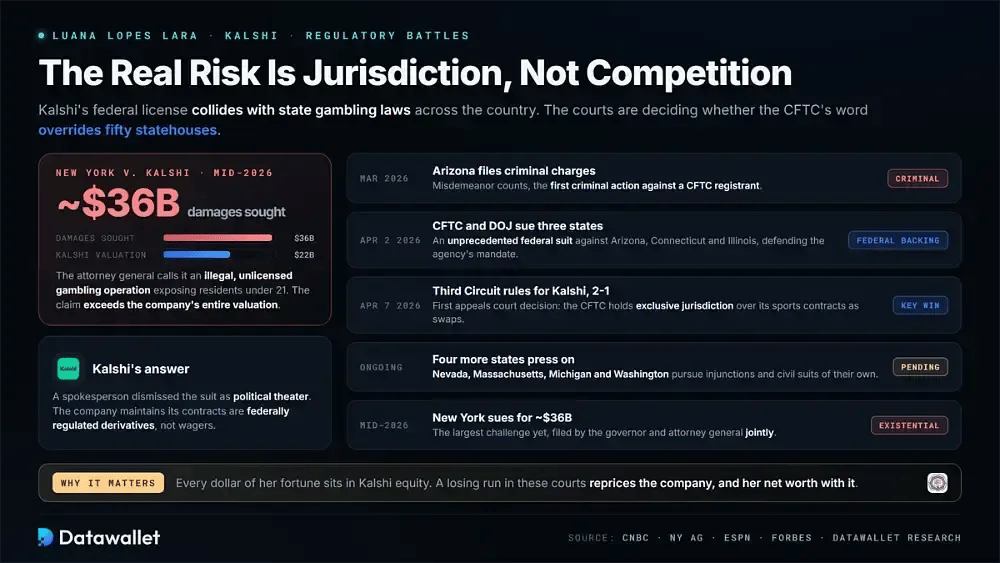
The defining risk to Lopes Lara's fortune is not competition but jurisdiction. Kalshi's federal license conflicts directly with state gambling laws, producing litigation across the country that could reshape the entire business model.
The company won a significant victory in April 2026, when the Third Circuit ruled 2-1 that the CFTC holds exclusive jurisdiction over its sports event contracts. It was the first federal appeals court decision on the question, treating the contracts as swaps under the Commodity Exchange Act.
Federal authorities have backed that position aggressively. On April 2, 2026, the CFTC and Department of Justice sued Arizona, Connecticut, and Illinois, an unprecedented step the agency described as defending its congressional mandate against state overreach.
State enforcement has intensified regardless. Arizona filed criminal misdemeanor charges in March 2026, the first such action against a CFTC registrant, while Nevada, Massachusetts, Michigan, and Washington pursued injunctions and civil suits of their own.
The New York Lawsuit
The largest challenge arrived in mid-2026, when New York sued Kalshi for operating what the attorney general called an illegal, unlicensed gambling operation exposing residents, including those under 21, to financial harm.
Court filings put the estimated damages sought at roughly $36 billion, a figure exceeding Kalshi's entire valuation. A company spokesperson dismissed the action as political theater, and Kalshi maintains its contracts are federally regulated derivatives rather than wagers.
Criticisms Around Luana's Kalshi
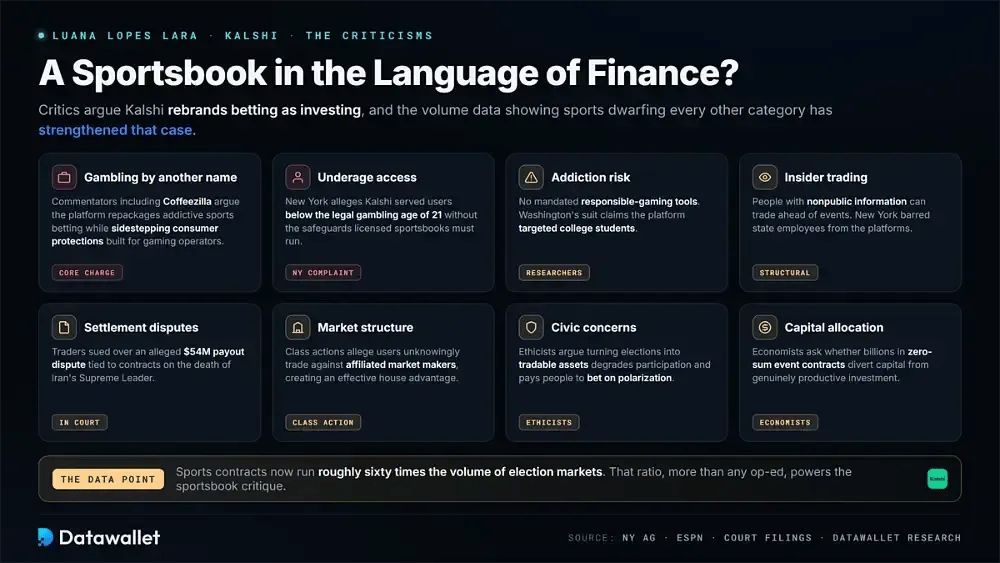
Critics increasingly argue that Kalshi functions as a sportsbook wearing the language of finance, and the volume data showing sports dwarfing every other category has strengthened that case considerably.
Major ethical and legal concerns facing the platform include:
- Gambling by another name: Commentators including Coffeezilla argue the platform rebrands addictive sports betting as investing, sidestepping consumer protections designed for gaming operators.
- Underage access: New York's complaint alleges Kalshi served users below the state's legal gambling age of 21 without the safeguards licensed sportsbooks must implement.
- Addiction risk: Researchers warn prediction markets lack mandated responsible-gaming tools, while Washington's suit specifically claimed the platform targeted college students.
- Insider trading: Concerns persist that people with nonpublic information can trade ahead of events, prompting New York to bar state employees from using the platforms.
- Settlement disputes: Traders sued over an alleged $54 million payout dispute tied to contracts on the death of Iran's Supreme Leader, raising questions about resolution criteria.
- Market structure: Class-action claims allege users unknowingly trade against affiliated market makers rather than genuine peers, creating an effective house advantage.
- Civic concerns: Ethicists argue that turning elections into tradable assets degrades political participation and creates financial incentives around polarization.
- Capital allocation: Economists question whether channeling billions into zero-sum event contracts diverts capital from genuinely productive investment.
Final Thoughts
Luana Lopes Lara has choreographed one of the sharpest wealth trajectories in recent memory, turning a dorm-room thesis into a $22 billion exchange and a personal stake worth roughly $2.6 billion before her thirty-first birthday.
What stands out to us is how completely her fortune rests on a single unresolved question. Every dollar of that valuation assumes federal preemption holds, and courts across the country are still deciding whether her contracts are derivatives or bets.
The discipline she learned in ballet may matter more now than during the regulatory slog that built Kalshi. If preemption survives, she has built the rulebook for a new asset class. If it fails, the most valuable prediction market in America becomes fifty separate licensing problems overnight.