




Which Countries Does Gate Restrict?
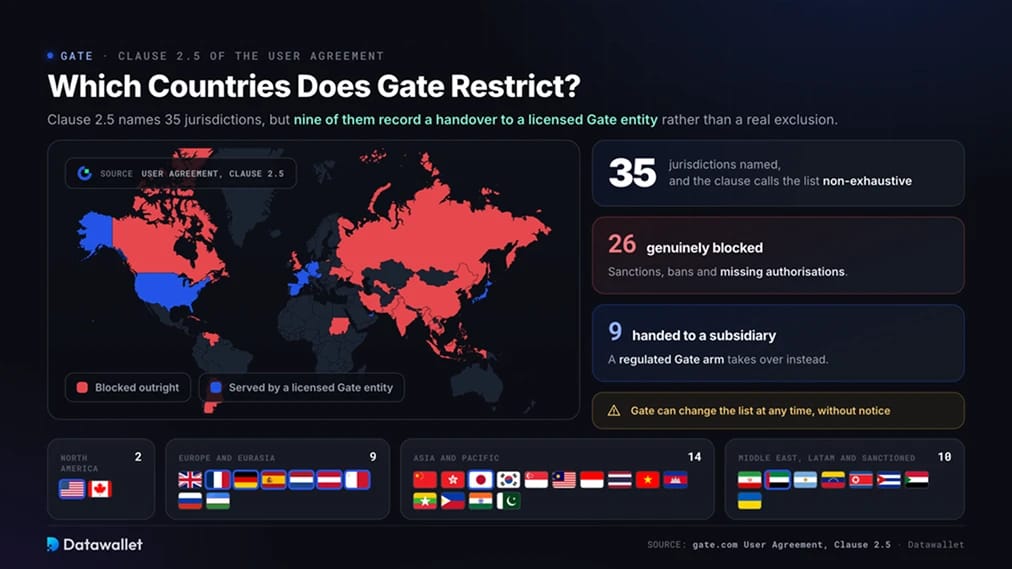
Gate sets out its blocked markets in Clause 2.5 of the User Agreement, which names 35 jurisdictions and calls the list non-exhaustive. Gate can change it at any time without notice, and users must check the current version and stop trading if their country appears.
Several entries need context. Japan is named even though Gate Japan K.K. holds a Japanese exchange registration, the UAE is named while Gate Technology FZE runs under a Dubai licence, and Malta sits on the list despite hosting Gate Europe, its licensed EU hub. In each case the offshore platform steps back so a regulated Gate subsidiary can take over.
The list has shifted since our previous audit. Russia, Vietnam, Myanmar, and Venezuela now appear by name, the United Kingdom is listed outright, and several sanctioned African states have dropped off the roster because a separate eligibility clause screens every user against international sanctions registers.
Note: Using a VPN from a blocked location breaches the agreement, and Gate can freeze the account and close open positions once a mismatch surfaces. Anyone in a restricted market can compare the best Gate alternatives instead.
Why Gate Blocks These Jurisdictions
Each entry traces to one of four pressures, and which one applies signals whether a market may reopen.
The four drivers behind the exclusions:
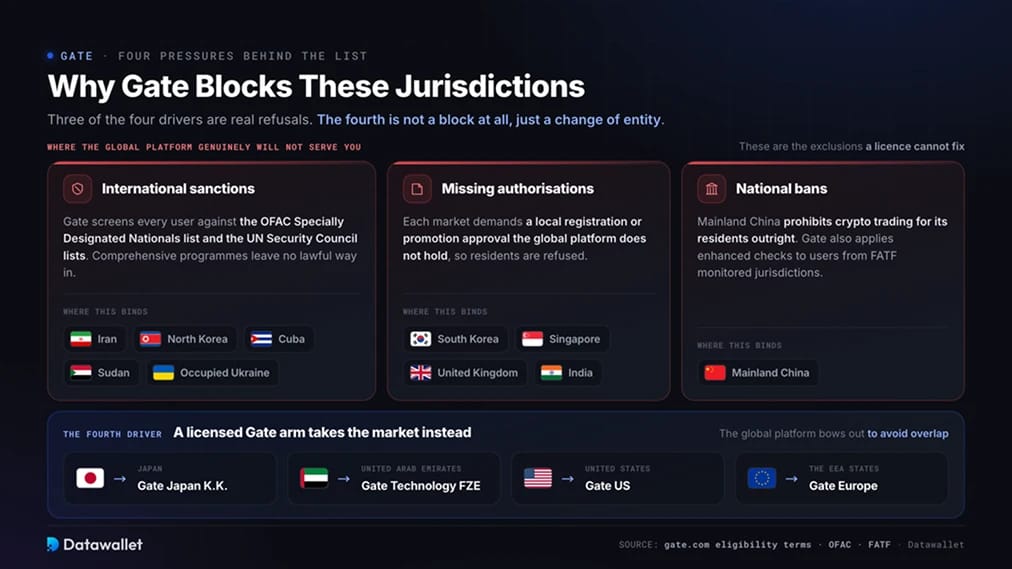
- International sanctions: Gate's eligibility terms bar anyone on the OFAC Specially Designated Nationals list or the United Nations Security Council sanctions lists, and comprehensive programmes against Iran, North Korea, Cuba, Sudan, and the occupied Ukrainian territories leave no lawful way to serve them.
- Missing authorisations: South Korea, Singapore, the United Kingdom, and India each demand local registrations or promotion approvals that the global platform does not hold, so residents are refused.
- Entity handovers: Japan, the United Arab Emirates, the United States, and the EEA states appear because a licensed Gate subsidiary covers them, and the global platform bows out to avoid overlap.
- National bans and high-risk designations: Mainland China prohibits crypto trading for its residents outright, and Gate applies enhanced checks to users from jurisdictions placed under increased monitoring by the Financial Action Task Force, the global body that sets anti-money-laundering standards.
Gate Supported Countries
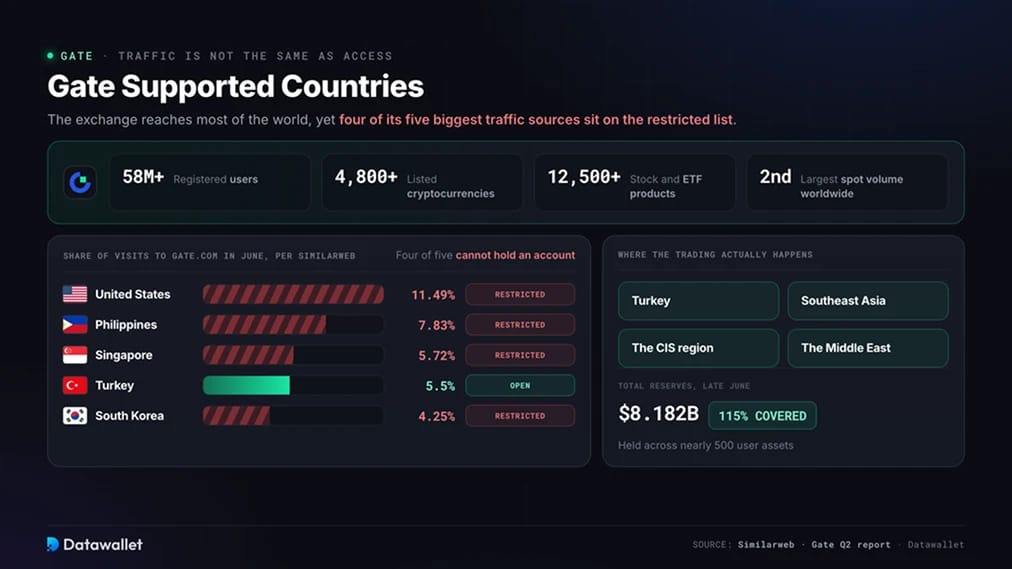
Outside the restricted list, Gate reported more than 58 million registered users in its latest quarterly update, alongside 4,800+ listed cryptocurrencies, 12,500+ stock and ETF products, and a spot trading volume that ranks second worldwide.
Traffic data hints at where those users sit, and where they do not. Similarweb recorded the United States as the top source of visits to gate.com in June at 11.49%, followed by the Philippines at 7.83%, Singapore at 5.72%, Turkey at 5.5%, and South Korea at 4.25%. Four of those five countries sit on the restricted list, so much of that traffic comes from visitors who can load the site but cannot legally hold an account. The largest active trading bases are Turkey, Southeast Asia, the CIS region, and the Middle East.
As of late June the platform held $8.182 billion in total reserves at a 115% coverage ratio across nearly 500 user assets, verified through proof of reserves reports that use cryptographic checks to confirm balances without exposing individual accounts.
Can I Use Gate in the EU Under MiCA?
Yes, but access runs through Gate Europe instead of the global platform. Gate Technology Ltd, the group's Malta-based subsidiary, received a crypto-asset service provider authorisation from the Malta Financial Services Authority in September 2025 under MiCA, the EU regulation that lets a platform licensed in one member state serve the whole bloc. The MFSA Financial Services Register records the licence, and Gate's own licences page shows the passport active in 29 EEA countries from Austria to Sweden.
The transition explains the odd shape of the restricted list. The global platform stopped onboarding new EU and EEA users in March 2025, and a follow-up notice this June confirmed the European platform is operational and existing EEA customers are being migrated across. France, Germany, Spain, the Netherlands, Austria, and Malta stay on the global exclusions because Europeans now belong on the regulated entity, so the listing reflects a change of entity rather than a loss of access.
Gate Europe has since added a Payment Institution authorisation under PSD2, the EU law governing payment companies, adding regulated fiat payment services alongside crypto trading and custody. That places Gate among the platforms that cleared MiCA's bar, a group our guide to the best MiCA-licensed crypto exchanges compares in detail, while Binance suspended EU services after reaching the deadline without a licence.
Can I Use Gate in the USA?
Not on the global platform. Clause 2.10 of the User Agreement requires every user to certify they are not a US person, citing the Securities and Exchange Commission and the Commodity Futures Trading Commission, the two federal regulators whose rules the offshore exchange does not satisfy.
American access instead runs through Gate US, a separate entity that launched spot trading on 1 August 2025. It opened with crypto-to-crypto pairs and had built its state Money Transmitter Licence coverage to 36 states by mid-year. Fiat deposits, custodial wallets, and local payment integrations are planned, though derivatives remain absent. Residents can weigh the platform against the licensed venues in our guide to the best crypto exchanges in the USA.
Gate Licences and Regulation
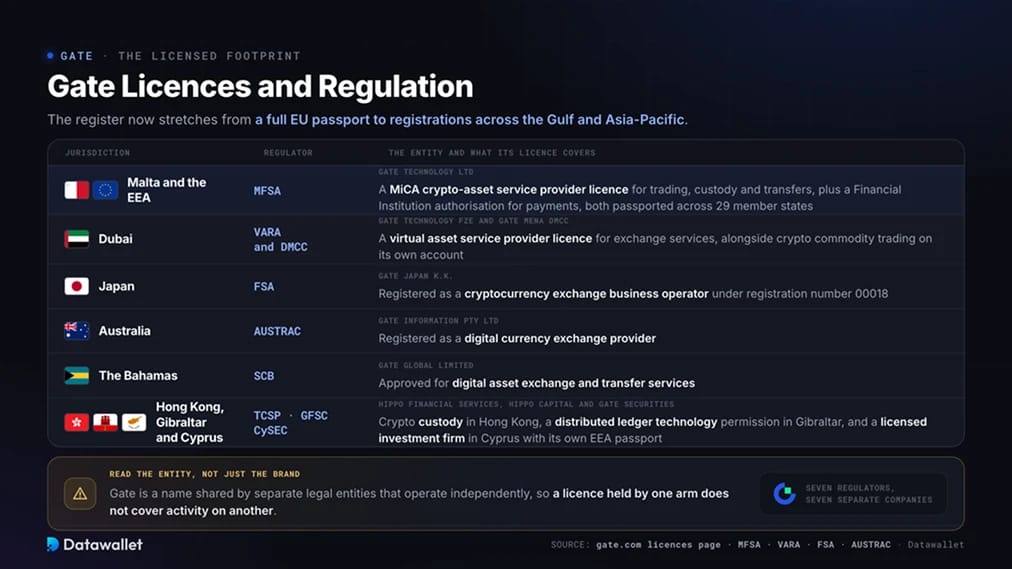
Gate publishes its authorisations on an official licences page, and the register now stretches from a full EU passport to registrations across the Gulf and Asia-Pacific.
The principal approvals across the group:
- Malta and the EEA (MFSA): Gate Technology Ltd holds a MiCA crypto-asset service provider licence covering trading, custody, and transfers, plus a Financial Institution authorisation for payment services, both passported across 29 EEA member states.
- Dubai (VARA and DMCC): Gate Technology FZE carries a virtual asset service provider licence from the Virtual Assets Regulatory Authority for exchange services, and Gate MENA DMCC trades crypto commodities on its own account under the Dubai Multi Commodities Centre.
- Japan (FSA): Gate Japan K.K. is registered as a cryptocurrency exchange business operator with the Financial Services Agency under registration number 00018.
- Australia (AUSTRAC): Gate Information Pty Ltd is registered with AUSTRAC as a digital currency exchange provider.
- Bahamas (SCB): Gate Global Limited holds approval from the Securities Commission of The Bahamas for digital asset exchange and transfer services.
- Hong Kong and Gibraltar: Hippo Financial Services Limited holds a Trust or Company Service Provider licence for crypto custody in Hong Kong, and Hippo Capital Co. Limited operates as a Distributed Ledger Technology provider under the Gibraltar Financial Services Commission.
- Cyprus (CySEC): Gate Securities (Cyprus) Ltd runs as a licensed investment firm under the Cyprus Securities and Exchange Commission, with its own EEA passport for traditional investment services.
Note: 'Gate' is a brand shared by separate legal entities that operate independently, so a licence held by one arm does not cover activity on another.
Does Gate Require KYC?
Yes, Gate has made identity verification mandatory for every user, and no deposit or withdrawal clears until it is complete. Applicants submit a valid government-issued passport, identity card, or driver's licence, and reviews typically finish within 10 minutes to 12 hours. Anyone under 18 cannot verify.
Verification is where the restricted list bites. The document you submit fixes your jurisdiction, so paperwork issued in a blocked location fails onboarding before any funds move. Common rejection causes are expired documents, photos with cropped corners or glare, scans or screenshots in place of the physical document, and a registered name that does not exactly match the ID.
About Gate
Gate launched in 2013 under founder Dr Lin Han, making it one of the longest-running exchanges still operating. It rebranded from Bter to Gate.io in 2017, then consolidated on the Gate.com domain in 2025, and its User Agreement is now governed by Panamanian law.
The product catalogue has pushed well past crypto over the past year. Users in eligible markets can trade US, Hong Kong, and Korean stocks, take positions on real-world events through an integrated Polymarket prediction market, and access contracts tracking gold and other traditional assets settled in stablecoins. Our full Gate review covers fees, security, and the wider product range.
Final Thoughts
Gate's restricted list has grown on paper while its licensed footprint has grown in practice. The names added over the past year sit alongside new regulated entities in Malta, Dubai, Japan, and the United States, and much of the list now records which Gate company serves a market instead of whether Gate serves it at all.
The durable exclusions are the sanctioned territories and Mainland China, where no licence can change the outcome. For everywhere else the User Agreement is the record to check, so anyone funding an account from a borderline market should read the current Clause 2.5 first.
EEA residents belong on Gate Europe and Americans on Gate US. The global platform is off-limits to both, and respecting that boundary is the difference between a working account and a frozen one.