
Kraken vs Binance: Overview
Kraken launched in 2013 under parent company Payward and now serves 15+ million users across 190+ countries from its Wyoming headquarters. The platform lists 500+ cryptocurrencies alongside 11,000+ US-listed stocks and ETFs for American clients, and offers tokenized equities internationally through xStocks. Its $1.5 billion NinjaTrader acquisition added CFTC-regulated futures infrastructure and nearly 2 million professional derivatives traders.
Kraken now operates as a diversified brokerage preparing for public markets. The company filed confidentially for a US IPO in November 2025, drew a $200 million investment from Deutsche Börse, and posted record quarterly revenue of $648 million in Q3 2025.
Binance was founded in 2017 by Changpeng Zhao and has crossed 300 million registered users under CEO Richard Teng. It runs the deepest spot and derivatives books in crypto, listing 500+ coins across 1,700+ trading pairs, and its daily spot volume of $15 billion to $25 billion dwarfs every competitor.
Binance's scale comes with regulatory baggage that shapes what you can access and where. The exchange operates under a five-year independent compliance monitor from its 2023 US settlement, and its failure to secure a MiCA license by the July 1, 2026 deadline forced it to restrict regulated services for EEA users while it pursues authorization through another member state.
The comparison table below shows how they stack up.
Kraken vs Binance: Features
Both exchanges cover the trading core of spot, margin, perpetuals, staking, and automation, so the real differences sit on top. Kraken expanded sideways into traditional finance with stocks, CME futures, and tokenized IPO access. Binance built downward into its own ecosystem of BNB Chain, Launchpool, and the largest P2P marketplace in crypto.
Each platform holds exclusive ground. Kraken's multi-asset reach into equities and regulated US derivatives has no Binance equivalent, while Binance's altcoin depth and BNB earning ecosystem sit well beyond anything Kraken offers.
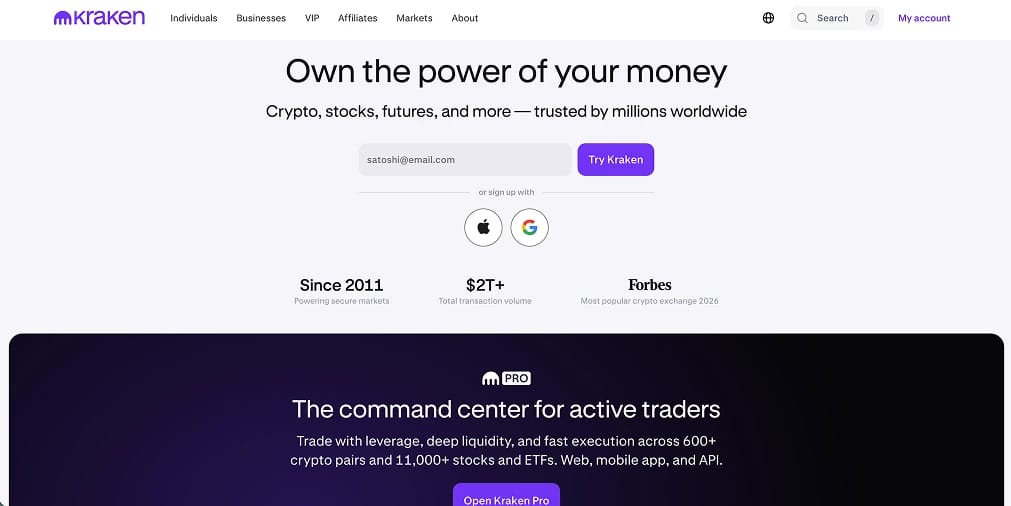
Kraken Products
Kraken serves three tiers of user through its simple app for buyers, Kraken Pro for active traders, and institutional services for funds.
- Spot Trading: 500+ cryptocurrencies with particularly deep BTC and ETH liquidity in USD and EUR pairs. The main app handles one-tap buys, while Kraken Pro trades the raw order book at far lower cost.
- Kraken Pro: The advanced terminal with TradingView charting, 25+ configurable widgets, margin to 10x, and full API access for algorithmic strategies.
- Stocks and ETFs: US clients can trade 11,000+ equities and ETFs commission-free in the same account as their crypto.
- xStocks: Tokenized US equities backed 1:1 by real shares, tradable around the clock in 100+ countries outside the US, UK, Canada, and Australia. The framework has cleared $30 billion in volume and now powers tokenized IPO access, with SpaceX as its first offering in June 2026.
- Futures: 300+ crypto perpetuals for eligible regions, CME-cleared micro contracts for US traders through the NinjaTrader acquisition, and TradFi futures on indices, gold, and oil for EU clients.
- Staking and Auto Earn: Bonded staking on 23+ assets with yields reaching around 21% APY on select tokens, plus weekly Auto Earn rewards without lockups in supported regions.
- Krak App: A payments product for sending fiat or crypto globally across 300+ currencies with custom handles and no hidden fees.
- Kraken Prime and OTC: Institutional brokerage combining execution, custody, and financing, alongside a white-glove OTC desk for tickets above $100,000.
Binance Products
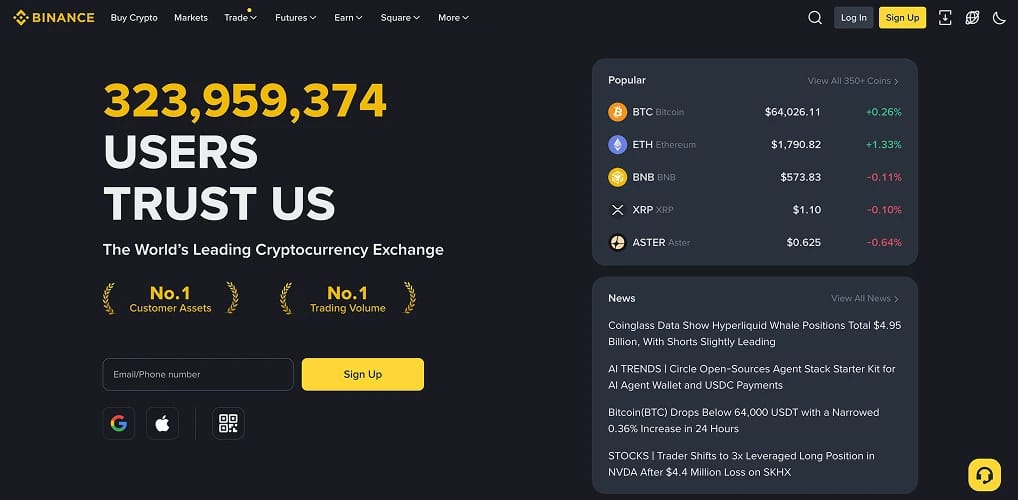
Binance organizes everything around depth and ecosystem engagement, funneling users from trading into earning, launch events, and BNB utility.
- Spot Trading: 1,700+ pairs with the tightest spreads in the industry on majors. Order book depth on BTC/USDT regularly exceeds $50 million, which matters for anyone executing size.
- Futures and Derivatives: USDⓈ-M and COIN-M perpetuals plus quarterly contracts with leverage to 125x, alongside a USDT-settled options market on select assets.
- Margin Trading: Cross and isolated margin to 10x, plus portfolio margin for advanced traders netting exposure across multi-leg positions.
- Binance Earn: Flexible savings, locked staking, dual investment, and Auto-Invest recurring buys covering hundreds of assets.
- Launchpad and Launchpool: Early access to new token launches by committing BNB or stablecoins.
- P2P Marketplace: The deepest peer-to-peer desk globally, supporting 100+ fiat currencies and hundreds of local payment methods at zero platform fees.
- BNB Chain Ecosystem: A native smart contract network hosting DeFi, gaming, and the exchange's Web3 wallet, with BNB holding a market cap near $90 billion.
- Copy and Bot Trading: Grid, DCA, and rebalancing bots plus copy trading that mirrors verified lead traders across spot and perpetual markets.
Kraken vs Binance: Security
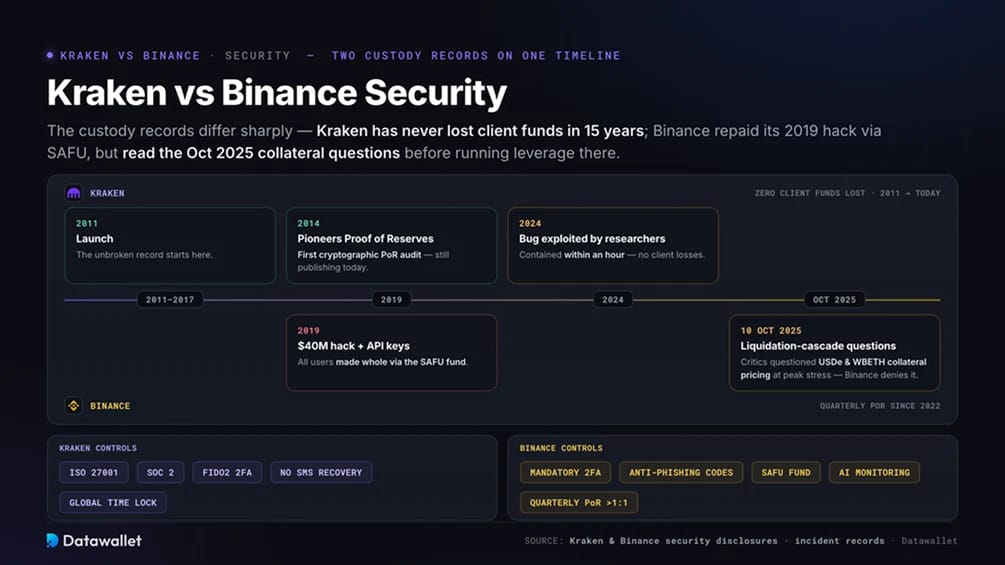
The custody records differ sharply. Kraken has never lost client funds from its managed wallets in 15 years of operation. Binance absorbed a $40 million hack in 2019, reimbursed users through its SAFU fund, and faced fresh questions about how its risk engine behaved during the October 2025 liquidation cascade.
Kraken Security Measures and History
- Certifications: ISO 27001 certified with SOC 2 examination, cold storage under 24/7 physical surveillance, and no SMS-based account recovery to block SIM swap attacks.
- Account controls: FIDO2 two-factor authentication, a global settings time lock, customizable API permissions, and withdrawal address allowlisting.
- Proof of Reserves: Kraken pioneered cryptographic Proof of Reserves audits in 2014 and continues publishing them so clients can verify their balances on-chain.
- Incident history: No breach of Kraken-managed custodial wallets since launch in 2011. A 2024 exploit of a platform bug by security researchers was contained within an hour with no client losses.
Binance Security Measures and History
- Account controls: Mandatory 2FA, anti-phishing codes, withdrawal allowlisting, and device management, with AI-driven monitoring flagging abnormal activity in real time.
- SAFU fund: An emergency insurance reserve established to cover user losses from security breaches, drawn on after the 2019 incident.
- Proof of Reserves: Quarterly attestations showing customer assets backed above 1:1.
- Incident history: Hackers stole $40 million and API keys in 2019, with all users made whole via SAFU. More recently, the October 10, 2025 liquidation cascade drew public criticism from rival executives over how Binance priced collateral assets like USDe and WBETH during peak stress, claims the exchange denies.
Neither platform should hold your long-term savings. Kraken's unbroken custody record is the strongest among major exchanges. Binance's engineering has held up under enormous load, but read up on the October 2025 collateral pricing questions before running leveraged positions there.
Kraken vs Binance: Regulation
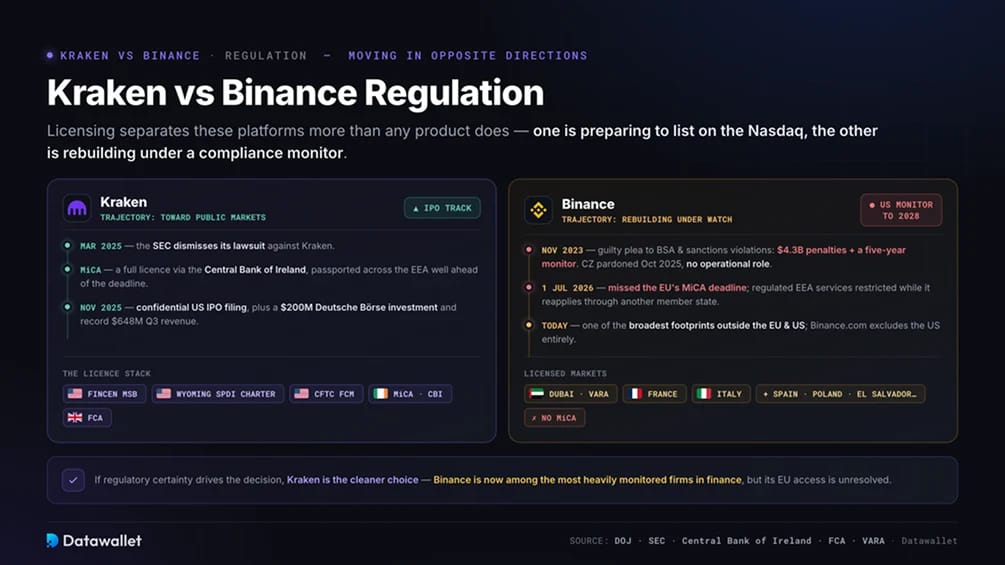
Licensing separates these platforms more than any product does. Kraken is preparing to list on the Nasdaq, while Binance is defending a UK court claim, operating under a US monitor, and rebuilding its European access from scratch.
Kraken's Licenses
- United States: Registered with FinCEN as a money services business and available in every state except New York and Maine. Kraken holds a Wyoming Special Purpose Depository Institution bank charter, and its NinjaTrader arm is a CFTC-registered Futures Commission Merchant. The SEC dismissed its lawsuit against Kraken in March 2025.
- European Union: A full MiCA license issued through the Central Bank of Ireland, passporting services across the EEA well ahead of the transition deadline.
- United Kingdom: FCA registration for crypto asset services.
- Restrictions: Kraken blocks 16 jurisdictions including Russia, Iran, and North Korea. See the current list of Kraken's supported countries.
Binance's Regulatory Position
- US settlement: Binance pleaded guilty in November 2023 to Bank Secrecy Act and sanctions violations, paying $4.3 billion in penalties and accepting a five-year independent compliance monitor. Founder CZ served four months in prison and received a presidential pardon in October 2025, though he holds no operational role.
- European Union: Binance's MiCA application through Greece did not clear the June 30, 2026 transition deadline, forcing restrictions on regulated services for EEA users from July 1. The exchange says it will seek authorization through another member state.
- Licensed markets: Dubai (VARA), France, Italy, Spain, Poland, El Salvador, and other jurisdictions, giving it one of the broadest registration footprints outside the EU and US.
- Restrictions: Binance.com excludes the US, and the separate Binance.US entity offers a narrower product set. Check Binance's restricted countries before registering.
If regulatory certainty drives your decision, Kraken is the cleaner choice. Binance's compliance program is now among the most heavily monitored in finance, but its European access remains unresolved and its legal history is a factor institutions cannot ignore.
Kraken vs Binance: Fees
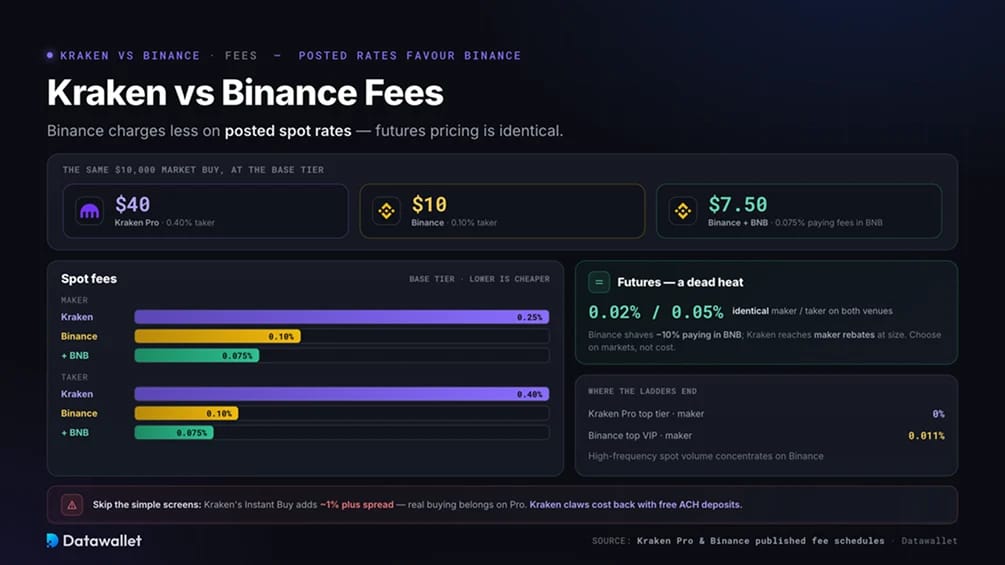
Binance charges less on posted rates, and the base-tier gap matters for active spot traders. Kraken claws some of it back through free ACH deposits and regulated bank funding. Our maker vs taker fees guide explains why order type matters as much as the venue.
Spot Trading Fees
- Kraken: Kraken Pro starts at 0.25% maker and 0.40% taker, falling with 30-day volume to 0% maker at the top tiers. The Instant Buy screen adds roughly 1% plus spread, so anything beyond a first test purchase belongs on Pro.
- Binance: A flat 0.10% maker and taker at the base tier, cut to 0.075% by paying fees in BNB. Top VIP levels reach 0.011% maker, which is why high-frequency spot volume concentrates here.
On a $10,000 market buy, the base-tier difference is $40 on Kraken Pro against $10 on Binance, or $7.50 with the BNB discount. For a monthly buyer the gap is trivial. For someone turning over six figures a month, it compounds into real money.
Futures Fees
- Kraken: 0.02% maker and 0.05% taker on crypto perpetuals, with volume tiers reaching maker rebates at institutional size. CME micro contracts through the NinjaTrader arm carry separate exchange-set pricing.
- Binance: 0.02% maker and 0.05% taker on USDⓈ-M perpetuals, with a further 10% discount for paying fees in BNB.
The two match each other on derivatives pricing at the standard tier, so choose on markets, leverage, and jurisdiction rather than cost.
Kraken vs Binance: Futures Trading
Both rank among the best crypto futures exchanges globally, so the decision rests on product range versus raw depth.
Available Markets
- Kraken: 300+ crypto perpetuals with leverage to 50x, plus a product shelf no rival matches, spanning CME-cleared micro Bitcoin and Ether futures for US traders, tokenized stock perpetuals on names like NVDA and TSLA for eligible international clients, and TradFi futures on the S&P 500, gold, and oil for EU accounts.
- Binance: The largest derivatives venue in crypto, with hundreds of USDⓈ-M and COIN-M contracts, leverage to 125x on majors, quarterly futures, and an options desk. Open interest runs at nearly double its closest competitor.
Execution and Liquidity
- Kraken: Tight order books on major perpetuals and dependable execution, though depth on smaller contracts trails the offshore giants. Funding settles hourly in the EU and every eight hours in the US.
- Binance: The deepest perpetual order books in existence, which is why large traders execute size here despite the regulatory noise. Slippage on majors is close to the theoretical minimum, and portfolio margin reduces collateral requirements for complex positions.
US Access
- Kraken: The only one of the two offering regulated derivatives to Americans, through its CFTC-registered Kraken Derivatives US arm and CME micro contracts.
- Binance: No futures access for US residents at all. Binance.US is spot-only, which rules Binance out for US derivatives traders. US-based readers can compare their real options in our guide to the best crypto exchanges in the USA.
Final Thoughts
For most traders weighing these two, Kraken is the better exchange. It pairs a spotless custody record with licenses in every major Western market, and its expansion into stocks, CME futures, and tokenized IPO access extends it well beyond crypto. The IPO filing adds financial transparency Binance cannot match as a private offshore company.
Binance still earns its place for a specific profile. If you trade altcoins in size, need the deepest perpetual books available, or run enough volume that the 0.075% BNB rate compounds into serious savings, no venue matches it. In return, you accept its unlicensed EU position, the US compliance monitor, and zero American access.
Many experienced traders run both accounts, holding core positions on Kraken and executing deep-liquidity derivatives on Binance. Before funding either account, verify your identity, confirm a small deposit and withdrawal clear cleanly, and switch on all security controls.
Our full Kraken review and Binance review cover each platform in more depth.