






Compare Top Luxembourg Crypto Exchanges
1. Kraken
Kraken takes first place by pairing rigorous supervision with the deepest euro markets that a Luxembourg investor can access. Its MiCA license from the Central Bank of Ireland sits alongside a MiFID license for regulated derivatives that most rivals here cannot offer. It has published proof-of-reserves attestations since 2014 and has never been breached in over a decade.
The trading side earns the ranking. Over 600 assets trade on some of Europe's deepest euro order books; staking covers the majors, and the MiFID arm offers regulated futures that Bybit EU cannot offer EEA retail clients. SEPA and SEPA Instant deposits are free on Kraken's side, and our transfer from a Luxembourg bank was tradable within the hour.
The downsides are the trading fees, which start at 0.25% maker and 0.40% taker. They sit above OKX and Bybit EU’s prices, a fair premium for the Irish oversight and audit history that cost-focused traders will still notice. Supervision runs through Dublin rather than the CSSF, and Kraken Pro throws a wall of charts at a first-time buyer. Our Kraken review covers it in full.
Pros
- Irish MiCA authorization paired with a MiFID license for regulated derivatives.
- Proof-of-reserves publication since 2014 and no breach across more than a decade.
- Free SEPA and SEPA Instant funding into deep euro markets with staking on major assets.
Cons
- Spot fees of 0.25% and 0.40% are higher than OKX and Bybit EU.
- Supervision sits with the Irish regulator rather than a local Luxembourg entity.
- Kraken Pro shows more interface than a casual buyer wants.
2. Coinbase
Coinbase is the safest home for a first account, for reasons specific to this country. It chose Luxembourg as its European headquarters and holds its MiCA authorization through Coinbase Luxembourg S.A., supervised by the CSSF, which oversees the funds industry in which half the country works. A Nasdaq listing adds audited quarterly accounts and 14 years with no customer funds lost to breaches.
The app is built for a first-time buyer. Our passport verification cleared within minutes, and because everything is settled in euros, there is no conversion to consider. A SEPA Instant transfer landed almost immediately, simple buys work from a card or euro balance, and recurring purchases build a position each month. With USDT gone from licensed EU venues, USDC now serves as the stablecoin across roughly 250 assets.
Price is the honest weakness, and it is avoidable. The one-tap simple buy adds in a spread that makes it the priciest route here, while Coinbase Advanced hides behind a mode toggle at around 0.40% maker and 0.60% taker on entry tiers. Switch to Advanced before your first order, and the cost drops to a reasonable amount. Our full Coinbase review goes deeper.
Pros
- CSSF MiCA authorization, with the exchange's European headquarters in Luxembourg.
- No customer funds have been lost to a breach in fourteen years, backed by audited public-company disclosures.
- The easiest onboarding here, with instant SEPA funding in euros and automated recurring purchases.
Cons
- Simple buys are the priciest purchases in this lineup.
- Advanced entry-tier fees still trail OKX, Gate and Bybit EU.
- The mainstream catalog skips much of the long tail that altcoin hunters want.
3. Bitstamp
Bitstamp is the veteran that planted its flag in Luxembourg. Founded in 2011, it is the oldest crypto exchange still trading in Europe, and on 16 May 2025, it became the first platform to win a MiCA CASP license from the CSSF. It runs through Bitstamp Europe S.A., listed as both a payment institution and a crypto-asset service provider, and has been part of Robinhood since a roughly $200 million acquisition in June 2025.
For a Luxembourg account, the mechanics are clean. SEPA deposits are free, our transfer cleared without a query, and fees open at 0.30% maker and 0.40% taker before falling with volume. The interface is calm rather than crowded, and withdrawals to a euro account cost a flat 3 euros, stated plainly instead of buried in a spread.
The limits are breadth and product depth. Around 85 assets means altcoin hunters need a second account, the instant card buy carries a 4% processor fee, and there is no margin, derivatives or earn shelf. Its job is the low-drama, locally supervised base layer, and nothing here does that better.
Pros
- First exchange authorized under MiCA by Luxembourg's CSSF, operating since 2011 with a clean record.
- Free SEPA deposits and transparent tiered fees from 0.30% maker and 0.40% taker.
- A calm, no-nonsense interface that suits buy-and-hold investors.
Cons
- Around 85 assets, so serious altcoin buyers need a second venue.
- Card and instant purchases carry a steep 4% processor fee.
- Spot only, with no margin, futures or advanced yield products.
4. Bybit EU
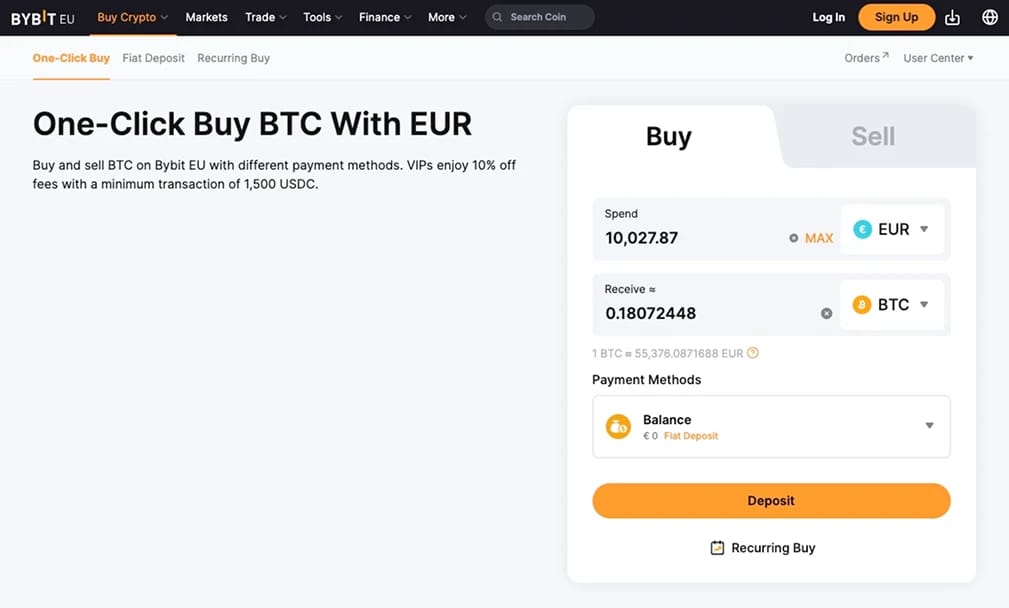
Bybit EU ranks fourth for its diverse trading and investment products. Bybit EU GmbH holds a MiCA authorization from Austria's FMA that passports into Luxembourg, and behind it sit 600+ cryptocurrencies, spot margin up to 10x, trading bots, a full Earn menu, demo trading, crypto loans, and the Bybit Card, all at a flat 0.10% on spot. Nobody else in the licensed field stacks this many products that cheaply.
Funding suits a euro country. Card and mobile wallet purchases charge in euros for quick top-ups; larger amounts are routed through SEPA, and our test transfer from BCEE settled on the day. For one login covering spot buying, some yield, and a bit of margin, the range is hard to argue with.
Know the boundaries first. Bybit EU is a separate Austrian entity, so anyone moving over from the global app repeats KYC, and the perpetual futures the brand is known for stay off-limits to EEA retail. There is no USDT either, since Tether never applied for EU approval, so USDC and euro stablecoins fill in. The full breakdown is in our Bybit review.
Pros
- The widest licensed product range here, spanning margin, bots, Earn and a card.
- 600+ assets at a flat 0.10% spot fee under an Austrian FMA authorization.
- Euro card and mobile wallet purchases alongside standard SEPA funding.
Cons
- Perpetual futures are unavailable to EEA retail clients for now.
- Existing global Bybit users must complete a fresh KYC on the EU entity.
- The February 2025 hack remains part of its history, even though customers were made whole.
5. Gate
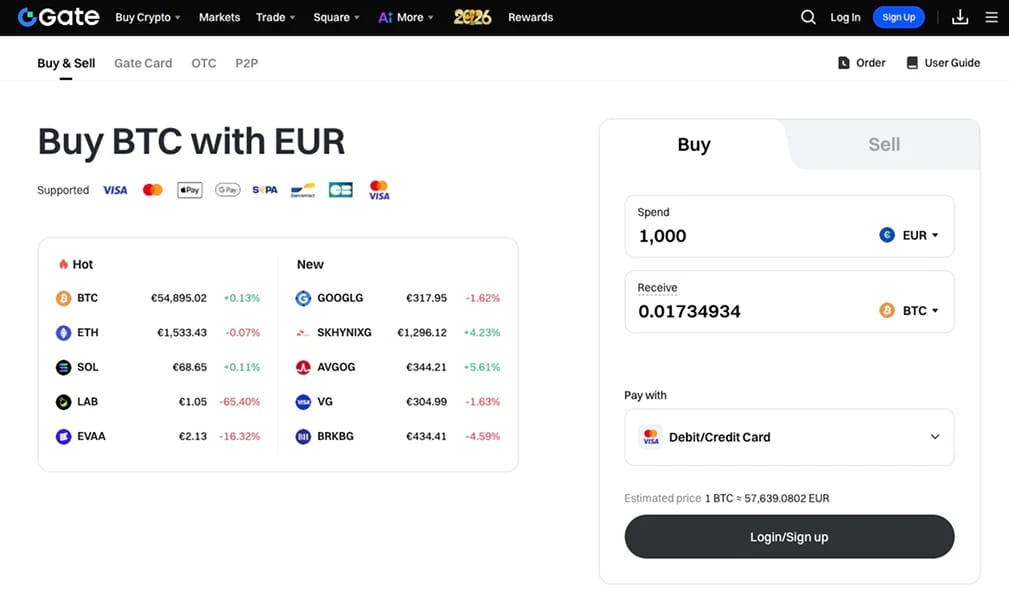
Gate is the answer when the licensed majors skip the token you want. Running since 2013 and serving over 30 million users, it lists more than 3,800 cryptocurrencies, while its European arm, Gate Technology Ltd, holds a MiCA authorization from Malta's MFSA covering custody, trading, exchange and transfer across the EEA.
Pricing and tools hold up for a catalog this deep. Maker fees start at 0.10% and taker at 0.20%, with GateToken holdings cutting them further, and the platform adds copy trading, Earn products, and a zero-knowledge proof-of-reserves system anyone can verify. Our SEPA deposit cleared in a day and was traded without question.
A few details matter before it becomes your main exchange. The license belongs to Gate Technology Ltd, so confirm in the app that the EU entity holds your account, and note the compliant catalog is smaller than the global figure. Liquidity thins fast in the long tail, where small listings carry real drawdown risk. The 2018 breach, repaid in full, and the rebuilt security stack are in our Gate review.
Pros
- The widest selection of assets of any licensed venue serving Luxembourg.
- MiCA authorization through Malta's MFSA plus verifiable zk proof of reserves.
- Competitive 0.10% maker pricing with GateToken discounts, copy trading and Earn.
Cons
- The EU entity's compliant catalog is smaller than the global number suggests.
- Thin order books and elevated risk far down the listing range.
- Malta's supervisory standing trails Ireland and Luxembourg after ESMA's peer review.
6. OKX
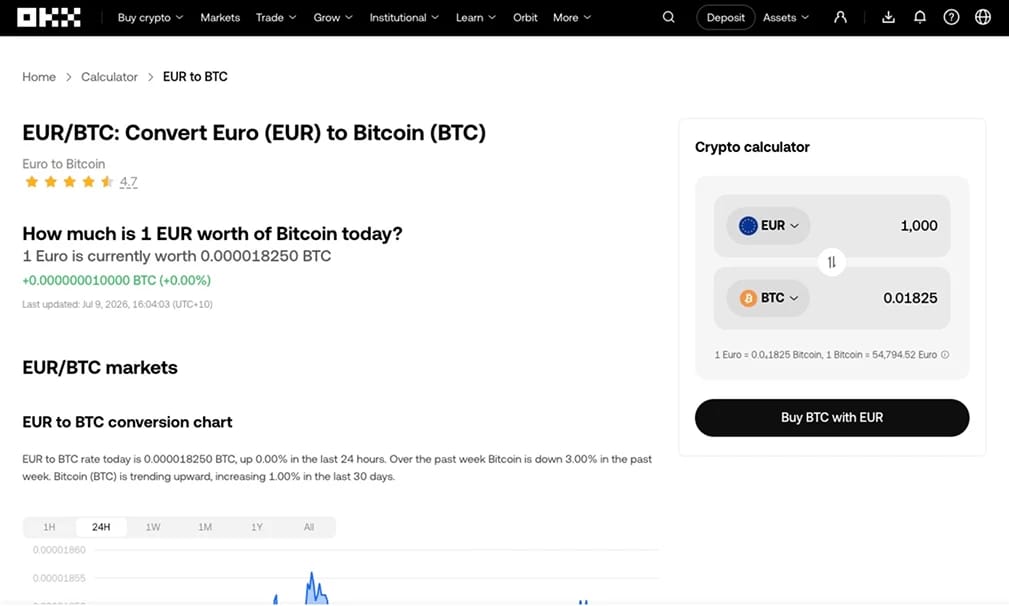
OKX wins on trading costs and on-chain reach. Spot pricing of 0.08% maker and 0.10% taker undercuts every major platform available here. The MiCA authorization comes from Malta's MFSA, and reserves are published monthly with Merkle-tree verification that anyone can check.
The self-custodial OKX Wallet is the differentiator. It spans more than 100 chains, bundles a DEX aggregator and turns one app into both a regulated exchange and a door into DeFi. Funding runs through SEPA in euros or by card, and our transfer settled the next morning without the bank flagging it.
ESMA's 2025 peer review questioned how strictly Malta vetted some early authorizations, the same doubt hanging over Gate, so the license is valid across the EEA yet carries less weight than an Irish or Luxembourg one. The product breadth can also pull a newcomer into instruments they are not ready for. The full picture is in our OKX review.
Pros
- The cheapest spot pricing among large licensed venues at 0.08% and 0.10%.
- Monthly Merkle-tree reserve attestations under a Maltese MiCA license.
- A self-custodial wallet covering 100+ chains with built-in DEX aggregation.
Cons
- Malta's supervisory reputation trails Ireland and Luxembourg after ESMA's peer review.
- Feature depth can overwhelm a buy-and-hold investor.
- No local entity, so oversight runs through the Maltese regulator.
How to Choose a Crypto Exchange in Luxembourg
Since the MiCA transition closed on 1 July 2026, the shortlist starts with the license and ends with your bank. Run these five checks before sending any euros.
- Verify the CASP authorization. A license belongs to one legal entity, not a brand. Coinbase Luxembourg S.A. and Bitstamp Europe S.A. are supervised locally by the CSSF, while Kraken, Bybit EU, Gate, and OKX passport in from other EU countries. Check the entity against the CSSF register and ESMA's MiCA register before depositing.
- Match the funding method to your bank. Luxembourg is in the eurozone, so there is no conversion, but not every account treats a crypto transfer the same. SEPA Instant is the norm at the big platforms, and a card buy is faster but usually carries a surcharge worth avoiding beyond small amounts.
- Confirm your bank clears the payment. Luxembourg banks screen crypto transfers under AML rules, and payments to licensed venues clear far more reliably than anything else. If you commute in and bank in France, Belgium or Germany, run a small test transfer first, since a foreign account can behave differently from a Spuerkeess or BIL one.
- Check that your assets survived the compliance filter. USDT is gone from licensed EEA venues because Tether skipped MiCA, and EU front ends trim parts of global catalogs. If a specific token matters, confirm it trades on the compliant version before you move money.
- Know your tax residency before the first trade. If you live here, the six-month rule and the €500 threshold below apply to you. If you are a cross-border worker, your crypto is taxed where you live, so a French or Belgian resident follows their own rules.
Crypto and Bitcoin Regulation in Luxembourg
Crypto is legal in Luxembourg and regulated under MiCA, with the CSSF as the competent authority. The euro remains the only legal tender, but owning, trading and accepting crypto by private agreement are all lawful, and the country has spent two years making itself one of the friendliest homes in the EU for licensed operators.
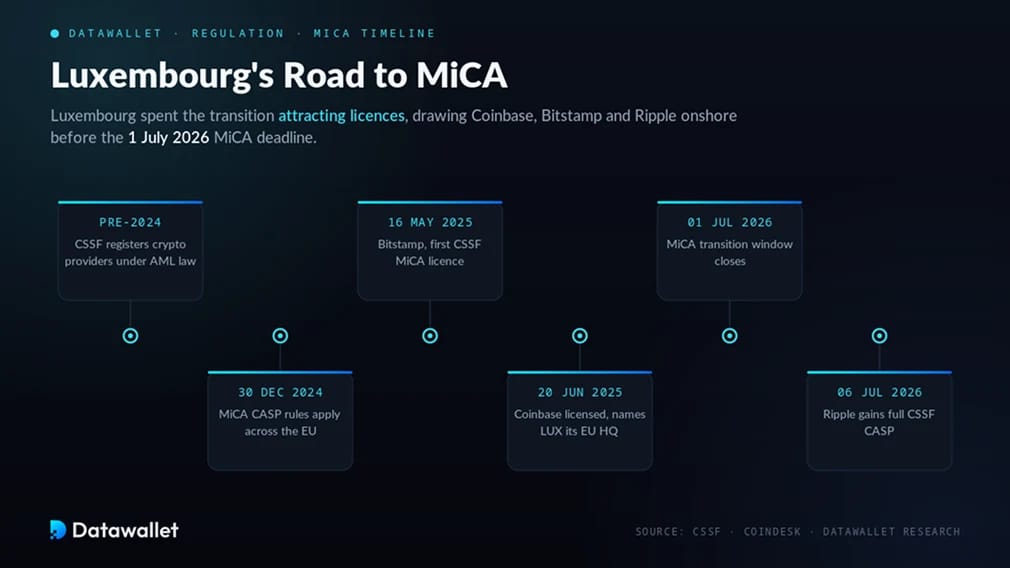
A short run of dates explains the market residents deal with today.
- Before MiCA: Luxembourg regulated virtual asset service providers under its AML law, with the CSSF registering providers and already hosting Bitstamp's European payment institution.
- 30 December 2024: MiCA's CASP rules became applicable across the EU, replacing national regimes with a single authorization that passports across the EEA.
- 16 May 2025: Bitstamp received the first MiCA CASP license issued by the CSSF, making Luxembourg one of the earliest countries to authorize a working exchange.
- 20 June 2025: Coinbase secured its CSSF MiCA license and named Luxembourg its European headquarters, over an earlier plan to base in Ireland.
- 1 July 2026: The MiCA transition window closed across the EU and EEA. Providers without authorization lost the right to serve clients, and the market settled around locally licensed and passported names.
- 6 July 2026: Ripple's preliminary CASP was upgraded to a full MiCA authorization by the CSSF, adding another major name to the register.
The pattern is what sets Luxembourg apart. Rather than watch the industry pass overhead, the CSSF drew Coinbase, Bitstamp, and Ripple into the country itself, so several exchanges a resident uses answer to a regulator down the road rather than one across the continent.
How Is Crypto Taxed in Luxembourg?
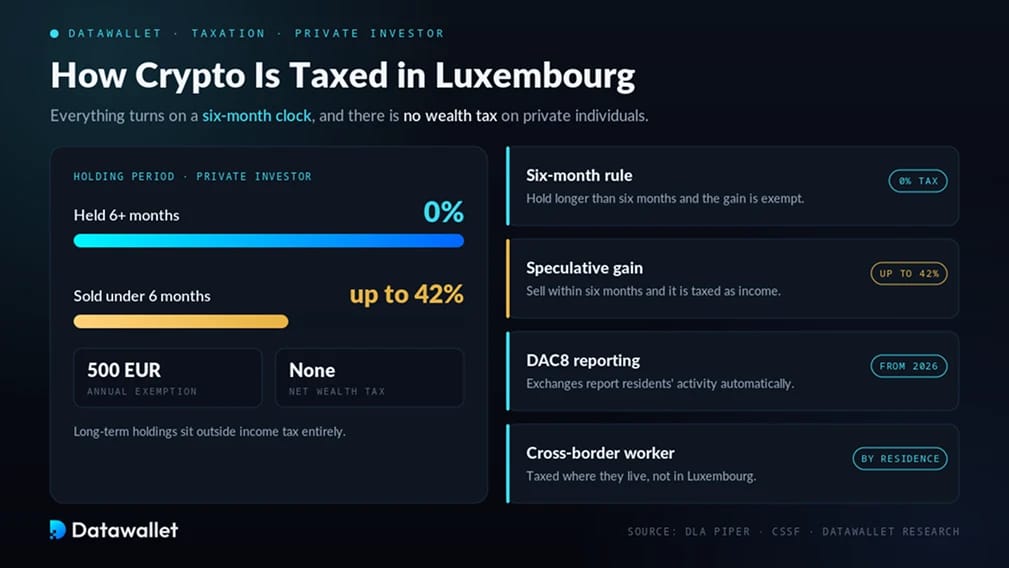
Luxembourg is one of the gentler places in Europe to hold crypto, provided you are a private investor and you are patient. Everything turns on the six-month holding period, and there is no annual charge simply for owning coins, as DLA Piper's Luxembourg tax guidance sets out.
- The six-month rule does the heavy lifting. Selling or swapping a crypto-asset held for more than six months results in a gain that is generally free of income tax, treated as private wealth management with no commercial intent.
- Sell inside six months, and it is speculative income. A disposal within six months is a speculative gain, added to your other income at progressive rates topping out at 42%, before the solidarity surcharge lifts the effective ceiling higher.
- The €500 cushion. Speculative gains are exempt entirely if your yearly total stays under €500. Cross that line and the whole amount is taxable, so it is a threshold, not an allowance.
- No net wealth tax for individuals. Unlike Norway or Spain, Luxembourg levies no wealth tax on private individuals, so a large portfolio owes nothing in a year with no sales. Net wealth tax applies to companies only.
- Track your lots by date. The six-month test runs purchase by purchase, so you need the date and cost of each lot to prove which disposals qualify. The exemption only holds if you can show it.
- Reporting is now automatic. From 1 January 2026, DAC8 obliges exchanges, foreign ones included, to report residents' activity to the Administration des contributions directes, so the tax office's figures should match yours.
One point catches people out. Nearly half of Luxembourg's workforce commutes across a border, and a cross-border worker is taxed on crypto where they live, not here. If that is you, the six-month rule may not apply at all, and you follow your home country's rules.
None of this replaces advice from a Luxembourg tax adviser, especially for staking, mining, or business-scale activity.
Cryptocurrency Adoption in Luxembourg
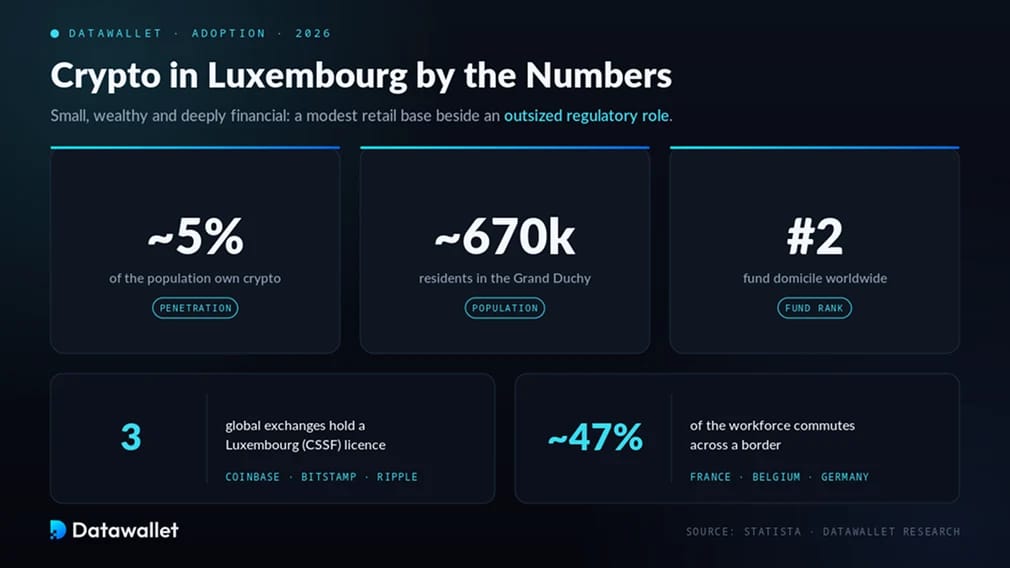
Luxembourg is small, wealthy, and deeply financial, and its crypto profile follows from all three.
- A compact but affluent user base. Statista figures put crypto penetration around 5% of the population, which in a country of roughly 670,000 people, works out to tens of thousands of users. Average wealth here is among the world's highest, so the money behind each user tends to be larger than the count suggests.
- An institutional hub more than a retail one. Luxembourg is the second-largest fund domicile on the planet, and its crypto story has leaned toward funds, custody and tokenization over street-level buying. Drawing Coinbase, Bitstamp, and Ripple onshore fits that identity.
- A cross-border population. With residents from across Europe and a workforce that arrives daily from three neighboring countries, adoption is unusually international. Many who trade "in Luxembourg" bank and pay tax elsewhere.
The global comparison sits on our crypto adoption statistics page. What stands out locally is the mismatch between a small retail base and an outsized role as regulatory home to some of the industry's biggest names.
How to Buy Bitcoin in Luxembourg
Buying BTC here is quick because the euro removes currency friction that other countries face. This is the process we used.
- Pick a licensed venue. Kraken for deep euro books and the cleanest record, Coinbase or Bitstamp for a CSSF-supervised account close to home, or Bybit EU for range at a low fee. Confirm the entity against the CSSF or ESMA register first.
- Clear verification. Upload a passport or national ID with a selfie and enter your name exactly as printed, since a mismatch stalls most applications. On the licensed platforms, this cleared for me in minutes.
- Fund in euros. A SEPA or SEPA Instant transfer from a Luxembourg account is free on the exchange side and usually lands within a day. A card buy is faster but carries a surcharge, so keep it small.
- Buy with a limit order. On any order book, a limit order on BTC/EUR nearly always fills better than a one-tap instant buy. That single tap of convenience is quietly the priciest button in the app.
- Decide where the bitcoin lives. Licensed venues must segregate client assets under MiCA, so keeping coins on the exchange is defensible for active trading. For anything long-term, withdraw to self-custody once you have checked the address and network twice. Our best crypto wallets guide compares the options.
Cashing out runs the same steps in reverse. Sell on a licensed venue, withdraw to a euro account in your own name, and note the date and value of each disposal in case the six-month rule applies.
Final Thoughts
Kraken is the account we would open first in Luxembourg today. Irish supervision, a MiFID derivatives license, reserve audits back to 2014, and a clean breach record make it the platform we trust with real size, and free euro SEPA funding keeps the mechanics simple.
The register is the only opinion that counts now. Luxembourg spent the MiCA transition attracting licenses rather than losing them, so residents can choose between global exchanges that answer to their own regulator. A sensible setup is one strong all-round account, one locally supervised name for peace of mind, and records tidy enough that the six-month rule never turns into an argument.
For the wider region, our guide to the best crypto exchanges in Europe maps the neighboring markets.
Our Methodology
Every score here comes from direct use under Luxembourg conditions rather than spec sheets. We opened each account with a passport, funded it by euro SEPA transfer and by card, placed real market and limit orders, then withdrew to a local bank. Six criteria set the rankings.
- Trust Score. Our proprietary rating out of 5, weighting the CASP authorization and issuing regulator, custody and reserve transparency, breach history, platform longevity and audit coverage.
- Euro Funding Methods: Confirmed SEPA, SEPA Instant and card support, measuring settlement speed, surcharges and the cost of withdrawing back to a euro account.
- Regulatory Standing: Verified each platform against the CSSF register and ESMA's MiCA register, the line separating legal operators from the rest since 1 July 2026.
- Security Track Record: Weighed breach history, client-asset custody, reserve disclosure frequency and account protections such as 2FA and withdrawal whitelists.
- Assets and Liquidity: Ran market and limit orders across BTC, ETH and a mid-cap pair on each venue, recording spreads, book depth and fill quality on euro pairs.
- Fee Structure: We looked at the maker and taker fees, deposit surcharges and the all-in cost of a euro round trip.
Platforms without a live MiCA authorization were excluded, which removed Binance after it pulled its EU application, and every operator that missed the cutover. Testing ran from April through July 2026, with each license rechecked after the 1 July deadline.
.webp)