



What Are Kraken's Fees?
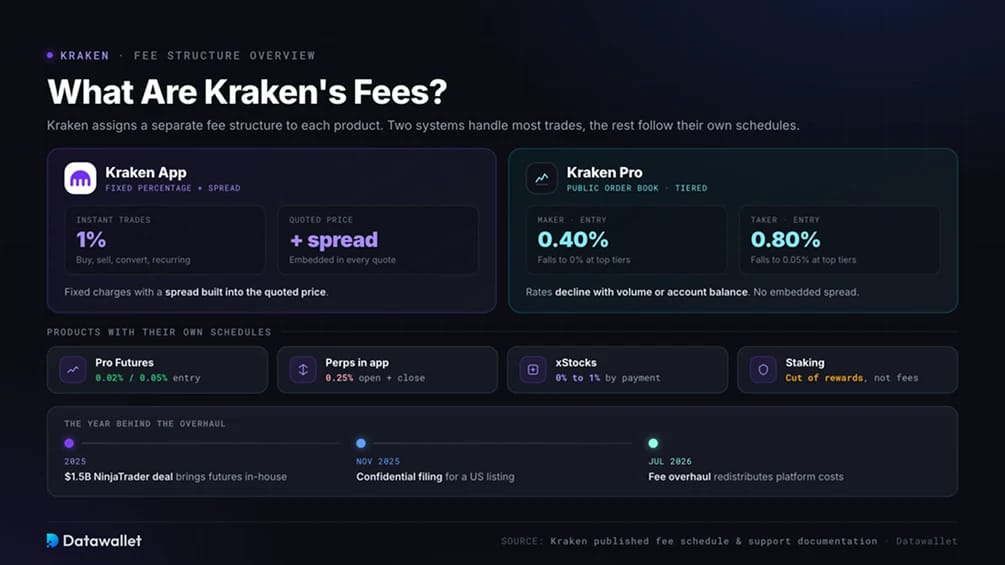
Kraken assigns a separate fee structure to each product. The app uses fixed percentage charges and includes a spread in the quoted price. Kraken Pro matches trades through a public order book with tiered maker and taker rates. Tokenized stocks, Perps, staking, and other newer products follow their own schedules.
In November 2025, Kraken confidentially filed for a US listing after a year of expansion that included its $1.5 billion acquisition of futures broker NinjaTrader. The fee overhaul that followed changed how costs are distributed across the platform.
All rates below come from Kraken's published fee schedule and support documentation.
Kraken App Fees (Instant Buy, Sell and Convert)
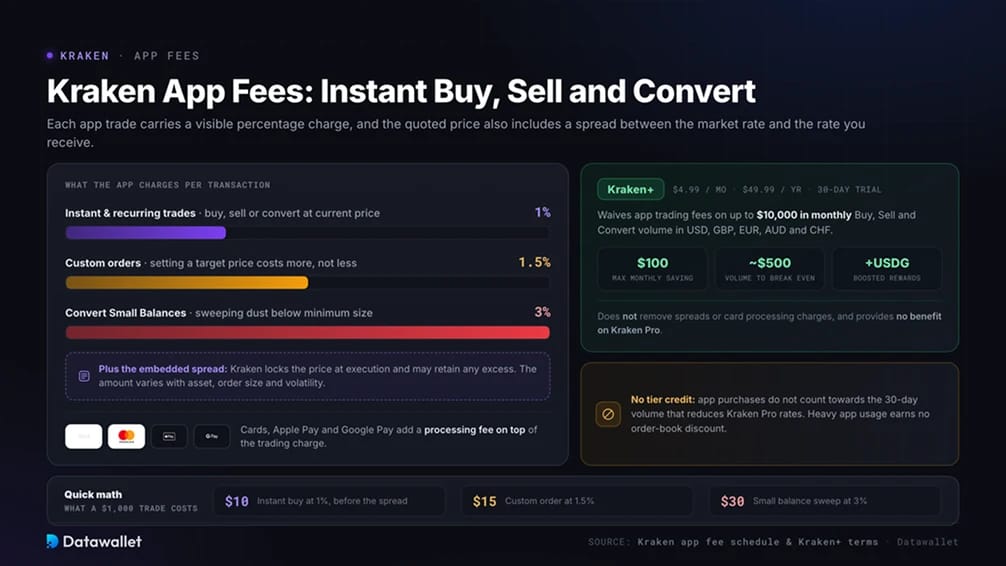
Each app trade carries a visible percentage charge. The price shown also includes a spread, meaning the difference between the market rate and the rate you receive.
Here is what the app charges on each transaction:
- Instant and recurring trades: Buying, selling, or converting at the current price costs a flat 1%, including scheduled recurring purchases.
- Custom orders: The app charges 1.5% when you set a target price, reversing the usual pattern in which limit orders cost less.
- The embedded spread: Kraken locks the price at execution and says it may retain any excess spread. The amount varies with the asset, order size, and market volatility.
- Payment method charges: Credit and debit cards, Apple Pay, and Google Pay add a processing fee on top of the trading charge.
- Small balance conversions: Using the Convert Small Balances tool to sweep amounts below the minimum order size costs a fixed 3%.
- No tier credit: Purchases made in the app do not contribute to the 30-day volume used to reduce Kraken Pro rates. Heavy app usage therefore earns no order-book discount.
Kraken+ and the $10,000 Fee Waiver
Kraken+ costs $4.99 per month and waives app trading fees on up to $10,000 in monthly Buy, Sell, and Convert volume. The waiver covers major currencies such as USD, GBP, EUR, AUD, and CHF. New subscribers receive a 30-day free trial, while annual billing costs $49.99.
For regular app buyers, the calculation is straightforward. Monthly purchases of $10,000 would ordinarily incur $100 in trading fees at the 1% instant rate. The subscription therefore pays for itself at just over $500 in monthly volume. Members also receive boosted USDG stablecoin rewards and early access to token launches.
Kraken+ does not remove spreads or card processing charges. It also provides no benefit on Kraken Pro, where the waiver does not apply.
Kraken Pro Spot Trading Fees
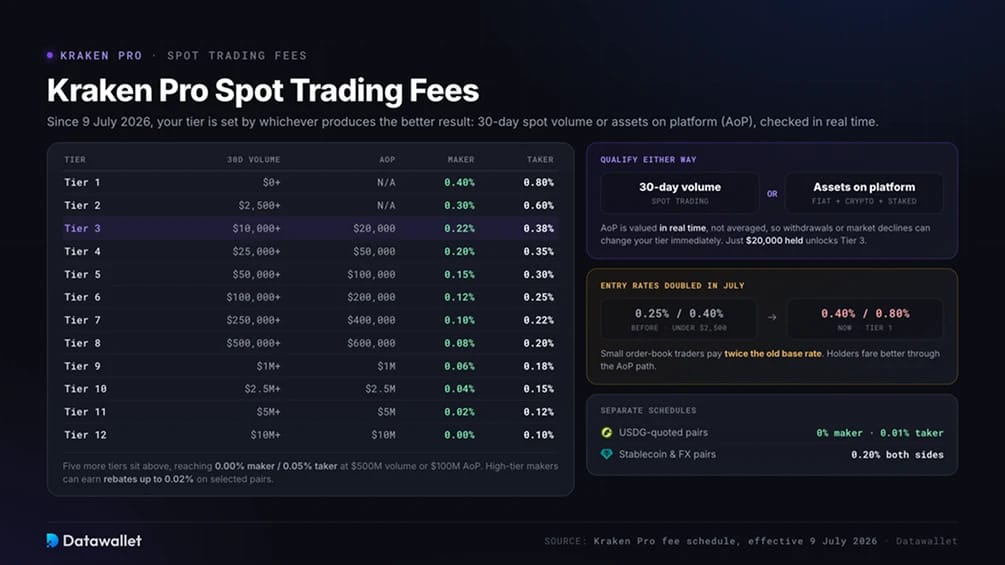
Kraken Pro underwent the largest pricing change. On 9 July 2026, the exchange replaced its product-specific volume bands with cross-platform fee tiers. Your rate is now determined by whichever measure produces the better result: 30-day spot volume or assets on platform.
Assets on platform, or AoP, is the current US dollar value of funds held with Kraken. It includes fiat, crypto, tokenized assets, and staked balances. Kraken checks the value in real time rather than using an average, so withdrawals or market declines can change your tier immediately.
Another five Pro tiers sit above those shown in the table. Rates eventually reach 0.00% maker and 0.05% taker at $500 million in volume or $100 million in AoP. Makers place limit orders that rest on the book and add liquidity, while takers fill orders already available. Our guide to maker vs taker fees explains the distinction in more detail.
The restructure did not reduce fees for everyone. Kraken's announcement presents it as a change to tier calculations rather than a blanket price cut. Traders with less than $2,500 in monthly volume previously paid 0.25% maker and 0.40% taker, compared with 0.40% and 0.80% now. Holders fare better because a $20,000 balance is enough to unlock Tier 3 pricing.
High-tier makers can earn rebates of up to 0.02% on selected lower-liquidity pairs. Stablecoin and FX markets use a separate schedule starting at 0.20% for both maker and taker orders. Pairs quoted in USDG cost 0% maker and 0.01% taker from the first dollar.
Kraken Futures and Margin Fees
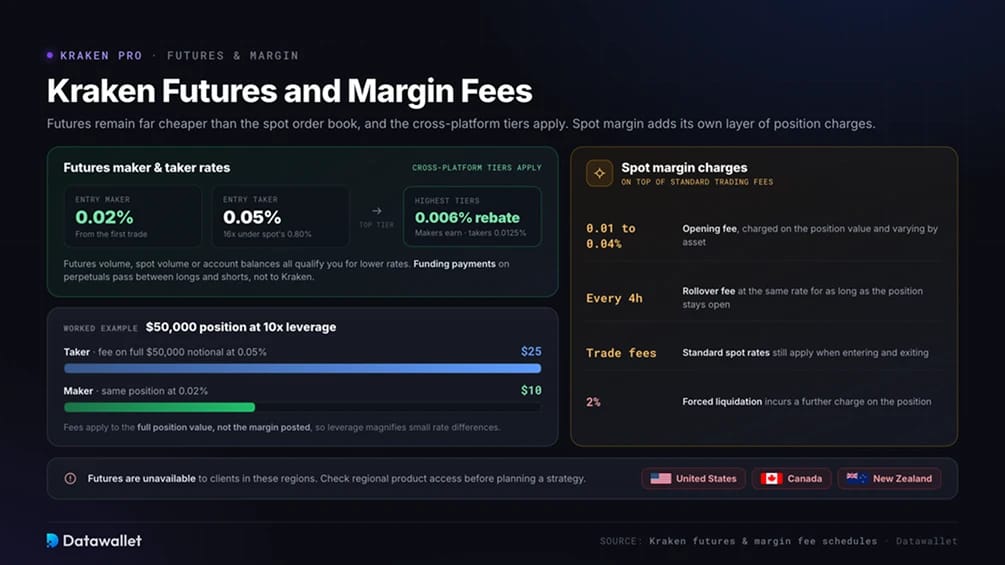
Kraken Pro futures remain considerably cheaper than the spot order book. Entry-level traders pay 0.02% maker and 0.05% taker. The cross-platform tiers also apply, allowing futures volume, spot volume, or account balances to qualify users for lower rates. At the highest tiers, makers receive a 0.006% rebate and takers pay 0.0125%.
Fees apply to the full value of a position, not only the margin posted, so leverage increases the impact of small rate differences. Opening a $50,000 position with 10x leverage costs $25 as a taker or $10 as a maker. Perpetual contracts also carry funding payments, which pass between long and short traders rather than going to Kraken. These can be compared across venues through our funding rates tracker.
Spot margin positions attract additional charges. Opening fees range from 0.01% to 0.04% depending on the asset, with an equivalent rollover fee charged every four hours while the position remains open. Standard trading fees still apply when entering and exiting, while forced liquidations incur a further 2% charge. Futures are unavailable to clients in the US, Canada, and New Zealand. Our guide to Kraken's supported countries covers regional product access.
Kraken Stocks, xStocks and Perps Fees
Traditional shares, tokenized equities, and Perps may look similar in the interface, but their fee schedules differ sharply.
Check which product you are holding before you trade:
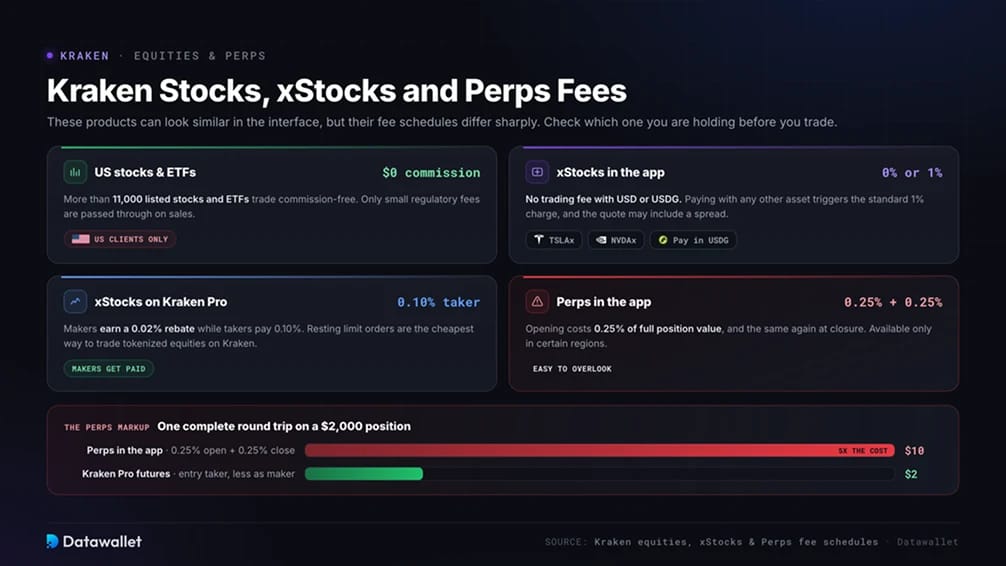
- US stocks and ETFs: Kraken offers zero-commission trading on more than 11,000 listed stocks and ETFs. Only small regulatory fees are passed through on sales, and the product is restricted to US clients.
- xStocks in the app: Tokenized shares such as TSLAx and NVDAx carry no trading fee when purchased with USD or USDG. Paying with another asset triggers the standard 1% charge, and the quoted price may include a spread.
- xStocks on Kraken Pro: Makers receive a 0.02% rebate, while takers pay 0.10%. Resting limit orders are therefore the lowest-cost way to trade tokenized equities on Kraken.
- Perps in the app: Opening a position costs 0.25% of its full value, with the same fee charged again at closure. The product is available only in certain regions.
Perps pricing deserves particular attention. A complete trade on a $2,000 app position costs $10. Equivalent exposure through Kraken Pro futures costs $2 at entry-level taker rates, or less when using maker orders. Our guide to perpetual vs spot trading explains how the products differ, while our ranking of the best tokenized stock trading exchanges places Kraken's xStocks rates in context.
Kraken Staking Fees
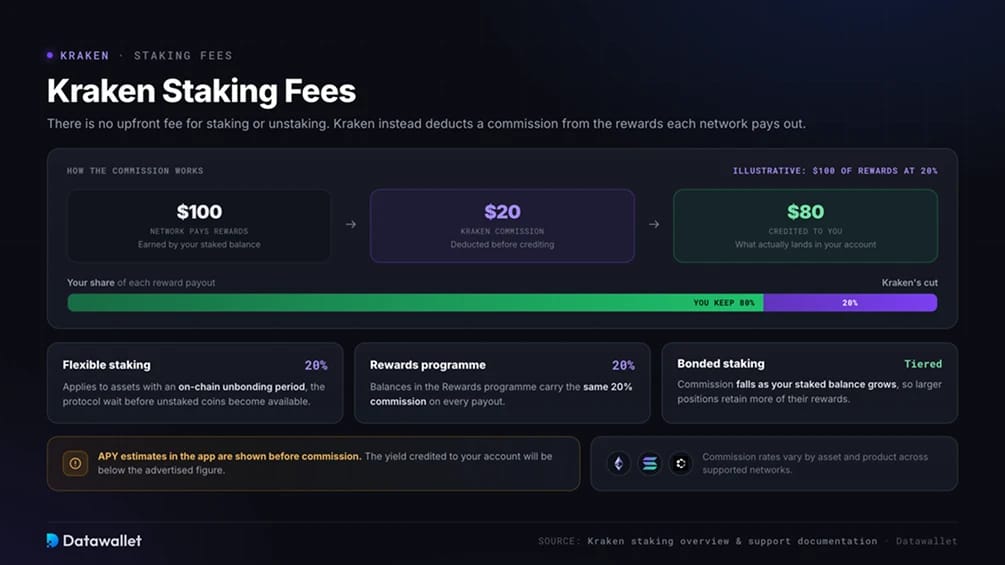
Kraken does not charge an upfront transaction fee for staking or unstaking. Instead, it deducts a commission from the rewards paid by each network, as detailed in its staking overview.
The commission varies by product. Flexible staking on assets with an on-chain unbonding period carries a 20% commission, as do balances in the Rewards programme. An unbonding period is the protocol-defined wait before unstaked coins become available. Bonded staking uses commissions tiered according to your total staked balance, allowing larger positions to retain more of their rewards.
APY estimates displayed in the app are shown before Kraken deducts its commission. The yield credited to your account will therefore be below the advertised figure.
Kraken Deposit and Withdrawal Fees
Funding costs vary by payment method, currency, and region. Bank transfers remain the least expensive option in almost every market. Kraken lists current figures on its cash deposit and cash withdrawal pages, which take precedence over third-party tables.
US customers can make free ACH deposits through Plaid and trade with the funds immediately, although withdrawals are blocked for seven days. Most European SEPA deposit methods are free. Wire transfer charges depend on the banking partner, while card processing fees make card purchases the costliest way to fund an account.
Most crypto deposits are free. Withdrawals incur a flat fee for each asset, adjusted to reflect network conditions. Certain payment methods also trigger security holds, including a 72-hour withdrawal block after card purchases.
How Kraken Fees Compare to Other Exchanges
Kraken's position in the market changed after the July restructure. These are the published entry-tier rates before discounts or promotional offers.
Kraken now has the highest entry-level spot fees among the four exchanges. Coinbase Advanced even charges less for taker orders, a change discussed in our Coinbase fees breakdown. Futures are more competitive, with Kraken matching or beating both offshore venues at their base rates.
Larger balances change the comparison. None of the other exchanges in the table allows an inactive $100,000 balance to unlock 0.15% maker and 0.30% taker rates without any trading. Assets staked through Kraken also count towards AoP. Our Coinbase vs Kraken and Bybit vs Kraken comparisons assess factors beyond trading costs. The best low-fee crypto exchanges ranking shows where execution is currently cheapest.
Tips for Reducing Kraken Fees
Product choice accounts for most avoidable costs on Kraken.
Use these habits to keep your trading costs down:
- Trade on Kraken Pro, not the app: The 0.80% entry-level taker rate is already close to the app's 1% charge before the spread. Every lower Pro tier is cheaper.
- Let your balance qualify you: Holding at least $20,000 on Kraken unlocks Tier 3 rates of 0.22% maker and 0.38% taker without requiring trading volume.
- Place resting limit orders: Maker fees are roughly half the taker rate across the schedule, and selected markets offer maker rebates.
- Subscribe to Kraken+ if you use the app: A $4.99 membership can remove up to $100 in monthly instant-trade fees.
- Avoid Perps in the app: In regions where futures are available, Kraken Pro provides equivalent directional exposure for one-fifth of the taker cost or less.
- Pay for xStocks in USD or USDG: Purchases funded with other assets incur the 1% trading charge.
- Fund by bank transfer: ACH and most SEPA deposits are free, whereas cards add processing fees to the trading charge.
- Claim a sign-up bonus: New users can combine fee savings with rewards through a Kraken referral code.
Final Thoughts
Kraken has exchanged simplicity for a broader range of products. The previous volume-based schedule has become a network of separate pricing models, where the same dollar of exposure may cost 0.05%, 0.25%, or 1% depending on the interface. July's restructure increased entry-level order-book fees but introduced discounts for assets held on the exchange.
Small order-book traders now pay more, while holders and users active across multiple products can pay less. Regular app buyers should consider Kraken+ or move their trades to Kraken Pro. The Perps markup and xStocks payment rule are particularly important because both can materially change the cost of otherwise similar transactions.
Kraken still ranks above much of the market for fee transparency. Its tiers, commissions, and rebates are published rather than hidden inside quoted prices. Our full Kraken review examines the platform once security, liquidity, and regulation are considered alongside fees.