



Top 8 Zcash Statistics and Trends
1. ZEC Printed an Eight-Year High Above $850
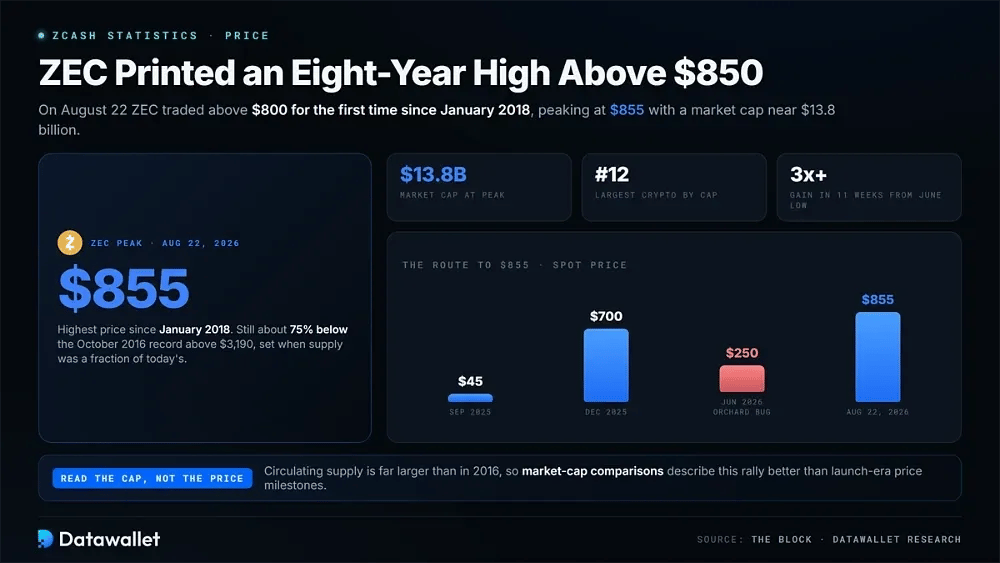
On August 22, Zcash traded above $800 for the first time since January 2018 and briefly reached $855, according to The Block. At that peak, ZEC carried a market capitalization of about $13.8 billion, making it the 12th-largest cryptocurrency.
The route to that level was volatile. ZEC was trading near $45 in September 2025, then moved toward $700 by year-end. After developers disclosed a critical shielded-pool vulnerability, it fell to roughly $250 in June. The token more than tripled over the following eleven weeks as the fix shipped and confidence recovered.
Nominal price alone gives an incomplete picture. At $855, ZEC was still around 75% below its October 2016 record above $3,190, which was set when circulating supply was only a fraction of today's. For that reason, market-cap comparisons provide a more representative view of the current rally than launch-era price milestones.
2. Futures Volume Neared $10B in a Single Day
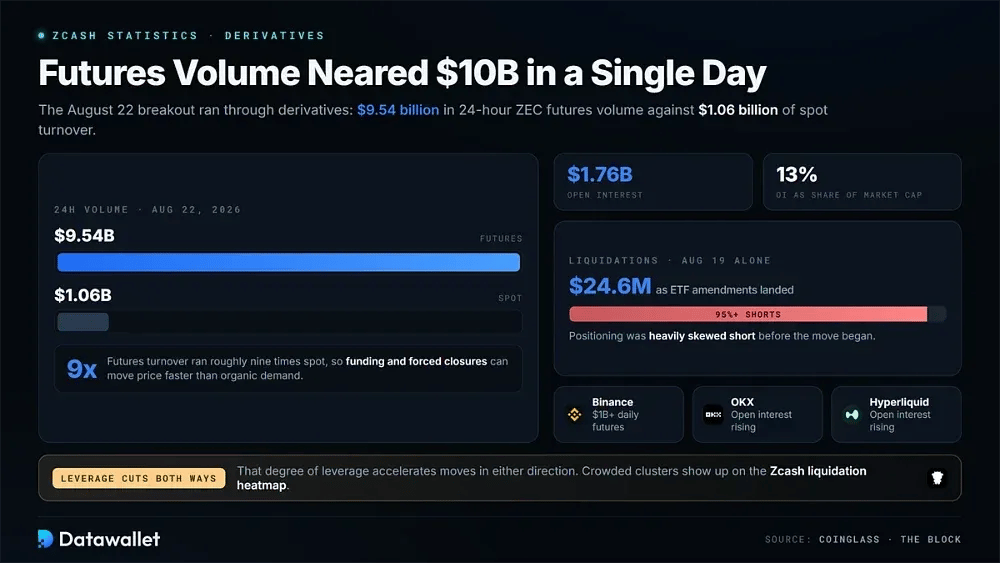
Most of the breakout came through derivatives rather than spot markets. During the August 22 surge, Coinglass recorded about $9.54 billion in 24-hour ZEC futures volume versus roughly $1.06 billion in spot turnover. Open interest climbed to approximately $1.76 billion, or about 13% of the token's total market capitalization.
Positioning was already heavily skewed before the move. Around $24.6 million in ZEC positions were liquidated on August 19 alone, and shorts accounted for more than 95% of those losses as Grayscale's ETF amendments landed. Binance generated more than $1 billion in daily futures activity, while open interest also increased on OKX and Hyperliquid.
That degree of leverage can accelerate moves in either direction. With futures turnover running at roughly nine times spot volume, funding rates and forced closures may move price faster than organic demand. The same dynamic is covered in our perpetual futures statistics. Traders watching crowded ZEC positioning can also use the Zcash liquidation heatmap to identify clusters at risk.
3. Shielded Supply Hit a Record 31% of All ZEC
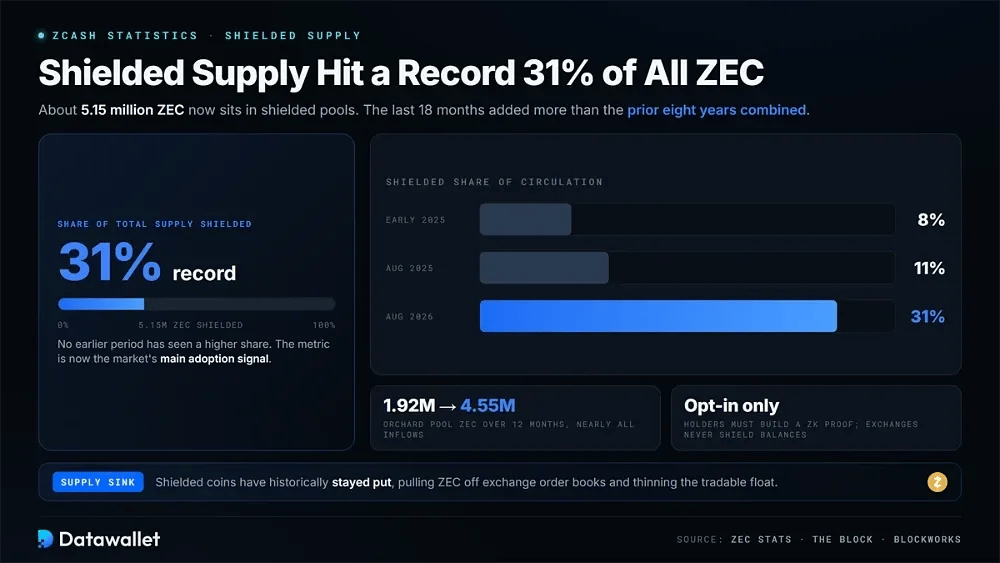
About 5.15 million ZEC is now held in shielded pools, equal to roughly 31% of total supply, according to ZEC Stats. No previous period has seen a higher share. The amount added over the past eighteen months exceeds the growth recorded during the network's prior eight years combined, turning shielded supply from a niche statistic into the market's main adoption signal.
The increase has been rapid. Shielded supply was near 8% of circulation in early 2025 and stood at 11% a year ago. Over twelve months, the Orchard pool alone grew from 1.92 million to 4.55 million ZEC, according to The Block, accounting for nearly all recent inflows.
Coins do not become shielded automatically. A holder must deliberately move ZEC into a private pool by constructing a zero-knowledge proof onchain, something exchanges do not perform for customer balances. That distinction is why analysts at Blockworks follow the metric closely. Shielded coins have historically remained in place, creating a supply sink that reduces tradable float.
4. Shielded Transactions Reached 59.3% of Activity
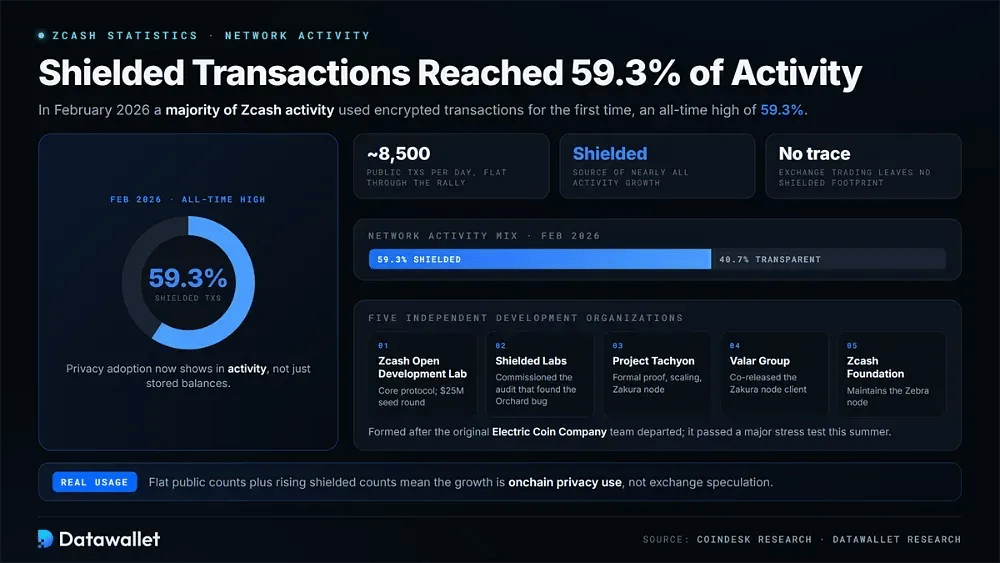
Privacy adoption is no longer concentrated only in stored balances. In February 2026, shielded transactions reached an all-time high of 59.3% of all Zcash activity, according to CoinDesk Research. That marked the first time a majority of network activity used encrypted rather than transparent transactions.
Public transaction counts provide important context. They have remained roughly flat at about 8,500 per day throughout the rally, so nearly all activity growth has come from shielded transactions. Exchange speculation cannot create the same pattern because trading on exchanges leaves no shielded footprint.
Protocol development has also become more decentralized. Five independent organizations now contribute to the network: the Zcash Open Development Lab, Shielded Labs, Project Tachyon, Valar Group, and the Zcash Foundation. This structure took shape after the original Electric Coin Company team departed and faced a major stress test during the summer.
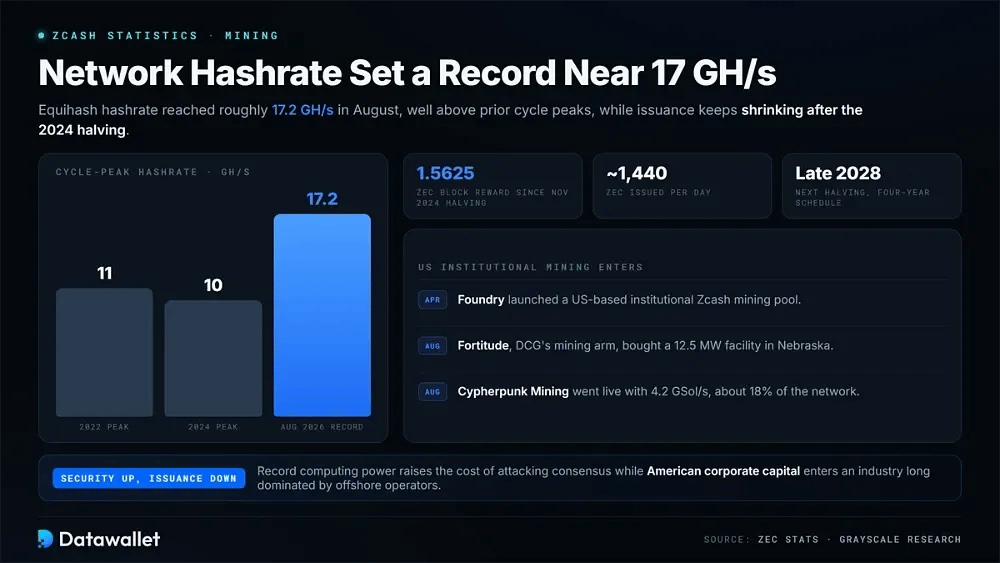
5. Network Hashrate Set a Record Near 17 GH/s
Zcash's Equihash hashrate reached roughly 17.2 GH/s in August, according to ZEC Stats. That level sits well above previous cycle peaks of about 11 GH/s in 2022 and 10 GH/s in 2024. Record computing power from miners raises the cost of attacking network consensus.
This expansion comes despite tighter issuance. The November 2024 halving reduced block rewards to 1.5625 ZEC, leaving miners with roughly 1,440 ZEC per day. The next reduction is expected around late 2028 under a schedule similar to the Bitcoin halving. Mining capacity is therefore growing while issuance contracts.
Institutional infrastructure accounts for part of that increase. Grayscale Research reported that Foundry launched a US-based institutional Zcash mining pool in April. In August, DCG's mining arm Fortitude acquired a 12.5 MW facility in Nebraska. Both moves bring American corporate capital into an industry that had long been dominated by offshore operators.
6. Ironwood Sealed a $1.7B Pool and Shipped a Formal Proof
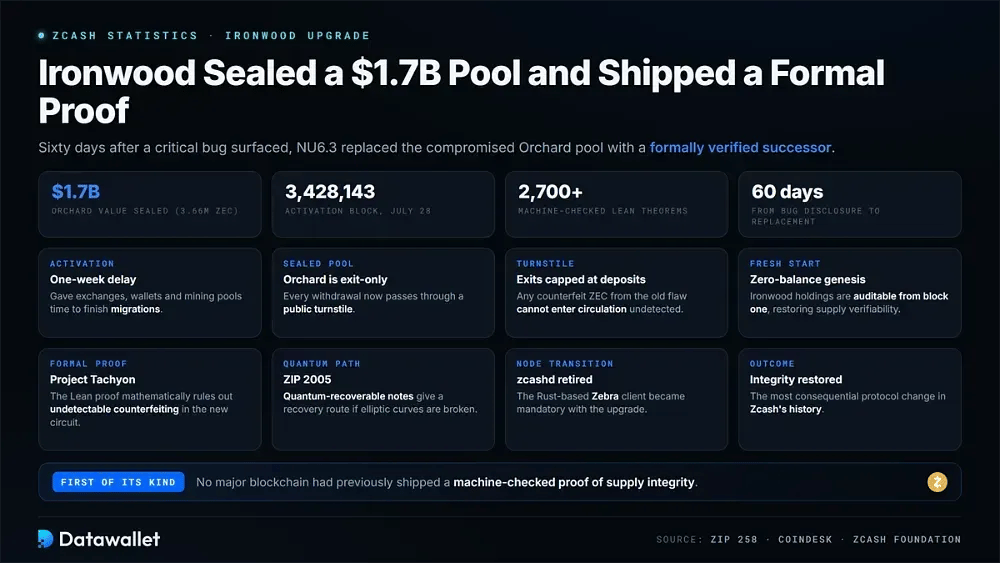
Ironwood represents the most consequential protocol change in Zcash's history. Just sixty days after a critical bug surfaced, the upgrade replaced the compromised Orchard shielded pool with a formally verified successor.
Key facts from the Ironwood activation and its aftermath:
- Activation: NU6.3 went live at block 3,428,143 on July 28 after a one-week delay, giving exchanges, wallets, and mining pools additional time to complete migrations.
- Sealed pool: Orchard held about 3.66 million ZEC worth roughly $1.7 billion when it became exit-only. CoinDesk reported that every withdrawal now passes through a public turnstile.
- Turnstile accounting: The checkpoint limits total exits to verifiable deposits. As a result, any hypothetical counterfeit ZEC produced through the old vulnerability cannot enter circulation without detection.
- Fresh start: Ironwood began with a zero balance. Its holdings can therefore be audited independently from genesis, restoring full supply verifiability for migrated funds.
- Formal proof: Project Tachyon completed a machine-checked Lean proof containing more than 2,700 theorems. The work mathematically rules out undetectable counterfeiting within the new circuit.
- Quantum path: Under ZIP 2005, Ironwood implements quantum-recoverable notes that provide a recovery route if future quantum computers break today's elliptic-curve cryptography.
- Node transition: Support for the legacy zcashd client ended with the upgrade, making the Rust-based Zebra implementation mandatory, as confirmed by the Zcash Foundation.
Data Sources: Zcash Improvement Proposals (ZIP 258) and CoinDesk reporting through late July.
7. Grayscale Filed Its Fifth Amendment for a Spot ZEC ETF
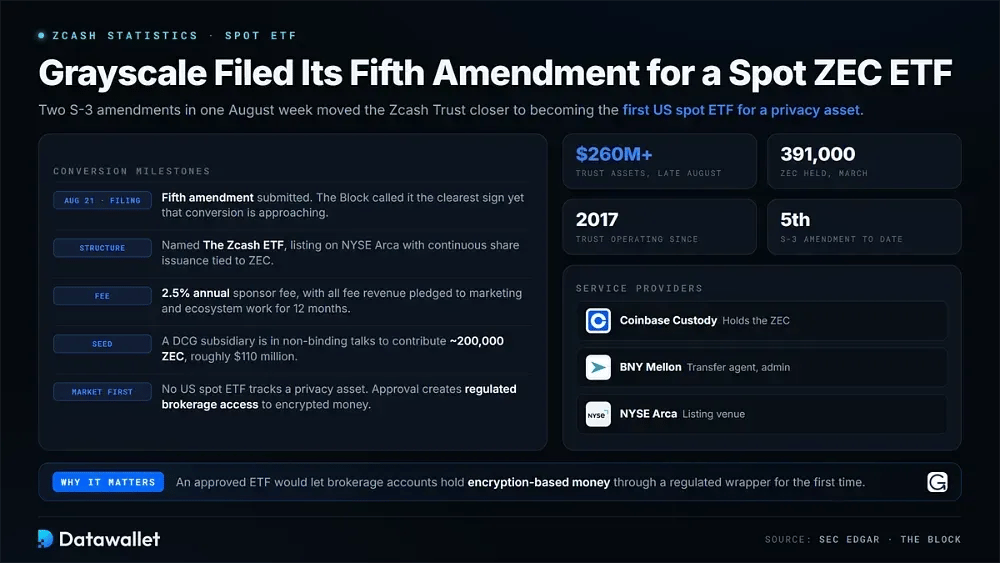
Grayscale moved closer to converting its Zcash Trust into the first US spot ETF focused on a privacy asset after filing two registration amendments with the SEC during a single week in August.
Key milestones in the Zcash ETF conversion so far:
- Fifth amendment: Grayscale submitted its latest S-3 revision on August 21. The Block described the filing as the clearest indication yet that conversion is approaching.
- Fund structure: The vehicle would take the name The Zcash ETF and list on NYSE Arca, continuously issuing shares at prices tied to ZEC and market demand.
- Sponsor fee: The filing establishes a 2.5% annual fee. Grayscale has voluntarily pledged to direct all fee revenue toward marketing and ecosystem development for twelve months.
- Service providers: Coinbase Custody Trust Company would hold the fund's ZEC. Bank of New York Mellon would act as transfer agent and administrator.
- Existing base: Operating since 2017, the trust held more than $260 million in assets as of late August and reported roughly 391,000 ZEC in March.
- DCG contribution: A Digital Currency Group subsidiary entered non-binding discussions to contribute about 200,000 ZEC worth roughly $110 million, providing substantial seed backing.
- Market first: No US spot ETF currently tracks a privacy asset. Approval would therefore create regulated brokerage access to encryption-based money for the first time.
Data Sources: SEC registration filings via EDGAR and The Block reporting through August 22.
8. Cypherpunk Holds 1.92% of Supply and 18% of Hashrate
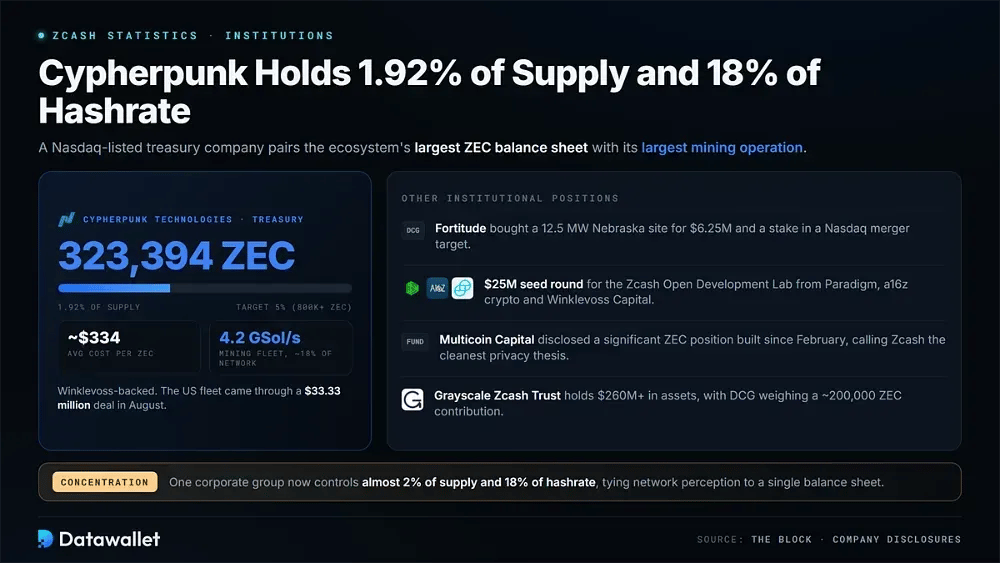
A Nasdaq-listed treasury company has become a structural force in Zcash markets by combining the ecosystem's largest ZEC balance sheet with its largest mining operation.
Largest institutional positions and commitments in the Zcash ecosystem:
- Cypherpunk treasury: The Winklevoss-backed company owns 323,394 ZEC, representing about 1.92% of circulating supply. Its cumulative average acquisition price is near $334 per token, according to The Block.
- Supply target: Management has publicly committed to owning at least 5% of all ZEC over time, which would amount to more than 800,000 coins at current issuance.
- Mining fleet: Cypherpunk Mining launched in August with 4.2 GSol/s of US-based Equihash capacity. The fleet represents roughly 18% of the network and came through a $33.33 million Winklevoss deal.
- DCG expansion: Fortitude, Digital Currency Group's mining subsidiary, purchased an operating 12.5 MW Nebraska site for $6.25 million and acquired a stake in a Nasdaq merger target.
- Venture backing: In March, the Zcash Open Development Lab raised $25 million in seed funding from Paradigm, a16z crypto, and Winklevoss Capital, reducing concerns around developer funding.
- Fund positioning: Multicoin Capital disclosed in May that it had accumulated a significant ZEC position since February, describing Zcash as the cleanest expression of the privacy thesis.
Data Sources: The Block and company disclosures through August 18.
What Is Zcash?
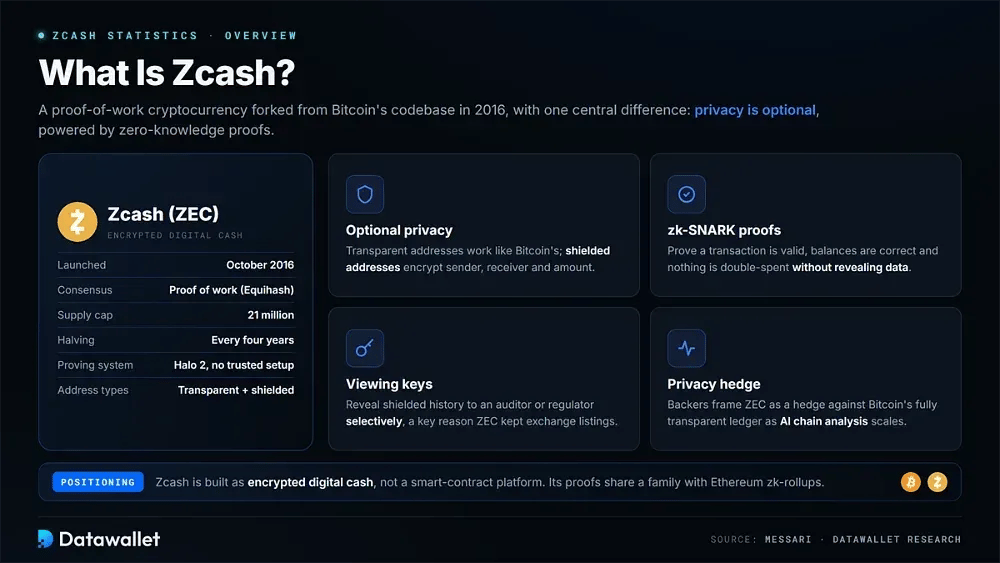
Zcash is a proof-of-work cryptocurrency launched in October 2016 from a fork of Bitcoin's codebase. Like Bitcoin, it has a fixed 21 million supply cap and a four-year halving schedule. The central distinction is optional privacy: users can choose transparent addresses that operate like Bitcoin addresses or shielded addresses that encrypt transaction information.
Zero-knowledge proofs secure those shielded transactions. They belong to the same cryptographic family used by zk-rollups on Ethereum. A zk-SNARK proves that a transaction is valid, balances are correct, and no double-spending has occurred without exposing the sender, receiver, or amount. Halo 2, the current proving system, also eliminated the trusted setup required by earlier versions.
Because privacy is optional, users can disclose information selectively. Viewing keys allow a holder to reveal shielded transaction history to an auditor, accountant, or regulator without making it public. Messari identifies that compliance flexibility as a core reason Zcash has retained broad exchange support while mandatory-privacy coins have faced widespread delistings.
Zcash is therefore positioned as encrypted digital cash rather than a smart-contract platform. Supporters, including prominent Bitcoin investors, describe ZEC as a privacy hedge against Bitcoin's fully transparent ledger. That thesis gained momentum as AI-driven chain analysis made it easier to deanonymize pseudonymous transaction histories at scale.
How Zcash Shielded Pools Work
A shielded pool is the encrypted part of the Zcash ledger. Within it, balances and transfers remain hidden behind zero-knowledge proofs. Holders can move coins between transparent and shielded portions of the network whenever they choose.
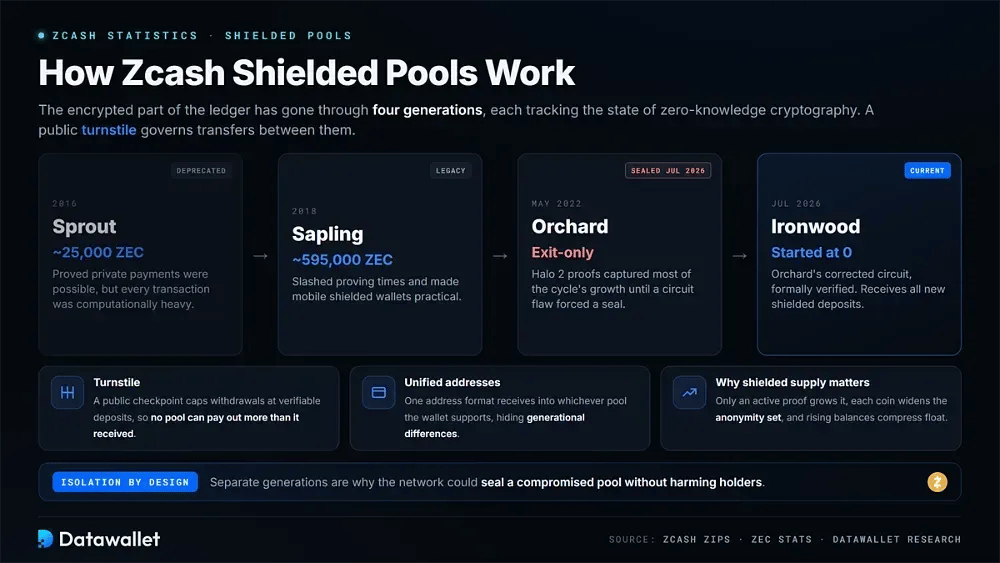
Since launch, Zcash has introduced four generations of shielded pools, with each generation advancing the cryptography used by the previous one. Transfers between pools are governed by a public accounting rule called the turnstile.
The Four Shielded Pool Generations
The evolution of Zcash's shielded pools mirrors the state of zero-knowledge cryptography at the time each one launched. That history also explains how the network was able to isolate a compromised pool without harming holders.
The shielded pool generations and mechanisms that govern them:
- Sprout: Zcash's original 2016 pool demonstrated that private payments were possible, but each transaction required substantial computation. The pool is now deprecated and holds only about 25,000 stranded ZEC.
- Sapling: Introduced in 2018, Sapling sharply reduced proving times and made mobile shielded wallets practical for the first time. Around 595,000 ZEC remains in Sapling addresses.
- Orchard: Launched in May 2022 using Halo 2 proofs, Orchard captured most of the cycle's shielded growth before being sealed in July after a circuit vulnerability was discovered.
- Ironwood: The current pool uses Orchard's corrected circuit with formal verification. It began at a zero balance and now receives all new shielded deposits across the network.
- Turnstile: Transfers between pools cross a public checkpoint that restricts withdrawals to the amount of verifiable deposits, preventing any pool from paying out more than it received.
- Unified addresses: Introduced with Orchard, the unified address format allows wallets to receive funds into whichever pool they support through a single address, keeping generational differences out of the user's way.
Why Shielded Supply Is the Key Metric
In privacy crypto, shielded supply provides a direct adoption signal because passive ownership cannot increase it. Someone who buys ZEC on an exchange and leaves the coins there adds nothing to the figure, since exchanges hold customer funds in transparent addresses. Supply becomes shielded only when a holder actively generates a proof and moves the coins into a private pool.
More shielded supply also enlarges the anonymity set, meaning the group within which any individual transaction is concealed. Each additional coin strengthens privacy for other participants at the same time. That can attract more privacy-focused users, whose deposits then expand the anonymity set further, producing the network effect now visible in the data.
For markets, rising shielded balances compress available float. Historically, shielded holders sell less frequently than transparent holders. As a result, coins leave exchange order books and liquid supply becomes thinner. The same dynamic intensified both the 2025 rally and the sharp drawdowns that interrupted it.
Zcash Key Terminology
A relatively small vocabulary covers many of the concepts needed to read Zcash network dashboards and compare shielded activity with transparent chains. These terms also appear throughout the statistics above.
The Orchard Bug and the Ironwood Response
Zcash's defining event of the year began with the discovery of a counterfeiting vulnerability that had existed for four years inside its primary shielded pool. Within sixty days, the network had replaced that pool entirely.
The incident forced Zcash to demonstrate whether a privacy network could establish the integrity of its own monetary supply. The response changed how the market valued ZEC.
Discovery and Emergency Response
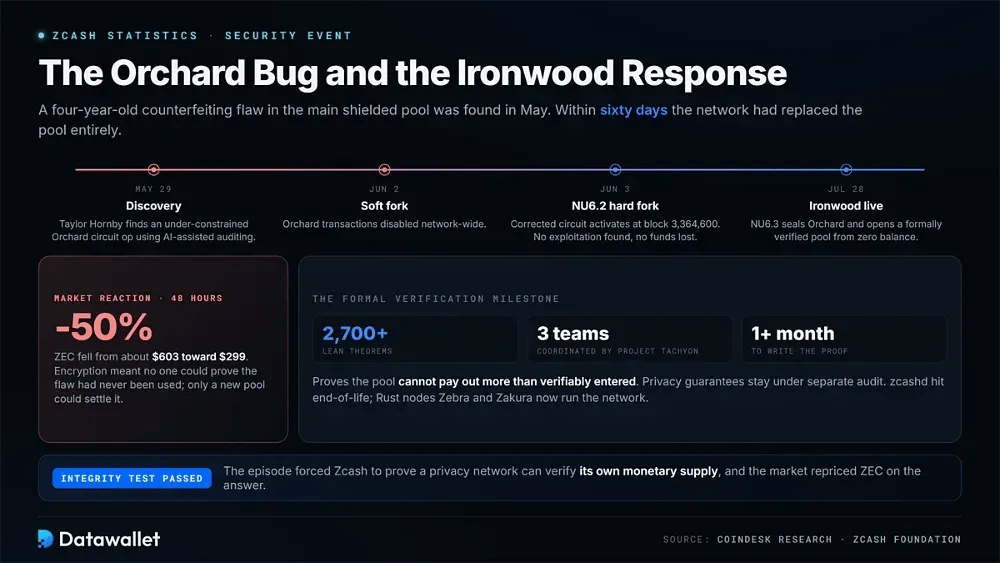
On May 29, security researcher Taylor Hornby found an under-constrained operation in Orchard's zero-knowledge circuit while working under contract for Shielded Labs with an AI-assisted auditing framework (using Claude Opus 4.8). The flaw had been live since May 2022 and could theoretically have allowed counterfeit ZEC to be created inside the pool without leaving an onchain trace.
An emergency response followed within days. Orchard transactions were disabled by soft fork on June 2. On June 3, the NU6.2 hard fork activated a corrected circuit at block 3,364,600. Investigators found no evidence that the flaw had been exploited during its four-year lifetime, and no user funds were lost.
The uncertainty still triggered a severe market reaction. Within 48 hours of disclosure, ZEC dropped roughly 50%, falling from about $603 toward $299. Orchard's encryption meant there was no cryptographic way to prove that exploitation had never occurred. Fixing the circuit prevented future use of the flaw, but the uncertainty could only be resolved permanently by replacing the pool.
The Formal Verification Milestone
Ironwood arrived with a capability no major blockchain had previously shipped: a machine-checked mathematical proof of supply integrity. More than 2,700 theorems covering the new pool's circuits and accounting were written in Lean over the course of more than a month by three research teams coordinated by Project Tachyon.
Under the system's stated assumptions, the proof establishes balance integrity by guaranteeing that the shielded pool cannot pay out more value than verifiably entered it. Privacy guarantees are deliberately excluded and remain subject to separate audits. Researchers are now applying the same AI tooling that found the original bug to ongoing verification work.
The security episode accelerated infrastructure changes elsewhere in Zcash as well. Partly because AI-assisted vulnerability discovery makes older codebases more exposed to scrutiny, the C++ zcashd client reached end-of-life and the network shifted to Rust-based nodes. Valar Group and Project Tachyon also released Zakura, a second independent node implementation forked from Zebra, increasing client diversity.
Zcash Cross-Chain and Wallet Adoption
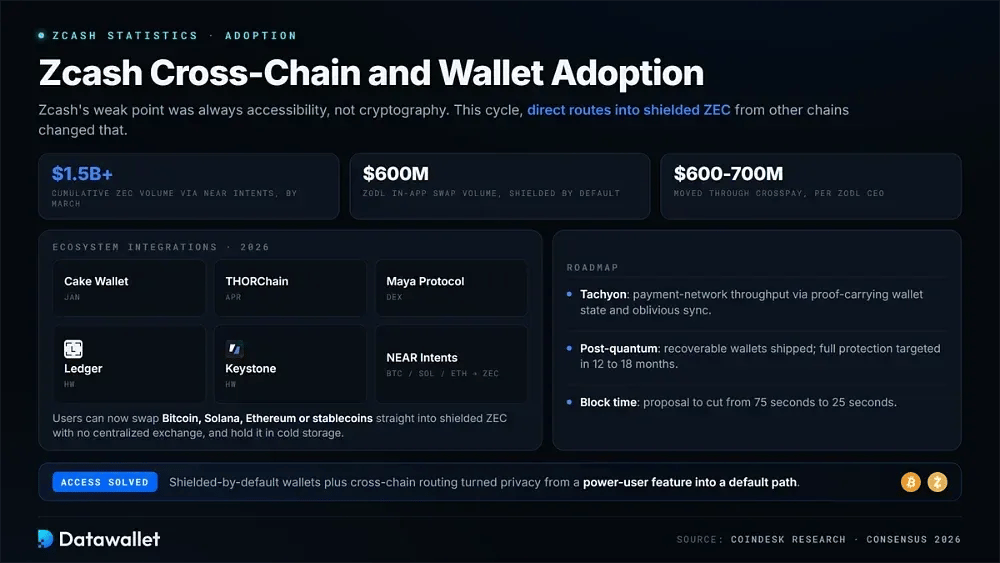
Zcash historically struggled more with accessibility than cryptography, but that limitation changed substantially during this cycle. By the end of March, cumulative ZEC volume routed through NEAR Intents had surpassed $1.5 billion, according to CoinDesk Research. The system allows users to exchange Bitcoin, Solana, Ethereum, or stablecoins directly into shielded ZEC without using a centralized exchange.
Wallet development was a major part of that shift. Zodl, formerly Zashi, moved to a shielded-by-default design and had processed around $600 million in cumulative in-app swap volume by March. CrossPay allows users to spend private ZEC while recipients receive another supported asset. At a Consensus event, ZODL CEO Josh Swihart said roughly $600 to $700 million had already moved through that route.
Other parts of the ecosystem expanded at the same time. Cake Wallet, long considered the leading Monero wallet, introduced shielded Zcash support in January. THORChain integrated ZEC swaps in April, while Maya Protocol offers additional decentralized liquidity. Shielded balances are now supported on Keystone and Ledger hardware devices, addressing the cold-storage gap for larger crypto wallet users.
Further changes remain on the roadmap. Tachyon is targeting payment-network-scale throughput using proof-carrying wallet state and oblivious sync. Quantum-recoverable wallets shipped with Ironwood, while full post-quantum protection is targeted within twelve to eighteen months. The community is also discussing a proposal to reduce block times from 75 seconds to 25 seconds.
Zcash Regulations
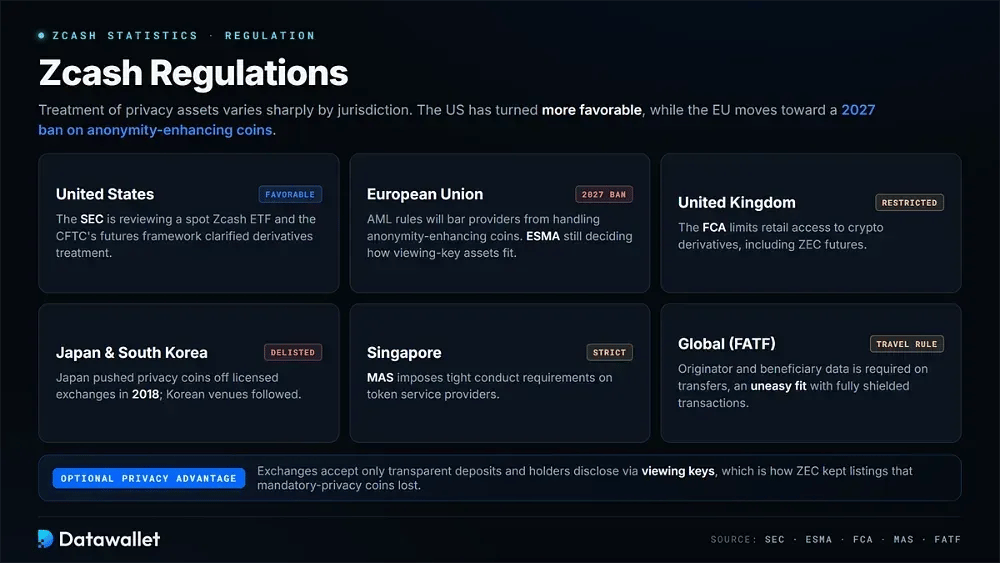
Regulation of privacy assets varies sharply by jurisdiction. A product available for unrestricted trading in one market may be unavailable in another. Conditions in the United States have become considerably more favorable: the SEC is reviewing a spot Zcash ETF, and the CFTC's futures classification framework has brought greater clarity to derivatives treatment.
The direction in Europe differs. When the EU's anti-money-laundering regulation takes full effect in 2027, crypto service providers will be prohibited from handling anonymity-enhancing coins. Supervisors working under ESMA coordination are still determining how the rules apply to optional-privacy assets that support viewing keys. Separately, the FCA limits UK retail access to crypto derivatives.
Across Asia, policy remains fragmented. Japan's regulator pushed privacy coins off licensed exchanges as early as 2018, with South Korean venues later following. Singapore's MAS imposes strict conduct requirements on token service providers. At the global level, the FATF travel rule requires originator and beneficiary information for transfers, creating an uneasy fit with fully shielded transactions.
Optional privacy gives Zcash a regulatory advantage. Exchanges can accept only transparent deposits, while holders can use viewing keys to disclose transaction history when necessary. Those features have helped ZEC preserve listings that mandatory-privacy coins have lost. Some traders in restrictive markets continue to use no-KYC exchanges, although doing so introduces legal and counterparty risks of its own.
Zcash Against Monero and Other Privacy Coins
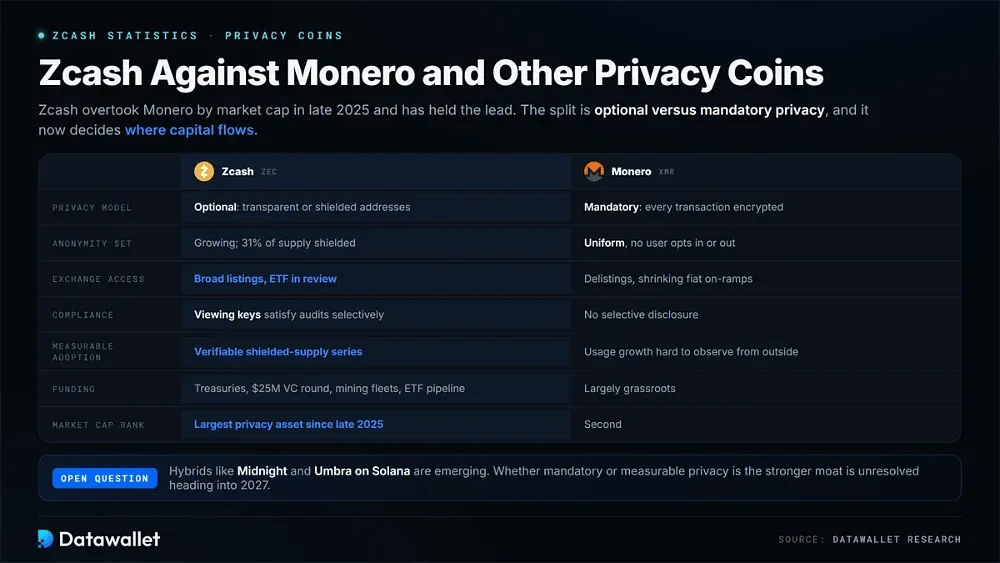
In late 2025, Zcash overtook Monero by market capitalization and became the largest privacy asset, a lead it has maintained. The two networks take fundamentally different approaches to the same privacy problem.
Monero applies encryption by default to every transaction. Zcash leaves privacy optional. That distinction increasingly determines how capital is distributed across the sector.
Where Each Model Wins
Because Monero shields every transaction, its anonymity set is uniform and users do not distinguish themselves by opting into privacy. For people who want privacy without additional configuration, that consistency is an advantage. It also carries a cost: mandatory encryption has led to delistings on regulated exchanges and progressively reduced Monero's fiat on-ramps.
Zcash gives up some default privacy in exchange for broader institutional compatibility. Transparent addresses allow exchanges, custodians, and a prospective ETF to handle ZEC in much the same way they handle Bitcoin.
Viewing keys can satisfy audit requirements where disclosure is necessary. The underlying wager is that privacy can scale further when regulated infrastructure is able to support the asset, and 2026 capital flows are consistent with that thesis.
Hybrid approaches are also emerging. Midnight brings selective disclosure to smart contracts, while projects such as Umbra on Solana add privacy to otherwise transparent high-throughput chains. Our privacy coins guide compares the leading models in greater detail.
What the Adoption Data Shows
One major distinction is the ability to measure adoption. Zcash's shielded supply produces a precise, verifiable time series. Monero's universal encryption makes comparable usage growth harder for outside capital to observe. Institutions investing around the privacy thesis have overwhelmingly favored the asset whose adoption can be charted directly.
The funding landscape reflects that difference. Zcash has attracted corporate treasuries, a $25 million venture round, dedicated mining fleets, and an ETF pipeline. Monero continues to rely largely on grassroots funding. Whether mandatory privacy or measurable privacy becomes the stronger long-term moat remains the central unresolved question for the category heading into 2027.
Risks of Buying and Trading Zcash
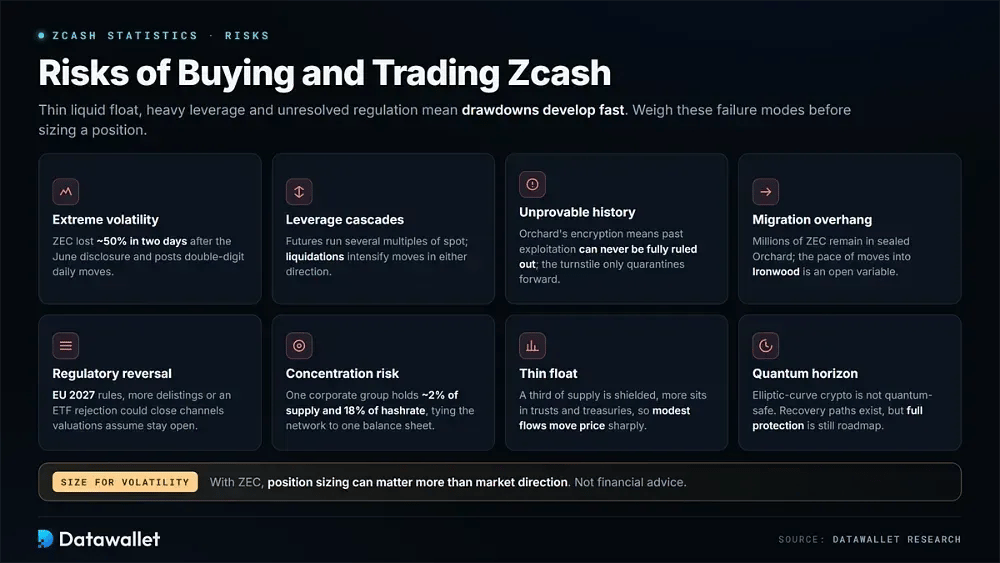
Zcash combines limited liquid float with substantial leverage and unresolved regulatory uncertainty. As a result, drawdowns can develop quickly and become severe. Consider the following failure modes before sizing a position.
Weigh each of these risks before gaining exposure to ZEC:
- Extreme volatility: After the June disclosure, ZEC lost roughly 50% in two days and has repeatedly posted double-digit daily moves. Position sizing can therefore matter more than market direction.
- Leverage cascades: Futures turnover regularly exceeds spot volume by several multiples. During volatile periods, concentrated liquidations can intensify moves in either direction.
- Unprovable history: Because Orchard is encrypted, historical exploitation of the counterfeiting vulnerability can never be ruled out completely. The turnstile can only quarantine the risk going forward.
- Migration overhang: Millions of ZEC remain in the sealed Orchard pool, leaving the pace of voluntary migration into Ironwood as an unresolved variable in supply data.
- Regulatory reversal: EU restrictions scheduled for 2027, further exchange delistings, or rejection of the ETF could eliminate access channels that current valuations already assume will remain available.
- Concentration risk: One corporate group controls almost 2% of supply and 18% of hashrate, linking perceptions of the network to the financial health of a single balance sheet.
- Thin float: Roughly a third of supply is shielded, with additional ZEC held in trusts and corporate treasuries. Even modest flows can therefore move price sharply, strengthening rallies and worsening selloffs.
- Quantum horizon: Current elliptic-curve cryptography is not quantum-safe. Recovery mechanisms now exist, but full post-quantum protection remains a future roadmap objective.
Final Thoughts
Zcash enters late 2026 with a rally supported by measurable usage. Roughly a third of supply is shielded, most transactions are encrypted, and hashrate is setting records. The network also responded to a worst-case security event by delivering a formally verified replacement pool within sixty days.
The past year brought two major structural changes. Institutional capital moved into Zcash through treasuries, mining fleets, and an ETF conversion that is close to completion. At the same time, protocol development shifted away from a single company and spread across five independent organizations. Both developments reduce the single points of failure that limited earlier cycles.
Even so, headline numbers need context. Futures turnover is far larger than spot activity, so leverage influences short-term price more strongly than adoption. Shielded metrics show demand for privacy; they do not guarantee price appreciation. A clearer market picture comes from reading shielded supply together with open interest and available float rather than relying on the price chart by itself.
Our Methodology
The statistics in this article were assembled from primary market and onchain sources instead of aggregated summaries. Coinglass, ZEC Stats, Blockworks, The Block, CoinDesk Research, Grayscale Research, and SEC filings are among the sources used, with figures cross-checked when different sources disagreed.
Five principles shaped what appears here:
- Primary sourcing: Figures are tied to live dashboards, research reports, regulatory filings, or company disclosures rather than secondary commentary and social media claims.
- Onchain preference: Verifiable chain metrics such as shielded supply and hashrate receive more weight than trading statistics because volume can be inflated more easily than protocol-level state.
- Scope disclosure: Shielded and derivatives totals can differ depending on tracker coverage, so the relevant measurement source is identified alongside each figure.
- Regulatory verification: ETF-conversion and protocol-upgrade details are based on SEC filings and block explorer data rather than issuer marketing.
- Date anchoring: Every figure uses the measurement period given by its source, an important distinction because ZEC market data can change materially within a week.
Zcash data changes quickly as migration continues, leverage expands and contracts, and the ETF review moves forward. Check live dashboards for current figures before acting on the information presented here.