






Bybit vs Kraken: Overview
Bybit arrived in 2018 as a perpetuals specialist under co-founder Ben Zhou and has since grown into the industry's second-largest venue by trading volume. Close to 80 million users trade 600+ spot coins and more than 2,000 derivatives contracts from its Dubai base, all inside one Unified Trading Account.
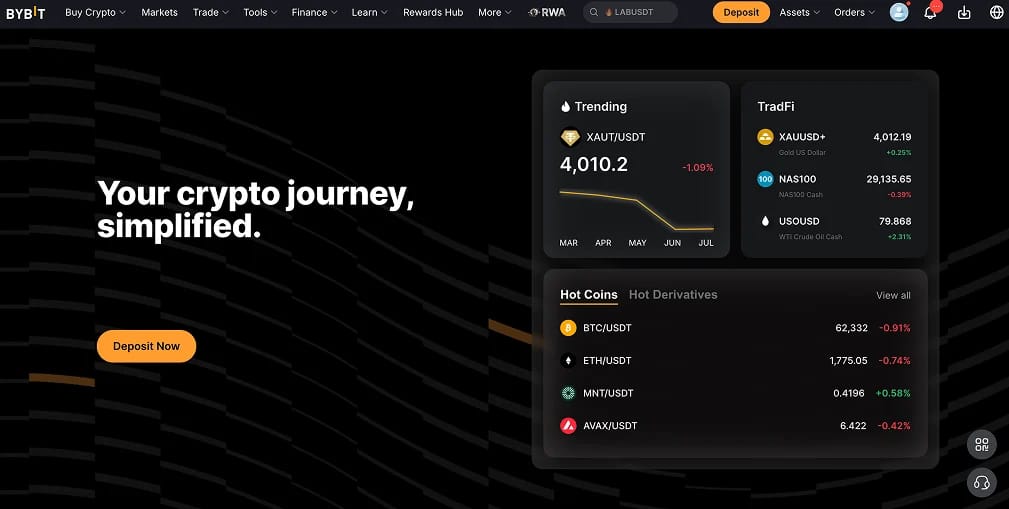
The platform still behaves like it was designed at a trading desk. Our USDT test deposit showed up in under five minutes, switching between isolated and cross margin took one tap, and the terminal keeps funding rates and liquidation prices on the chart.
Kraken belongs to a different generation. Jesse Powell began building it in 2011, trading opened in 2013, and it now reaches 15 million clients in more than 190 countries with 500+ cryptocurrencies. Along the way it picked up a bank charter in Wyoming, a US stockbroker, CFTC futures venues, and tokenized equities, and it confidentially filed for a US IPO in late 2025.
Testing Kraken feels less like trading and more like banking. Fiat moves through real payment networks rather than card processors, every Kraken Pro ticket shows the exact fee before submission, and nothing in the interface nudges you toward leverage.
Bybit vs Kraken: Products
Both platforms carry the expected core of spot, perpetuals, staking, copy trading, and bots. What separates them is where each spends its development budget. Bybit keeps stacking tradable instruments, from options to oil CFDs, into one margin account. Kraken keeps acquiring regulated venues, from a FINRA stockbroker to CFTC futures exchanges, behind one login.
Bybit Products
Everything on Bybit orbits the Unified Trading Account, which lets spot holdings, stablecoins, and open positions share a single collateral pool.
- Perpetuals and Futures: The core business. USDT, USDC, and inverse contracts carry ceilings of 125x on majors, and BTC and ETH fills in our testing printed at the quoted price even at size.
- Options: USDC-settled contracts on BTC, ETH, and SOL with visible chain depth. Kraken has no comparable listed options market.
- Spot Trading: 600+ coins with steady, vetted listings. We treat it mainly as the funding layer for derivatives, though it covers portfolio building comfortably.
- xStocks and Tokenized Gold: Tokenized equities from issuer Backed, plus the gold tokens XAUT and PAXG, trade directly on Bybit spot, giving on-chain ownership exposure without a separate account.
- Bybit TradFi: An MT5-based CFD arm covering 380+ stocks, forex, indices, gold, and oil, run through Mauritius-licensed Infra Capital, plus USDT-settled TradFi perpetuals added this April. Our Bybit TradFi explainer unpacks the full suite.
- Copy Trading and Bots: One of the industry's largest Master Trader networks, plus grid and DCA automation in the same account.
- Earn and Loans: Dual assets, fixed staking, flexible savings, and collateralized borrowing, including on-chain vaults such as the Mantle product.
- Web3 and Byreal: A self-custody wallet plus Byreal, the Solana DEX Bybit backed in 2025, extend the ecosystem past the centralized order books.
Kraken Products
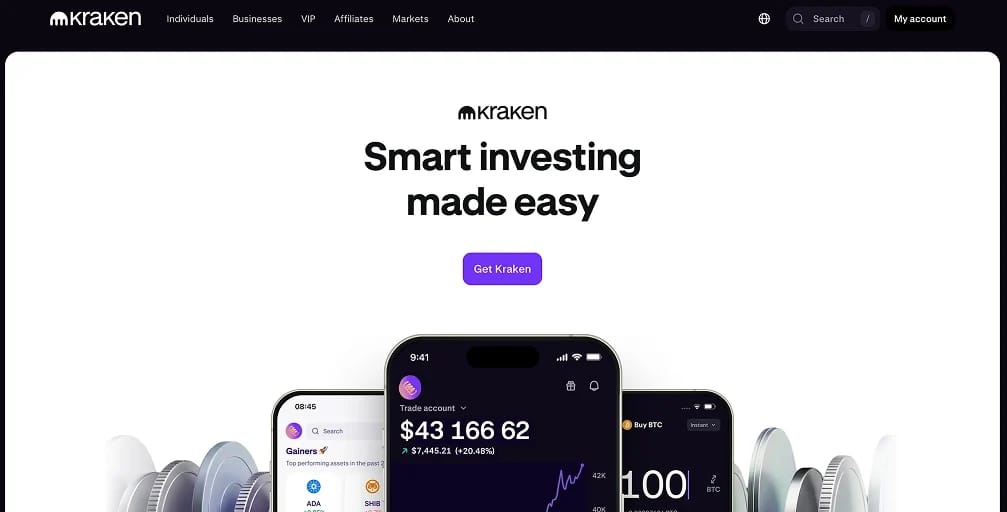
Kraken has rebuilt itself into a multi-asset brokerage, and the crypto exchange is now one product among several.
- Kraken Pro: The professional terminal for 500+ assets, with the volume-tiered fee schedule, margin, and full API coverage. Instant buys in the simple app cost roughly 1% plus spread, so anyone trading monthly belongs on Pro.
- Futures: Perpetual and expiry contracts capped at 50x for international clients. Americans trade CFTC-supervised crypto perpetuals through domestic entities Kraken assembled by acquiring NinjaTrader and Bitnomial.
- xStocks: Tokenized versions of US stocks and ETFs, each collateralized by a real share in custody, withdrawable on-chain and eligible for tokenized IPO allocations.
- US Equities: Kraken Securities holds FINRA membership, putting 11,000+ real stocks and ETFs in the same account as an American client's crypto, commission-free.
- Staking: On-platform staking across 20+ assets, available again to US clients since the SEC case was dropped in 2025.
- Krak and Kraken Embed: A payments app for instant cross-border transfers, and white-label infrastructure that already powers crypto trading for the neobank bunq.
- Custody, OTC, and Indices: The institutional layer, which took on new weight after Kraken's banking arm gained direct Federal Reserve payment access this March.
Bybit vs Kraken: Security
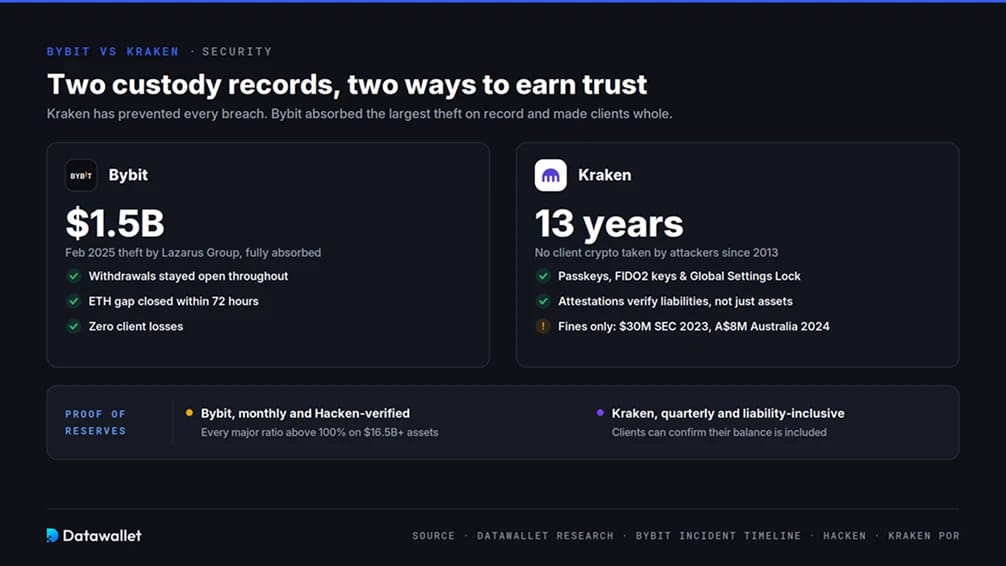
The custody histories could hardly read more differently. Kraken has never surrendered client crypto to an attacker in thirteen years. Bybit was robbed of roughly $1.5 billion in February 2025 and made every client whole. Which record reassures you more depends on how you weigh prevention against crisis response.
Bybit Security Measures and History
- Incident history: In February 2025, North Korea's Lazarus Group manipulated a routine cold wallet transfer and drained about $1.5 billion in ETH, the largest exchange theft ever recorded. Bybit kept withdrawals running, restored the missing ETH within 72 hours through loans and purchases, and no customer lost anything.
- Proof of Reserves: Monthly Merkle-tree reports verified by Hacken, with June's disclosure showing over $16.5 billion in mainstream assets and every major reserve ratio above 100%, loan liabilities included.
- Account controls: Anti-phishing codes, address whitelisting, hardware 2FA, and device management. Since the hack, Bybit has also overhauled the wallet signing setup the attackers exploited.
Kraken Security Measures and History
- Incident history: Zero custodial breaches since trading began in 2013. The blemishes sit elsewhere, in a 2023 SEC settlement over staking that cost $30 million, an Australian court fine of A$8 million a year later, and two insider cases disclosed this year in which support staff improperly viewed limited client data, one leading to an attempted extortion. Client funds were untouched in every instance.
- Proof of Reserves: Quarterly attestations compiled alongside an independent accounting firm. They verify liabilities on top of assets, so any client can confirm their balance is included.
- Account controls: Passkeys and FIDO2 hardware keys, PGP email signing, and the Global Settings Lock, which blocks account changes for a chosen window even against someone holding your password.
Our read favours Kraken. Bybit's crisis management in 2025 was exceptional and proved its balance sheet, yet the breach happened at the cold storage layer. Kraken's record is prevention over thirteen years, backed by attestations that count what it owes as carefully as what it holds.
Bybit vs Kraken: Regulation
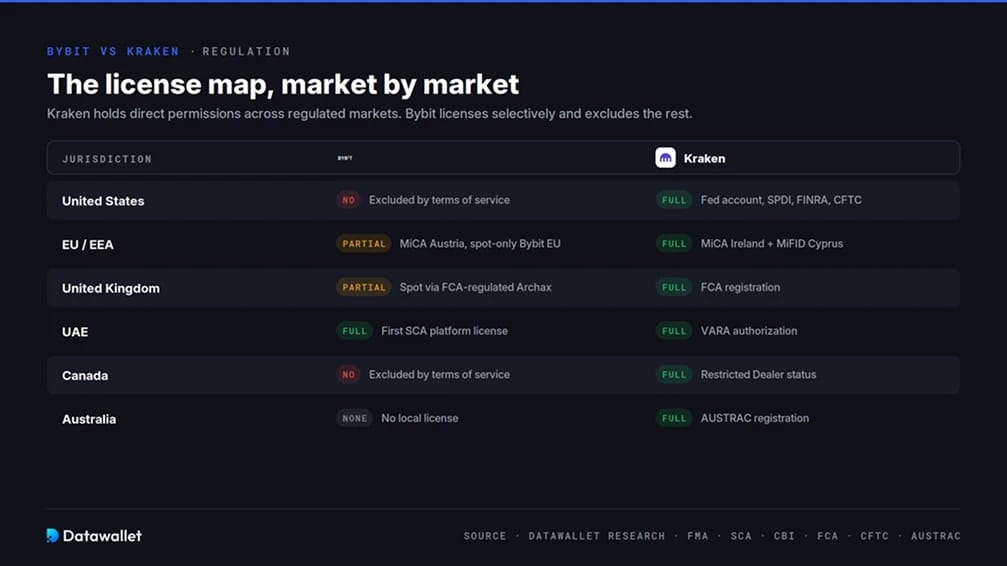
Kraken holds one of the deepest permission sets in the industry, touching banking, securities, and derivatives across three continents. Bybit has licensed up since 2023, though its coverage remains narrower, and this month brought a structural change for its European users.
Bybit's Licenses
- European Union: Vienna-based Bybit EU GmbH was licensed under MiCA by Austria's FMA in May 2025. MiCA's transition period ended on 1 July, so Bybit began restricting its global platform for EEA residents, who must migrate to bybit.eu. The regulated entity currently offers spot and custody only while it pursues derivatives permissions.
- United Arab Emirates: In October 2025, Bybit became the first exchange awarded the Emirati securities regulator's full Virtual Asset Platform Operator license.
- United Kingdom: Service resumed in December 2025 through a partnership with FCA-regulated Archax, covering spot markets.
- India and Kazakhstan: FIU-IND registration with trading restored through 2025, plus an Astana Financial Services Authority authorization.
- Restrictions: The US, Canada, Singapore, and Mainland China remain excluded. The live list sits in our Bybit restricted countries guide.
Kraken's Licenses
- United States: Kraken's banking arm has run under Wyoming's SPDI charter since 2020, and this March it became the first crypto company granted a Federal Reserve master account, wiring it directly into US payment infrastructure. FINRA membership covers equities, and CFTC registrations cover regulated futures and perpetuals.
- Europe: Ireland's central bank issued Kraken's MiCA CASP authorization in June 2025, and Cypriot MiFID permissions cover derivatives, so EEA clients keep spot and regulated derivatives alike after the 1 July cutoff that narrowed Bybit's local offering.
- Other markets: The UK is covered by FCA registration, Canada through Restricted Dealer status, Australia through AUSTRAC, and the UAE through VARA. Our Kraken supported countries page maps availability.
Kraken takes this section with room to spare. It is regulated as a bank, a broker, and an exchange at once, and in the US, UK, Australia, and Canada it holds direct permissions where Bybit is absent or works through a partner. Bybit's licensing progress is real, but a spot-only EU entity and no US presence leave the footprints in different weight classes.
Bybit vs Kraken: Fees
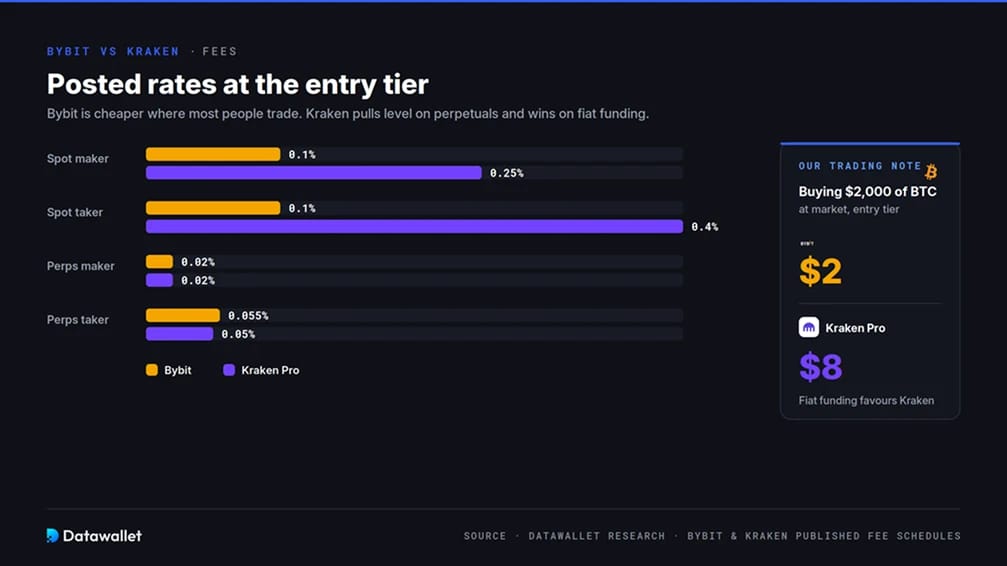
Bybit is cheaper where most people trade, and the difference at the spot base tier is substantial. Futures pricing lands within a rounding error of even. For background on why limit and market orders carry different rates, see our breakdown of maker and taker fees.
Spot Trading Fees
- Bybit: A flat 0.10% for makers and takers, thinning as VIP tiers unlock with volume or account balance. Recurring deposit and volume promotions layer on top, detailed in our Bybit bonus breakdown.
- Kraken: Kraken Pro opens at 0.25% for makers and 0.40% for takers, falling with 30-day volume. An update this month also lets platform holdings qualify accounts for lower tiers, so holders no longer need volume to earn discounts.
Our trading note: Buying $2,000 of BTC at market cost us $2 in fees on Bybit and $8 on Kraken Pro. Both filled cleanly at the top of book, so at entry tiers the spot gap is exactly what the schedules suggest. Kraken narrows it as volume or balances grow, and cost-sensitive spot traders will still land on Bybit.
Derivatives Fees
- Bybit: 0.02% maker and 0.055% taker on standard perpetuals, with options billed at 0.02% maker and 0.03% taker.
- Kraken: 0.02% maker and 0.05% taker on global futures, a hair under Bybit on the taker side, and the CFTC-supervised US venue bills per contract instead.
Funding Costs
- Bybit: Crypto deposits are free, and most fiat arrives through cards or one-click buy providers whose margins vary by region. There is no native USD banking channel.
- Kraken: Free ACH in the US, free or near-free SEPA in Europe, and wire withdrawals at fixed dollar rates, with the Fed master account now clearing institutional USD movements in-house.
Split decision. Bybit wins the spot schedule outright and effectively ties on perpetuals. Kraken wins the moment fiat is involved, because bank-grade funding channels cost less than card processors.
Bybit vs Kraken: Stock Trading and TradFi Markets
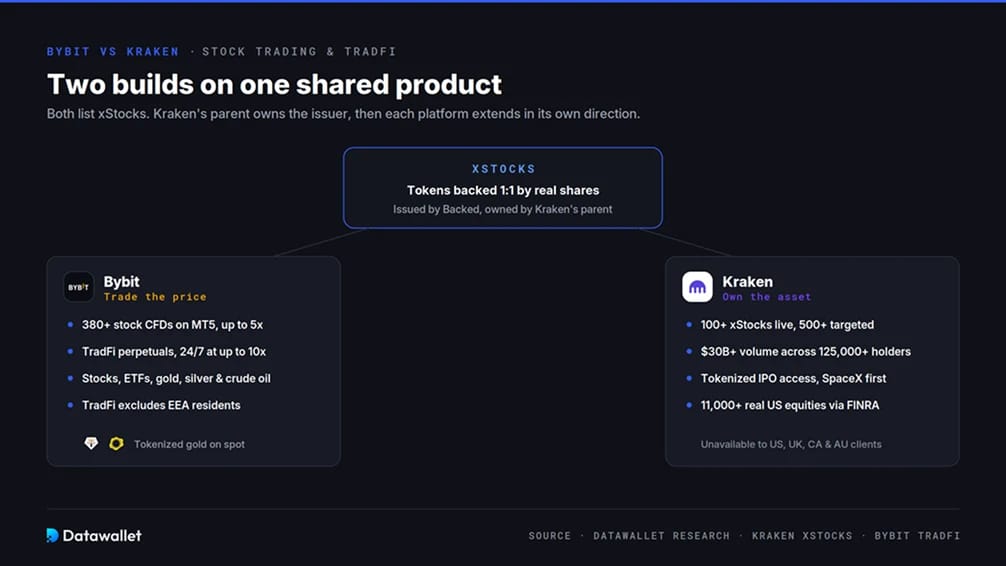
Stock exposure is on sale at both venues, and they even share a product. Each lists xStocks, the tokenized equities issued by Backed, and Kraken's parent company bought the issuer outright in late 2025. Bybit's stock shelf therefore runs on infrastructure its rival owns, and each platform builds outward from it differently. Our ranking of the top tokenized stock exchanges covers the whole category.
Kraken xStocks and US Equities
xStocks went live on Kraken in June 2025, and the Backed acquisition means Kraken now controls the product end to end. Every token is collateralized 1:1 by a share in regulated custody, the shelf crossed 100 listings with a target above 500, and cumulative volume has passed $30 billion across more than 125,000 holders. Tokens withdraw onto Solana or Ethereum, dividends reinvest automatically, and eligible clients can take tokenized IPO allocations at the offer price, starting with SpaceX.
The second layer is unique to Kraken. Through its FINRA broker-dealer, US clients trade 11,000+ actual stocks and ETFs commission-free, with full ownership rights. A Nasdaq partnership on tokenized equity infrastructure suggests the layers will converge. The catch runs in the opposite direction to Bybit's, since xStocks themselves are unavailable to US, UK, Canadian, and Australian clients.
Bybit xStocks, CFDs, and TradFi Perpetuals
Bybit approaches stocks as instruments to trade rather than assets to hold. xStocks and tokenized gold sit on the spot market, Bybit TradFi adds 380+ stock CFDs plus forex, indices, and commodities on MT5 at up to 5x for equities, and TradFi perpetual contracts launched this April wrap US stocks, ETFs, gold, silver, and crude oil in 24/7 USDT-settled perps at up to 10x.
That breadth of wrappers has no equal on Kraken, which offers nothing in CFDs and keeps commodities exposure to tokenized gold and a gold perp. The trade-offs are jurisdiction and substance. TradFi products run through a Mauritius-licensed entity and exclude EEA residents, and CFDs confer no ownership, no dividends, and no votes.
Buyers who want to own something pick Kraken. Traders who want to short Tesla at 3 a.m. with USDT margin pick Bybit.
Bybit vs Kraken: Derivatives
Derivatives are where Bybit built its name, and the gap in catalogue depth shows it. Kraken competes on a different axis, offering the only CFTC-supervised crypto perpetuals an American can legally trade. Both feature in our best crypto futures exchanges ranking.
Available Markets
- Bybit: More than 2,000 perpetual and expiry contracts across USDT, USDC, and inverse settlement, with 125x ceilings on majors, pre-market perps on unlisted tokens, and the USDC options desk. The TradFi perps extend the same engine to equities and commodities.
- Kraken: Perpetuals and fixed-maturity futures on majors and a meaningful altcoin selection, capped at 50x and margined against multiple collateral types. US clients trade domestic perpetuals under CFTC customer fund segregation, a protection no offshore venue can replicate.
Execution and Liquidity
- Bybit: Book depth on flagship perps ranks among the best anywhere. Our BTC and ETH positions opened and closed with no measurable slippage, and altcoin pairs held up better than expected well down the list.
- Kraken: Majors filled tight in our testing, in keeping with its reputation for order quality, though depth thins earlier in the altcoin tail than on Bybit's books.
Risk Structure
- Bybit: Isolated and cross margin, portfolio margin for qualifying accounts, and a published insurance fund. Treat the 125x ceiling as a marketing number; we would not run a position anywhere near it.
- Kraken: Conservative leverage caps, a transparent liquidation framework, and the US venue's segregated customer funds, which turn a regulatory formality into a working protection.
Bybit is the stronger pure derivatives platform on catalogue, options, and leverage range. Kraken is the only defensible answer for Americans, and the more conservative structure for anyone who treats leverage as a risk tool rather than a lottery ticket.
Final Thoughts
Bybit is our overall winner. For eligible traders it is the more capable machine, running deeper perpetuals books, a real options desk, TradFi stocks and commodities, and 0.10% spot fees, and its 2025 crisis response proved that client funds survive even a worst-case event. European users should note they are now served through the narrower, spot-focused Bybit EU platform rather than the global exchange.
Kraken is the better home in regulated markets. It is the only option for Americans, and in the UK, Australia, and Canada its own registrations outrank Bybit's partner-based access or absence. Thirteen years without a custodial loss, plus Federal Reserve payment access, make it the stronger vault for a core portfolio.
Holding both is a coherent setup. Kraken serves as the vault and fiat gateway while Bybit handles the active trading. Whichever you fund, enable hardware 2FA, whitelist withdrawal addresses, and move a small test amount before anything meaningful. Our full Bybit review and Kraken review go deeper on each.
.webp)