


What is Papertrade?
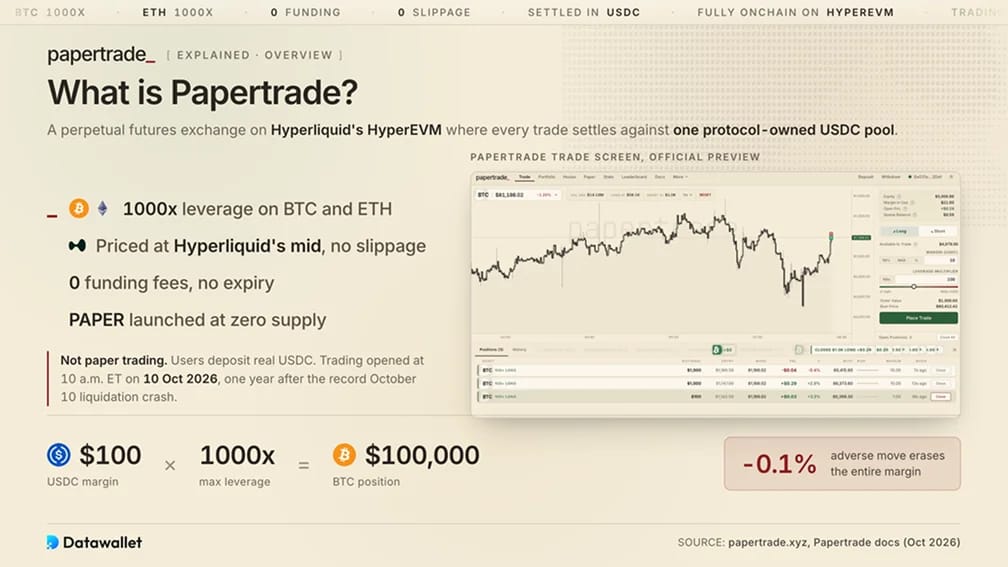
Papertrade is a fully onchain perpetual futures exchange built on HyperEVM, the smart contract layer of the Hyperliquid blockchain. Perpetual futures are leveraged contracts that track a coin's price without expiring. On Papertrade, users take long or short positions on Bitcoin and Ether at up to 1000x leverage, with all profits and losses settled against one protocol-owned pool rather than other traders.
Despite its name, Papertrade has nothing to do with paper trading, which means practising with simulated money. Users deposit real USDC, a dollar-pegged stablecoin. Losing positions are liquidated, or force-closed, when their margin runs out. A $100 deposit at 1000x controls a $100,000 position, so a 0.1% adverse move erases the entire margin.
The exchange has neither an order book nor a price oracle of its own. Entries and exits use the midpoint between the best bid and best offer on Hyperliquid's order book, meaning the highest resting buy order and lowest resting sell order. Trades execute at that exact price without slippage. There is also no funding rate, the periodic fee used to keep perpetual prices tied to spot.
PAPER launched with zero supply and no allocation for the team, investors or an airdrop, which is why Papertrade describes itself as 100% user owned. Trading opened at 10 a.m. ET on October 10, 2026, exactly one year after the October 10 crash that set a record for crypto liquidations.
How Does Papertrade Work?
Papertrade users bet against a shared pool at prices copied from Hyperliquid. Trading fees apply only to winners, while a staged launch keeps bots out initially.
1. Synthetic Trades Priced From Hyperliquid
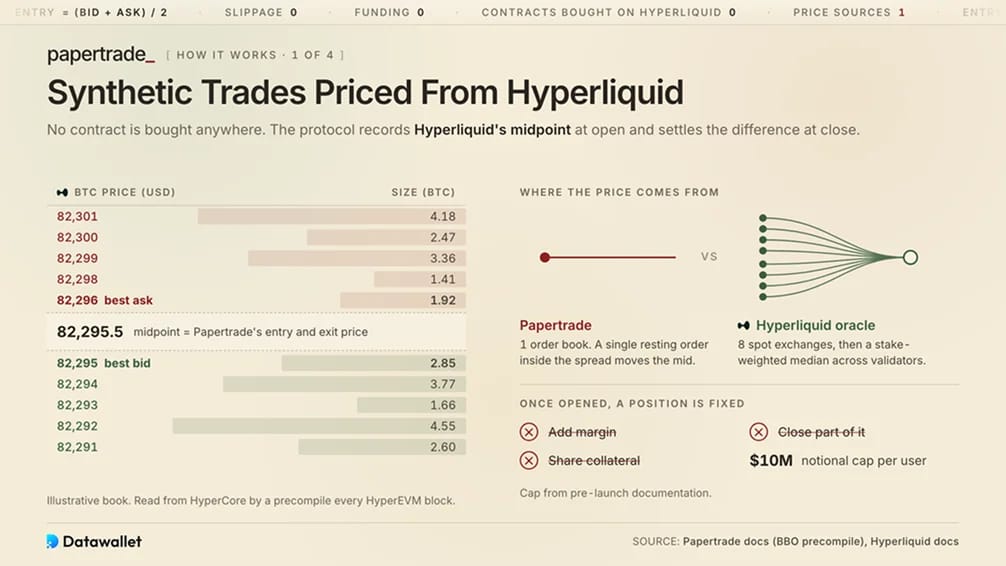
Papertrade positions are synthetic. No actual contract is bought on Hyperliquid or another venue. Instead, the contract records Hyperliquid's midpoint when a position opens and settles the difference against the price at close. Built-in read precompiles supply that price from HyperCore, Hyperliquid's trading engine, returning its latest state whenever a HyperEVM block is built.
This gives Papertrade free access to the deepest onchain BTC and ETH order books, but leaves its pricing dependent on a single exchange. By comparison, Hyperliquid's own oracle price combines prices from eight spot exchanges and takes a stake-weighted median across validators. A single resting order can move the midpoint Papertrade uses.
Once opened, positions cannot be adjusted. Traders cannot add margin or close part of a position, and collateral cannot be shared across trades. Pre-launch documentation limited each user to $10 million in notional exposure, the full leveraged value of their positions.
2. The Martingaler LP and Payout Queue
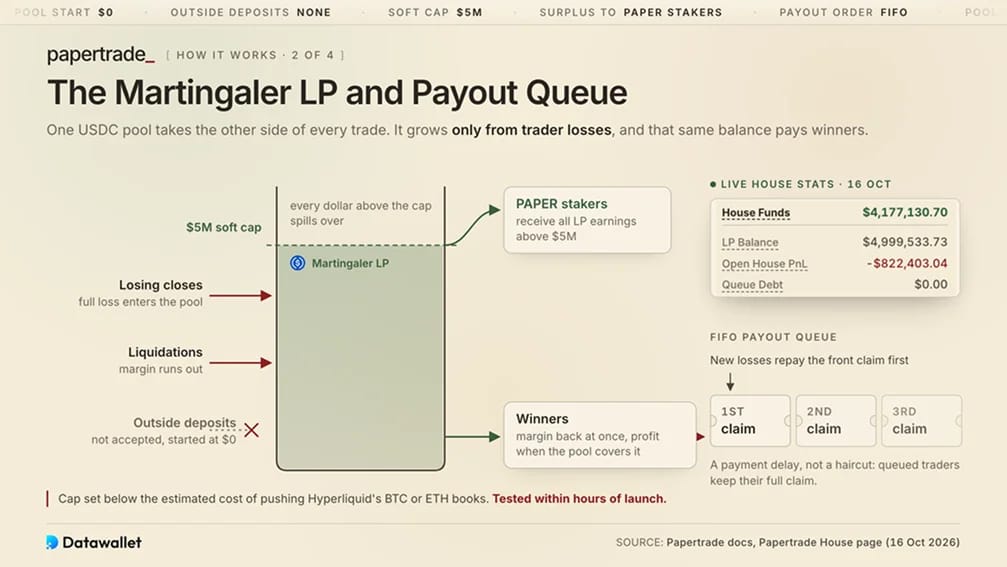
The counterparty to every trade is a USDC liquidity pool (LP) that the founders call the Martingaler LP. Starting from $0, it accepts no outside deposits and grows only through losing closes and liquidations. That same balance pays winners, much like Hyperliquid's HLP house vault.
Winners receive their margin back immediately even if the pool cannot cover their profit. Any unpaid amount becomes an onchain debt claim in a first-in, first-out queue. New losses repay those claims before rebuilding the pool. Under Papertrade's documentation, this is a payment delay, and queued traders retain their full claim.
Every extra dollar earned after the pool's tracked balance exceeds $5 million goes to PAPER stakers. The founders placed this soft cap below the estimated cost of pushing Hyperliquid's BTC or ETH order books, reasoning that an attacker would not spend more than the pool held. That assumption was tested within hours of launch.
3. Winner Haircut and Close Fees
Opening and holding a position cost nothing. Losing trades incur no fee beyond the loss itself. For winners, an asymmetric impact haircut first reduces the raw gain, with the deduction shrinking as the price move grows. A 2% fee applies to the remaining profit and is split equally between PAPER stakers and the developers.
Small price moves attract a steep cut to discourage trading around tiny midpoint changes. Gains below a minimum threshold pay nothing. The curve draws on the profit-sharing model used by Rollbit for its house-backed 1000x futures.
On a $100 margin that earns $100, Blockworks Research's worked example shows:
- 1000x on a 0.1% move: The trader keeps about $72 of the profit.
- 100x on a 1% move: The trader keeps about $86.
- 20x on a 5% move: The trader keeps about $88, close to the curve's 90% ceiling.
Liquidations incur a 2% fee on the lost margin, split in the same proportions.
4. Relayers, Session Keys and Launch Phases
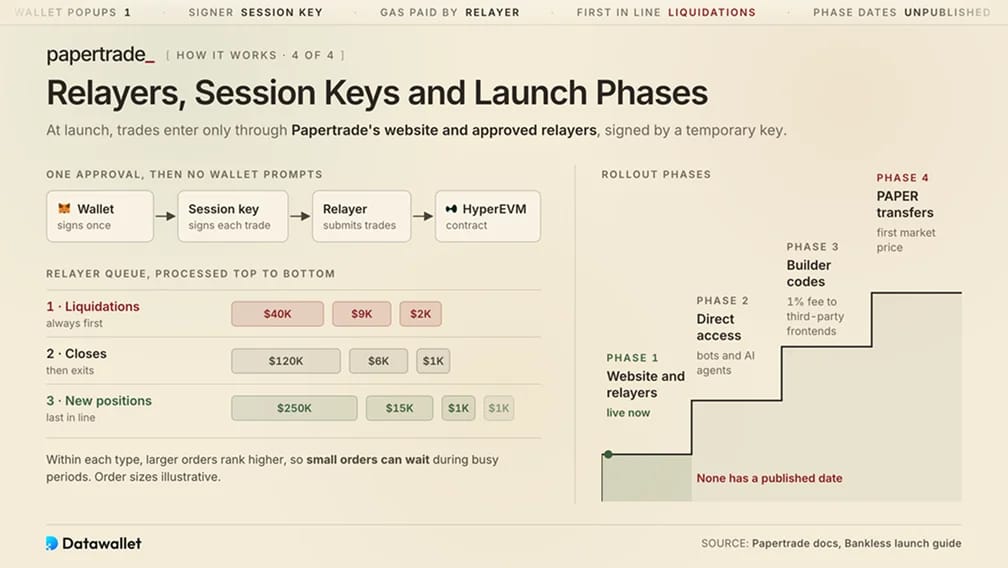
At launch, the contracts accept trades only through Papertrade's website and approved relayers. These services submit signed trades onchain for users. A one-time approval creates a session key, a temporary signing key that removes the need for a wallet prompt with every order.
Pending actions are ranked by type and order size. The relayer processes liquidations first, followed by closes and then new positions. Small orders can therefore wait during busy periods. Bankless's launch guide describes the subsequent stages.
The remaining rollout phases are:
- Phase two: Direct contract access, allowing bots and AI agents to use Papertrade once launch congestion clears.
- Phase three: Builder codes that pay third-party frontends a 1% fee on trades they bring in.
- Phase four: PAPER transfers, allowing the token to trade freely and establish a market price for the first time.
None of these phases has a published date.
How to Trade on Papertrade
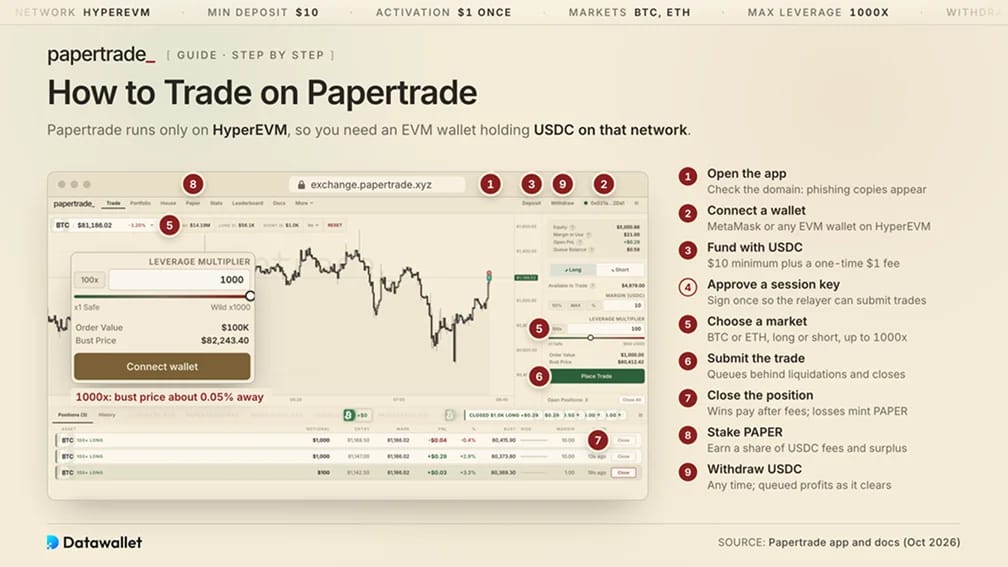
Papertrade operates exclusively on HyperEVM, so traders need an EVM wallet funded with USDC on that network.
A typical Papertrade session follows these steps:
- Open the app: Visit the official trading interface and check the domain. Phishing copies spring up around busy launches.
- Connect a wallet: Use MetaMask or another EVM wallet after adding HyperEVM as a network.
- Fund with USDC: Move USDC onto HyperEVM. If your funds are elsewhere, follow our guide to bridge to Hyperliquid. The minimum deposit is $10, plus a one-time $1 activation fee.
- Approve a session key: Sign once to authorise the relayer to submit your trades.
- Choose a market: Select BTC or ETH, choose long or short, and set leverage up to 1000x. According to the team, 1000x positions are liquidated after roughly a 0.05% adverse move.
- Submit the trade: New orders queue behind liquidations and closes, so expect delays during busy periods.
- Close the position: A winning close returns your margin and profit after the haircut and 2% fee. Any shortfall enters the payout queue. Losing closes and liquidations mint PAPER to your account.
- Stake PAPER: Stake, or lock, earned PAPER in the protocol to receive a share of USDC fees and pool surplus.
- Withdraw USDC: Available balances can be withdrawn at any time. Queued profits become available as the queue clears.
PAPER Tokenomics & Supply
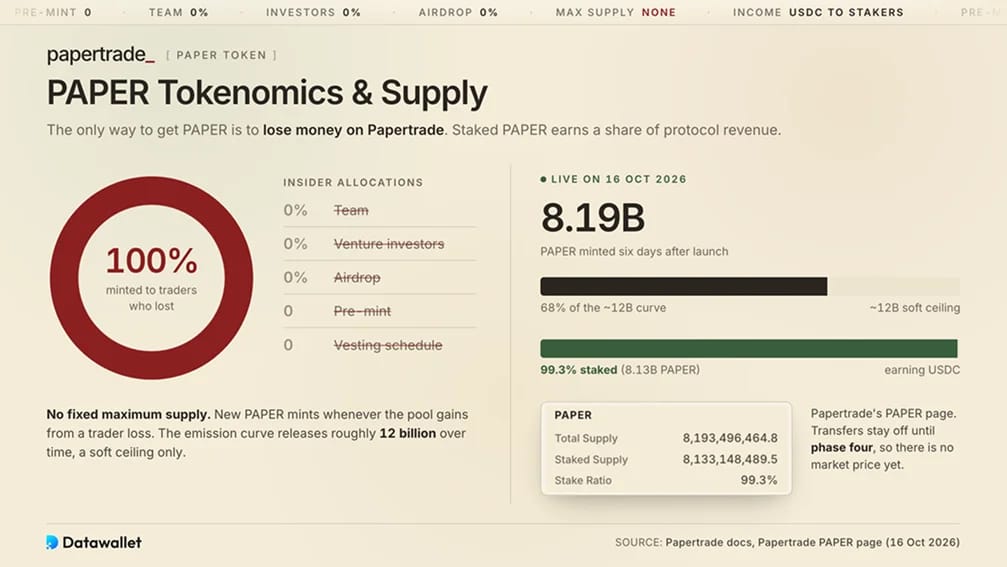
PAPER can only be obtained by losing money on Papertrade. Holders who stake it receive a share of protocol revenue. There is no fixed maximum supply, as new tokens are minted whenever the pool gains from trader losses.
Emissions and Supply
PAPER began without a pre-mint, team or venture allocation, airdrop or vesting schedule. Each $1 of eligible loss mints 100 PAPER while the pool holds less than $2 million, including periods when it is in deficit.
Once the pool exceeds $2 million, emissions decline with its high watermark (H), the most it has ever earned above that threshold. ChainCatcher's review of the documentation gives the decay formula as 100 × (120M ÷ (120M + H))².
Over time, the curve releases roughly 12 billion PAPER, with half issued by the time cumulative LP earnings reach $120 million. This is a soft ceiling only. Whenever the pool falls below $2 million, emissions return to 100 PAPER per dollar, rewarding losses more generously precisely when winners face the risk of queued payments.
By October 12, the rate had dropped to about 30.8 PAPER per $1. Community farming guides put it near 16.6 by October 16. Early losers consequently receive an outsized share of supply. For example, the wallet involved in the launch-day incident earned about 17.6 million PAPER from a single $450,000 liquidation, or roughly 39 tokens per dollar lost.
Staking and Revenue Share
Income is paid in USDC exclusively to staked PAPER. Distributions require an empty payout queue and enough funds in the pool to cover them.
Staker income comes from:
- Fee share: Half of the 2% fee on winning profits and liquidated margin. The developer fee recipient receives the other half.
- Pool surplus: All LP earnings above the $5 million cap, by far the larger source so far.
DefiLlama's income statement records $49.78 million in gross revenue through mid-October. Pool surplus contributed $42.52 million, with trading and liquidation fees accounting for $7.26 million. That left $46.15 million for stakers. Their yield would shrink quickly in calmer markets or during a run of profitable trading.
PAPER provides neither governance rights nor fee discounts. Until phase four, it also cannot be sold or used as collateral. Delphi Digital analyst tempest has warned that traders can use paired long and short positions to mint PAPER cheaply, diluting existing stakers without adding much cash to the pool.
Papertrade Statistics and Trends
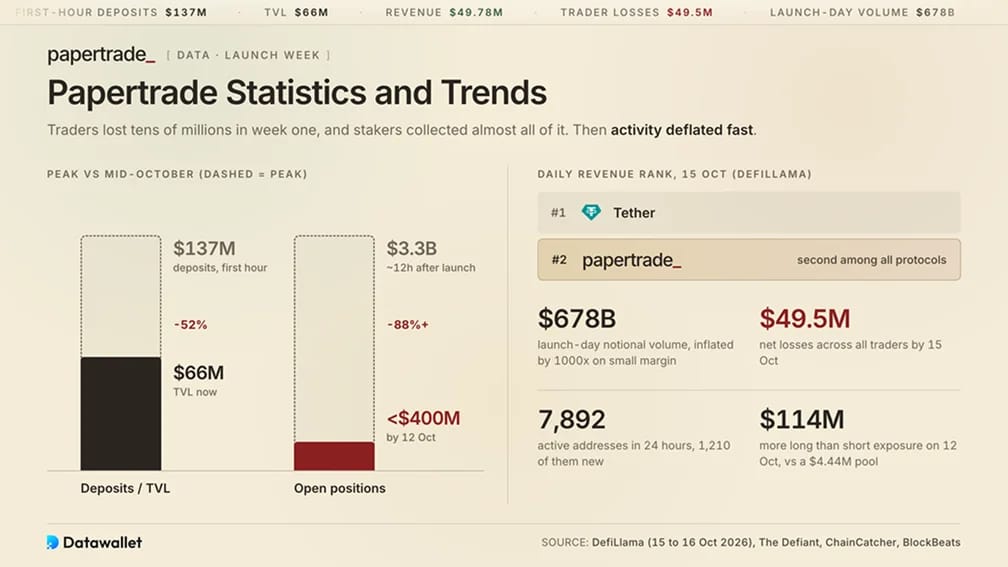
Traders lost tens of millions of dollars in Papertrade's first week, and stakers collected almost all of it. These figures rank among the most extreme in onchain perpetuals. We cross-checked deposit and revenue figures against DefiLlama as of October 15 and 16, 2026.
Key metrics include:
- Deposits: Trader balances stood at about $137 million during the first hour of trading, according to DefiLlama data reported by The Defiant. Total value locked (TVL), the funds held in its contracts, has since fallen to roughly $66 million.
- Revenue: Cumulative revenue reached $49.78 million, of which $46.15 million went to PAPER stakers.
- Revenue rank: Papertrade ranked second among all protocols for daily revenue on October 15, behind Tether, according to DefiLlama rankings cited by BlockBeats.
- Trader losses: Net losses across all users totalled about $49.5 million by October 15.
- Notional volume: Launch-day volume exceeded $678 billion, according to ChainCatcher's analysis of Papertrade's dashboard. Applying 1000x leverage to modest margin inflated that total.
- Open positions: These peaked near $3.3 billion roughly 12 hours after launch before falling below $400 million by October 12.
- Users: DefiLlama recorded 7,892 active addresses and 1,210 new addresses over 24 hours.
- Pool exposure: The pool held about $4.44 million on October 12. At the time, traders' bets on rising prices exceeded those on falling prices by roughly $114 million.
After launch week, volume, mint rates and open interest, the value of all open positions, fell sharply as early farmers secured cheap PAPER. Losses continue to push the pool above its cap, keeping daily staker income high. Whether traders will keep losing at much lower mint rates remains an open question.
Papertrade's $1.28 Million Price Manipulation Incident
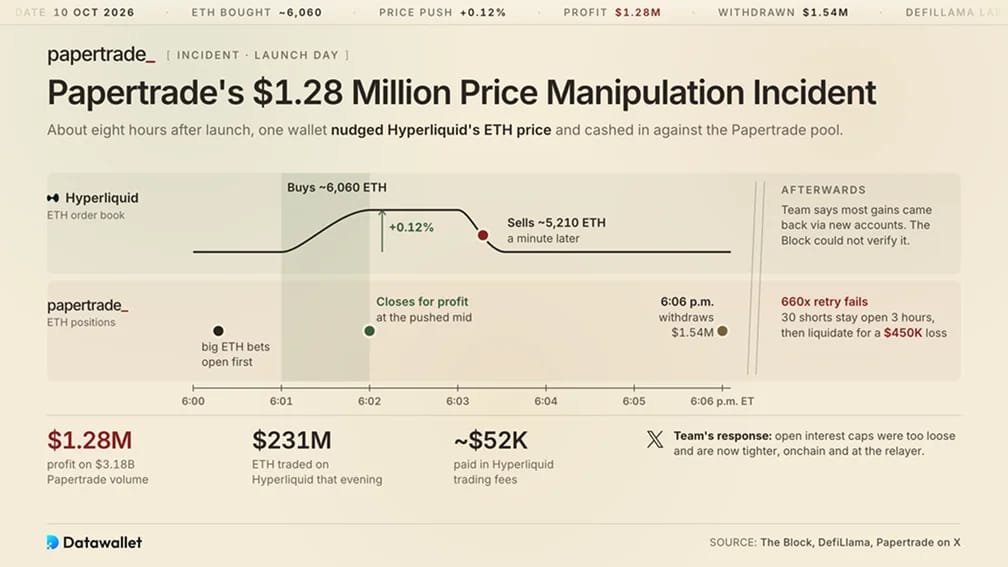
About eight hours after launch, reliance on a single price source cost Papertrade's pool roughly $1.28 million. One wallet opened large ETH positions on Papertrade before buying about 6,060 ETH on Hyperliquid between 6:01 and 6:02 p.m. ET. The purchases lifted the price around 0.12%. According to The Block, the wallet then closed its Papertrade positions for a profit and sold about 5,210 ETH a minute later.
Across that evening, the wallet traded about $231 million of ETH on Hyperliquid and paid around $52,000 in fees. Its Papertrade portfolio page showed $1.28 million in profit on $3.18 billion of volume. At 6:06 p.m. ET, it withdrew $1.54 million. A subsequent attempt at 660x failed when 30 shorts remained open for three hours and were liquidated at a $450,000 loss.
In an X post, Papertrade attributed the incident to loose open interest caps set to accommodate launch demand. It said it was tightening those limits both onchain and at the relayer level. The team also claimed the trader returned almost all the gains through new accounts, which The Block could not verify. DefiLlama now classifies the event as a $1.28 million oracle manipulation.
Before launch, Papertrade's own disclosures had identified midpoint manipulation as its main unresolved risk. They explained that a small order between the best bid and best offer could shift the midpoint without ever being filled. Jez had argued that an attack would require eight-figure capital. An attacker who sells immediately after buying, however, recovers almost all of that capital.
PAPER Farming and the Papertrade Ecosystem
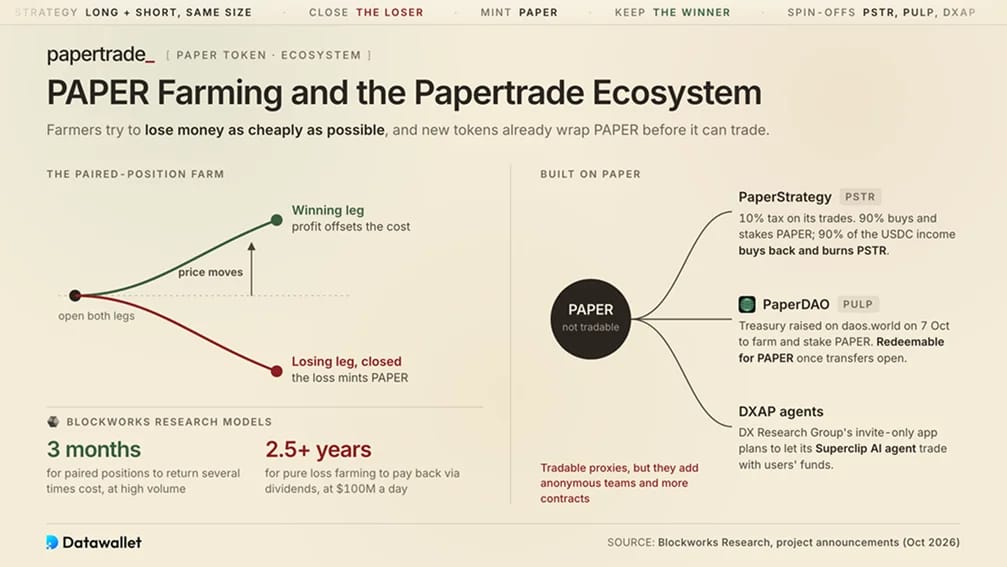
Traders seeking PAPER without substantial losses have developed ways to lose money as cheaply as possible. The most common strategy pairs a long with an equally sized short. After a meaningful price move, the trader closes the losing position and offsets the cost with profit from the winning side. Automated bots now execute this strategy in exchange for a cut of the farming cost.
At high daily volumes, Blockworks Research modelled paired positions returning several times their cost by the third month. Pure loss farming at $100 million in daily volume took more than two and a half years to recover its cost through dividends alone. Neither projection can be confirmed yet, as both assume PAPER retains value once transfers open.
Projects already built around PAPER include:
- PaperStrategy (PSTR): An anonymous token with a 10% tax on its own trades. It uses 90% of that tax to accumulate and stake PAPER, then directs 90% of its USDC staking income towards buying back and burning PSTR.
- PaperDAO (PULP): A pooled treasury raised on daos.world on October 7 to farm and stake PAPER. PULP will be redeemable for PAPER once transfers go live.
- DXAP agents: DX Research Group's invite-only app plans to allow its Superclip AI agent to trade on Papertrade using users' funds.
The spin-off tokens provide a tradable proxy for PAPER before transfers open. They also introduce anonymous teams and additional smart contracts into an experiment barely a week old.
Papertrade vs Hyperliquid vs Rollbit
Papertrade takes its prices from Hyperliquid and draws its fee design from Rollbit. Comparing the three clarifies the trade-offs. Hyperliquid operates a conventional onchain order book where traders face one another. Rollbit's centralised futures product is backed by its own house.
For traders seeking deep order books across many markets, Hyperliquid offers transparent maker and taker fees, though BTC leverage is limited to 40x. Rollbit offers the same maximum leverage as Papertrade, but users must trust a Curaçao-licensed operator with custody and undergo identity checks.
Papertrade combines Hyperliquid's self-custody with Rollbit's house model. Its house balance is publicly visible onchain, and profits belong to the traders who lost to it. More established alternatives appear in our ranking of the best decentralised perpetuals exchanges.
Is Papertrade Safe?
Papertrade's design protects deposits from team access but offers little protection against market losses or manipulated prices. Users can always withdraw directly, and admins have no control over balances under the contract. Session keys cannot withdraw funds. Anyone can trigger liquidations and queue payouts, while contract upgrades must pass a seven-day timelock, a mandatory delay before changes take effect.
The founders retain operational control through a 2-of-3 multisig, which requires two of three keyholders to sign. Jez, Blurr and a third admin, UngusTrade, hold those keys. They can pause trading, freeze markets and alter fee settings. Guardian Audits was hired before launch, but no audit report had appeared in the reporting we reviewed.
Risks
Key risks include:
- Liquidation speed: A move of about 0.1% at 1000x erases the margin. Liquidation may occur even earlier.
- Queued profits: If the pool runs dry, winners face an unknown wait for payment.
- Price manipulation: The single-exchange midpoint remains the main unresolved risk in Papertrade's own disclosures.
- Thin cushion: Hundreds of millions in open positions are backed by a pool capped near $5 million. Lopsided exposure could drain it in one move.
- Admin control: A small multisig can pause markets and change fees, while the founders remain semi-pseudonymous.
- Unaudited code: The deployed contracts have no public audit report.
- Token dilution: PAPER has no market yet, and each new loss increases its supply.
- Hyperliquid dependence: Hyperliquid or HyperEVM outages and congestion would disrupt pricing and settlement.
- Spin-off tokens: PaperStrategy, PaperDAO and similar projects introduce anonymous teams and further contract exposure.
- Regulatory exposure: Paying winners from losers' funds at a house-banked 1000x venue resembles what many regulators classify as gambling or a bucket shop, a venue that bets against its customers.
Papertrade Founders
Two semi-pseudonymous traders, Jez (@izebel_eth) and Blurr, created Papertrade. Jez announced it on May 12, 2026 as a fair-launched perpetuals exchange with a self-funding pool. He also wrote the Martingaler LP paper explaining how such a pool could start from nothing.
According to Jez, the team consists solely of the two founders, and the frontend was built with AI tools. No venture funding has been disclosed, consistent with the absence of a token allocation for insiders. Critics, including D2 Finance, called the design an onchain bucket shop. The launch-day incident made that criticism harder to dismiss.
Final Thoughts
Papertrade stands out as one of DeFi's most unusual experiments in 2026. By converting trader losses into ownership, it paid stakers more than $46 million in USDC within a week. It also offers leverage that almost no onchain venue will touch.
Those returns depend on traders continuing to lose. The price feed was gamed on the first day, and control rests with a three-person multisig while audit results remain unpublished.
Anyone using Papertrade should treat their margin as already spent and PAPER as an unpriced claim until transfers open. Check the pool balance and payout queue before counting on a profit.