




What Is Hyperliquid's HLP Vault?
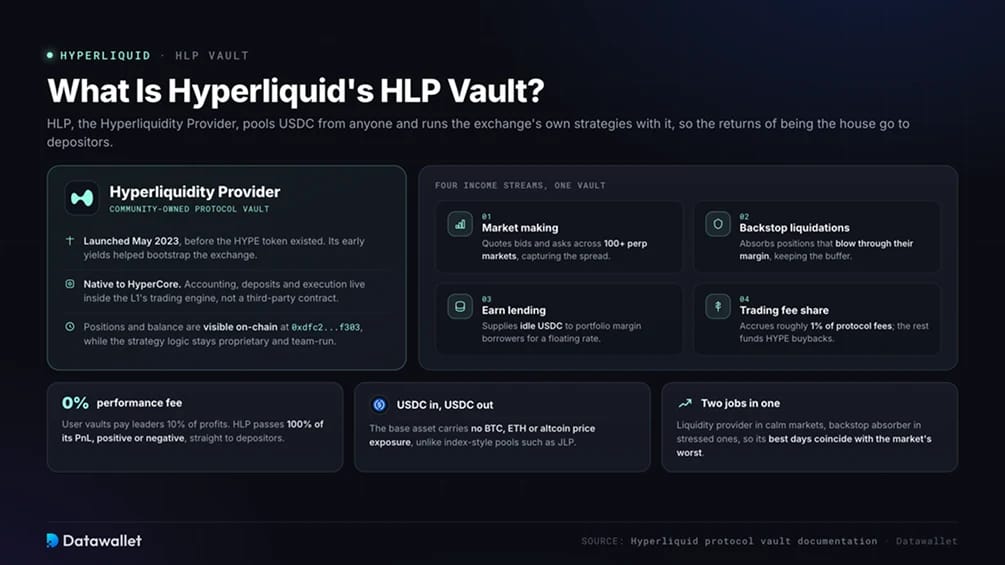
HLP, short for Hyperliquidity Provider, is Hyperliquid's flagship protocol vault. According to the official documentation, it provides liquidity through multiple market-making strategies and performs liquidations. The vault also supplies USDC through Earn and accrues part of the exchange's trading fees. The resulting profit and loss (PnL) is shared with community depositors.
Because HLP is native to HyperCore, its deposits, accounting, and strategy execution sit within the L1's trading engine instead of a third-party smart contract. Positions, fills, and balances are visible on-chain at the vault address (0xdfc2...f303). The underlying strategy logic remains proprietary and is operated by the Hyperliquid team.
Three features distinguish HLP from other DeFi yield products:
- No performance fee: User vaults pay their leaders 10% of profits, while HLP passes 100% of its PnL, whether positive or negative, to depositors.
- USDC only: Deposits and withdrawals use USDC. Unlike index-style pools, the base asset has no BTC, ETH, or altcoin price exposure.
- Dual role: HLP supplies liquidity during calm markets and absorbs backstop liquidations during periods of stress. As a result, its strongest days often coincide with the market's worst.
HLP launched in May 2023, before the HYPE token existed. Its early yields helped bootstrap the exchange.
How Does HLP Work?
HLP combines several strategies within a single vault. The position displayed in the app represents the net result of component strategies historically labelled Strategy A, Strategy B, and the Liquidator. Income comes from four sources.
1. Market Making
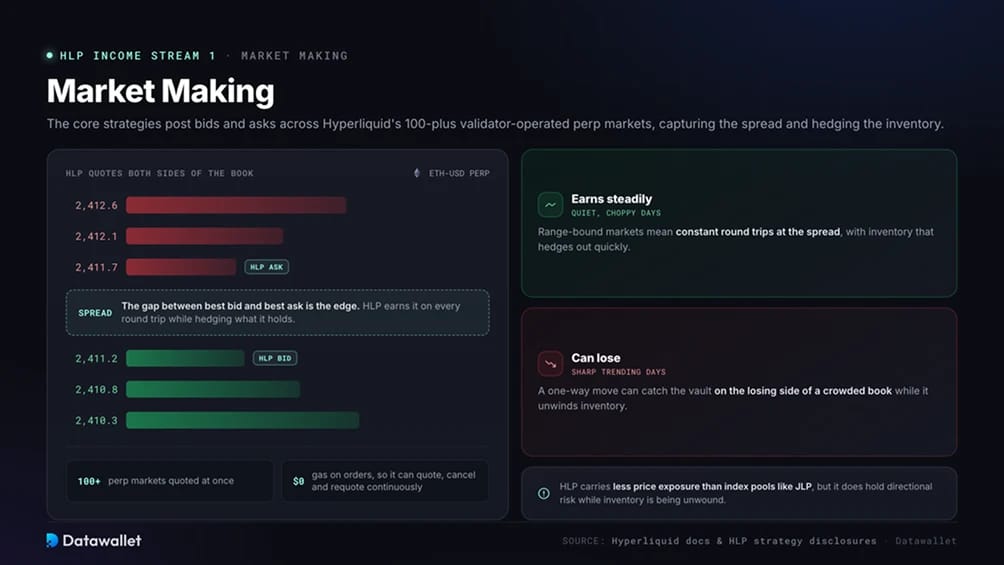
HLP's core strategies place bids and asks across Hyperliquid's 100-plus validator-operated perpetual markets. They capture the difference between buy and sell prices while hedging the inventory accumulated through those trades. HyperCore charges no gas for order placement, allowing the vault to quote, cancel, and update orders continuously at negligible cost.
Quiet, choppy markets can produce steady market-making income. Sharp trends are more dangerous because the vault may be caught on the losing side of a crowded order book. Although HLP has less price exposure than index pools such as JLP, it still carries directional risk while positions are unwound.
2. Backstop Liquidations
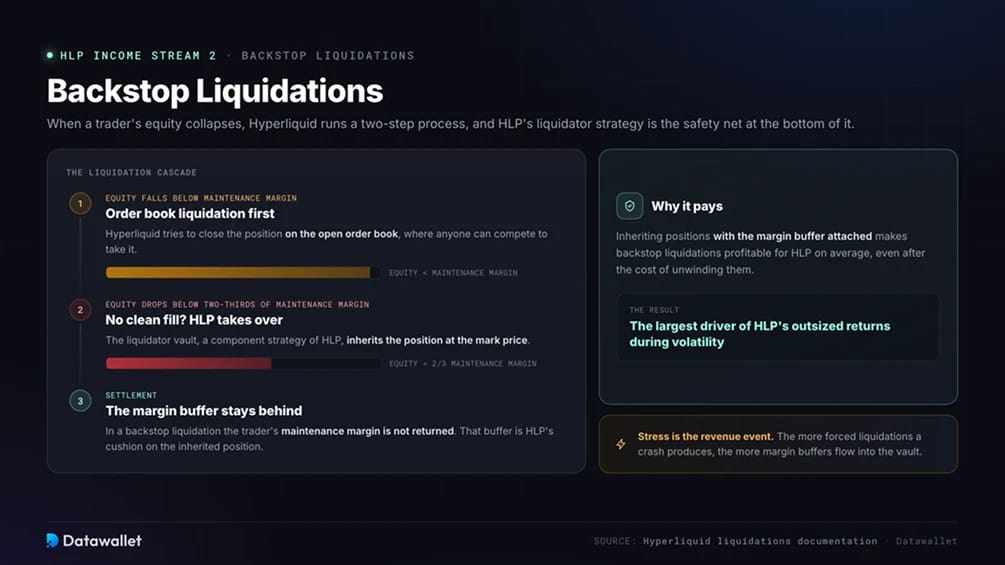
When a trader's equity falls below maintenance margin, Hyperliquid initially attempts to close the position through the order book, where any participant can compete for it. If the equity falls below two-thirds of maintenance margin without a clean fill, the liquidator vault takes over the position at the mark price. This vault is one of HLP's component strategies.
The trader's maintenance margin is not returned during a backstop liquidation. That buffer makes the process profitable for HLP on average and accounts for much of its exceptional performance during volatile periods. Our crypto liquidations tracker and HYPE liquidation heatmap show where liquidation pressure is developing.
3. Earn Lending via Portfolio Margin
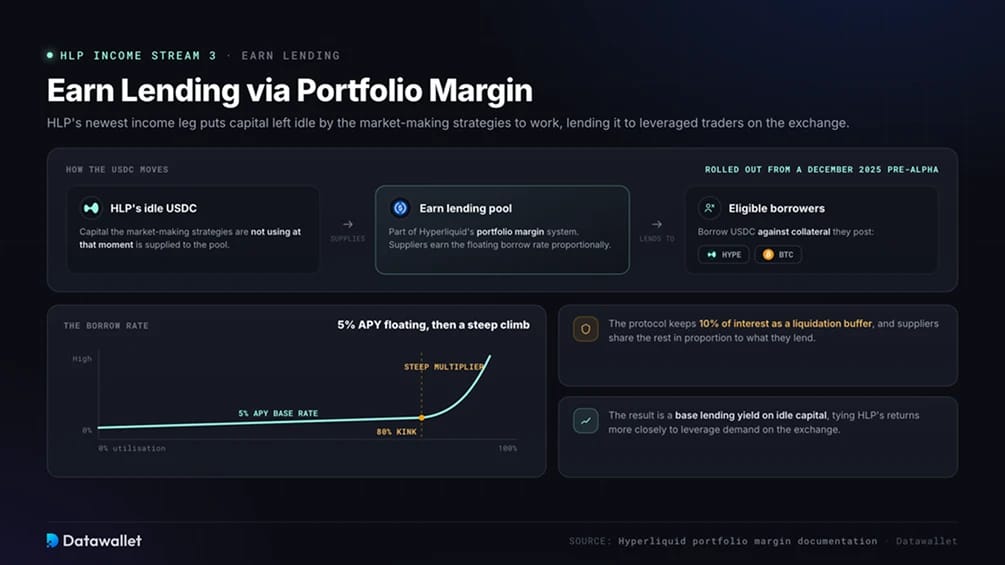
Hyperliquid's portfolio margin system is HLP's newest source of income. Rolled out from a December 2025 pre-alpha, it allows eligible accounts to borrow USDC against HYPE or BTC collateral. HLP supplies its idle USDC to this pool.
Stablecoin borrowers pay a floating rate of 5% APY, with a steep multiplier once utilisation rises above 80%. Suppliers receive the interest proportionally after the protocol retains 10% as a liquidation buffer.
Capital not being used by HLP's market-making strategies can therefore earn a base lending yield. This links vault performance more closely to demand for leverage on the exchange.
4. Trading Fee Accrual
HLP receives a portion of protocol trading fees, although the share is much smaller than many guides suggest. DefiLlama estimates that HLP receives roughly 1% of perpetual and spot trading revenue. The remaining 99% goes to the Assistance Fund for HYPE buybacks.
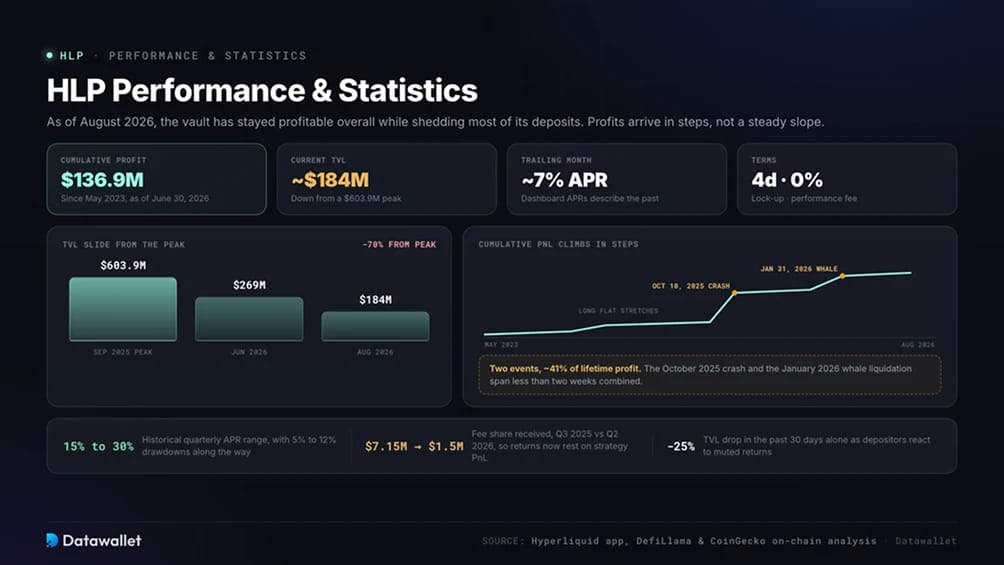
HLP's fee receipts declined from $7.15 million in Q3 2025 to $1.5 million in Q2 2026. Its returns now depend primarily on strategy PnL rather than fee subsidies. Our Hyperliquid fees explained guide covers how the remaining fees are allocated.
5. Deposit and Withdrawal Mechanics
Deposits and withdrawals work as follows:
- Deposit: Transfer USDC from your Hyperliquid perps balance to the HLP vault. There is no minimum beyond account activation.
- Share accounting: A deposit represents a proportional share of the vault. If vault equity increases by 10%, the value of your share also increases by 10%.
- Lock-up: Withdrawals become available 4 days after your most recent deposit. Adding more USDC resets the clock for the entire balance.
- Withdraw: Once the lock-up ends, shares can be redeemed at their current value. Reducing open positions to fund an exit may create some slippage.
HLP does not cover HIP-3 builder-deployed markets. Every HIP-3 DEX uses a separate system address for its own backstop liquidator. Stock, commodity, and index perpetuals consequently neither contribute to nor draw from HLP's book.
HLP Performance & Statistics
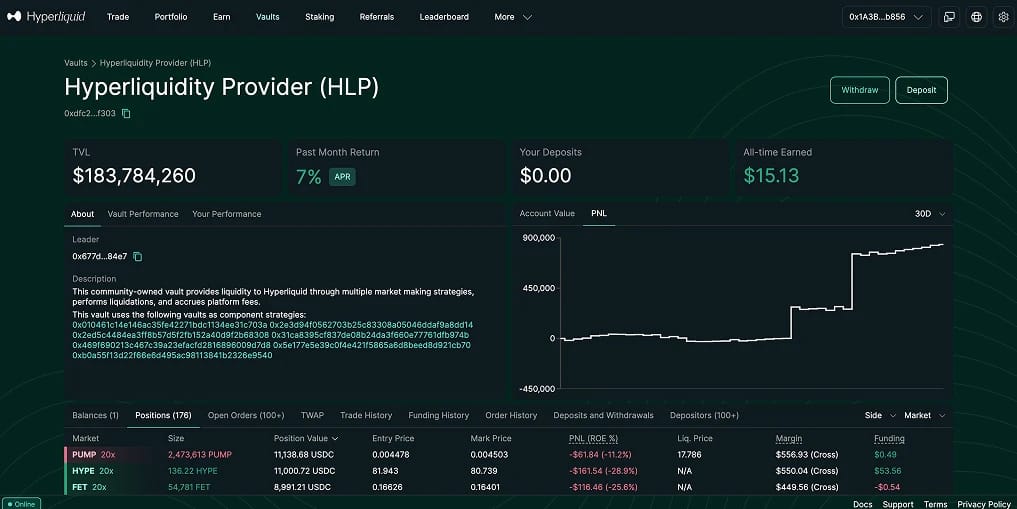
As of August 2026, data from the Hyperliquid app, DefiLlama, and CoinGecko's analysis of the vault's on-chain history shows that HLP has remained profitable overall despite losing most of its deposits:
The PnL curve rises in steps rather than following a consistent slope. CoinGecko's data records long periods of little movement, followed by abrupt gains when volatility spikes. Two events alone account for roughly 41% of HLP's lifetime profit: the October 10, 2025 crash and a whale liquidation on January 31, 2026. Together, they lasted less than two weeks.
TVL has fallen by more than two-thirds from its high. HLP held about $269 million in June 2026 before declining to roughly $184 million, including a 25% drop over the past 30 days. Muted returns between volatility events and repeated manipulation attempts, discussed below, appear to have prompted depositors to withdraw.
Our Hyperliquid statistics roundup examines the exchange volume, open interest, and HYPE metrics that shape HLP's opportunity set.
How HLP Profits from Market Crashes
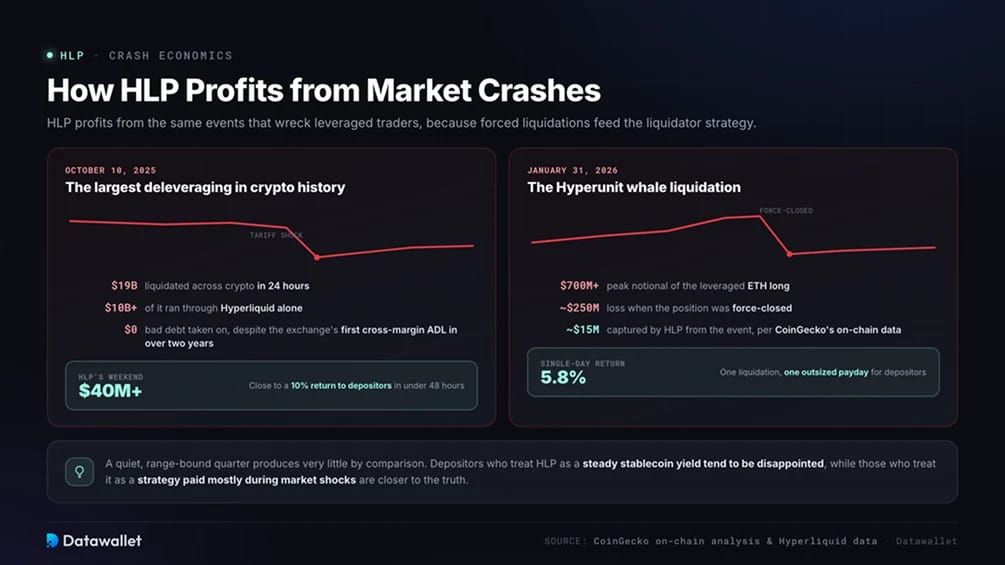
Forced liquidations feed HLP's liquidator strategy, allowing the vault to profit from events that cause severe losses for leveraged traders.
- October 10, 2025: A tariff announcement caused the largest deleveraging in crypto history. Approximately $19 billion was liquidated within 24 hours, including more than $10 billion on Hyperliquid. HLP is estimated to have earned between $40 million and $41.5 million that weekend. Depositors received close to a 10% return in less than 48 hours, while the exchange incurred no bad debt. The pressure also caused Hyperliquid's first cross-margin auto-deleveraging event in more than two years.
- January 31, 2026 whale liquidation: The trader known as the "Hyperunit whale" held a leveraged ETH long that had exceeded $700 million in notional value. It was forcibly closed at a loss of roughly $250 million. CoinGecko's on-chain data indicates that HLP earned about $15 million from the event, producing a 5.8% single-day return for depositors.
By comparison, a quiet and range-bound quarter may generate very little. HLP is unlikely to satisfy depositors seeking consistent stablecoin yield. Its return profile more closely resembles a strategy paid during market shocks.
HLP Manipulation Incidents
HLP inherits positions that pass through the backstop liquidation process, making the vault a potential target. Several traders have deliberately engineered self-liquidations in thin markets to transfer losses to HLP.
JELLY remains the most controversial episode. Settling the contract at the attacker's entry price protected depositors, but it also demonstrated that validators could override market pricing during an active attack. The intervention drew comparisons with centralised exchange bailouts. Hyperliquid subsequently introduced stricter open-interest caps and leverage tiers, along with fully on-chain validator voting for delistings.
None of these incidents pushed HLP's cumulative PnL into negative territory, and the largest individual loss represented less than 1% of TVL at the time. Even so, each attack has revived questions about whether passive depositors receive enough compensation for the tail risk they assume.
HLP vs User Vaults on Hyperliquid
Hyperliquid offers two vault categories, each with different fees, lock-ups, and risk profiles.
User vaults function as managed funds without a regulatory wrapper. Anyone can create one, and thousands are available. Strategies range from disciplined market-neutral approaches to aggressive directional positions. Their records are visible on-chain, although results from one market environment may reveal little about future performance.
Hyperliquid's documentation now classifies HyperCore vaults as legacy. Builders are instead encouraged to create tokenised vaults on HyperEVM using CoreWriter and precompiles. These products can use standards such as ERC-4626 and, unlike legacy vaults, trade spot assets and HIP-3 markets.
HLP vs JLP vs GLV vs LLP Compared
HLP drew inspiration from GMX's GLP and later became a model for other products. The four largest exchange-native liquidity vaults now use distinct structures to implement the same broad concept.
Jupiter JLP
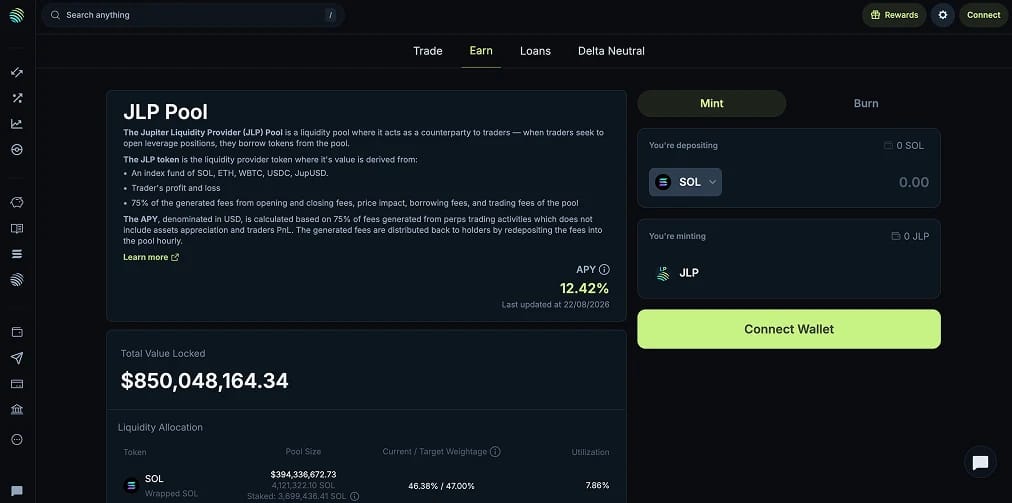
JLP acts as the counterparty pool for Jupiter Perps on Solana. Holders own a basket weighted toward SOL that also contains ETH, WBTC, and stablecoins. They receive 75% of trading, borrowing, and price-impact fees, which accumulate in the token price. JLP produces genuine yield but also carries direct price exposure. The token generally follows the major crypto assets and must pay traders from pool assets when their collective positions are profitable.
Two major events have affected JLP this year. Drift's $286 million exploit on April 1 drained about 41.7 million JLP tokens, valued at roughly $155 million, in one transfer. In early June, on-chain trackers also recorded whales leaving the pool at more than 14 times the normal rate.
At approximately $750 million, JLP still has the highest TVL in the group, although Jupiter's perpetuals volume remains far below Hyperliquid's. Our best decentralized perpetual exchanges ranking compares the venues.
GMX GM Pools and GLV
GMX discontinued its original GLP index in July 2025 following a $42 million exploit involving the V1 architecture. Liquidity has moved into isolated GM pools for individual markets. GLV vaults serve as auto-rebalancing wrappers across pools that use the same collateral.
According to GMX's docs, LPs receive 63% of the fees generated from trading, liquidations, borrowing, and swaps across Arbitrum and Avalanche.
GMX is no longer the default platform for active perpetuals traders. Its pools nevertheless remain a well-audited choice for DeFi-native LPs, and a stablecoin-only GLV vault is planned for MegaETH.
Lighter LLP
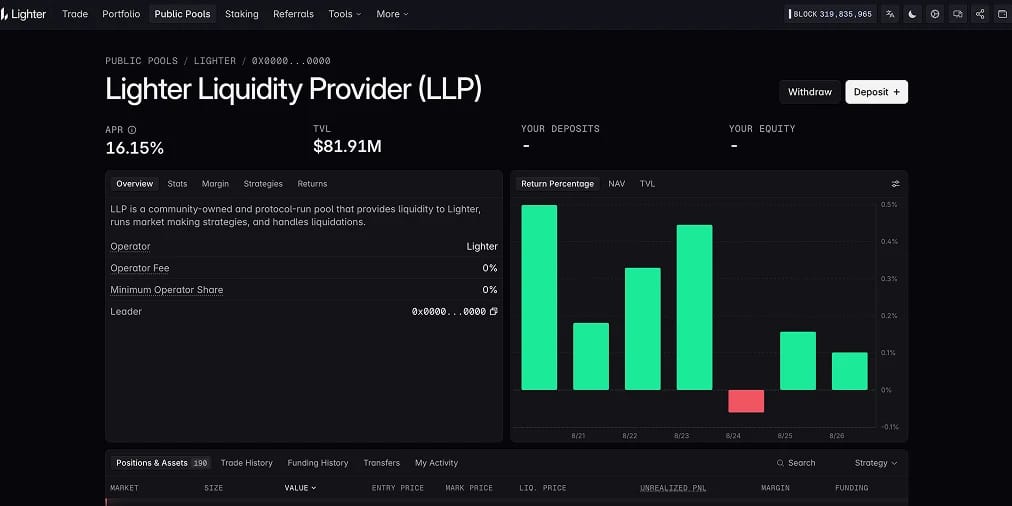
Lighter's LLP is the closest equivalent to HLP. It combines market making with backstop liquidation on a zero-fee order book, where matching is verified using zero-knowledge proofs. LLP grew from about $20 million in May 2025 to more than $700 million by late 2025, while reporting APYs above 30%. Much of that performance reflected the smaller number of external market makers competing for the same trades on Lighter.
In February 2026, Lighter divided LLP into separate buckets for crypto, FX, and tokenised commodities. Losses in one market can no longer spread across the full pool, an approach informed by HLP's JELLY incident. Access is now capped and requires LIT staking. As more professional market makers enter, its yield is likely to move closer to HLP's range.
How to Deposit into Hyperliquid HLP
Once an account has been funded, depositing takes a few minutes:
- Fund your account: Bridge USDC to Hyperliquid through Arbitrum or a native deposit option. Confirm that the funds are held in your perps balance.
- Open the Vaults tab: Open Vaults in the Hyperliquid app and choose Hyperliquidity Provider (HLP) from the top of the list.
- Review live stats: Before depositing, review the vault's TVL, past-month APR, cumulative PnL, and maximum drawdown.
- Deposit: Enter the amount of USDC and confirm the transaction. Your share updates immediately, and the 4-day lock-up starts.
- Monitor and withdraw: Follow the position under "Your Performance." After 4 days, you can withdraw from the same page at the current share value.
Applying a Hyperliquid referral code when opening an account reduces trading fees. The discount does not apply to vault deposits.
Risks of Depositing into HLP
HLP involves risks that do not apply to a stablecoin savings account. Depositors should consider the following:
- Counterparty and strategy risk: HLP can lose when traders are collectively profitable or its inventory sits on the wrong side of a market trend. The vault has posted negative returns over individual days and weeks.
- Toxic liquidation risk: As the backstop liquidator, HLP may inherit oversized or manipulated positions. JELLY, POPCAT, and FARTCOIN followed a similar approach, and the pattern will likely recur in thin markets.
- Lumpy return profile: Two brief periods produced a substantial share of HLP's lifetime profit. Months of flat performance are common, while displayed APR figures describe past results rather than guarantee future returns.
- Lock-up and exit timing: Funds cannot be withdrawn during the first 4 days after a deposit. This restriction may prevent an exit during the early stages of a stress event, when losses are most likely to materialise.
- Governance intervention: Validators have previously voted to delist and force-settle a market during an attack. The decision protected HLP in 2025, but it creates discretionary risk that could work in either direction.
- Shrinking fee subsidy: Most fees are directed toward HYPE buybacks, leaving HLP dependent on strategy performance. Changes to the Hyperliquid team's strategies or capital allocation will affect returns.
- Protocol and bridge risk: A failure involving Hyperliquid's consensus, oracles, or bridge could affect HLP. The Arbitrum bridge has also been paused before.
- Regulatory access: Hyperliquid blocks several jurisdictions through its front end, including the United States. Rules governing derivatives venues continue to change.
Experienced depositors generally use HLP as a limited portion of a stablecoin portfolio that earns returns by absorbing market shocks, rather than treating it as a core cash holding.
Final Thoughts
HLP remains one of DeFi's most original products. By placing the market maker and liquidator's role inside a public vault, it opened one of the most profitable positions on an exchange to ordinary depositors. The vault has distributed roughly $137 million while helping Hyperliquid become the leading on-chain perpetuals venue.
Its current position is more complicated than the initial proposition. Fee subsidies have become negligible, and most returns arrive during crisis periods. A repeatable pattern of manipulation has also contributed to TVL falling by two-thirds from its peak.
Other developments have strengthened the model. Earn lending now supplies a base yield, cumulative PnL has remained positive through every attack, and competitors such as Lighter are adopting the structure with additional risk segmentation.
The key consideration is not the headline APR, but whether you want exposure to a strategy that earns by absorbing extreme market events. For depositors who do, HLP remains the most battle-tested on-chain option. Review the live vault page for its latest TVL, drawdown, and past-month return before deciding how much to allocate.