




Onchain perpetuals matured considerably during 2026. DeFiLlama data shows perp DEXs cleared about $643 billion over the past 30 days, still less than half the $1.36 trillion record from October 2025. Airdrop farming faded while activity concentrated around venues with durable products, paying users, and established distribution.
Lighter has become one of the clearest examples of that shift. Every match and liquidation is proven through zero-knowledge circuits anchored to Ethereum, retail traders pay no fees, and the exchange now powers perpetuals inside Robinhood Wallet. At the same time, token burns, an approaching insider unlock, and unresolved US regulation keep scrutiny high.
This guide explains the architecture, LIT tokenomics, the newest integrations, and the risks worth weighing. 👇
What is Lighter?
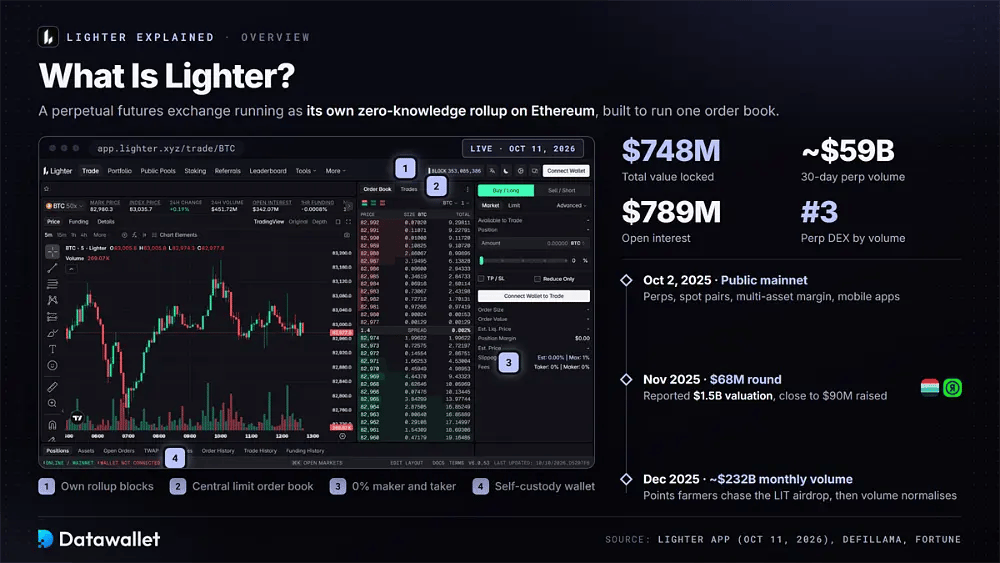
Lighter is a decentralised perpetual futures exchange operating as its own zero-knowledge rollup on Ethereum. Because the chain is application-specific, it exists solely to run a central limit order book. Each match, margin check, and liquidation is verified through a validity proof submitted to Ethereum mainnet.
The structure is designed to combine centralised-exchange speed with self-custody. User collateral remains in Ethereum smart contracts rather than company-controlled wallets. If the operator goes offline or censors withdrawals, users can force an exit through Layer 1. Beyond perps, Lighter also supports spot pairs, multi-asset margin, and iOS and Android apps.
Public mainnet launched on October 2, 2025. Monthly volume climbed to nearly $232 billion that December as points farmers pursued the LIT airdrop, then later normalised. DeFiLlama currently shows $748 million in TVL, around $59 billion in 30-day perp volume, and $789 million in open interest, placing Lighter third among perp DEXs by volume.
The exchange is operated by Elliot Technologies, Inc., a US C-Corp trading as Lighter and founded by former Citadel engineer Vladimir Novakovski. The company has raised close to $90 million, including a $68 million round in November 2025 led by Founders Fund and Ribbit Capital at a reported $1.5 billion valuation.
How Does Lighter Work?
Exchange responsibilities are split between an off-chain operator and Ethereum smart contracts. Custom zero-knowledge circuits then verify that the operator followed the protocol's rules. Five core components explain how Lighter orders trades, verifies execution, manages risk, sets prices, and settles activity.
1. App-Specific zk-Rollup
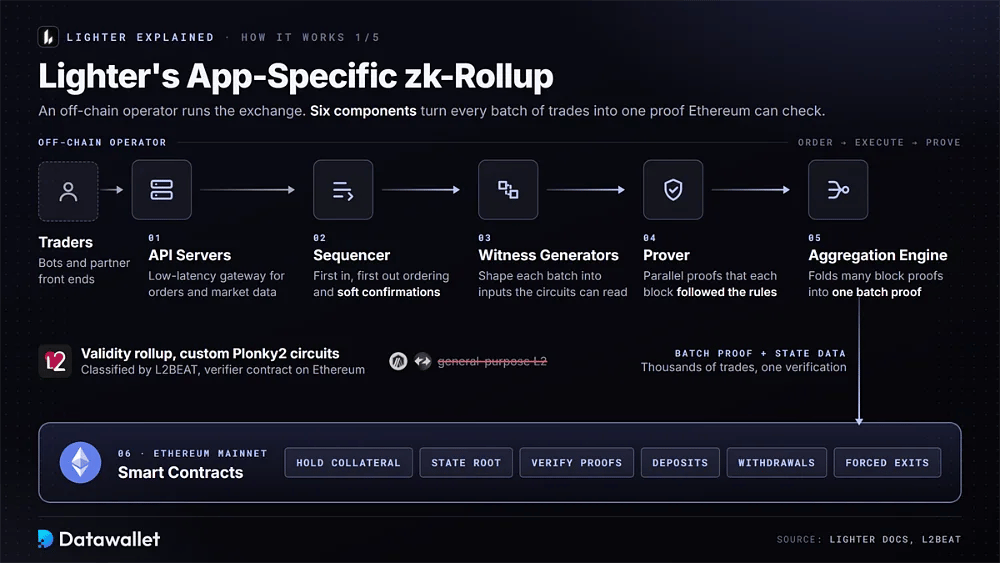
Unlike protocols deployed on general-purpose Layer 2s such as Arbitrum or zkSync, Lighter runs its own dedicated rollup. L2BEAT classifies it as a validity rollup whose custom Plonky2 circuits are compiled into a verifier contract on Ethereum.
Lighter's technical documentation describes six components that keep the system operating:
- Sequencer: Orders incoming transactions on a first-in, first-out basis and builds blocks. It also provides fast soft confirmations so makers and takers do not need to wait for Ethereum finality.
- API Servers: Provide traders, bots, and partner front ends with a low-latency gateway for submitting orders and reading market, order book, and account data directly from the rollup.
- Witness Generators: Transform each executed transaction batch into the structured inputs required by the proving system, converting raw exchange activity into data the circuits can evaluate.
- Prover: Generates execution proofs in parallel, demonstrating that each block followed protocol rules covering price-time priority, funding calculations, margin requirements, and published liquidation formulas.
- Aggregation Engine: Combines many block proofs into a single batch proof across multiple layers, reducing the Ethereum mainnet cost of verifying thousands of trades.
- Smart Contracts: Hold collateral and the canonical state root on Ethereum. They verify submitted proofs and handle deposits, withdrawals, and forced exits to Layer 1.
2. Verifiable Matching and Liquidations
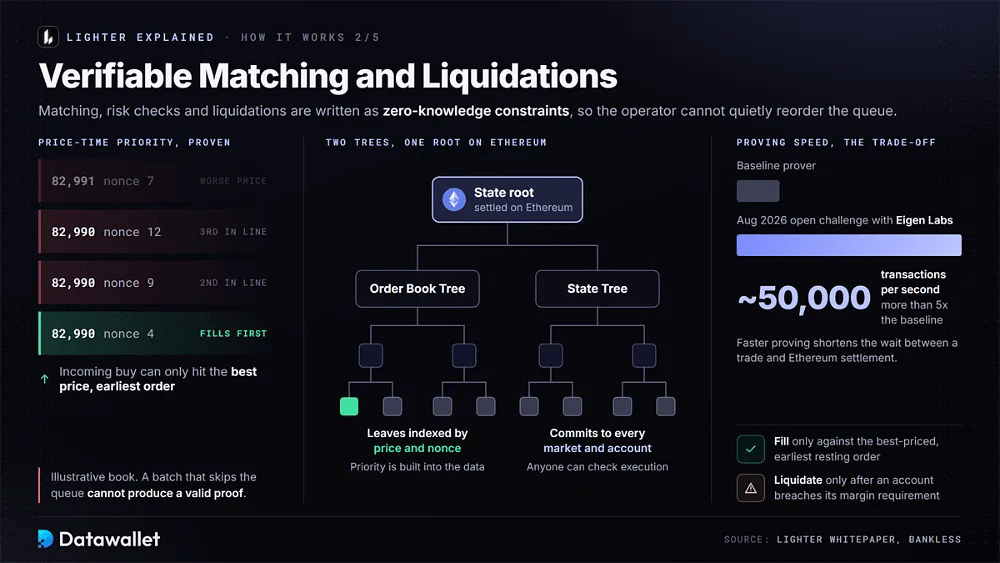
The important distinction lies in what the circuits verify. Matching logic, risk checks, and liquidations are encoded as zero-knowledge constraints. An order can therefore fill only against the best-priced, earliest resting order, while liquidation becomes valid only after the account breaches its margin requirement. The operator cannot silently reorder the queue.
The Lighter whitepaper describes an Order Book Tree with leaves indexed by price and nonce, embedding priority directly into the data structure. A separate State Tree commits to every market and account, allowing anyone to confirm that the Ethereum state root reflects valid execution.
Proving speed remains the trade-off, though performance has improved. An open challenge held with Eigen Labs in August 2026 produced a prover submission capable of roughly 50,000 transactions per second, more than five times the baseline, according to Bankless. Faster proving reduces the delay between trade execution and Ethereum settlement.
3. Censorship Resistance and the Escape Hatch
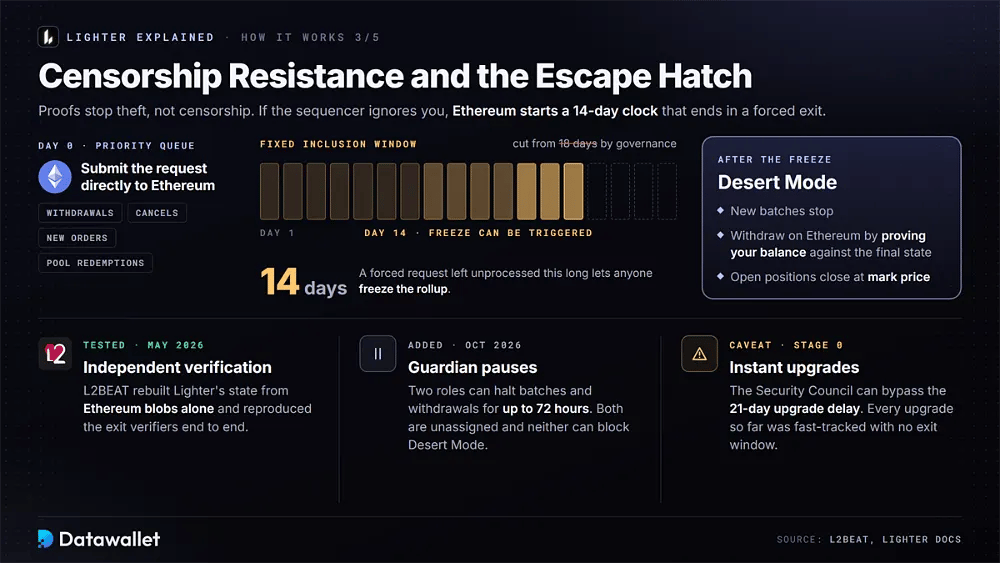
Validity proofs prevent the operator from stealing funds or fabricating trades, but they cannot compel it to include a transaction. Lighter addresses that limitation through Layer 1 mechanisms that L2BEAT has independently tested.
The exit path depends on the following safeguards and constraints:
- Priority Queue: Users can submit withdrawals, order cancellations, new orders, and pool-share redemptions directly to Ethereum. The sequencer must include them within a fixed window.
- 14-Day Window: A forced request left unprocessed for 14 days can trigger a rollup freeze. That period was reduced from 18 days through an earlier governance change.
- Desert Mode: After a freeze, new batches stop. Users can withdraw through Ethereum by proving balances against the final settled state, while open positions close at mark price.
- Independent Verification: In May 2026, L2BEAT researchers reconstructed Lighter's state using Ethereum blobs alone and reproduced its exit verifiers, confirming the permissionless exit process works end to end.
- Guardian Pauses: An October 2026 upgrade introduced two Guardian roles that can halt batches and withdrawals for up to 72 hours. Both remain unassigned and neither can prevent Desert Mode.
- Upgrade Caveat: Lighter is still classified as a Stage 0 rollup because its Security Council can bypass the 21-day upgrade delay. Every upgrade so far has been fast-tracked without providing an exit window.
4. LLP and Risk Isolation
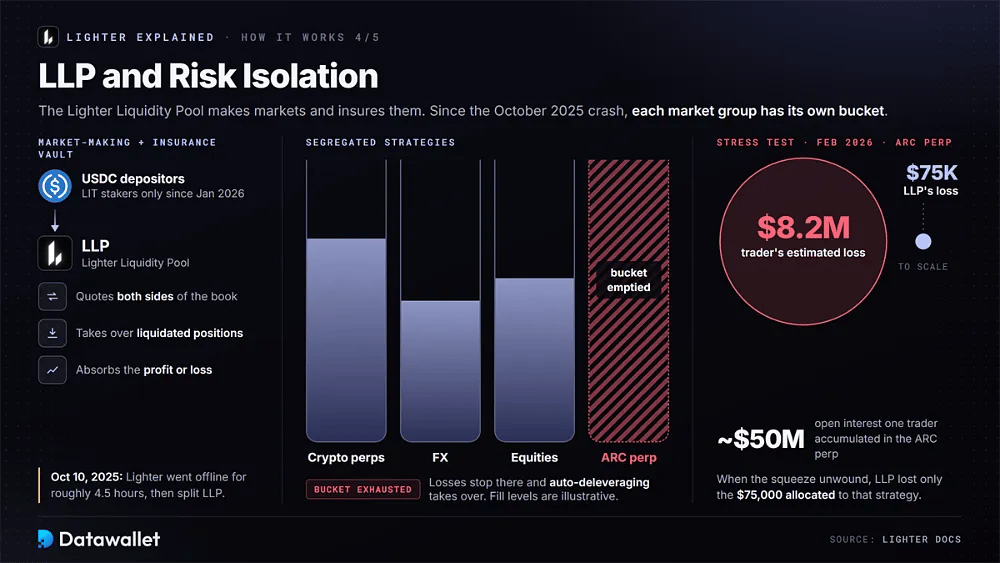
The Lighter Liquidity Pool (LLP) serves as the protocol's market-making and insurance vault. Depositors provide USDC, while the pool quotes both sides of the order book, assumes liquidated positions, and absorbs the resulting profit or loss. Since January 2026, deposits have been limited to LIT stakers, as detailed in the tokenomics section below.
The October 10, 2025 crash left Lighter offline for roughly 4.5 hours. Afterwards, the team split LLP into segregated strategies. Each market now belongs to a distinct bucket, such as crypto perps, FX, or equities. Once a bucket exhausts its allocated capital, auto-deleveraging takes over.
That structure was tested in February 2026. A trader accumulated about $50 million of open interest in the ARC perp and lost an estimated $8.2 million when the squeeze unwound, yet LLP's loss was limited to the $75,000 allocated to that strategy. Lighter's documentation now states that LLP, rather than the older experimental XLP pool, backs RWA markets.
5. Account Tiers and Fees
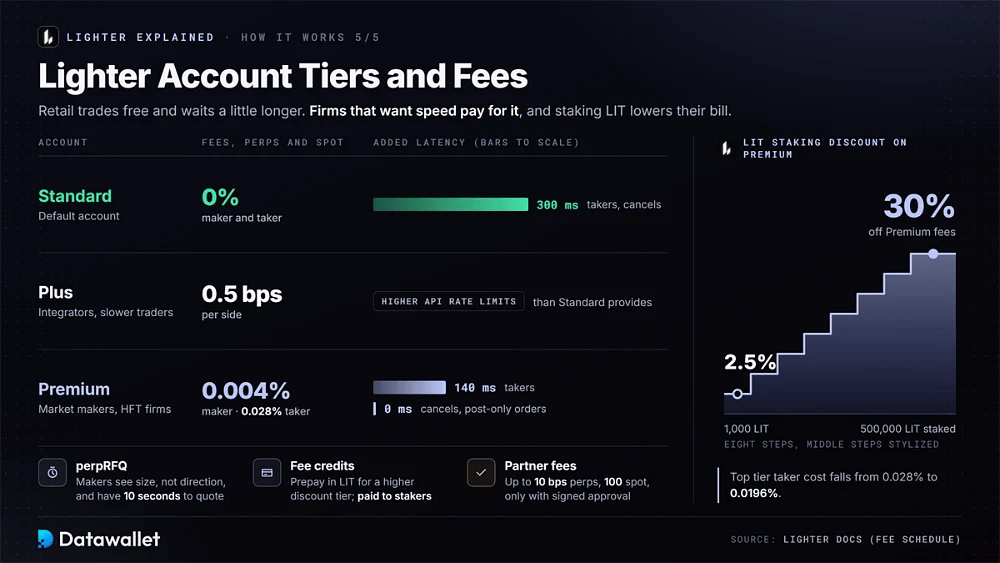
Lighter's zero-fee model applies to its default account. Revenue instead comes partly from traders willing to pay for lower latency and greater access. The current fee schedule lists three account types alongside several additional mechanisms.
Each tier and fee feature currently works as follows:
- Standard Account: The default account charges zero maker and taker fees on perps and spot. In return, taker orders and cancellations carry 300 milliseconds of added latency.
- Premium Account: Designed for market makers and high-frequency firms, this opt-in tier charges 0.004% maker and 0.028% taker. Taker latency falls to 140 milliseconds, with no delay on cancellations or post-only orders.
- Plus Account: A middle tier charging 0.5 basis points per side. It targets latency-insensitive traders and integrators that require higher API rate limits than Standard accounts provide.
- Staking Discounts: Premium fees decline across an eight-step schedule, starting with a 2.5% discount at 1,000 staked LIT and reaching 30% at 500,000 LIT. At the highest tier, taker costs fall to 0.0196%.
- Fee Credits: Premium traders can prepay in LIT to access a higher discount tier for a fixed period without increasing their stake. Those payments are distributed to LIT stakers.
- perpRFQ: Large orders can request quotes from whitelisted market makers. Makers see the size but not the direction and have ten seconds to respond before the order falls back to book execution.
- Partner Fees: Third-party front ends may charge up to 10 basis points on perps and 100 on spot, but the user must sign approval for the fee.
LIT Tokenomics
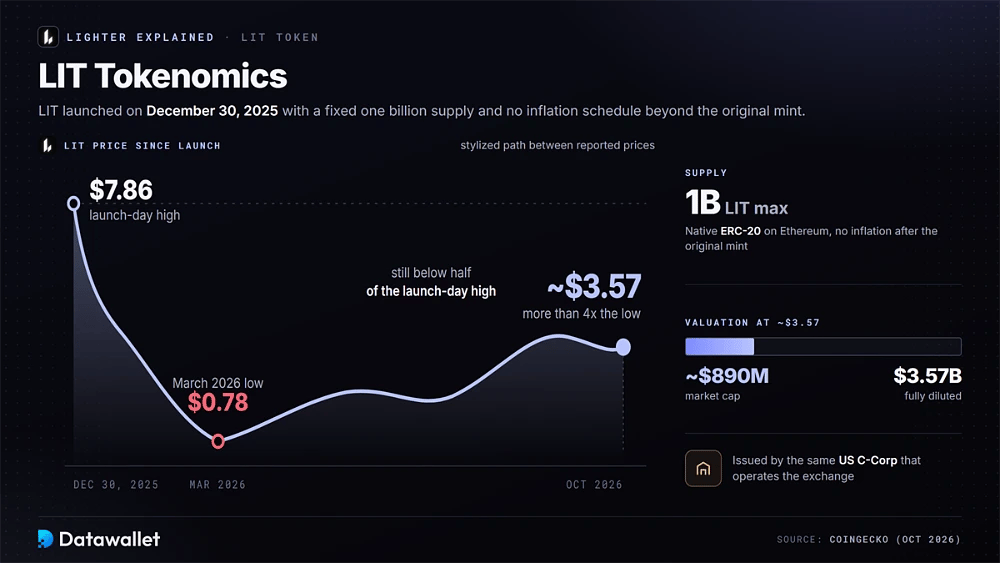
LIT is Lighter's native ERC-20 token and is issued by the same US C-Corp that operates the exchange. It launched on December 30, 2025, with a maximum supply of one billion tokens and no inflation schedule beyond the original mint.
CoinGecko prices LIT near $3.57, implying a market capitalisation of about $890 million and a fully diluted valuation of $3.57 billion. The price is more than four times its March 2026 low of $0.78, although it remains below half of the $7.86 launch-day high.
Allocation
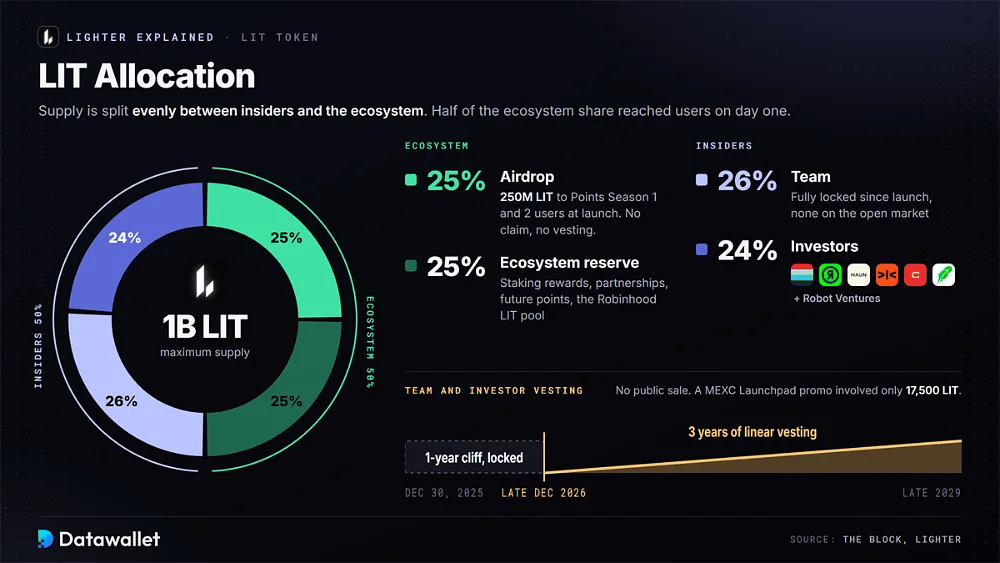
At launch, Lighter confirmed that supply would be divided evenly between insiders and the ecosystem, an unusually community-heavy allocation for a venture-backed exchange. Half of the ecosystem share was released on the first day.
The remaining supply is divided across these buckets and lock-up schedules:
- Airdrop: 25% of supply, equal to 250 million LIT, was distributed directly to Points Season 1 and 2 participants at launch. There was no claim process or vesting requirement.
- Ecosystem Reserve: Another 25% supports staking rewards, partnerships, and future points programmes, including the LIT pool allocated to Robinhood users. No Season 3 allocation has been announced.
- Team: The core team holds 26% of total supply. Those tokens have remained fully locked since launch, so none has entered the open market.
- Investors: Backers hold 24%, including Founders Fund, Ribbit Capital, Haun Ventures, Dragonfly, Craft Ventures, Robot Ventures, and Robinhood. Their tokens follow the same lock-up terms as the team's allocation.
- Vesting: Team and investor holdings have a one-year cliff followed by three years of linear vesting, extending insider unlocks from late December 2026 through late 2029.
- Public Sale: Lighter did not conduct a public token sale. A small MEXC Launchpad promotion in December 2025 involved only 17,500 LIT and had no meaningful impact on supply.
Buybacks, Burns and Unlocks
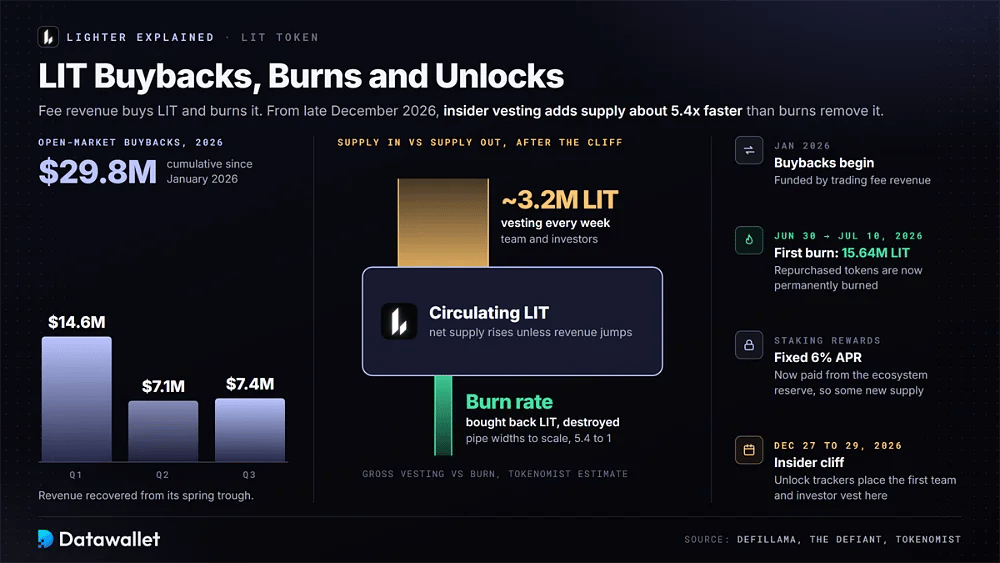
Open-market LIT purchases began in January 2026 using trading fee revenue. DeFiLlama records $29.8 million in cumulative buybacks, including $14.6 million during the first quarter, $7.1 million in the second, and $7.4 million in the third as revenue recovered from its spring trough.
A June 30 tokenomics update changed the destination of repurchased tokens. Bought-back LIT is now permanently burned, with the first burn destroying 15.64 million LIT on July 10, 2026. Staking rewards, previously funded from pre-launch revenue, now come from the ecosystem reserve at a fixed 6% APR and therefore introduce some new supply.
The more significant supply event is still approaching. Unlock trackers place the insider cliff between December 27 and 29, 2026. After that, roughly 3.2 million LIT is expected to vest each week. Tokenomist estimates gross vesting will run at about 5.4 times the burn rate, meaning net supply increases unless revenue rises sharply.
Utility
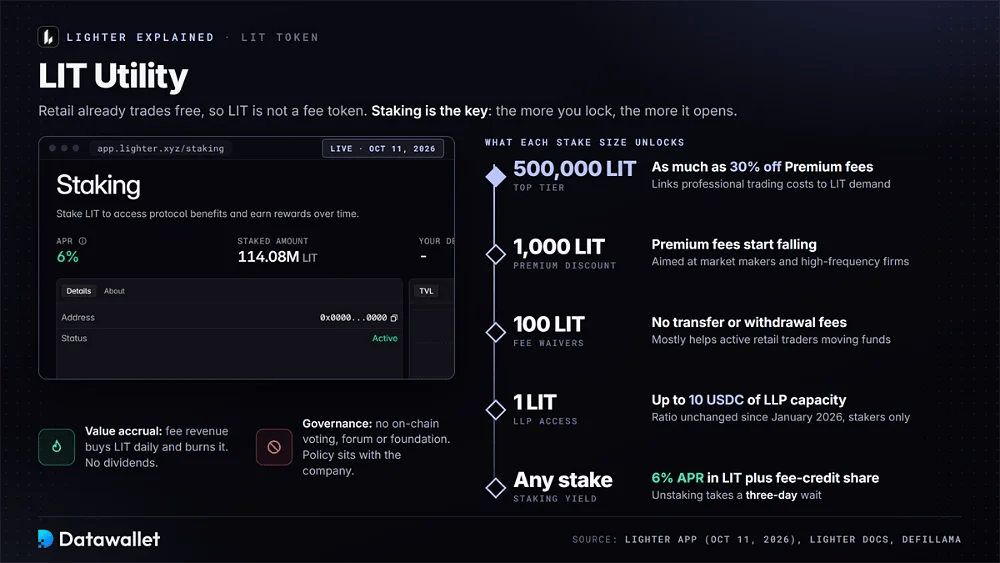
LIT does not function as a conventional fee token because retail users already trade for free. Its documented utility centres on staking, which controls access to certain products and trading discounts.
Holding or staking LIT currently provides these functions:
- LLP Access: Deposits into the Lighter Liquidity Pool are restricted to stakers. Each staked LIT unlocks up to 10 USDC of capacity under a ratio that has remained unchanged since January 2026.
- Fee Waivers: Staking at least 100 LIT removes transfer and withdrawal fees, mainly benefiting active retail traders who frequently move funds on and off the exchange.
- Premium Discounts: Market makers and high-frequency firms can reduce Premium trading fees by as much as 30% as their stake grows, linking professional trading costs to LIT demand.
- Staking Yield: Stakers receive a fixed 6% APR in LIT plus a share of fee-credit payments. Unstaking requires a three-day waiting period.
- Value Accrual: Trading fee revenue funds daily open-market purchases that are subsequently burned. Holders therefore gain exposure through supply reduction rather than direct revenue distributions or dividends.
- Governance: Lighter currently has no on-chain voting system, forum, or foundation. DeFiLlama's token-rights review lists governance and treasury rights as absent, leaving policy decisions with the company.
How Lighter's Economics Fit Together
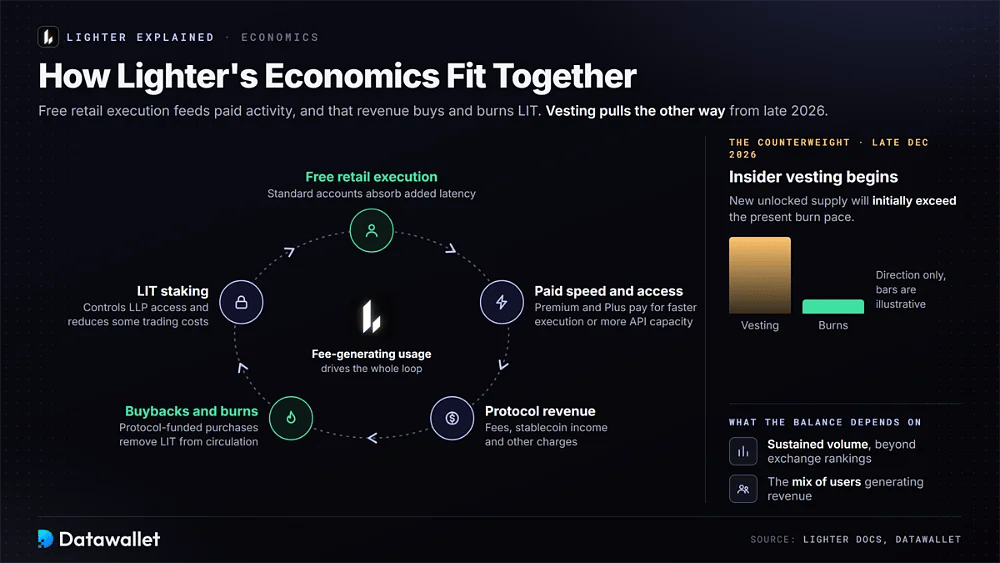
Lighter's economic model links free retail execution to several paid or yield-generating activities rather than charging every trader directly. Standard accounts absorb added latency, while Premium and Plus users pay for faster execution or increased API capacity. Stablecoin income and other charges add separate revenue streams.
LIT sits around that operating model rather than replacing it. Staking controls LLP access and reduces certain trading costs, while protocol-funded buybacks remove tokens from circulation through burns. The balance changes once insider vesting begins in late December 2026 because new unlocked supply will initially exceed the present burn pace.
That makes trading activity important for more than exchange rankings. Higher fee-generating usage can increase the resources available for token purchases, whereas weaker revenue leaves the burn mechanism smaller relative to scheduled vesting. The protocol's economics therefore depend on both sustained volume and the mix of users generating revenue.
Lighter vs Hyperliquid
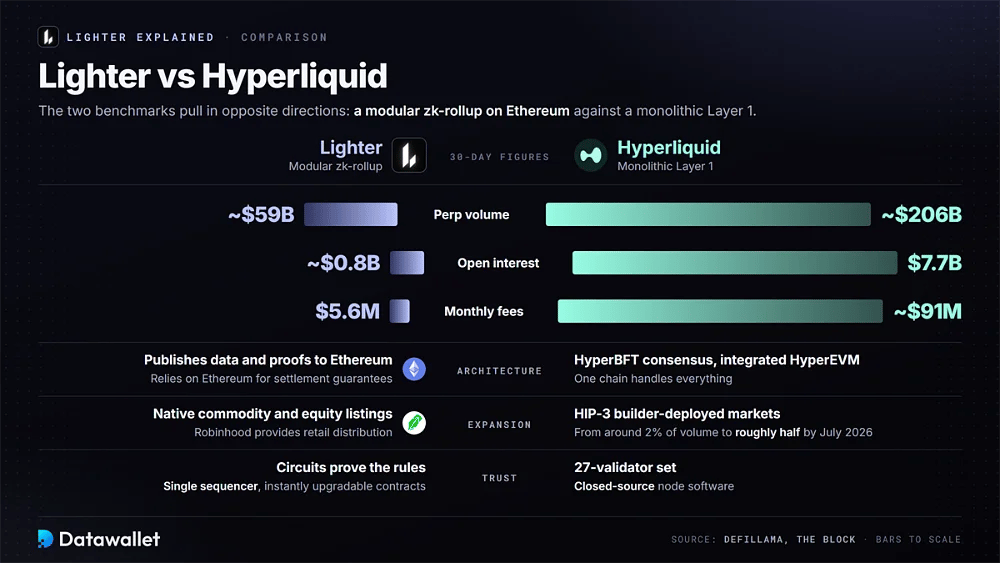
Lighter and Hyperliquid remain the most obvious benchmarks for one another, but their architectures move in opposite directions. Hyperliquid operates as a monolithic Layer 1 using HyperBFT consensus and an integrated HyperEVM. Lighter instead runs a modular zk-rollup, publishing state data and proofs to Ethereum while relying on Ethereum for settlement guarantees.
Their current scale differs substantially. DeFiLlama's perps dashboard puts Hyperliquid at roughly $206 billion in 30-day volume and $7.7 billion of open interest, versus about $59 billion and $0.8 billion for Lighter. Hyperliquid also generated approximately $91 million in monthly fees, while Lighter recorded $5.6 million.
Expansion has followed different paths. Hyperliquid grew through HIP-3 builder-deployed markets, which The Block reported increased from around 2% of volume to roughly half by July 2026. Lighter lists commodities and equities natively, while partnerships such as Robinhood provide retail distribution.
Trust assumptions differ as well. Hyperliquid uses a 27-validator set and closed-source node software. Lighter proves protocol rules through circuits but still depends on a single sequencer and contracts that can be upgraded instantly. Our Lighter vs Hyperliquid comparison examines fees in more detail, while our perp DEX ranking compares both protocols with the wider market.
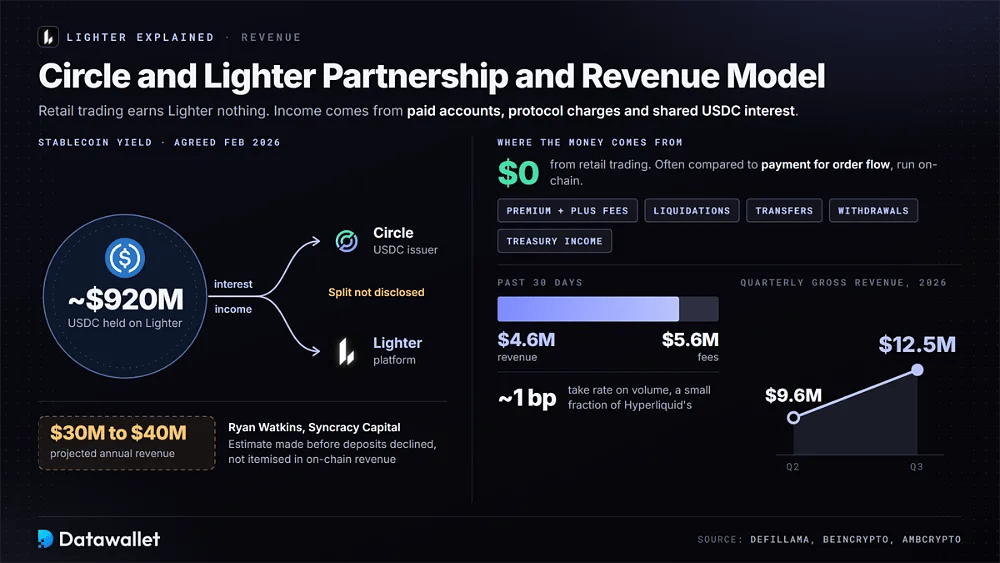
Circle and Lighter Partnership and Revenue Model
Retail trading itself produces no revenue for Lighter. Income instead comes from Premium and Plus account fees, along with liquidation, transfer, and withdrawal charges and treasury income. DeFiLlama reports $5.6 million in fees and $4.6 million of revenue over the past 30 days. Quarterly gross revenue rose from $9.6 million in Q2 to $12.5 million in Q3 2026.
The structure is often compared by both supporters and critics to payment for order flow implemented on-chain. Sophisticated firms pay for faster access to retail activity while retail users trade without fees. Lighter's take rate is around one basis point of volume, a small fraction of Hyperliquid's, which helps explain why revenue remains lower than its market share might imply.
Stablecoin yield forms the other major pillar. Lighter and Circle agreed in February 2026 to share interest income generated by about $920 million of USDC held on the platform, an arrangement resembling Coinbase's relationship with the issuer. A follow-up in May 2026 designated USDC as the preferred stablecoin for trading, settlement, and onboarding.
Financial terms were not disclosed. Syncracy Capital's Ryan Watkins projected annual revenue of $30 million to $40 million, though that estimate came before deposits declined and is not itemised in on-chain revenue figures. Hyperliquid has since announced a USDC agreement of its own, suggesting that issuer revenue sharing is becoming an industry pattern.
RWA and Pre-Launch Markets
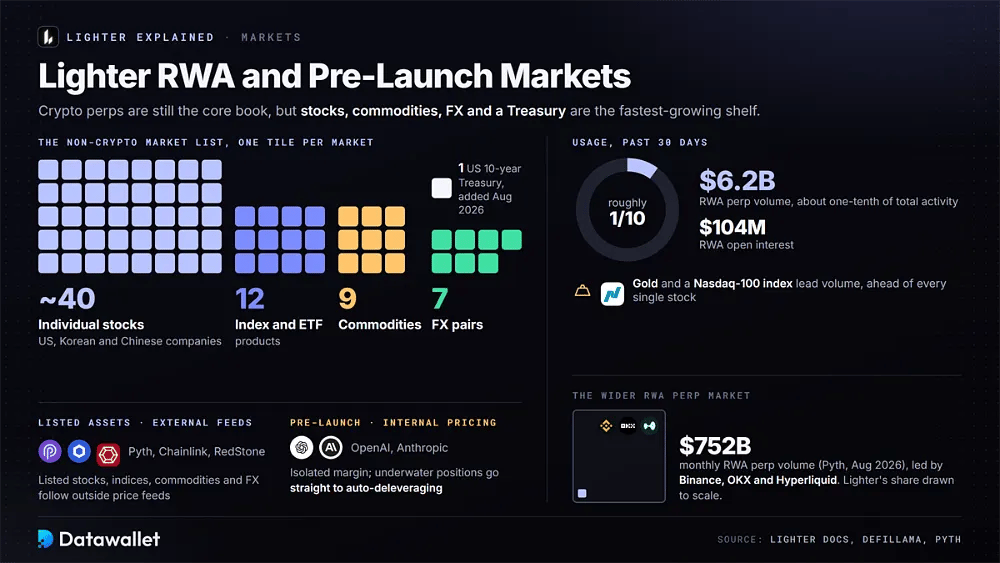
Crypto perpetuals still make up Lighter's core order book, but its non-crypto offering is expanding fastest. The current market list covers around 40 individual stocks across US, Korean, and Chinese companies, alongside a dozen index and ETF products. It also includes nine commodities, seven FX pairs, and a US 10-year Treasury market added in August 2026.
Usage has become meaningful without approaching crypto activity. DeFiLlama's RWA tracker reports $6.2 billion in 30-day RWA perp volume and $104 million of open interest on Lighter, equivalent to roughly one-tenth of total activity. Gold and a Nasdaq-100 index lead volume, ahead of every individual stock.
Private-company and pre-launch contracts follow a different structure. Markets covering companies such as OpenAI and Anthropic use an internal pricing mechanism rather than an external oracle. They trade with isolated margin, and underwater positions move directly into auto-deleveraging. Listed assets instead rely on external feeds from providers including Pyth, Chainlink, and RedStone.
The broader RWA perpetuals market is substantially larger. Pyth's August 2026 report estimated monthly RWA perp volume at $752 billion, with Binance, OKX, and Hyperliquid dominating activity. Lighter's distinction is that these products run through the same proof-verified execution engine and risk-isolated liquidity structure as its crypto markets.
Lighter on Robinhood Chain
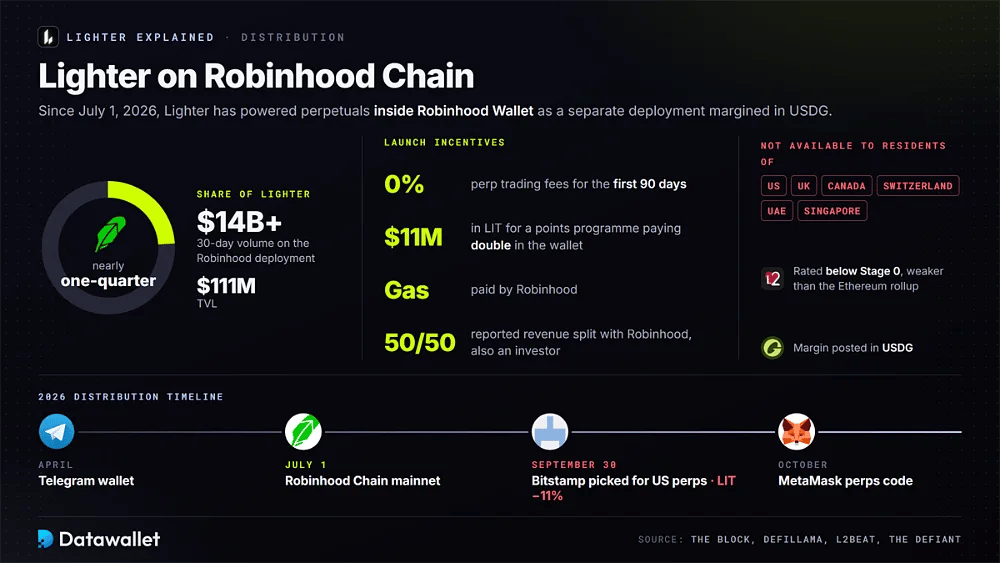
Distribution has been the largest change for Lighter in 2026. On July 1, Robinhood Chain launched with Lighter providing perpetuals inside Robinhood Wallet. The integration runs as a separate deployment, uses USDG for margin, and excludes residents of the US, UK, Canada, Switzerland, the UAE, and Singapore.
Launch incentives included zero perpetual trading fees for the first 90 days, Robinhood-paid gas, and $11 million in LIT allocated to a points programme that pays double through the wallet. Revenue from the deployment is reportedly divided evenly between Lighter and Robinhood, which is also an investor.
Adoption arrived quickly. DeFiLlama attributes $111 million in TVL and more than $14 billion of 30-day volume to the Robinhood deployment, approaching one-quarter of Lighter's total. Distribution has expanded through other channels as well, including Telegram's wallet in April and October code adding Lighter trading to MetaMask's perps stack.
There are two notable limitations. L2BEAT rates the Robinhood deployment below Stage 0, weaker than the Ethereum rollup's classification. On September 30, Robinhood also selected Bitstamp, rather than Lighter, for its US perpetuals launch. LIT fell 11% that day, highlighting how strongly sentiment now responds to a single partner.
Lighter Regulation and US Availability
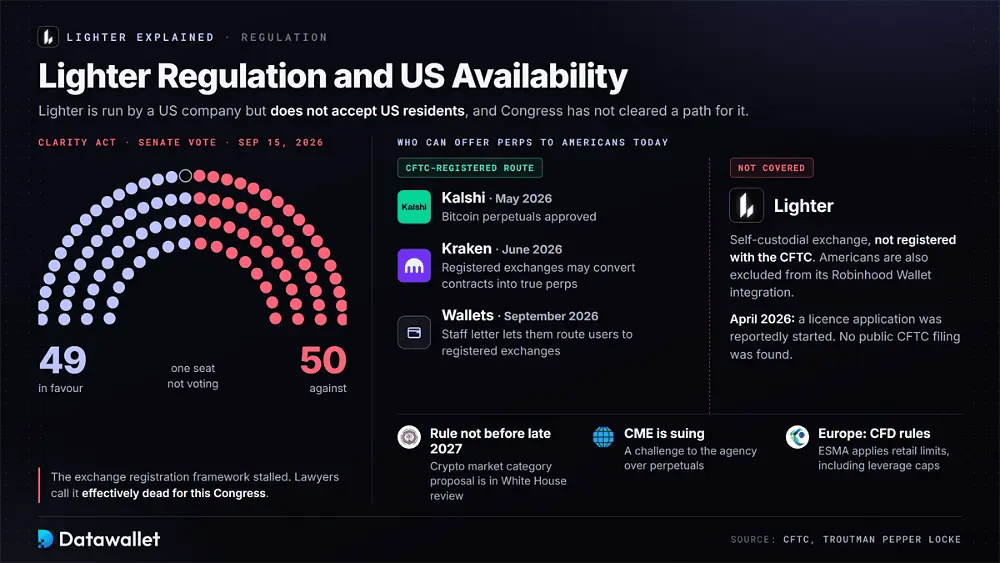
Lighter is operated by a US company but does not accept US residents. It is not registered with the CFTC, and Americans are also excluded from its Robinhood Wallet integration. Novakovski reportedly told investors in April 2026 that the company had started a licence application, although later reporting found no public CFTC filing.
Congress has not resolved the uncertainty. The CLARITY Act, intended to establish a registration framework for crypto exchanges, stalled after the Senate rejected a procedural vote 49 to 50 on September 15, 2026. Lawyers following the legislation describe it as effectively dead for this Congress.
Regulators have taken separate steps. In May 2026, the CFTC approved Kalshi's Bitcoin perpetuals. The following month it allowed registered exchanges to convert existing contracts into true perpetuals, after which Kraken launched US perps. A September staff letter permits wallets to route users toward registered venues, but self-custodial exchanges such as Lighter are not covered.
Any broader route remains slow. A CFTC proposal establishing a dedicated crypto asset market category entered White House review in September, with a binding rule not expected before late 2027. CME is also suing the agency over perpetuals. In Europe, ESMA treats perpetuals as subject to retail CFD restrictions, including leverage caps.
Where Lighter's Main Trade-Offs Sit
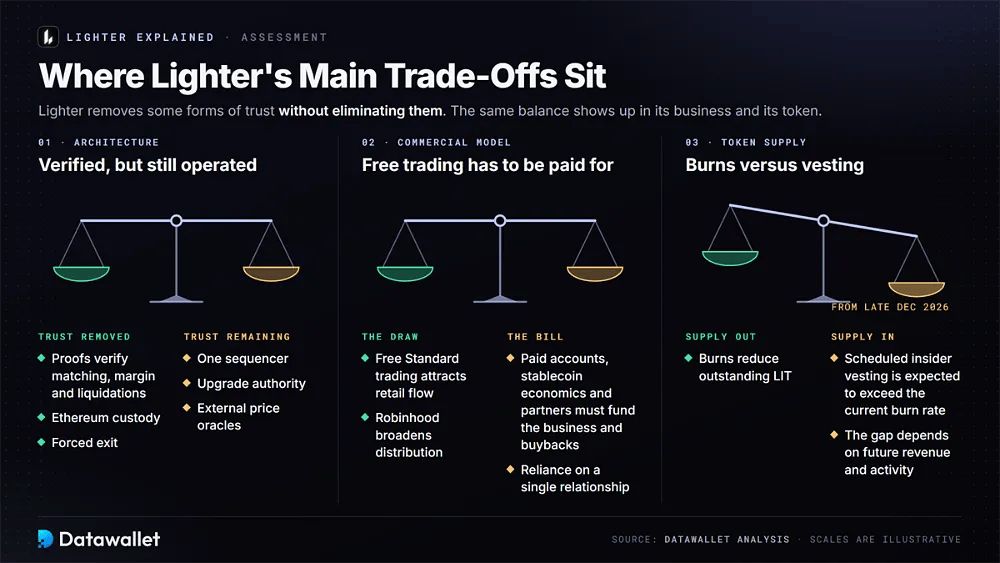
Lighter's architecture removes some forms of trust without eliminating them. Validity proofs can verify matching, margin rules, and liquidation logic, while Ethereum provides custody and a forced-exit mechanism. Day-to-day operation, however, still depends on one sequencer, upgrade authority, and external infrastructure such as price oracles.
Its commercial model has a similar balance. Free Standard trading can attract retail flow, but paid accounts, stablecoin economics, and partner distribution must generate enough revenue to support the business and token buybacks. Robinhood broadens distribution while simultaneously increasing dependence on a single relationship.
Token supply adds another variable from late December 2026. Burns reduce outstanding LIT, but scheduled insider vesting is expected to exceed the current burn rate. Whether that gap narrows depends on future revenue and activity rather than the burn mechanism alone.
Lighter Risks
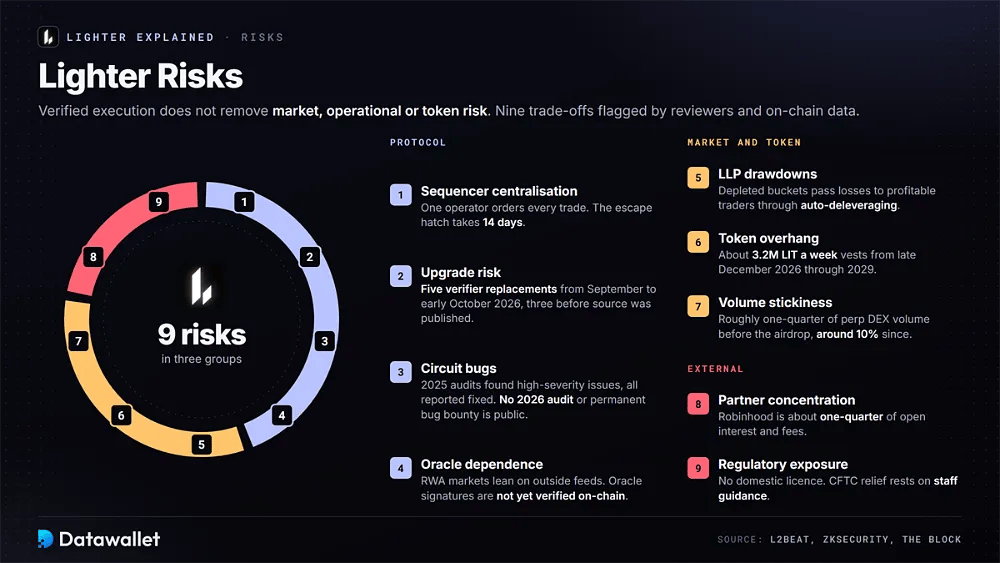
Lighter is one of the more carefully engineered perp DEXs, but verified execution does not eliminate market, operational, or token risk. Traders and depositors still need to account for the trade-offs highlighted by independent reviewers and current on-chain data.
The main risks to understand before using Lighter are:
- Sequencer Centralisation: One operator determines the ordering of every trade and could extract value from that role. Users facing censorship must wait 14 days before the escape hatch becomes available.
- Upgrade Risk: Contracts can be upgraded instantly. L2BEAT recorded five verifier replacements between September and early October 2026, with three deployed before their source code was published.
- Circuit Bugs: Smart contracts and circuits create a broad attack surface. zkSecurity audits identified high-severity issues during 2025, all reported fixed, but no 2026 audit or permanent bug bounty has been made public.
- LLP Drawdowns: Pool depositors sit opposite traders and liquidations. Segregated strategies limit losses within each market group, yet depleted buckets can shift remaining losses to profitable traders through auto-deleveraging.
- Token Overhang: Half of LIT supply begins vesting in late December 2026 at approximately 3.2 million tokens per week. That pace is several times the current burn rate and creates ongoing dilution through 2029.
- Volume Stickiness: Lighter controlled roughly one-quarter of perp DEX volume before its airdrop but has remained around 10% since, according to The Block. The decline illustrates how much early activity depended on incentives.
- Partner Concentration: Robinhood contributes about one-quarter of open interest and fees while acting as an investor and revenue partner. A change in that relationship could therefore have an immediate effect.
- Regulatory Exposure: A US company offering leveraged derivatives without a domestic licence remains dependent on rules that are still unresolved. Current CFTC relief is based on staff guidance and could be reversed.
- Oracle Dependence: Real-world asset markets depend on outside price feeds and an internal fallback when those feeds become stale. L2BEAT notes that oracle signatures are not yet verified on-chain.
Lighter Founders
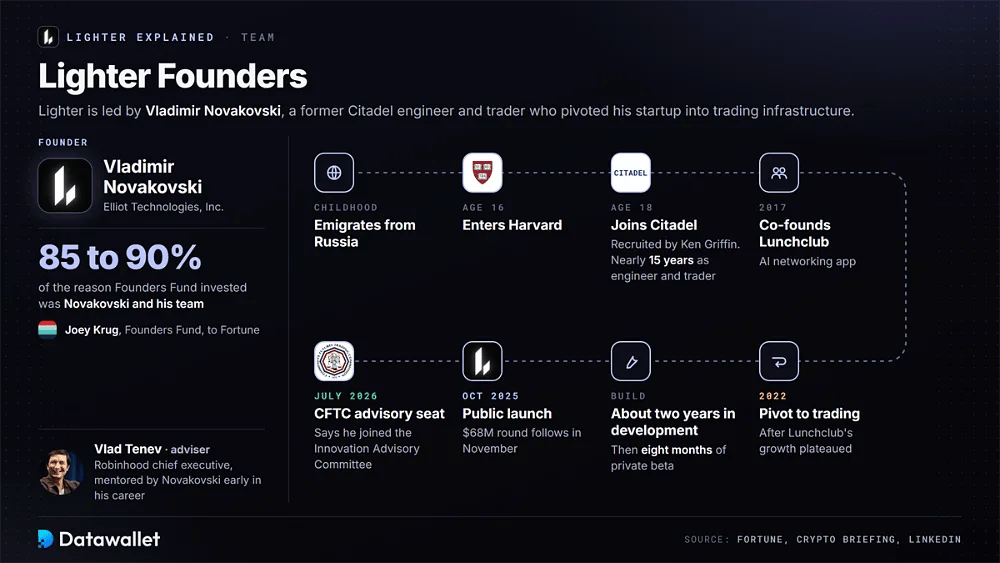
Lighter is led by Vladimir Novakovski, who emigrated from Russia as a child, entered Harvard at 16, and joined Citadel at 18 after Ken Griffin recruited him. He spent nearly 15 years working as an engineer and trader before co-founding the AI networking application Lunchclub in 2017.
After Lunchclub's growth plateaued in 2022, Novakovski shifted the team toward trading infrastructure. Lighter remained in development for about two years and then spent eight months in private beta before public launch. Founders Fund partner Joey Krug told Fortune that Novakovski and his team represented 85% to 90% of the reason for the firm's investment.
His professional network continues to influence Lighter's strategy. Robinhood chief executive Vlad Tenev, whom Novakovski mentored early in his career, advises the company. Novakovski described the Robinhood Chain launch as twelve years in the making. In July 2026, he also said he had joined the CFTC's Innovation Advisory Committee, giving Lighter a place inside US policy discussions.
Final Thoughts
Lighter remains one of crypto's most technically ambitious exchanges. Verifying matching, margin calculations, and liquidations through zero-knowledge circuits is far harder than running an off-chain order book. Independent researchers have also reproduced its Ethereum exit path, and the system now operates at meaningful scale.
The bigger 2026 development has been commercial. Zero-fee Standard accounts now sit alongside paid Premium access, stablecoin revenue sharing, and Robinhood distribution. Repurchased LIT is burned, linking protocol revenue more directly to token supply. Revenue has recovered from its spring low but remains well below Hyperliquid's.
Key questions remain. Volume must hold near a 10% share as rival venues launch tokens. The sequencer and upgrade keys are still centralized, while burns face insider unlocks starting in December 2026. US regulators must also decide whether self-custodial perpetual exchanges have a viable path to market.