



Coinbase vs Robinhood: Overview
Coinbase was founded in 2012 by Brian Armstrong and Fred Ehrsam. Its 2021 NASDAQ listing made it the first major crypto exchange to trade on a US stock market. The platform operates in more than 100 countries, while its second-quarter results showed a record 10.3% share of global crypto trading volume. This was its third consecutive quarterly gain.
The company now describes itself as an everything exchange. Bitcoin trading once produced more than half of its revenue but contributed just 12% in the latest quarter. Over the past year, Coinbase has launched commission-free US stock trading, prediction markets, Deribit options, and tokenized equities for non-US customers. That expansion has been costly. The company recorded a $359 million net loss on quarterly revenue of $1.2 billion.
Robinhood began in 2013 as a commission-free stockbroker founded by Vladimir Tenev and Baiju Bhatt. It now has 28.4 million funded customers with $369 billion in platform assets. The second quarter delivered record revenue of $1.31 billion and net income of $573 million. Crypto trading revenue, however, declined 38% year over year to $100 million as prediction markets moved ahead of it for the first time.
Those weaker app figures do not reflect the scale of Robinhood's crypto infrastructure expansion. It acquired Bitstamp for $200 million and bought Canada's WonderFi. The public mainnet for Robinhood Chain went live in July, tokenized US stocks expanded to more than 120 countries, and UK customers gained crypto trading through Bitstamp in August.
Coinbase vs Robinhood: Products
The two companies are approaching the same market from different starting points. Coinbase began with crypto and has added equities, derivatives, and event contracts. Robinhood built its business around equities before adding exchange infrastructure, tokenization, and its own blockchain.
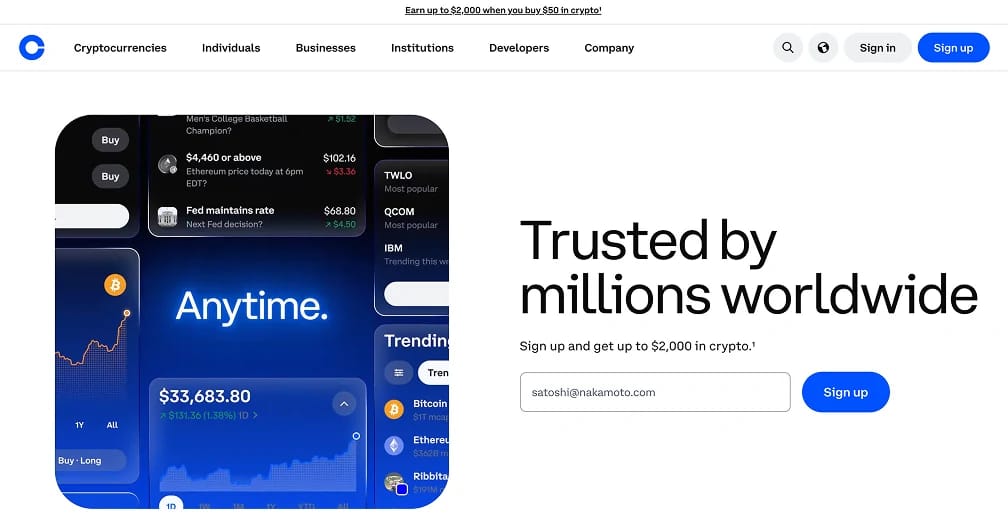
Coinbase Products
Coinbase divides its services across a simple retail interface, the Advanced Trade order book, and an expanding range of regulated derivatives.
- Spot and Advanced Trade: Around 260 cryptocurrencies with the deepest available USD order books. Moving beyond the default purchase screen adds TradingView charts, limit and stop orders, and API access.
- Stock Trading: Zero-commission US equities and ETFs launched inside the main app. Users receive 24/5 access and can pay in USD or USDC. The service is also available to UK customers across nearly 4,000 stocks.
- Deribit Options: Coinbase completed its $4.3 billion Deribit acquisition in August 2025. The purchase gave it the deepest crypto options market globally, a product Robinhood cannot match.
- US Perpetual-Style Futures: Coinbase became the first US exchange cleared by the CFTC to list perpetual-style contracts, which track an asset's price without an expiry date. It also offers nano Bitcoin and Ether futures sized for retail accounts.
- Prediction Markets: Event contracts are available through a Kalshi partnership, alongside Coinbase's own crypto price binaries. Contract volumes and revenue increased 106% quarter over quarter.
- Tokenized Equities: Coinbase Tokenize is rolling out 1:1 backed tokenized US stocks to eligible non-US customers. The assets provide on-chain ownership and automatic dividends.
- Coinbase Wallet and Base: Its self-custody wallet provides full DeFi access and connects to Base, the Ethereum Layer 2 network developed by Coinbase.
- Staking and USDC Rewards: Customers can stake a broad range of assets, with Coinbase retaining a 35% commission on rewards. The rate falls to 25% for subscribers, while idle USDC balances earn yield automatically.
Robinhood Products
Robinhood combines an unusually broad range of investments within one account. Most of its newest products sit outside conventional crypto trading.
- Robinhood Crypto: US customers can trade roughly 30 assets without a separate commission. Costs are incorporated into the quoted spread instead. Through Bitstamp, UK customers gained access to more than 50 tokens in August.
- Stocks, ETFs, and Options: Its core brokerage offers thousands of US equities and ETFs without commissions. Index options cost $0.50 per contract, falling to $0.35 for Gold members.
- CME Futures: More than 40 CME Group products cover markets including the S&P 500, gold, oil, and currencies. Pricing starts at $0.50 per contract, placing Robinhood among the cheapest retail futures brokers in the US.
- Prediction Markets: Customers can trade event contracts tied to sports, elections, and economic data. These now clear through Rothera, Robinhood's CFTC-licensed exchange and clearinghouse, following 13.6 billion contracts traded in the second quarter.
- Robinhood Legend and Cortex: Legend is a free desktop terminal offering advanced charts and one-tap ladder execution. Cortex, its AI assistant, explains price movements within individual asset pages.
- Robinhood Gold: The $5 monthly subscription includes 3.35% interest on cash and a 3% IRA match. Members also receive lower futures and index options pricing, Morningstar research, and the 3% cash-back Gold Card.
- Robinhood Chain and Stock Tokens: Robinhood offers tokenized US equities around the clock in more than 120 countries. They run on its Arbitrum-based network, which processed $18 billion in decentralized exchange volume during its first weeks.
- Staking and Robinhood Earn: Customers can stake ETH, SOL, and ADA from $1, subject to a 25% commission on rewards. Robinhood Earn also supports on-chain USDG lending through a self-custody wallet.

Coinbase vs Robinhood: Fees
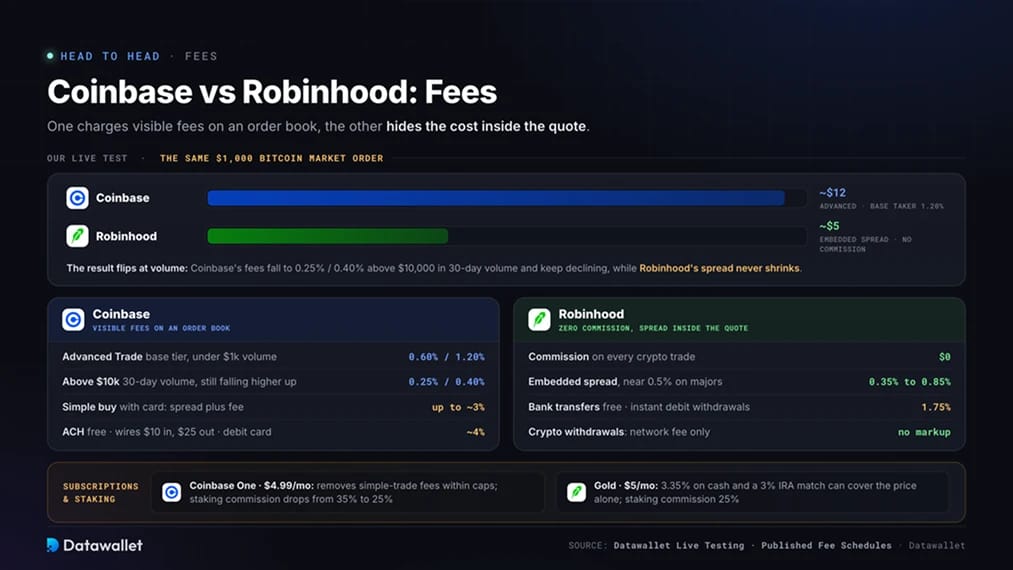
Which platform costs less depends on the product and how the order is placed. Coinbase Advanced charges visible maker and taker fees through its order book. Our maker vs taker guide explains how the order type affects the rate.
Robinhood advertises commission-free crypto trading but widens its quoted prices. The customer still pays a trading cost, even though it does not appear as a separate fee.
Crypto Trading Fees
- Coinbase: The default purchase screen combines a spread with a fee that can reach roughly 3% on card transactions. This is the most expensive buying method across either platform. Advanced Trade starts at 0.60% maker and 1.20% taker for accounts with less than $1,000 in 30-day volume. Rates improve to 0.25% and 0.40% above $10,000, then continue falling at higher tiers.
- Robinhood: No commission is charged, but the spread on major assets sits near 0.5% and generally ranges from about 0.35% to 0.85% based on liquidity. This can cost less than Coinbase's retail interface for small and mid-sized Bitcoin or Ether orders. Larger transactions lose more to the spread than they would through a limit order on a genuine order book.
Our trading note: A $1,000 Bitcoin market order cost approximately $12 at Coinbase Advanced using the base-tier taker rate. The embedded spread on Robinhood brought the equivalent cost closer to $5. High-volume traders get a different result because Coinbase's fees decline as volume rises, whereas Robinhood's spread does not.
Subscriptions and Staking
- Coinbase: Coinbase One starts at $4.99 per month and removes simple-trade fees within applicable volume caps, although spreads remain. The standard staking commission is 35%, reduced to 25% for subscribers.
- Robinhood: Gold costs $5 per month or $50 annually. The IRA match and interest paid on cash can cover that price by themselves. Robinhood takes a 25% commission from staking rewards on ETH, SOL, and ADA.
Funding and Withdrawals
- Coinbase: ACH bank deposits and withdrawals are free. Incoming wires cost $10, while outgoing wires cost $25. Debit card purchases carry a fee of around 4%, and crypto withdrawals incur the relevant network charge.
- Robinhood: Bank transfers are free. Instant debit card withdrawals cost 1.75%, subject to a $1 minimum. Outgoing crypto transfers incur network fees without an additional Robinhood charge.
Coinbase vs Robinhood: Perpetuals and Derivatives
The largest difference between the platforms appears in derivatives, where each serves a distinct type of customer. Coinbase focuses on crypto derivatives that Americans can legally access. Robinhood offers traditional futures with competitive retail pricing. Both appear in our assessment of the best crypto futures exchanges.
Coinbase Derivatives
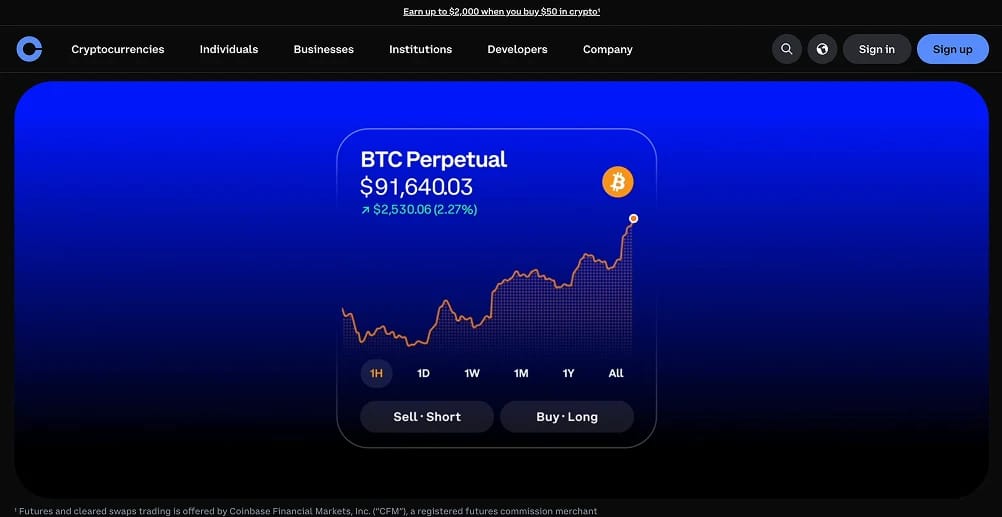
- US perpetual-style futures: Eligible US customers can trade CFTC-cleared Bitcoin and Ether contracts that replicate the perpetual structure used by offshore exchanges. Trading takes place through a dedicated regulated entity.
- Nano contracts: Contract sizes of 0.01 BTC and 0.10 ETH keep margin requirements manageable for ordinary retail accounts.
- International perpetuals: Eligible non-US customers can access crypto perpetuals with leverage of up to 50x through Coinbase International Exchange. Newer products include stock and pre-IPO perpetual contracts.
- Deribit options: Coinbase provides calls and puts through the deepest crypto options order book in the market. Access to Deribit is the strongest individual reason for derivatives traders to maintain a Coinbase account.
Robinhood Derivatives
- CME futures: More than 40 contracts cover equity indices, metals, energy, and foreign exchange within the same app used for stocks and crypto. Commissions are $0.50 per contract or $0.35 with Gold, undercutting most US retail brokers.
- Micro crypto futures: CME micro Bitcoin and Ether futures give US customers leveraged exposure without requiring them to hold the underlying coins. Robinhood does not offer crypto perpetuals to Americans.
- EU crypto perpetuals: European customers can trade perpetual futures, with orders executed through Bitstamp's derivatives venue.
- Execution tools: Robinhood Legend includes a futures ladder for placing or adjusting limit and stop orders with one tap. It performed reliably in our testing during a fast-moving market.
Coinbase vs Robinhood: Prediction Markets & Tokenized Stocks
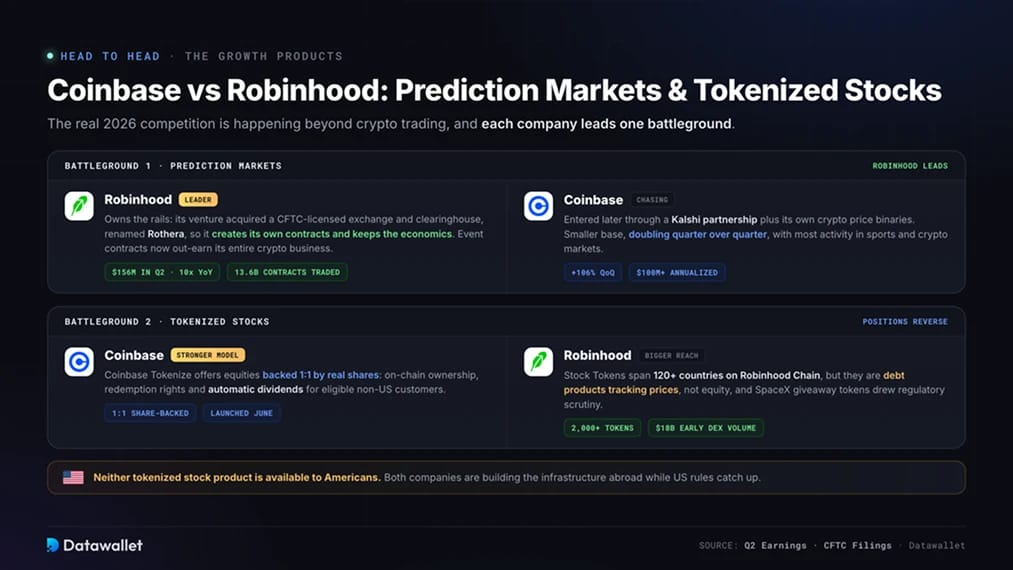
In 2026, the most significant competition between these platforms is happening beyond standard crypto trading. Both view event contracts and tokenized equities as major growth areas. Each has also spent heavily to control the underlying infrastructure.
Robinhood currently leads in prediction markets. Its joint venture acquired MIAXdx, a CFTC-licensed exchange and clearinghouse that was renamed Rothera. The venue processed its first trade in June.
Direct ownership of the licenses allows Robinhood to create its own contracts and retain the economics. Event contracts generated $156 million in the second quarter, ten times the figure from a year earlier. The product also generated more revenue than crypto trading for the first time. Our prediction markets explainer examines how these contracts operate.
Coinbase entered the category later and chose a partnership model. It lists event markets through Kalshi and offers its own crypto price binaries alongside them. The business is expanding quickly from a smaller base. Contracts and revenue doubled quarter over quarter, annualized revenue passed $100 million, and most activity comes from sports and crypto markets.
The positions reverse for tokenized stocks. Robinhood launched Stock Tokens for EU customers in mid-2025, then expanded them to more than 120 countries through Robinhood Chain. Its catalog now includes over 2,000 tokens.
These instruments are debt products that follow share prices rather than actual equity. Giveaway tokens linked to private businesses such as SpaceX also attracted regulatory scrutiny, which our SpaceX IPO explainer discusses.
Coinbase responded in June with tokenized US equities backed 1:1 by real shares. Eligible non-US customers receive on-chain ownership, redemption rights, and automatic dividends. Neither company's product is currently available to Americans.
Coinbase vs Robinhood: Security
Both companies store most customer crypto in offline cold wallets, and neither has lost customer assets through an exchange hack. Each platform has experienced one substantial data security incident.
Coinbase Security Measures and History
- Custody: Approximately 98% of customer crypto is stored in geographically distributed cold wallets. Coinbase also custodies a large portion of the assets supporting US spot Bitcoin and Ethereum ETFs.
- Cash protection: Customer US dollars are held in pooled accounts at FDIC-insured banks. Eligible cash receives pass-through insurance of up to $250,000 per customer. Neither platform provides equivalent government protection for crypto holdings.
- Account tooling: Security options include passkeys, support for hardware security keys, withdrawal allowlists, and delayed Vault withdrawals for long-term holdings.
- Incident history: Coinbase disclosed to the SEC in May 2025 that bribed overseas support contractors had exposed personal information belonging to fewer than 1% of monthly transacting users. The attackers obtained no passwords, funds, or private keys. Coinbase rejected a $20 million ransom demand, reimbursed phishing victims, and rebuilt its support access controls.
Robinhood Security Measures and History
- Custody: Most customer crypto is held in cold storage. Crime insurance covers part of the assets against theft originating from Robinhood's systems.
- Securities protection: Robinhood is a registered broker-dealer and SIPC member. SIPC protects up to $500,000 in securities and cash if the broker fails, but this coverage excludes crypto.
- Account tooling: Users can enable two-factor authentication and manage trusted devices. Automated monitoring also identifies unusual account activity.
- Incident history: A social engineering attack targeting a support employee exposed information from around 7 million customers in November 2021. Most of the compromised data consisted of names and email addresses. No customer funds were lost, and Robinhood has not suffered a comparable breach since.
Crypto that is not being actively traded is better kept in self-custody. Our best crypto wallets guide compares the available options.
Coinbase vs Robinhood: Regulation and Country Access
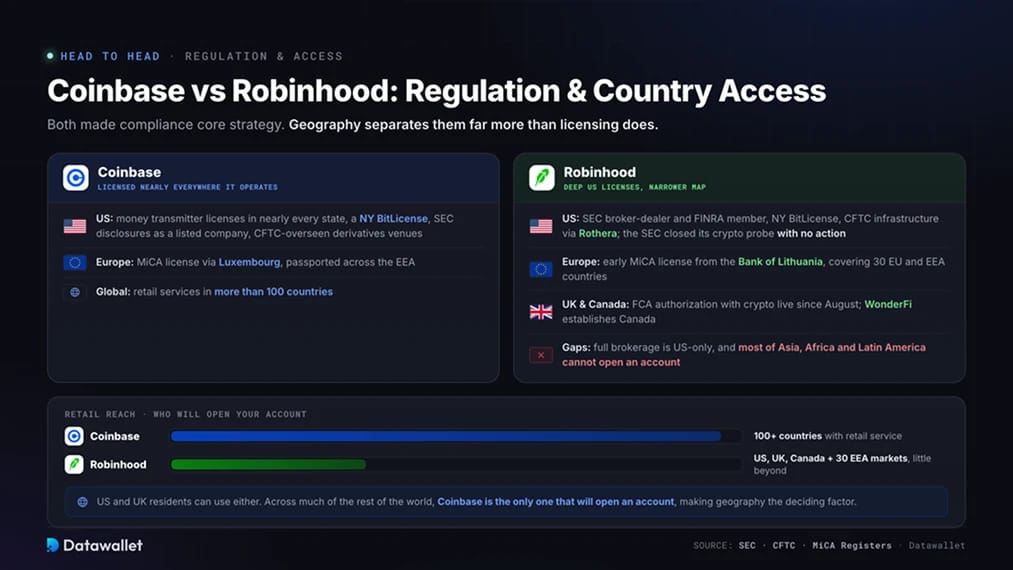
Coinbase and Robinhood are publicly traded US companies that have made compliance a core part of their strategies. Geographic reach separates them more clearly, with Coinbase operating across a much larger number of markets.
Coinbase's Position
- United States: Coinbase maintains money transmitter licenses in nearly every state and holds a New York BitLicense. It provides continuous SEC disclosures as a listed company, while its derivatives venues fall under CFTC oversight.
- Europe: The company secured a MiCA license through Luxembourg. This can be passported throughout the EEA under the EU's unified crypto framework.
- Global reach: Coinbase provides retail services in more than 100 countries. Our Coinbase supported countries guide contains the full list.
Robinhood's Position
- United States: Robinhood is an SEC-registered broker-dealer and FINRA member for securities. It holds a New York BitLicense for crypto and owns CFTC-licensed derivatives infrastructure through Rothera. In early 2025, the SEC closed its Robinhood Crypto investigation without any enforcement action.
- Europe: Robinhood received one of the first MiCA licenses, issued by the Bank of Lithuania. It covers crypto services across 30 EU and EEA countries.
- United Kingdom and Canada: The company has FCA authorization in the UK, where crypto trading launched in August. Its purchase of WonderFi established a presence in Canada.
- Coverage gaps: Complete brokerage accounts remain restricted to the US. Most of Asia, Africa, and Latin America cannot access Robinhood at all. Our Robinhood supported countries guide tracks its current availability.
Residents of the US or UK can use either platform. Across much of the rest of the world, Coinbase is the only one that will open an account, making geography the deciding factor. US readers considering other platforms can use our guide to the best crypto exchanges in the USA.
Final Thoughts
Coinbase is our overall choice for crypto investors. It offers nearly ten times as many assets, supports withdrawals for every listed coin, and combines deep USD liquidity with derivatives unavailable through Robinhood. These include CFTC-cleared perpetual-style futures and Deribit options. Its presence in more than 100 countries makes it the more complete crypto platform.
Robinhood is the stronger option for investors whose portfolios primarily contain stocks and options, with crypto held as a smaller allocation. One app provides commission-free trading, inexpensive CME futures, a 3% IRA match, and the leading prediction markets product in the US. Spread-based pricing can also make occasional, small crypto purchases cheaper than using Coinbase's retail interface.
Using both can make sense. Equities and event contracts can remain on Robinhood, while Coinbase handles crypto trading where asset selection and withdrawal support are stronger. On either platform, enable a passkey or hardware security key. Test deposits and withdrawals with a small amount before transferring a larger balance, then move long-term holdings into self-custody.