
What is Pons?
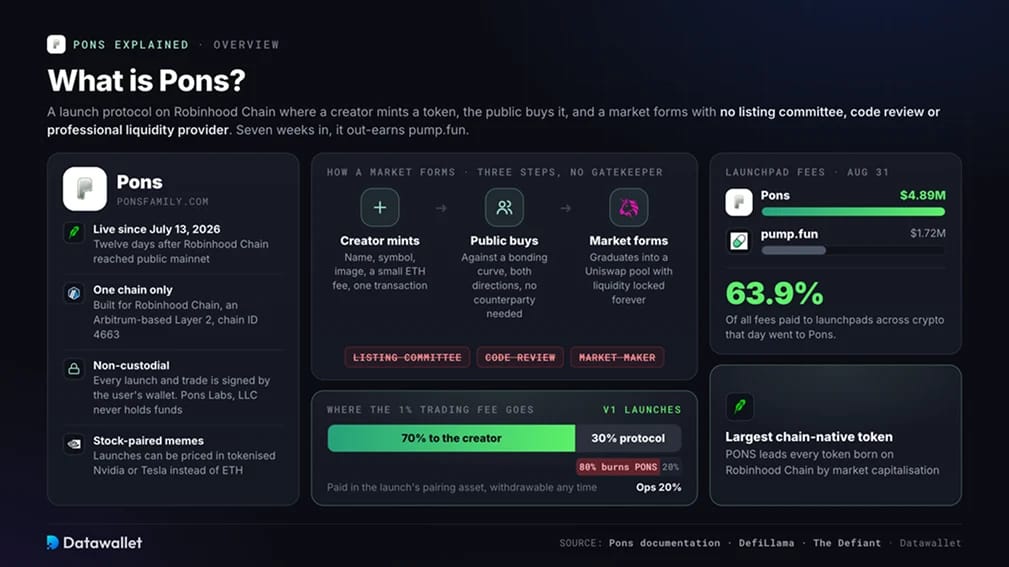
Pons is a launch protocol that lets creators mint tokens and open them for public trading without a listing committee, code review or professional liquidity provider. Users sign every launch and trade through their own wallets. Pons Labs, LLC operates the interface but never holds their tokens or funds.
The platform launched on July 13, 2026, twelve days after Robinhood Chain reached public mainnet. Robinhood built the Arbitrum-based network for tokenised stocks, but memecoin trading emerged within its first week. Pons was designed for that demand on a single chain rather than as a general-purpose launchpad.
Memecoins paired against tokenised stocks have since become the chain's defining trade. One example is Artificial Inu against Nvidia. Pons added these pairs in v2 to compete for that market.
The platform favours creators while reducing its token supply. V1 launches pay a 1% trading fee, with 70% going to the creator and 30% to the protocol. According to the official documentation, 80% of the protocol's share is used to buy PONS on the open market and send it to a burn address.
On August 31, Pons collected $4.89 million in fees compared with $1.72 million for pump.fun. It accounted for 63.9% of all fees paid to crypto launchpads that day, based on DefiLlama data reported by The Defiant. PONS is now the largest Robinhood Chain-native token by market capitalisation.
How Does Pons Work?
Pons operates two protocol versions side by side. Under the original v1 design, tokens launch directly into locked Uniswap v3 pools. Pons shipped its v2 contracts on August 3, according to The Defiant. V2 begins with a bonding curve before graduating tokens into permanently locked Uniswap v4 pools.
1. Fixed-Supply Token Creation
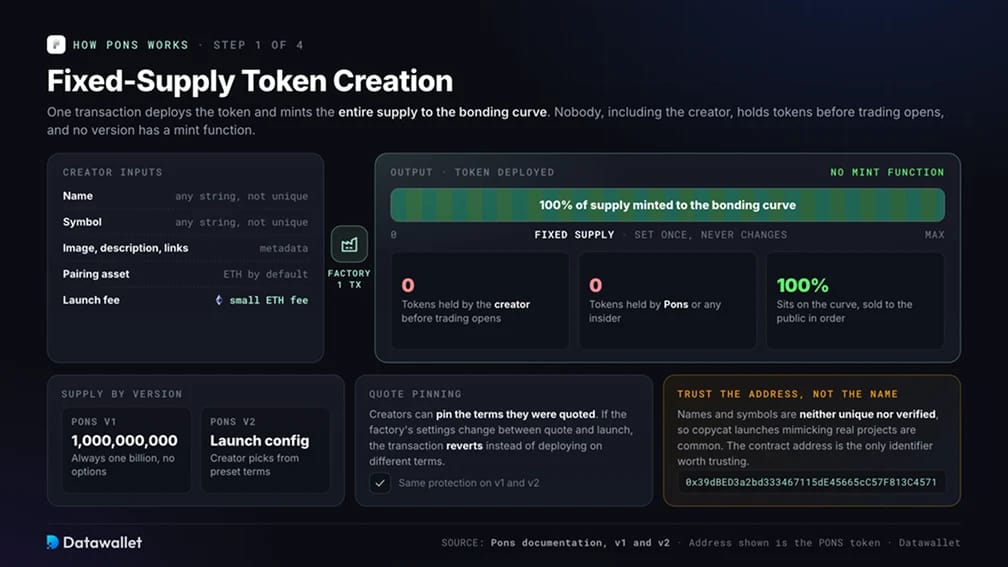
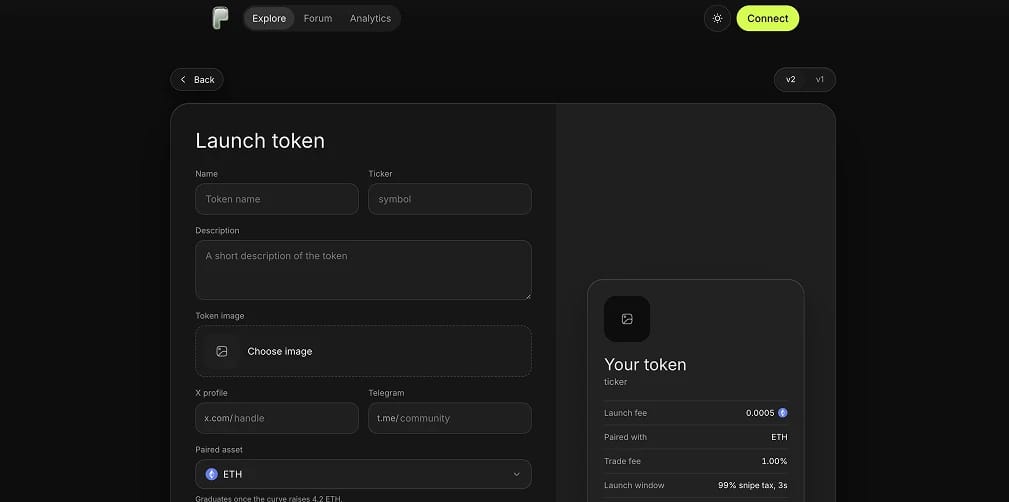
A creator enters the token details and pays a small ETH launch fee. The factory then deploys the token and mints its entire supply to the bonding curve in one transaction, leaving no allocation with the creator before trading begins.
Both versions use fixed supplies without a mint function. V1 creates one billion tokens, while v2 determines supply from the selected launch configuration. Creators can also pin the quoted terms so the transaction reverts if they change. These mechanics are documented in the official Pons v2 technical documentation.
Token names and symbols are neither unique nor verified. Pons advises users to treat the contract address as the only reliable identifier.
2. Bonding Curve Pricing
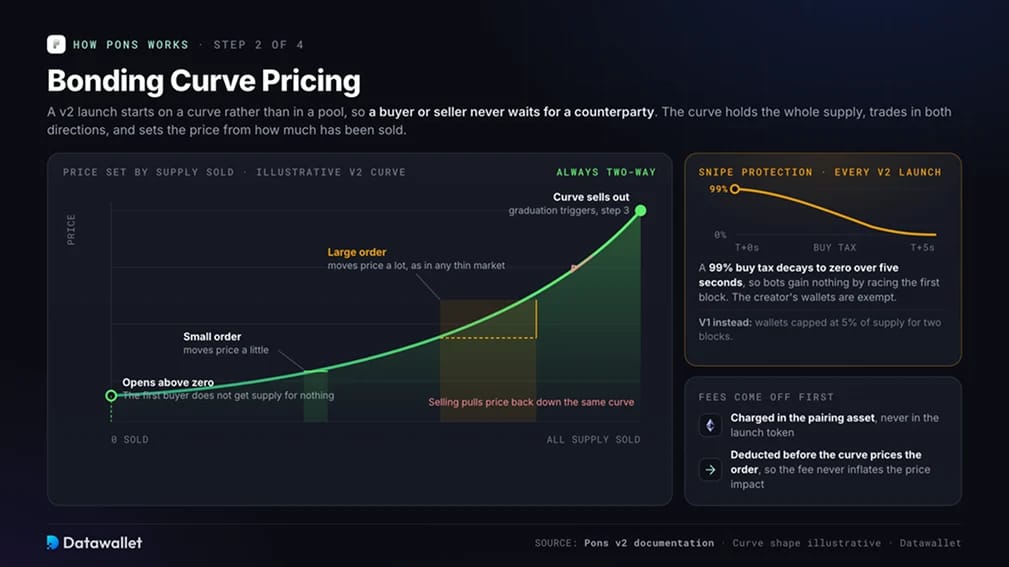
V2 launches begin on a bonding curve instead of inside a liquidity pool. Buyers and sellers trade directly against the curve rather than waiting for a counterparty. The curve holds the full supply, supports trading in both directions and calculates price according to how much has sold. Purchases raise the price, while sales lower it.
What that means in practice:
- Starting price: The curve opens above zero, preventing the first buyer from receiving tokens for nothing.
- Price impact: Large orders affect the price more than smaller trades, as they would in any thin market.
- Fee currency: Fees are charged in the launch's pairing asset rather than its own token. They are deducted before the curve prices the order.
- Snipe protection: Each v2 launch begins with a 99% buy tax that falls to zero over five seconds, according to the v2 documentation. This removes the benefit of racing for the first block. The creator's wallets are exempt. V1 instead limited wallets to 5% of supply for two blocks.
3. Graduation into Locked Uniswap v4 Pools
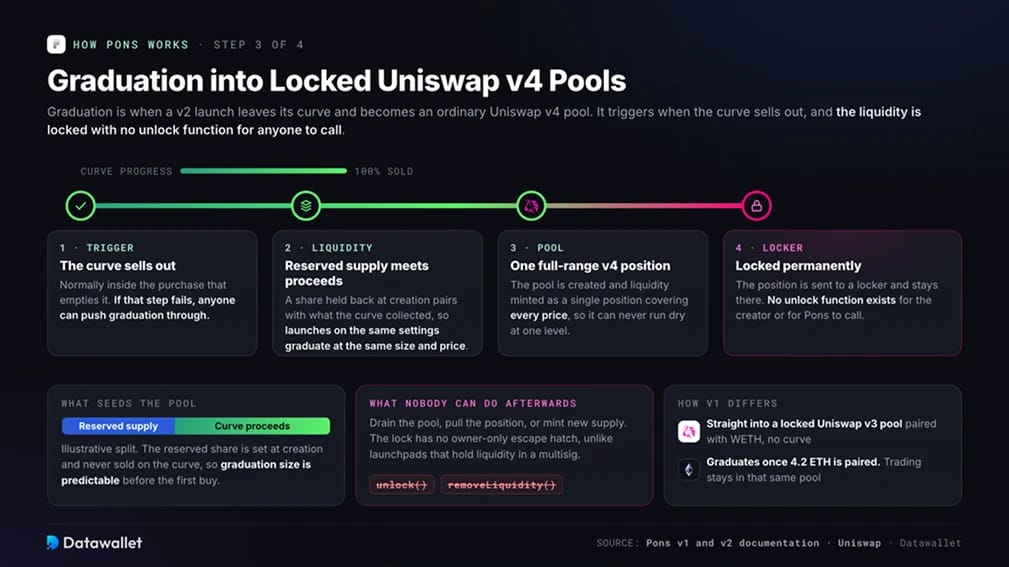
A v2 launch graduates when it leaves the bonding curve and moves into a standard Uniswap v4 pool. Graduation occurs when the curve sells out, normally during the purchase that clears the remaining supply. If the process fails, anyone can trigger it again.
Part of the token supply is reserved at creation. Upon graduation, those tokens are combined with the assets collected by the curve to provide liquidity. Launches with identical settings therefore enter pools at the same size and price.
The liquidity is minted as a single full-range position and permanently deposited in a locker. Neither the creator nor Pons has access to an unlock function.
V1 tokens work differently. They launch directly into locked Uniswap v3 pools paired with WETH, the wrapped form of ETH used in Uniswap pools. Graduation occurs once 4.2 ETH has been paired, after which trading remains in the same pool.
4. Custom Pairs: ETH, USDG, Tokenised Stocks and cbBTC
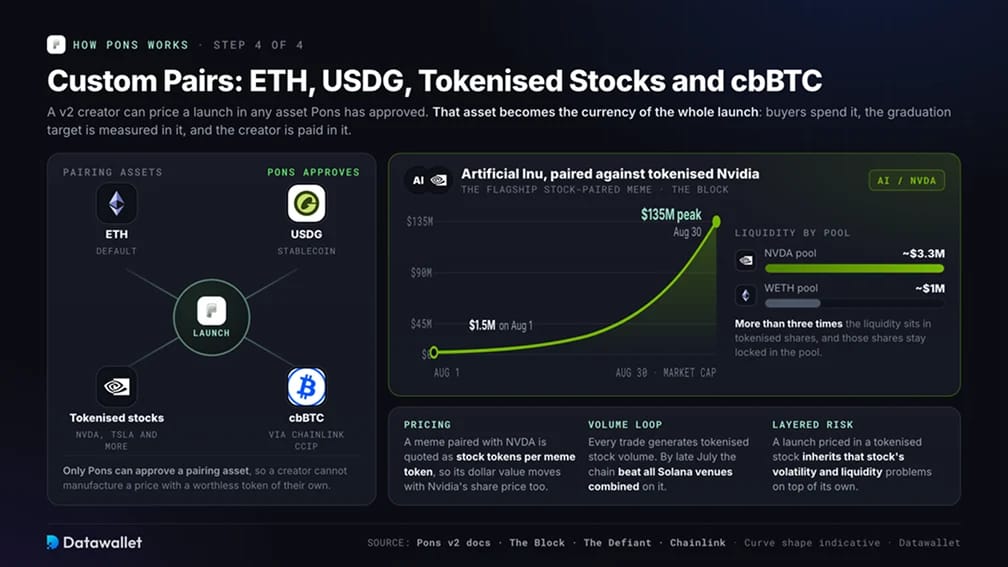
Stock-paired memecoins helped define trading on Robinhood Chain, and Pons v2 uses custom pairs to compete for this activity. Creators can pair launches with any asset approved by Pons instead of using ETH. That asset becomes the launch currency, meaning buyers spend it, graduation is measured in it and creator fees are paid through it.
The model first appeared on rival launchpads Bankr and long.xyz in mid-July. Its flagship token is Artificial Inu (AI), a dog coin paired with Robinhood's tokenised Nvidia stock. AI's market capitalisation rose from $1.5 million on August 1 to a peak of $135 million on August 30. Its NVDA pool holds about $3.3 million in tokenised shares, more than three times the value in its WETH pool, according to The Block. Stock-paired memecoins now represent roughly one-quarter of all stock-linked trading volume on the chain.
These mechanics create an extra layer of exposure. A memecoin paired with NVDA is valued as a ratio of stock tokens per meme token. Its dollar price therefore changes with Nvidia shares and demand for the memecoin itself. Each trade also produces tokenised stock volume, while deposited shares remain locked in the pool.
This loop helped Robinhood Chain carry more tokenised stock volume than all Solana venues combined by late July, according to The Defiant.
Pons v2 supports Robinhood's tokenised US stocks, USDG and Coinbase's cbBTC. The latter became available after cbBTC expanded to Robinhood Chain in late August through Chainlink's Cross-Chain Interoperability Protocol (CCIP), which moves tokens between networks.
Pairing assets require approval from Pons, preventing creators from manufacturing prices with worthless tokens they control. However, a launch paired with tokenised stock inherits the stock's volatility and liquidity risks alongside its own.
5. Fees, Creator Payouts and Token Buybacks
Every trade pays a standard 1% fee, both on the curve and after graduation. The protocol receives 30%, with the remainder allocated between the creator and an optional buyback. Creators can add another tax at launch, capped at 10%, based on contract reads published by The Defiant.
The graduated pool charges no fee itself. Traders therefore pay the Pons fee without an additional Uniswap charge.
How creators get paid:
- Currency: Fees are paid in the launch's pairing asset and can be withdrawn from an escrow contract at any time.
- Accrual: Before graduation, fees accumulate on the curve. Afterwards, they collect through a shared Uniswap v4 hook, a plug-in contract executed on each swap, until they are swept into escrow.
- Buybacks: Creators may use part of their share to repurchase tokens. These tokens are locked and released over five years rather than burned.
How to Launch or Trade a Token on Pons
Pons requires a wallet connected to Robinhood Chain and enough ETH to cover gas, as the network does not have its own gas token. Launching and trading use the same interface.
A typical creator and trader path looks like this:
- Connect wallet: Visit ponsfamily.com, verify the domain and connect an EVM wallet such as MetaMask. First, add Robinhood Chain using chain ID 4663.
- Fund with ETH: Transfer ETH from Arbitrum, Ethereum or another network through a bridge to Robinhood Chain. Keep enough ETH for gas and the launch fee.
- Choose a pairing asset: Select ETH or an approved alternative such as USDG, tokenised stock or cbBTC. This decision is permanent for the launch.
- Set token details: Add the name, symbol, image, description and social links. Choose a creator tax within the allowed cap and decide whether to enable buybacks.
- Launch and buy: Create the token and make an opening purchase through the launch-and-buy contract. Both actions execute in one transaction, preventing anyone from trading between them.
- Trade the curve: Buy or sell through the bonding curve. Set an appropriate slippage tolerance and check the live snipe tax if the token launched only seconds earlier.
- Watch graduation: Follow progress toward the graduation threshold. Reaching it only confirms that the curve sold out.
- Trade the pool: Once graduated, trade through the token's Uniswap v4 pool using Pons or any v4-compatible aggregator.
- Claim fees: Creators can withdraw accrued fees from escrow at any time in the original pairing asset. Future fees may also be redirected to another wallet.
Pons V1 vs V2
Both versions remain active, with the explore page allowing users to filter between them. The following comparison draws on the official documentation for each version.
PONS Tokenomics & Supply
PONS is the protocol's native token and was created like any other v1 launch. The documentation identifies it as a graduated reference token from the legacy factory. It continues to trade in its original locked Uniswap v3 pool under the 90/10 fee split.
Supply and Distribution
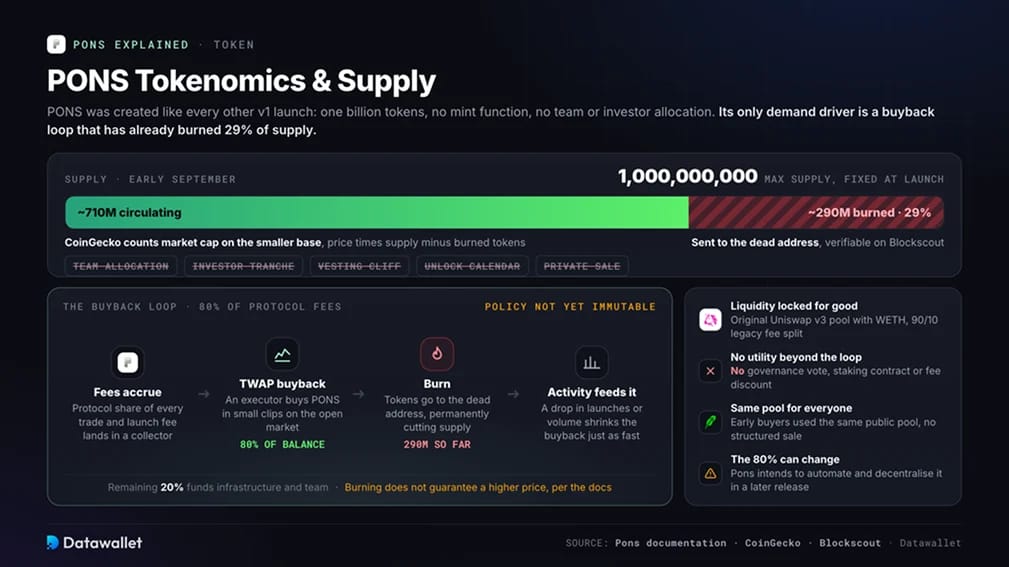
PONS launched with the standard v1 supply of one billion tokens and has no mint function. It has no disclosed team allocation, investor tranche, vesting cliff or unlock calendar because there was no structured sale. Early buyers purchased from the same pool available to everyone else.
Key supply facts as of early September:
- Maximum supply: One billion PONS, fixed at launch with no mechanism for creating more.
- Burned supply: About 29% of the original supply, or close to 290 million tokens, has been sent to the burn address. The documentation calculates burn-adjusted market capitalisation by multiplying price by total supply minus burned tokens.
- Circulating supply: Around 710 million tokens, according to CoinGecko. Market capitalisation is therefore based on a smaller figure than the original one billion supply.
- Distribution method: PONS launched through the legacy v1 factory as an ordinary fixed-supply token, with no disclosed private sale or team reserve.
- Liquidity: Liquidity is permanently locked in its original WETH-paired Uniswap v3 pool on Robinhood Chain.
Utility and Buyback Mechanism
PONS provides no governance rights, staking or fee discounts. Its value depends on a mechanical link between platform activity and token supply.
The documentation describes a manually run buyback that uses automated time-weighted average price (TWAP) execution. This divides purchases into smaller orders instead of placing one large trade. The process uses 80% of protocol fees.
How the buyback loop operates:
- Fee collection: The protocol's share of trading and launch fees accumulates in a collector wallet.
- TWAP buyback: An automated executor uses 80% of the balance to buy PONS on the open market in small orders. The documentation still describes the process as manually run.
- Burn: Purchased tokens are transferred to the dead address, permanently reducing circulating supply. Each transaction can be verified through Blockscout.
- Operations: The remaining 20% pays for infrastructure and team expansion.
- Policy status: Pons acknowledges that the 80% allocation is not immutable. It intends to decentralise and automate the mechanism in a future release.
The documentation makes clear that burns do not guarantee price appreciation. Buybacks depend on launches and trading volume, so weaker activity would reduce them as quickly as growth increased them.
Pons Statistics and Trends
Within roughly seven weeks, Pons became one of crypto's highest-earning protocols. The following figures come from DefiLlama, CoinGecko, The Defiant and the protocol's Dune-sourced analytics.
Key metrics as of September 1:
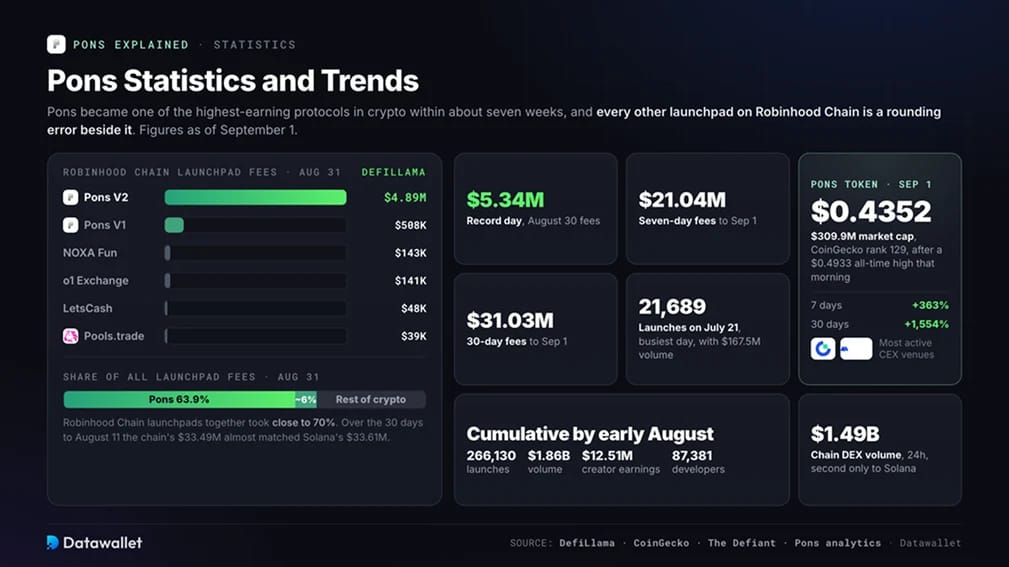
- Daily fees: Pons generated $4.89 million on August 31, compared with pump.fun's $1.72 million. This represented 63.9% of all crypto launchpad fees that day, based on DefiLlama data reported by The Defiant.
- Record day: Fees reached $5.34 million on August 30. The protocol earned $21.04 million over seven days and $31.03 million over 30 days.
- Chain dominance: Competing Robinhood Chain launchpads were considerably smaller on August 31. Pons V1 generated $508,139, followed by NOXA Fun at $142,924, o1 Exchange at $141,382, LetsCash at $47,925 and Pools.trade at $38,553, according to The Defiant.
- Peak activity: July 21 remains the busiest day recorded, with 21,689 launches and $167.5 million in volume.
- Cumulative scale: By early August, Pons had processed 266,130 launches and $1.86 billion in volume. Its analytics page, cited by The Defiant, also recorded $12.51 million in creator earnings across 87,381 unique developers. Later founder posts reported more than $15 million in creator payouts and nearly $2.5 billion in volume.
- PONS price: On September 1, PONS traded at $0.4352 with a market capitalisation of $309.9 million and a CoinGecko ranking of 129. It had gained 363% over seven days and 1,554% over 30 days after reaching an all-time high of $0.4933 that morning.
- Chain context: Robinhood Chain processed $1.49 billion in decentralised exchange (DEX) volume over 24 hours, behind only Solana at $2.5 billion. Total value locked reached $738.7 million.
Robinhood Chain now leads launchpad activity. Its platforms captured almost 70% of all crypto launchpad fees on August 31, according to The Defiant. During the 30 days ending August 11, the chain generated $33.49 million in launchpad fees, nearly matching Solana's $33.61 million.
Pons vs Uniswap Pools.trade
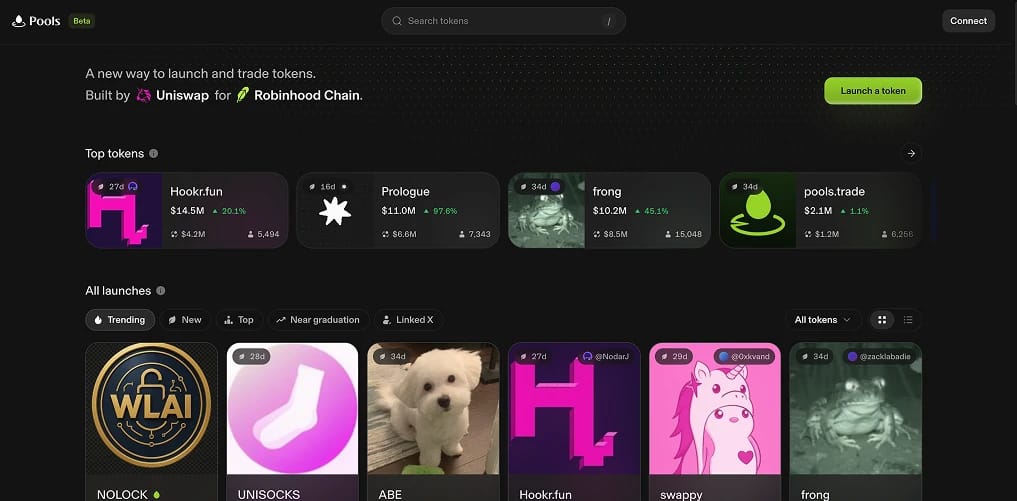
The arrival of a competing product from Uniswap Labs marked the defining episode in Pons's short history. Pons was built on Uniswap infrastructure, beginning with v3 before adopting a v4 hook. On July 30, Uniswap's Launches aggregator identified Pons as a builder using Uniswap as its trading layer. Uniswap then launched Pools.trade six days later, on August 5.
Pools.trade has no launch fee. Each token opens in a v4 pool charging 0.25%, with fees compounded into permanently locked liquidity. Creators can also receive an optional 0.05% cut. Founder Hayden Adams argued that the roughly 1% fee charged by most launchpads is where extraction occurs.
Pools.trade recorded more launches than Pons on its first day, with 10,506 tokens compared with 7,210, according to The Defiant. PONS fell 49% that week to around $0.021.
By August 31, the positions had reversed. Pools.trade collected $38,553 in daily fees, while Pons generated $4.89 million, based on DefiLlama data. Creators appear to have preferred Pons's 70% fee share and buyback structure despite its higher headline fees. The episode also demonstrated the risk of relying on infrastructure whose developer can launch a competing application.
Pons vs Pump.fun
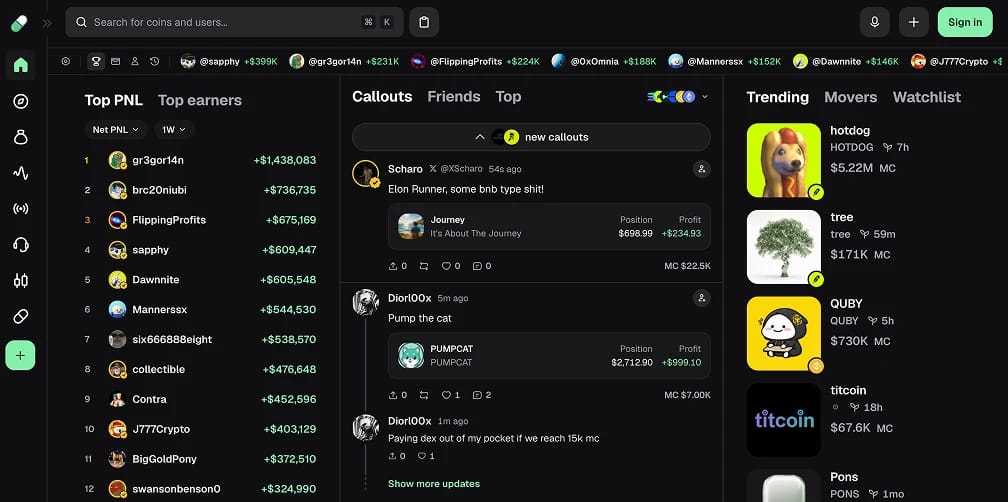
Pump.fun is the main benchmark for Pons because both follow a similar template while making different economic choices. Pump.fun launched on Solana in January 2024 and popularised bonding curve token launches. Over the trailing 30 days, it generated $47.7 million in launchpad fees, including $36.5 million in protocol revenue, according to DefiLlama.
Despite being seven weeks old and limited to one chain, Pons overtook pump.fun in daily fees on August 29 and has remained ahead since. Market figures in the comparison below come from CoinGecko.
Pump.fun retains the advantage in operating history, distribution and overall scale. It has handled millions of launches, operates its own exchange and has expanded into livestreams, prediction markets and multi-chain deployments.
The platform also faces issues Pons has not yet encountered. These include a class action alleging that it operates an unlicensed casino, along with a substantial overhang of team and investor tokens.
Pons currently offers stronger alignment. Creators retain a larger share of fees, while holders benefit from an 80% burn allocation rather than the 50% locked in by pump.fun. Pons also has no insider allocation awaiting release.
Its durability depends on Robinhood Chain maintaining memecoin activity and Pons defending its share against Uniswap, GMGN and newer competitors. Neither platform is inherently safe. Graduation only confirms that a token reached another trading venue.
Is Pons Safe?
Pons reduces several common launchpad risks. Token supply is fixed, creator taxes cannot be raised after launch and graduated liquidity is permanently locked. Community takeovers can redirect creator fees, but cannot change pricing, supply or liquidity. These protections are enforced onchain, according to the Pons v2 documentation.
However, Pons v2 remains unaudited. Reviews by SB Security, Dingbats and Pashov Audit Group are still in progress, with no final reports published. The team can also change the 80% protocol buyback allocation.
Risks
Launch tokens remain highly speculative regardless of these protections.
- Total loss: Tokens can lose all value. Graduation only means the bonding curve sold out, not that the project is legitimate.
- Unaudited contracts: An undiscovered flaw in v2 could affect graduation, liquidity or fee distribution.
- Founder and policy risk: The founder is pseudonymous, the full team is undisclosed and the buyback allocation is not immutable.
- Impersonation: Names and symbols are not unique, so traders must verify the contract address.
- Market dependence: Lower memecoin activity or stronger competitors would reduce Pons revenue and PONS buybacks.
- Pairing asset risk: Stock-paired tokens and cbBTC pairs inherit the volatility and liquidity risks of their pairing assets.
- Chain dependency: Pons relies on Robinhood Chain's sequencer. Robinhood does not guarantee its uptime, so outages or latency could disrupt trading.
- Regulatory exposure: Permissionless tokens paired with tokenised securities could face future restrictions or enforcement.
Pons Founders
Pons was created by a pseudonymous developer known as Ozzy, who posts on X under @MEADGod using a Pomeranian avatar. His only documented previous project is RootsFi, a Berachain lending protocol with a stablecoin called MEAD, which he discussed in governance forum posts in May 2025.
Neither his legal identity nor the full team has been disclosed. Pons Labs, LLC operates the interface.
At launch, Ozzy described Pons as a response to existing launchpads that collected fees without supporting their communities. Uniswap's communications lead has also identified a second contributor, 0xnobi.
The project attracted attention after Robinhood CEO Vlad Tenev followed its account on July 21. Markets interpreted the follow as a positive signal, although it carried no official endorsement. World Liberty Financial adviser Ogle has also been a prominent early holder and promoter, with no evidence that he holds a formal role.
Final Thoughts
Pons turned a single-chain launchpad into one of crypto's leading fee generators within seven weeks. Its token structure has no insiders positioned to sell into the rally. Permanent liquidity locks and fixed supply strengthen the model, while 80% of protocol revenue is directed toward burns.
Its weaknesses are just as apparent. Pons depends on Robinhood Chain retaining memecoin momentum, a pseudonymous founder maintaining a changeable buyback policy and v2 contracts whose audits remain open. The arrival of Pools.trade showed how quickly sentiment can reverse when a larger competitor enters.
Traders should treat Pons as a high-beta bet on speculation across Robinhood Chain, not as a durable revenue business. Verify the token address and creator tax before trading, check burns through Blockscout and assume that any launch token can fall to zero.