




What is USDG?
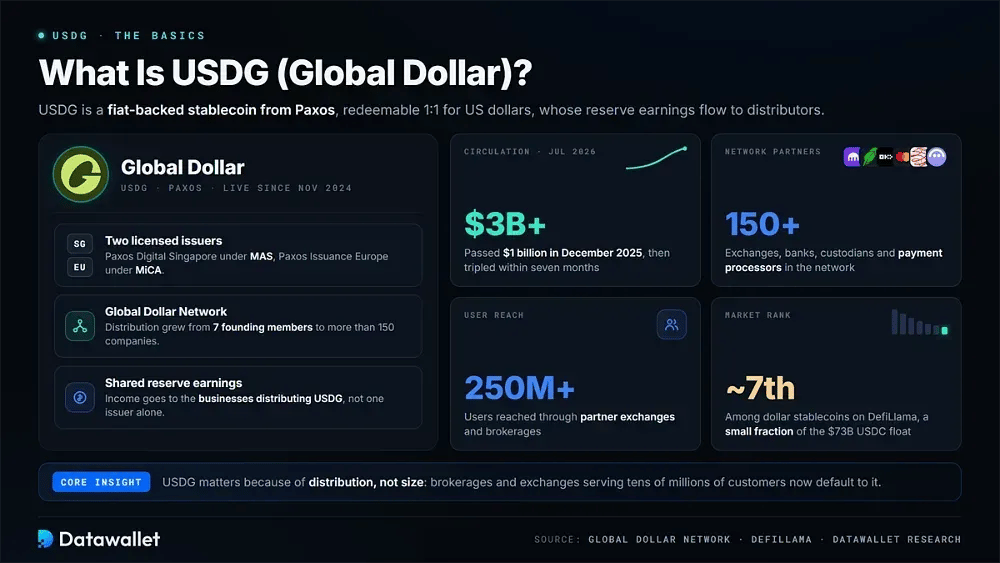
USDG, short for Global Dollar, is a fiat-backed stablecoin that Paxos launched in November 2024. Each token can be redeemed for one US dollar. The original model was built around regulated digital money whose reserve earnings go to the businesses distributing it rather than remaining entirely with one issuer.
Two licensed entities mint USDG. Paxos Digital Singapore operates as a Major Payments Institution under the Monetary Authority of Singapore. Paxos Issuance Europe covers the European Economic Area under Finnish supervision and MiCA, allowing the same dollar asset to circulate across Asia, Europe and many other markets.
The Global Dollar Network handles distribution. It began with seven members: Anchorage Digital, Bullish, Galaxy Digital, Kraken, Nuvei, Robinhood and Paxos itself. Membership has since grown beyond 150 companies. OKX, Mastercard, Worldpay, Bitpanda, Aave Labs and Maple Finance have joined, alongside banks, custodians and payment processors.
Growth has been unusually rapid for a regulated dollar token. Circulation passed $1 billion in December 2025. According to the network's own July 2026 update, it exceeded $3 billion seven months later. Partner exchanges reached more than 250 million users, while rewards already paid totaled tens of millions of dollars.
That scale still needs perspective. DefiLlama ranks USDG around seventh among dollar stablecoins. Its supply is only a small fraction of the roughly $73 billion USDC float and the much larger USDT supply. What gives USDG relevance is distribution: brokerages and exchanges serving tens of millions of customers now default to it.
How Does Global Dollar Work?
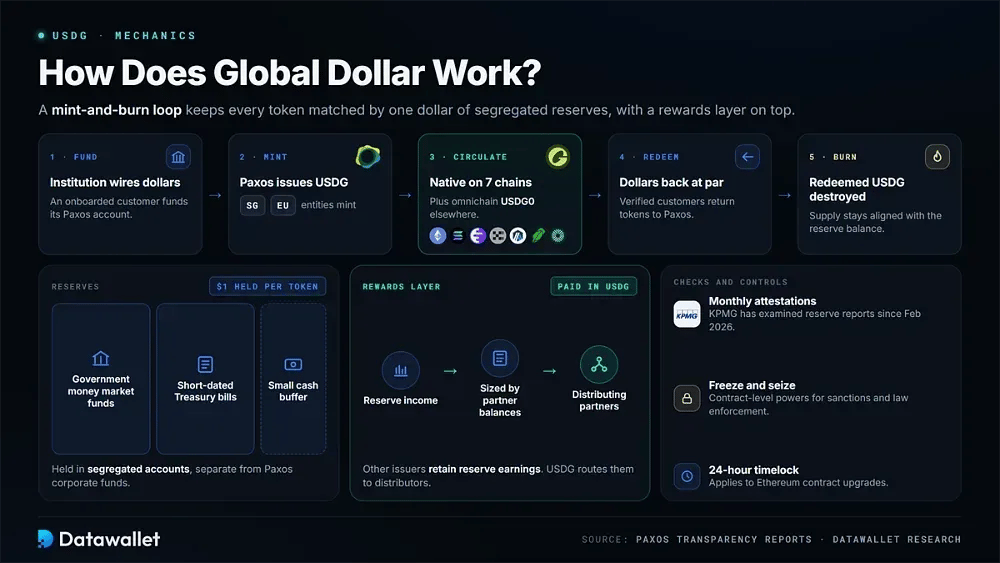
USDG uses a mint-and-burn structure. Every token in circulation corresponds to one dollar of segregated reserves, while a separate rewards layer directs reserve income toward the businesses that distribute the stablecoin instead of leaving those earnings solely with the issuer.
Here is how the Global Dollar system operates from mint to redemption:
- Issuance: Paxos Digital Singapore or Paxos Issuance Europe creates new tokens after an onboarded institutional customer funds its Paxos account with dollars and requests a conversion.
- Redemption: Verified customers send tokens back to Paxos and receive dollars at par. The redeemed USDG is then burned, keeping circulating supply aligned with the underlying reserve balance.
- Reserves: Backing is held in government money market funds, short-dated Treasury bills and a small cash buffer. Those assets remain in segregated accounts separate from Paxos corporate funds.
- Attestations: KPMG has examined the monthly reserve reports since February 2026, replacing Enrome. Each report confirms that redemption assets equal or exceed outstanding tokens at period end.
- Native chains: Paxos issues USDG directly on Ethereum, Solana, Ink, X Layer, Arbitrum, Robinhood Chain and Mantle. Holders on those seven networks avoid wrapped versions and most third-party bridge exposure.
- Omnichain: USDG0, created by Paxos Labs using LayerZero's token standard, locks native supply and mints an equivalent amount elsewhere. Initial networks include Hyperliquid, Plume and Aptos.
- Rewards: Reserve income is calculated against the balances that each partner holds or distributes, then paid in USDG. This distinguishes the model from stablecoins whose issuers retain reserve earnings.
- Controls: Paxos can freeze or seize tokens at contract level when sanctions rules or law enforcement requirements apply. Ethereum contract upgrades are subject to a 24-hour timelock.
Top USDG Use Cases
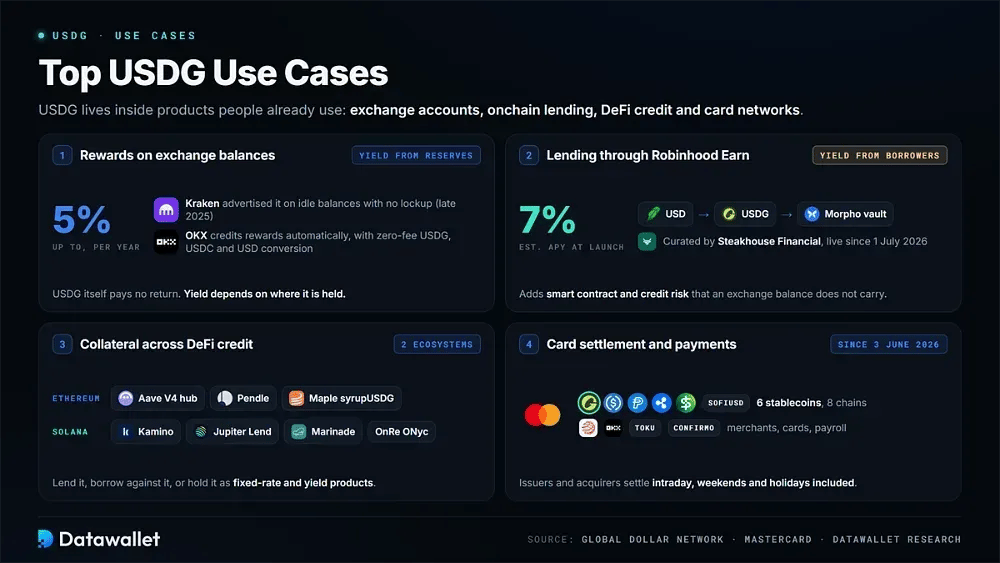
USDG is integrated into products people already use rather than relying only on standalone demand. By late 2026, meaningful balances and settlement activity appeared across exchange accounts, onchain lending, DeFi credit markets and payment networks.
1. Earning Rewards on Exchange Balances
Partner exchanges receive reserve income on the USDG held by their customers, and some return a portion of it to users. In late 2025, Kraken advertised rewards of up to 5% a year on idle balances without a lockup. Kraken+ subscribers paying a monthly fee could receive a boosted rate.
OKX takes a similar approach. Rewards are credited automatically to account balances, and the platform offers zero-fee conversion among USDG, USDC and dollars. Rates vary by platform. USDG itself pays no return, so any yield depends entirely on where the holder keeps the token.
2. Onchain Lending Through Robinhood Earn
Robinhood selected USDG as the lending asset for Robinhood Earn, a self-custodial product launched alongside Robinhood Chain on 1 July 2026. Dollar deposits convert to USDG before entering a Morpho vault curated by Steakhouse Financial. Borrowers provide collateral and pay interest to lenders.
At launch, the app displayed an estimated 7% annual yield, reported as fixed for the first year. That return comes from onchain borrowers rather than reserve income. As a result, the product introduces smart contract and credit risk that does not apply in the same way to a standard exchange balance earning partner rewards.
3. Collateral Across DeFi Credit Markets
USDG's DeFi footprint expanded sharply in 2026. The stablecoin became a native asset on Aave V4 through a dedicated Global Dollar Hub. It also trades as fixed-rate and yield products on Pendle and backs syrupUSDG, the institutional credit token Maple Finance launched in July across Ethereum and Robinhood Chain.
A similar stack exists on Solana. Holders can lend USDG or borrow against it through Kamino and Jupiter Lend. Marinade distributes it as an automated staking reward, while products such as OnRe's ONyc allow users to mint yield-bearing assets. These integrations extend USDG's utility across DeFi protocols beyond straightforward trading pairs.
4. Card Settlement and Merchant Payments
Mastercard added USDG to its settlement options on 3 June 2026, together with USDC, PYUSD, RLUSD, USDP and SoFiUSD. Issuers and acquirers can settle card obligations intraday, including on weekends and holidays, across eight supported blockchains. Rollout began in the United States and Latin America.
The same infrastructure supports consumer and business payments. European users can spend USDG through the OKX Card at Mastercard merchants, where funds convert to euros during checkout, joining other crypto debit cards. Worldpay offers USDG settlement to merchants, while firms including Toku and Confirmo use it for payroll and invoices.
USDG Statistics and Trends
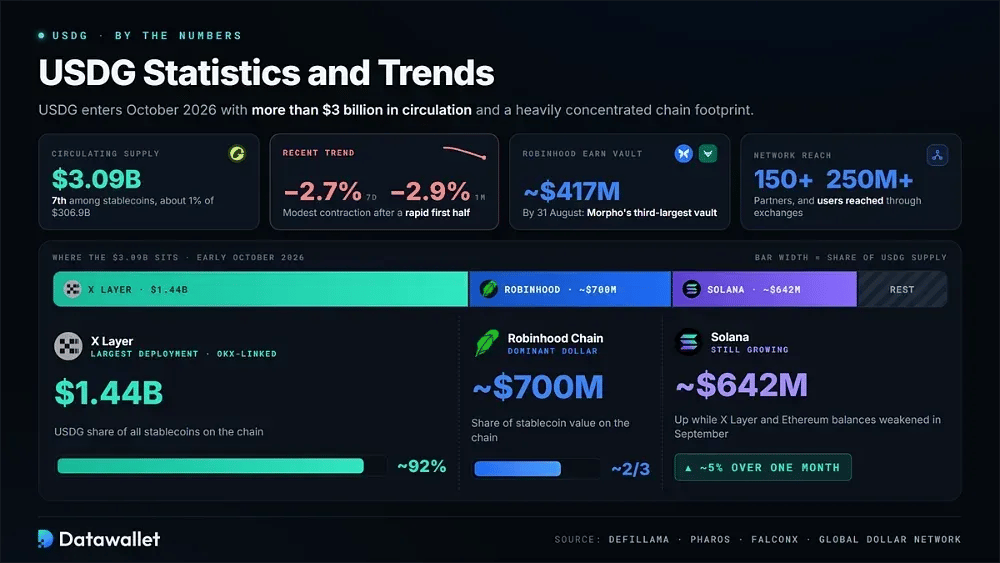
USDG enters October 2026 with more than $3 billion in circulation and a heavily concentrated chain footprint. The latest figures come from DefiLlama, Pharos and FalconX.
Key USDG metrics as of early October 2026:
- Market size: DefiLlama lists USDG at about $3.09 billion in circulating supply, ranking seventh among tracked stablecoins and representing roughly 1% of the $306.9 billion market.
- Recent trend: USDG supply was down about 2.7% over seven days and 2.9% over one month, showing modest contraction after its rapid first-half expansion earlier in 2026.
- X Layer: Around $1.44 billion of USDG sits on X Layer, where it represents roughly 92% of stablecoin supply, making the OKX-linked network its largest deployment.
- Robinhood Chain: USDG accounts for roughly two-thirds of stablecoin value on Robinhood Chain, with about $700 million circulating there as the network's dominant dollar asset in early October.
- Solana supply: DefiLlama tracks roughly $642 million of USDG on Solana, up about 5% over one month despite weaker balances on X Layer and Ethereum during September.
- Earn deposits: FalconX reported the Steakhouse USDG vault behind Robinhood Earn reached about $417 million by August 31, becoming Morpho's third-largest vault and largest stablecoin Earn program.
- Network reach: Global Dollar Network reported more than 150 partners, exchange distribution reaching 250 million-plus users and tens of millions of dollars in cumulative USDG rewards.
How the Global Dollar Network Shares Revenue
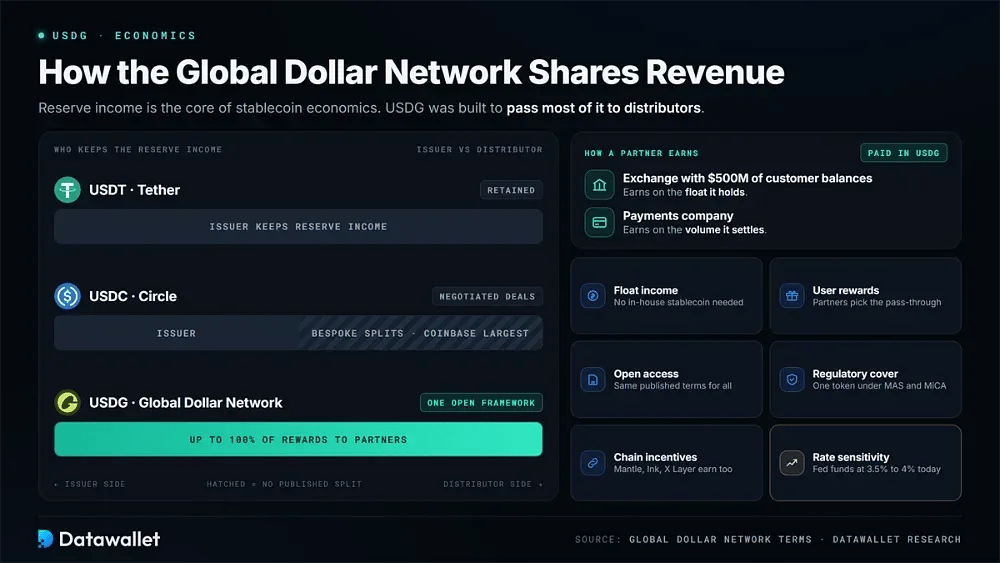
Reserve income is central to stablecoin economics, and USDG was designed to distribute most of it. That structure helps explain why exchanges and brokerages have adopted a token whose circulating supply remains far below those of the market leaders.
How partner rewards are calculated
Every dollar backing USDG earns interest through Treasury bills and government money market funds. Network terms allow partners to receive up to 100% of the reserve rewards produced by balances held on their platforms. Additional incentives can apply to minting, liquidity and payment activity that increases circulation.
Payments are made in USDG and rise with each partner's contribution. An exchange holding $500 million in customer balances earns from that float. A payments company instead earns according to the volume it settles. The network's July 2026 update said cumulative partner distributions had reached tens of millions of dollars.
The model differs from its largest competitors. Tether retains its reserve income. Circle compensates distributors through negotiated agreements, with Coinbase receiving the largest share. USDG instead uses one framework available to qualifying businesses, combined with governance that the network describes as member-led.
Why distributors keep signing up
A platform holding customer stablecoin balances earns nothing from USDT and receives only negotiated amounts from USDC. That difference gives businesses a direct financial reason to consider USDG and helps explain partner growth since its 2024 launch.
These are the main reasons platforms adopt USDG over larger rivals:
- Float income: Customer balances become a revenue source without requiring the platform to launch, reserve or license its own proprietary stablecoin.
- User rewards: Partners choose how much income to return, allowing Kraken, OKX and Robinhood to fund stablecoin earn programs without financing promotional rates entirely from their balance sheets.
- Open access: Qualifying businesses can participate under the same published terms rather than negotiating bespoke distribution contracts that favor partners with greater bargaining leverage.
- Regulatory cover: MAS and MiCA supervision allow a global exchange to list one dollar token across Asia and Europe instead of maintaining separate assets for individual jurisdictions.
- Chain incentives: Networks including Mantle, Ink and X Layer participate as partners, earning from natively issued supply while adding a regulated dollar asset to their DeFi ecosystems.
- Rate sensitivity: Rewards move with short-term Treasury yields. Partner income therefore rises and falls with Federal Reserve policy, which currently places the funds rate between 3.5% and 4%.
What Drives USDG Adoption?
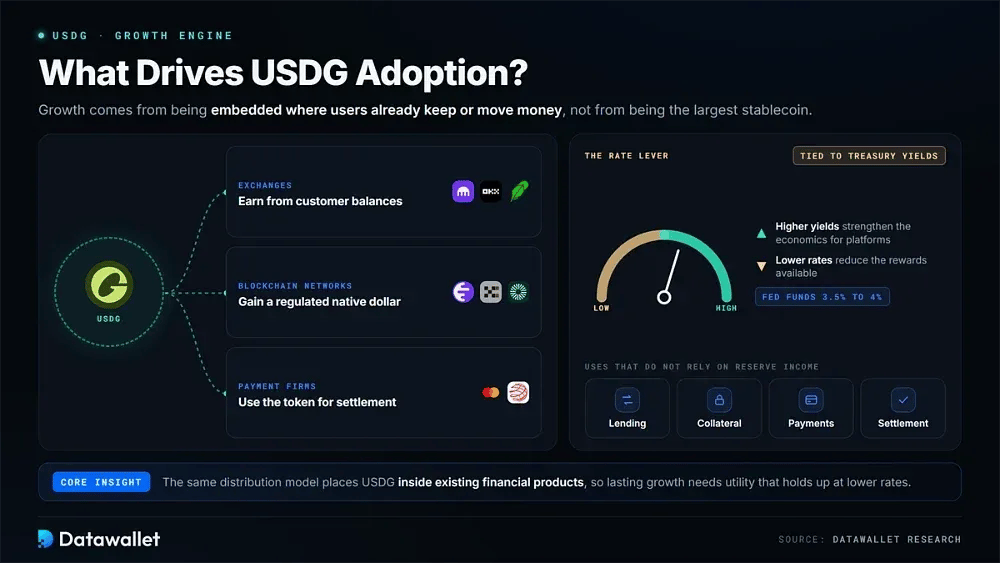
USDG's growth depends less on being the largest stablecoin than on being embedded where users already keep or move money. Exchanges can earn from customer balances, blockchain networks gain a regulated native dollar, and payment firms can use the token for settlement. The same distribution model places USDG inside existing financial products.
That advantage is closely tied to the interest generated by reserves. Higher Treasury yields strengthen the economics for participating platforms, while lower rates reduce the available rewards. Continued adoption therefore also depends on uses that do not rely solely on reserve income, including lending, collateral, payments and settlement.
USDG Regulation and Licensing
Unlike most major dollar stablecoins, USDG is not issued by an American entity. Its structure provides regulated access across Asia and Europe, but it also creates an unresolved US issue as new federal stablecoin law approaches its effective date.
Singapore and European oversight
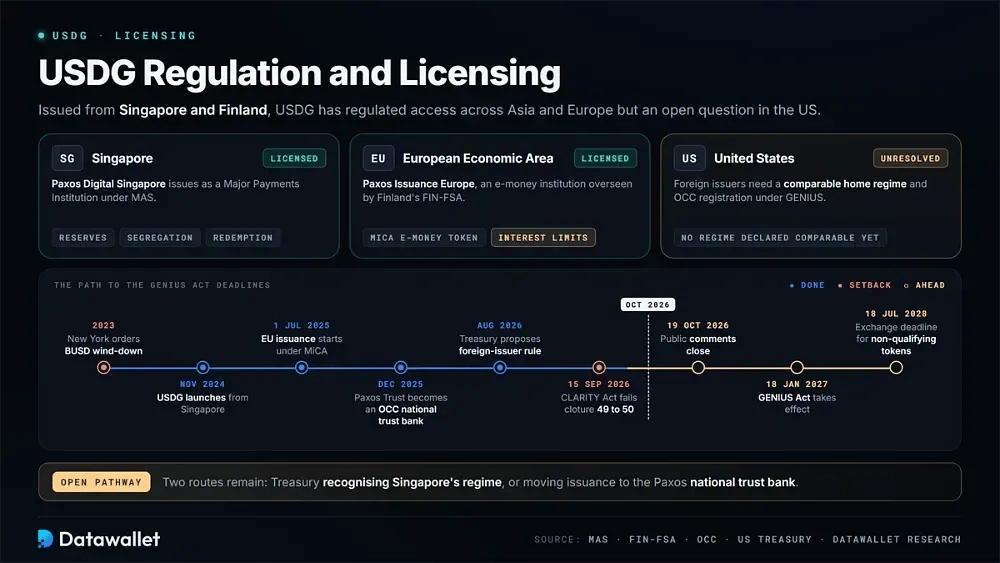
Paxos Digital Singapore issues USDG as a Major Payments Institution supervised by the Monetary Authority of Singapore. It operates under the regulator's stablecoin framework covering reserves, segregation and redemption. Paxos established the Singapore base after its 2023 exit from BUSD issuance, which New York regulators ordered the company to wind down.
European issuance started on 1 July 2025 through Paxos Issuance Europe, an electronic money institution overseen by Finland's FIN-FSA. MiCA treats USDG as an e-money token. Holders in the bloc have a statutory right to redeem at par, and MiCA-licensed exchanges can list it.
MiCA also limits interest on e-money tokens, which changes how reward programs can operate inside the European Economic Area. Global Dollar Network disclosures say rewards remain subject to jurisdictional restrictions. Features promoted in other regions may therefore differ or be unavailable to customers based in the bloc.
The open question in the United States
The GENIUS Act takes effect on 18 January 2027, with separate treatment for foreign-issued dollar tokens. USDG is minted in Singapore and Finland, making several provisions directly relevant to its US status.
Here is where USDG stands under US stablecoin rules today:
- Issuer status: Paxos Trust Company converted to a national trust bank under OCC supervision in December 2025. That entity issues PYUSD and USDP, whereas USDG is issued by overseas affiliates.
- Foreign pathway: Under the GENIUS Act, foreign issuers can serve American customers only if Treasury judges their home regulatory regime comparable and the issuer registers with the OCC.
- Treasury proposal: A rule proposed in August 2026 outlines that process. Public comments close on 19 October, and regulators have not yet declared any foreign regime comparable.
- Key dates: Foreign-issuer restrictions begin when the law takes effect in January 2027. Exchanges face a firm 18 July 2028 deadline for offering any token that does not qualify.
- Rewards scrutiny: Proposed OCC rules presume that third-party yield arrangements violate the prohibition on issuer interest, an interpretation that would become important if USDG issuance moved onshore.
- Stalled bill: The CLARITY Act would allow activity-based rewards while prohibiting passive yield on balances. It failed a Senate cloture vote 49 to 50 on 15 September 2026.
- Open pathway: Possible routes include Treasury recognising Singapore's regulatory regime or moving issuance to the national trust bank. Independent trackers still described USDG's US authorization as unresolved in October 2026.
USDG on Robinhood Chain and Beyond
Chain expansion became USDG's main growth lever during 2026. Paxos has not tried to pursue every available network. Instead, native issuance has been paired with partners that control meaningful distribution, with Robinhood Chain providing the clearest example so far.
Inside the Robinhood Chain launch
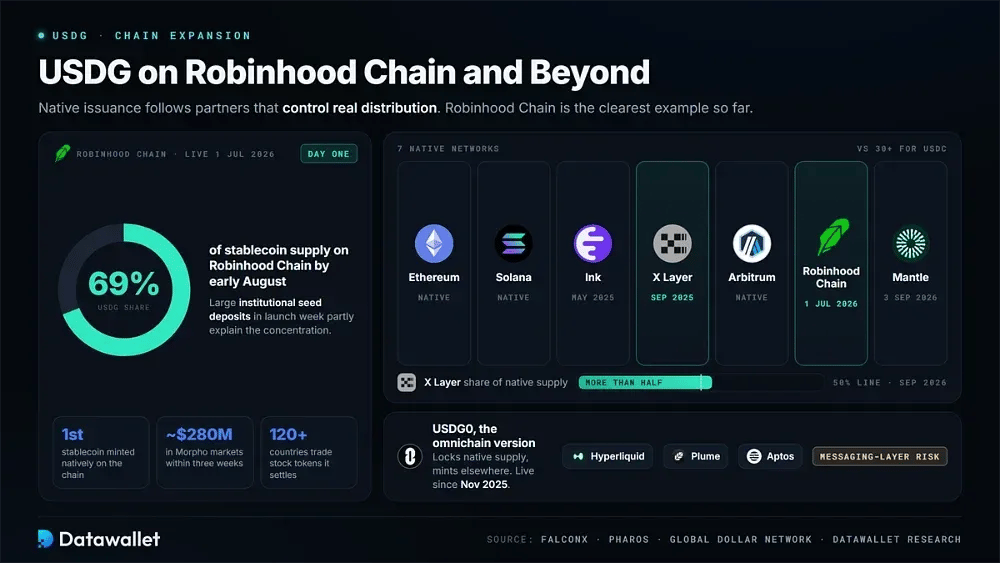
Robinhood Chain launched on 1 July 2026 as an Arbitrum-based Layer 2 for tokenized assets. USDG arrived on day one and became the network's first natively issued stablecoin, giving it a central role from the start.
Here is what defines the token's position on Robinhood Chain:
- First issuance: USDG was the first stablecoin minted natively on Robinhood Chain, allowing developers to use a regulated settlement dollar without depending on tokens bridged from Ethereum mainnet.
- Earn default: Robinhood Earn converts customer dollars into USDG, then lends the tokens through Morpho vaults curated by Steakhouse Financial. Ethena, Spark and Maple provide the collateral markets.
- Early scale: FalconX research estimated that Morpho markets on the chain reached roughly $280 million within three weeks, with the Steakhouse USDG vault accounting for most vault deposits.
- Chain share: By early August, USDG represented about 69% of stablecoin supply on Robinhood Chain. Large institutional seed deposits during launch week partly explain that concentration.
- Stock tokens: Tokenized equities trade around the clock on the network in more than 120 countries. USDG serves as collateral and as a settlement asset for emerging tokenized stock venues.
- Transfer limits: Robinhood allows USDG deposits and withdrawals over Ethereum, Solana and Robinhood Chain. Robinhood Chain transfers remain unavailable to customers in New York.
X Layer, Ink, Mantle and USDG0
Exchange-owned networks hold a substantial share of circulating USDG. Kraken introduced the token on Ink in May 2025, followed by OKX on X Layer that September. Pharos analytics showed that more than half of all natively issued USDG was sitting on X Layer alone by September 2026.
Mantle joined on 3 September 2026 as both a deployment and a network partner, adding USDG alongside AUSD, USDe and USDT0 as part of its real-world asset push. Native issuance is also live on Arbitrum. That brings direct coverage to seven networks, compared with more than thirty for Circle's USDC.
Other networks use USDG0. Paxos Labs launched the omnichain version with LayerZero in November 2025, initially covering Hyperliquid, Plume and Aptos. The system extends reach more quickly, but USDG0 holders assume messaging-layer risk that does not apply to native issuance on the seven core networks.
Pros and Cons of Using USDG
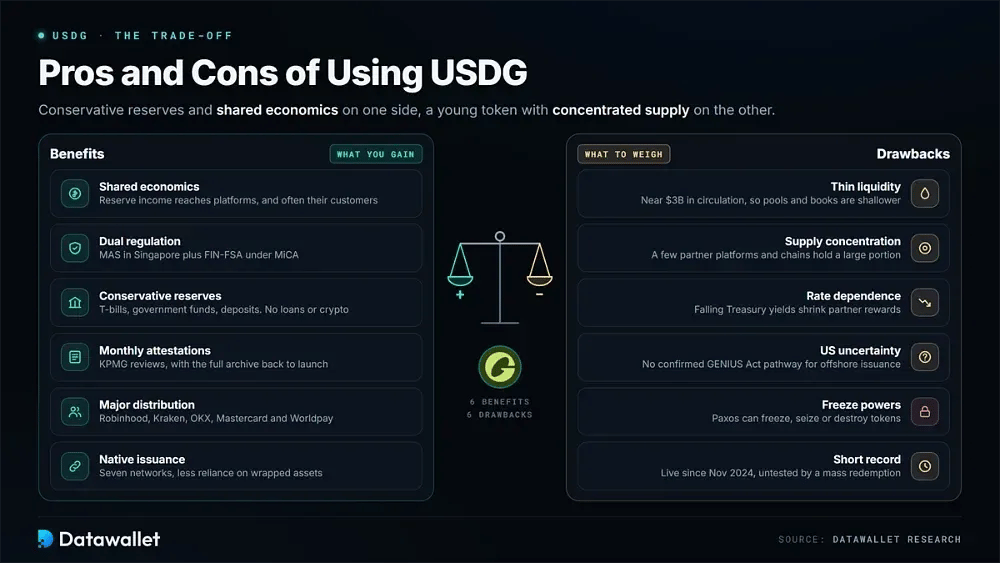
USDG combines conservative reserve assets with an incentive model that larger rivals have struggled to match. It is also a young token with concentrated distribution and exposure to regulations that are still evolving. Those trade-offs matter before committing a meaningful balance.
Benefits of Using USDG
Its main strengths come from regulatory oversight, distribution and the way reserve income is shared. Those features help explain why circulating supply more than tripled over seven months in 2026.
These are the main benefits USDG offers holders and businesses:
- Shared economics: Reserve income goes to distributing platforms, many of which return a portion to customers. USDT and USDC holders rarely receive comparable rewards by default.
- Dual regulation: Oversight by MAS in Singapore and FIN-FSA under MiCA gives institutions across Asia and Europe a dollar token that compliance teams can approve.
- Conservative reserves: Backing consists of Treasury bills, government money market funds and bank deposits. It contains no loans, corporate debt, crypto collateral or precious metals.
- Monthly attestations: KPMG examines the reserve report each month. Paxos publishes the full archive back to launch, allowing anyone to compare reserve backing with circulating supply.
- Major distribution: Robinhood, Kraken, OKX, Mastercard and Worldpay expose the token to hundreds of millions of users through products and accounts those customers already use.
- Native issuance: Direct minting on seven networks, among them Ethereum, Solana and Robinhood Chain, limits dependence on wrapped assets and the bridge exploits that have affected other tokens.
Drawbacks of Using USDG
The principal weaknesses are its short operating history, concentrated supply and uncertain US regulatory position. High-quality reserves do not resolve those issues, several of which already influence how the token trades and behaves in practice.
These are the drawbacks worth weighing before holding USDG:
- Thin liquidity: Circulation near $3 billion remains a fraction of USDC or USDT. DeFi pools and exchange order books are therefore shallower, especially away from the main partner venues.
- Supply concentration: A significant portion of USDG sits on a small number of partner platforms and chains. A change in strategy by one distributor could reduce circulation quickly and visibly.
- Rate dependence: Treasury yields fund partner rewards. Falling interest rates would reduce the incentive for exchanges to promote USDG instead of competing dollar stablecoins.
- US uncertainty: USDG is issued offshore and does not yet have a confirmed GENIUS Act pathway, leaving its long-term availability on American platforms unresolved while regulators complete rulemaking.
- Freeze powers: Paxos can freeze, seize or destroy tokens under its terms. Self-custody does not eliminate that centralized control, which decentralized assets do not carry.
- Short record: USDG launched in November 2024 and has not yet experienced a banking crisis or mass redemption event. Price trackers have also recorded at least one erratic early print.
Where to Buy USDG
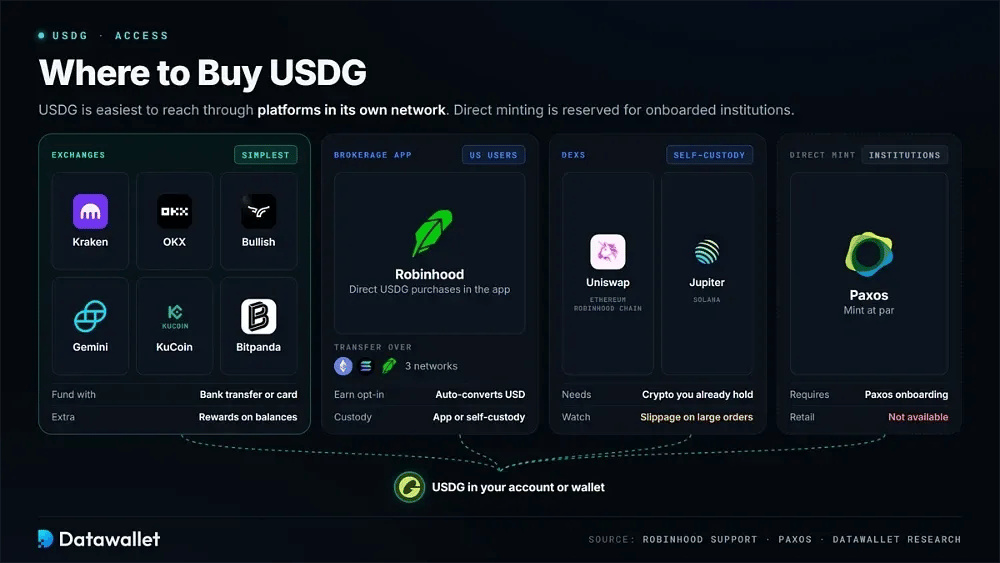
USDG is most readily available through platforms belonging to its network. Centralized exchanges provide fiat on-ramps, brokerage apps can convert dollars automatically, and decentralized venues serve users who already hold crypto. Direct minting is restricted to institutions that complete Paxos onboarding.
For most buyers, centralized exchanges are the simplest option. Kraken and OKX accept bank transfers and card payments, list USDG against dollars and major tokens, and offer rewards on balances. Bullish, Gemini, KuCoin and Bitpanda provide additional markets for customers in the United States, Asia and Europe.
Robinhood offers a straightforward route for American users. Its app supports direct USDG purchases and transferring it over Ethereum, Solana and Robinhood Chain. Eligible customers who opt into the self-custodial Robinhood Earn product have their dollar deposits converted into USDG automatically for onchain lending.
Users who prefer self-custody can swap into USDG through decentralized exchanges such as Uniswap on Ethereum and Robinhood Chain or Jupiter on Solana. Funds stay in self-custody during the trade. Pool depth is thinner than for USDC, however, so larger orders warrant careful attention to quoted slippage.
USDG vs Competitor Stablecoins
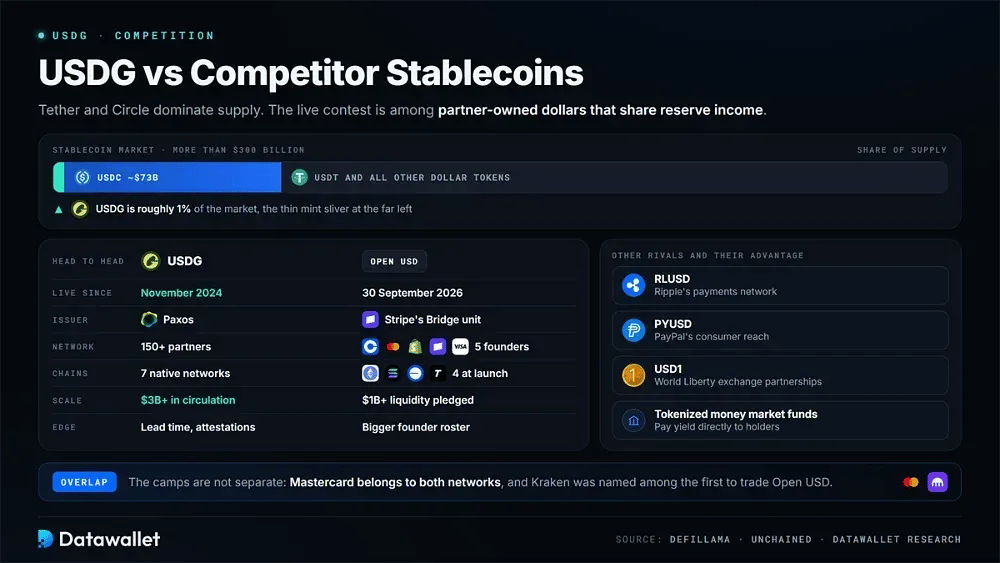
The stablecoin market exceeds $300 billion, with USDG representing roughly 1%. Tether and Circle continue to dominate overall supply. A more active contest is emerging among partner-owned dollar tokens that direct reserve income toward distributors, a category USDG effectively introduced when it launched in late 2024.
Open USD is the clearest direct challenger. It went live on 30 September 2026 across Ethereum, Solana, Base and Tempo. Stripe's Bridge unit issues the token, reserves are held at BlackRock, Lead Bank and BNY, and Coinbase, Mastercard, Shopify, Stripe and Visa jointly founded the network.
Its founder roster is larger and initial liquidity is deeper, with more than $1 billion pledged. USDG, by comparison, has almost two years of lead time, published attestations and established integrations. The groups are not entirely separate: Mastercard belongs to both networks, and Kraken was named among the first venues expected to trade Open USD.
Other competitors rely on different advantages. RLUSD draws on Ripple's payments network, while PYUSD benefits from PayPal's consumer reach. USD1 uses World Liberty Financial's exchange partnerships, and tokenized money market funds pay yield directly. USDG's distinguishing feature remains a live, open framework with public attestations that qualifying distributors can join.
Is USDG Safe?
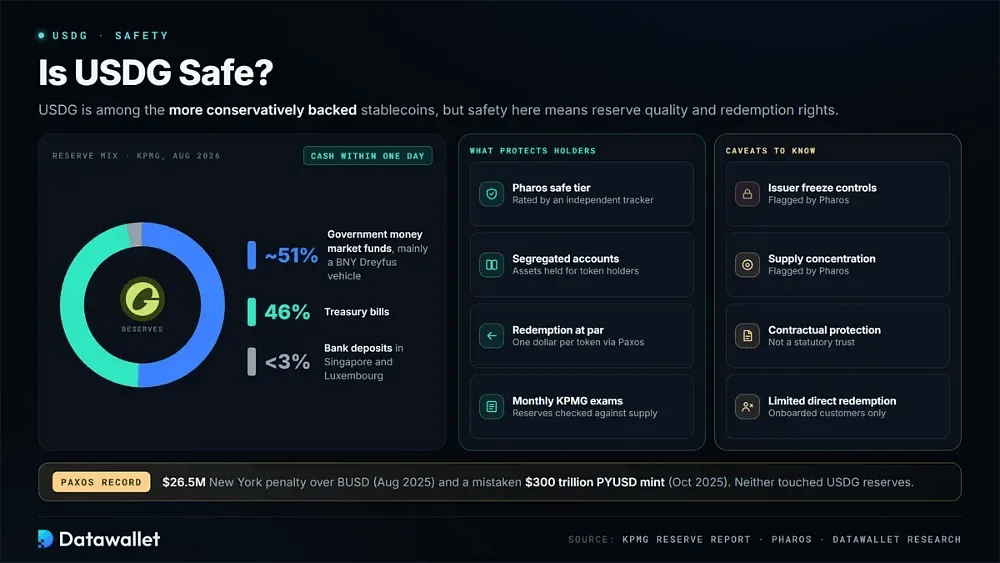
USDG sits among the more conservatively backed stablecoins, but that does not make it risk-free. Here, safety refers primarily to reserve quality and redemption rights. Independent stablecoin tracker Pharos places USDG in its safe tier while identifying issuer freeze controls and supply concentration as its two main caveats.
KPMG's August 2026 examination showed that roughly 51% of reserves were held in government money market funds, mainly a BNY Dreyfus vehicle. Treasury bills represented 46%, while deposits at banks in Singapore and Luxembourg made up less than 3%. Every reserve category can be converted to cash within one day.
Reserve structure is also important. Assets are kept in segregated accounts for token holders, although this protection is contractual rather than a statutory trust. Only onboarded customers can redeem directly through Paxos. Other holders depend on exchanges and market makers to maintain the token's price at par.
Paxos's wider history provides additional context. The company paid New York regulators a $26.5 million penalty in August 2025 over compliance failures connected with BUSD. In October 2025, it mistakenly minted $300 trillion of PYUSD before burning the excess shortly afterward. Neither incident affected USDG reserves.
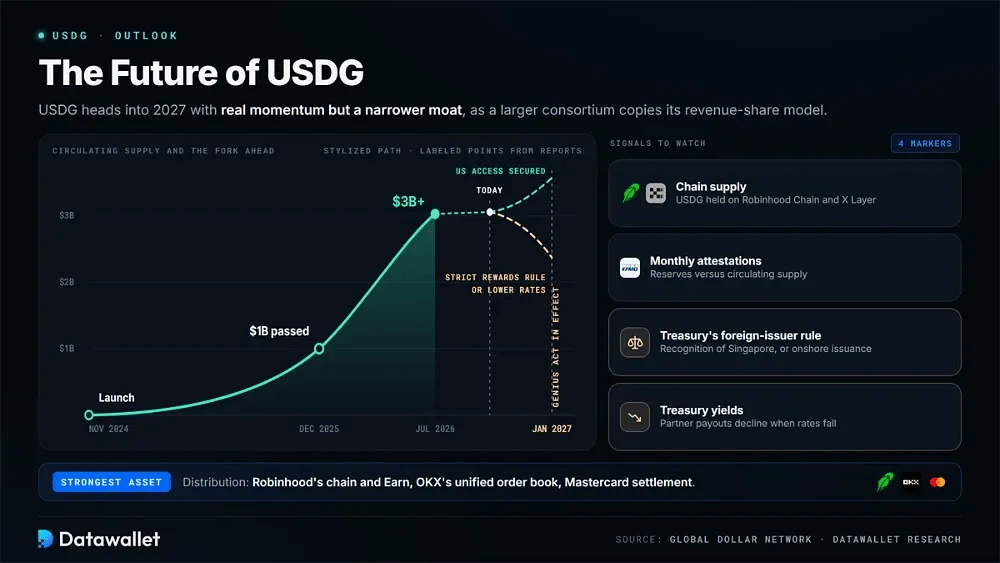
The Future of USDG
USDG approaches 2027 with substantial momentum but a narrower moat than it had a year earlier. Supply tripled within seven months. At the same time, the revenue-sharing structure it pioneered is now being copied by a consortium whose members are larger and backed by considerably deeper balance sheets.
Distribution remains the strongest part of the model. Robinhood has connected USDG to its blockchain, Earn product and tokenized stock strategy. OKX has incorporated it into a unified order book. Mastercard settlement creates access to card flows that only a small number of stablecoins can currently reach.
Regulation could determine how far that advantage extends. Treasury recognition of Singapore's regime, or a shift to issuance through the Paxos national trust bank, would largely secure access to the American market. A strict final interpretation of third-party rewards could instead weaken the incentive that currently differentiates USDG from larger competitors.
Interest rates will also shape the economics. Partner payouts decline when Treasury yields fall, so long-term expansion depends on utility that remains useful at lower rates, particularly payments, collateral and settlement. Supply on Robinhood Chain and X Layer, monthly attestations and Treasury's foreign-issuer rule are the clearest signals to watch.
Final Thoughts
USDG has demonstrated that a stablecoin can expand rapidly by sharing reserve income with the businesses responsible for its distribution. In less than two years, it reached more than 150 partners and $3 billion in circulation while keeping reserves in Treasury bills, government money funds and cash under two regulators.
Most of the unresolved issues surround the token rather than its reserve portfolio. US rules for foreign issuers remain unfinished. Open USD is now pursuing many of the same partners, and a significant share of supply sits on a small group of platforms whose commercial priorities can change.
For everyday users, the decision is practical. USDG works well on platforms that support it and share rewards, as long as holders accept centralized freeze powers, lower liquidity than larger rivals and returns determined by individual platforms. Compare it against the safest stablecoins before concentrating savings in a single token.