Top 10 Crypto Crashes Ranked
1. The Mt. Gox Hack Flash Crash (June 2011)
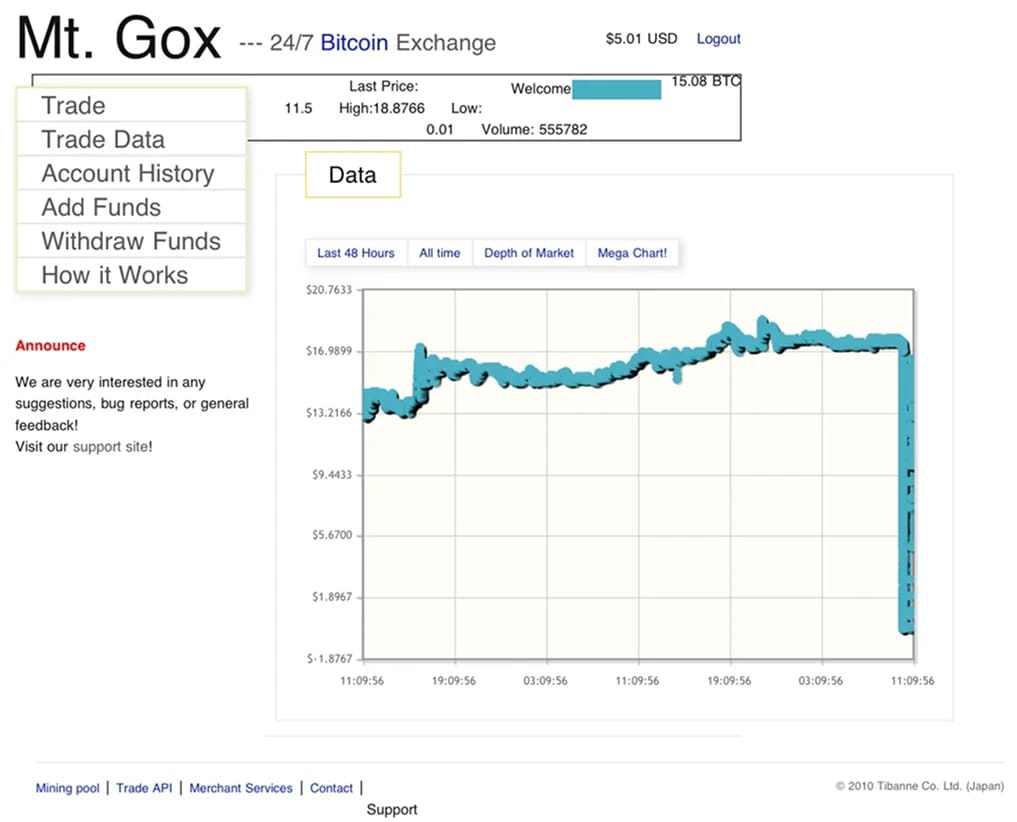
Decline: 99.9% | $32 to $0.01
The single largest percentage crash in crypto history happened on June 19, 2011. Hackers breached Mt. Gox, the exchange handling roughly 90% of all Bitcoin trading, compromised user accounts, and dumped stolen BTC onto the order book. The price briefly hit one cent.
Bitcoin had only just reached $32, its first notable milestone. The entire crypto market cap sat around $175 million. Confidence in Bitcoin's viability as a secure store of value collapsed alongside the price, and BTC didn't reclaim pre-hack levels for months.
The incident exposed a critical vulnerability: the entire market depended on a single centralized platform with inadequate security. The aftermath catalyzed the first wave of exchange security improvements and diversified trading across multiple platforms.
2. The 2018 Great Crypto Winter
Decline: 84% | ~$20,000 to ~$3,200
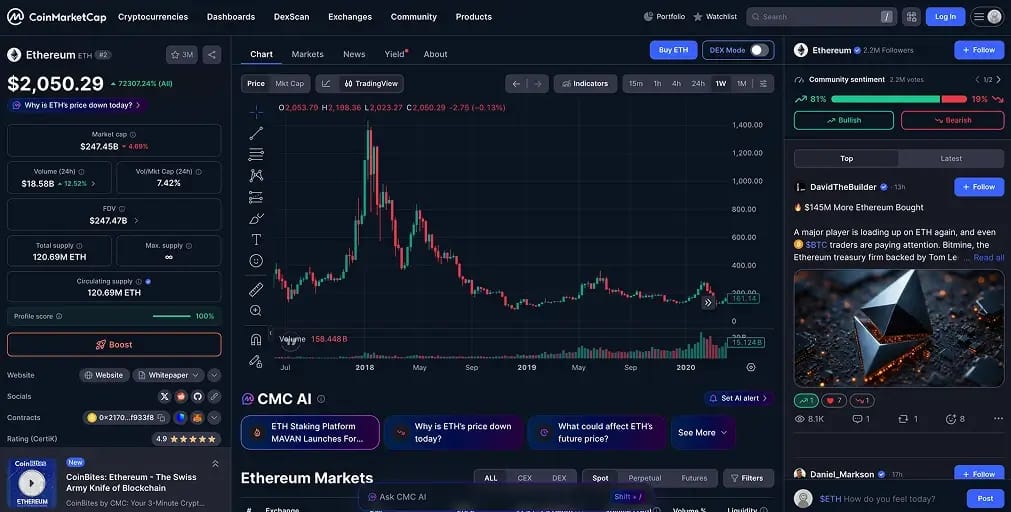
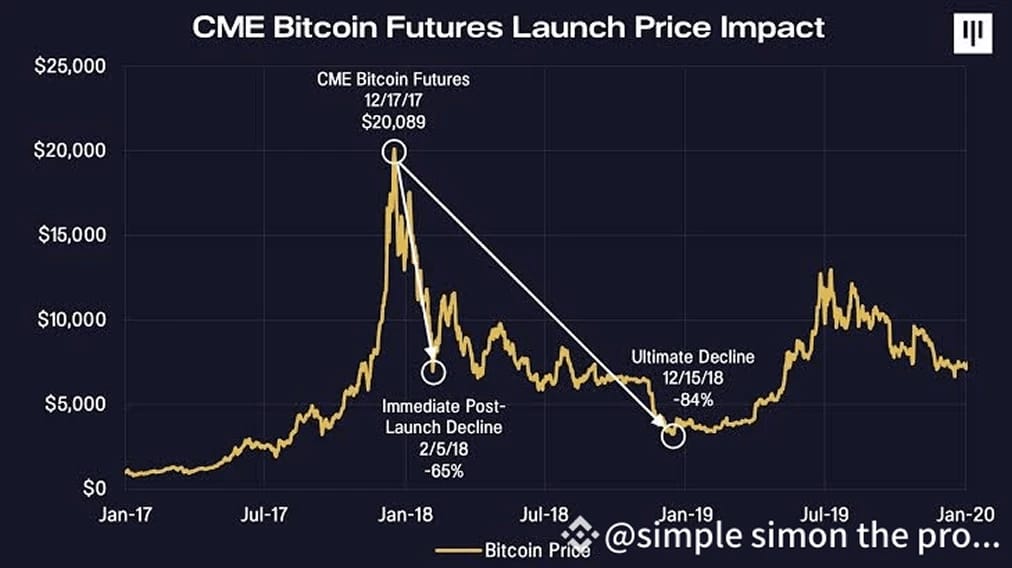
After Bitcoin peaked near $20,000 in mid-December 2017, it entered a sustained decline that bottomed at roughly $3,200 by December 2018. Total market capitalization shrank from $830 billion to under $130 billion. Ethereum collapsed 93.8% from $1,396 to $86.54 over the same window.
Several forces converged. The CME and CBOE had just launched regulated Bitcoin futures in December 2017, giving institutional short sellers a mechanism to bet against BTC for the first time. The Federal Reserve Bank of San Francisco later published research attributing the reversal directly to the introduction of futures.
Meanwhile, the SEC was cracking down on fraudulent ICOs, exchange hacks rattled South Korea and Japan, and BitConnect was exposed as a Ponzi scheme promising "up to 40% per month." The resulting bear market lasted a full year and established crypto's four-year cycle template. Bitcoin didn't reclaim $20,000 until December 2020.
3. The 2021-2022 Bear Market
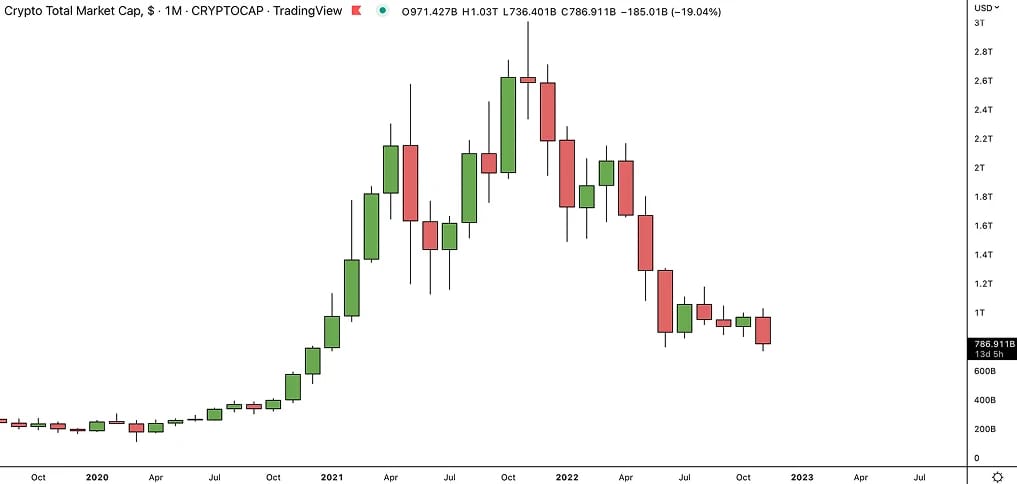
Decline: 77% | ~$68,000 to ~$15,479 | ~$2 Trillion Lost
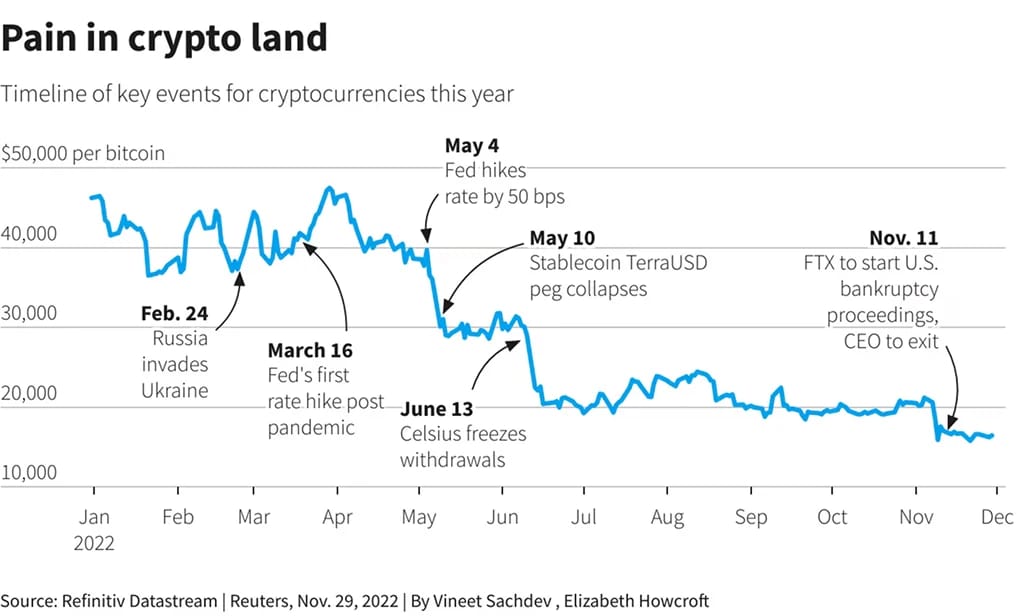
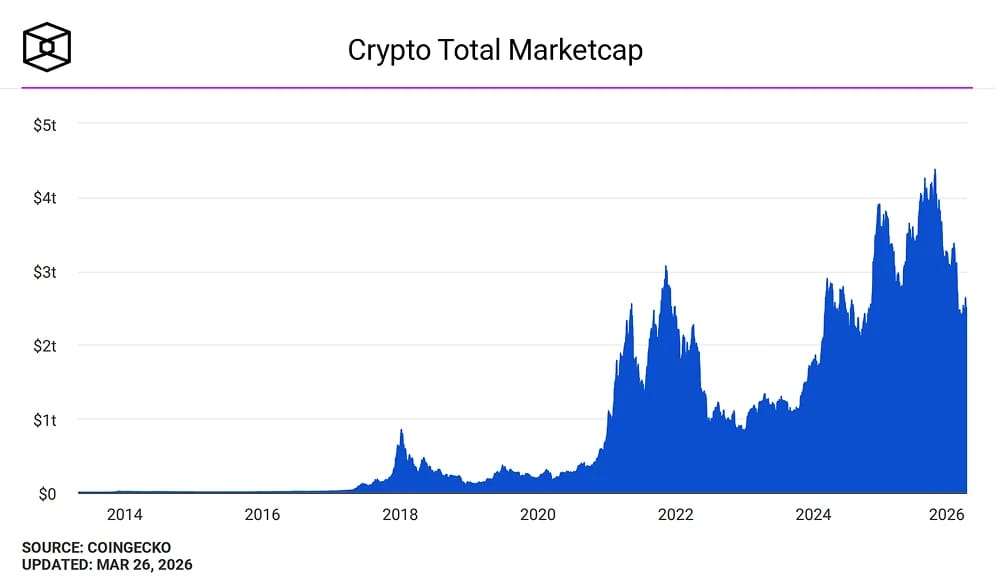
The broadest crash in absolute dollar terms. Bitcoin peaked above $68,000 in November 2021 while the total crypto market touched $3 trillion. Over the next 12 months, the industry shed more than $2 trillion in value, with Bitcoin bottoming near $15,479 in November 2022.
This was not a single event but a cascading series of failures:
- Macro trigger: The Federal Reserve signaled the end of ultra-loose monetary policy and began its most aggressive rate-hiking cycle in decades.
- Terra/LUNA collapse (May 2022): Wiped out $45 billion and triggered insolvencies at Celsius, Voyager, and Three Arrows Capital.
- FTX bankruptcy (November 2022): Delivered the final blow, bringing Bitcoin to its cycle low.
By December 2022, total market capitalization had fallen to roughly $800 billion. Ethereum dropped over 75%. Many altcoins lost 90% or more.
4. The Terra/LUNA Death Spiral (May 2022)
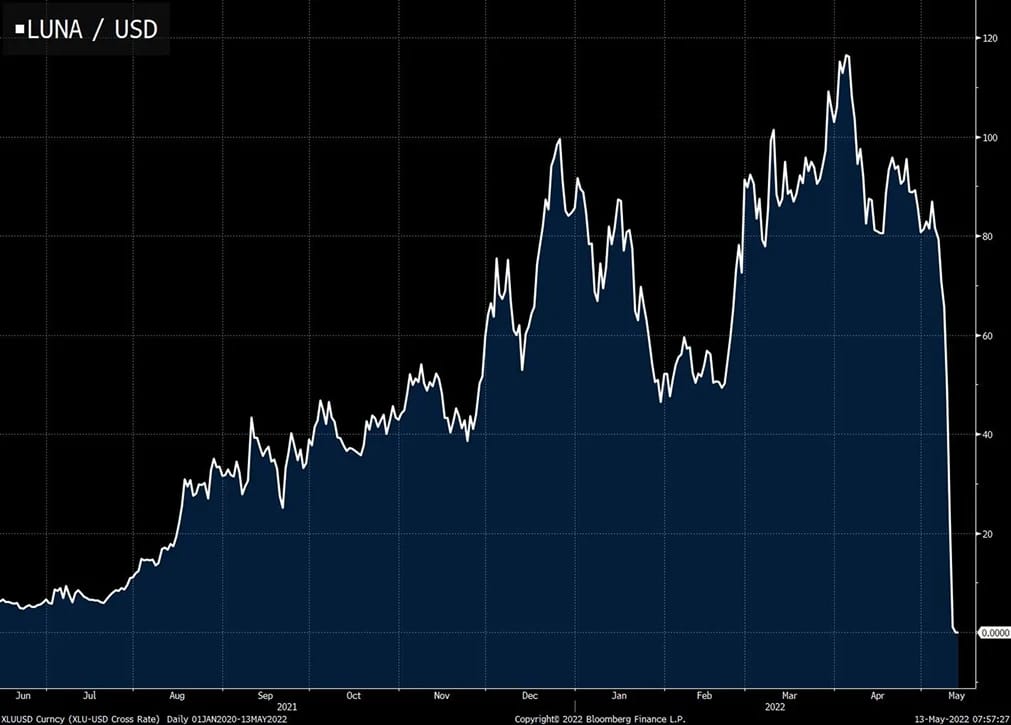
LUNA Decline: 99.99% | ~$119.51 to <$0.001 | ~$45 Billion Destroyed
The most catastrophic single protocol failure in crypto history. At its peak, the Terra ecosystem was the third-largest behind Bitcoin and Ethereum, valued at over $60 billion. Within three days, that valuation was effectively zero.
The catalyst was a bank run on Anchor Protocol, which had attracted depositors with a subsidized 19.5% annual yield on UST deposits. On May 7, large wallets withdrew approximately 375 million UST, triggering cascading panic.
UST's fatal flaw was its algorithmic design. Unlike Tether or USDC (backed by off-chain reserves), UST maintained its peg through a mint-and-burn mechanism with LUNA. When UST broke below $1, the arbitrage mechanism flooded the market with LUNA tokens, hyperinflating the supply from 725 million to over 7 trillion in eight days.
The Luna Foundation Guard deployed $2.4 billion in Bitcoin reserves to defend the peg. It wasn't enough. Do Kwon was sentenced to 15 years in federal prison in December 2025, with the judge calling it "fraud on epic, generational scale."
5. The FTX Collapse (November 2022)
FTT Decline: 80%+ in 48 hours | $8 Billion Customer Shortfall
FTX was the third-largest exchange by volume with over one million users. It filed for Chapter 11 bankruptcy on November 11, 2022, after withdrawals exposed an $8 billion hole in customer accounts.
The unraveling started on November 2 when CoinDesk reported that nearly 40% of Alameda Research's balance sheet consisted of FTT, FTX's own token. Binance announced it would liquidate its FTT holdings. Customers rushed the exits. FTT crashed from $22 to under $5 in two days.
Investigations revealed Sam Bankman-Fried had been funneling customer deposits into Alameda Research, which held a secret exemption from FTX's own liquidation rules. The exchange's balance sheet showed $9 billion in liabilities against $900 million in liquid assets. Restructuring specialist John J. Ray III described FTX's financial controls as the worst he'd encountered in 40 years, including his work on the Enron bankruptcy.
Bitcoin hit a two-year low. Total crypto market cap dropped $183 billion in weeks. Bankman-Fried received 25 years in prison and $11 billion in forfeiture.
6. Mt. Gox Insolvency (February 2014)
Decline: 68% | ~$1,127 to ~$360 | 850,000 BTC Lost
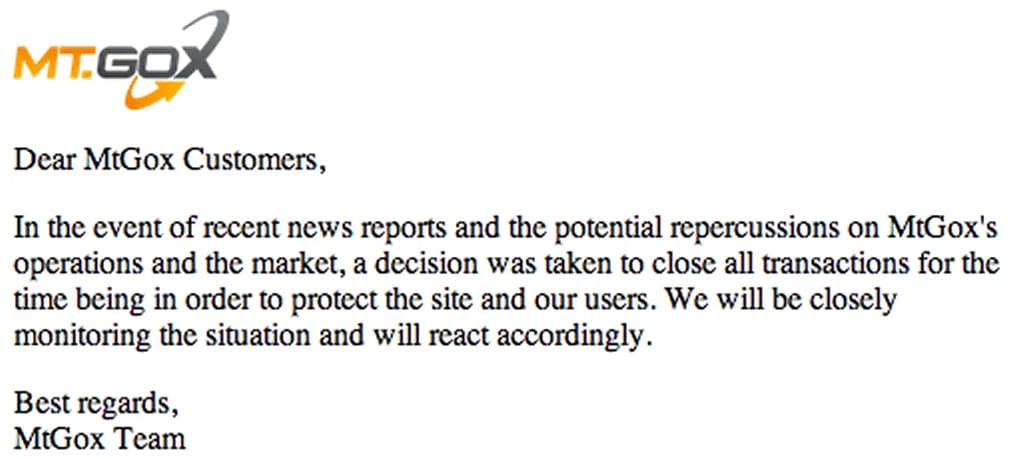
Mt. Gox, which at its peak handled over 70% of global Bitcoin transactions, halted withdrawals in February 2014 after discovering approximately 850,000 Bitcoin were missing. The exchange filed for bankruptcy shortly after.
At 2014 prices, the loss totaled roughly $460 million. At Bitcoin's 2025 all-time high, those same coins would have been worth over $100 billion. The price, already declining from its late-2013 high, accelerated to $360 by April 2014.
The collapse established "not your keys, not your coins" as a foundational principle and directly accelerated the development of hardware wallets and self-custody solutions. Bankruptcy proceedings dragged on for over a decade, with creditors only receiving partial distributions starting in 2024.
7. COVID-19 Black Thursday (March 12, 2020)
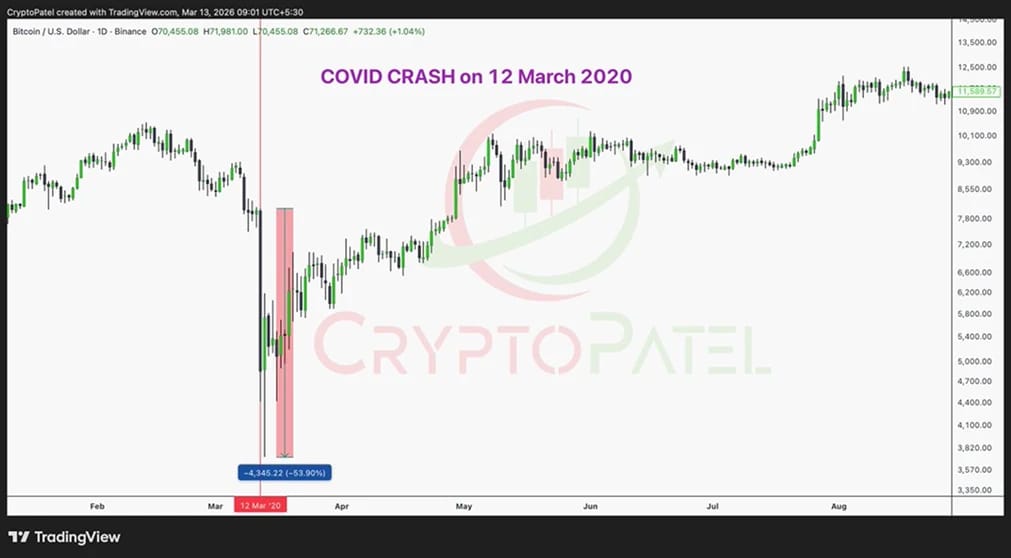
Decline: ~50% in 24 hours | ~$8,000 to ~$4,850
The day after the WHO declared a global pandemic, Bitcoin lost nearly half its value in under 24 hours. The crash earned the moniker "Black Thursday."
The sell-off was not crypto-specific. The S&P 500 posted its worst day since 1987. Bitcoin, long positioned by advocates as an uncorrelated hedge, instead fell harder than equities, undermining the "digital gold" narrative. Cascading liquidations across leveraged platforms amplified the decline, with billions in long positions automatically unwound.
The recovery was remarkable. The Fed's emergency rate cuts to zero and massive quantitative easing created exactly the liquidity conditions crypto thrives in. Bitcoin reclaimed pre-crash levels within two months and went on to hit $64,000 by April 2021.
8. China Mining Crackdown (May-July 2021)
Decline: 53% | ~$64,000 to ~$30,000 | ~$1 Trillion Market Wipeout
Two shocks hit in rapid succession. First, Elon Musk reversed Tesla's plan to accept Bitcoin for vehicles, citing environmental concerns. Then the People's Bank of China reiterated its ban on crypto services and provinces began shutting down mining operations.
China at that point controlled roughly 65% of global Bitcoin hash rate. The forced migration of mining infrastructure caused hash rate to plummet, stoking anxiety about network security. On June 21, Bitcoin fell roughly 30% from $43,000 to $30,000 in about 12 hours, earning the "Black Wednesday" label. Approximately $8 billion in leveraged positions were liquidated in a single session.
The sell-off permanently ended China's dominance in Bitcoin mining and shifted global hash rate to the United States, Kazakhstan, and other jurisdictions.
%25201.webp)
9. The 2017 Crypto Futures Launch Crash (December 22, 2017)
Decline: 33% in 24 hours | ~$16,500 to ~$11,000
Bitcoin had climbed from roughly $2,000 in July 2017 to near $20,000 by mid-December, fueled by mainstream media coverage, retail FOMO, and the debut of regulated Bitcoin futures on the CBOE and CME exchanges.
On December 22, it reversed hard. BTC dropped from $16,500 to $11,000 in 24 hours, marking the start of the 2018 Crypto Winter. The San Francisco Fed later published research concluding the crash was "consistent with trading behavior that typically accompanies the introduction of futures markets for an asset."
For the first time, Wall Street had a regulated tool to short Bitcoin without holding the underlying asset. While the crash was painful, the introduction of regulated derivatives laid the groundwork for the eventual launch of spot Bitcoin ETFs in January 2024.
10. The 2025-2026 Correction (Ongoing)
Decline: -51.9% | $4.27T to $2.33T | $2.21 Trillion Lost in 230 Days
The most recent correction began after Bitcoin hit an all-time high of $126,198 on October 6, 2025. As of late March 2026, BTC trades around $69,000 and total crypto market cap has been cut in half, erasing $2.21 trillion in value.
Unlike previous crashes caused by exchange failures or protocol collapses, this sell-off has been driven almost entirely by external forces:
- Macro and geopolitics. Hawkish Fed signaling, escalating U.S.-Iran-Israel tensions, Trump-era tariff escalation, and a broad rotation into gold (which surged past $5,500/oz) dragged crypto lower alongside tech equities.
- Whale redistribution. CryptoQuant documented three major selling waves from Satoshi-era holders after BTC crossed $100,000. The largest was a single dormant wallet moving ~80,000 BTC through Galaxy Digital in July at $108,000, worth over $9 billion.
- Emerging tech risks. Google's Willow quantum chip demonstrated a 13,000x speed advantage over classical supercomputers in October 2025, reigniting debate about Bitcoin's long-term cryptographic vulnerability. Meanwhile, rapid AI trading adoption raised concerns about algorithmic sell pressure in an increasingly bot-driven market.
- ETF reversal. Spot Bitcoin ETFs flipped from sustained inflows to outflows, with BTC falling below the average ETF investor entry price of ~$81,600 per Citi. A single-day liquidation on February 1 wiped out $2.2 billion in leveraged positions, surpassing even FTX-era volumes.
The critical difference from 2022: no major crypto-native institution has failed. Chainlink co-founder Sergey Nazarov noted the absence of "large risk management failures leading to institutional collapses." The infrastructure held. The macro didn't.
What Causes Crypto Crashes?
Every crash on this list was driven by one or more of the same five forces: exchange failure, protocol design flaws, government action, macroeconomic shifts, and leveraged liquidation cascades.
The early crashes were almost entirely self-inflicted. Mt. Gox, FTX, and the long list of failed exchanges on the Bitcoin Wiki were custodial blowups. Terra was a protocol that ate itself. China's 2021 mining ban wiped out over 65% of global hashrate overnight and tanked the price with it.
The dominant catalyst has shifted over time. Before 2020, Bitcoin's correlation with equities sat between -0.2 and 0.2. By 2024, BTC-Nasdaq correlation had peaked at 0.87. The 2025-2026 correction was driven by the Fed, tariffs, and institutional rotation out of risk assets, with no fraud or broken protocol involved.
The accelerant in nearly every case is leverage. Crypto derivatives now account for three-quarters of all trading volume, and when prices breach liquidation thresholds, forced selling compounds mechanically. In October 2025, Amberdata documented $3.21 billion liquidated in a single 60-second window, with 93.5% of it being forced long exits.
What History Tells Us
Two patterns emerge from 15 years of crypto crashes.
- Declining severity. The 2011 crash was 99.9%. The 2014-2015 decline was 86%. The 2018 winter hit 84%. The 2022 collapse reached 77%. The current correction has so far peaked around 52%. As market cap grows and institutional infrastructure matures, the potential for total catastrophic loss is shrinking.
- Every crash has preceded a new all-time high. Bitcoin recovered from all nine previous major corrections to surpass its prior peak, though timelines ranged from two months (post-COVID) to over three years (post-2018). Whether the current correction follows this pattern remains the open question for 2026.
Final Thoughts
The most underappreciated signal in this data is not that crashes keep happening. It's that the type of crash is changing. Every major collapse before 2025 was self-inflicted: exchange hacks, Ponzi schemes, algorithmic stablecoins that failed their own math, outright fraud. The crypto industry kept building bombs and stepping on them.
The 2025-2026 correction is different. No protocol imploded. No exchange committed fraud. No stablecoin depegged. Bitcoin fell because the Fed stayed hawkish and institutional investors rotated out of risk assets across the board. Crypto crashed for the same reasons stocks crash.
When an asset class stops collapsing from internal dysfunction and starts correcting alongside global macro, it's no longer a casino. It's a market. A volatile, immature one, but a real one. That's the most painful version of progress.