

Who is Do Kwon?
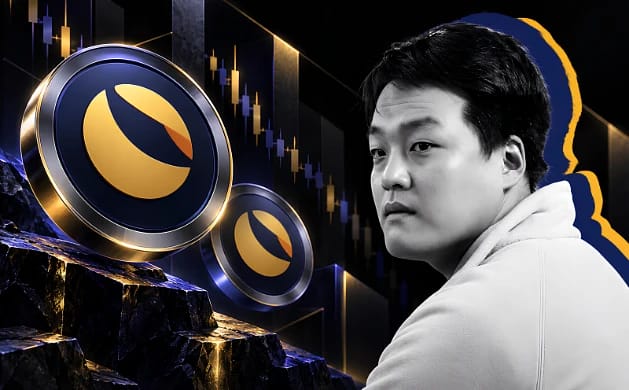
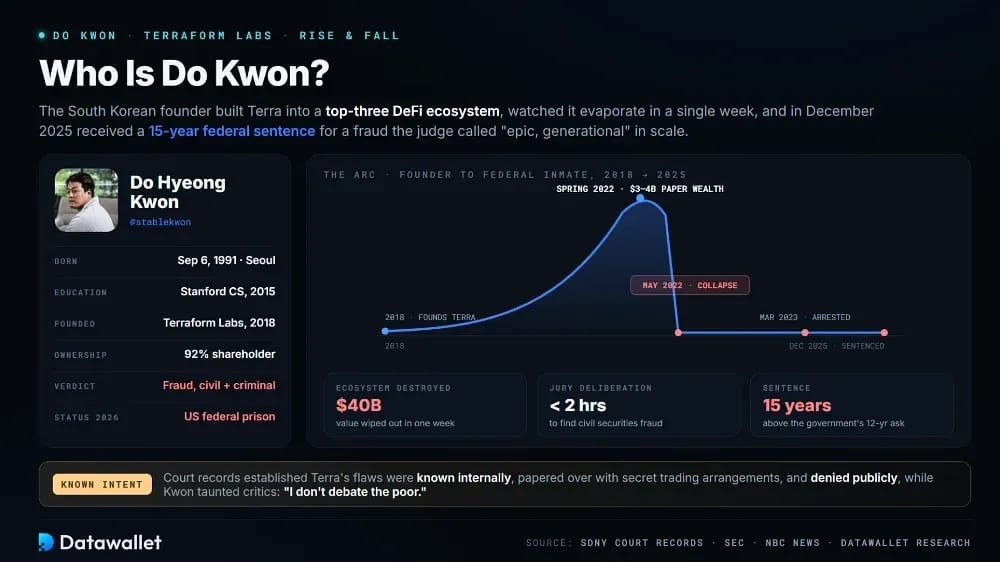
Do Kwon is a South Korean entrepreneur whose rise and collapse spanned the 2021-2022 crypto cycle. After launching Terraform Labs in 2018, he built the Terra blockchain into a top-three DeFi ecosystem. It then disappeared within a week after his algorithmic stablecoin lost its dollar peg.
Intent is what distinguishes Kwon from many other failed founders. Court records established that Terra's flaws were known internally and concealed through secret trading arrangements while being denied publicly. A jury took less than two hours to find him liable for civil securities fraud. Kwon later admitted criminal fraud himself.
At its peak, the ecosystem paired TerraUSD, an uncollateralized stablecoin, with the volatile LUNA token. Kwon promoted the project through a combative persona on X (@stablekwon), dismissing critics of the design with remarks such as "I don't debate the poor."
When Federal Judge Paul Engelmayer handed down the 15-year sentence in December 2025, he described the scheme as a fraud of epic, generational scale. He also said the government's own recommendation of 12 years was unreasonably lenient.
Do Kwon Background
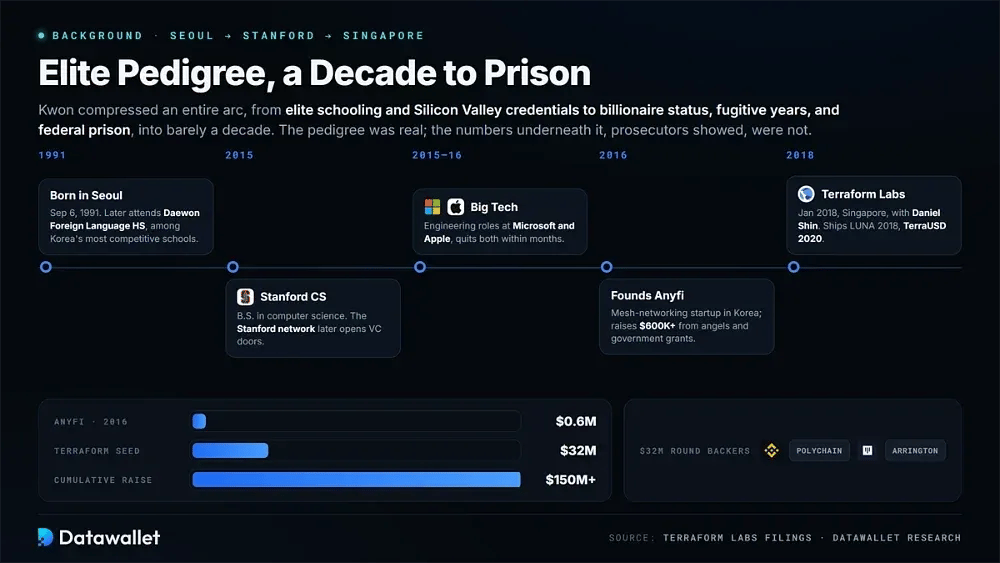
Barely a decade separated Kwon's elite education from Silicon Valley employment, billionaire status, years as a fugitive, and ultimately federal prison. Each stage influenced both the fortune he accumulated and the amount that remains today.
His background also helps explain why major funds, exchanges, and retail investors trusted him. The pedigree was genuine. Prosecutors later showed that the numbers underneath it were not.
Early Life and Education
Do Kwon was born on September 6, 1991, in Seoul, South Korea. He attended Daewon Foreign Language High School, one of the country's most competitive private schools, before continuing his university education in the United States.
In 2015, he earned a bachelor's degree in computer science from Stanford University. Little about his time there entered the public record, but the Stanford network later proved valuable by opening doors to venture capital firms that would eventually fund Terraform Labs.
Professional Career
After Stanford, Kwon worked as a software engineer at Microsoft and Apple. Both jobs were short-lived. By his own account, he found engineering inside large companies tedious and left within months, deciding instead to build something himself.
He returned to South Korea and founded Anyfi in 2016. The startup used mesh networking to provide decentralized peer-to-peer connectivity. Anyfi raised more than $600,000 from angel investors and Korean government grants, giving Kwon his first substantial experience pitching investors on ambitious infrastructure projects.
Founding Terraform Labs
Kwon and Daniel Shin founded Terraform Labs in Singapore in January 2018. Their pitch combined e-commerce with cryptocurrency: stablecoins designed to make payments cheaper and faster than card networks, with Shin's Korean shopping platform Chai serving as an anchor.
Funding arrived quickly. Binance, Polychain Capital, Pantera Capital, and Arrington Capital participated in an initial $32 million round, while cumulative funding later exceeded $150 million. To institutional investors searching for the next major payments company, Terra appeared to meet every requirement.
Terraform released LUNA in 2018 and launched TerraUSD in 2020. Anchor Protocol for yield followed, alongside Mirror Protocol for synthetic stocks and an expanding ecosystem of applications. With each addition, Terra looked less like an experiment and more like a functioning economy.
The Rise of the Terra Ecosystem
From the outside, Terra looked remarkably convincing. Sophisticated venture funds, market makers, and DeFi developers all committed capital, which helps explain why its failure became one of the most damaging events in crypto crash history.
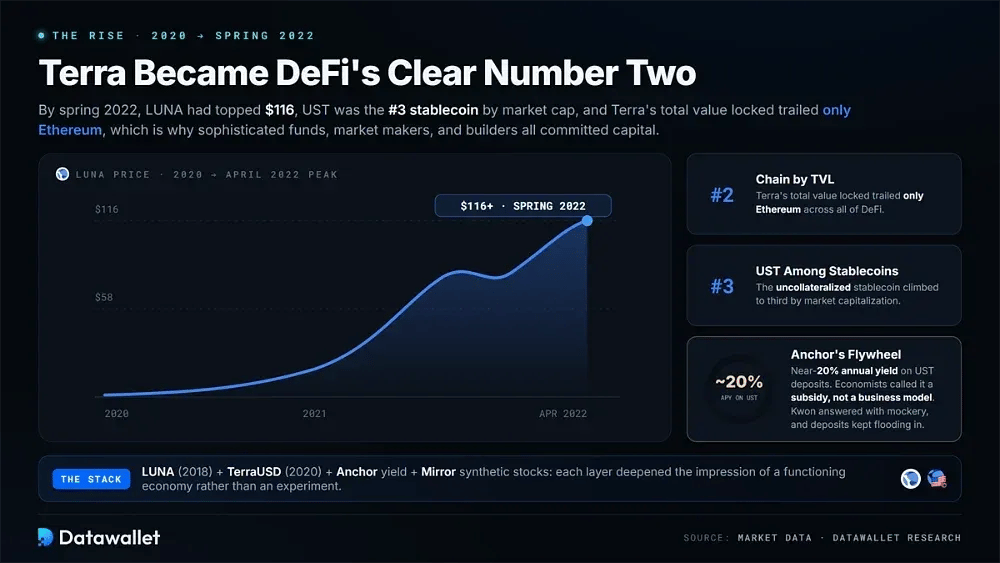
By spring 2022, LUNA had traded above $116, while UST had become the third-largest stablecoin by market capitalization. Terra's total value locked ranked behind only Ethereum, putting it firmly in second place among decentralized finance chains.
Anchor Protocol drove much of that growth by offering UST depositors annual yields near 20%. Economists warned that the rate functioned as a subsidy rather than a sustainable business model. Kwon answered critics with mockery instead of mathematical justification, and deposits continued to pour in.
The Terra Collapse
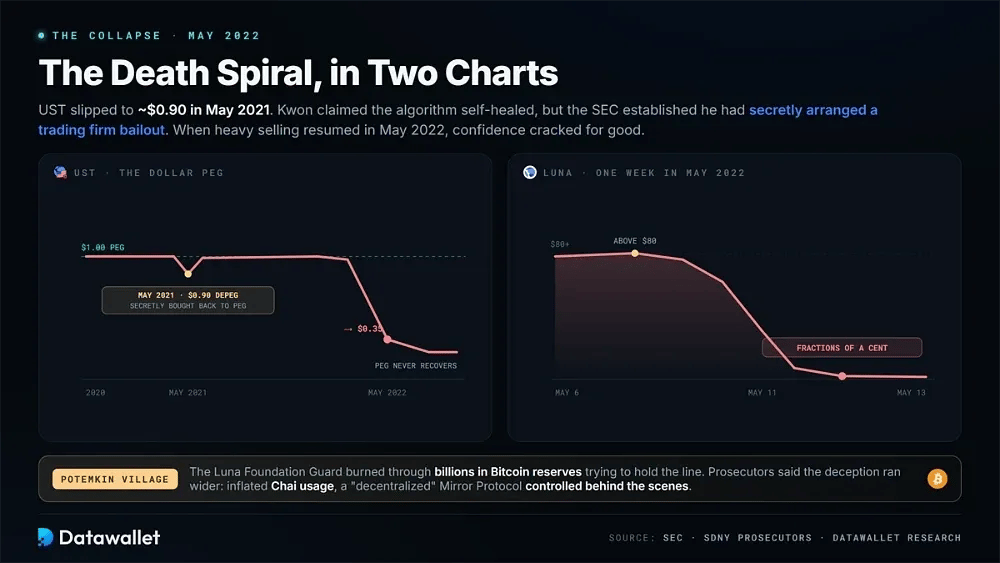
Terra's system had failed before the wider market recognized the problem. In May 2021, UST fell to roughly $0.90. Kwon publicly said the algorithm had restored the peg on its own. The SEC established, however, that he had secretly arranged for a trading firm to purchase large quantities of UST and push the price back to $1.
That hidden intervention set the stage for May 2022. Heavy selling returned, confidence broke, and UST fell toward $0.35. LUNA dropped from more than $80 to fractions of a cent, while the Luna Foundation Guard exhausted billions of dollars in Bitcoin reserves attempting to defend the peg.
Prosecutors later said the deception extended beyond UST. Terraform overstated Chai's purported blockchain usage and promoted Mirror Protocol as decentralized while retaining control behind the scenes. In court, Assistant US Attorney Jared Lenow described the ecosystem as a Potemkin village.
Do Kwon's Net Worth in 2026
Estimating Kwon's net worth in 2026 requires comparing traced assets with frozen accounts, forfeiture orders, and creditor claims spanning three jurisdictions. Court filings and on-chain research provide a workable picture, though not a perfect one.
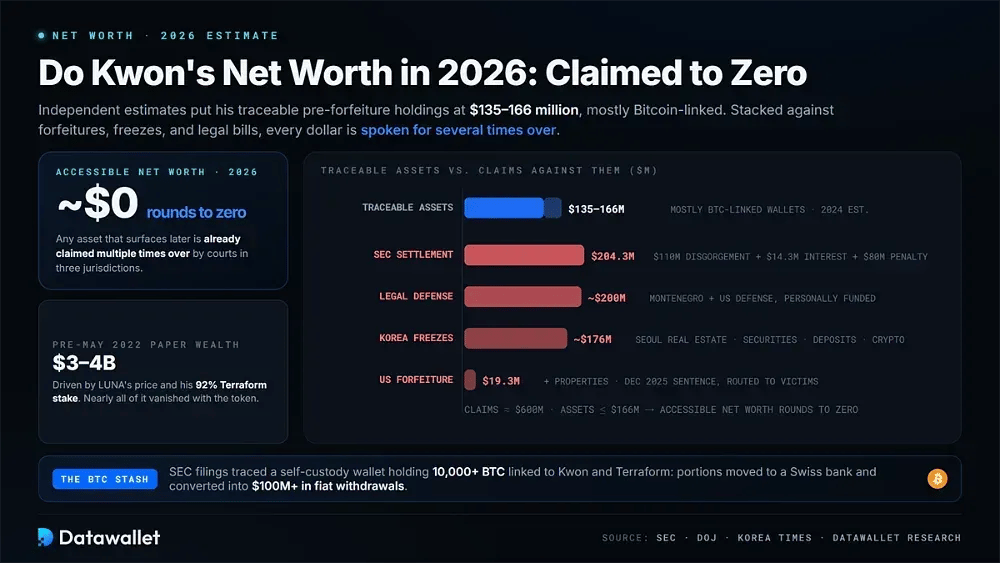
Before the May 2022 collapse, Kwon's paper wealth was estimated at $3-4 billion, largely because of LUNA's market price and his position as Terraform's 92% shareholder. Most of that disappeared with the token's value, leaving investigators to focus on assets that existed outside LUNA.
Here is what happened to the money that remained:
- Bitcoin stash: SEC filings traced a self-custody wallet holding more than 10,000 BTC linked to Kwon and Terraform. Portions were later transferred to a Swiss bank and converted into more than $100 million in fiat withdrawals.
- Frozen assets: South Korean courts froze roughly $176 million tied to Kwon. The assets include Seoul real estate, securities and bank deposits, as well as cryptocurrency held across several domestic and offshore exchange accounts.
- SEC settlement: His civil judgment requires him to transfer at least $204.3 million to the Terraform bankruptcy estate. That amount includes $110 million in disgorgement, $14.3 million in interest, and an $80 million civil penalty.
- Criminal forfeiture: The December 2025 sentence imposed forfeiture of $19.3 million plus properties. Seized funds are being directed to victims through the Justice Department's remission process rather than through a restitution order.
- Legal costs: Kwon personally financed a defense effort reported at around $200 million across Montenegro and the US. Those expenses consumed much of the liquid wealth his lawyers were still able to access.
Independent estimates placed his traceable pre-forfeiture holdings at between $135 million and $166 million in 2024, with most of the value held in Bitcoin-linked wallets.
Against that figure sit the US forfeiture, the $204 million estate obligation, Korean asset freezes, and legal expenses. On that basis, his accessible net worth in 2026 rounds to zero. Any assets discovered later are already subject to claims several times over.
Where Is Do Kwon Now?
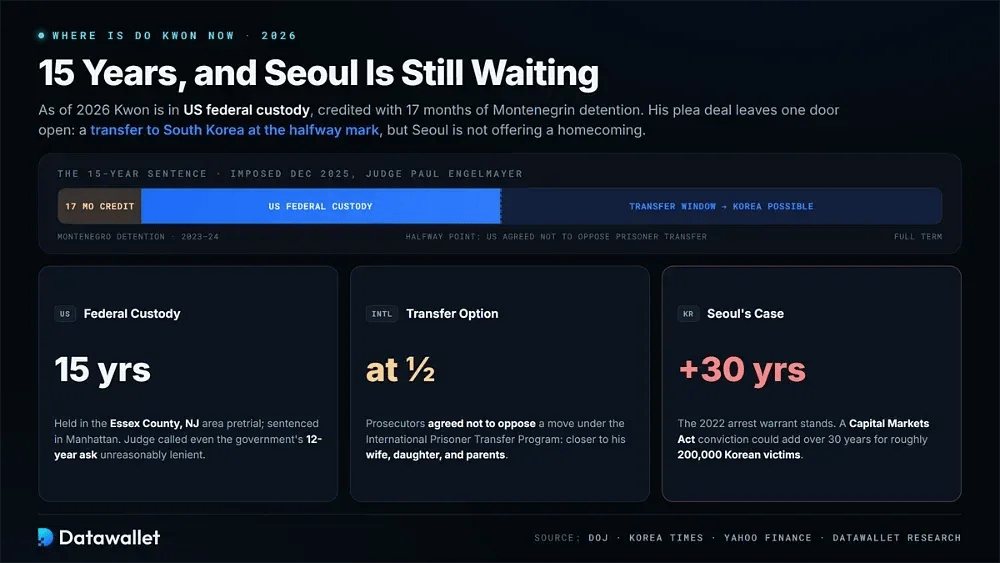
As of 2026, Kwon is serving his 15-year sentence in US federal custody, with credit for the 17 months he spent detained in Montenegro. Before sentencing in Manhattan, he had been held in the Essex County area of New Jersey during the pretrial period.
His plea agreement does leave open the possibility of a transfer. Prosecutors agreed not to oppose a move to South Korea under the International Prisoner Transfer Program after he completes half of the sentence. Such a transfer would place him closer to his wife, daughter, and parents.
South Korea, however, still plans to prosecute him. The Seoul Southern District Prosecutors' Office retains its 2022 arrest warrant and intends to bring a case under the Capital Markets Act. Officials say a conviction could add more than 30 years for conduct affecting roughly 200,000 Korean victims.
Do Kwon's Crypto Wallets
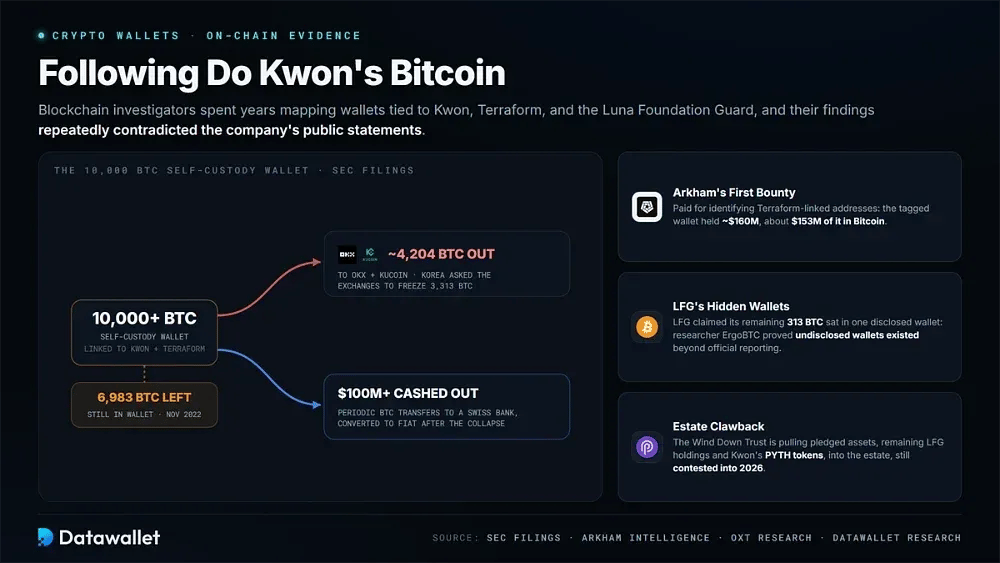
For years, blockchain investigators mapped wallets associated with Kwon, Terraform, and the Luna Foundation Guard. Their findings repeatedly conflicted with the company's public statements. Arkham Intelligence even awarded its first-ever bounty for the identification of Terraform-linked addresses.
Key wallet findings and on-chain evidence:
- LFG discrepancies: The Luna Foundation Guard said its remaining 313 BTC were held in a single disclosed wallet. Researcher ErgoBTC of OXT Research later demonstrated that additional undisclosed wallets existed beyond the official reserve reporting.
- 10,000 BTC wallet: SEC filings documented a self-custody wallet holding 6,983 BTC in November 2022. About 4,204 BTC had previously flowed from it to exchanges including OKX and KuCoin.
- Freeze requests: South Korean authorities asked OKX and KuCoin to freeze 3,313 BTC they attributed to Kwon. The request became an early test of cross-border cooperation in tracing cryptocurrency allegedly controlled by a fugitive.
- Swiss conversions: Court records describe recurring Bitcoin transfers to a Swiss financial institution, where the holdings were converted into fiat. More than $100 million was withdrawn through that channel after Terra collapsed.
- Arkham label: Arkham tagged the bounty-identified wallet as "Terraform Labs." At the time of identification, it contained about $160 million in cryptocurrency, with approximately $153 million denominated in Bitcoin.
- Estate recovery: The Wind Down Trust has continued trying to claw pledged assets into the estate, including remaining LFG holdings and Kwon's PYTH tokens. Court filings show that the process remained contested into 2026.
Do Kwon Legal Battle Timeline
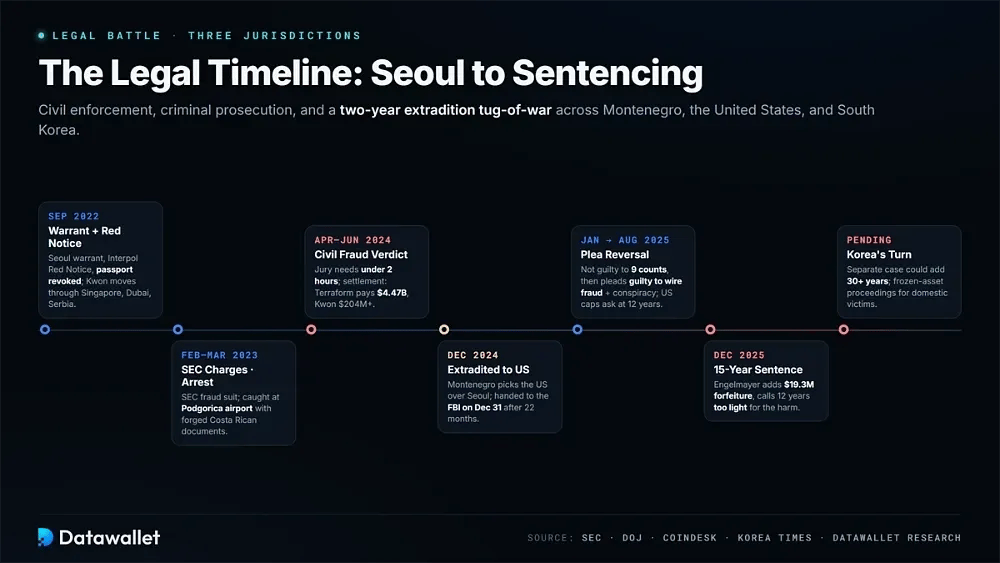
Kwon's legal proceedings span Montenegro, the United States, and South Korea. They include civil enforcement, criminal charges, and a two-year dispute over which country would extradite him. The timeline below shows how those proceedings developed.
Key legal proceedings and outcomes:
- Sep 2022: Months after Terra collapsed, Seoul prosecutors obtained an arrest warrant. Interpol issued a Red Notice, and South Korea revoked Kwon's passport while he moved between Singapore, Dubai, and Serbia.
- Feb 2023: The SEC charged Kwon and Terraform with fraud and unregistered securities offerings. The resulting civil case ultimately became central to efforts to compensate victims.
- Mar 2023: Montenegrin police arrested Kwon at Podgorica airport as he attempted to board a flight to Dubai using forged Costa Rican documents. He received a four-month local sentence for document falsification.
- Apr 2024: A Manhattan jury deliberated for less than two hours before unanimously finding Kwon and Terraform liable for securities fraud in the SEC's civil trial before Judge Jed Rakoff.
- Jun 2024: The court approved a settlement requiring Terraform to pay $4.47 billion and Kwon personally to transfer more than $204 million into the bankruptcy estate for harmed investors.
- Dec 2024: Montenegro's justice minister selected the US extradition request instead of South Korea's. After 22 months in Balkan custody, Kwon was transferred to FBI agents on December 31.
- Jan 2025: Kwon pleaded not guilty to a nine-count indictment alleging securities, commodities, and wire fraud, along with money laundering conspiracy. His trial was set for January 2026.
- Aug 2025: Before that trial, he changed his plea and admitted guilt to wire fraud and a fraud conspiracy count. Prosecutors agreed to cap their sentencing recommendation at 12 years.
- Dec 2025: Judge Engelmayer sentenced Kwon to 15 years and imposed $19.3 million in forfeiture. The sentence exceeded the government's recommendation, which the judge said was too lenient given the scale of the harm.
- Pending: South Korean prosecutors continue pursuing a separate case. Potential sentences exceed 30 years, while frozen-asset proceedings are also continuing with the aim of compensating domestic victims.
What's Left of Terraform Labs in 2026?
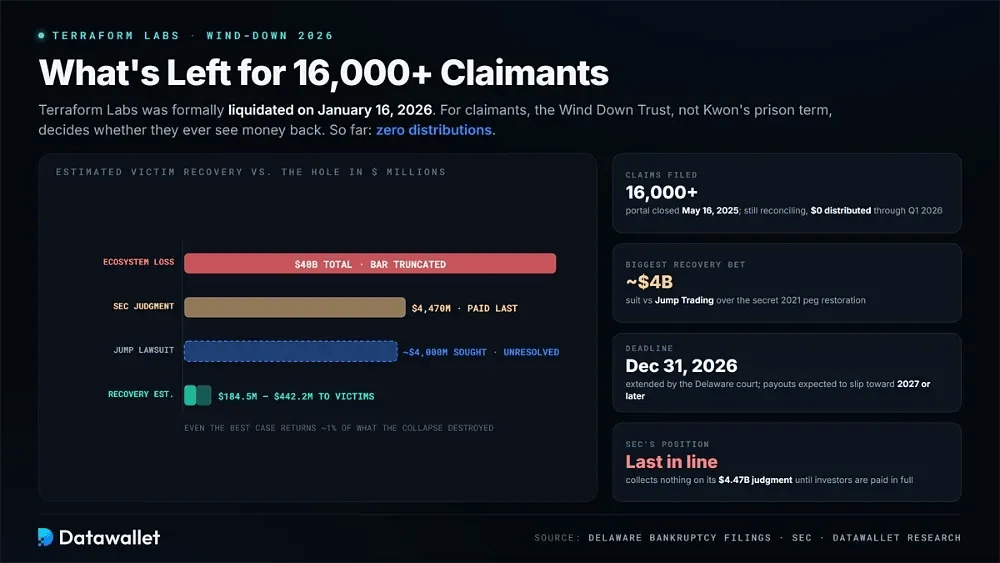
Terraform Labs itself is gone, but its bankruptcy process continues. For more than 16,000 claimants still waiting for repayment, the wind-down rather than Kwon's prison sentence will determine how much money they ultimately recover.
Where the Terraform wind-down stands in 2026:
- Corporate dissolution: Terraform Labs Pte. Ltd. was formally liquidated on January 16, 2026. All remaining assets were transferred to the court-supervised Wind Down Trust operating under the Delaware bankruptcy plan.
- Claims backlog: The claims portal closed on May 16, 2025. Administrators are still reconciling more than 16,000 crypto loss claims, and the trust reported zero creditor distributions through the first quarter of 2026.
- Recovery range: Terraform estimated that victims could receive between $184.5 million and $442.2 million. That would cover only a fraction of total losses, and the eventual amount depends heavily on litigation recoveries and claim valuations.
- Jump lawsuit: The estate's largest potential recovery is a roughly $4 billion lawsuit against Jump Trading concerning the secret 2021 peg restoration. A successful action could substantially increase the pool available to victims.
- Extended timeline: The Delaware court extended the wind-down deadline to December 31, 2026. Analysts following the case expect meaningful creditor distributions may not arrive until 2027 or later.
- SEC position: The regulator agreed to collect nothing on its $4.47 billion judgment until investors and creditors have been paid in full through the bankruptcy waterfall.
How the Terra Collapse Rewrote Stablecoin Rules
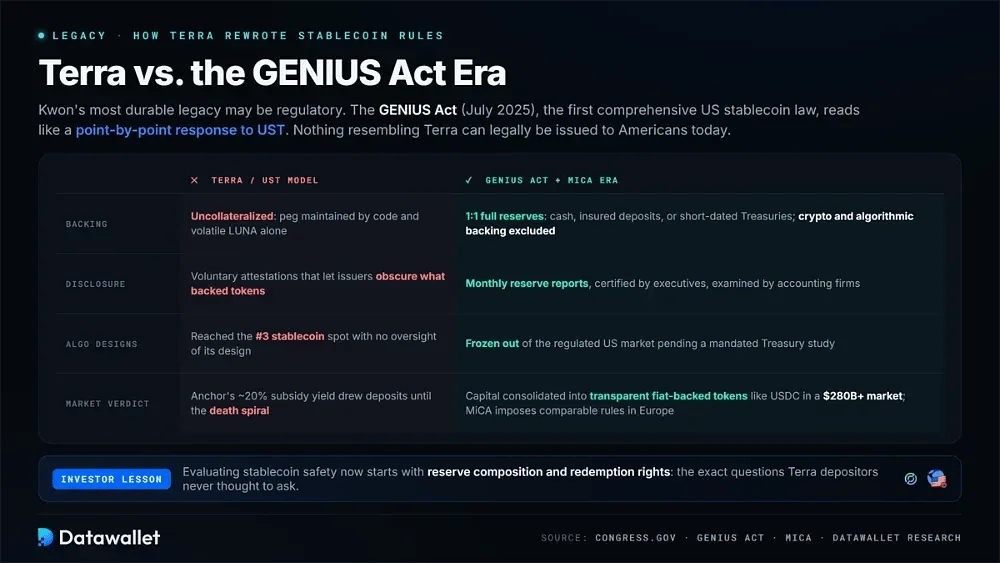
Regulation may prove to be Kwon's most lasting legacy. Lawmakers in both the United States and Europe treated Terra as evidence of the risks posed by dollar pegs maintained solely through code, and new rules followed.
The GENIUS Act, signed in July 2025, became the first comprehensive US stablecoin law. Its structure directly addresses many of the weaknesses exposed by UST and explains why a Terra-like product cannot legally be issued to Americans today.
How post-Terra regulation reshaped the stablecoin market:
- Full reserves: Permitted issuers must hold one dollar in cash, insured deposits, or short-dated Treasuries for every stablecoin issued. Crypto collateral and algorithmic backing mechanisms are explicitly excluded.
- Mandatory disclosure: Issuers must provide monthly reserve reports certified by executives and examined by accounting firms. Those requirements replaced the voluntary attestations that allowed Terra and other projects to obscure what supported their tokens.
- Algorithmic study: The law does not prohibit algorithmic stablecoins outright. Instead, it directs the Treasury to study them, effectively keeping new Terra-style designs outside the regulated US market.
- Global convergence: Europe's MiCA framework introduced similar reserve and licensing requirements. The result has been a broader shift toward the fully collateralized model that now dominates the $280+ billion stablecoin market.
- Market verdict: Capital increasingly moved toward transparent fiat-backed tokens such as USDC. Newer yield-bearing products now compete on disclosed collateral rather than promises of algorithmic stability.
- Investor lesson: Assessing which stablecoins are actually safest now begins with reserve composition and redemption rights. Those were the questions Terra depositors never thought to ask.
Final Thoughts
Do Kwon's net worth illustrates the divide between paper wealth and honest wealth. His billions existed only while the peg held, and the peg depended on lies that eventually unraveled. Once both failed, courts across three continents began dividing the relatively small amount of value that remained.
His path now resembles Sam Bankman-Fried's: elite credentials and enthusiastic capital followed by criminal conviction, with the former fortune converted into victim claims. With a 15-year US sentence and another trial still pending in South Korea, Kwon is arguably the most heavily punished founder from the 2022 collapse era.
For victims, the outcome is still unresolved. Creditors had received zero distributions by early 2026, and further recovery depends on the Jump Trading litigation and a wind-down that could extend into 2027. Kwon's lasting legacy is the regulatory framework designed to prevent anyone from rebuilding what he broke.