
What is Zama?
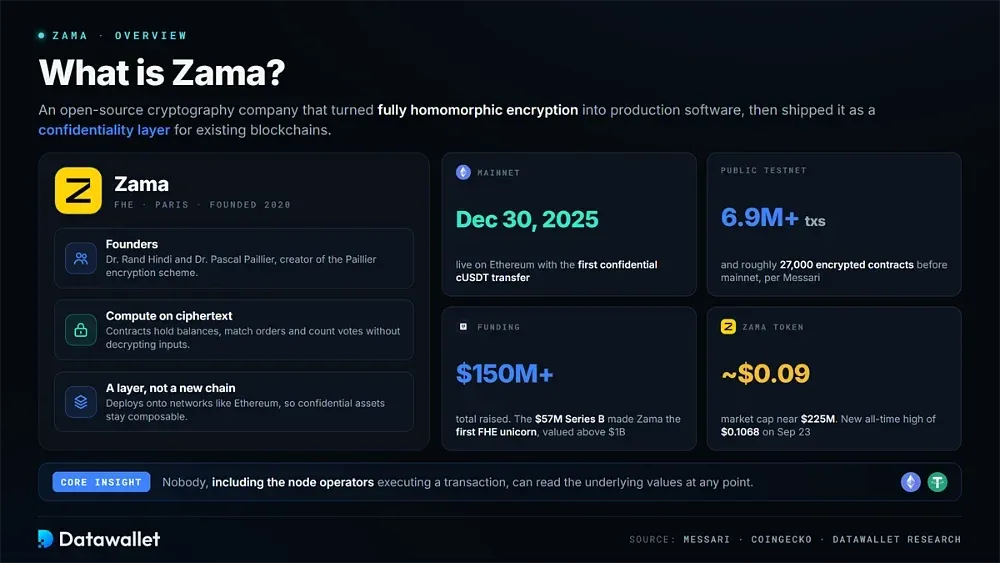
Founded in 2020, Zama is an open-source cryptography company led by entrepreneur Dr. Rand Hindi and Dr. Pascal Paillier, the researcher behind the Paillier encryption scheme. Its Paris-based team claims to have the largest research group in homomorphic encryption and has spent years developing fully homomorphic encryption from an academic concept into production software.
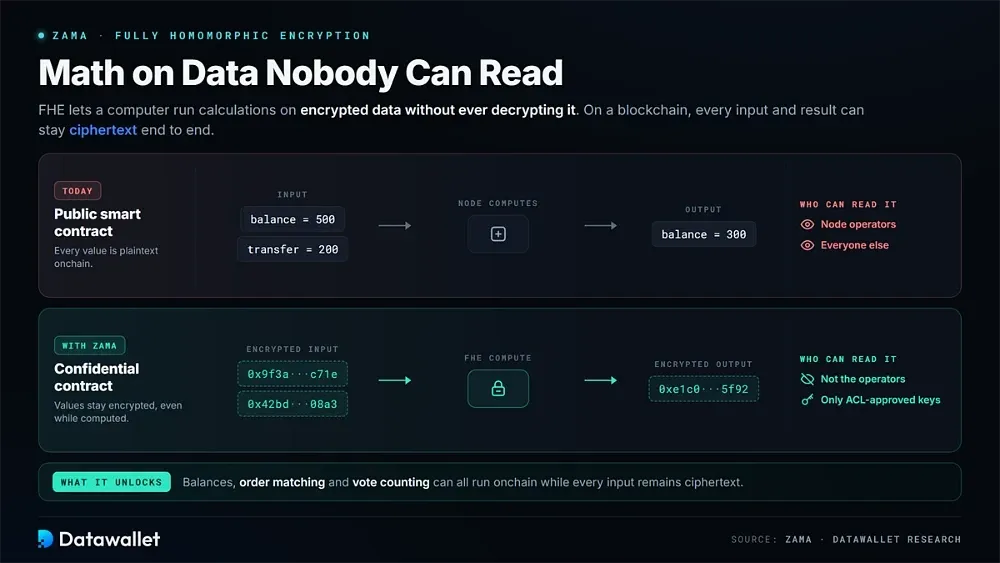
FHE enables computers to perform calculations on encrypted data without decrypting it. On a blockchain, this allows smart contracts to maintain balances, match orders, or count votes while keeping every input encrypted. Even the node operators executing transactions cannot read the underlying values.
Rather than creating a separate blockchain, the Zama Protocol brings this confidentiality layer to existing networks. Mainnet launched on Ethereum on December 30, 2025, with the first confidential cUSDT transfer. Before launch, its public testnet processed more than 6.9 million transactions and roughly 27,000 encrypted contracts, according to Messari's protocol overview.
Zama's corporate development has also attracted substantial investment. In June 2025, a $57 million Series B co-led by Pantera Capital and Blockchange Ventures brought total funding above $150 million. The round valued Zama at more than $1 billion, making it the FHE industry's first unicorn before its token had launched.
ZAMA followed on February 2, 2026. According to CoinGecko, the token now trades around $0.09, with a market capitalization near $225 million. It set a new all-time high of $0.1068 on September 23 as capital moved from the Zcash-led privacy rally into FHE infrastructure.
How Does the Zama Protocol Work?
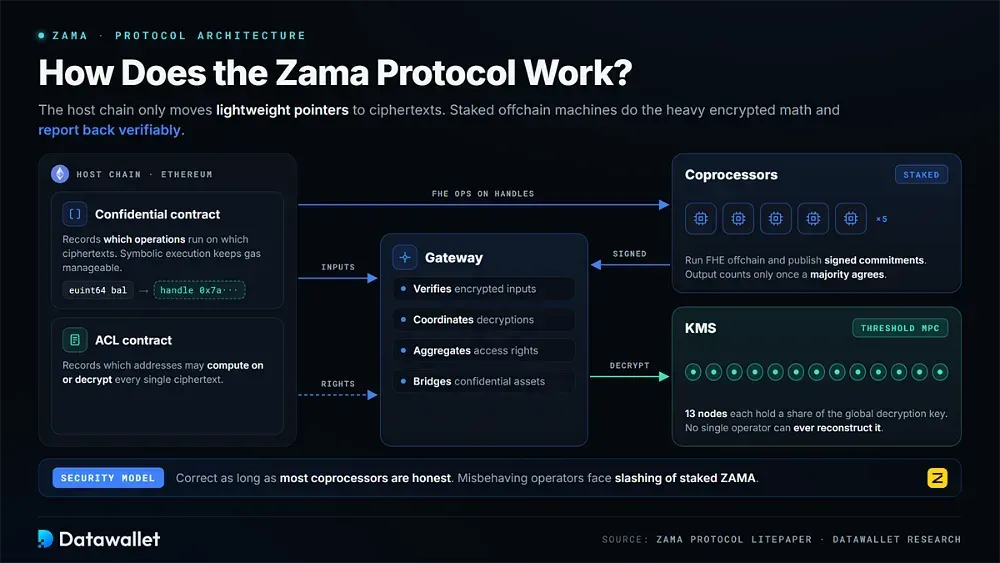
Zama separates the operations visible to a blockchain from the encrypted computations performed behind them. Smart contracts on the host chain work with lightweight pointers to ciphertexts. Specialized offchain infrastructure handles the computationally intensive homomorphic operations and returns verifiable results.
1. FHEVM and Confidential Smart Contracts
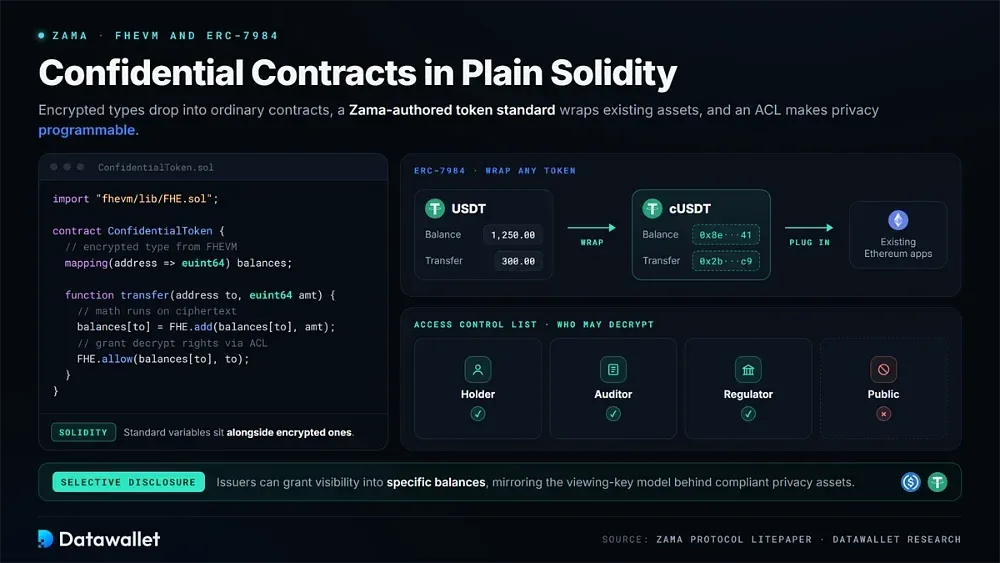
Developers build confidential contracts in ordinary Solidity using the FHEVM library, which adds encrypted types such as euint64 alongside standard variables. Symbolic execution allows a contract to record the operations required on each ciphertext rather than performing the full computation onchain. Coprocessors carry out the encryption workload offchain, keeping gas costs manageable. The process is detailed in the Zama Protocol litepaper.
Zama also authored ERC-7984, the confidential token standard used by assets such as cUSDC and cUSDT. These assets wrap ordinary tokens into versions with encrypted balances and transfer amounts. They remain composable with existing Ethereum applications, avoiding the need to move liquidity onto an isolated privacy chain.
Privacy is programmable rather than absolute. An onchain Access Control List determines who can decrypt each value, allowing issuers to grant auditors or regulators access to specific balances. This selective-disclosure approach resembles the viewing-key model that has allowed compliant privacy assets to remain listed on regulated exchanges.
2. Coprocessors, the Gateway, and the KMS
A small network of specialized, economically accountable machines handles the protocol's offchain operations. Each component has a defined role in moving transactions from encrypted inputs to verified encrypted outputs.
The main components of the Zama Protocol architecture are the following:
- Coprocessors: Staked nodes perform FHE computations offchain and publish signed commitments that allow anyone to verify the results. Outputs are accepted only after a majority of operators agree.
- Gateway: A set of orchestration contracts verifies encrypted inputs and coordinates decryption requests. It also aggregates access permissions and manages confidential asset bridging between supported host chains.
- KMS: A threshold multi-party computation network comprising thirteen nodes protects the global decryption key. No individual operator can reconstruct the key or decrypt user data independently.
- ACL: An Access Control List contract on each host chain records which addresses and contracts have permission to compute on or decrypt each ciphertext.
- Security model: Computation remains correct as long as most coprocessors behave honestly. Operators that misbehave risk having their staked ZAMA slashed through automated checks or governance fraud proofs.
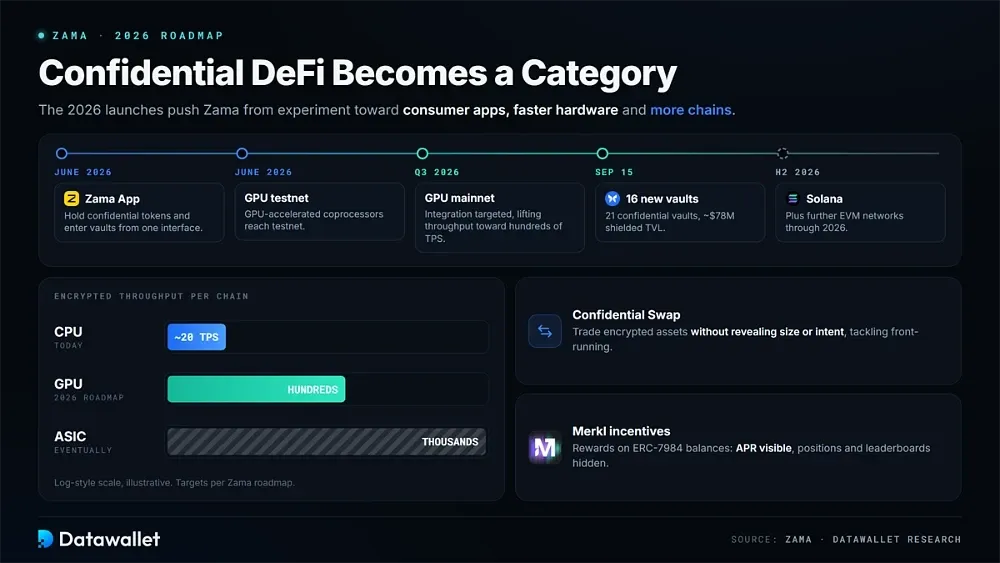
- Throughput: Current CPU execution supports around 20 encrypted transactions per second per chain. GPU acceleration is on the 2026 roadmap, with a target of hundreds of transactions per second and, eventually, thousands through ASICs.
3. Operators, Staking, and Governance
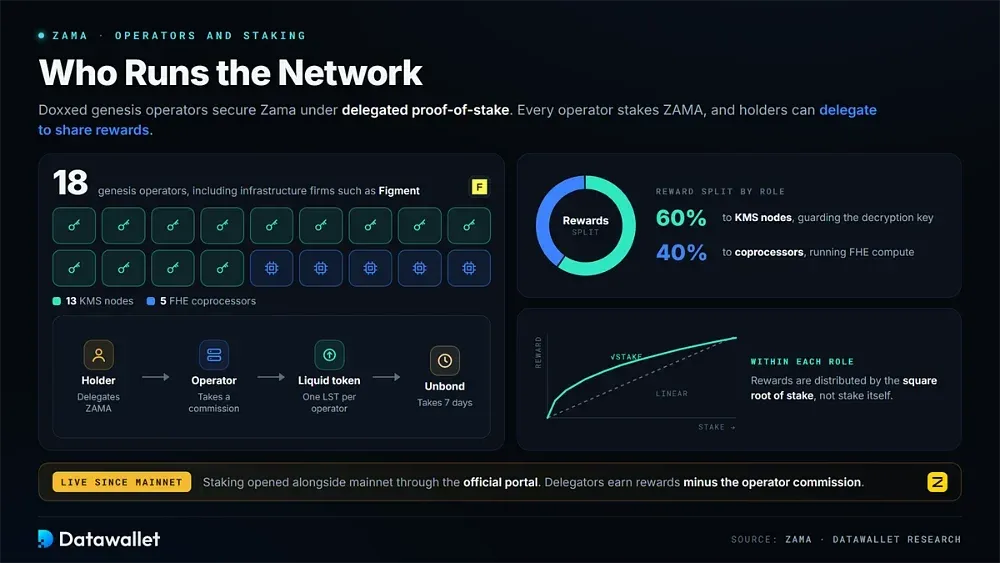
The network launched with eighteen doxxed genesis operators under delegated proof-of-stake. Initially, thirteen operated KMS nodes and five ran FHE coprocessors. The group includes infrastructure firms such as Figment. Operators must stake ZAMA, while token holders can delegate to any operator and receive a share of rewards after commission.
Staking went live alongside mainnet through the official portal. KMS nodes receive 60% of rewards, with the remaining 40% allocated to coprocessors. Within each group, rewards are distributed according to the square root of stake. Delegators receive a liquid staking token for each operator, and the unbonding period is seven days.
ZAMA Tokenomics
ZAMA launched on February 2, 2026, following a sealed-bid Dutch auction that raised roughly $118 million. The token secures Zama's network and pays for confidential operations through a burn-and-mint model. Its long-term supply depends on the balance between usage-driven token burns and new emissions distributed to operators and stakers.
$ZAMA Token Launch and Public Auction
Zama chose a sealed-bid Dutch auction instead of a fixed-price sale or retroactive airdrop. The auction used the protocol's encryption technology to conceal bid sizes, putting its own product through a direct stress test during token distribution.
Key facts from the January 2026 public sale and February listing:
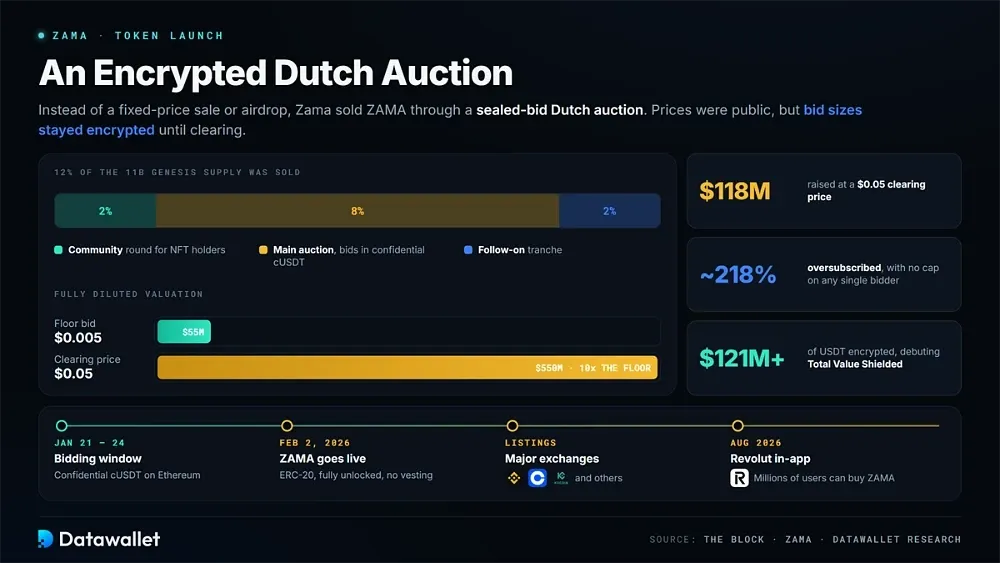
- Sale size: A total of 12% of the 11 billion genesis supply was sold. This comprised a 2% community round for NFT holders, an 8% main auction, and a 2% follow-on tranche, according to The Block.
- Auction format: Between January 21 and 24, participants submitted bids in confidential cUSDT on Ethereum. Prices were publicly visible, but individual bid quantities remained encrypted until clearing.
- Floor pricing: Bidding started at $0.005 per token, corresponding to a $55 million fully diluted valuation. There was no ceiling on how much an individual participant could commit.
- Clearing result: The auction raised roughly $118 million at a clearing price of $0.05. Oversubscription reached around 218%, implying a $550 million fully diluted valuation at settlement.
- Shielded milestone: More than $121 million in USDT was encrypted during the auction. Zama used the event to debut Total Value Shielded as a new privacy metric.
- Token launch: ZAMA launched as an ERC-20 token on Ethereum on February 2, 2026. All claimed tokens were fully unlocked, with no vesting schedule.
- Exchange reach: Binance, Coinbase, KuCoin, and other exchanges listed ZAMA. By August 2026, millions of Revolut users could also purchase the token directly in-app.
$ZAMA Burn-and-Mint
ZAMA serves as the network's staking asset and payment token for protocol operations. Fees are denominated in dollars, paid in ZAMA, and burned, while newly minted tokens reward operators and delegators. The relationship between these two mechanisms determines whether the token's total supply expands or contracts.
How the ZAMA supply and its value flows are structured:
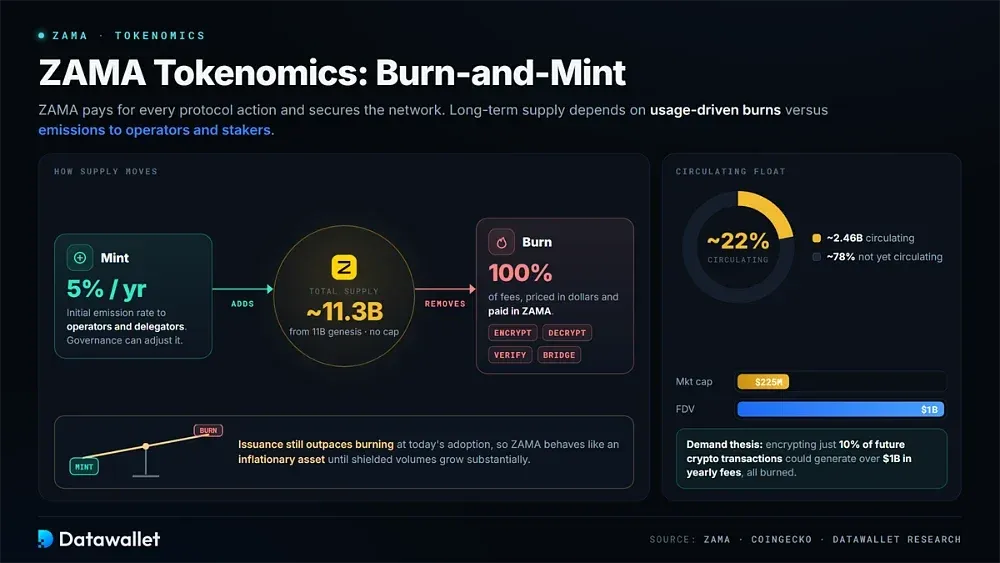
- Genesis supply: ZAMA launched with 11 billion tokens and no maximum supply cap. Total supply has since moved toward 11.3 billion as staking emissions accumulate.
- Fee burning: Encryption, decryption, input verification, and bridging requests each incur a dollar-denominated fee. Payments are made in ZAMA, which the protocol burns in full.
- Emissions: New tokens are minted at an initial annual rate of 5% to compensate operators and delegators. Protocol governance can adjust this rate over time.
- Circulating float: Approximately 2.46 billion tokens, or close to 22% of total supply, are currently circulating. This gives ZAMA a market capitalization of around $225 million against a $1 billion FDV.
- Demand thesis: Zama projects that encrypting just 10% of future crypto transactions could produce more than $1 billion in annual fees, with every dollar removed from token supply.
- Current imbalance: At present adoption levels, issuance exceeds burning. ZAMA therefore remains inflationary until shielded transaction volumes increase substantially.
How Can Developers Build on Zama?
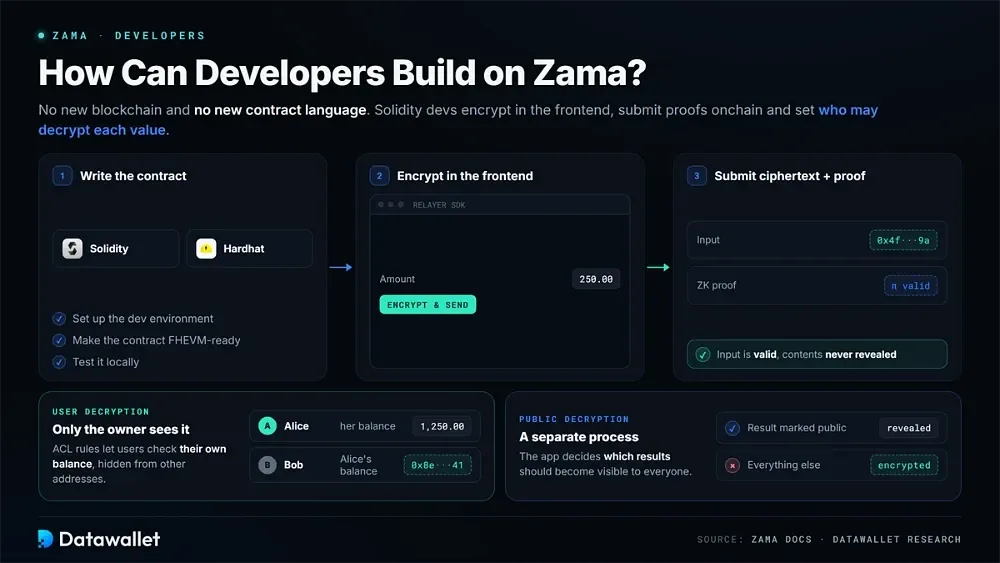
Developers can build confidential applications on Zama without creating a new blockchain or learning a separate smart contract language. Its quick-start tutorial uses Solidity and Hardhat to demonstrate how an ordinary contract becomes FHEVM-compatible, covering the development environment, contract implementation, and local testing.
The frontend handles encryption before sensitive values reach the blockchain. Users submit ciphertexts alongside zero-knowledge proofs that validate encrypted inputs without revealing their contents. Zama's Relayer SDK guide explains how web applications initialize the library, encrypt parameters, and request authorized decryption.
Developers must also configure access permissions for each encrypted value. A contract can allow users to inspect their own balances while keeping them hidden from other addresses. Public decryption follows a separate process, requiring applications to determine which results should become visible to everyone.
What Does It Cost to Use Zama?
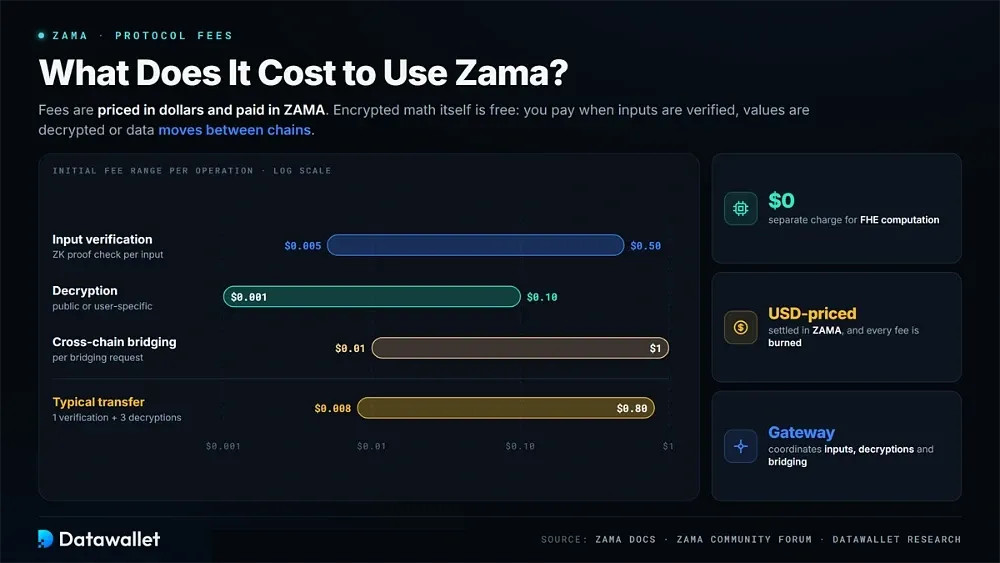
Zama charges for confidential operations through a dollar-denominated fee model, with payments settled in ZAMA tokens. The protocol does not charge separately for FHE computation. Instead, fees apply when encrypted inputs are verified, ciphertexts are decrypted, or confidential data moves between supported chains.
The main costs and payment mechanisms are as follows:
- Input verification: Submitting encrypted data requires a zero-knowledge proof to verify its validity. Zama charges a fee for this process, with initial pricing ranging from $0.005 to $0.50 per verification.
- Decryption: Revealing encrypted balances or transaction results incurs a fee ranging from $0.001 to $0.10 per operation. Both public and user-specific decryption requests are supported, as explained in Zama's official pricing discussion.
- Cross-chain bridging: Moving encrypted values between supported networks requires additional verification and coordination. The initial fee structure ranges from $0.01 to $1 per bridging request.
- Transaction costs: A typical confidential token transfer involves one encrypted input verification and three decryptions. Under Zama's initial pricing model, the combined protocol fee ranges from $0.008 to $0.80, depending on the applicable discount.
- Payment flexibility: Developers can cover protocol fees on behalf of their users through applications or relayers. This allows confidential DeFi platforms to offer transactions without requiring every user to hold ZAMA directly.
- Developer discounts: Monthly subscription plans offer reduced protocol fees, with discounts reaching up to 99% compared with pay-as-you-go pricing.
The Zama Gateway coordinates encrypted input validation, decryption requests, and cross-chain operations. Although protocol fees are priced in dollars, the amount of ZAMA required adjusts through a price oracle. This separates the cost of confidential transactions from fluctuations in the token's market price.
Confidential DeFi and the 2026 Roadmap
Zama aims to connect private transactions with existing DeFi liquidity rather than build a separate ecosystem. Its first Morpho vault, developed with Steakhouse Financial, grew from zero to more than $40 million shielded within seven weeks of its June debut.
The launches turning confidential DeFi from experiment into category during 2026:
- Vault expansion: Deposits opened across 16 new confidential vaults on September 15. The expansion brought the total to 21 vaults and raised shielded TVL to approximately $78 million.
- Curator lineup: Five institutional curators manage strategies covering USDC, USDT, WBTC, AUSD, and the tokenized British pound tGBP. They are Steakhouse, Wintermute's Armitage, Flowdesk, RockawayX, and Bitwise.
- Hybrid design: Twelve vaults offer confidential access to existing curated Morpho vaults. Depositors retain the underlying strategy, liquidity, and risk profile while keeping individual positions private.
- Confidential Swap: A new swap protocol allows users to exchange encrypted assets on Ethereum without disclosing trade size or intent. This directly addresses front-running and strategy leakage.
- Encrypted incentives: Through its Merkl integration, Zama extends reward campaigns to ERC-7984 balances. Depositors can view an APR and earn rewards without exposing their positions, rewards, or leaderboards.
- Zama App: Launched in June 2026, the consumer application provides a single interface for non-technical users to hold confidential tokens, access vaults, and manage encrypted balances.
- Performance scaling: GPU-accelerated coprocessors reached testnet in June 2026. Mainnet integration is targeted for the third quarter, with throughput expected to increase toward hundreds of transactions per second.
- Multichain expansion: Zama's roadmap includes additional EVM networks throughout 2026 and a Solana launch targeted for the second half of the year. The expansion joins efforts such as Umbra on Solana in bringing privacy to that network.
Confidential yield can therefore operate alongside the best DeFi projects rather than competing with them. Deposits ultimately flow into the same underlying venues.
Zama vs Zcash vs Inco: Privacy Models Compared
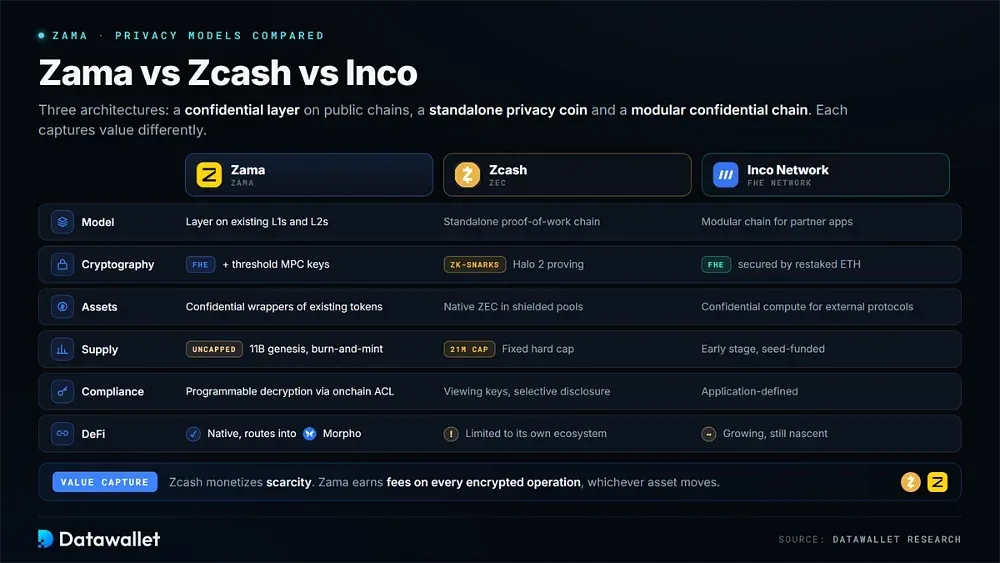
Crypto privacy now encompasses three distinct architectures: dedicated privacy coins, confidentiality layers on public blockchains, and modular confidential networks. Zcash encrypts payments on its own blockchain. Zama brings encrypted state to existing chains such as Ethereum, while Inco operates an FHE-powered confidential network that external applications can use.
Each architecture has a different approach to value capture. Zcash derives its scarcity proposition from a fixed-supply coin, whereas Zama collects fees for encrypted operations regardless of the asset being transferred. Both benefited from the 2026 privacy rotation. The ZEC rally spilled into FHE tokens and lifted the broader privacy coin sector.
Composability and standards authorship distinguish Zama from its competitors. It proposed ERC-7984 and operates the largest FHE deployment on Ethereum, while projects such as Inco and Mind Network remain at earlier stages. However, shielded TVL of roughly $78 million is still small relative to mainstream lending markets. The category has considerable room to grow, alongside substantial execution risk.
Is ZAMA Safe?
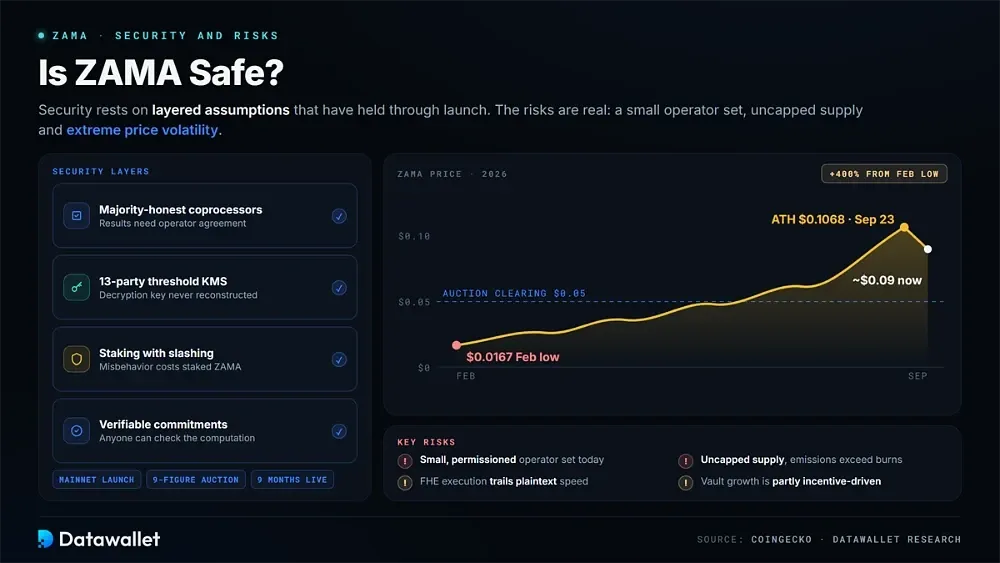
Zama's security model depends on several layers: a majority-honest coprocessor network, a thirteen-party threshold KMS that never reconstructs the decryption key, and staking backed by slashing. Publicly verifiable computation commitments provide another safeguard. Its genesis operators are established, doxxed firms, and the system has operated through mainnet launch, a nine-figure encrypted auction, and nine months of live value.
Several risks remain. The current operator set is small and permissioned, while FHE execution continues to lag behind plaintext performance. Token supply has no hard cap, emissions exceed burns, and incentives partly drive vault growth. Price volatility is also significant: ZAMA rose more than 400% from its February low of $0.0167 within seven months.
Risks
Despite these safeguards, Zama remains an emerging cryptographic infrastructure project with technical limitations and economic risks. Its security model depends on a relatively small operator network, while the ZAMA token faces supply pressures that are not directly tied to the protocol's encryption guarantees.
The main risks associated with Zama and its ZAMA token include:
- Operator centralization: The network currently relies on a small, permissioned set of eighteen genesis operators. Its security assumptions require most coprocessors to behave honestly, while the thirteen-party KMS protects the global decryption key.
- Execution performance: FHE computation remains slower than plaintext execution. Current CPU throughput supports around 20 encrypted transactions per second per chain, making the planned GPU upgrades important for scaling confidential applications.
- Token inflation: ZAMA has no maximum supply cap, with new tokens minted to compensate operators and delegators. At current adoption levels, staking emissions exceed protocol fee burns, creating ongoing inflationary pressure.
- Incentive-driven liquidity: Confidential vault growth is partly supported by Merkl reward campaigns. Deposits may decline as incentives taper, making sustained organic demand an important measure of adoption.
- Market volatility: ZAMA has experienced substantial price fluctuations, rising more than 400% from its February low of $0.0167 within seven months. Such movements expose token holders to significant market risk, regardless of the protocol's underlying security.
Final Thoughts
Within twelve months, Zama has launched its Ethereum mainnet, completed an oversubscribed auction settled in its own encrypted stablecoin, and released a fully unlocked token. Binance and Revolut distribution have broadened access, while its confidential DeFi stack allows institutions to enter through venues they already use. Compliance is built into the protocol's design rather than added afterward.
The underlying thesis is that fully transparent ledgers become a liability as tokenized funds, payrolls, and institutional balance sheets move onchain. Providers of credible encryption can capture the resulting fee stream. Zama's burn-and-mint model links that demand directly to token value, provided shielded volumes expand far beyond current levels.
Three developments warrant attention heading into 2027: whether GPU mainnet achieves its promised throughput, whether hybrid vault deposits persist as Merkl incentives taper, and how the Solana expansion performs. If these initiatives launch successfully, the first FHE unicorn will have established Total Value Shielded as a metric tracked across the wider market.